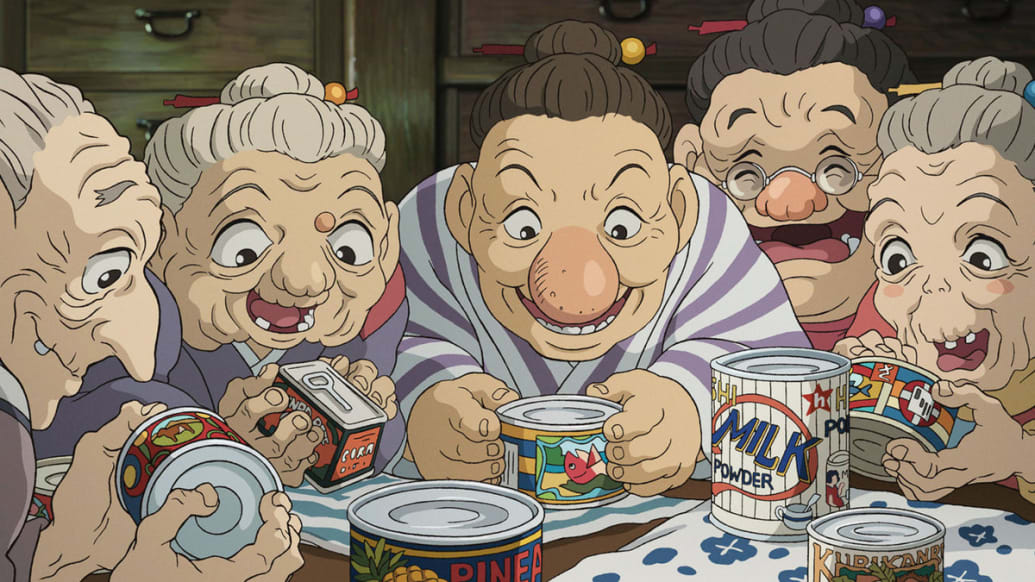
“If a background is really good, it’s taken for granted —viewers can ignore it and just immerse themselves in the world of the movie,” he said. “If it’s bad, they can’t help noticing it, and lose their concentration. When we remember the good times in our lives, we always remember the background as beautiful, even if we didn’t pay much attention to it at the time. That is the kind of realistic beauty that I want to depict.”
Over at All the Anime, my obituary for the scenic artist Nizo Yamamoto.
“Mannerheim!… He rode as if in a snowstorm, the air flickering from flowers thrown down from windows, balconies and rooftops. Around him clamored the street with its black banks of tightly packed humanity… Their arms gesticulated, hats and handkerchiefs waved in the wind, from thousands of throats rolled an avalanche of cries.”
In describing the triumphant march of Gustaf Mannerheim into a newly liberated Helsinki in 1918, Henrik Meinander’s Mannerheim, Marshal of Finland: A Life in Geopoliticschooses to quote from Jarl Hemmer’s 1931 novel A Fool of Faith. His choice of perspective reminded me of something I found myself doing in my own Mannerheim book – discarding the approved images of the official record and picking through the offcuts and supposed duds, in search of images that brought with them striking moments of unexpected context. For Mannerheim’s triumph, I deliberately chose an unused image from the archives, “ruined” in officialdom’s eyes by some guy jamming his hat in the air, whereas for me the sight helped convey the excitement with which the victorious general was welcomed into Finland’s capital.
Meinander’s account of Mannerheim’s triumph is one of the highlights of his new book, not for the depiction of the homecoming war hero, but for the nuanced appraisal of the language being used around him. Mannerheim, like many of the politicians in the Finnish parliament, was deeply reluctant to accept unbridled democracy, sure that Communists would try to game the system and drag the newly freed nation back into a Russian orbit.
Much modern writing on Mannerheim is put through a breathlessly teleological focus, as if he is the hero of his own HBO mini-series, propelled inexorably towards military achievement and the leadership of his nation. Meinander zooms in on tiny details that shunted Mannerheim, sometimes randomly, towards his fate, such as his failure to pass the Russian language exam in 1892, which closed off many promotional routes to him within the Tsar’s military, and forced him to concentrate on his existing, equestrian specialty, increasingly outdated in the age of the internal combustion engine. He also picks out some illuminating asides in history that run counter to the official narrative, such as a German report of Mannerheim’s 1918 headquarters that finds the whole thing “rather Russian.” Mannerheim is remembered today as a founder and defender of a free Finland, but Meinander digs up contemporary accounts that frame him instead as the last loyalist to a “White” Russia, failing to turn Finland into the first step of a White counter-offensive against the Reds.
Meinander served for some years as the curator of the Mannerheim Museum, and has plenty to say about the contradictions of a gentleman who is obliged to buy his own furniture. As a member of Finland’s landed gentry, Mannerheim should have been able to fling together his Helsinki residence with a jumble of antiques and heirlooms. Instead, his father’s bankruptcy in his childhood had lost the family much of his possessions, and Mannerheim was obliged to assemble his home from scratch, the manner of the nouveau riche. It is an oddly telling observation from Meinander, and helps explain the very modern way that so much of the house draws upon Mannerheim’s personal acquisitions in his mission across the Far East. It also leads to a lovely glimpse, depending on your point of view, as Mannerheim as an insufferable fusspot or cast-iron planner, travelling Europe with a detailed set of measurements for every room in his house, just in case he ran into a chest of drawers that might look nice on the landing.
Meinander’s Mannerheim is, above all, a creature out of time, a Swedish-speaking aristocrat, trained in the Tsar’s army, catapulted into the highest echelons of a modern, republican state. He rumbles with resentment at what he sees as the Swedes’ failure to come to Finland’s aid, although Meinander is on hand, with a somewhat hurt tone, to point out how quickly history forgets: “no other European country stood up for Finland anywhere near as much as Sweden, a fact that was often disregarded both during and straight after the war….” When Mannerheim issued an order of the day to announce the end of the Winter War, it was only those acculturated to Swedish literature who would have seen the message hidden in his comment that Finland had defended “the West” against the Soviet aggressor, and “we have paid every last penny of the debt we owed.” It was a reference to Originala skuldsedeln (1872), a poem by Zacharias Topelius that chided the Finns for not being grateful to Sweden for its cultural heritage.
Meinander’s Swedish-speaking perspective is the most valuable element of his book, cutting through posterity’s fog to focus on the man who only reluctantly addressed crowds in Finnish after careful rehearsal; who carried crib cards with him in case he needed to reach for unfamiliar vocabulary, and whose interactions with most of his confidantes remained in Swedish, the secret cant of Finland’s wealthy elite. Much of this context has been erased by posterity, particularly in the light of the “Real Finns” (aitosuomalaiset) movement of the 1930s, which tried to purge the Swedish language from public discourse. These days, it’s become something of a running gag that although Finland has two official languages, everything happens in Finnish, and some wag might append to the end of a text “och samma på svenska” (“and the same in Swedish”), as a little afterthought that someone ought to sort that out for the 5% of the country that still claim Swedish as their mother tongue.
Meinander regards Mannerheim as an incredibly lucky figure, afforded the luxury of communicating with the public through ghost-written military orders of the day, while his political bosses are put through the wringer of media attention. In fact, Meinander goes so far as to say that if the Finnish people had been exposed more directly to Marshal Mannerheim on a regular basis, they would have found him snooty, diffident and undemocratic, a very reluctant servant of parliamentary democracy. I have heard much the same from many a modern-day Finn, some of whom are happy to accept Mannerheim as their national demigod, but gingerly opine that if they had ever met him, they probably wouldn’t have got along.
Meinander does not shy away from the upper-class clique of industrialists and magnates with whom Mannerheim hobnobs, and the personal connections that buoyed him up in lean times. Mannerheim’s friendship with his sometime brother-in-law, the millionaire Hjalmar Linder, survived the latter’s divorce from Mannerheim’s sister after he proved infamously uninterested in sex with a lady. Later on, Linder tried to set Mannerheim up with his half-sister, although Meinander takes evident glee in pointing out that while Mannerheim’s published correspondence is fulsome in praise and flirtation with the young Kitty Linder, Kitty herself described her suitor as a frightful “old bore.”
Age is indeed a factor, not only in Mannerheim’s love life, but in his interactions with many of the movers and shakers of the Finnish republic. Meinander observes that at the outbreak of the Winter War in 1939, Mannerheim was 72, literally old enough to be the father of most of the generals serving under him, with an attitude towards strategic planning that was arguably a generation behind the times. Meinander stops short of knocking off Mannerheim’s crown as the Greatest of Finns, but is unafraid to point to conflicts between Mannerheim and his officers, and numerous moments where he dodged becoming one of history’s also-rans by sheer luck.
If Meinander’s book seems to have a personal touch to it, that is all to the better. It is not merely the author’s intimate experience of the Mannerheim Museum and the Swedishness that is often lost to modern readers, but the experience of teaching a younger generation that lacks much of the habitus for understanding the recent past. When discussing Mannerheim and his officers retiring for coffee and cigars, Meinander feels obliged to explain that “the large majority of the male population of Europe smoked regularly,” as if already considering the next elements of the Mannerheim story likely to soon be twisted, confused or forgotten by the next generation of historians.
“These terrible defeats showed up increasingly in the military dispatches as ‘shattered jewels’. It became media shorthand for a battle in which everybody dies, and the enemy is left with nothing but ruins and ashes.”
Over at All the Anime, I discuss some of the wartime allusions in Hideaki Anno’s Gunbuster.
“Jonathan,” said Mamoru Hosoda, “I wonder if you have ever heard of an anime called Gunbuster? Because there’s this scene in Gunbuster where the mecha comes out and stands with its arms folded on the prow of the ship, and that’s such a fantastic moment in anime, and that’s what I was trying to evoke with Belle on the back of that whale.”
Over at All the Anime, I fold my arms and wait for the alien hordes.
The Luoyang Museum, an inverted ziggurat at the edge of town, deliberately designed to evoke the shape of a ding – the ancient sacred tripods that once marked the capital of the ancient kings. It’s packed with relics, but also with surprisingly cool oil paintings of key moments from ancient Chinese history, painted by a local artist with a real eye for both historical accuracy and alluring, pulp-fiction moments of iconic action. Others might scoff, but I found them to be very helpful in illustrating interesting moments like the coming of the Xiongnu nomads to Luoyang, or the fall of the Shang dynasty, or Empress Wu on tour, which are otherwise conveyed through wandering long halls of pots in cabinets.
Luoyang tourist literature makes a big deal about how it was the capital of “thirteen dynasties”, but that is rather economical with the truth. A lot of the time it was merely one of the capitals of those dynasties, like the Tang, that were obliged to shuttle up and down the Yellow River in order to allow the trees to grow back elsewhere – Xi’an had to be periodically evacuated when it became too difficult to get lumber nearby for building and fuel. Some of the other dynasties for which Luoyang was a capital were relatively minor ones that only laid claim to parts of China during periods of unrest. Still others were historical dead-ends, like the ten years that Wu ruled from Luoyang in her self-proclaimed “Zhou” dynasty. That’s not to say that those dynasties weren’t fascinating in their own right – most of you know all about Wu, but the Northern Wei, whose scandals make Game of Thrones look like the Tellytubbies, were also based here.
But they aren’t the big-picture dynasties like the Song or the Ming or the Qing. Empress Wu’s Luoyang wasn’t actually finished in the Tang dynasty. The Western part of the planned city was never built, the encircling wall never completed, as everything went into decline before they could get there. Regardless, you can’t dig a hole in Luoyang without finding some ancient junk. Two miles from our hotel, workmen digging the foundations for a new shopping mall have just hit into a tomb from the Eastern Han dynasty, and the 24-hour metro construction keeps running into temples and palaces from times gone by.
Today I am interviewing Gao Xisheng, the curator, about the arrival of the Sogdians (the Greek-influenced Persians on the very western edge of China), who were the middle men of the Silk Road, and responsible for a lot of the cultural and culinary imports of the cosmopolitan Tang era. My job here is to keep him talking, and to keep his eyes on me, not on the camera; to interject at regular intervals with signals that I understand, which usually take the form of extra questions about fire-worshipping customs.
Mr Gao is very keen on metadata, pointing out that the Sogdian tombs in Xi’an and Luoyang suddenly arrive around the 7th century, as if out of nowhere, thereby demonstrating that as one might expect, Tang China suddenly became the sort of place that could end up with a community of immigrants that stayed around long enough to start dying there. He has similar things to say about the sancai pottery, noting that it was a tiny flash in the historical pan, and is only really found in the Xi’an-Luoyang area, and only in the Tang dynasty. New commodities from along the Silk Road, particularly cobalt from Afghanistan, transformed Chinese pottery with far more interesting blues in the late Middle Ages, causing everybody to give up on crappy brown-spinach-cream combinations.
He also points out to me a pattern of turquoise pebbles, once inlaid into a staff or similar symbol of power, now with the wood rotted away, delineating a sinuous pattern in the ground like an elephant’s trunk, topped by an abstract square head. “I mean,” he says, “it might be an elephant’s trunk, but we think it’s probably something much cooler – China’s first dragon.” It’s 3,000 years old, so those are probably fighting words in Anyang, where we are going next week.
I have developed a sixth sense with interviewees. I can tell the moment I look at them if they are going to be a garbage fire or a fun time, and it’s never about what they know. It’s more about the degree to which they are prepared to say what they don’t know, and thereby allow us to discard pointless questions and spare them the nerves generated by lying and bullshitting on camera. Mr Gao was chatty charm on a stick with me, to the extent that when he showed me an entirely mundane-looking, modern looking mug and told me it was 3,000 years old, I was able to tell him he was trying to fool me, and get a laugh instead of a slap.
“I know,” he says. “It looks like something you might find in Starbucks. But people get fixated on all the weird-shaped ceremonial vessels used by the ancient aristocracy. The common people drank out of mugs. Just like us.”
It’s more of the same after lunch with Li Ying, who proves to be a coquettish and chatty historian when engaged about her subject. I get her to talk me through beauty tips for Tang women (always paint red stripes on your face… try to be as fat as possible) as well as elaborate Tang hairstyles like the Parrot, the Cocoon (a swept-up bun modelled on a silk-worm’s) and the Knife. There’s only one that she can’t give me the etymology for, which is the Treasures – a sort of forward-drooping rolled top knot, flanked by two lateral buns.
“The thing is,” I whisper to the director afterwards, “I think it’s a reference to the Three Treasures, pickled and retained by eunuchs to keep themselves whole in the afterlife. In other words, the Treasures hairstyle is a giant stylised cock and balls, resting on a lady’s head.
But it’s all fascinating stuff, not the least because the Luoyang Museum has dated the development of hairstyles, which means to a certain extent, they can roughly gauge the era of tomb decorations simply by the hairstyles on display. There’s even some fun to be had about the Hufu (literally Barbarian Garb) tomboys of Wu’s era, who would exude cool by wearing narrow-sleeved jackets with lapels and trousers.
I won’t lie, it was a gruelling day. It’s taken a while for my Chinese to grind back into action, and I made the rookie error of not sitting down whenever the opportunity arose, thereby ending up on my feet practically all day. The museum was a riot of phones going off, and shouty visitors, nosey passers-by and cacophonous audio-visual displays. A new Chinese habit, of loudly playing phone games or faffing with the internet while having a dump, has turned any nearby toilet into an echo chamber of shitty pop music and beepy bang-bang noises, accompanied by the occasional cough and plopping sound. But I have been earning my money today in subtle ways, such as the moment when the director made me stand beside a statue of a man with a beard, and told me to come up with a 30-second piece to camera about the historical relevance of the Sogdians. I can do that. It’s what I do.
Jonathan Clements is the author of A Brief History of China. These events formed part of Route Awakening S05E01 (2019).
“The chorus of voices that sings ‘“’Gunbuster~~~!’”’ in the eycatch is actually a single man, overdubbed repeatedly to sound like a group of people. The voice is that of the composer, Kohei Tanaka, sneaking his way onto the audio as a bit of cost-cutting DIY.”
Over at All the Anime, I investigate Kohei Tanaka’s wonderful score for the Gunbuster series.
Cheery waste-paper collector Mikko (the ever-reliable Aku Korhonen) falls asleep in a bin and concocts a fantasy lifestyle for himself that incorporates the people who hit him with their car earlier in the day, along with some of the detritus he has found on his rounds – news of a company merger, a nickel-mine find, a lottery win, and the love of a good woman, in the form of Aune (Sirkka Sipilä) the attractive daughter of a wealthy industrialist.
It is, however, all a dream. The viewer has long enough to forget about the framing device that introduced Mikko as little more than a kind-hearted vagrant. We are encouraged to forget about his real-world problems, and instead to fret about the relatively low-intensity drama of whether or not he can win Aune’s heart. It is therefore something of a jolt in the final reel when Mikko wakes up again back in the real world, with Aune a stranger to him, along with any chance of money or power. He accepts this fate with a good-hearted shrug, and goes about his business.
Many Finnish films of the period were obsessed with wealth and social climbing, which made Jos oisi valtaa’s gentle satire somewhat more palatable in the eyes of Finland’s left-wing press. Toini Aaltonen in the Suomen Sosiaalidemokraati called it “a rather modest and childish film” and praised it for disrupting the “postcard truths” of so many other romances and comedies. Paula Talaskivi in the Ilta Sanomat complained that “the dream should have started more clearly as a dream.” And she has a point – it’s not 100% obvious when Mikko’s dream starts. Is it when he is hit by Aune’s car, or when he goes to bed that night, or is it, in fact, that the whole movie is a dream up until the moment he wakes up? We see him regain consciousness in the bin, but we never actually see him go to sleep in it, meaning that an entire chunk of the early film may or may not be the reveries of a woozy rag-and-bone man.
Like many a movie in the period, the film also shoe-horned in as much variety performances as it could, leavening its thin plot with several sequences of puppetry and opera. Olavi Vesterdahl in Aamulehti was unimpressed, noting that even though the film only lasted 93 minutes, it was still dragged down into “slowness and long-windedness” by a surfeit of unnecessary dance numbers and songs, including chunks of Puccini, Strauss and Bizet and a full-on ballet sequence shot at the Helsinki opera house. But one wonders if Vesterdahl had not seen the variety sequences for what they really were – not merely padding for the film, but a scramble to find work and publicity for Finland’s many performers and entertainers, fallen on hard times after a war in which dancing had been literally declared illegal until the soldiers came home.
If I Only Had the Power artfully encapsulates the contradictions of Finland in the days immediately after the end of the Winter War – our hero enjoys a meteoric success, a lavish lifestyle and a romantic denouement, only to wake up in dire straits, his happy ending revealed as a mere illusion. One can readily imagine austerity-era Finns thrilling to its allegory of their predicament, daring to dream of better days amidst the deprivations of the real world… but one would be wrong. The film under-performed at the box office, and it was the last to be directed by Yrjö Norta for Suomen Filmiteollisuus. His contract dropped by the studio bosses, Norta defected to Fenno-Film where his first work would be Maskotti (1943).
Jonathan Clements is the author of A Short History of Finland. He is watching all the Finnish films, so you don’t have to.
Over at the Pieces of Eighth podcast I talk to Kenny Smith about my Doctor Who radio play Immortal Beloved (2007), in a convoluted back story that includes Goodness Gracious Me, Roger Zelazny and the mystery of the ether trumpet.
I must be getting good at this. Driving back to the Wastes of Yin, I know more about the site than the crew, because I already shot here once before. So I can direct the car and the van to the right institute, and point out Dr He, because I’ve met him before, and I can tell them that the meeting room is not the ideal place, because there is a warehouse upstairs full of relics that is more photogenic. I can also point out that if they want to get the lens really close to an oracle bone, Dr He has a bunch in a box that he will literally hold up to the camera.
Dr He remembers me from the Chinese chariot shoot a couple of years ago, and so he is immediately at ease and merry. When it comes to the interview, in front of boxes marked HUMAN TEETH, DOG BONES, HUMAN BONES, COW HORNS etc., we rattle through in a single long take. I quiz Dr He about the problems of reassembling oracle bones, and the fun he had tunnelling through a Sui dynasty tomb and a Han dynasty tomb in order to get to the Shang stuff two metres down. He tells me that the size of the turtle plastrons used in divination usually suggest that they came from the river, but some of them were so big that they were liable to be sea turtles, thereby suggesting that the Shang dynasty had trade links as far away as Malaysia.
Of course, that doesn’t mean that there was some Malaysian Marco Polo who travelled all the way to Anyang. These things might have taken decades to drift from village to village until they ended up in the Shang capital. Dr He rattles on non-stop for 45 minutes, which delivers us 90 minutes of footage on two cameras. Time for the pick-ups and then we are out, as if we knew what we were doing.
Turtles are important, says Dr He, because they lived so long, but also as Sarah Allan has argued in The Shape of the Turtle, because they may have signified the shape of the cosmos to the ancient Chinese – a north, south, east and west around a central plain, and in the sky, a big dome overhead.
The Shang people were a bloodthirsty bunch. The Shang dynasty is the most popular topic among Chinese heavy metal groups, because after you hear about all the incest, human sacrifice and torture of the Shang kings, biting the head off a bat looks a bit everyday and soft. The on-site museum has trouble skirting around the fact that their royal graves are full of dead children, chucked in to keep them company in the afterlife, along with dismembered dogs and the usual dead horses, and a special ceremonial axe used for beheading enemies. I’ve read the oracle bones, so I know already about the boiled heads, burned slave-girls and other atrocities littering their tombs.
We finish up in the tomb of Lady Fuhao, the female general who led the armies of the late Shang, wife, or possibly sister, or possibly both to the king Wuding, who entirely by chance turns out to be the guy we know most about because Anyang was the site of oracle bone pits dating from his era. Fuhao’s tomb was miraculously undisturbed; she was buried not only with her signature C-shaped dragon rings and a gaggle of dead slaves, but a collection of bronzes that were already quite ancient when they went into the ground. Some of Fuhao’s bronzes were specifically cast as grave goods (we know this, because they included her posthumous title), but others were seemingly part of what today we would have to call her antique collection.
I felt today that I was really earning my money, and that the crew were really on top form snatching footage, sometimes, when the drone was up, with three cameras running at the same time. What with all the shooting on 4K resolution, as future-proofing against TV channels that might insist on higher quality film in future, we are generating two or three terabytes of data every week. Michelle the assistant producer has to stay up each night uploading it to a server in Hong Kong so the editors can get to work.
“Toren ended up living in a ‘room’ that was actually a walk-in closet that they had put a bed into. And during the time that he was there, the people of Gainax were working on Gunbuster, and decided that they needed a handsome love interest.”
Over at All the Anime, I explain the genesis of Gunbuster‘s love-interest, Smith Toren.