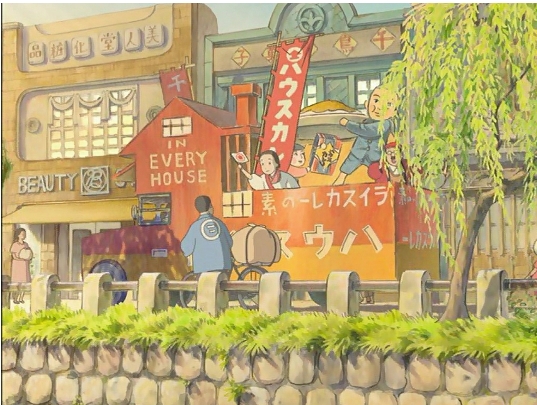
“Denison devotes entire sections to Ghibli’s short films and advertising contracts, many of which will be completely new to some self-proclaimed fans, despite a cumulative running-time equivalent to that of a whole other movie. These include, for example, Hayao Miyazaki’s nostalgic advert for House Foods, made in 2003 and unseen abroad.”
Over at All the Anime, I review Rayna Denison’s new book, Studio Ghibli: An Industrial History.
Out today to a world-famous series of valleys of Mesozoic rock, known in Chinese as the “Rainbow Ridges” for their beautiful multi-coloured strata. Do not believe everything you hear.
“It’s just fifty shades of brown,” says the director.
Our driver, who has been supplied by the marketing office, answers her with a weary and hostile tone, which makes me think that he has to say this rather a lot.
“Don’t you have eyes? Can’t you see the subtle gradations? Anyway, the many colours only really show up after a rainstorm, but in the sunshine, at the sunset, in springtime…” He continues to list an absurd set of parameters for the valley looking the way it does in the pictures. We soon discover that even the publicity shot that brought us here, taken in the valley, was in a location that was impossible for a car to reach, and had been created with the magic of Photoshop.
I start to realise why the visitor centre has three windows: one for information, one for tickets, and one for complaints.
Four locations in the park are set aside for scenic views, but all of them have been thoroughly ruined, festooned with toilets, construction sites, visitor centres, and in one place, a permanent loud-speaker loop of a man singing a song about horses. Also, mirabile dictu: camel rides. So the director gets the driver to drop us off at a secluded spot where I can wander along the base of the mountains, while our drone buzzes above me.
“Don’t actually climb the mountains,” warns the driver, “because there’s a fine.”
We walk a couple of hundred metres across the plain, and start to set up the drone. Immediately, a jobsworth on a moped beeps his horn and drives onto the plain with us, gouging up deep tyre tracks in the soft wadi.
“You can’t go off the road,” he shouts.
“We can’t go up the mountain,” says Clarissa the fixer. “We can go off the road.”
“No you can’t!” The security guard is quite adamant about this, despite the fact that he has no trouble riding his motorcycle into the middle of it, and from the tracks all around, he is not the only one.
“Yes we can!”
“On whose authority?”
Clarissa waves a pink piece of paper from the Marketing department, who have given us access at the request of the Ministry of Foreign Affairs. But this isn’t good enough, because the security guards only answer to the Head Security Guard, and he is having lunch, while the Head of Marketing is somewhere in the park that doesn’t have radio reception. Clarissa and the security guard argue for so long that we could literally have done our drone shot and left again. Meanwhile, a group of Chinese women see us standing on the plain and decide that if we are there, they can go off the road, too, and start climbing the slope. This results in the surreal sight of the security guard bellowing at us that we are not allowed in, while three Chinese women cavort behind him, taking selfies on the supposedly forbidden ridge.
As far as the guard is concerned, he is doing his duty by obstructing us until his superiors confirm otherwise. Clarissa makes a point of taking his uniform number. He makes a point of setting his mobile to record, and placing it in his top pocket. After half an hour has been wasted, the director announces that the park can shove its publicity up its arse, and Clarissa pointedly rings the marketing department to tell them after travelling a thousand miles to get their rocks on film, that we have wasted our allotted time waiting for a man on a moped to get out of the way, and that their rocks will consequently not be appearing in the National Geographic documentary, even though they boast on all their signage that National Geographic decreed them to be one of the ten wonders of the natural world. We stomp off back towards the car park, from where we sneakily film some footage over the fence, after the director sees a nice view when she goes into the bushes for a piss.
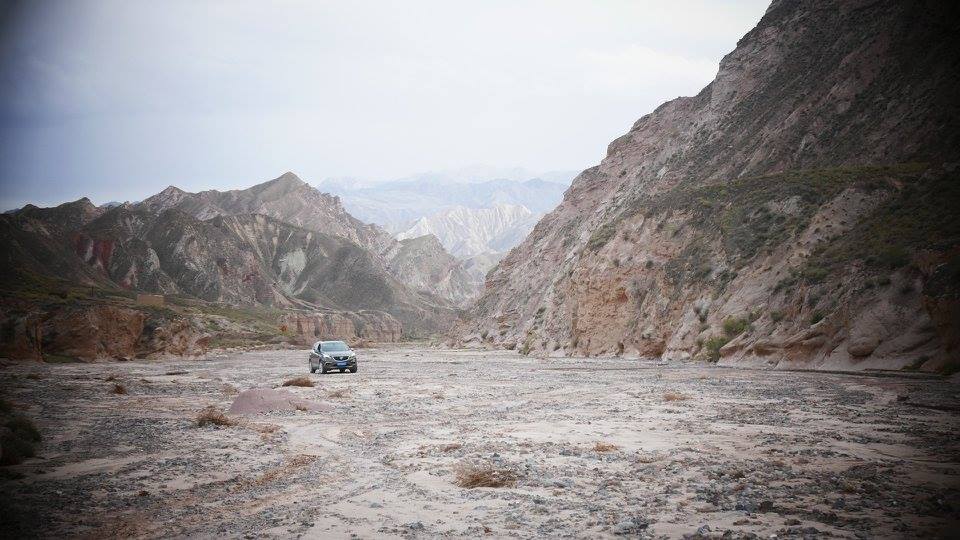
Our driver, however, who seems to know everybody and everyone, knows another place where he can get us in. The mountains there are sort of like the ones in the park, he says, and he knows a dry riverbed between them, where we can get some good shots.
Which is why I find myself driving a Buick, wheel-spinning my way along a wadi, sending flints and quartzes flying, bumping along the ridges and gullies carved by spring streams, as the Yuneec Q500 Typhoon buzzes overhead, and our spare camera, bolted to the dashboard, films me at the wheel.
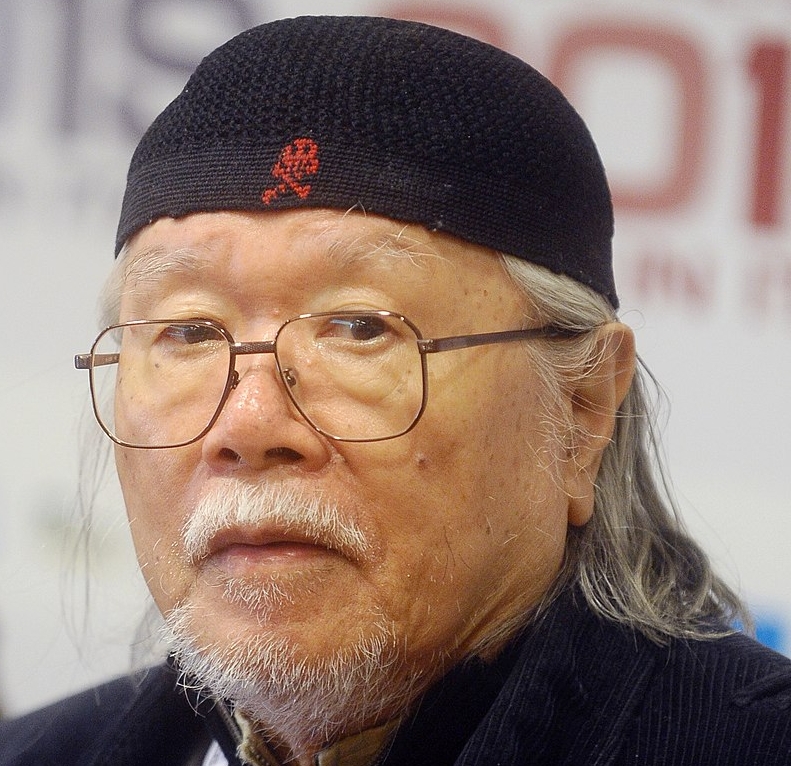
I’ve got a couple of things in the archive for any would-be obituarists covering Leiji Matsumoto :: this wide-ranging interview with him from Salon Futura, and my own entry on him from the Encyclopedia of Science Fiction.
“It’s not quite some teenager’s fan fiction thrown up online and then stuck between covers as IP bait to lure in an anime company, but that’s largely because I can see that an editor has been near this: the first chapter is the work of a much better author than the second, as if the experience of writing the book has already taught Nahuse some tricks of the trade, and he snuck back to write a better opening. Either that, or he had his whole life to write chapter one, but chapter two came swiftly afterwards, against a deadline.”
Over at All the Anime, I review the first volume of Nahuse’s Rebuild World.
After days of pleading, the director is persuaded to let us get the cable cars up the mountain. There are two stages, which eventually put us at 2800 metres, or in other words, the same height we were at last week in Lijiang. But now we have a vista below us that looks like the Grand Canyon, if the Grand Canyon’s lower flanks were green with trees and shrubs.
The tourist office had claimed that the place would be rammed with travellers today, but it is surprisingly quiet. It takes until 11am for the yammering Chinese to make it to the summit and yell “MY NAME IS WANG! HELLO!” into the abyss, as if anyone will be impressed with that. Earnest notices inform passers-by that the cliff opposite is known as the Two Elephants Paying Homage to the Dragon or The Sleeping Buddha, and we launch our drone from the top of Thousand Turtle Mountain, the peak of which is criss-crossed with domes and lines like a cluster of tortoise shells.
This is the most breathtaking scenery I have seen in China, and it is still relatively unspoilt. Stern notices forbid smoking anywhere at the summit, and for once the Chinese seem to be obeying, leaving the area mercifully free of fag ends and forest fires. The peaks dip sharply into the valley below. In more developed parts of China, this would surely all be rice terraces by now, but it is still clad with wild forest. I am glad I have seen it before someone puts advertising hoardings and a shopping mall on it.
I am still not at 100%. Last night I dined on a packet of crisps and two cans of beer. I tried to eat something at lunch, but had to run for the bathroom when we returned to the hotel. Skipping a few meals will do me no harm, and it is preferable to being caught short out in the wilderness where the only toilet makes my in-laws’ shed in the forest look like a five-star hotel.
The director is better, but miserable about the state of the footage we have. So far we have one good episode, about the Kam and Death, and scattered fragments of three others, none of which really have any rhyme or reason to them. Tonight, we are pinning all our hopes on the Lisu Courtship Dance, which promises to be an evening of song, dance and booze, in colourful costumes, and will hopefully hold this episode together. But we have no interviewees so far, as the only person we have had any contact with who speaks Mandarin is the tourism officer, and he is a Naxi.
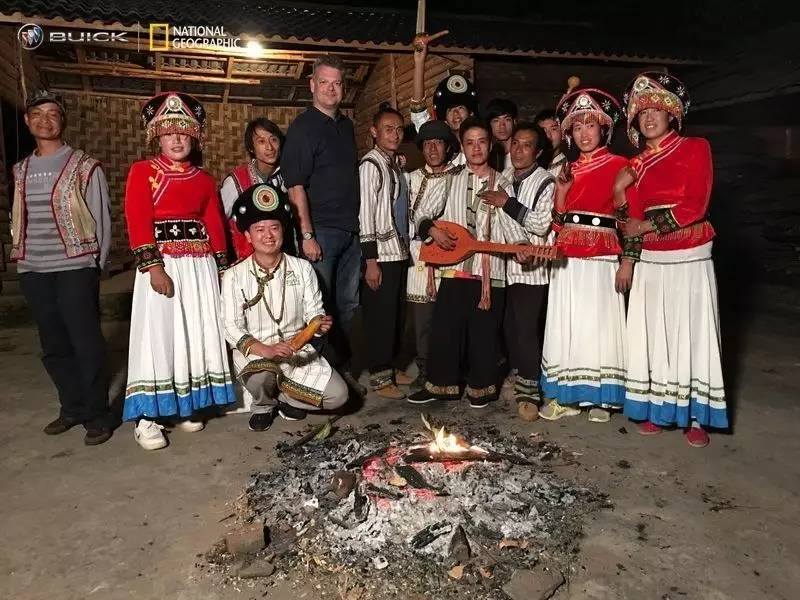
Wang Yonggang has arranged a tribal get together at his shed. He turns out to be something a big name in the world of lusheng-playing and climbing ladders of knives, and has even been whisked away to Paris to perform. Tonight he has rounded up a dozen of his mates, their wives and children, and stages a series of Lisu songs and dances for the camera, the men in their white tunics adorned with career-related patches, the women in their ornate red skirts, topped by jangly headdresses.
Overhead, there are more stars than I have ever seen before, so many in fact that I can barely recognise any constellations. Cassiopeia, which is a simple, recognisable W-pattern of five stars, has about thirty new members.
The first performance is the Welcome Dance, a ring-a-roses performed around the fire, into which I am dragged. I am not however, informed just how fast it’s going to get or how close to the fire, and I am left wheezing and coughing from the smoke. The director then announces that the cameraman was changing lenses at the crucial moment when the tempo switched up, and that consequently we have to do the whole thing again. On both occasions, the giggling Lisu flee for the shadows the moment the music stops, leaving me standing, dazed and panting, on my own by the fire, which ought to make for a good shot.
Then there is the Back to Back Dance, an important component of Lisu socialisation, and once in which I am fortunately not asked to participate, since it also comprises holding hands boy-girl-boy-girl, dancing around the fire once more, and energetically rubbing your arses together, first to the left, then to the right, repeat. “Back to Back”, I would suggest is probably a modern spin on what I would call the Arse Rubbing Dance, which ends with everybody piling into the shed, around another smoky fire, and singing at each other about their requirements for a mate.
“I would really like a girl with brown eyes,” sings one man, which is a low-level boss in China.
“I want a man with at least five cows,” sing the girls in response and one of the Lisu men gets up and glumly leaves.
This goes on until only a single boy and a girl are left in the shed, at which point he sidles over to her bench and they sing together softly, before sidling out into the night. The couple in question are actually married, and the director asks them how they met.
“We were doing the Arse Rubbing dance,” laughs the man, “and at the end she wouldn’t unlace her fingers, she just kept hanging on to me!” Sadly we don’t get their little love story on film, because the cameraman is already pacing outside waiting to leave, but the rest of the crew are encouraged to socialise for a while in the shed, sipping on crappy Xuehua beer and gnawing on baked potatoes from the fire.
There is a drinking song with much clinking of glasses, which goes something like:
I invite you to drink with me
I invite you to drink with me.
If you won’t drink with me.
Fuck you.
One of the dancers reveals that he can speak a little English, having graduated from a police college in the nearest big town. He is only the third person from the valley to get a bachelor’s degree (our tourist liaison was the first). The Lisu, he says, rarely think about tomorrow, and that includes their planning for education. They are usually married shortly after high school, a fact attested by the ages of the women present. One of the dancers, a leggy model who takes off her tribal dress to reveal denim hotpants over black tights, is not only married to one of the men, but appears to be the mother of a teenage daughter, not quite old enough to join in, who hovers in the shadows in a yellow sweater, mouthing the lyrics to herself and practising the steps.
We don’t leave until half past eleven; the director is still miserable, but the footage required to make this an episode about Courtship, and hence to fulfil our “Circle of Life” brief, is in the can, along with clean audio of the songs.
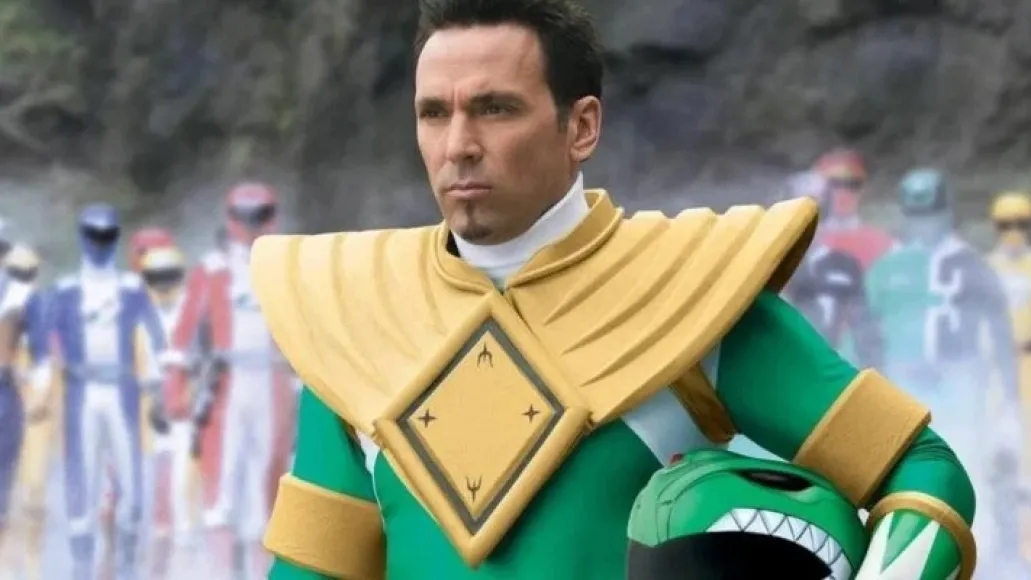
When I met Jason David Frank for the first and only time, I was a 24-year-old newshound for a children’s magazine, and he’d drawn the short straw, dispatched on a press tour of Europe to promote Mighty Morphin’ Power Rangers: The Movie.
It was driving him slowly crazy. He was holed up in a west London hotel suite, with only an old school buddy of his to keep him company. The publicity people, usually hands-on and clock-watching, were nowhere to be seen.
I introduced myself and showed him our magazine, and he laughed heartily at our electric rotating lollipop cover-mount, which everybody agreed looked like a sex toy.
“The thing is,” I said to him as we sat down to talk, “when I watched the film–”
“You watched it!?” he said. “Dude, nobody who’s come through here today has seen anything more than the trailer.”
“Well, I thought it would be smart to watch it.”
“D’ya think?” he laughed around the rotating electric lollipop in his mouth. “Go on, man.”
“I saw that some of the actors were under-cranked so they looked like they moved faster. But you– ”
“Yeah! Right!” Suddenly he sat bolt upright, flinging the electric lollipop onto a coffee table, looking at me with intense focus. “They don’t have to speed me up. Sometimes I think they want to slow me down. It’s because we’ve all got our skill sets, you know, like one’s a dancer and one’s a gymnast and so on, but I’m a martial artist. This is what I do.”
We talked about the martial arts, about how he’d taken the job as the Green Ranger and been so overwhelmed by the love of his fans – an entire generation of children who thrilled to have him back in successive iterations of the franchise, as the White Ranger. In later years, he would be a Red Ranger, a Black Ranger and a Green Ranger again. He boasted that he was throwing all the money he could spare from his starring role into real estate, because this might be the only chance he got to make proper money. I don’t think it ever registered with me that he was still only 22 – he had a presence about him that made him seem much older.
The next journalist in line had been kept waiting for almost half an hour as we ran over. But Frank didn’t want me to go. “A lot of these guys,” he confided. “They don’t care. It’s just great that someone appreciates the work, you know.”
You can forget Sun-Moon Lake. It’s so last season, darling. “It’s pretty but I don’t go there anymore,” says one of Ian Rowen’s interviewees. “If I wanted to feel like I am in China, I’d just go to China,” she adds.
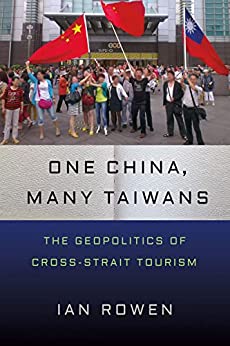
Rowen’s new book, One China, Many Taiwans, delves into what it actually means when Taiwanese tourist officers and mainland Chinese entrepreneurs tried to rustle up tour groups to come to that famous island across the Taiwan Strait – an island with tourist attractions that can actually be seen among the watermarks of a People’s Republic passport. What would they see? What would they not see? He ends up lifting an idea from the science fiction of China Miéville, particularly The City and the City – that the Taiwan where people actually live is a reality that phases in and out of existence in tandem with the Taiwan experienced by mainland visitors.
Rowen’s account of the geopolitics of cross-Strait tourism starts with the long decades of no contact at all, and the slow thaw that saw a few veterans and exiles granted compassionate leave to visit long-lost family members or attend funerals. But he swiftly dives feet-first into the sudden boom in actual tourism that saw thousands of mainlanders boarding planes to see the island that still claimed to be the Republic of China.
The centrepiece and tour-de-force of Rowen’s book is his fourth chapter – a diary of his adventures on a ghastly package tour for Chinese visitors around Taiwan’s major tourist sites in August 2014. Along with his fellow inmates, he schleps dutifully around the edges of Sun-Moon Lake, sees Alishan, and almost gets into Taroko Gorge (closed due to landslides), mopes joylessly around the shopping centre at the base of Taiwan 101 (because a trip to the observation gallery costs extra), soaks up some culture at the National Palace Museum, and refuses to buy over-priced tea shilled at him by pushy girls in aboriginal costumes.
Recalling the arch commentary of Mark Twain in Innocents Abroad, Rowen chronicles the miseries of his fellow passengers, the local factionalism among two very different tour groups lumped in together, and the careful language of their put-upon guide. He also interviews hotel managers and tea-sellers, restaurateurs and bus drivers, in order to get a sense of what high-falutin’ scholars might call the political economy of Taiwanese tourism.
Rowen is fascinated by the degree to which attempts to depict Taiwan as just another Chinese province repeatedly backfire, everywhere from the booking office where secretaries tut at his very inclusion, to passport control, where a small boy doesn’t understand why the visa form has a different flag on top of it, and indeed why his mainland family needs a visa at all.
He is particularly good on nuances within nuances – the market traders who have learned, without official directives, to rephrase their language in order to avoid ruffling the feathers of sensitive mainland visitors. Sometimes this can result in intriguingly counter-intuitive approaches, as in the case of a tour guide who studiously avoids mentioning the 228 Incident and the ensuing “White Terror”. You would think something like that would be catnip to visitors from the People’s Republic, but the tour guide regards Chiang Kai-shek and his Nationalists as “people from the mainland” too, and hence doesn’t want to insult customers that he regards as their cousins.
Rowen also notes a recurring complaint among his fellow tourists that the Taiwan tour experience is too xiaoqingxin – a difficult term to translate, but immediately evocative for me of the last twenty years of Japanese tourism aimed at office ladies and empty-nest housewives – I say twenty years, but Japanese media theory has related it to the last fifty, ever since women with disposable incomes were identified as an exploitable travel niche. I suspect that a lot of the experiences that the Chinese chafe at were first concocted to impress Japanese ladies who lunch, with history thrown out of the window in favour of gourmet experiences, photo-ops and kawaii.
For years, I have cherished the idea of booking myself into one of the coach tours advertised in London’s Chinatown, taking in Bath and Stonehenge, Harry Potter’s supposed childhood home and the Bicester freeport. They are not officially Chinese-only, but you need to read Chinese to know they are even there. And I have been fascinated by the implications, and curious about the information imparted. Are they, to steal the lyrics of a satirical Chinese song, a case of: “Get on the coach and sleep / get off the coach and pee / go home knowing nothing”?
Rowen unpacks his own experience within a far broader context – that of the immense bargaining power wielded by Chinese tourists since the opening up of their country and the enrichment of its middle class. This is a concept that has exercised me on many occasions, not the least in my travels with National Geographic, where my attempts to chronicle the dying customs of a remote hill-tribe were once compromised by the invasion of an entire coach party of amateur photographers from Guangzhou, come to do the same. In the case of Taiwan, he points to what he unflinchingly calls weaponised tourism, which is to say a massive ding-dong between Beijing and Taipei, particularly after the landslide win of the Democratic Progressive Party in 2016 called into question the status quo that had existed across the Taiwan Strait for the previous two decades. Rowen argues that this political event jeopardised many years of lucrative cross-straits tourism, particularly after the torrent of PRC tourists in Taiwan slowed to a trickle, putting thousands of people’s livelihoods and businesses at risk.
Such big-picture politics helps put things like China’s own interest in internal tourism – e.g. the cynical creation of a new holy mountain – in perspective. Rowen also relates it to local political infighting in Taiwan, especially the Sunflower movement of 2014, ably demonstrating how supposedly parochial issues over language and policy can escalate into empty Arrivals halls and deserted hotels… themselves the cause of a massive protest march by Taiwan’s hospitality sector in 2016, which Rowen gleefully joins.
He also takes the time to ask, very pertinently, if amidst all this cross-Straits hoo-ha, the Chinese tourists are actually getting value for money, or are they being ground up in a relentless money-making scheme that shunts them around a bunch of non-descript hotels and maroons them for hours on end in shops trying to sell them tat? “Chinese tourists are getting up earlier than roosters,” comments one tourism official, “eating worse than pigs, and are totally exhausted from spending most of their days on intercity buses.”
Chris Miller’s Chip War begins with a stirring account of US Navy operations in the Taiwan Strait in 2020. With China lobbing missiles into the sea, the USS Mustin toughs it out by flying the Stars and Stripes. The US government had recently revised its Entity List – previously a set of limits on exporting materials or technology with military applications, so, you know, please don’t send uranium to Iran or missiles to North Korea. But now the Entity List had been significantly tightened, and included a ban on shipping computer chips to China, itself a warning shot fired at Huawei, the Chinese manufacturer that was drastically under-cutting the international competition.
Miller links all this bluster to the “must-have” commodity of 2020, the Apple iPhone 12, an item crucial to the profits of its manufacturers in China and its distributors in the United States and all around the world. The iPhone 12, it turns out, is unable to function without something called the A14 chip, which at the time was exclusively made by the Taiwan Semiconductor Manufacturing Company (TSMC), a company that is responsible for 37% of the planet’s annual computing power. The Taiwanese chip fabrication market has a stranglehold on global commerce, and the power to shut down most modern production lines. It comes as no coincidence that the sabre-rattling in evidence began in the middle of the COVID-19 pandemic, when the fragility of the global supply chain had been amply demonstrated.
TSMC was founded in 1987 by Morris Chang, a man of Chinese extraction who had served for 25 years as a prominent figure in Texas Instruments. It had been Chang, in fact, who accompanied Texas Instruments’ Mark Shepherd to Taiwan in an almost-disastrous business trip in 1968, where the chippy Texan bristled at the serving of his steak with soy sauce, and almost lumped the economics minister for saying that intellectual property was a colonialist bullying tool. Despite such potential wrenches in the works, Texas Instruments had a Taiwanese chip factory by 1969. Passed over at TI for the job of CEO, Chang was eventually lured back to Taiwan to establish TSMC, for which a bunch of Taiwanese businessmen ponied up much of the funding, after some sinister arm-twisting from the Taiwanese authorities.
Miller suggests that the People’s Republic of China was aware of the implications and importance of semiconductors as early as the 1960s, but had already shot itself in the foot by sending all its best scientists into the countryside for “re-education”. It was only with the grand reforms of Deng Xiaoping in the 1980s, particularly the massive investment in high-tech industries around the soon-to-be-handed-over Hong Kong, that China really got going in high technology at all. But even then, its integrated circuits turned out to be sub-par, sometimes with only one in a thousand functioning as planned. Instead, China’s high-tech industries started to fudge the science part.
This, as Miller chronicles, turned many of them into “fabless” manufacturers – companies that lacked fabrication facilities to buy their own chips, but instead bought them in from somewhere else. As computer chips became crucial components in everything – not just computers, but also cars, fridges, and children’s toys (not to mention missiles), the PRC even leaned on its ideological enemies, bending over backwards to let Chang establish a Shanghai division of TSMC in 2000, even to the extent of allowing special permission for an on-site Christian church. But that was then; this is now, and the 2020s see a number of enclosures sweeping the world – of borders, of supply chains, and even of data. Xi Jinping is now scrambling to bring China’s chip manufacture up to a global standard.
“World War II was decided by steel and aluminium,” writes Miller, “and followed shortly thereafter by the Cold War, which was defined by atomic weapons. The rivalry between the United States and China may well be determined by computing power.” With Taiwan stuck in the middle.
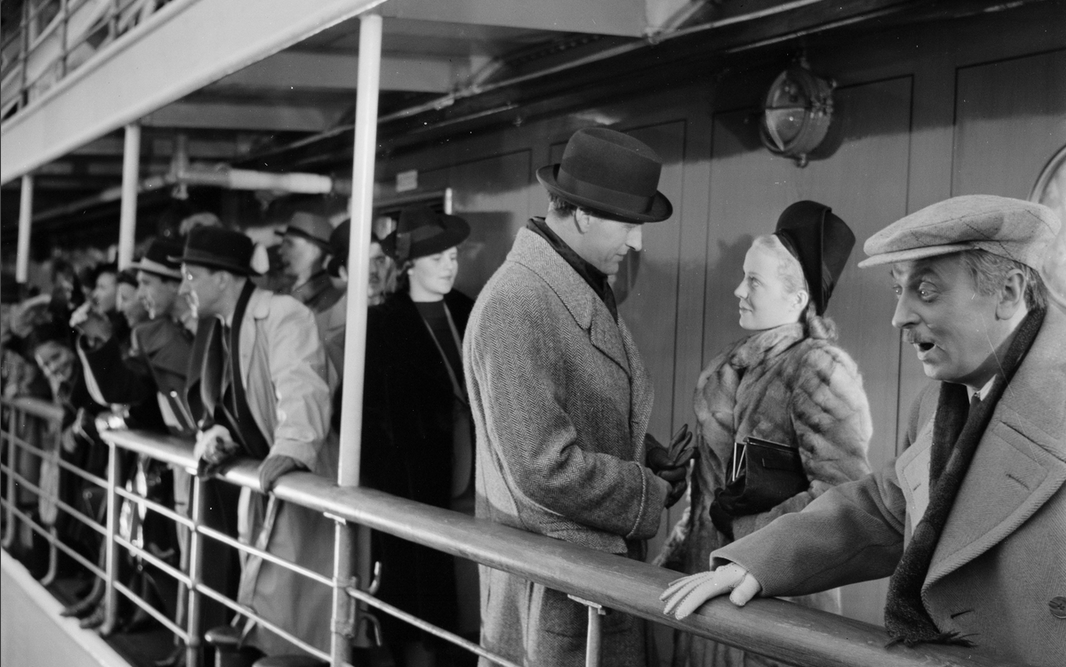
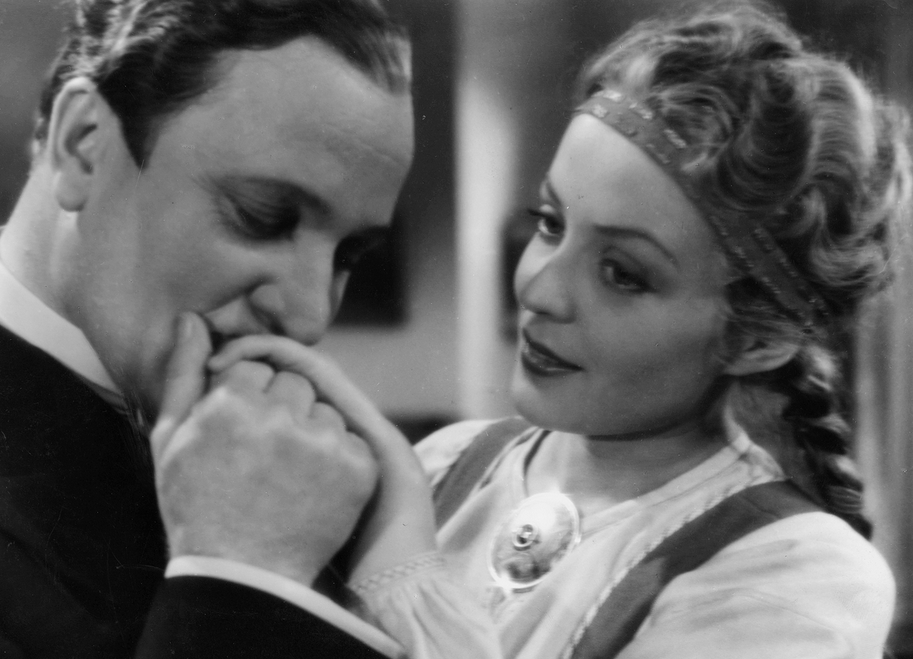
Hard-up student Inkeri (Helena Kara) wins a trip to That Fancy Stockholm, and in order not to stick out on the ship, borrows some clothes and accessories from her rich friend Kaisu (Lea Joutsena). She does everything she can to attract the attentions of the handsome Taavi Takkulainen (Tauno Majuri) but he is immune to her charms, largely because he recognises her borrowed cigarette case as a Korri family item, and assumes she is an irritating rich girl, as opposed to what she actually is, which is an irritating poor one. After this rather pointless case of mistaken identity, the young couple hit it off, and agree to meet the next day at the Grand Hotel, where Taavi’s brother Albert (Uuno Laakso), the Consul General, also happens to be staying.
In a series of farcical set-ups, betraying the origins of this film in a 1934 theatrical piece by TheKing of Poetry and the Migratory Bird’s Elsa Soini, everybody manages to miss each other, and someone ends up holding a fur coat like the Prince in Cinderella. Inkeri takes a job at the Takkulainen household, tutoring the family’s youngest son Erkki (Hannes Häyrinen). Confusions continue as the pushy mother of the Takkulainens tries to manoeuvre Inkeri into marrying Albert in order to increase his prospects as an international diplomat. Inkeri is batted between the brothers like a giggly tennis ball, before eventually Taavi wins through, dashing to her hospital room in the belief that she is dead, only to discover that she is perfectly fine and ready to hear his confession of undying love.
All this might sound rather humdrum, and indeed, on its later TV broadcast, the critic Ilkka Juonala rightly dismissed it as “a rather routine Finnish comedy that drives along the same old safe and familiar roads.” But over the Christmas season of 1940, this mediocre farce garnered oodles of praise in the nation’s newspapers. Kauppalehti singled out its “relentless pace”, Uusi Suomi called it “a triumph of cultural comedy” and Aamulehti called it a “fast-paced and funny film.”
As suggested by the fact that the titular consul doesn’t get the girl in the film, the movie version differed substantially from the original play, to the extent of marrying Inkeri off to a different brother. It also adds an entirely new first act – the play took place solely in the Takkulainen office and library, whereas for the film version, writer-director Ilmari Unho throws in that whole Swedish sequence at the beginning, presumably as a means of getting everybody away on a tax-deductible, fur-coat-wearing jolly to Stockholm amid wartime austerity measures. The opening half-hour, in fact, extends the running time to 109 minutes, which made it something of a whopper among many “features” of the era that struggled to make it past the 60-minute mark. Unsurprisingly, it’s the cast’s sly Swedish trip that is the most interesting part of this film, with glimpses of shipboard life before the Stockholm ferry became little more than a karaoke booze-cruise. The bulk of the film, however, was conspicuously shot in Helsinki, with only a few scattered Stockholm exteriors to suggest that the crew even got off the boat.
Jonathan Clements is the author of A Short History of Finland. He is watching all the Finnish films so you don’t have to.










 The Official Schoolgirl Milky Crisis Blog