“Chi has argued that discrimination and stigma are forms of societal self-harm, a position that gained substantial weight after a Taiwanese scandal in which donor organs from a dead man were transplanted into five Taiwanese recipients, along with the AIDS virus, because the donor’s family had been unaware of his condition or its implications.”
Siamo fuori di testa, ma diversi da loro (We’re out of our minds, we’re different from them). We’re back for the game of the year, the Eurovision Song Contest hosted this time by the Netherlands, who won with Duncan Laurence in 2019 – you remember him, right? It’s hosted by three normal-sized people and A Giant.
We’ve already had to say goodbye to North Macedonia’s glitterball waistcoat, Slovenia’s half-cloak and whatever the hell Australia thought they were doing, but there are still plenty of mentalists remaining, in what appears to be a year in which multiple performers have decided to wave their hands in the air like they just don’t care.
The bookies are claiming that it’s all down to a stand-off between Italy (love their bass player, and their drummer’s name is Ethan Torchio) and France (a shouty woman in a basque), but be ready for some outliers – Iceland hoovering up the nerd vote, and several appeals to the woke generation, most notably the Netherlands’ rather sweet anti-colonial my-lovely-horse, featuring Captain Crunk the Crazy Bendy Dancer, who looks on the verge of throwing up.
Step One: you will probably need to be quite drunk. Step Two: The following sights and sounds will occur during this Saturday’s Eurovision Song Contest. Can you spot them first? Remember to shout it out. As ever, there is more than one key change, and plenty of orbital cleavage. Keep your eyes (or ears) open for any of the following. And when you notice it, SHOUT IT OUT! Points can be scored all through the contest, on and off stage, including during the voting and in the greenroom.
In no particular order, in Saturday’s final you should be ready for:
KEY CHANGE! (every time you hear one)
E(uro) V(ision) finger-signals (Roop will start it but people will copy)
Tap-dancing in trainers
Two giant trumpets
An unnecessary number of belts
The Invisible Man backing dancers
The prancing, dancing pair of glowing ringpieces
Dalek dress
Those fateful words “JAJA DINGDONG”
LYRICS: “Excuse my French.”
Sitting on a man chair
Big Golden Ball
Big Golden Ball with a Snake in it
The Mondrian Brass Section
Tix takes his sunglasses off
Tix puts his sunglasses back on
Lyrics: “Hear my body talk talk talk”
“WHO!?” – every time someone says “Duncan Laurence”.
LYRICS: “Every psycho on the scene…”
Dancing German Victory V
Walk like an Egyptian (every time)
Keyboard Circle!
Vulcan hand signal (Live Long and Prosper)
Necklace that says: “ANNOYING”.
Trinity from The Matrix wearing a dead muppet
Shoulder dancing
Liberty Jazz Hand (wiggling fingers at the back of the head in an attempt to imitate the Statue of Liberty)
Eclipse!
Look for the word “JOIN”
Glitterball leotard
Holy shit, it’s LORDI!
Ukulele throwing
Pointing
LYRICS: “I really don’t care dat you vant to bash me.”
Hands make a heart
Red middle finger
FLAME ON! (every time there’s pyrotechnics)
WINKING
COSTUME CHANGE
Bimbling*
ORBITAL CLEAVAGE**
Buddha Jazz Hands***
Our optional bonus categories are:
COVID BINGO – which entry will be suddenly withdrawn from competition owing to a plague scare?
THE PALESTINIAN PROTEST SWEEPSTAKE – can you guess the time of the inevitable Palestinian protest? It could be a flag, it could be a speech, it could be a stage invasion, but you know someone’s going to try it on.
HOLA OLA! Surprise sighting of former supervisor Jon-Ola Sand. Can he really stay away?
Denmark awards 12 points to Italy, whose band has a Danish bass player and a Danish name / Greece awards 12 points to Cyprus / Cyprus awards 12 points to Greece / Former Yugoslavian Republic awards 12 points to Former Yugoslavian Republic.
(*swaying one’s head from side to side in a snakey fashion) (**ostentatious cleavage sufficient to see from a satellite in orbit, which, according to Eurovision bra consultant Tom Clancy, requires a minimum of C-cup)
(***the dancers all pile behind the singer in a line and then fling their arms out, creating a multi-limbed oriental deity-look)
“I used to have the final moves planned out, but lately I’ve been thinking I’d rather figure them out when I come to it, so now it’s hard to say what could happen. Being the sort of person I am, though, I actually don’t think I could let such a long grim story end with a grim ending – like, say, having him suddenly die. I don’t really like that kind of entertainment.”
My obituary for the manga artist Kentaro Miura, creator of Berserk, is now up on All the Anime.
I’ve long given up expecting decent oriental food in the small town where I live, but sometimes even I get riled about the low expectations of the customers and the cooks. Exhibit A: the monstrous abomination that shuffled into view at the local sushi buffet, when the mainland Chinese who used to run it sold out to a bunch of Thais, and within days they were putting processed cheese on the maki rolls and leaving out platters of tuna sandwiches!
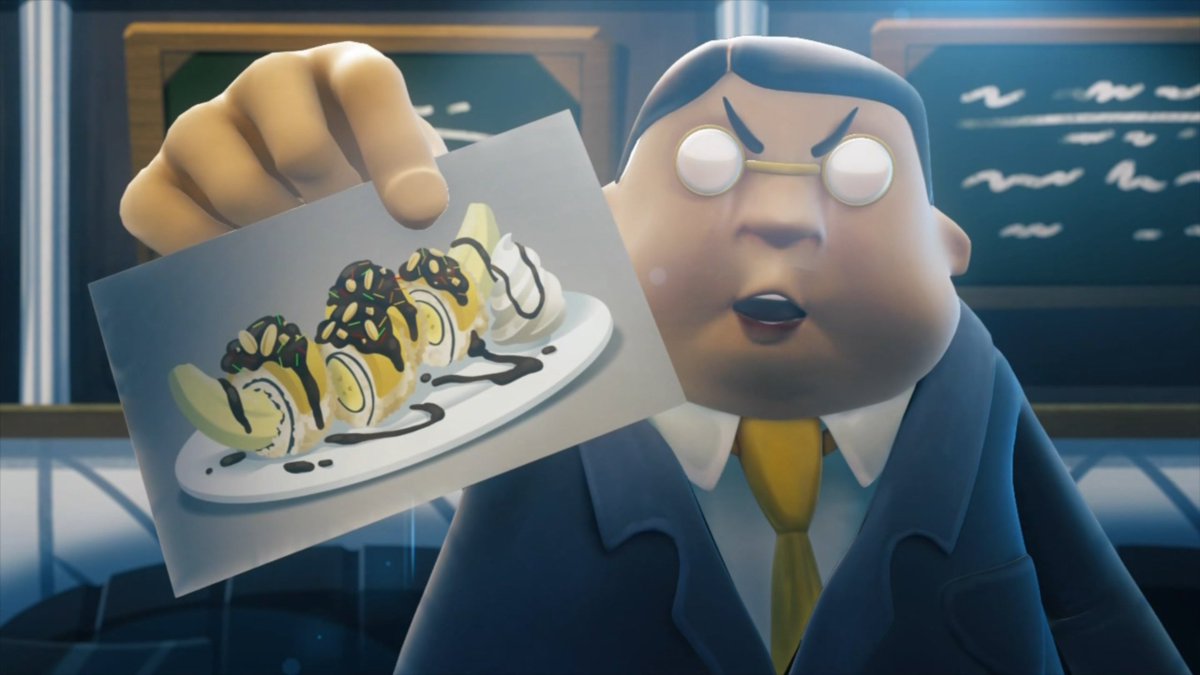
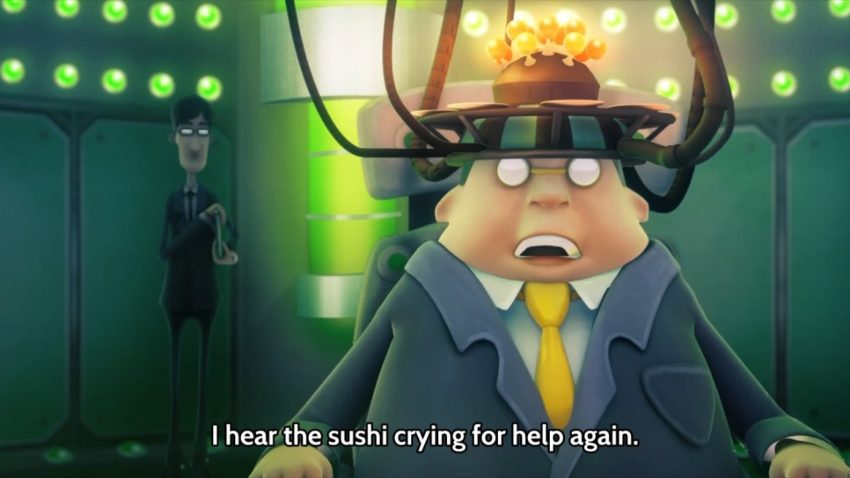
There are limits, and if there was such a thing as the Sushi Police, I would definitely have called them. In the anime series directed by Tatsushi Momen, Honda, Suzuki and Kawasaki are enforcers for the Japanese government, making sure that restaurants around the world are serving proper, traditional sushi, and none of these madcap overseas inventions. First screened in Japan in 2016, Sushi Police was commissioned amid a certain braggart mood in Japan that the Olympics were coming soon, and that the world was sure to become so obsessed with Japan that its far-flung corners would need an inspectorate to slap any slipping standards out of them.
One wonders, however, about where cultural policing disappears so far up itself that it becomes a cure that’s deadlier than the disease. Sushi started off as an utterly commonplace snack food in samurai-era Tokyo, slung together with fresh ingredients and a dash of sauce, no weirder than a hot dog… albeit usually not actually hot. And this wouldn’t be the first time that an “authentic” food had evolved abroad. As the name implies, one of my favourite varieties, the California Roll, has origins far away from bay-side Tokyo, and is all the better for it.
But in Japan there are super-high-end establishments for people much posher than you and me, which have a whole set of rules of their own. There are sushi bars that only run two sittings a night, where seats are booked months in advance, where you pay in advance and forfeit your money if you are five minutes late. There’s no reaching for the soy sauce here – the chef decides on the flavouring you need, not the flavouring you want. And in order to avoid offending the fine palates of your fellow diners, you are not allowed to wear any form of perfume.
Would the Sushi Police crack down on them, too, for being ridiculously snooty, or would they secretly approve of such white-collar crime?
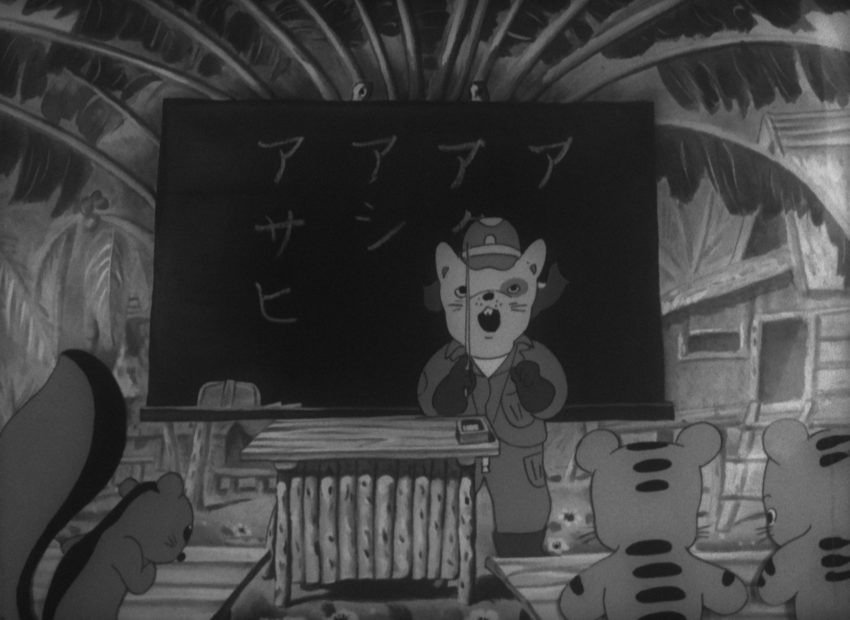
‘“The AIUEO Song” was one of several films screened in the Japanese empire to teach the Japanese writing system to schoolchildren, released close behind the tunes “Flower of Patriotism” and “Our Unity” – there are accounts of all three being screened repeatedly. Digging around in the archives, Takashi Kayama has uncovered another version of the song, released on vinyl by Nippon Columbia in November 1942, and recorded by schoolchildren in Singapore, seemingly native Chinese speakers struggling to get the sounds exactly right.’
Over at the All the Anime blog, I delve into new revelations about the singalong Japanese lesson that forms an early highlight of Momotaro, Sacred Sailors.
‘Suzuki excels at unreliable narration. In the Bradbury-esque “Night Picnic” (translated by Sam Bett), four creatures that identify as human beings pore over a library of forgotten books, comically and ham-fistedly trying to reconstruct what it means to be an Earthling. In “That Old Seaside Club” (translated by Helen O’Horan), a possibly drug-addled glimpse of seafront nightlife turns out to be the hallucinatory refuge of a doleful housewife, reliving a replay of her twenties heyday. In much the same fashion, in “Smoke Gets in Your Eyes” (translated by Aiko Masubuchi), a woman’s recounting of her night-club experiences carries a niggling, growing sense that time is not working in the way it should, and that her perception of the passing of the minutes and the passing of the years might be confused.’
Over at All the Anime, I review the new collection of science fiction stories by the late Izumi Suzuki.
“Copper is adept at finding out things for himself, and the reader shares in his joy as he uncovers such things as the supply chain that puts a mouthful of Australian dairy milk onto his Tokyo breakfast table – the cows and the milkers and the factory and the freight train and the steamship… Uncle is there to point out that what he is actually talking about is the ‘relations of production,’ and gently tries to inform him about the basic principles of Marxist economics.”
Over at All the Anime, I’ve been reading the book of Hayao Miyazaki’s next film.
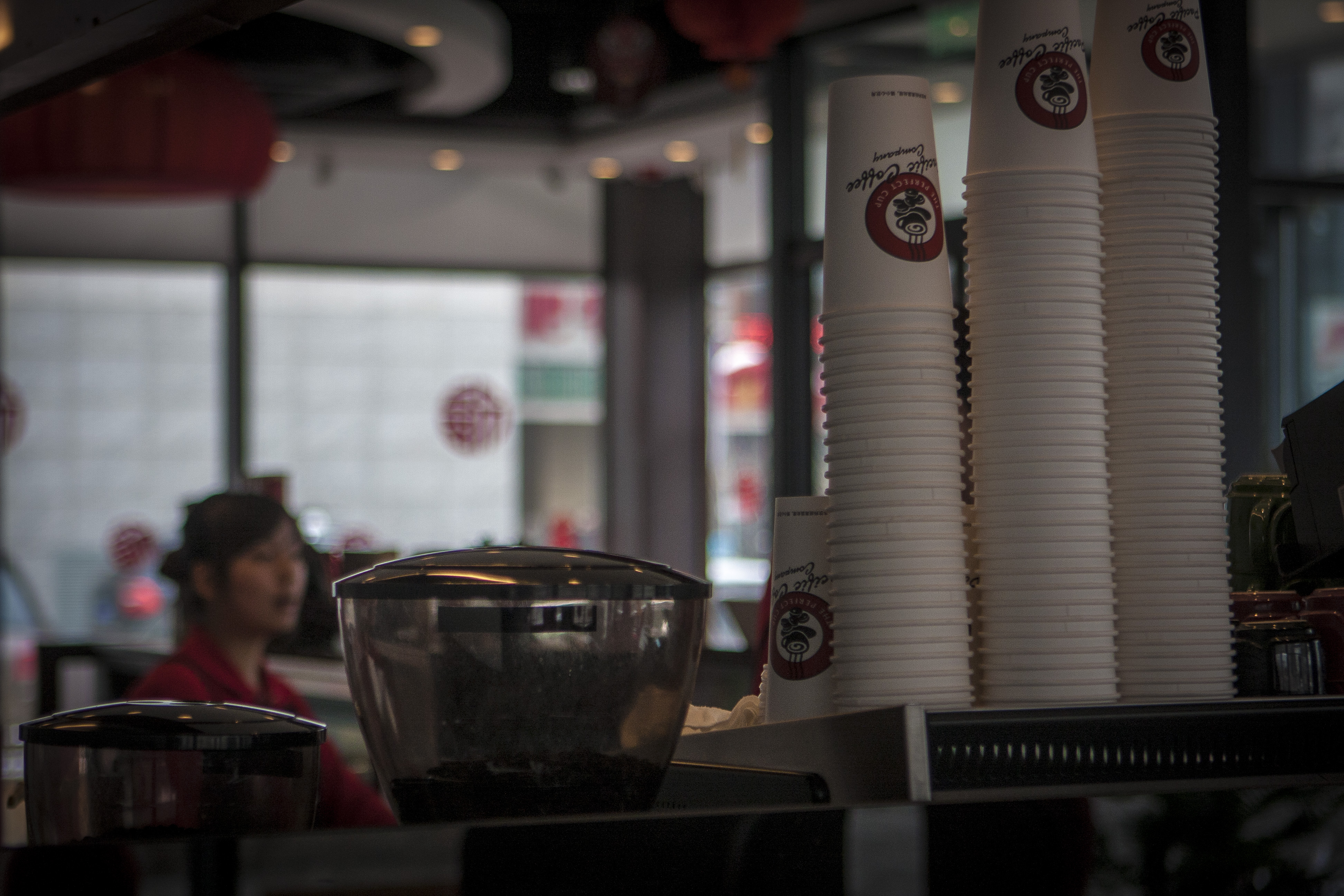
The last thing I want to discuss at 9am is whether I want whipped cream on top of my coffee, particularly in Mandarin. Why can’t I ask for a coffee and get one, and not have to say grande instead of medium? The arseholes who invented the illusion of choice at coffee shops clearly never stopped to consider the miseries of ordering such minutiae in Chinese, where foreign concepts are assembled from a jumble of syllables that sound almost equivalent to Chinese ears, all of which have their own discrete meaning. Even asking for a Caramel Latte involves saying that you desire Cooked Sugar Seize Iron Add Africa. And a Mocha is a Magic Card. I feel like I am inside some Situationist art installation, asking a woman in an apron to bring me a Shining Fish Wiggle Rainbow, and doing so with a straight face.
“What size do you want?” asks Betty.
“I just told you,” I say, “dabei”. Which means Big Cup.
“Does that mean the biggest cup?” she asks, which is tebie dabei (or Special Big Cup) in Chinese, “Or does that mean the medium cup?” which is called ‘Big Cup’ in Chinese, as I just told you. And her.
“Grande,” I sigh. “You call it dabei. It says dabei here on the sign. I am reading out your own labels.”
“Ah,” she says. “Gu Lan De,” making up an entirely new concept in Chinese to describe the thing that is already described as Big Cup, but now is apparently also to be referred to as an Old Blue Independent.
“All right, then,” I say. “An Old Blue Independent Cooked Sugar Seize Iron Add Africa,” using the correct terminology, which is only correct at this moment, in this conversation, between me and Betty. If I use the same jumble of ideas with anyone else, they will blink at me blankly and wonder if I am mad.
“Would you like a muffin?” she adds, innocently. Which, if you ever need it in Mandarin, is Ma Fen, which means Carnelian Finn. But if you say it with the wrong tones, it means a Pointless Faff.
“One medieval text… mentions a ‘sushi’ dish so sour that if you accidentally threw up in a barrel of it, it was possible to mix the vomit in and leave nobody any the wiser.”
Over at All the Anime, I review Eric C. Rath’s exhaustive and entertaining Oishii: The History of Sushi.
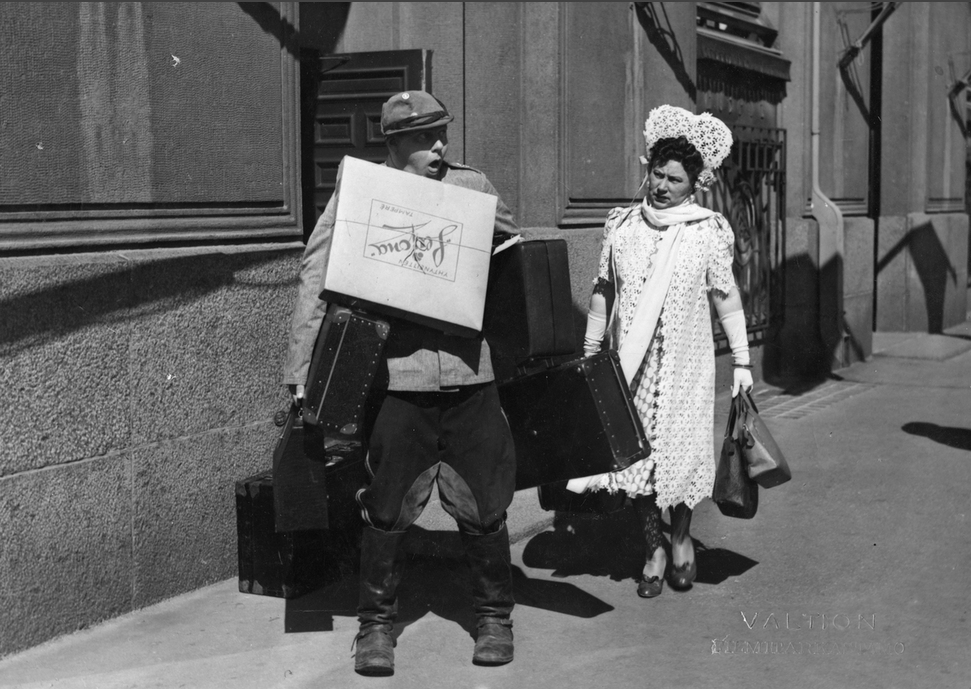
At the garrison in Lappeenranta, Cavalryman Erkki Kallio (Uuno Lakso) and “Kalle Kallola” Mäkinen (Matti Lehtilä) are colossal wastes of space, workshy layabouts who hope to make it through their whole military career by being so incompetent that they are pushed away from active duty to potato-peeling and swine-herding. So far, their plan has worked well, and they have been demoted to work so far down the military scale that they are essentially servants to the housekeepers and cooks at the barracks.
But Erkki and Kalle are not the only malingerers – the master of the horse, Kalpa (Kalevi Mykkänen) has taken so many personal days to “visit his sick aunt” that the colonel in charge of the regiment demands that he prove the woman has not already died of numerous ailments. Both men are thrown into a series of intrigues at the barracks, as their boss Mrs Westergren (Valma Lahtinen) enlists their help in discovering the intentions of the attractive young Hilja (Tuulikki Paananen, radiant as ever), a soubrette who has suddenly started lurking flirtily around the unattached colonel. Meanwhile, Kalpa enlists Kalle’s real Aunt Loviisa (Martta Karlo, in a series of ridiculous frocks) to pretend to be his aunt, in order to get the colonel off his case, and prove that he did not merely make her up.
Hoping to marry the colonel off to her own daughter, Mrs Westergren does everything she can to push Kalpa and Hilja into each other’s arms, including a series of lessons in Understanding Women in which she comedically reads out sections of the manual for handling horses. Kalpa, however, makes the fateful error of admitting to the lustful Hilja that he was coached to act indifferent until she tried to seduce him.
Mrs Westergren, realising that her attempts to hitch her own daughter to the colonel have come to nothing, decides to quit the barracks, and Kalle arranges a parade for her by setting off an alarm to cause the soldiers to assemble just as she is leaving. Hilja is revealed as the colonel’s niece (although since Mrs Westergren is the colonel’s cousin, surely she would have known this!), thereby freeing her to marry Kalpa, their previous altercation having been smoothed over. Kalle arranges for the young lovers to elope.
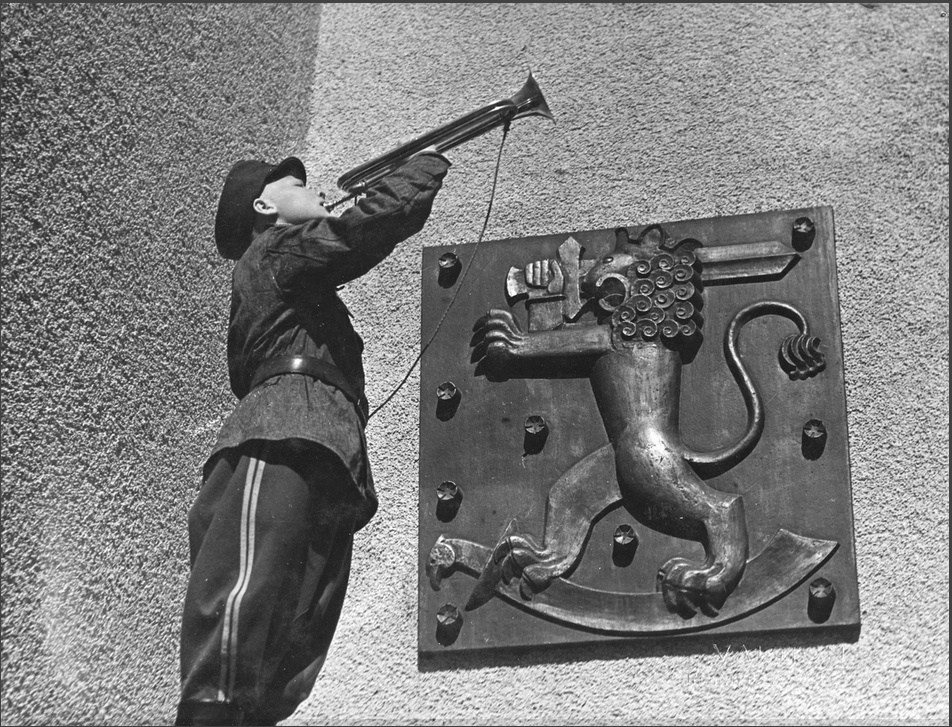
Despite appearing like a piss-poor copy of The Regiment’s Tribulation (1938), Rakuuna Kalle Kollola began life as a play that even pre-dated the theatre version of that story, The Beloved Uniform (1932, Rakas univormu) by Jalmari Finne. It was the first production from the newly formed company Sampo-Filmi, itself backed by a bunch of investors based in Lappeenranta, who obviously thought that it would be a neat idea to capitalise on the local scenery and availability of military personnel as extras – there are many scenes of dashing horsemen doing dashing things. In doing so, the crew from Sampo-Filmi ram-raided the staff of the other film companies then operating in Finland. The script was written by Suomi-Filmi’s Ilmari Unho under a pseudonym, the sound equipment was rented from Suomi-Filmi, the lights were rented from Elo-seppo, and director Kalle Kaarna was dragged in from Jäger Films. In a triumph of jammy-bastard luck, the film was rushed into cinemas weeks ahead of the actionably similar Red Trousers (1939), which was also shot in Lappeenranta (with Unho as director!) just before the crew of Kalle Kollola, Cavalryman arrived to begin production. As a result, cinema-goers in the summer of 1939 were saddled with not one, but two silly military romantic farces.
The press was suitably annoyed, hammering the fledgling company for making light of military men in tense times. The Helsingin Sanomat damned it with faint praise, noting that it lagged far behind The Regiment’s Tribulation, but that “people always like to see their soldiers.”







 The Official Schoolgirl Milky Crisis Blog