The Anime Boom

Up on the All the Anime blog, my book review of Daliot-Bul and Otmazgin’s The Anime Boom in the United States: Lessons for Global Creative Industries, which includes the following incendiary quote from Marco Pellitteri:

“Fans are a noisy minority that led many observers in the industry (and in academia!) to think that they are more numerous, representative and important than they actually are…. today, the targeting of narrow audiences is a self-fulfilling prophecy in terms of total economic failure: you make a series for a very tiny specific audience, then you want to sell it [overseas] for a higher price, because you want to make abroad the money that you failed to make in your own country.”

The Path of the Righteous Men

Jussi Vares (Antti Reini) is approached by Olle (Markku Maalismaa), a pastor from small village in the hinterland, who wants him to solve a crime that the police seem to have given up on. Just for a change, it’s about the murder of a sexy young girl, and there is a long list of potential suspects. Could it be Taisto Raapana (Peter Franzén), a fire-and-brimstone preacher whose Christian sect has dragged many of the already devout locals away from Olle’s church? Or Sulander (Järmo Mäkinen), the seedy printer who publishes Raapana’s religious tracts? Or even the local police, who are demonstratively suspicious of Vares as he pokes into their business?

Not for the first time, the Vares series tests the limits of the Finnish acting profession. The constant need for fresh murder bait, it seems, has exhausted the entire crop of this year’s young Finnish starlets, leaving this episode’s love-interest in the more mature hands of Elisabeth (Merja Larivaara), Raapana’s sexually frustrated wife. Meanwhile, the bent doctor Hento, who secretly prescribes her birth control pills, is played by Kari-Pekka Toivonen, who previously played another role in the second Vares film, Frozen Angel. Famous Finnish crooner Kari Tapio, no stranger to provincial barn dances full of murderous banjo-twanging cultists, I am sure, appears as himself in a concert scene.

Legend has it that the four 2011-12 Vares films were shot back-to-back on a 120-day schedule. And someone has certainly made the most of the economies of scale, presumably shooting a bunch of top-and-tail pub scenes with our hero’s drinking buddies that will suffice for all four movies, while another crew gets on with the aerials. Lauri Törhönen could have been off shooting the prison break sequence for Garter Snake, which involves none of the regulars, while Anders Engström was off with the leading man in the countryside, banking this low-key, low-budget diversion almost entirely featuring a guest cast, released straight to video in 2012.

So even though we begin with the usual overhead shot of summertime Turku, the shadow of the helicopter visible in frame as if to advertise the money spent – no drone footage here! – the bulk of Path of the Righteous Men is set in Ostrobothnia, on the Finnish Baltic coast. Considering the Vares serial’s ongoing feud with things Swedish, I am rather surprised they didn’t make more of the region’s Swedishness. Even its name, “East of the [Gulf of] Bothnia” rather than the more logical “West Finland”, parses it in terms of its geographical relationship to Sweden. I drove through the area once researching the John Grafton incident, and the road signs were in Swedish first and Finnish second. Instead, the script by Mika Karttunen and Katariina Souri, and presumably the 1992 Reijo Mäki novel Vares ja kaidan tien kulkijat on which it is based, focuses on another element of the Finnish hinterland, religious fundamentalism.

It’s certainly refreshing to take Vares out of his Turku home to see a little of the countryside, packed off to a dry county where only low-alcohol beer is available, and his landlord gets a telling-off from the police if he lets him have a snifter of brandy. Raapana’s happy-clappy sect all seems mostly harmless, until Vares realises that the preacher is offering places in heaven in exchange for donations of real estate. There’s certainly something fishy going on, and Vares soon finds himself wading hip-deep into the tawdry secrets of a one-horse town. It’s not clear to me, however, to what extent he actually solves all the mysteries – as with the novels by Reijo Mäki, which mix first- and third-person narratives, there are some scenes of vital exposition that take place when Vares is absent. He certainly stumbles across the truth of who committed the murder, but the degree to which he leaves town having solved all the crimes witnessed by the audience is debatable.

Jonathan Clements is the author of The Armchair Traveller’s History of Finland.

Ninja: Unmasking the Myth

Ninja: Unmasking the Myth is a brave book. With a scientific sense of objectivity, Turnbull tears down an edifice that he himself helped to build, shining the harsh glare of academic rigour on his earlier work. In doing so, he uncovers some striking facts about the evolution of the ninja, not the least that the word doesn’t even occur in Japanese-English dictionaries until 1974.”

My review of Stephen Turnbull’s demolition (and reconstruction) of ninja in history, up now on the All the Anime blog.

From Our Sponsors

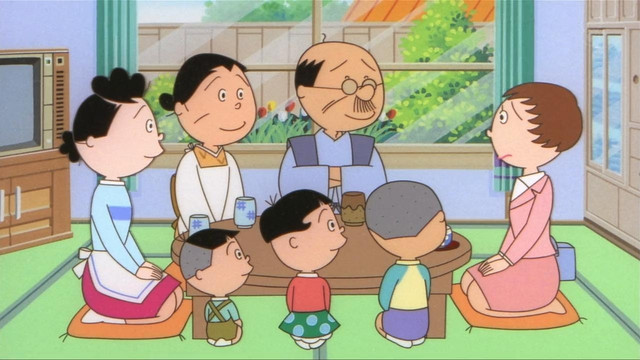
Everybody’s trying really hard not to call it the end of an era. But after 48 years the Toshiba Corporation is no longer the chief sponsor of the Sazae-san cartoon. Based on Machiko Hasegawa’s mild-mannered comic series, which itself ran from 1946 to 1974, Sazae-san has always been a time-capsule of post-war Japan. Its leading characters, a family with three children and several relatives, led by the titular harassed housewife, were always intended to be timeless. Scriptwriter Masaki Tsuji once explained that the stories were supposed to be as taboo-free as possible, sure to catch the largest possible viewership on primetime. But they were also decreed to be free of bad language, modern slang and electronic devices.

Sazae-san lives in a Japan untroubled by right-wing nationalism or looney religious cults, where nobody has heard of Tinder or Facebook. She has become a living fossil – even her three-child family is an outmoded phenomenon in a Japan where few can afford more than one kid. If you haven’t heard of her, then you can blame her late creator, whose contracts, signed before most of you were born, stipulated no spin-offs, which has been interpreted as meaning a ban on videos and DVDs.

That hasn’t stopped Sazae-san being the top-rated cartoon on Japanese television, and the longest-running cartoon series in the world. And all through her broadcasting history, Toshiba has paid the big bucks to top and tail every episode with whatever is up to the minute in electronics – air conditioners, washing machines, faxes and laptops. For the first thirty years, Toshiba was the sole sponsor, and even sneaked some of its devices into the show itself in early product placements.

But now that all has to change. Stumbling in the American atomic energy market and reeling from a series of accounting scandals, Toshiba can’t afford to keep fronting the cash. Instead, it gave the producers a season’s head start to find new sponsors, and officially bows out this March.

Is this the end for Sazae-san? Fortunately not – although nobody has the clout to be the sole sponsor of a primetime anime, someone did rustle up a committee of new sponsors to carry the costs. Clearly seeing the viewership as a bunch of young home-makers, the baby-wares company Nishimatsu has stepped up, alongside Daiwa House, a residential builder. Another new funder is Amazon Japan, suggesting that perhaps Sazae-san might soon be under pressure to allow a particular kind of new spin-off after all. Could streaming episodes be in its future…?

Jonathan Clements is the author of Anime: A History. This article first appeared in NEO #174, 2018.

Admiral Togo: Nelson of the East

At long last, available on the Kindle, my biography of Admiral Togo, from Amazon in the UK and Amazon in the US.

“ … a fine attempt to revive the memory and reputation of a most professional and successful naval officer who lived through a period of astonishingly rapid and radical change for his country and service.   Recommended for the general reader, but especially for those who may find themselves working with the Japanese.” – Naval Review

“Clements… recounts the life of a Japanese admiral famous for his victory at the Battle of Tsushima during the Russo-Japanese War. Through his extensive reading of multiple-language sources, Clements points out deficiencies in some of the… sources he quotes, and presents so far little-known episodes like the important roles French advisers played in the Battle of Miyako Bay in 1869 during Japan’s civil war in the early Meiji period.” – CHOICE

“This book is a refreshing account of a defining figure of modern Japan. It is well written and deals with themes such as leadership, individual commitment, social transformation and cross-cultural understanding of great contemporary relevance.” – Mariner’s Mirror

Garter Snake

Sukkanauhakäärme (1989) was one of the earliest Vares novels, set at a time when our hero was still fixated on the life he almost had as a big-shot lawyer. Some faint echoes of this remain in Lauri Törhönen’s 2011 film adaptation, in which Jussi Vares takes on a job tracking attorney Pauli Kontio’s unfaithful wife Annika (Rebecca Viitala), at least partly out of envy for the client seemingly having it all.

Someone who is most definitely having it all is Jesus Lobo (Ilkka Villi), a smarmy piano player who seems to have tupped half the women in Turku. Vares starts tailing him with the expectation that he has found Mrs Kontio’s lover, only to discover that Lobo has a girl in every piano bar. He also tinkles the ivories on the ferry to Stockholm, which makes him an ideal mule for drugs and “special” Swedish porn, the nature of which is never revealed, but presumably involves lukewarm saunas and insufferable smugness. As ever in Vares, Sweden is the source of all criminality and torment, a sinful utopia at the other end of the ferry lines.

Meanwhile, Torsten Rapp (Petri Manninen) busts out of jail. If that sounds like a non sequitur, it is for most of the movie, which begins with the prolonged preparations for a jailbreak. But as soon as Rapp has fought his way out of prison with a guard’s uniform dyed blue with toilet bleach, and an improvised shotgun made out of a crutch, he disappears for half the running time, only popping up again at the end for the now-traditional sequence in which one set of criminals is trumped by an even more violent thug, allowing Vares to save himself and the day by dropping between the cracks and cleaning up the mess they leave behind.

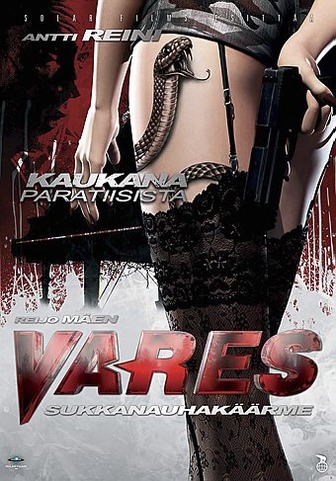
Even by the standards of the Vares films, this is a low-rent offering much more on the straight-to-video end. You can even see this in the box-art, which features a sexy, suspendered thigh flashing a snake tattoo on the DVD cover, but hides this behind a more demure basque version on the cardboard sleeve. This is pretty much all there is to say about the titular “Garter Snake” – an epithet directed at a femme fatale in a throwaway line, but otherwise nothing to do with the film at all. Our hero, meanwhile, finally gets behind the wheel of a car, tooling around town in an old Volvo before someone blows it up.

Vares, as usual, spends most of his time blundering between Turku’s watering holes – a Vares drinking game could only avoid alcohol poisoning if viewers took a sip whenever a glass wasn’t in his hand. We can only imagine the product-placement bingo that precedes each shoot, as the cast roll up in some guy’s pub and offer to make sure the sign gets into shot, as long as everyone can have free booze. In one scene, Vares and his friends each have two drinks in front of them, as if they are desperately trying to cram one more in before closing time. The fact that this was the earliest chronological Vares book to be adapted for the screen also creates a continuity confusion, as Vares “finally” sleeps with his perky part-time stripper neighbour Anna (Maria Järvenhelmi), even though she has been acting like his occasional squeeze in the four previous films.

Jonathan Clements is the author of The Armchair Traveller’s History of Finland.

Steven Bochco 1943-2018

“I’ve always tried to console myself,” writes Steven Bochco, “that if you’re a baseball player, and over the course of a twenty-five year career you fail to get a hit six or seven times out of ten, you’re still a sure shot to get elected to the Hall of Fame.” He will be remembered as the co-creator of a run of television serials from 1981-2005 that transformed the nature of television, particularly Hill Street Blues, LA Law, and NYPD Blue. His memoir, Truth is a Total Defense: My Fifty Years in Television, gives ample space to his hits, but also to his misses, including the police musical Cop Rock and the animated satire Capitol Critters. He alludes, smartly, to “the distinction I have always made between failing and not succeeding.”

Truth is a Total Defense is framed by the experience of the older, semi-retired Bochco, experiencing a heart attack and a leukaemia diagnosis in quick succession. It is openly intended as a message to his children, an account of who he was and how he got there, to be set down before his inevitable death. As such, it contains an degree of score-settling, ranging from the entertaining attack on the man who boffed his first wife (“Hey Barry, how’ve you been?… Wherever you are – if you’re alive – go fuck yourself!”) to an embarrassing diatribe against the sister who refused to be screened for a bone marrow match.

Bochco saw himself on both sides of the precinct desk, as both the maverick cop who doesn’t play by the book, and the hard-pressed captain trying to keep a lid on trouble. Twice, in his book, he mentions middle management with “crushing responsibilities and not enough authority” – it’s the empathy he had, not just for the crime-busters on the street, but those Suits in City Hall, that allowed him to pursue so many unexplored elements of the life of police and lawyers.

He seems to have been unable to avoid trolling his superiors. When he titled one episode of Hill Street Blues “Moon Over Uranus”, he started a month-long fight with the censors. Episode titles were never shown onscreen, but higher-ups objected to the fact that titles were often included in TV Guide listings. Although he eventually won, he pushed them further by writing subsequent episodes called “Moon Over Uranus: The Sequel”, and “Moon Over Uranus: The Final Chapter.” In order to avoid vetting from a real-life police station, he never specified which city Hill Street Blues was set in, but still ran into trouble from executives. An episode featuring a man caught in a hotel room with a sheep was the source of constant bickering with his boss, Brandon Tartikoff, who demanded to be reassured that it was, at least, not a gay sheep. His biggest score surely came after he discovered that the Fox network was refusing to take bids for syndication on NYPD Blue, hoping thereby to sell it to one of its own affiliates at a knock-down price. Bochco was barred from the studio canteen after having the company owner, Rupert Murdoch, served with a subpoena there, but when the company settled out of court, he insisted not only on being reinstated, but having the table next to Murdoch’s.

His memories of the making of Silent Running clearly still wound him after 40 years; he was paid $1500 for a week’s work writing the script, but never worked in film again, choosing instead to work in television, where he could control his own material. He blames Bruce Dern, specifically, for adding dialogue to the film that was sure to date it, and is unforgiving, thereafter of any badly-behaved actor. He is brutal towards David Caruso, who nearly wrecked NYPD Blue before its second season, and Sharon Stone, whose attitude was unappreciated on the set of Bay City Blues.

His account of Daniel Benzali’s behaviour on the set of Murder One, demanding to take a morning dump in a specific Malibu toilet, verges on the unbelieveable. Actors largely seem to get Bochco’s attention when they are difficult. He has kind words to say about Dennis Franz, who clung on for all twelve seasons of NYPD Blue, and speaks for all mankind on the divine beauty of Hill Street Blues’ Veronica Hamel, but is usually focussed on what’s going on behind the camera, not in front of it. Included in such stories is a hymn to his lawyer, The Doberman, who secured him the sweetest of exit deals on Hill Street Blues. Fired from his own show with two seasons still to be made, Bochco could put his feet up and enjoy $75,000 per episode as creator, effectively “paid not to come to work.”

But his book also presents fascinating glimpses of the workings of television, including a masterclass in story-editing as he cuts down the pilot of Hill Street Blues from its original, bloated length to something that can be broadcast. Around about the time of the publication of his one and only novel, Death by Hollywood, Bochco gave an interview in which he suggested that his time had passed. He felt outnumbered by young executives, and marginalised by a TV industry that didn’t care about drama any more. I was one of his greatest fans, and the author of an entire Judge Dredd script in homage to his work, but even I could see that he had been left behind. NYPD Blue with its shakey-cam edginess and its studied theatricality, was very much a 1990s show. The last series of Bochco’s that I bought sight-unseen, Over There, was an ill-judged attempt to cram the Gulf War into the modes of his police and legal procedurals.

There are moments in Bochco’s book where you can see attitudes that would never play today. He boldly states he is “all for nepotism”, simply observing with very white, very male blinkers on that nobody stays in the business unless they’ve got what it takes. This swiftly neutralises any criticism that he might have got where he was through the exercise of privilege and connections, but undermines much of the modern diversity and equality that his shows helped to foster in the popular imagination.

Bochco gets to dump in long screeds of his emails from hospital, in which he chronicles the indignities and inanities of chemotherapy. The attentive reader might also notice a distinct change in tone between the emails he sends his friends and family, and the writing in the rest of the book. Being self-published, Truth is a Total Defense lacks front matter and indicia, and it’s only after the epilogue that he acknowledges the assistance of an amanuensis. There would have been no shame in publishing this as a book of interviews – indeed, framing it in such terms would have given Rich Eisen a chance to impose a stronger mode of emplotment. For posterity’s sake, Eisen could have pressed Bochco a little more on big-picture issues, such as whether Hill Street Blues ever earned back the money in syndication that its backers hoped it would. But that’s another legacy that Bochco has left the TV world – TV shows like Mad Men, with tiny audiences but huge award-winning profiles, monetising for their makers in marketing and subscriptions, rather than ratings.

Bochco finished his career barnacled with Emmy awards, and recalls the moment when he received his first, and accidentally stabbed himself in the thigh with its sharp tines. He has a modest proposal for the Emmys today, suggesting that nobody is ever allowed to win more than once in the same category for the same job. “Once you’ve been acknowledged by your peers,” he suggests “it’s time to get off the stage and let someone else have a turn.”

Jonathan Clements is the author of Anime: A History.

Reading Mononoke-hime

Fittingly for a twentieth anniversary collection of essays on a single, much-loved film, Rayna Denison’s just-published Princess Mononoke: Understanding Studio Ghibli’s Monster Princess (Bloomsbury) throws in everything but the kitchen sink. In the sense that it went mainstream and has been the focus of widespread appreciation, Princess Mononoke has generated a vast amount of secondary materials. Through critical acclaim, corporate backing and foreign sales, Hayao Miyazaki remains the best-represented anime director in translation in his own words, which boosts him in terms of scholarly access – it’s not only easier to sell a Miyazaki book to publishers, but also to readers and even contributors.

And this is an impressive bunch of contributors, featuring some of the sharpest minds working on anime today. Shiro Yoshioka examines the position of Princess Mononoke within Miyazaki’s work, noting that is very success may have forced him into a compromising niche, turning him from an action director into an eco-pundit. Eija Niskanen pokes around Japanese archaeological sites in search not only of Miyazaki’s inspirations, but the gaps in knowledge that he imaginatively filled with his own designs and ideas, noting in the process that the film defies traditional notions of what a “period film” should be like – a samurai movie with no samurai in it, showcasing the also-rans of Japanese history. Julia Alekseyeva provocatively but persuasively argues that Princess Mononoke is a prolonged homage to the Soviet film The Snow Queen, which Miyazaki saw in his shop-steward days. Both Helen McCarthy and Alice Vernon argue for Miyazaki as a feminist storyteller, seeing in his work echoes of the Maid, Mother and Crone of Robert Graves and the “heroine’s journey” of Maureen Murdock, and in Vernon’s case, asking whether the pragmatic, driven Lady Eboshi is a threatening vision of what the future holds for the heroic San.

Other chapters review cunning ruses in stunt-casting, not only of the film’s A-list voices, but of Neil Gaiman as the script adaptor, examining both the promotional value of these decisions and the nuances they introduced to the English-language version, the marketing of which is carefully analysed from the perspectives of posters, trailers and featurettes. Refreshingly, Denison has assembled writers who are not only prepared to dive into appreciations of the film itself, but overlooked elements as its critical reception (for which Emma Pett wades through over 800 reviews), and the long tail of its merchandise. The result is an impressive meeting of Princess Mononoke minds, although at £80 hardback and £55 on the Kindle, Bloomsbury seemingly lacks faith that the film’s much-mentioned blockbuster status will translate into a wide readership.

Jonathan Clements is the author of Anime: A History. This article first appeared in NEO #173, 2018.

The Girls of April

Hard-up Finnish journalist Ruuhio (Mikko Lempilampi) leans on his drinking buddy, private eye Jussi Vares (Antti Reini) to poke around a cold case that has long been forgotten. Fifteen years earlier, three girls from Turku disappeared in swift succession – maybe they left the country, maybe they were murdered – but the town has already forgotten the scandal.

This is probably because the town is munted. Antti Reini’s second outing as Vares rarely strays far from the pub, which seems to be the location for much of Turku’s thinking, drinking and big pimping. He’s been so smashed for the last decade that he hasn’t even noticed that his drinking buddy Luusalmi (everybody is a drinking buddy) not only dated one of the missing girls, but wrote a book in which he outlined his personal theory about their disappearance. Luusalmi, however, is not renowned for his problem-solving skills – he thinks they were in a sapphic love triangle, and that one bludgeoned the other two to death with a dildo before running off to Lesbos to become a tour guide.

Ruuhio’s challenge to Vares to bring him some reheated column inches is only the first of a remarkable series of unlikely coincidences, which put most of the suspects, victims and investigators not only in the same city, but often in the same building, and sometimes the same pub. One of the girls, it transpires, didn’t even leave town, but put on a wig and switched careers to become a fortune-teller. We see her in the opening sequence, telling Vares’ hot mess of an ex-girlfriend that she knows just the guys to put the scare on our hero, a pair of off-the-peg thugs, one of whom also used to date one of the murder victims. Meanwhile, menacing bad-guy “Tristan da Cunha” (Taisto Oksanen) gets off the ferry from Sweden (it’s always the ferry from Sweden, which is like Mordor if you’re Finnish) and soon establishes his bad-guy credentials by picking up a man in a gay club, force-feeding him a cock-shaped birthday cake, and then savagely murdering him so he can squat in his apartment.
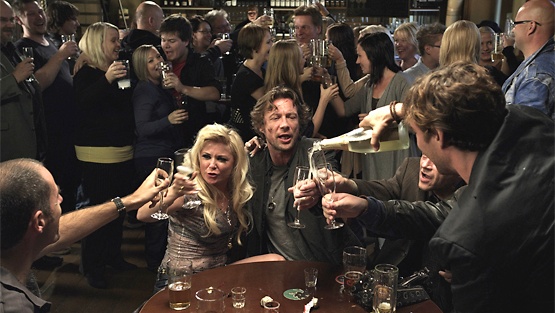
Based on Huhtikuun tytöt, the 15th book in Reijo Mäki’s Vares series, Girls of April (2011) is an odd choice for adaptation, coming right behind a similar cold-case in the previous instalment, Kiss of Evil. One wonders how problematic a dozen other novels had to have been for this one to get the greenlight. Our hero is so drunk, in fact, that he doesn’t dare get behind the wheel of a car, and travels everywhere either on public transport or in a taxi driven by a part-time stripper. A vital clue is provided for him when his cat goes missing, prompting him to shamble, sozzled, into his next-door neighbour’s storage unit and kick over a box full of 15-year-old photographs. If anyone is more incompetent than Vares, it’s the police, who need him to tip them off that there’s been a murder, and who do not seem to have drawn any of the dots together on the case for the last decade and a half. Vares has stumbled into a complex web of blackmail and double-crossing over high-end prostitutes, and half-heartedly fends off the blunt and clinical advances of one victim’s sister, who has been told by a fortune-teller that he’s going to be the best shag she has that year. Admit it, we’ve all been there.

Screenwriter Katariina Souri (who, as Kata Karkkainen, was also the December 1988 Playboy Playmate of the Month, because this isn’t surreal enough already) takes her hands off the wheel and lets Mäki’s original story carom through its plot. She appears to have been hobbled not only by the original story, but by what is now clearly the restrictions of network television, with several gruesome murders happening off-camera, leaving characters to coyly tiptoe around even their descriptions of what has happened. In one crucial moment, a death is merely hinted at by the sight of a pile of fresh earth, and the viewer has to embark on a detective mission of their own to work out who’s been killed. Meanwhile, elements of what I blush to call magic-realism creep in, with visions in a crystal ball that appear to accurately reflect events going on elsewhere, and Vares himself haunted by sado-masochistic dreams in which the murder victims seemingly try to offer him clues.

Souri, like Mäki himself and every other author working today, must also grapple with the narrative problems introduced by the singularity of social media. Vares is investigating a case from 1995 (1983 in the original novel), at least in part because 21st century metadata would have made it so much easier to crack. My bank statements today will tell you how much I spent on booze last month, where I bought my groceries, and even which cab I took home on Monday. Such an information overload has confronted the world of the crime novelist with a huge crisis; it has ruined half of the plots that used to work, solved a bunch of cases within moments, and forced criminals, police and, indeed, authors to come up with a whole new bunch of ruses, hacks and tricks to carry on their trade. Dating from 2004, the original novel is ironically more recent than the three sources that were adapted into movies before it (1999, 1990 and 1998 respectively), but looks back to the 20th century for its crime and its evidence.

Souri does add one moment of subtle drama, drawing fittingly on the nature of alcoholism, or rather, its absence. A kindly supporting character is revealed to have been a complete bastard 15 years ago – entirely reformed through giving up the bottle, he is something of an object lesson to the other cast members, although the change in him is so complete as to call into question whether he could even be considered to be the same person. One would hope that a female scenarist would find some fun to be had with the outrageously toxic masculinity of the Vares cast, but instead she leaves them to it, perhaps on the understanding that anyone who doesn’t already see these characters as ludicrous failures is probably a lost cause.

In the lead role, Antti Reini remains counter-intuitively charming – there is no evidence in the script that he is anything more than a piss-artist, but he exudes heroic charisma, even when unsteadily toasting his chums in the eighth or ninth bar-room scene of the film, or shooting the shit in his mate’s bookshop. The women in this film, meanwhile, are all crazy bitches, fit to be banged or murdered, or banged then murdered. Much like the growing pile of corpses that turn Inspector Morse‘s Oxford into a comedically unsafe place to live, Vares’ Turku is a veritable minefield if you are a girl in a miniskirt. Even the danger is chauvinist – girls and gays are expendable, but the straight men in Vares’ world live oddly charmed lives. If you’re a good guy, even the criminals sent to beat you up will give you a free pass, and even the murderer you’re chasing will cut you loose if he sees another criminal planning to kill you. Violence is occasionally dealt out to men, but usually by criminals dispensing rough justice to other criminals. Vares’ Turku has to be the cushiest police assignment anywhere; you just sit in the pub all day and wait for one bunch of thugs to murder another. Meanwhile, the blonde at the bar is giving you the eye, and is probably up for it.

The Vares series seems to dwell in a time warp where the latter part of the twentieth century never happened, when men were men and women were grateful. It often seems uncaring or ignorant of the social contract that is to be found even within old-school sexism – call it chauvinism or chivalry, the code implies that the womenfolk within it are protected, but the men of Vares’ world inevitably arrive years too late to save a damsel in distress, although they are available to shag her sister, and/or write a book in which they call her a dyke.

If you asked me to pitch a more “Finnish” crime series, it would be about a tough, female detective in a country run by women for women, more Jane Tennison in a socialist utopia than these losers. Maybe such an idea was itself a structuring influence: the Vares films went into production shortly after the broadcast of Rikospoliisi Maria Kallio, based on Leena Lehtolainen’s novels about just such a heroine. I can’t help but wonder if that’s part of Vares’ appeal for its readers and viewers. Somewhere in Finland there are unreconstructed men who miss the good old days of fags, booze and knee-tremblers behind the kebab shop. And they yearn for simpler times, when women knew their place, which was apparently either bed or a shallow grave.

Jonathan Clements is the author of The Armchair Traveller’s History of Finland.