Some China Diaries

“There is a tension between the obstructions of getting things done, and the enormous decency and kindness and genuine humor of the people.” – George Bush, 1975
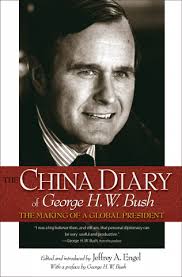
I read a lot of travel books about China, ranging from the sublime to the infuriating, from the clueless observations of disinterested tourists, to the considered memoirs of people who live and work in China for years on end. There’s also a wide range in intent, from simply telling one’s relatives about what one’s been up to, to the first book up for review today, which chronicles the “making of an American president” by publishing his forgotten account of a period spent as Our Man in Beijing.

George Bush Senior’s China Diary is fascinating, as the Party cadre flees America in the wake of Watergate, and volunteers, much to his superiors’ bafflement, for a posting to China, long before the US and China had normalised relations. Bush is hence an ambassador in all but name in the dying days of Chairman Mao, biking around Beijing and attending endless rounds of parties with other diplomats. Barbara Bush, meanwhile, risks causing an international incident at the hair-dressers, where she strikes up a friendly conversation with a woman who turns out to be the Cuban ambassador’s wife.

As a result of his non-official status, Bush represents a global superpower but comes lower down the pecking order than the ambassador of Gabon, and hence must exercise extreme diligence not to be caught out in the cold at photo calls and banquets. What struck me most about his memoirs was how many of the names of his fellow diplomats were familiar to me. Party politics will get you on the diplomatic track, but so will knowing a hell of a lot about the country in question, so I suppose I shouldn’t be surprised to see people like Jan Vixseboxe (Netherlands ambassador) and Ann Paludan (wife to the Danish ambassador), whose work I know better as “scholars”, popping in for tea and caviar.

Bush narrated his diary into a Dictaphone that was transcribed many years later. Jeffrey Engel edits and annotates the messy original by correcting solecisms and adding copious footnotes, sometimes critical of the author himself.  Published in 2008, the China Diary is oddly obscure – I only stumbled across it by accident, and was rather surprised that I had never bumped into it before – it’s not on the shelves at the London School of Oriental and African Studies, for example. And it’s not available on the Kindle (time travel footnote: now it is), a device which has hoovered up £400 of my book spending since I succumbed to digital devilry in September.

One of the joys of Kindle access is that it is possible to charge what the market will bear. I enjoyed and greatly appreciated the unique sections of Alan Paul’s Big in China that were about his expat life as a corporate househusband, but rapidly lost interest when he drifted into (for me) tedious reminiscences about his band. This isn’t any fault of the author; it’s plainly something that interests him greatly. Unfortunately, it interests him so much that he stops talking about China in order to talk about guitar strings and music clubs, about which this reader does not give a toss. Don’t get me wrong, Big in China was an enjoyable book, but I would have enjoyed it a lot more if it had cost me a third as much. I might have been similarly put off by Leanna Adams’s Pretty Woman Spitting, but in pragmatically charging me a mere 77p to read her China diary, the author ensured that I finished it with a smile on my face, feeling that my money had been well spent.

Despite conceding that she knows very little about China, and peppering her book with questionable statistics and outright apocrypha, Adams has an eye for detail and character that makes her writing entertaining and worthwhile. She also constructs a proper narrative for herself, turning what could have easily been a series of random diary entries into a character arc of growth, love, loss and learning. Pretty Woman Spitting is a well-written and carefully balanced account of an American woman in China – the title itself is a fair encapsulation of Adams’s innate ability to find drama and poetry in the most mundane of situations.

Sometimes it seems that everyone and his dog has a China memoir about the time they spent trying to pronounce the words for “I NO WANT CHICKEN HEAD” to uncomprehending waiters, but coming back such books after several years evaluating anime industry testimonials, I have come to regard them in a new and indulgent light. Historical researchers will sympathise, perhaps, with having to hunt around in obscure library collections for forgotten, hand-written travel diaries from the distant past, many of which only reach a larger public when a distant descendant or relative edits them for a PhD. The internet and e-Books makes such pieces immediately and widely available in real time, chronicling hundreds of snapshots of life in a fast-changing country. I find it fascinating, as a historian, that I can read such testimonials as reportage, and eavesdrop on the contemporary China experience of total strangers. Rated in such terms, Chris McElwain’s Dispatches from Crazytown is similarly great value: informative about life in Xi’an, and laugh-out-loud funny, at a cost of approximately 15p per chuckle. McElwain, like Adams, arrives in China as a teacher, but approaches his experience with merciless snark. Openly confessing that his book is the ramblings of a “confounded yokel”, he seems to court trouble, initiating a Frisbee competition at the tomb of the First Emperor, and contemplating exactly what he is supposed to do with the live catfish he can buy at the local supermarket. There is a very fine line between hostility and humorous observation, but McElwain keeps resolutely on the right side of it – he loves China, but is unafraid of puncturing its pomposities when the opportunity arises.

Jonathan Clements is the author of Mannerheim: President, Soldier, Spy, now out on the Kindle.

2012: The Year in Anime Books

Possibly for the last time, we return to my annual round-up of books I have read about the animation industry in Japan. This year I have published several extensive reviews of some of my anime reading, including Marc Steinberg’s Anime’s Media Mix, Nobuyuki Tsugata’s Before the Dawn of TV Anime, Liliane Lurcat’s Alone With Goldorak, and Tobin’s book on the Pokemon phenomenon.

Behind the scenes, I have also been wading away through Japanese-language works on the subject, including two accounts of anime in China, Tomoyuki Aosaka’s Contents Business in China: Fluctuating Markets, Emerging Industry, and Homare Endo’s The New Breed of Chinese ‘Dongman’: Japanese Cartoons and Comics Animate China. Both authors must write in a tense environment, with evidence pointing to a strong potential market for Japanese animation and comics in China, but also to a strong anti-Japanese feeling all over China. It’s a fascinating dichotomy, where there is minimal evidence of anime and manga in Chinese stores, but anecdotal evidence everywhere you look that illegal downloaders and torrenters form a significant silent population. Meanwhile, even though only 35 foreign films are permitted in Chinese cinemas each year, you can guarantee that two of the slots otherwise reserved for Tom Cruise, or James Cameron, or Pixar, or whoever will go to the year’s Conan the Boy Detective film and the year’s One Piece movie. Anime and manga in China are not only on a critical cusp, but have been teetering there for the last decade and could still fall either way.

There was also an account of the life and work of Osamu Dezaki, and another about the achievements of Akiyuki Shinbo, adding welcome detail to the public profiles of two prolific directors. At the edge of the anime field, Yasuo Nagayama published an interesting “occasionalist” history of science fiction in Japan, concentrating not on the texts themselves but on the events that surrounded them. In the wrong hands, this could have all too easily turned into a tedious account of things that happened at conventions, but Nagayama keeps closely to his methodology, discussing not only the fan politics of the Japanese con scene, but also the effects of media fads and scares, and the public performances of popularity every time certain anime break box office records.

A few books disappointed me. A new work that purported to offer an insiders’ view of Sazae-san had nowhere near the detail I was hoping for, and Mitsuhisa Ishikawa’s account of his “revolution” at Production IG lacked the kind of nitty-gritty details that I personally go for. Much more fun was to be had in a series of books about the Japanese animation business, particularly the wonderful Otaku Marketing by the Nomura Research Institute, which offers hard data about the various types of otaku to be found in numerous consumer sectors, and how best to sell them stuff. Another book on the industry, This is the Anime Business, by Makoto Tada offered a run-down of the ten secret “Rules of the Devil” recited at the Dentsu corporation by its loyal minions. They are, apparently, a secret handbook to understanding the way the best animation studios work, too:

Rule 1: Work is something you should create not something that should be given.

Rule 2: Work is something where you take initiative and not something you do passively.

Rule 3: Tackle an important job. A small job will make you small.

Rule 4: Target a difficult job. You can progress by accomplishing it.

Rule 5: Once you tackle, don’t let it go. Hold on like grim death, until you achieve the target.

Rule 6: Drag the people around you. It will be worlds apart between the one who drags and who is dragged in a long term.

Rule 7: Plan. If you have a long-term plan, patience, devices, correct effort and hope will be born.

Rule 8: Have confidence. Without confidence, your work does not have punch or tenacity or even depth.

Rule 9: Use your brain in full all the time. Be always on the alert. Don’t slip your guard. That is what service is.

Rule 10: Don’t be afraid of friction. Friction is the mother of progress and manure of drive. Otherwise you will be obsequious and irresolute.

If it seems like I am reading less anime books than usual this year, it’s because this year saw me come to the end of the long writing process on my doctorate. I handed it in back in July, and the prospect of reading it so terrified my superviser that he ran away to China. As a result, it’s still languishing at the faculty waiting for the committee to get its act together; I didn’t help matters by running for China myself for four months this year, making it a little difficult to turn up for my viva; I shall have to sort out all of that in the new year, or else I shall never be Dr Clements. Meanwhile, the book version, some 60,000 words longer (in fact, as one wag commented, a whole other PhD worth of stuff) makes its way through the peer review process at the British Film Institute. I am just about to deliver the second draft of that, and with any luck you should see the published result – ANIME: A History of the Japanese Animation Industry, published in late 2013. As the name implies it is a massive chronicle of animation in Japan since the year 1909 (yes, 1909, you will have to read it to find out why), based almost entirely on the Japanese-language testimonials of the actual creators, rather than the speculations of foreign pundits. If you are the kind of person who has read this far on this blog, then I think you will like it very much.

Arctic Air

The Map of My Dead Pilots reads in two ways – as an account of a systematic, scholarly study of the history of plane crashes in Alaska, and as an oral history of the kind of people who are likely to be flying those very planes. As the title implies, some of these figures are mere names in the newspaper archives, and pins stuck in charts. Others are people that Colleen Mondor knew personally, from her days as a dispatcher at a weird little airline in the middle of nowhere.

The two accounts advance on each other – a dispassionate enquiry into aviation history, and a melancholy memoir of life among the ice pilots. Mondor artfully constructs snapshots of a snowbound world where men treat dogs like machines and machines like spouses; where weather is more than just scenery; where everyone has come north with a story they don’t want to tell. She wrestles with what it is to have an authorial mind in a world of harsh truths, as she tries to reconcile academic rigour with narrative romance. There are tantalising snapshots here, from the scarred girl who must relive the moments of her long-ago accident in the eyes of everyone who sees her face, to the nuns who refuse to give up their seats for a hospital-bound teenager. The result is gripping, as a fledgling author finds her style and suddenly takes wing. With a start, Mondor realises what she is really writing about, and lets the reader find out along with her.

Mondor’s pilots gripe that they might as well be bus drivers on the Moon, as if that is not an incredible idea in itself. The US Mail has to get through, not because some Inuit trapper is waiting for a postcard from Puerto Rico, but because the plane that is being vastly overpaid to carry the postcard will now also have hold space for medicine, food and supplies. But this is the land of Mondor, where the shadows lie, as the author sits forlorn amid pieces of broken lives, and carefully builds something beautiful with the fragments. Like an antique, graceful plane thunking onto the landing strip with bingo fuel and a hold full of howling dogs, The Map of My Dead Pilots touches down just in time. Any longer, and this lovely little book would have broken its spell.

Jonathan Clements is the author of Mannerheim: President, Soldier, Spy.

2011: The Year in Anime Books

For the last few years, it has been my mission to read through as many Japanese books about anime as possible, with special concentration on personal testimonies from the animators themselves. And I have been annotating as I go. For some reason, many of the people who write books about anime are allergic to indices, so I have been writing my own, of dozens upon dozens of memoirs and biographies, in order to build up a picture of the way the anime business looks to the people who actually work in it. The concordance is currently at 230 typed pages, although I think it will hit 300 before I am done. The work has functioned as a sort of audit of what people think they know about the business they work in, and has allowed me to chart several memes and misconceptions from their birth through to their establishment as industry lore.

And so my neck-deep wade through Japanese-language books on anime has continued, most recently with the NTT collection of scholarly essays Anime in Transition (or Anime Across Borders? or Anime Transnational?). The book is something of a landmark, forming an entire volume of the eight-part Japanese Film is Alive series from Iwanami Shoten, and hence perhaps redeeming anime as just as reasonable a field of study as, say, documentary, performance or audience. Notably, however, five of the eleven chapters in the book are written by foreign authors, with the likes of Marc Steinberg, Thomas Lamarre and Hu Tze-yue providing commentary and perspectives that the Japanese seem unwilling or unable to provide themselves. Is Japanese academia on animation really that lacking in local heroes, or is this a form of auto-orientalism, with the Japanese lapping up foreign attention as a means of validating their own interests in such an unlikely, unloved field as animation studies?

I’d believe it if NTT Shuppan had not answered within the year with an all-Japanese collection. There is no question about the anime book of the year 2011 — that award surely goes to Anime Studies, edited by Mitsuteru Takahashi and the omnipresent Nobuyuki Tsugata. Anime Studies contains ten chapters of detailed commentary on many interesting areas in the anime field, including education, intellectual property and national animation policy. The authors include academics, but also producers and directors, most notably with a chunky section from Ryosuke Takahashi about Tezuka’s anime “revolution”. Anime Studies is the book to which I wish every Western scholar had access, laden with charts and diagrams explaining the way that modern anime works, but also with informed references to peripheral areas, and, that greatest rarity in books on anime, a functional index.

Anime directors continued to be feted with studies and analysis, notably in books about Kenji Kamiyama and the journeyman director Keiichi Hara, now enjoying a new-found fame thanks to his breakout feature Colorful. This has also been a good year for books that analyse anime from the perspective of a producer or manager. Six years after he penned a guide to the anime business, Hiromichi Masuda writes an all-new account of the same subject, incorporating the wild ride of changes since the 2006 production peak. Meanwhile, Kinema Junpo jumps on the bandwagon with books on the below-the-line squabbles that get anime made in the first place including How to Make a Hit “Mundane” Anime and On the Job of the Anime Producer. Meanwhile, Yuichiro Oguro publishes the long-awaited second volume of his Anime Creator Interviews, collating material originally run in Animage at the beginning of the last decade.

You’ll notice, perhaps, that many of the books have dully typographical covers. In a country where Japanese studios will often charge magazines even for illustrations used to accompany rave reviews, the studios are often their own worst enemies when it comes to picture sourcing. I am pleased to note that the current crop of Japanese academics and scholars have simply given up playing the studios’ game, and instead published the texts that they want to publish, without bending over for outrageous fees or assenting to textual tampering — here’s a hello to the idiot who tried to get us to lie about the production details of his company’s movie in the Anime Encyclopedia, and who tried to use image access as the lure to make us cooperate. Anime is, assuredly, a visual medium, but I would much rather have good books published without pictures than see compromised picture-books, defanged of all their interesting content.

There is still a good deal of pretension awash in the anime field. Ani Kuri 15 DVD x Material is an infuriatingly packaged book of interviews and storyboards from the short series of NHK commercials made to order by creatives including the late Satoshi Kon, as well as Yasufumi Soejima and Shinji Kimura. Which is all very well, but it comes with a tight yet flimsy paper wraparound that is sure to tear after a single use, and includes an origami robot by way of apology.

Other books I’ve read this year have included Yuka Minakawa’s two-volume account of the “rise and fall” of Tezuka’s Mushi Production, although the fall is bundled into the final few pages. Like Eiichi Yamamoto’s much-cited 1989 Rise & Fall of Mushi Pro, the book is presented in fictionalised form, although Minakawa presents detailed references, usually to DVD sleeve-note interviews and other ephemera that might elude the more traditional scholar. I also found much of interest in Makoto Misono’s 1999 Complete Book of TV Animation, a forerunner of the Anime Studies collection that diligently attempted to create an institutional memory for television cartoons more than a decade ago. I think I bought it when working on the first edition of the Anime Encyclopedia, but I haven’t properly gone through it till now. I also stumbled across Masaki Tsuji’s long out-of-print The Youth of TV Anime, a memoir of the 1960s and 1970s by the scriptwriter of, among other things, Astro Boy, Star of the Giants and Sazae-san. It’s the last that interests me in particular, since the studio that made Sazae-san has never really had to try since. Go on: see if you can name it without opening a book or another window. It’s not all that famous, despite making Japan’s highest-rated and longest-running cartoon. Whereas other studios have to push and flash and bluster to get attention, the studio that makes Sazae-san just motors along on a job that is essentially below-the-line… certainly below the notice of many foreign fans.

In this periodic round-up, which I have previously run in 2010 and 2009, it’s usually my habit to talk about the English-language books on anime that come my way. In many cases this year, I have already reviewed them elsewhere, such as this piece on the excellent Ladd and Deneroff memoir of early anime in America. I’ve also written a glowing review of Iwao Takamoto’s autobiography, but that won’t appear until later in 2012. In others, I simply haven’t got round to them, since the Japanese-language books are prioritised ahead of them. In a couple of others, I have read them, although they were so awful that I cannot bring myself to even name them. One was an academic account so up itself as to be entirely impenetrable, including an interview with a Japanese creator who actually tells the author to piss off and talk to someone else. The other was a seemingly self-published witter about divinity in anime, by a man who couldn’t even spell Wikipedia, even as he cited it.

My Book of the Year

And so we come to the Book of the Year round-up. I’m not waiting till the holiday season this time, as I realise that many readers would prefer to hear my thoughts now, just in case it inspires their Christmas shopping. And why not? Buy someone a book for Christmas this year. It’s more fun than socks.

Well, your mileage may vary. Runners-up from my reading this year include the utterly filthy Decadence Mandchoue: The China Memoirs of Edmund Trelawney Backhouse, rescued from obscurity by Derek Sandhaus in a beautiful hardback edition by Hong Kong’s Earnshaw Books. I was left thoroughly depressed by Paradise Found, an informative account of the American ecology on the eve of the arrival of European colonists. Also, sped to me on the day of its publication, Matthew Sweet’s West End Front: The Wartime Secrets of London’s Grand Hotels.

Sweet’s previous books changed the way I wrote history; I have come to love his persistence in tracking down testimonials rather than memoirs, a dogged quest that often seems to find him sipping tea in old people’s home while the spivs, movie stars and spies of yesteryear struggle to recall their glory days. West End Front is a carnival of (largely) ghastly people, often described with Wodehousian glee, and Sweet presents a superb angle on the culture of WW2, from the switchboard operator who overheard of the war’s arrival before the rest of the country, to the huddle of ousted politicians listening on a hotel radio to the news of Japan’s surrender. Kings in exile, hookers on the make, and Marxists in search of a bespoke bomb shelter all rub shoulders in Sweet’s vivid account, some under the mistaken impression that the solidly built hotels of London were “bomb-proof.” I would say more, but Simon Guerrier already has.

For the second year running, my fortnight at Scotland Loves Anime found me raiding the Glasgow Waterstone’s, coming away with the wonderful Lore of Scotland and The Faded Map, a run-down of the various kingdoms once found in Caledonia. The focussed, localised Faded Map has been overshadowed somewhat by Norman Davies’ sprawling Vanished Kingdoms: The History of Half-Forgotten Europe, which offers potted histories of continental also-rans such as the Byzantine Empire, Aragon, Burgundy and Tolosa. But through no fault of Davies, I was left slightly more satisfied by The Faded Map, partly because it set its sights very small, on Scotland, and hence was able to be far more comprehensive. There is a picky, ungrateful sense of entitlement that comes over the reader of Davies’ larger work, as one starts to wonder about all the vanished realms he’s left out – what about al-Andalus? The Danelaw? The Austro-Hungarian Empire…? His book is popular enough and has made it onto many other best-of lists this winter, so perhaps it will soon gain a companion volume. If it does, may I plead with his publishers to make a better book. For £30, I would prefer one that doesn’t start shedding its pages before I’ve even got halfway in. By the time I finished, it was less of a book than a sheaf of papers.

Lost Colony by Tonio Andrade is an impeccably researched account of the fall of Fort Zeelandia in Taiwan to the “pirate king” Koxinga, a.k.a. Zheng Chenggong, Coxinga, the Knight of the Imperial Surname, etc. Barnacled with grants and fellowships, and aided by four research assistants, Andrade reframes the story of Fort Zeelandia in terms of the popularly-held idea of the inherent superiority of the modern west. He points out that when the Chinese first met with European military might, the Chinese won, and ponders if the victimhood of the 19th century was an anomaly. Entertainingly, Andrade is not above arch comments about the Dutch disaster as it unfolds, and has the odd achievement of including a chart that made me laugh out loud. It’s a list of defectors in each direction between the Dutch and the Chinese, but is set up with such mathematical precision that it allows for the possibility of half a defector. A lower torso, perhaps? For reasons I don’t quite follow, this playfulness also extends to the book’s cover, which shows a picture of Batavia, not Taiwan at all.

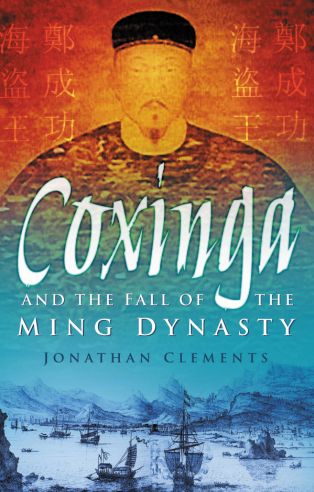
When I clicked a copy of Andrade’s book into my shopping basket, Amazon kindly informed me that “people who bought Lost Colony also bought Coxinga and the Fall of the Ming Dynasty by Jonathan Clements”. This is somewhat ironic, since Coxinga and the Fall of the Ming Dynasty is entirely unmentioned in Lost Colony, which has the gumption to bill itself as an “untold story.” There’s some half-hearted hand-wringing in Andrade’s acknowledgements about his “scholar’s discomfort” with this claim, but it apparently didn’t bother him enough to actually do anything about it. Which is a shame, because Lost Colony is an excellent book, and now many would-be readers will be confronted its spurious “untold” assertion every time they browse an online bookseller.

It is, one presumes, because academic presses do not wish to dirty themselves with citations from the garish world of commercial publishing, a reluctance which, to some extent, I do understand, particularly if someone has inconveniently told your “untold” story eight years previously – and I, of course, was not even the first. But if you are going to dismiss popular predecessors as beneath your notice, please don’t succumb to the hucksterish allure of misleading, grandstanding titles. Untold, my arse.

Which brings me to my actual book of the year, which I doubt very much you could buy even if you wanted to: China on the Western Front, by Michael Summerskill. Untold? No. Unread? Seemingly. Unloved? Absolutely not. It’s an amazing book about the Chinese Labour Corps, nearly 100,000 men who came from China to dig trenches and unload ships in a Europe starved of manpower during WW1. Eight hundred of them died, mainly from the influenza of 1918, although several dozen died in bombing raids and German attacks. It was published in 1982, and is so obscure that the School of Oriental and African Studies library doesn’t have a copy. It’s a paperback of less than 250 pages, acquired for the princely sum of £85 from a second-hand bookseller who knew exactly how much it was worth to me. I bought it because I’m considering writing a book of my own about WW1 in the Far East, and the fact that 100,000 Chinese put a girdle round the Earth in order to drag corpses from the trenches at Verdun is simply fascinating. Summerskill plainly found his obsession so odd, so unique, that no publisher would touch it. He published it himself, in numbers so tiny that I doubt there are three copies left in Europe. But nevertheless, thanks to the interwebs, I was able to find a copy. And if Summerskill’s family ever want to republish it, they could have it available on the Kindle in days. Has its time come? I hope so.

Instead, the most accessible book on the subject is another product of the modern age, an obscure 1919 account by a white officer in the Chinese Labour Corps, brought back into print by the Imperial War Museum, and maintaining its cheerily racist original title: With the Chinks. It doesn’t hold a candle to Summerskill, but was a fun read. [Time Travel Footnote: John Watson points out that this book came out this year.]
We stand on the verge of a sea-change in publishing. Summerskill’s book, still a great rarity in 2011, might easily be a similar print-on-demand or e-Book commonplace by this time next year, easily rushed to your door or to your tablet. I have two books coming out in 2012, and for what is for me the first time, both will be in dual paper and electronic versions as my publishers wake up to the potential of new media. My reading this year has been skewed more than ever by the technology that delivers it to me. Amazon, in particular, reminds me to put money down on books I forgot I once wanted, or hunt down obscurities that might have eluded me in a bookshop. I have also noticed with increasing regularity, the number of books from academic presses that have clearly been printed on demand, to meet my order and not in anticipation of it. Nothing, however, quite competes with the joy of poking around a real-world Foyle’s or a Waterstone’s, where acres of new worlds are waiting to be discovered, analogue style.

I’m not one of the publishing doomsayers. There is certainly a paradigm shift in the way that books are sold and consumed, but if anything it makes the field more financially rewarding for writers, not less so. I have certainly benefited from both paper and e-sales this year. I suspect that within the decade, the default condition of all books will be electronic, and that old-fashioned people like me who want it on paper can pay to have their digibook made real, much as 18th century bibliophiles popped down to the printer to have their papers bound. But there will be a transitional phase when electronica dominates, and when that comes, you’ll have a lot more trouble putting a ribbon around it and giving it to your dad.

So buy someone a book for Christmas this year. Next year you might have nothing to give but electrons.

Coxinga on the Kindle

My book Coxinga and the Fall of the Ming Dynasty is suddenly available on the Kindle. I can only guess that the History Press, who inherited it from the now defunct Sutton Publishing, realised they were onto a good thing when the National Geographic documentary came out. No complaints here: I’m immensely pleased that people can zap it onto their tablets in seconds. Here’s hoping the rest of my books are fast behind.

There You Go, Astro Boy

It’s taken me a while to get to Astro Boy and Anime Come to the Americas, thanks largely to a £30 cover price. But I got there in the end, and my review of it is now up on the Manga UK blog. It’s great to have such solid information from Fred Ladd about the first ten years of the anime localising business, although I can live without the latter half of the book and its vague hand-waving about what happened next. That said, it’s still worth every penny, if only for the 100 pages of golden testimony about the way in which Japanese cartoons were treated in the TV industry of the 1960s and early 1970s.

Hello, Sailors

The Mariner’s Mirror, or to give it its fantastic full title, The Mariner’s Mirror, wherein may be discovered his art, craft & mystery after the manner of their use in all ages and all Nations, has just published a glowing review of my Admiral Togo: Nelson of the East. Alessio Patalano, lecturer in War Studies at King’s College London and a specialist in East Asian security issues, really gets the book, noting its concentration on “the multiple applications of naval power, from diplomatic to constabulary and military functions.” This is particularly important in the case of Togo, as there was considerably more to his life than his sudden appearance in 1905 as the hero of the battle of Tsushima. He’d first encountered the British as a teenage samurai, and watched swordsmen standing knee-deep in water on the shores of Kagoshima, angrily brandishing their blades at “retreating” Royal Navy vessels. He’d studied for several years in Victorian England, and been part of dockside politics and naval espionage in China, Korea, and Hawaii before he saw military action against China and Russia. Patalano thinks, rightly, that I have romanticised Togo, but also notes: “This book is a refreshing account of a defining figure of modern Japan. It is well written and deals with themes such as leadership, individual commitment, social transformation and cross-cultural understanding of great contemporary relevance.”

Museum Piece

My review of Yukinobu Hoshino’s Professor Munakata’s British Museum Adventure is up now on the Manga Entertainment blog. I don’t think I have ever seen an institution spend its junket money in a more productive way. The BM managed to get a ten-issue manga series read by tens of thousands of Japanese readers, and now this massive advert for what the BM is and what it means for the people of the UK. All because they invited the right artist at the right time, and made sure that he went home inspired. Now, if they’d invited Toshio Maeda…

The Footprints of a Gigantic Mind

Out now in the US, and coming in a couple of weeks to the UK, Sherlock Holmes & Philosophy. This collection of essays on matters Sherlockian includes my own “Curious Case of the Dog in Prime Time”, a discussion of the Japanese cartoon series Sherlock Hound. See what I did, there?

In fact, my chapter is partly about the reception of Sherlock Holmes in Japan, and partly about the development of anthropomorphic anime. Other contributors have written pieces on, amongst other subjects, Sherlock Holmes and Buddhism, Sherlock Holmes and Hip Hop, unreliable narrators, Star Trek, marriage, feminism and the overall Holmes canon.