The Luoyang Shovel

It is the afternoon and I am in a fallow field an hour outside Luoyang. I kneel down in the grass in front of what appears to be a large, football-sized pile of firm turds and announce that I am on an archaeological quest. I then pick up one of the turds and start breaking it apart with my hands.

They are the core samples from a Luoyang Shovel, a device originally developed by medieval grave-robbers for testing the land beneath their feet in search of treasure. Guo Zhenya’s is a three-metre pole, terminating in a long, curved trowel. You push it into the ground, wiggle it around, and withdraw a sausage-sized cylinder of earth, before plunging it in for another go, pushing deeper and deeper.

Mr Guo has an eye for subtle changes in colour. One trowel down, he is pointing to loose yellowish earth that is nothing but common topsoil, churned over every year by the plough. Another trowel down and we’re in darker more compacted earth, backfilled after the local archaeologists had finished excavating Erlitou. Another trowel down, and the backfilled earth reaches a line of sand, which marks the lowermost point of the dig. After this point, we are looking at terra incognita.

“The soil is turning reddish,” he observes. “We could be looking at a Han dynasty tomb. Yeah, this looks like shentu – disturbed ground.” Another few trowels, and we are almost all three metres of the Luoyang Shovel into the ground.

“No,” he says with a shrug. “False alarm. This darker soil is undisturbed. No human being has dug this deep in the last few thousand years. Nothing to see.” Mr Guo was one of the excavators in the Erlitou excavation that stripped this entire field wide open, uncovering a city from some 2,800 ago, laid out in a familiar square pattern, with a royal enclosure, a bronze foundry, and a temple. This was, people still believe, the likely site of the capital of the Xia, the earliest known Chinese dynasty, a people who had only just discovered bronze and seemed to lack any real writing. All we know about them we have got from legends collected in ancient Chinese classics.

Although the Erlitou site was discovered in 1959, excavation there was shut down a few years ago, one suspects because it failed to yield anything as photogenic as the Terracotta Army. It did produce “China’s First Dragon”, a staff or ceremonial item, the wood long rotted away, but retaining an intricate mosaic of turquoise stones, curling like an elephant’s trunk and terminating in a square, symbolic head. I’ve seen a picture of it, but the dragon is in Beijing, propping up an exhibit of ancient Chinese culture in the capital.
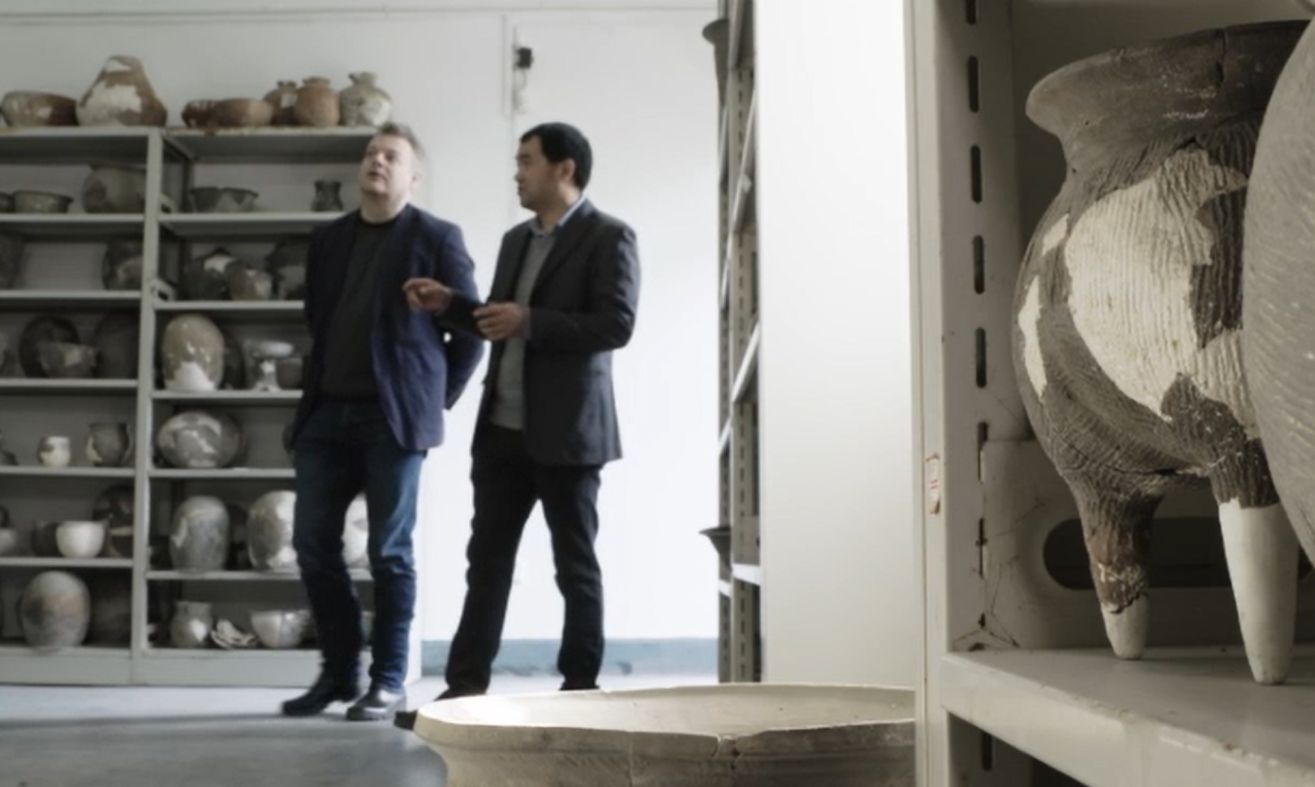
At the research institute, an army of workers are poring over the crates and crates of shards from the site, piecing together its pots, and trying to work out the nature of the bronze ceremonial artefacts that Erlitou seems to have supplied to the rest of the Yellow River floodplain. I’m here to interview the second most important man in Erlitou archaeology, the foremost authority having sworn off television appearances after a bad experience on someone’s late-night comedy chat show.

Zhao Haitao is soft-spoken and twitchy. It takes a while for me to draw him out of his shell, by asking questions about the site that make it clear I know what I am doing – the apparent trade value of turquoise, and the mystery that they have found cart tracks at Erlitou, but no evidence of horses.

“If you ask me,” says Dr Zhao, “the chariots here were pulled by slaves,” thereby literally putting the cart before the horse. I get him talking about pseudomorphs on Erlitou pottery, the potential for other finds on nearby sites, and the likely damage done to the north of the site by a shift in the flow of a nearby tributary of the Luo river, until he is laughing and joking, and holding out ancient ceremonial pots for me to touch.

I’ve noticed several times already on this trip that this is a new and unexpected service that I now perform – simply making it clear to the interviewees that there is someone on the other side who is listening to them and understanding what they are saying. That we are not a gaggle of uncaring camera-pointers with a fat white sock-puppet, but an award-winning crew with a public face who know the difference between the Sui and Tang dynasties; who understand the problems with rescue archaeology, and who don’t blink uncomprehendingly when hit with Chinese terms like liusongshi (turquoise) or renlache (man-pulled cart). I know these things because I was up at 4am reading the Erlitou chapters in the Cambridge Introduction to Chinese Archaeology on my Kindle, but that’s what I am paid for.

Another long day that comprises standing around for interminable hours, before being dragged by a shouty director to stand in front of a tree and extemporise a 30-second piece to camera about sustainability in the Tang economy. But I am doing my job, and coming up with several ideas for actual bits, including a semi-jokey bit where Mr Guo and I take the Luoyang Shovel out of the back of the Buick, its three-metre length seemingly never-ending, like people leaving a clown car.

Jonathan Clements is the author of A Brief History of China. These events formed part of Route Awakening S05E01 (2019).

That Hambroek Girl

Jan Willem Pieneman, “De zelfopoffering van predikant Hambroeck op Formosa” (1810)

Anthonius Hambroek was a Christian minister on Taiwan, who fatefully became embroiled in the negotiations between the besieged Europeans in Fort Zeelandia, and the Chinese who surrounded them. In a moment celebrated in paintings and plays, he returned to deliver bad news to the “pirate king” Koxinga, sure in the knowledge that he would be executed. Despite his daughters’ pleading, he went back to Koxinga and was never seen alive again. Later on, his daughters were among the Dutch girls handed out to Koxinga’s men as part of the spoils of war – one of them allegedly serving briefly as Koxinga’s own bedmate.

Pastor Hambroek’s sacrifice was one of the most iconic moments in the siege of Fort Zeelandia, an event already riddled with high drama and cinematic spectacle. It’s also become the lynchpin of many a fictional account, beginning with a Dutch stage play by Johannes Nomsz, Anthonius Hambroek, or the Siege of Fort Zeelandia (1775).

Dominicus Anthonius Peduzzi “Hambroeks zelfopoffering te Formosa” (1859)

Its most recent manifestation in popular culture is as the background to Yao-cheng Chen’s historical novel A Tale of Three Tribes in Dutch Formosa. Before he turned to fiction in his long retirement, Chen was a pioneering Taiwanese specialist in bone marrow transplants – a background that surprisingly produces one of the most gripping passages in his book. On hearing that one of the legendary ancestors of his own clan was a Dutch woman, he counts the incidences of ankylosing spondylitis (a type of arthritis), and determines that 4% of modern Taiwanese have a north European ancestor somewhere in their genes.

This is what inspired him to write his story, which comes deeply invested in the interlocking politics and tensions of the Dutch, Chinese and indigenous Formosans in the 17th century. They are, supposedly all given equal weight, although that Hambroek girl inevitably takes centre stage.

Who was she? In Nomsz’s play her name was Cornelia. In Joyce Bergveldt’s novel Lord of Formosa, her name is Johanna. In Chen’s book, her name is Christina, although her fate is kept discreetly off-stage, and instead we focus on her sister Maria, who may, or may not be, Chen’s own distant ancestor.

Chen realises that there’s a whole rack of Iliad allegories to be had, with a long siege, a vainglorious enemy and even a last-ditch hoped pinned on a ship called the Hector. His heroine, Maria Hambroek, archly observes that she is a bit like Cassandra, the seer cursed to always be ignored. I would suggest that there might have been more poetic currency to be had with her similarity to Briseis, the captive concubine whose fate is deeply entwined with that of the heroes.

One of the most compelling elements of the story of Koxinga’s invasion of Taiwan, for me at least, is the treatment of the Dutch women, a number of which were parcelled out among the Chinese. Modern authors seems to shy away from what this might have really meant; Bergveldt concocts a subplot in which Koxinga merely pretends to ravish a Hambroek girl as part of a bigger scheme; Chen is delicately coy about the sexual politics at play here, limiting himself to mentioning a few inter-racial “marriages”. Contemporary documentation, however, is considerably more forthcoming about it, particularly Frederik Coyett’s Neglected Formosa (1675), in which he mentions a number of Dutch girls returned pregnant to the East India Company at the final hostage exchange, as well as their widely varying reports of their treatment at the hands of the Chinese.

Dutch girls handed to soldiers who already had Chinese wives were often put to work as skivvies and slaves, complaining about months of hard labour under fierce mistresses. But this is where Chen’s Mills & Boon romanticism finds a legitimate purchase, since Coyett also reported that the Dutch girls who found themselves berthed with unmarried soldiers were “considerably caressed” and “did not complain too loudly, despite having half a Chinese in their belly.” He adds, in an arch footnote, that: “Those who had been kept honest by the ugliness of their faces, those were the women who were the loudest of all and who accused their companions of whoring and merry-making with the Chinese.”

I don’t know what really happened to that Hambroek girl. But I bet she had a story to tell.

Jonathan Clements is the author of Rebel Island: The Incredible History of Taiwan.

Local Ghosts

On Christmas Day 1953, a huge fire tore through the slums and squats of Shek Kip Mei in Hong Kong. The blaze left 53,000 people homeless, and galvanised the authorities into a rapid building scheme to create new housing for the refugees and migrants that had been clogging the hillsides of the New Territories.

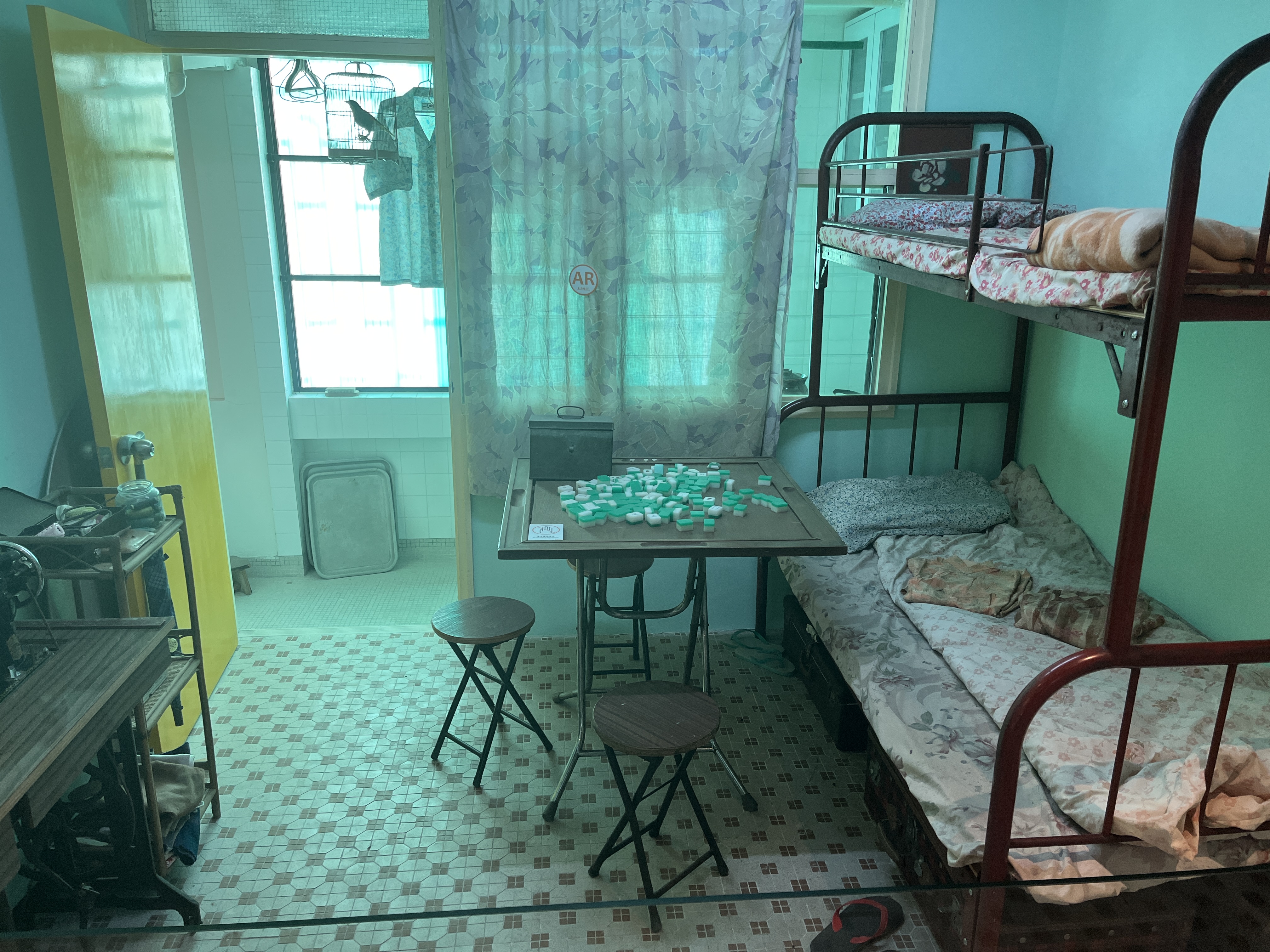
Mei Ho House is an unassuming apartment block in Berwick Street, but it is actually the last surviving example of these emergency housing blocks. Half of the H-block tower is a youth hostel today; the other wing has been preserved as a museum to daily life for thousands of Hong Kong residents in the 1950s, schooled in open-air rooftop classrooms, cooking on open fires on their balcony stoves, and sharing centralised washroom facilities at the building’s core.

The numbers of rehoused locals actually climbed higher in local reports, as they assimilated several thousand more refugees who were evicted from their shanty towns in order to make space for the “Mark I” estates like Mei Ho – several pundits noted that the speed of the government response might have been humanitarian, or might have been the sudden excuse to pull the trigger on an urban renewal project that was already in the pipeline.

A simple public housing project unpacks into the many stories of the 800,000 refugees who formed a third of Hong Kong’s populaton by 1957, a cataclysmic number of new mouths to feed and people to house. A section of the Mei Ho museum pauses to wonder how they were entertained, providing a wealth of stories about the Hong Kong film industry in the period.

For the older generation, newly uprooted from what had become the People’s Republic, the Hong Kong film industry offered a huge number of filmed performances of Cantonese operas – between 1913 and 1990, Hong Kong churned out 1,092 filmed versions of Cantonese opera – and that’s straight ports of the stage shows, not action-movie adaptations like 14 Amazons. Only 800 of these films survive today, but they are largely overlooked. Their heyday was in the 1950s, when the aging population of migrants in Hong Kong, including the tens of thousands of refugees fleeing the People’s Republic, thrilled to old-time entertainments – in 1958 alone, Hong Kong produced eighty-nine of them. A generation later, their grown-up children were entertained by a hybrid of the old stories with a new mode of filming, what you and I might call kung fu movies.

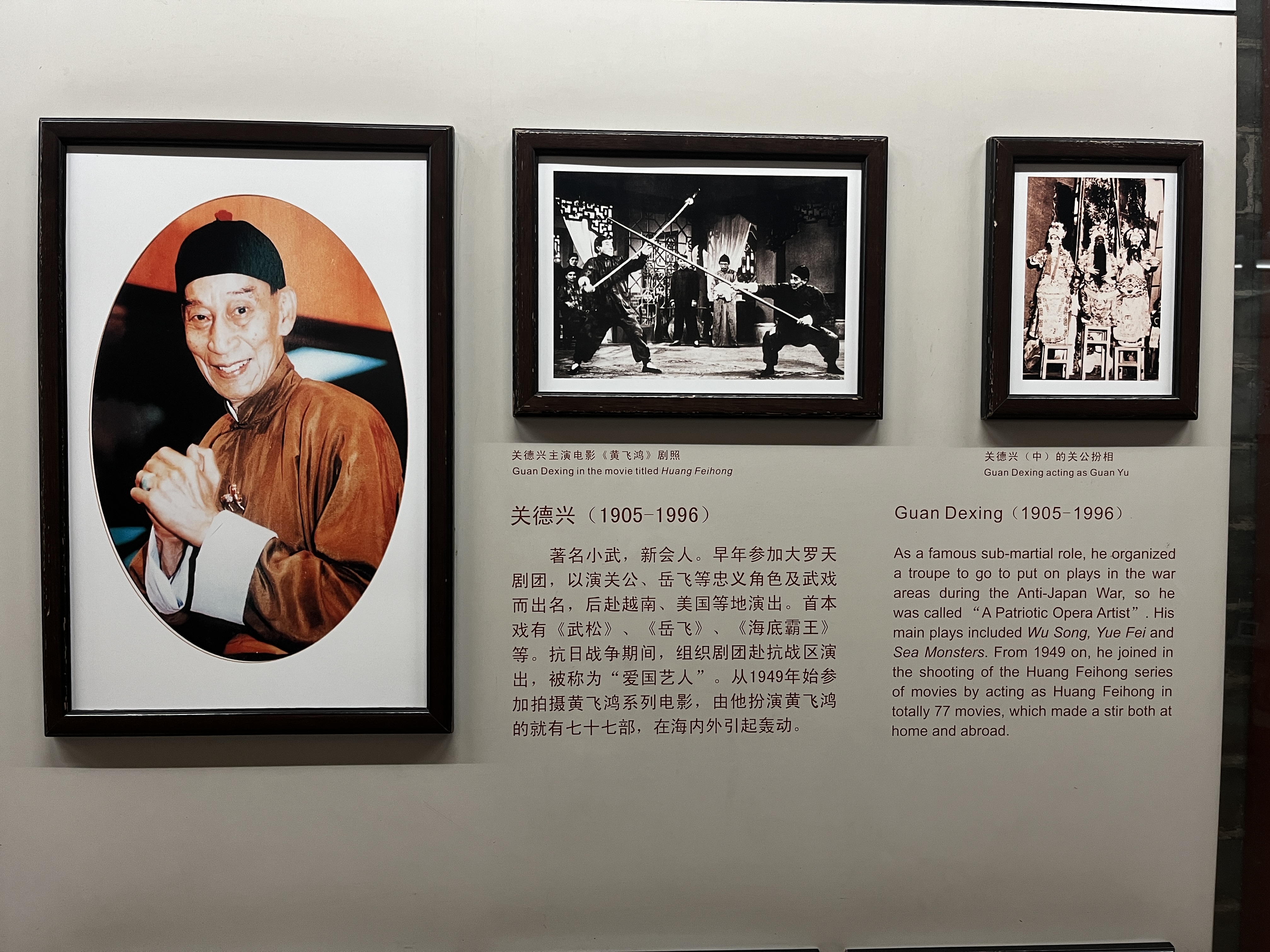
Upriver in Foshan, at the Guangdong Museum of Cantonese Opera, many of the galleries are dedicated to the cross-over between Cantonese Opera and Hong Kong film, not merely in subjects, but in performers. I recognise one of the actors immediately: the sign gives his name as Guan Dexing, but he is better known in Cantonese as Kwan Tak-hing, who played the hero Wong Feihong in 77 Hong Kong movies. I am, in fact, quite astonished that I have been in Foshan for two days and only once heard his famous theme song being played in a restaurant.

Wong Feihong has a whole museum dedicated to him inside Foshan’s Ancestor Temple – and his fame is widespread enough that it has separate galleries for his life story as told on television, in comics and in movies. The list merely of Wong Feihong movies is currently at 101, but the curators have left space on the wall for it to go up to 120.

But Wong is not the only figure to unite Hong Kong film and Cantonese Opera. At Guangzhou’s Museum of Cantonese Opera Art, there is an extended display on the Red Boats – itinerant troupes of opera performers, who plied the waters of the Pearl River Estuary and its tributaries, putting on shows, wowing the locals, and so it was said, harbouring dissidents and revolutionaries.

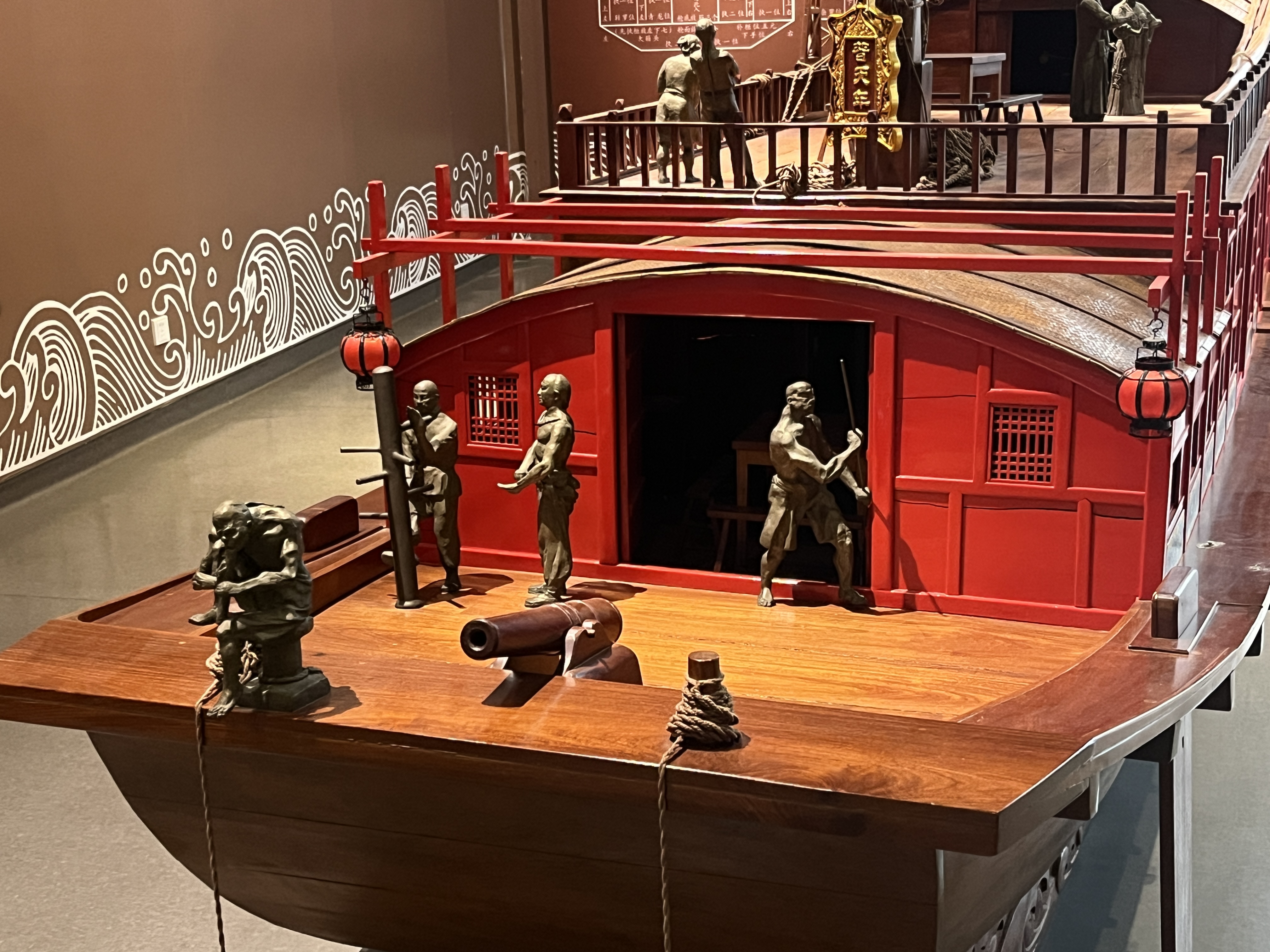
The model ship in Guangzhou even features a group of martial artists practising with a Wing Chun dummy on its stern, whereas the museum in Foshan dedicates an entire gallery to the most famous of the Red Boat performers, Li Wenmao, who briefly led a rebellion and declared himself king of part of South China, before a savage government reprisal wiped out the theatre in the region for a decade. Li’s generals, so it was said, went into battle in their Cantonese Opera costumes, which must have been a sight to see.

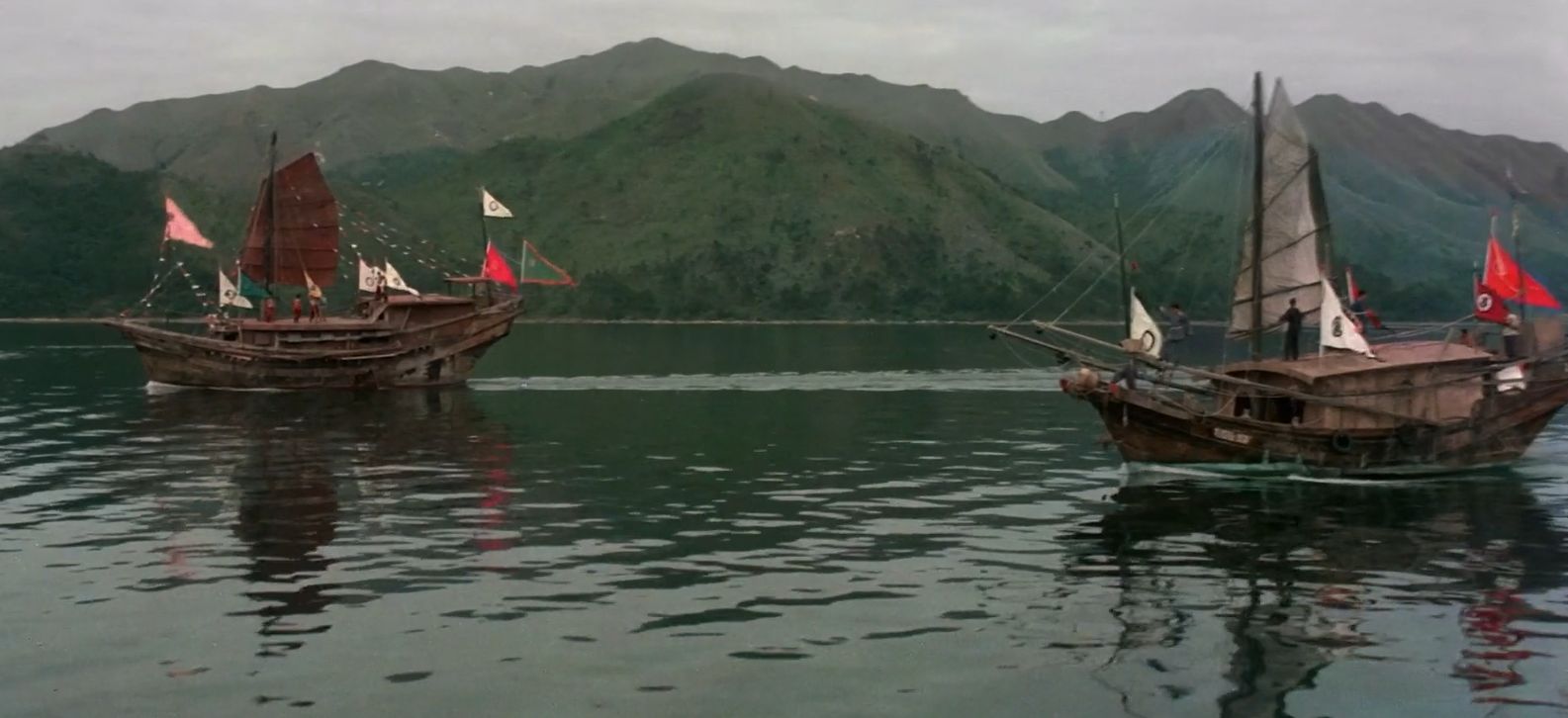
I’ve written several times about the Red Boats, mainly in my work for Arrow Films explaining all the real history behind their appearances in kung fu movies. There’s some fascinating stuff to be found out about life on these wandering minstrel ships, including timetables of shipboard life, and the logistics of being travelling players on the water. Most boats travelled in pairs – a Heaven and Earth boat that tended to reflect the division between drama players and the action troupe. The larger companies added a third vessel, the Picture Boat, which transported sets and extra props — the picture I have included below is a historical reconstruction, a screenshot from the Shaw Brothers film Executioners from Shaolin.

The average boat had its dockings booked two years in advance, and the culture is riddled with all sorts of interesting lore and ideas, such as the presence of four all-female troupes, and the fact that the term in Cantonese for a backstage prompter is a “local ghost.” The full list of Cantonese opera plays tops 11,000, but most Red Boat troupes had a revolving repertoire of just 18, of which ten were performed most often, with the final eight dragged out for special occasions. The first play performed in most venues was Tribute to the White Tiger, a staged fight between an actor and the spirit of onstage cock-up, who would depart chastened and defeated, and hence bless the performance. The last play performed each night was Sealing the Stage, a ten-second ritual in which a masked actor closed the performance and shut down the magic, in the fashion of Shakespeare’s “for their sake / In your fair minds let this acceptance take.”

Largely unexamined by theatre historians, for obvious reasons, are the Outline Plays, improvised operas for which the actors were handed a possibly randomised series of stock characters and situations and told to wing it. So there might be a board in the wings that reads (very hypothetically): “Comedy refugees from war / Farmboy argues with Uncle / takes them to the Hermit (old man with secret) / thence to harbour to seek passage with Pilot.” And if you were lucky, you might get something like the first thirty minutes of Star Wars. Sung. With six tones.

The Red Boats were wiped out in the Manchu retaliation after 1858, which toppled Li’s rebel state and murdered a million people in the region, outlawing theatre for a decade. They did return in the 20th century, and were a feature of local entertainment right up until 1938, when almost the entire fleet was unluckily anchored in Foshan harbour during a Japanese bombing raid. A cryptic comment in Toa Wong’s Time of the Red Boats notes: “The last known pair of Red Boats were spotted near Macau in 1951,” as if they might still be out there somewhere, haunting the coast.

Jonathan Clements is the author of A Brief History of China. He has recorded several film commentaries on Hong Kong movies, including Martial Arts of Shaolin, Heroes of the East and 14 Amazons. He is the writer and narrator of the Arrow documentary Rivers and Lakes: History, Myth and the Martial Arts Film.

The Qi’Ao Anti-British Skirmish

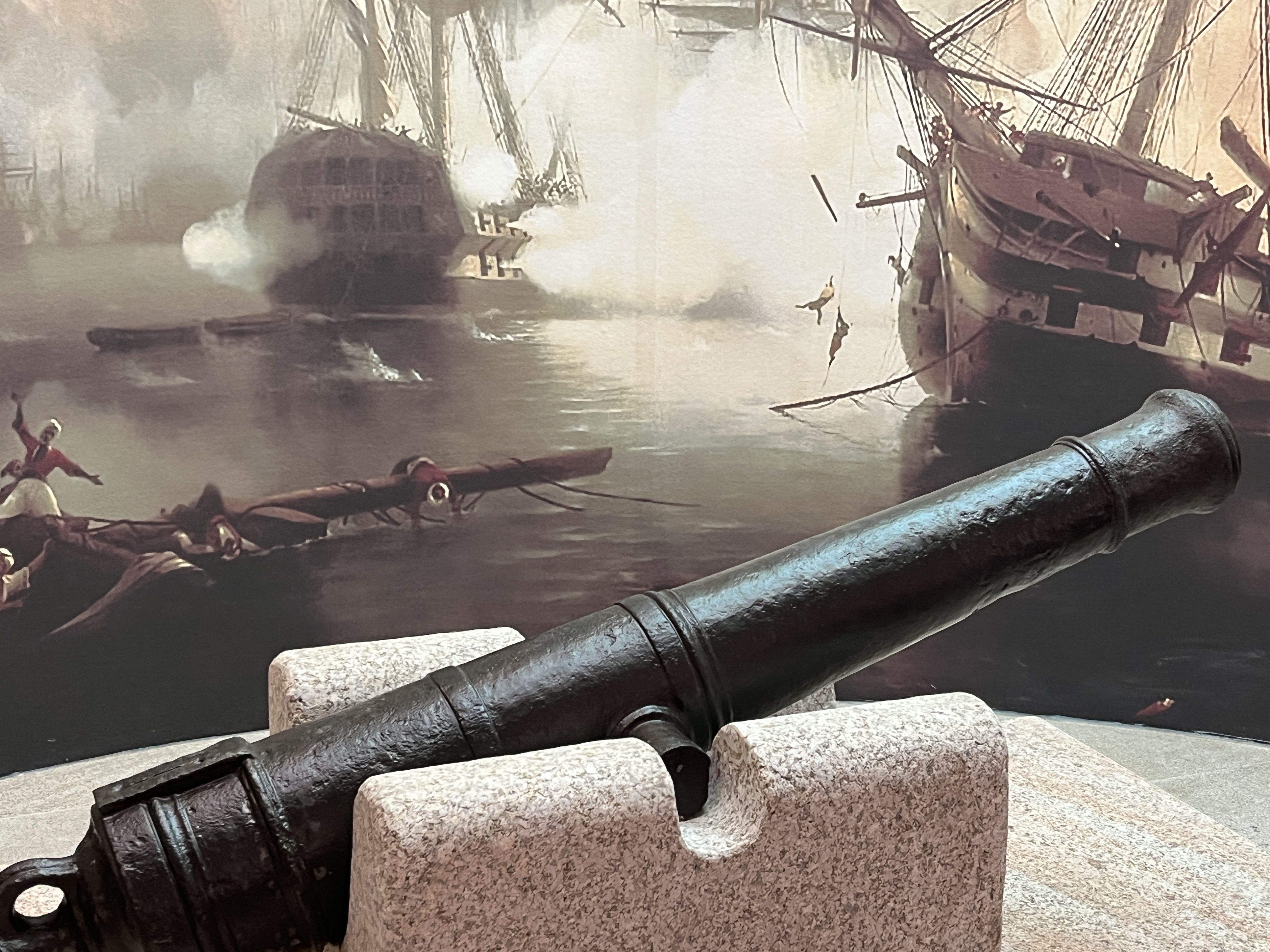
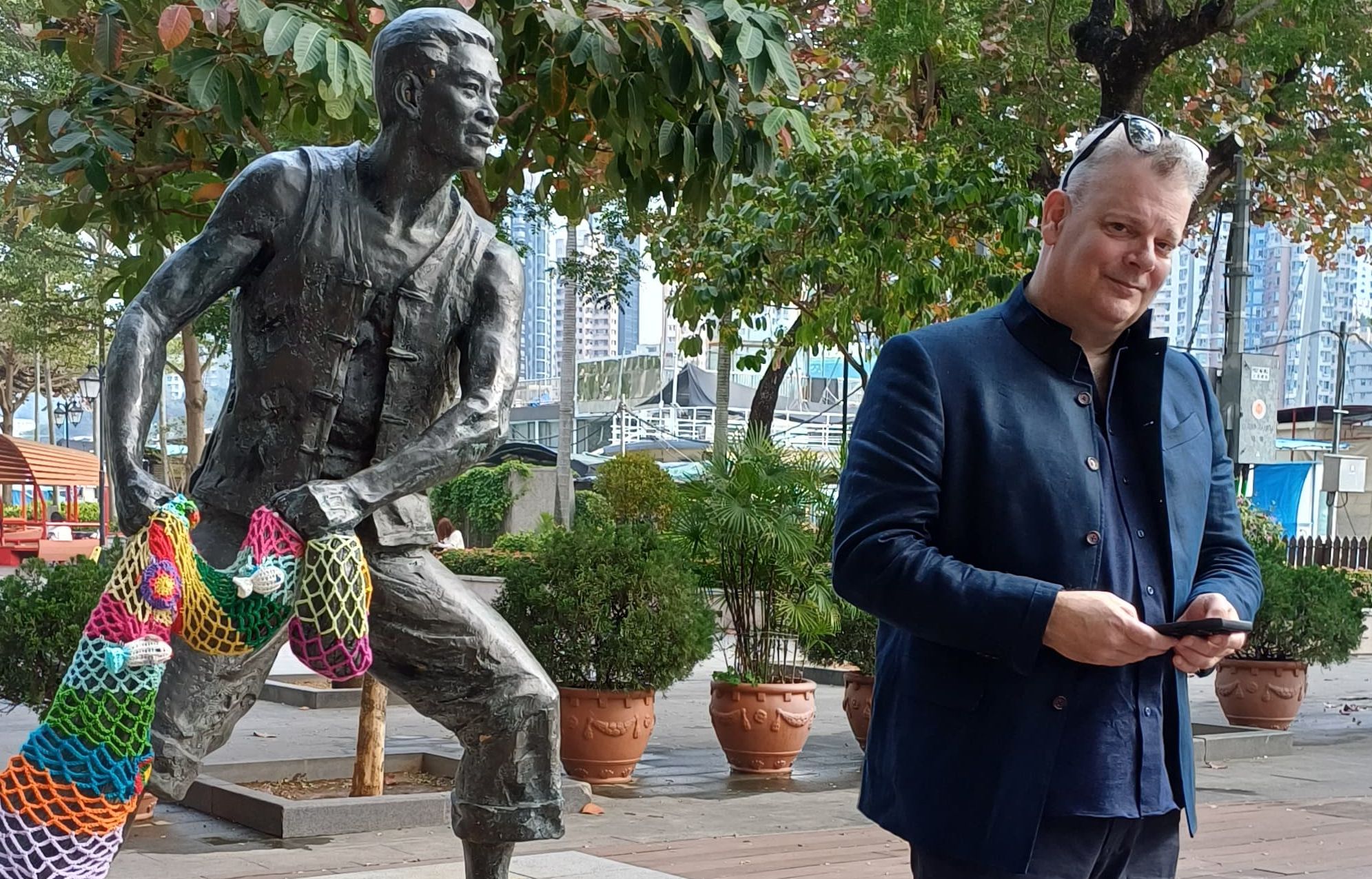
The seaside town of Zhuhai is famed for its seafood, its modernist clamshell opera house and its statue of a fisher girl, but my ongoing fascination with Red Tourism leads me to ignore all of that and instead go in search of the Zhuhai Martyrs Cemetery, a modest park with an on-site museum that proudly puts the city on the revolutionary map. For those who had never even heard of Zhuhai before it become one of the Special Economic Zones in the 1980s, the museum has a bunch of interesting stories, starting with the “Qi’ao Anti-British Skirmish” of autumn 1833, in which two Dutch cannons, said to have been liberated from Taiwan over a century earlier by local-born official Zhong Bao, were turned upon foreign opium-smugglers.

According to a 2016 article from the Guangzhou Ribao, the Manchu authorities had “not offered a single silver tael” for civil defence, turning the Qi’ao resistance into a moment of considerable historical moment, in which the Chinese people not only stood up for themselves eight years ahead of the Opium Wars, but did so with half a dozen locally-made guns and two antique cannons – the eight ordnance pieces are, supposedly, still there on the Qi’ao waterfront, elegantly rusting away.

The defence of Qi’ao was a response to years of harassment from opium smugglers, who used the nearby cape as an anchorage, and thought nothing of stealing supplies and livestock and terrorising the villagers. A statue to Cai Yi, one of the defenders, claims that his cannon emplacement sank two of the enemy, leading to his local sobriquet Shen Paoshou, the Divine Gunner. Another commemorates the local men and women, who are said to have held off the attackers with pitchforks and kitchen knives. The British, according to the Guangzhou Ribao, were eventually obliged to hand over 3,000 silver taels in compensation, which was used to restore the local temple of the Goddess of the Sea – and, I suspect, initiated a new era in which the smugglers still showed up, but with a degree more respect.

“Qi’ao has not fallen,” brags the local monument. “And we draw our swords and volunteer to slay the enemy together; the British army [sic] seeks death, and throws away their armour and flees for their lives. Four years of haze are swept away in one day, and the mountains and rivers are forever preserved and the sun and moon are shining again.”

And I’m still only three steps inside the front door!

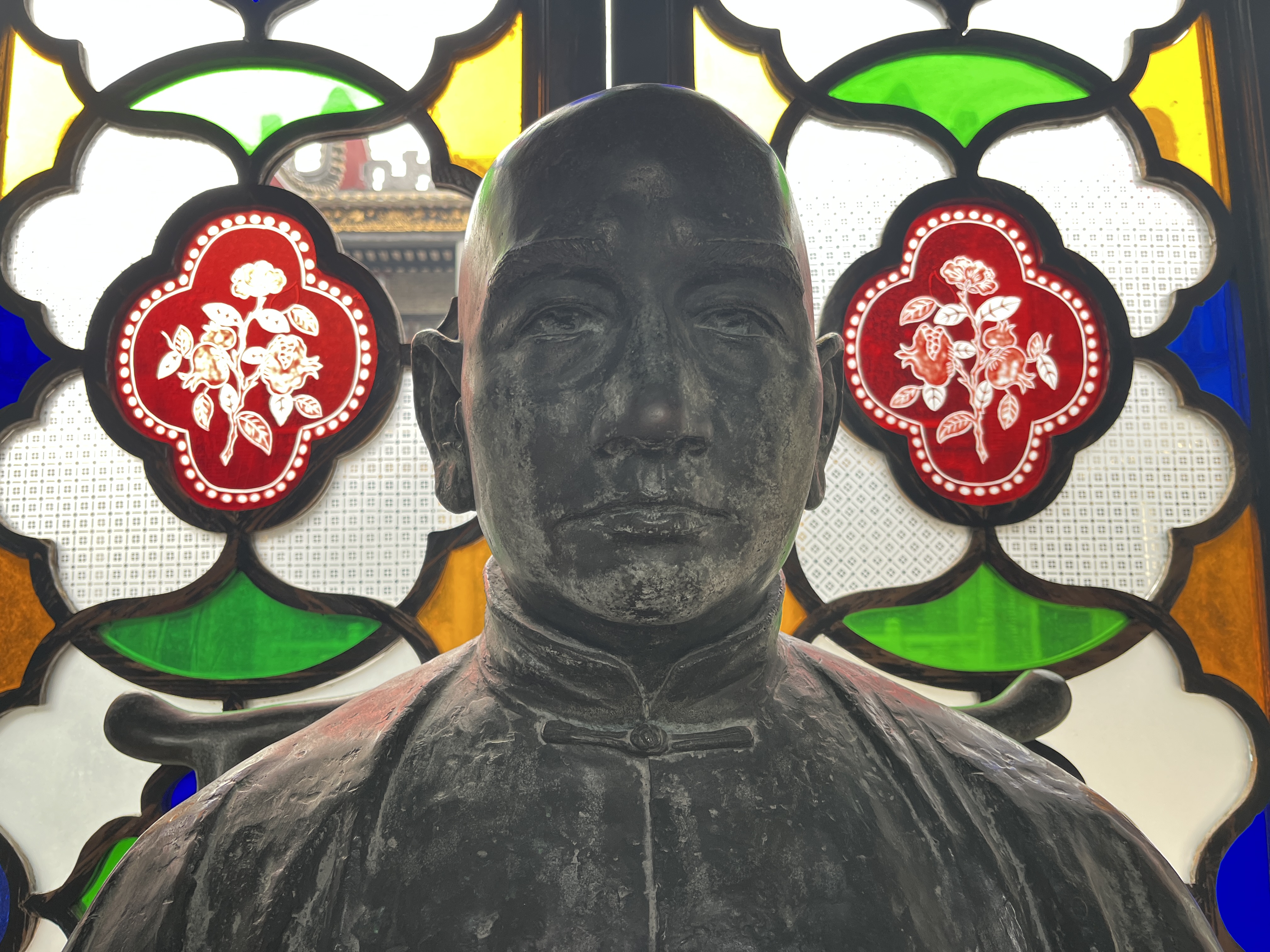
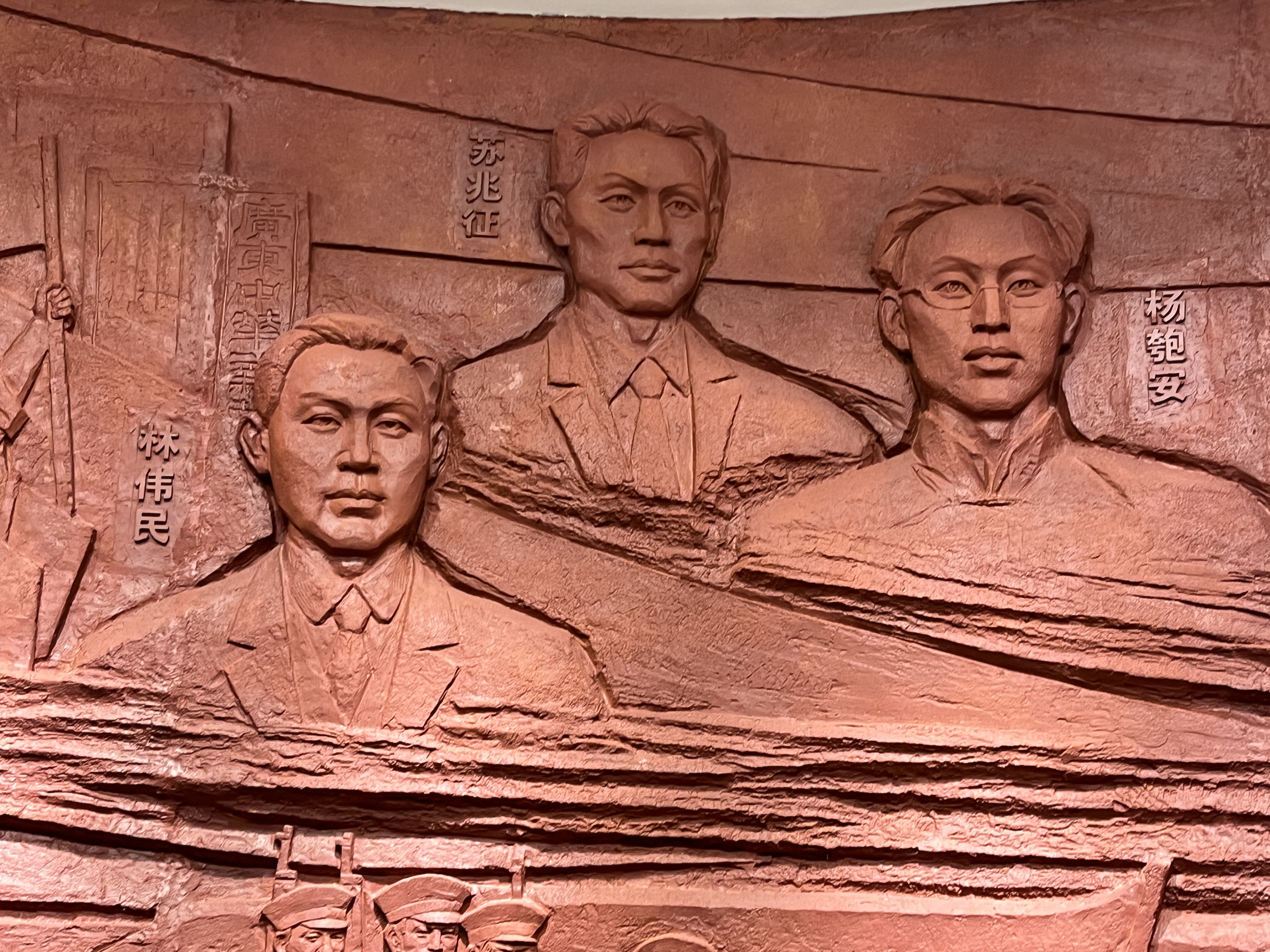
Pride of place in the opening bas-relief is given to three local boys who were instrumental in the Chinese labour movement. Qi’ao-born Su Zhaozheng (1885-1929) [centre] was the Seaman’s Union leader who masterminded the Hong Kong strike of 1922, over inequities in Chinese pay. Without answers for their demands for 40% pay rises, 1,500 deckhands and stokers walked out in January. Numbers grew to 30,000 by the end of the month, paralysing the colony’s shipping. By February, the numbers had climbed to 50,000, and included workers in the food and transport sectors, and even civil servants at Government House. With Hong Kong shut down, the authorities passed an Emergency Regulations Ordinance allowing the chef executive to enact extreme measures in times of crisis. [As a pre-existing law from colonial times, it remains a “nuclear option” on the statute books in modern Hong Kong, and was recently invoked in 2019 to ban protestors from wearing face masks].

Governor Edward Stubbs imposed strict passport rules, leading to a performative attempt by local union members to walk to Guangzhou to collect their strike pay. Four were shot and killed as they approached a line of colonial troops.

Lin Weimin (1887-1927) [left] went to Hong Kong to work on foreign ship, but became a key figure in the Canton-Hong Kong General Strike of 1925, inspired by the shooting of anti-colonial protestors in Shanghai and Guangzhou. Fearing that the authorities were about to retaliate by poisoning the water supply, a quarter of a million Chinese labourers fled Hong Kong, again shutting the colony down. Notably, he started out as a left-wing Nationalist, before joining the Communist Party and effectively becoming its representative for Hong Kong until his death, apparently from overwork at 40.

Yang Pao’an (1896-1931) [right] was the sole survivor of nine children, who embraced Marxism in his twenties as the only form of “scientific socialism.” He was an early representative of the Communist Party within the Republican government, which ousted him in 1926 on the grounds that he was a subversive and Communist recruiter. He embarked upon writing a Marxist history of the world and was arrested in Shanghai for pamphleteering and sedition. He was executed at the Longhua Garrison Command, now the Longhua Martyrs Cemetery.

Like the cemetery outside, the museum divides its main curation into the fallen heroes of the Revolution, of the war of resistance to Japan, of the civil war with the Nationalists (which actively stretches into the 1950s), and a rather vaguely defined Any Other Business, which I suspect, as in Shanghai, celebrates local-born people who have died in civil actions such as fire-fighting or sea rescue.

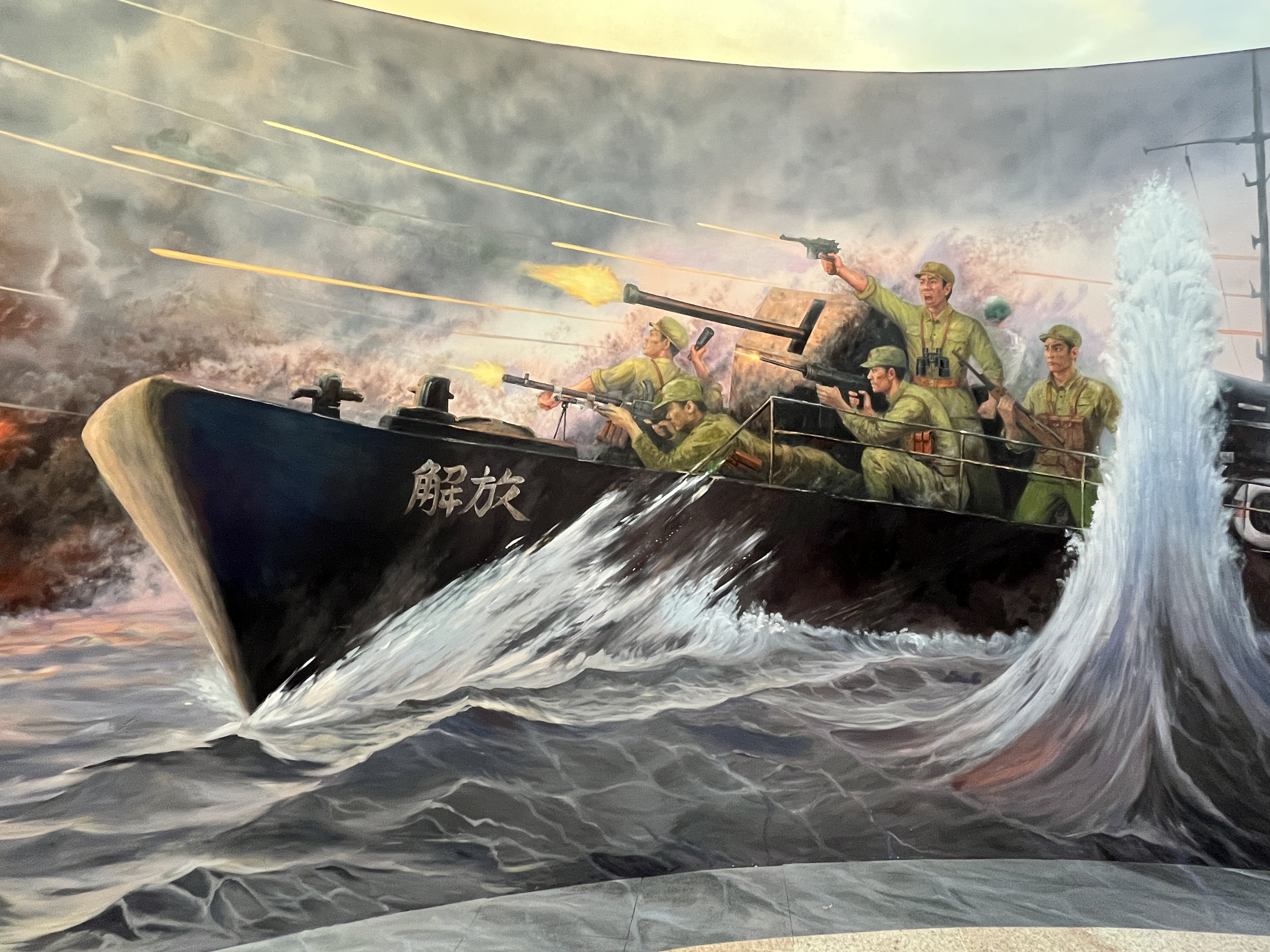
In particular there is a wall-length painting of Communist gunboats repelling Nationalists from islands near Zhuhai, bursting with pew-pew energy, and focussing on the immense dichotomy between the plucky little PRC boats and the Nationalist ships they are fighting – a victorious spin on the story that I have normally heard told by the other side, as a lament about lost territory.

Jonathan Clements is the author of Rebel Island: The Incredible History of Taiwan and A Brief History of China.

Surviving in Cashless China 2025

Last year I wrote an article about the surprises of returning to mainland China after five years’ absence due to COVID and other circumstances. I’ve just come home from another trip in which I drew a lazy circle around south China’s “Great Bay Area”, up and around the Pearl River estuary. So this is your update about getting by as a visitor to a China that has tried to remove all cash from daily life: including ten apps that may make your life easier. I’ve also included a few details about the Special Administrative Regions of Hong Kong (which still takes cash and everyday credit and debit cards) and Macau (which is a law unto itself).

The official story is that services have to accept cash because not all old people have compatible phones. In reality, whereas you can usually pay in cash at a supermarket or train station information desk, you need to find a human who will take it from you, and they will need to find change. Meanwhile even buskers and beggars now have QR codes written on their buckets, and an irritating enshittification is underway in which some restaurants now want you to scan in a QR code and then do all your ordering and payment on their supposedly bespoke website. I was struggling to scroll down to the noodles in one cafe, when the old lady sitting next to me shouted: “I am not dogfarting around with this nonsense. Give me a paper menu.” They very swiftly provided her with one, so if you are old and angry, you can still get away with it.

On this most recent trip, I only used cash on three occasions — once when a pointlessly faffy restaurant website in Foshan wouldn’t load for long enough to let me pay for my noodles (I handed 51 kuai, the exact amount, to a waitress who may well have pocketed it); once to buy a mini Macanese flag at a souvenir shop in Macau; and once at the bizarrely old-school left luggage office at Hong Kong Airport Express station, which continues to insist on cash-only like it’s 1985.

ALIPAY. My default payment option in China, Alipay offers a visitors’ version that does not require a Chinese phone number. This only works in China, but as it requires a scan of your passport page and some warm-up box-ticking, it is best done before you arrive. Most shops and services take Alipay, and instead of the old “cash or card”, servers now normally say some variant of “Scan you or scan me?” referring to the barcode that activates the transfer. Alipay also has a Transport option that allows you to immediately join the local travel card network. So the moment I walked across the border in Shenzhen, I was able to create a Shenzhen Tong travel card on my Alipay, and use that instead of faffing around trying to find someone to sell me a real Shenzhen Tong card. As an additional bonus, fares are deducted from your standard Alipay account (which links to your credit or debit cards), so you don’t leave China with £20 unspent on a travel card you might not ever use again.

WEIXIN (WeChat). Most Chinese seem to prefer Weixin, which works just like Alipay and seems to have more supporters among some small shops and in certain areas of China. I found myself using it almost exclusively on my first trip to Guangzhou, where the locals seem to favour it. Weixin is fine for payments, and comes barnacled with a bunch of other things such as travel booking, which I don’t bother to use. It also has its own chat service, which often makes it the default app for taking down someone’s contact details. You can also see who else has WeChat near you, which inevitably means a bunch of hellos from under-dressed ladies each time I arrive in a new phone catchment area.

TRIP. For the last fifteen years, I have increasingly come to rely on Trip (formerly cTrip), a travel booking option that streamlines hotels, planes, and trains, as well as access to local attractions and experiences. I’ve used Trip to book me onto a bullet train at twenty minutes’ notice, and onto the Macau hydrofoil with no fuss. The app preloads travellers’ passport details, so your passport *is* your ticket on Chinese trains. To my great surprise, Trip also turned out to offer me better deals on hotels than a well-known chain’s own laughably titled “loyalty” scheme, of which I had been a member for many years. I love Trip so much that I even got it to book my hotels last time I was in London. Trip also has an unexpected bonus value in China, since it has a Map function that works behind the Great Firewall and not only shows you where you are, but items of interest nearby, which led me to several tourist sites on my most recent trip that I would not have otherwise known about.

OCTOPUS. The absolute joy of travelling in Hong Kong is the Octopus card. The version sold for tourists does not require a local phone number, and can be loaded onto your iPhone. Octopus is a reloadable travel card like London’s Oyster card, which works on trains, ferries, buses and the metro. It even works on the Peak funicular tram and the piddly little boat that putt-putts across Aberdeen harbour in three minutes. It can often also be used in place of other payments in 7-11s, restaurants and other shops. Nothing feels quite as welcoming as shambling off a plane at the airport and straight onto the express into Kowloon without a moment’s thought — the Octopus card makes a huge difference to Hong Kong’s ambience by making you feel like a local the moment you arrive.

ALOSIM. None of these digital apps work without an internet connection. You can pay for a travel connection from your usual service provider, but if you have an iPhone X or later you can load in an eSIM card that will handle all your data. I use aloSIM, which offers an Asia data package that works in 13 countries and regions, so there is no tech fiddling as I cross from Hong Kong to Shenzhen to Macau. I also use aloSIM everywhere else I travel, switching from their European, to American, to Asian data packages depending on where I am. It usually works out about half the price of getting the same service from my regular provider. If you use my customer code M74D4V9, both you and I will get a $3 discount.

EXPRESS VPN. If you use Gmail, or Facebook, or Google, you may find that these sites are blocked in China. To spare yourself the frustration of suddenly not being able to see your emails, Express VPN will create a tunnel made of Science, under the Great Firewall and onto a server in another country. If you want a free month on your first year’s subscription, you can use this link and I will get a free month, too.

METROMAN. For many years, I have had a growing number of Chinese metro maps proliferating on my phone. Now I just have Metroman, which corrals them all into one place, updates them when a new line suddenly appears, and allows you to plot likely routes before you head out for the day, instead of squinting at a map on a station concourse.

MOOVIT. I didn’t make huge use of Moovit on this recent trip, but on several occasions when I found myself in the middle of nowhere in a strange town, it was handy to be able to call up a free app that told where I could get to from the nearest bus stop.

PLECO. Not everybody reading this is going to be a Chinese speaker. But if you are, Pleco is an app that allows you to write unfamiliar words with your finger, and then look them up in a dictionary. It requires you to be able to work out the correct stroke order to enter your query, so it is not suitable for people who are new to the language.

MPAY. I would like to be able to sing the praises of MPay, a Macanese app that works in much the same way in Macau as Octopus works in Hong Kong. Except currently MPay requires you to have a Chinese, Macanese or Hong Kong phone number, so it was as much use to me as a dog filled with sand. I had no trouble using cash in Macau, but local cash machines only dish out money in large notes. Most places happily accept Hong Kong dollars as payment, but since Hong Kong dollars are worth 10% less than MOP$, everything comes attached to a “surprise” surcharge, like you are in America being having to come up with extra change for a sales tax. Of course, it’s not really a surprise — the Macanese are doing you a favour by taking foreign notes, but they could do everyone an even bigger favour by taking Octopus payments or just setting up an “MPay for Tourists” in the Octopus style. Hopefully there will be some good news about that next time.

Not all these apps will be ideal for everyone — not all of them were ideal for me! But as a Chinese speaker venturing into unfamiliar parts of the country, and trying to make the best of my time, many of them (except MPay) proved to be very useful indeed.

Jonathan Clements is the author of A Brief History of China.

Shaking That Arse

Early morning interview with our landlord, Tubby (his real name is Yu), a jolly little man half my height who will shortly become the village chairman. This makes him something of a heavy-hitter with the locals, and he truly appreciates the value of TV coverage, so he is ready and willing to talk about the history of the Miao, their affection for the pheasant as their totem animal, and sundry other organisational issues to do with the village. He even obliges us by running down the hill to tell the singing competition, which has been running right through the night, to bloody shut up for half an hour so we can film him in relative quiet. When they get shirty with him, he literally steals their microphone, strolling back to the house with it and telling us all will be well.

The Tubby interview is swift and efficient, and it gives us ample material to cover our B-rolls and cutaways. Despite the misery of filming here in what is now our fourth day of impenetrable fog, we have enough in the can now for this episode to work. The fog has become part of the story, as have the armies of amateur photographers getting in the way. There is even a rival Chinese film crew, dubbed Mr Osmo and the Neckbeards, since their chief cinematographer is wielding an Osmo – a tiny steadicam like a gun on gimbals, allowing for running shots and action.

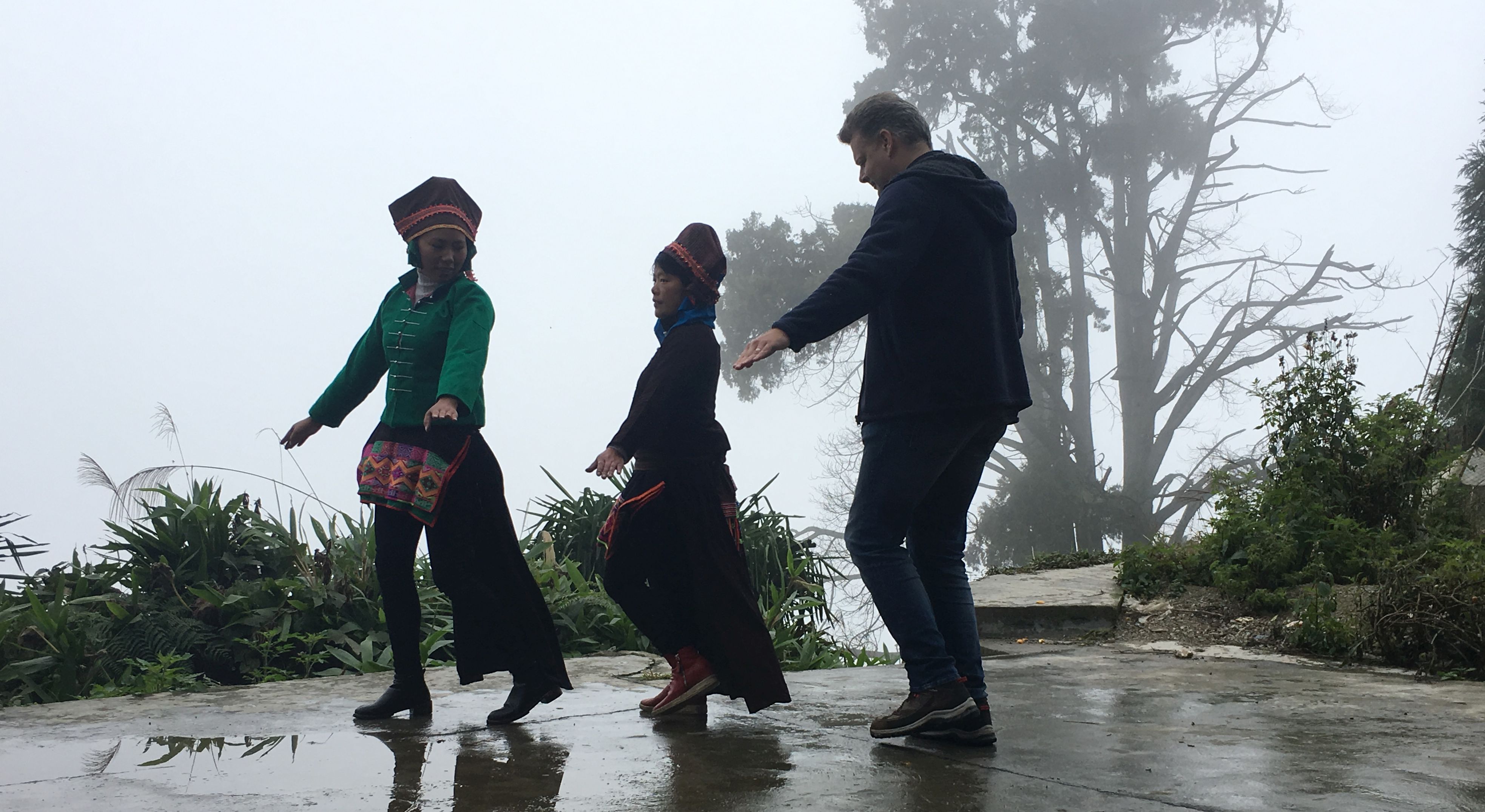
Mrs Yu (Tubby’s wife) and Miss Yu (Tubby’s sister) take me out onto a clifftop to teach me how to walk like a woman. This takes longer than expected, as they have to put their glad rags on and do their hair, and then we have to wait for the air-raid sirens to stop. Today is the anniversary of the Japanese invasion of China, and sirens all over China are going off to remind people of who the enemy is.

“Left foot forward,” says Mrs Yu. “Now watch my arse. I wiggle it this way, and then that way, then this way, then that way.” It’s only when the cameraman reframes for a close-up that she realises she is volunteering to wiggle her bottom on camera for viewers in 30 countries.

The sisters-in-law then move onto the Phoenix Dance, that slow-motion invisible skipping rope motion that combines their wiggly walk with flapping arms and steps that go left-right-left-right-right-left-right-left-left, over and over again.

“Do you think they enjoy doing this?” wonders our fixer.

“I hope so,” I reply. “Because this lot don’t seem to do anything else.”

Mrs Yu is very excited about the electric kettle we have acquired in a vain attempt to have some warm water to wash in every day. She walks around the house caressing it like an adored pet. I have not washed properly for four days now. It is theoretically possible to barricade the door to the combined toilet-shower, strip off and use a kettle, but such an enterprise would require washing the floor first, and drying off afterwards, which since we are literally living inside a cloud, would be a futile exercise. As for going to the toilet, don’t get me started. I am happy if I manage to hit the hole and remember toilet paper.

“When we get to the Congjiang hotel tomorrow,” says the director dreamily, “I’m going to turn the lights low, put on some ambient background music, light some aromatic candles, and have a massive dump.”

Jonathan Clements is the author of A Brief History of China. These events featured in Route Awakening S03E06 (2017).

The Very Slow Motorcycle Race

One of the photographers staying in the same building as us seems different from the rest. She is a slim Chinese girl in a bobble hat, dubbed “Alice” by Mickey the sound man because we are living next door to her – one of many obscure 20th century pop references in Mickey’s everyday banter. He noticed her because she alone seemed to know how to operate her camera, and it turns out that she is a genuine professional. She sells prints of her photos, but is wandering China, somewhat aimlessly, in the help of selling a book about it, because “foreigners don’t know anything about any tribe apart from the Han.” I resist the urge to point out that even if it were true, there are thousands of pre-existing picture books about China, none of which she appears to have heard of.

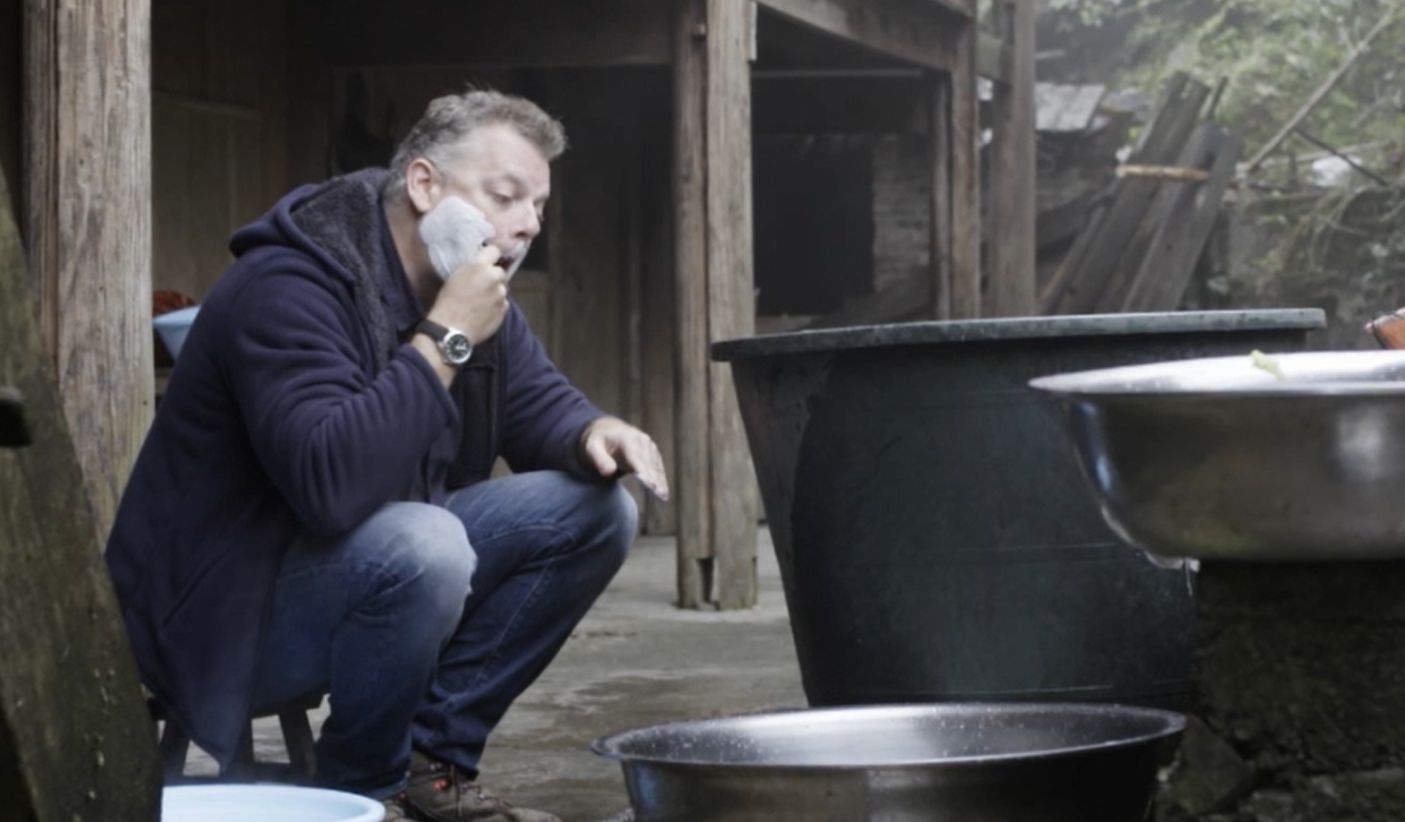
Alice was born in Hong Kong and now lives in New York, and is one of those Chinese girls who believe that being Chinese is the sole qualification required for understanding China, that she has learned everything she needs to know solely through her DNA, and that foreigners are all clueless. She has already pegged me as a high-maintenance idiot after overhearing half a conversation between me and the director the day before, about the best time for me to shave when there is no hot water.

Yes, I say, we were going over what kind of timing was needed to make my face look presentable in 4K digital. If you’re behind the camera, you can look like shit warmed up and nobody will care. But if you’re in front of it, you need to look like you’ve run a comb through your hair, or it is distracting.

“Oh,” she says in surprise, “you appear to understand quite a bit of Chinese.”

Behind their porridge bowls, the crew snicker and snort.

“Have you been to China before?” she asks, and the snorts turn to giggles.

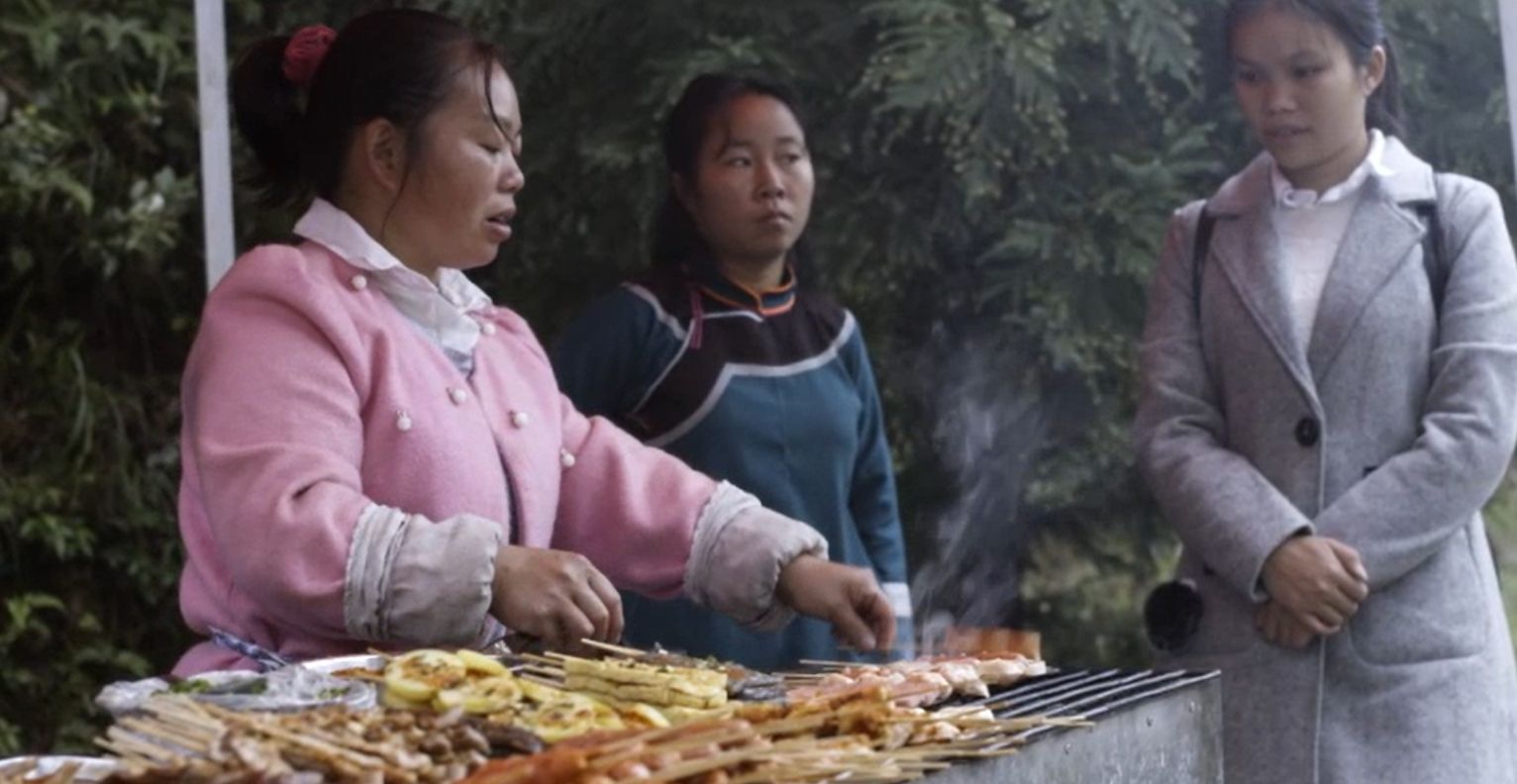
A village fete of some sorts has sprung up around the village gate. There’s a mobile convenience store on the back of a truck, a fruit seller, a lady selling gristle on sticks, a lucky dip and a spin-the-wheel stall where you can win a live terrapin in a cup.

The Very Slow Motorcycle Race is another of the town committee’s attempts to keep the young people interested. Chalk marks in a wavy chicane are drawn across the car park, and the local bikers are made to traverse the path in the slowest time possible. Not that that is much of an issue, because only two bikers actually make it all the way along the fiendishly winding path at all. The director decides that I shall have a go, and purloins a bike from a passing man.

It is a 250cc white Chinese model, and as I sit astride it with entirely misplaced confidence, I remember that I haven’t actually sat on a motorbike for 25 years. The locals immediately cluster around with helpful advice, including “Starting in second gear is a stupid idea, mate”, and “If you rev it that much, you’ll go over the cliff.”

Luckily, I have vague memories of the five minutes I once spent in a Taiwanese car park on Gilbert Mackay’s little 150cc bike in 1991, so at least I know that what would be the left brake on a bicycle is actually the clutch on a motorbike. I know where the gears are to shift it down into first (they’re by your left toe), and I know that pulling too hard on the front brake will pitch my head over the handlebars.

I gingerly wheel it to the starting line with only two stalls, and then head off when Tubby, our landlord, blows his whistle. It’s all over in barely a second, as I careen along the opening leg, fail to correctly take the first corner, and whirl off into the crowd, through a screaming flock of onlookers, and around the car park, coming to a juddering halt a couple of feet away from the precipice that leads down into the rice paddy.

The camera catches not just my comedy performance, but all the Chinese laughing at me at the starting line, as well as the fleeing onlookers as I charge through them. It’ll look good.

I chug the bike over the man we got it from, and thank him for letting us use it.

“Oh, it’s not mine,” he says. “I have no idea whose bike you just stole.”

Jonathan Clements is the author of A Brief History of China. These events featured in Route Awakening S03E06 (2017).

The Same Old Song

Breath freezes in the air in the morning, and there is no view past the next house, since we are level with the clouds and the whole place is shrouded in fog. I grit my teeth and dowse my hair in cold water in an attempt to get it to assume a reasonable shape. Nobody elsefrom the crew wants to wash.

The fog has not lifted. If anything, it is even worse. We cannot see to the next house, let alone the allegedly stunning vista below. The hill-climbing race has been postponed, if not cancelled, and there is no point in sending up the drone, because all it will be able to film is the inside of a cloud.

With nothing else to shoot, the crew are trying to get footage of the family cooking in their kitchen, but there are already six photographers blocking the view and getting in the way. Some of them are wearing the logo of the Guizhou Photography Club, and have plainly been bussed in with the same vague hope as us of catching something suitably ethnic.

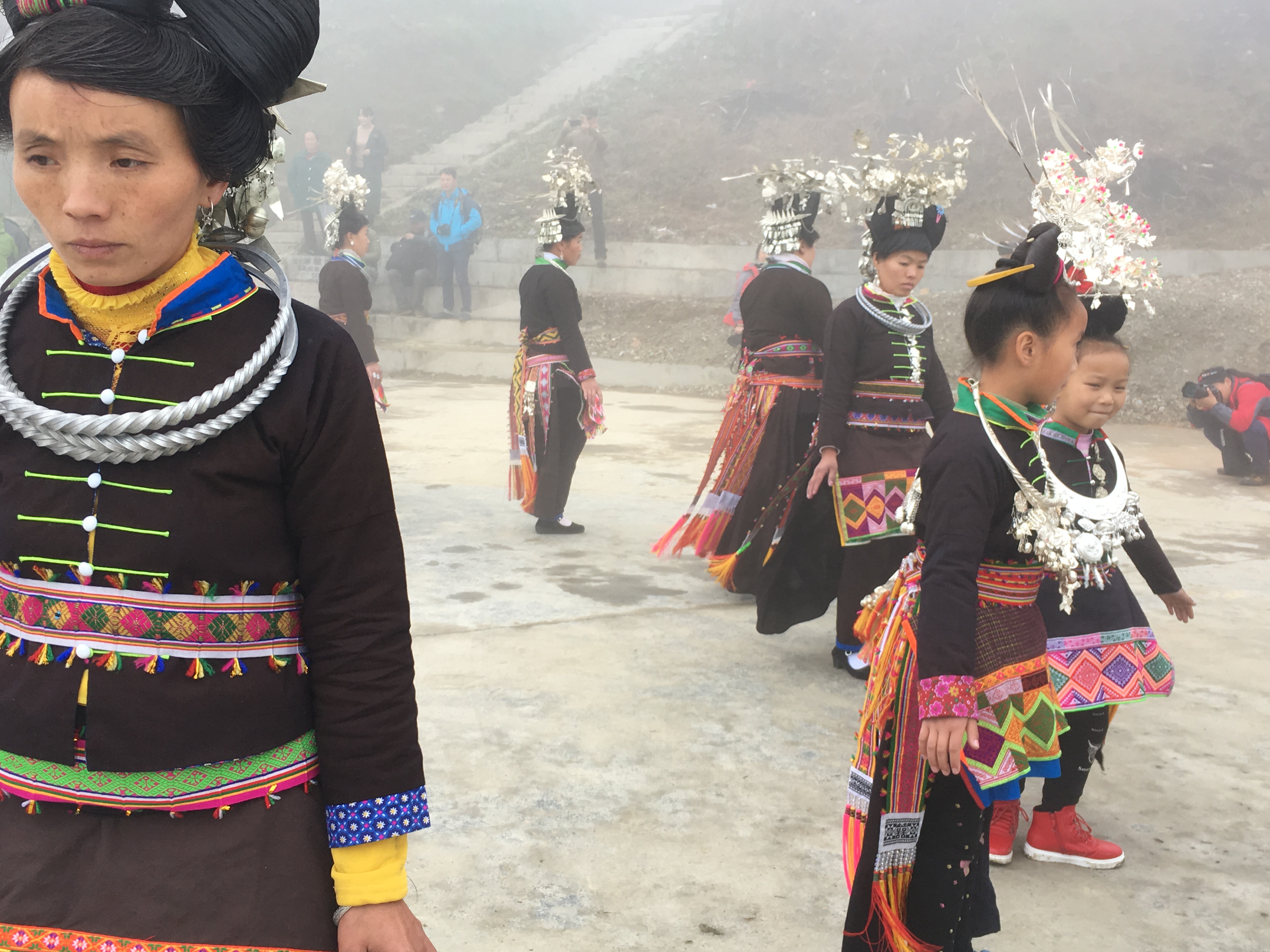
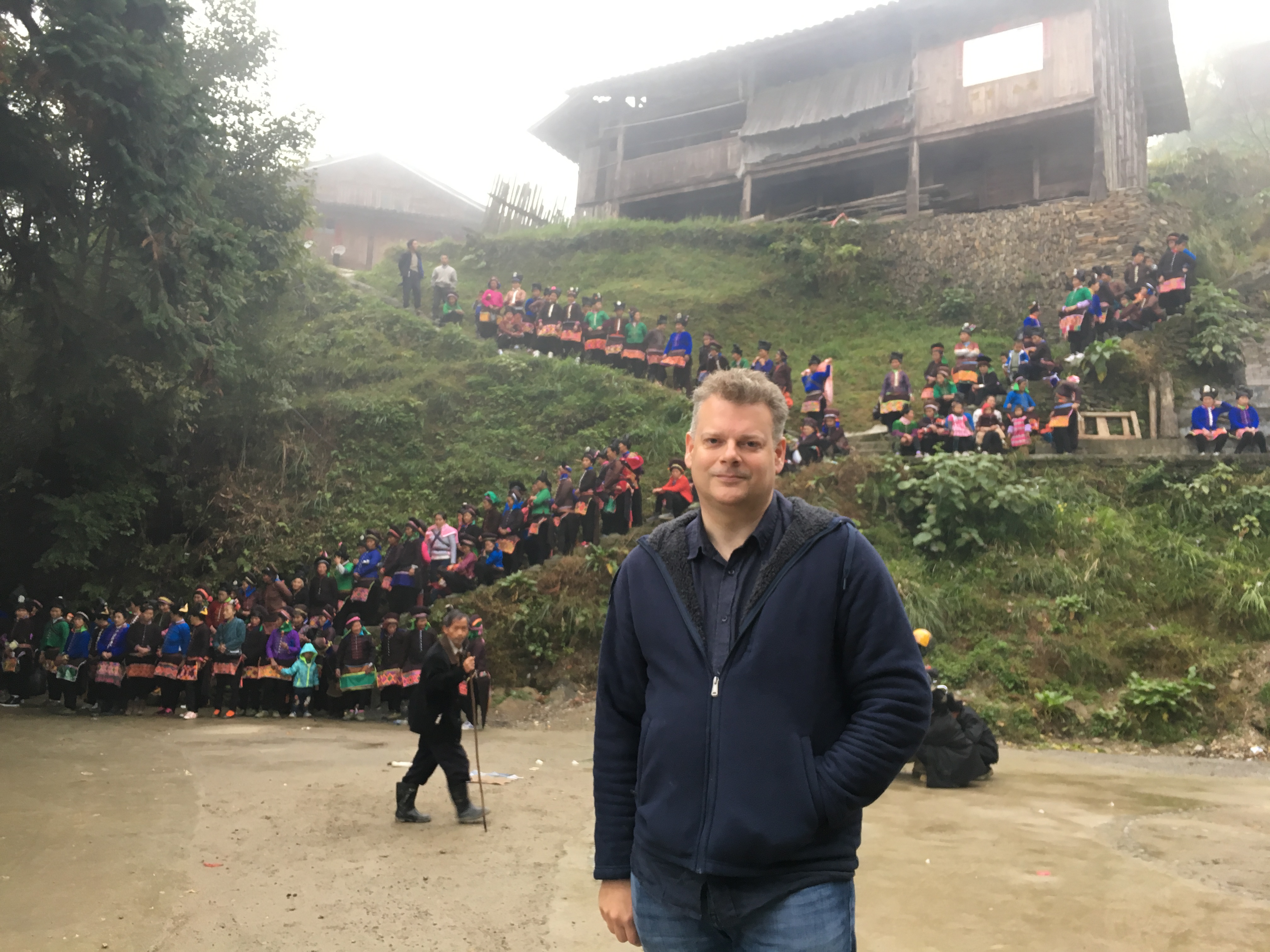
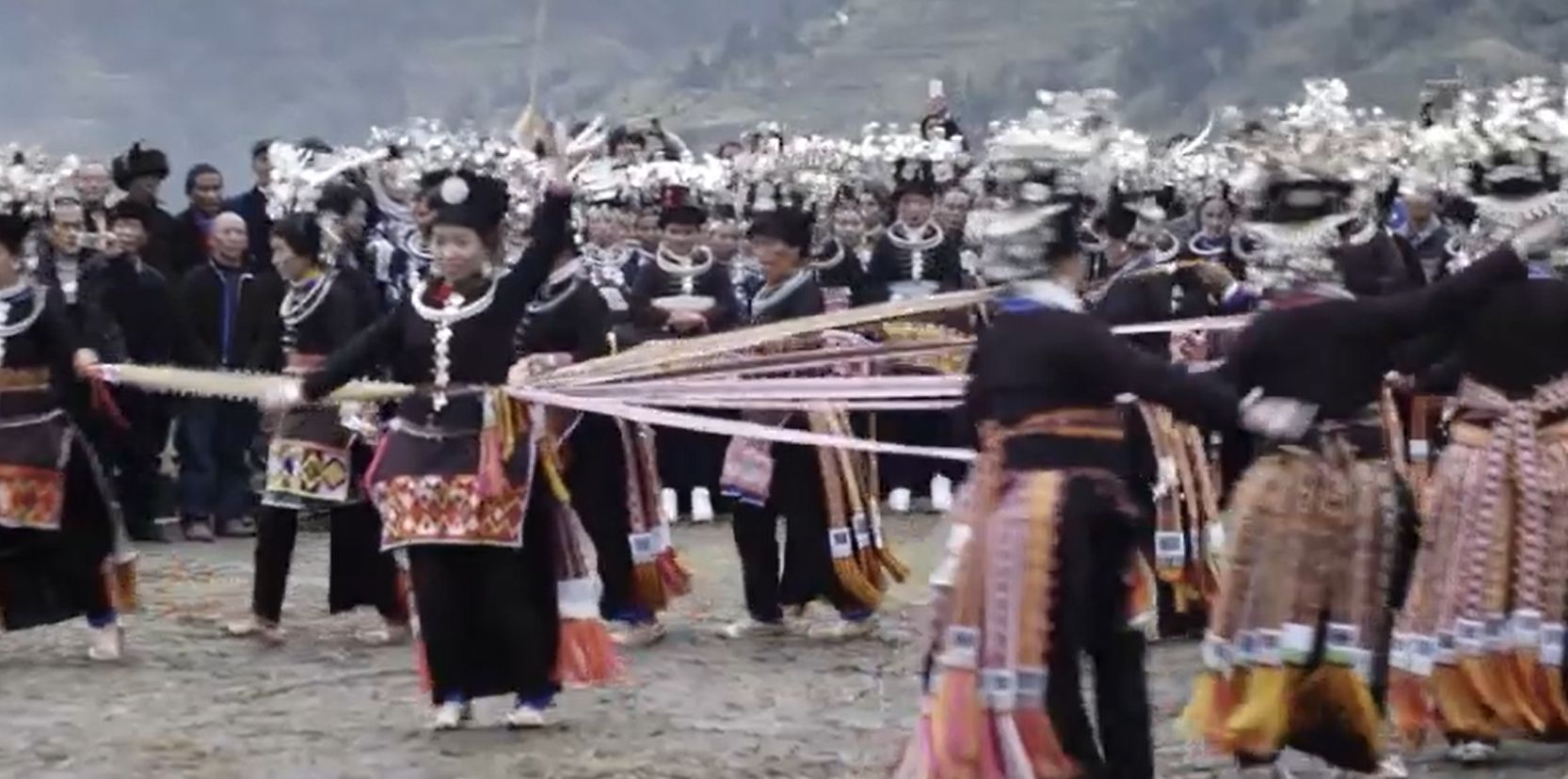
The Miao village women are assembling for the Pheasant Dance in the square. A lusheng band, some of them carrying instruments twelve or more feet high, are blowing a farty, unchanging tune that sounds like The Doors trying to tune up to play “Light My Fire”, with an additional unnecessary tuba player co-opted into the band. The Pheasant Dance involves making a half-hearted motion with one’s hands, as if skipping with an invisible rope, and then shuffling left-left-right-right-left-left-right, endlessly, endlessly, for hours.

There are fourteen or so dancers and a five-man band, already outnumbered by a crowd of photographers, toting expensive Nikons and Canons that they seem ill-equipped to use, with lenses that cost more than a year’s wages for some Chinese. Our cameraman is already getting pissed off with the two dozen, then soon three dozen interlopers, who keep ruining his shots, wandering into the frame and talking over the music. There are even several foreigners – desiccated pensioners with Tibetan jackets and Spock haircuts, grimly pointing their own cameras at the mess.

The village women are crowned with elaborate headdresses topped with pewter birds and foil ribbons, wearing dresses that give them bulky hips, tailing embroidered streamers. The embroidery is all done themselves, serving as advert for their potential wifely skills.

The crew and I lurk around the village gate, where we are soon accosted by a bunch of local characters. There is the drunken, bespectacled man from Beijing, who has plainly necked far too many dishes of welcome booze, and wants to talk to me about Northern Ireland. There is the local Party secretary, whom I have dubbed Man With a Stick, because he walks everywhere with a nobbly branch that he insists is used in massage techniques. And there are two giggly girls from a Beijing college who want their photograph taken with me because they have never met an American before. And they still haven’t.

A Pheasant Dance competition breaks out in a drained rice paddy… well, partly drained, as my shoes soon discover. Different Miao tribes compete over their interpretation of the Pheasant Dance, but since the music is the same every time, and you can’t score them for having better headdresses just because they come from a different tribe, the judges (and indeed the crew) resort to judging them on entirely arbitrary criteria – matching shoes, boob size, and whether or not they look as bored as we are. There really is no contest, since the last group on is the local girls from this village, Maniao, who actually have a bunch of different steps and a Eurovision costume-change gimmick where the outer dancers grab the skirt ribbons of the lead girl, and form a pheasant tail behind her.

The director is phoning it in from the house, supposedly because we are droning from that vantage point, but actually because the chaos is unfilmable, and she knows that the best our cameraman can do is snatch some cutaways. It’s not like we need new audio when everybody plays the same song; the light is fading; the background looks like a building site in the mist, and the place is full of middle-aged men with preposterously expensive cameras, trying to snatch a “National Geographic”-style bit of local colour, and ironically preventing National Geographic from doing so.

I am perhaps the last to realise that today is a disaster. I have been hired, at least in part, for my curiosity about such things, and I confess that I stayed to watch the welcoming ceremony because I wasn’t going to travel for ten hours and not see it. Our director and cameraman, with an eye on the visuals, probably worked out at lunchtime that there was no point in shooting any more footage today. The rest of the crew just took the path of least resistance.

A huge dance, a swirling circle of all the Miao tribes, is kicking off in the main square as the sun sets, with all visitors invited to join the end of the invisible-skipping-rope conga line. But by the time it begins, I am all alone from the crew, radioing back up to the house with increasingly plaintive reports about the number of dancers and the tribes who have joined the fray.

“Thank you for the commentary, Jonathan,” says the director carefully over the walkie-talkie. “But come back to the house. Today is a wrap.”

Jonathan Clements is the author of A Brief History of China. These events featured in Route Awakening S03E06 (2017).

Shawscope 3

“He had little time for magic swords or charmed arrows, since any everyday weapon could become ‘magical’ in the hands the right martial artist. Indeed, as he noted, the higher echelons of martial artists should have no need for weapons at all, since they had become so at-one with the universe that they could draw upon the qi around them to fashion their bodies into deadly weapons. Perhaps out of a sense of deliberate contrariness, he even bucked against the trend for morose, troubled knights errant, pushing instead for libertine, sensual ‘happy heroes,’ an idea which would itself form the basis of his novel of the same name, inspired in part by John Steinbeck’s novel Tortilla Flat (1935).”

Out today from Arrow, the majestic Shawscope #3 box set, which includes my long article on the writer Gu Long, and my feature-length commentary track on the Song dynasty historical epic 14 Amazons (1972).

Guess Who’s Coming to Dinner

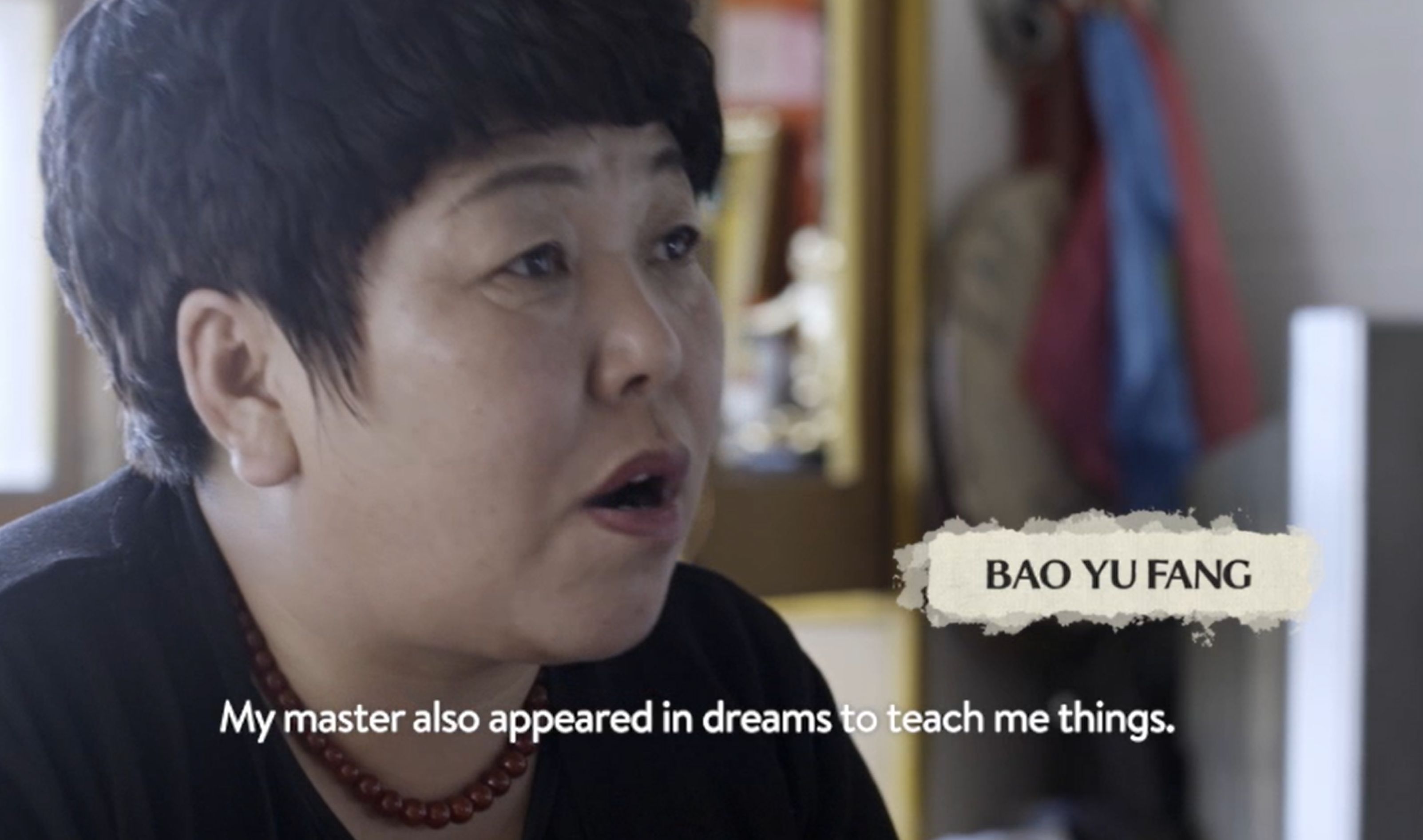
Yufang, the instigator of the infamous “OKAY, OKAY” dance, has invited us out into the countryside to witness a qingshen ceremony, in which the gods are invited into someone’s home. The director accepts, figuring it will be more shamanic mentalism.

Yufang and her long suffering husband live in a single-room cottage two hours outside of Songyuan, next to a pig sty, and with a back yard that swiftly turns into a field of maize. Their single room is dominated by a kang, a traditional Chinese heated dais that functions
as central heating, stone sofa and warmed-up bed – I lie on it, enjoying the sense of history and attracting the unwelcome attentions of the local cat. There’s plainly not a lot to do out here in the countryside. Yufang, along with all the other people we meet here, has an odd notch in one of her front teeth, which I first mistook for a shamanic initiation symbol.

“Oh no,” she giggles, tapping her gappy tooth. “That’s where we bite on the husks of sunflower seeds. It wears down over the years.”

It slowly sinks in that the foreign idiots she has invited to her house are actually a film crew, and that far from merely hanging out with us to prolong the fun from our days in Songyuan, she will actually be appearing on camera. The interview is postponed for five minutes while she slaps on some lippy. In all our dealings with the shamans, Yufang has been the clown and the Head of Morale, ever ready with an impersonation or a piss-take to liven things up when we’re standing around in the cold waiting for Mickey the drone pilot to warm up his batteries. But when the camera is pointed at her, she is suddenly all business, prim and serious.

“There’s no way I can make a living here as a shaman,” she sighs, gesturing outside her window at the tiny huddle of nearby houses. “Maybe if I was in the big cities, there would be more work, but less people in the big cities actually believe in this.”

I am not sure that all that many of the locals believe it in, either. The neighbours soon gather to gawp, standing not only around the Buick as the crew try to film me, but wandering unbidden into the house, where they have no compunction about hawking up a mouthful of phlegm and spitting it onto Yufang’s kitchen tiles.

Yufang shows me her shamanic credentials, since Gorlos shamans are now accredited by the government, and also by the committee that runs an annual wizard school at Changbaishan, (Long White Mountain) on the border with Korea. There are nine grades to attain, none of which have anything to do with actual religious belief at all. Instead, the government recognises shamanism as a cultural performance, and insist on shamans achieving acceptable levels in dance classes, paper cutting, knife walking, costume, and sundry other handicrafts.

These include drum-making, which Yufang’s long-suffering husband (I think it’s fair to add the prefix “long-suffering” to all the witches’ husbands I have met) has apparently got himself a qualification in. He shows me a rancid bucket in which a sheep’s skin has been soaking for several days.

“The hairs are much easier to pull out if you soak it for a couple of days,” he says brightly. “And the bonus is that in winter it doesn’t smell so much.”

Yufang’s husband and I sit glumly pulling hairs from the wet skin in the bucket, which feels like I am sticking my hand into the cold bathwater of an entire pack of wild dogs.

We then piss about hammering designs into the metal crown, but the sun is already setting and our hearts aren’t really in it. Yufang is already cooking dinner, ready for the big event, which will be a four-way qingshen after dark.

A crowd gathers. The entire village empties itself of a bunch of wizened crones and tubby men, with a couple of hot-looking yummy mummies and a one-eyed granny, all of whom pile into Yufang’s kitchen and start staring variously at either the shamans or the film crew. For once, the director doesn’t call for quiet, but gets me to do a piece to camera in the middle of all the hubbub, surrounded by snickering yokels who believe my name is Foreigner.

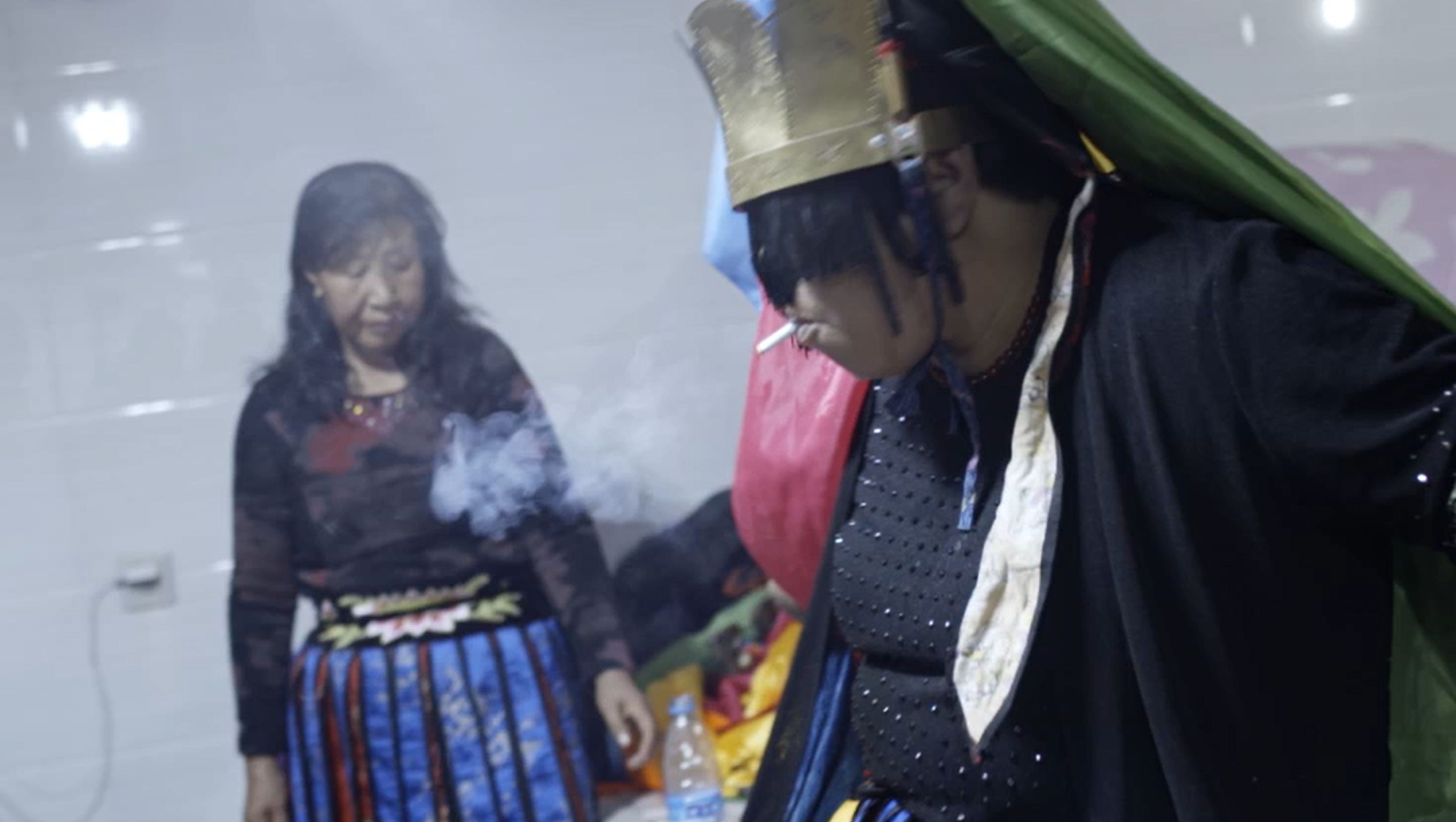
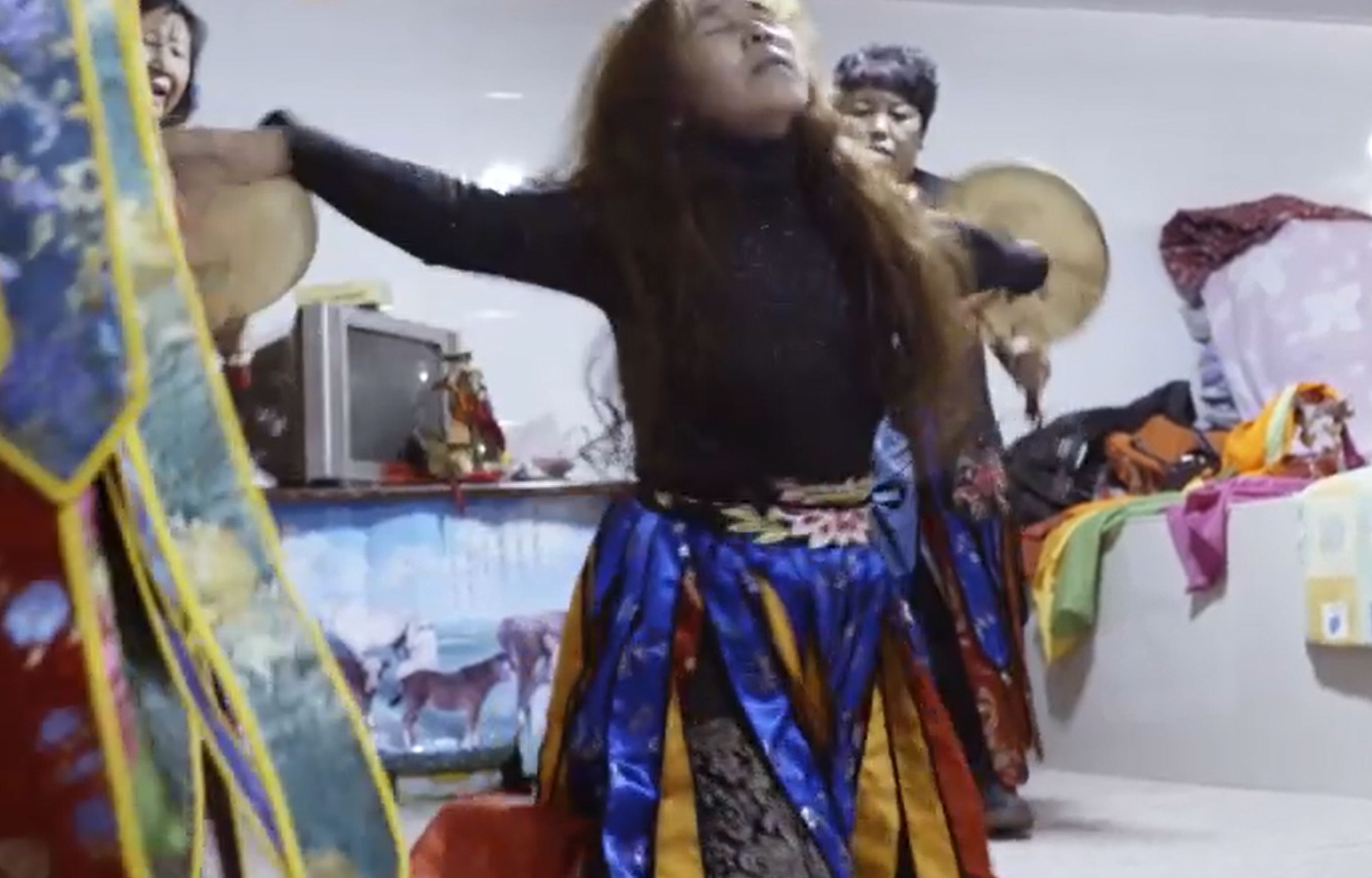
The shamans start chanting and skipping in circles, spinning ever more wildly. In each case, the person to be possessed is the only one in full finery, including the all-important beaded fringe that hides the host’s eyes from incoming spirits. The first up is a woman I refer to as Wallflower, who seems very quiet, but has always gamely jumped into all the ceremonies, and has been there for everyone. As the door to the icy fields outside is opened, she spins and whirls, her arms suddenly outstretched in an imitation of wings.

She throws herself back onto the kang, and sits there panting, and growling repeatedly: “FIRE! FIRE! FIREFIREFIRE!” Yufang’s husband lights a fag and hands it to her, and she smokes the whole thing down in seconds, rotating it rapidly as she puffs. Suddenly, when most of the cigarette is ashes, she flips it around and sticks it in her mouth, chewing on the ashes and the lit embers and chasing them with a few mouthfuls of the local hooch. She whispers a few words in guttural hisses to Yufang, revealing that she is an Eagle Spirit who has popped in to see what’s happening, and then she announces that she is leaving.

She jumps to her feet, spinning and flapping again, and two men position themselves by the open door, to stop her flying away along with the soul inside her. Wallflower charges at ramming speed straight for the door, but she is physically stopped while, we are told, the Eagle spirit flies from her mouth. The room is quiet once more, except for the sound of Wallflower retching and throwing up on the doorstep, as you might well do if you’d gargled a lit fag with a vodka chaser.

Next up is Red – not her real name, just what I have ended up calling her – a sour-faced old lady with a ginger dye job, who similarly dances in circles and similarly welcomes an eagle spirit. But when she grabs a lit fag, she immediately inverts it and puts the lit end in her mouth and blows, which turns out to have an effect not unlike a smoke machine. Then, she is also hunched over the doorstep, throwing up.

Yufang is next, and apparently receives the spirit of her own grandfather, who doesn’t have much to say, but does neck an awfully large amount of booze before coughing a lot and growling.

Afterwards, there is a break when Yufang asks to see the director’s monitor, as she has never seen what happens to her when she is in a trance. She stands there, clutching the small TV as Daniel plays back from the camera. She shakes and weeps at the sight and sound of her grandfather’s spirit.

The last of the women is simply called October, a name of such startling lack of interest that it suggests an entire lifetime lived as a parental afterthought. She turned to shamanism in her late thirties after an unspecified illness, and reports that she, too, had no interest in it until it cured her. Shamanism has plainly given her something to shine at, and she is the big finish, in which she will not merely invite a spirit to pop into her body for a bit, but will actually swap souls with it for a while. This looks not unlike the process from before, except she flings herself around with somewhat gayer abandon, and doesn’t ask for any fags, which is a relief, because the place is starting to smell like a fire in a sofa factory. Instead, she downs three quarters of a bottle of firewater, makes a few bibbling noises, and jumps up to her feet. The two catchers rush to stand guard at the door, and October makes a run for it, but is so munted by this point that she actually misses the door by three or four feet, instead running straight into the wall next to it, and bouncing off like a drunken clown with a gold crown and rainbow streamers, smelling of hard liquor and carrying a tambourine… if you can imagine that.

The day before, I had joked with Mandula the musician that his 20-a-day habit must be have been a boon for throat singing. “Oh yes,” he replied, straight-faced. “And so is booze.”

I bring this up because one of the unique selling points of shamanic performances is that the women suddenly speak with the voice of men, which, I suggest to you, is easier if you’ve just smoked three tabs in a row, stuck the last one into your mouth while still lit, and gargled with a bottle of industrial-strength vodka. I will also observe the odd way that Wallflower smoked her cigarette, twisting and twisting as she puffed… possibly an odd spirit-world affectation, but perhaps more likely to be a way of keeping all the ashes balanced in place, instead of allowing them to fall on the floor before she could stick them in her mouth. In other words, an oddly organised approach from someone supposedly in a trance.

Michelle our associate producer was very impressed with it all, and as an exorcist’s daughter, she is usually the crew’s go-to girl for spiritual matters. But I found the whole thing to be an elaborate carnival of parlour tricks and stunts, performed rather than enacted, by a bunch of women who can pack the whole village into their living room if they purport to be consorting with talking eagles. The sceptical reader might also note the degree to which Yufang was waving around her stack of credentials from the Long White Mountain School of Wizards, which strikes me as about as useful as a loathsome “Team-Building Exercise” in a Northampton adventure playground.

But there was something about the look on her face as she watched herself on the monitor, and the tears on her cheeks as she heard her grandfather’s voice, that made me doubt myself.

Jonathan Clements is the author of A Brief History of China. These events featured in Route Awakening (S03E03), 2018.