

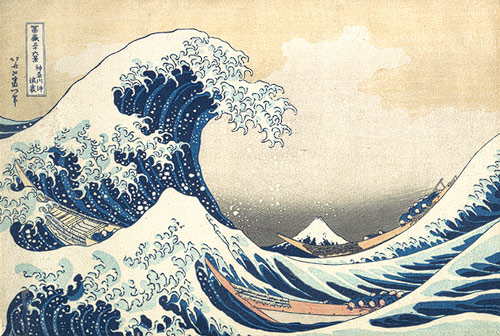
Hokusai was the most famous print artist in 19th century Japan. He drew the iconic Great Wave Off Kanagawa, the Views of Mount Fuji and the Stations of the Tokaido Road. He celebrated the celebrities of the kabuki stage and even kicked off the beginnings of tentacle porn. In 1814, he published the first of a long-running series of “how-to-draw” manuals and art references, known as the Manga (Sketchbooks) and eventually lending their name to comics from Japan. And… he had help.
As Hokusai got older, there are stories that he suffered from palsy and infirmity. There are rumours in the Japanese art world that he was practically unable to hold a brush by his final years, and yet somehow kept churning out masterpieces. Word on the street, but rarely admitted in the auction houses, is that for the last years of his life, much of his work was ghosted by his daughter O-ei.
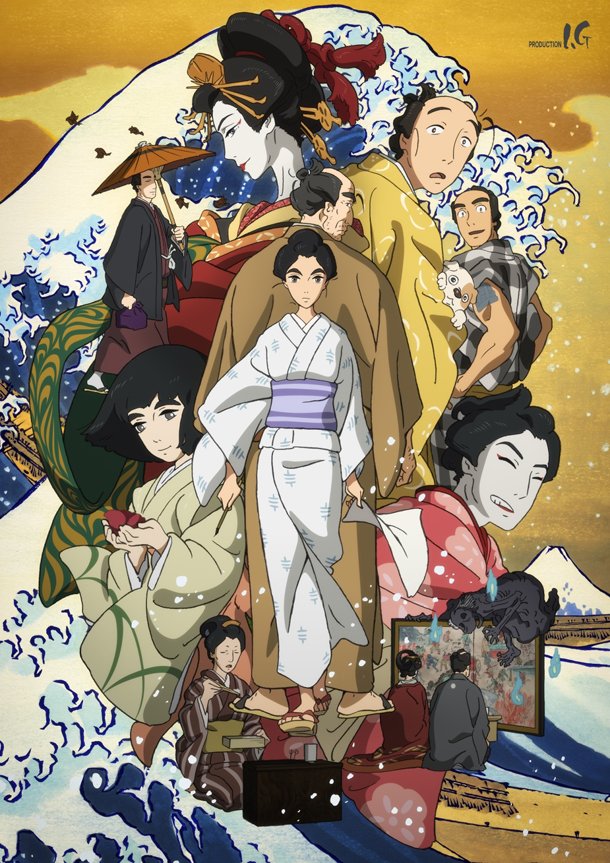
Keiichi Hara’s Miss Hokusai is not a biopic. There is far too little known about the historical O-ei for that to work, and barely a dozen of her acknowledged art pieces remaining. But this itself has inspired numerous fictional accounts, from Katherine Govier’s novel The Print-Maker’s Daughter to numerous untranslated Japanese novels, and an award-winning manga by Hinako Sugiura. It’s this latter work that is the basis for Hara’s film – the director is the world’s biggest Sugiura fan, and deeply in love with the creator’s unique perspective on life in 19th century Japan.
“I wanted to be fresh,” Hara told me at the UK premiere. “Sugiura wrote about the common people; about the townsfolk, artisans and prostitutes. Japanese media is full of depictions of the Edo period, but Sugiura’s manga told me things I had never seen anywhere else.” And his animated film is packed with incidental detail – the bumping of boats under the Sumida river bridge, the chaos caused by the fires that were poetically known as “the flowers of Edo”, even the sensation of stepping in a samurai-era dog turd.
“Of course, we wanted to use Hokusai’s prints as reference material,” notes Hara. “But 19th century prints were not intentionally realist. They play tricks with perspective and proportions. They aren’t blueprints for evoking the period. Sometimes, you still have to go with your imagination.”

The same might easily be said of the other anime Edo-period piece recently released, Masayuki Miyaji’s Fuse: Memoirs of the Hunter Girl. Despite being demonstrably more irreverent and playing havoc with fantasy elements, false colours and bawdy backgrounds, Miyaji’s film is just as much a celebration of the same city that would be renamed Tokyo, “East Capital” in 1868. Miyaji’s movie is an Edo of the mind, conceived as a commemoration of the 90th anniversary of a famous Japanese literary magazine, and stumbling joyously through a number of different literary modes. It is a retelling and a re-imagining of The Hakkenden, a samurai serial novel first published in 1814, the same year as Hokusai’s infamous Manga, but the film is actually based on a modern “light novel” by Kazuki Sakuraba – one of the notoriously throwaway potboilers popular with modern commuter kids on their iPhones.
The Yoshiwara pleasure quarter looms large in both movies. In Miss Hokusai, it is a place of shadows, the inspiration for O-ei’s most famous surviving picture. In Fuse it is a vibrant, dingy ghetto, ringed by a sewer but aspiring to be a bawdy Disneyland. The historically faithful Hinako Sugiura would have had conniptions if she saw Miyaji’s centrepiece, an entirely unhistorical clock tower in the shape of a woman’s torso, with a skirt that spins and lifts as the chimes strike the hour. But it is arguably just as evocative of the Yoshiwara as Miss Hokusai’s studious recreation.
Fuse is a faithful retelling of the fantasies of the Edo period, when merchants and samurai sat down to read lurid novels about lycanthropic dog-warriors, wandering swordsmen, and geisha with hearts of gold. Its colours are eye-bogglingly vivid, its characters calculatedly larger than life, sometimes threatening to cotton on that they are ciphers in a story being written by an aging samurai trying to pay the bills. Or are they? There are suggestions in Fuse that the real story is being written by his bespectacled, geeky grand-daughter…
This article first appeared in Geeky Monkey #6, 2016. Jonathan Clements is the author of A Brief History of the Samurai.

 And so my neck-deep wade through Japanese-language books on anime has continued, most recently with the NTT collection of scholarly essays
  I’d believe it if NTT Shuppan had not answered within the year with an all-Japanese collection. There is no question about the anime book of the year 2011 — that award surely goes to Anime Studies, edited by Mitsuteru Takahashi and the omnipresent Nobuyuki Tsugata. Anime Studies contains ten chapters of detailed commentary on many interesting areas in the anime field, including education, intellectual property and national animation policy. The authors include academics, but also producers and directors, most notably with a chunky section from Ryosuke Takahashi about Tezuka’s anime “revolution”. Anime Studies is the book to which I wish every Western scholar had access, laden with charts and diagrams explaining the way that modern anime works, but also with informed references to peripheral areas, and, that greatest rarity in books on anime, a functional index.
 Anime directors continued to be feted with studies and analysis, notably in books about
  You’ll notice, perhaps, that many of the books have dully typographical covers. In a country where Japanese studios will often charge magazines even for illustrations used to accompany rave reviews, the studios are often their own worst enemies when it comes to picture sourcing. I am pleased to note that the current crop of Japanese academics and scholars have simply given up playing the studios’ game, and instead published the texts that they want to publish, without bending over for outrageous fees or assenting to textual tampering — here’s a hello to the idiot who tried to get us to lie about the production details of his company’s movie in the
  There is still a good deal of pretension awash in the anime field. A
 In this periodic round-up, which I have previously run in
  The Official Schoolgirl Milky Crisis Blog