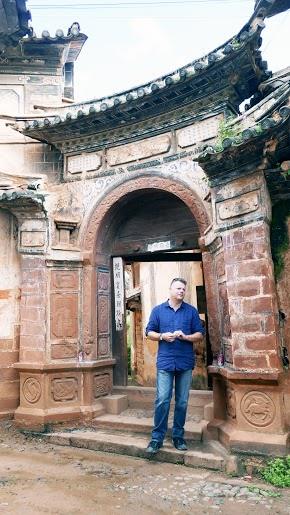
We are now in Xizhou, near Dali, in an area that is largely Bai, and which has somehow embraced heritage in a way entirely unlike the rest of China – I have not seen a skyscraper for two days. Closer to the coast, “heritage” seems to mean that everywhere gets a shopping mall and a car park, and a bunch of hawkers selling plastic machine-guns. But out here, it means that the old architecture is retained, with acre upon acre of quaint pointy-gabled houses, temples and taverns.
Green foothills loom above us on all sides – they will eventually merge into the Himalayas. This is the locus of the old Tea-Horse Route, a lesser-known trade network that sent tea into Tibet to buy ponies for the Chinese market. Salt, tea and trinkets would cross over the mountains into Burma, often carried by porters lugging their own weight or more, singing a song that went:
Six steps up and rest
Seven steps down and rest
Eleven steps flat and rest
You’re stupid if you don’t rest.
I’ve heard that someone would bang a gong at the end of each verse, signalling the next brief stop. Two hours’ drive into the mountains bring us to Shaxi, once the centre of the Tea-Horse network, now a slightly-touristed heritage town, selling wood carvings and Yunnan coffee. The place is plainly on the backpacker trail, and boasts an untold number of boutique cafes, tea houses and restaurants. Lunch is dry-fried beef in crisped mint leaves, Yunnan ham in tofu and goji berries, and tasteless mushroom fronds harvested with a sickle from the nearby canal.
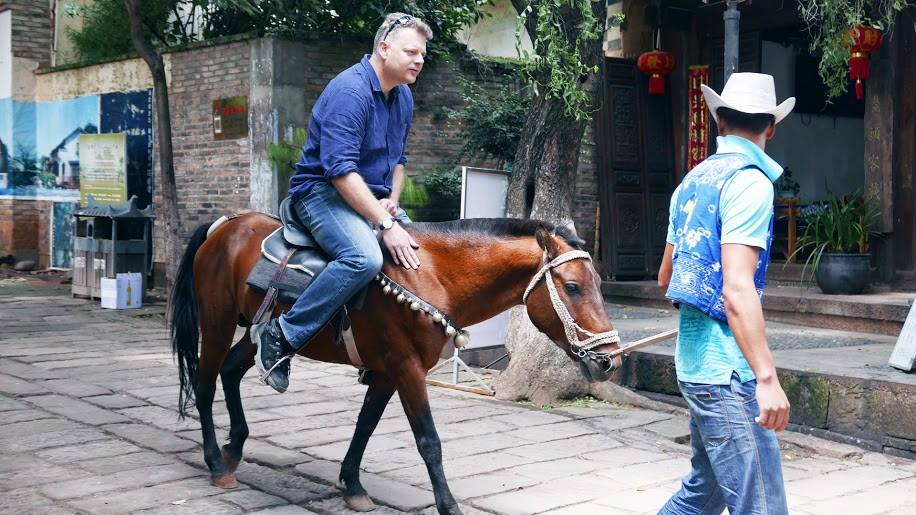
My job is to walk around town reiterating what I’ve just told you, until two Bai dressed like Marlboro Men trot past on ponies. A price is swiftly agreed, and I am hoisted up onto Zhitu (Red Rabbit), an uncomplaining little horse supposedly descended from the pack animals of the old trading routes, so that I can continue my explanation while riding along. I look ridiculous, like a gorilla perched on a sausage dog. I am taught how to say whoah in Bai, which turns out to be waah, something I would probably end up saying anyway if Red Rabbit were to bolt. But we walk through three iterations – a wide-shot, a close-up and a safety, and he doesn’t throw me, and I clamber down and tell him he is a good little horse before I kiss him goodbye.
“Why did you do that!?” asks the aghast director.
“I’m British,” I explain. “We only show affection to dogs and horses.”
Jonathan Clements is the author of A Brief History of China. These events appeared in Route Awakening S02E01 (2016).
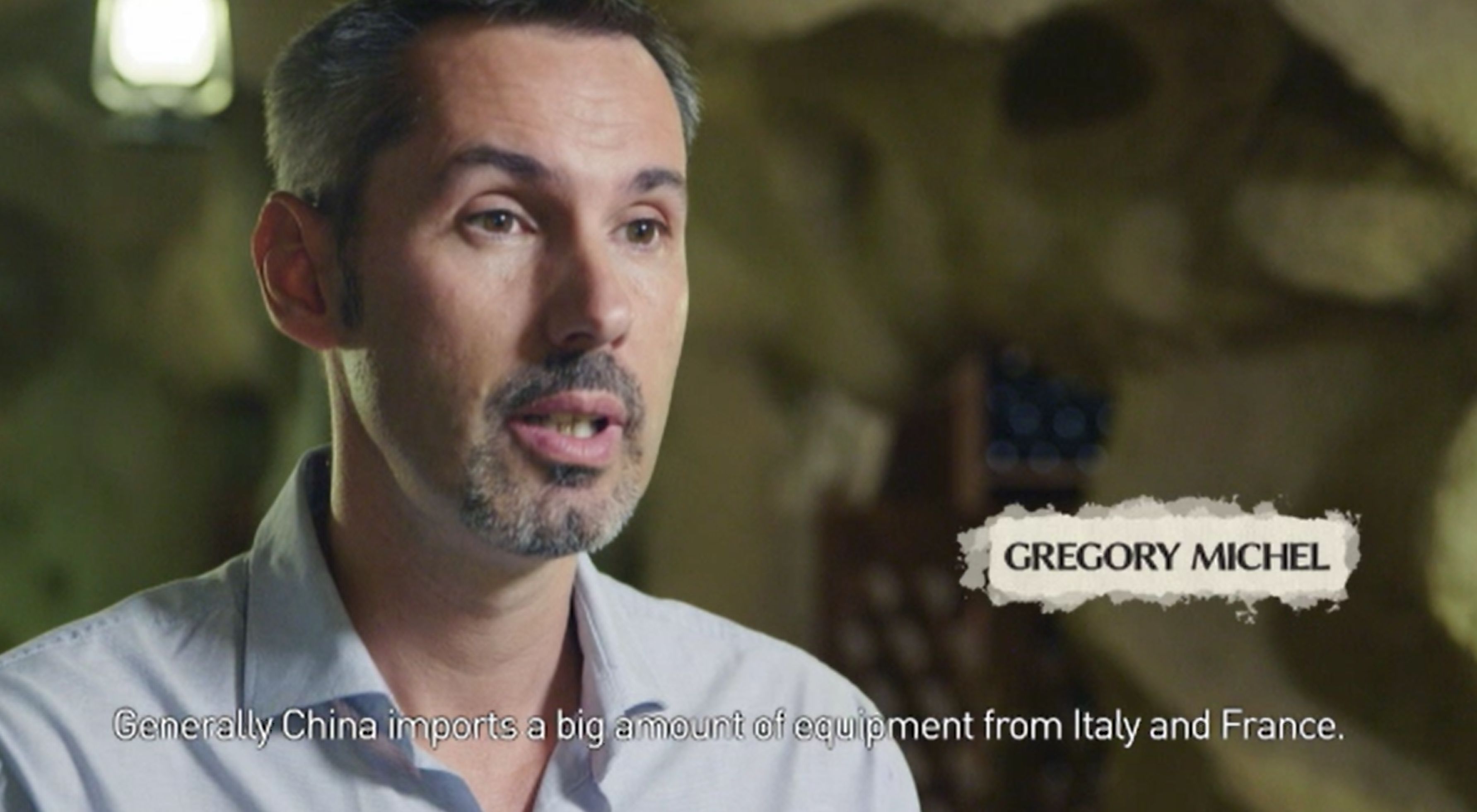
We drive an hour or so through the Xinjiang countryside and the vineyards of the Turfan Depression, to the Loulan Winery, which is not actually in Loulan at all, but has purloined its name. A private Chinese enterprise, it started up in the immediate years after the Deng Xiaoping economic reforms, transplanting French and Italian vines to Turfan soil. The chef de domaine is French: Grégory Michel, a man from Provence who could not possibly have wanted to live here, except for the handy fact that he is married to a Chinese woman and hence regards it as something of a cushy posting.
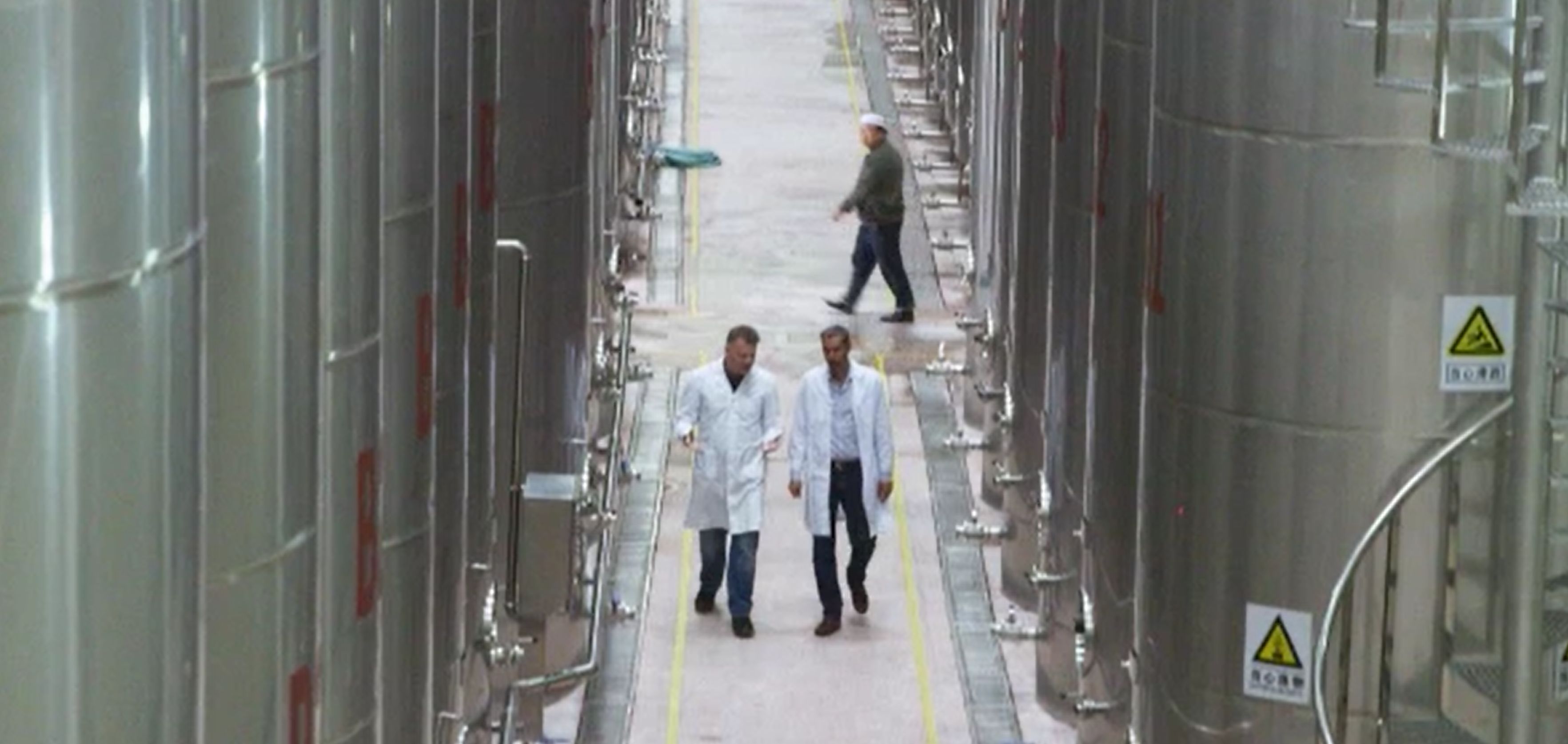
Grégory shows us around the huge factory, with giant steel vats towering thirty feet above us. We all wear little white coats, mine looking particularly petit since it is designed for a little girl, or so it seems. It’s a far cry from Ismayil’s hand-cranked meat grinder, repurposed to mash grapes. Grégory’s industrial-size, conveyor-belt macerator is big enough to throw a whole person into.
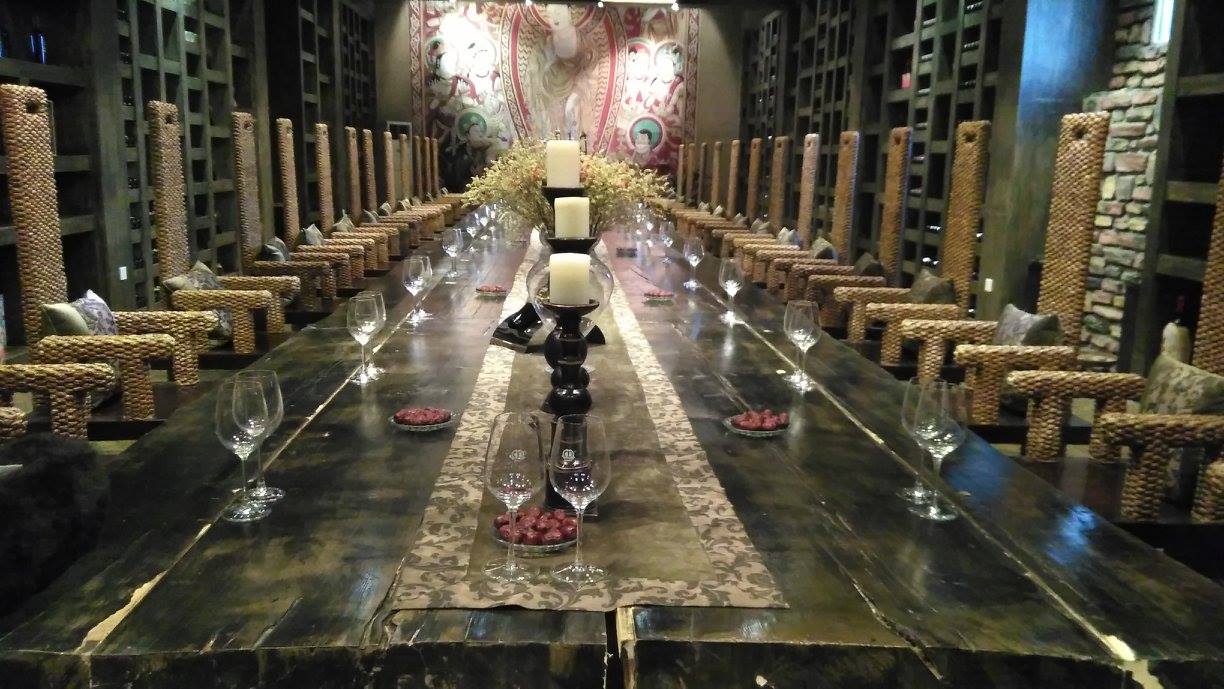
The Loulan Winery is clearly pushing for the luxury tourist market. We wander faux caves decorated with Buddhist art, and sit in an elegant VIP room, with posh chairs of knotted rope, and a giant slab of a Viking table.
Grégory plainly has no idea that a convoy of Buicks is about to descend on his factory, but brightens with each passing moment when he realises that we are the advance party for an entire posse of journalists, who are shadowing our travels in a long crocodile of cars. “I shall get zem drunque!” he promises me, as we wander the pipes and vats.
We do the interview to camera in French, which ought to help the programme look suitably cosmopolitan, and puts a smile on Grégory’s face, which is very difficult with a Frenchman.
The advance car of the convoy turns up at lunchtime, and we snatch the chance to get some shots of me driving it past some vineyards. Meanwhile, the usual too-many-cooks cacophony of the publicity team is at full throttle. Even though they approved my speech outline two days earlier, they have now decided that they wish that my speech was 20 minutes longer. Luckily for them, I am precisely the sort of guy who can write an extra page about Wine on the Silk Road in sixty minutes.
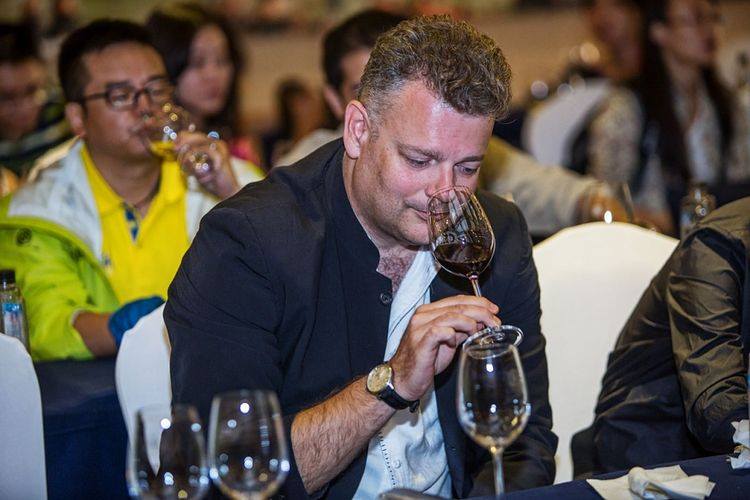
I do my speech about the stories associated with wine on the Silk Road, including the arrival of grapes in the Han dynasty, the sozzled poetry of Li Bai in the Tang, the Mongols drinking themselves to death, and so on. It fills the time nicely and gets several laughs. Grégory then takes to the stage while his minions pour samples for the crowd, and within another 20 minutes, everybody is thoroughly munted on Chinese wine.
The Loulan Cabernet Sauvignon is very nice. This being China, I have never actually been able to have it chilled before, and it is perfectly drinkable. Grégory has plainly done a good job on quality control, although it remains to be seen if he can turn a profit. He says that the cost of making a bottle of wine in China is roughly the same as making one in France, but the local market won’t bear high prices, and the country is so big that simply putting a bottle in every off-licence costs 1000 times as much. Most of the price label of a bottle of Loulan wine is taken up with marketing.
We are invited to dinner, but need to be in Urumqi for the evening, so we hitch a lift with our local fixer, Ali. Halfway to Turfan, the producer calls for a toilet break (we have long since learned not to ask for any more details), and I lurk outside the bogs with Ali, while he sucks on a cheroot that smells like someone has set fire to an old sofa.
“I realised yesterday,” says Ali, “how difficult your job is. You really have only a few seconds to get it right, and there are people on their phones, and shouting at the crew, and there are radios in the background, and people knocking on the door, and the sun moves – you actually become aware of the fact that the sun is moving and there are clouds in the sky… it’s very hard.”
He doesn’t know that he makes it worse by subjecting me to the Gipsy Kings for a two-hour drive through the desert, but I suppose it is his car.
Today, Mr Jiao is supposed to be showing me the remaining parts of the process for making hempen Bai Yi clothes. We’ve been shooting the process out of order, so it’s only on day two that we get to harvesting the hemp itself. He takes us to a tiny little patch of weeds at the edge of a cornfield – it is no bigger than a minibus, but turns out to be the only hemp in the village. The director’s plans to have us wandering through acres of it has to be rewritten on the spot.
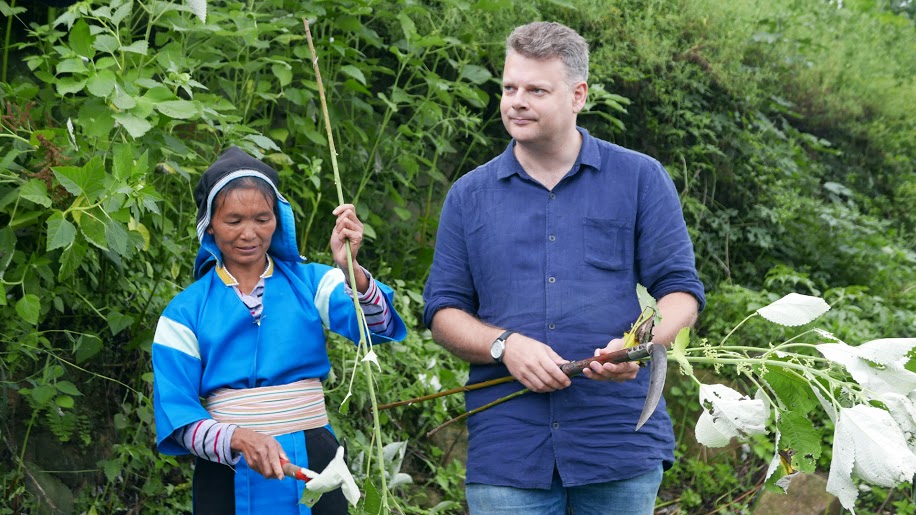
She decides instead to do an aerial drone pass of the pair of us reaching the patch, where three Bai women in their black wimples and blue tabards are hacking at the copse with sickles. But they are so quick at it that the director has to beg them not to cut it all down before we can get to the wide shot. I am told to stand in the field with Mr Jiao and talk to him about hemp, not the world’s most riveting subject. Our drone is supposed to sail over our heads, recording us and the village above us. Except suddenly I hear a sound like a hedge trimmer hitting a bucket of turtles, and realise that the overhead shot has failed to take into account the presence of terraces. Our Yuneec Q500 Typhoon has scythed its way several feet into a stand of corn before coming to a halt, meekly bleeping a distress signal. Mr Jiao fishes it out and returns it, minus one propeller. Luckily, we have spares.
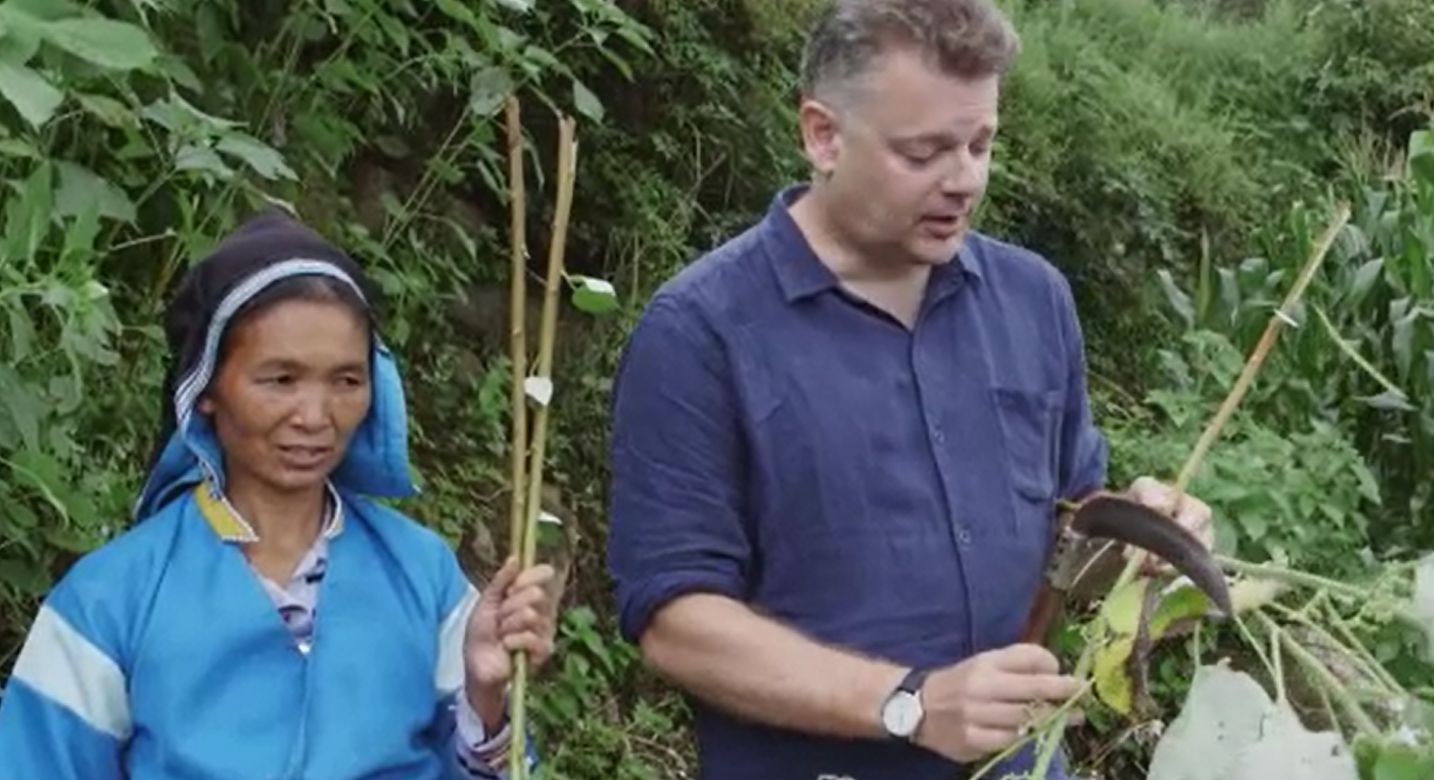
Meanwhile, the wimple-wearing sickle-girls have got bored. One has wandered off entirely, and the other two are stripping some of the hemp stalks to make a basket. They have to be herded back to work. I manfully wade in with a sickle, and hack out a bunch of hemp stalks, stripping their leaves away and casting aside the long stalks. I put the leaves in a basket and head up to Mr Jiao, feeling pleased with myself.
“What are you doing with those?” he asks.
“These are to make the thread, right?”
“No,” he says. “We feed the leaves to the pigs. It’s the stalks that we use to make the thread.”
There is the sound behind me of furious crossings-out in the director’s notebook. As we move on to the huocao stripping and the hemp bark stripping. We are running so late now that the director just puts the camera on the ever-changing numbers of women in wimples, and tells them to get on with it.
“I can’t help but notice,” I hiss to her behind the camera, “that we have basically spent two days filming a documentary about string.”
At last, we have the result, or rather, one they made earlier. To great fanfare, I hold up Mr Jiao’s Bai Yi traditional tunic, a grotty thing which has not seen a steam iron in the last decade. Making it takes up half a harvest of hemp from their little plot, which turns out not to be theirs at all, but shared by the whole village, who must now wait six months for another crop.
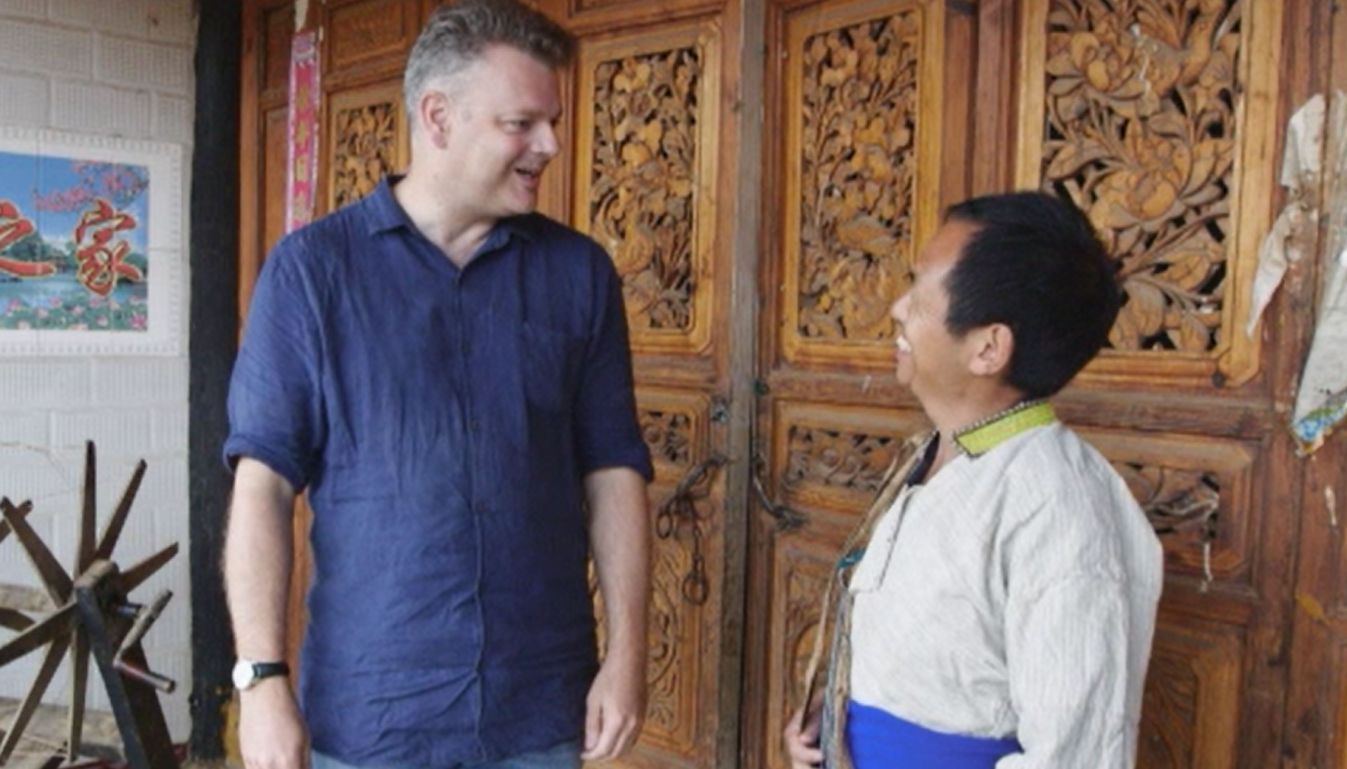
He proudly puts his tunic on, while explaining that it used to be daily wear, but in a common refrain, “nobody can be arsed” and so now they only wear them on special occasions. He tops the ensemble with a blue belt and a man-bag made of leather, which he keeps his phone in.
“Suits you,” I can’t help saying, and he giggles in response.
We are already two hours late for the three-hour drive to Xizhou. The director pleads that we can’t stay for dinner, so we are waved off with a sack of pomegranates, some fresh-made poppadoms, and some nan bread. There is a cup of home-made chili sauce that goes with them, but our fixer drops it in a cowpat on the climb up the hill back to the minibus.
Mr Jiao, the chieftain of the Yi village, wants to have dinner with us to discuss the shooting tomorrow. I dread these occasions, but it goes very well. He turns up wearing a regulation issue tribal nylon anorak, brings his big brother, who is the designated driver. Our own driver, unlike the sullen anti-socials we have had before, joins the talk (a huge benefit having another Mandarin speaker at the table), and they are clearly pleased with the attention they are getting. The chief is a small, small man with dark brown skin, more Burmese than Chinese, and with a high-pitched voice that could easily be mistaken for a woman’s. He will be interpreting for me, because his mother-in-law, who is the hemp spinner, only speaks Yi, an antiquated version of Chinese that sounds like someone throwing a pot of alphabet soup down some stairs.
The food is Chinese, but recognisably distinct – lantern-shadow beef, fried squid, a soup of river fish and mountain greens. Mr Jiao orders a bottle of Damaijiu, a local malt firewater that is supposedly 45% proof, and from which the crew recoil in terror. It is smooth and tasty, like vodka, and between us we down the whole (small) bottle until he is red-faced and giggly.
Our director looks Chinese, but she grew up speaking Teochew and Malay, and her Mandarin is understandable but error-riddled, such that if she gets tipsy she sounds like the policeman in Allo Allo. On the last shoot, she apparently mixed up her vowels so much that she ended up wishing a departing artist “a trip in which you suffer from permanent influenza.” Our fixer pleads with her not to open her mouth at all. Tonight at dinner with the village chief, she realised that he was making his own personal documentary about his tribe’s way of life, and offered to share with him whatever drone footage we got tomorrow. However, owing to some chance mispronunciations, she ended up saying: “And tomorrow, if you like, we will masturbate all over your village.” I thought he was going to spit out his tea.
But he seems nice enough, and toasts me with a story of his international friends. “You are only the third English person I have ever met,” he says to me. “The second was an ethnomusicologist who came to study our songs. And the first was Margaret Thatcher, your Iron Lady.” Apparently, she came to see some sort of ethnic dance he was in many years ago.
Today we are shooting the collection of wild huocao, literally fire-grass, i.e. tinder. It looks like a white-backed dock leaf, and forms the weft of their traditional clothing. The warp is hemp, which we will also have to harvest.
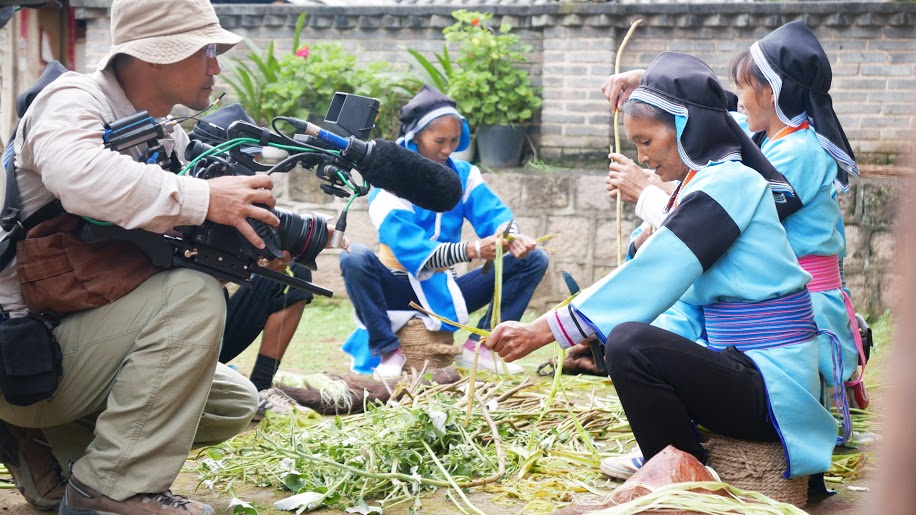
Mr Jiao has assured us that collecting the huocao is a two-man job. But by the time we set out, we have somehow acquired a dozen Bai Yi women in black wimples and blue tabards, clutching baskets and giggling at the thought of being on telly. The director is ready to blow a gasket, because she knows what will happen next. The Yi women’s love of telly will proceed in inverse proportion to the amount of time they are to stand there, no there, no over here, no, please be quiet. Nobody say anything; please stop moving; go and do that thing again; now go and do it over there. Only one of them actually speaks Mandarin; the rest only speak Yi, which means all the spoken directions wander at a leisurely pace through several stages of Chinese whispers, and are often countermanded before they reach the last in line.
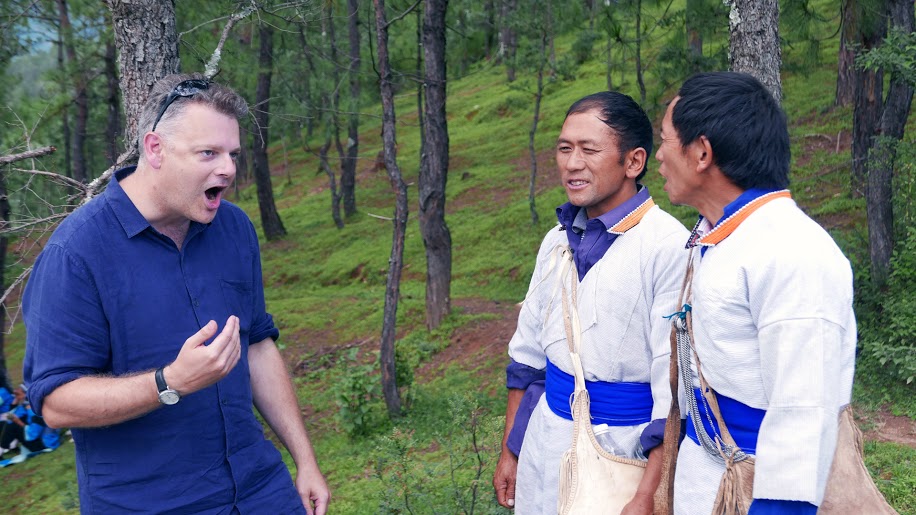
Meanwhile, two men, wearing traditional hemp clothes over their tracksuits, burst into song on the mountainside. It’s a yodelling song, about how happy one is collecting huocao, wondering if there is anyone else on the mountainside of the opposite sex, who wishes to sing a refrain in response. It’s all very idyllic for about ten seconds, but then the women’s refrain drifts up as well, ruining the immediate sound recording. We go for another take, but now the men are singing in response to the women, and by the time we have shut them up, the women are singing back. This medieval tinder hook-up continues until it starts to rain, but Alvin the cameraman grabs some footage of the women puttering around in the grass, and of them trying to teach me their song with comedy clumsiness.
Gwyneth, my name for the only woman who speaks Chinese, is determined to stand close by, because she is the one who can show me what huocao is. Meanwhile, a cowherd wanders across the back of the shot with clanging cowbells. The director is starting to regret ever saying that she was looking forward to shooting in the countryside, since there is soon just as much noise pollution as in a built-up urban area, except here we are also hot and clammy with mosquito repellent and sun lotion, and there is nowhere to have a piss. You would think there would be handy bushes everywhere, but behind every one is a black-wimpled woman in a blue tabard, singing a song about grass.
Dinner is back at their quaint farmhouse, sitting on benches in the courtyard. The women eat separately, chattering in Yi about whether or not this will make them famous. The men dish out the Damaijiu malt firewater, and serve Yunnan food – succulent local ham, chicken and garlic, pumpkins and potatoes, and punguent home-made pickles. A sullen two-year-old boy wanders between the tables, gnawing balefully on a chicken’s head. He’s teething, explains his mother, and the beak is good for him.
“I can’t help but notice,” I say, “that your tribe is called the Bai Yi, meaning ‘white clothed’, but everybody’s wearing blue.”
“Ah yes,” says Mr Jiao brightly, “making the white clothes is such a faff, we can’t be arsed any more.”
An 0545 start, up for breakfast and in the van for the two-hour drive to Weinan, the home town of Xi Jinping’s dad. For this reason, this city in the middle of nowhere has an incredibly swish hotel, in which every room looks like a suite. I have another robot bathroom with automatic, motion-sensitive lights, and two complimentary condoms, courtesy of the Weinan Health & Safety Initiative. What on earth do they imagine goes on this hotel? Not a lot tonight, because the film crew will be the only people staying.
Our merry band of nine (the crew and two drivers) has now swelled to eleven, since the guy from the Buick dealership (our sponsors) has decided to bring his parents along. Christ knows what he must have said to them when he got home yesterday, but presumably they were very excited to sample the glamour. It’s a ridiculously unprofessional thing to do, and makes us look like a convoy of muppets.
They are underfoot all morning, soon as bored as only a spare wheel on a film location can be, and largely have to be left at a remote farmhouse while the rest of us shuttle backwards and forwards on a mountain road through fields of corn.
The morning is dedicated to getting shots of me driving the Buick up hairpin turns on mountain roads – a disastrous prospect remedied by getting the driver to do all the hard work, and me to do all the bits that are straight lines and close-ups. We are in the foothills of the Qinling mountains, in sight of Huashan, with the peaks in the misty distance, and endless fields of ripening corn. It’s going to look great, although we still manage to attract eleven dicks on mopeds who stand around pointing at us and asking what we are doing.
Mickey the Mic is the sound man, so spends all day with eight kilos of recording equipment strapped to his front like a cybernetic beer-gut. You can tell which one he is, because his regulation-issue floppy sunhat has holes cut in the brim for his headphones. He is Singaporean, with the odd lilt that makes him sound Indian lah, and has the Singaporean habit of injecting the Chinese particle denoting a change in circumstance into the end of any sentence where it would be relevant. I have started to pick up the pidgin English of the crew, and was heard at one point today saying: “Soon be dark lah.”
Mickey is also the drone man, which means that he swaps his sound rig for a complex remote-control tray, with which he joysticks our robot team member Yuneec Q500 Typhoon, a squat, sleek metal dragonfly with four rotors and a gimbal-mounted camera with a 16-gigabyte memory card. Unfortunately, its batteries only last for ten minutes at a time, which means the crew need to be absolutely, totally sure where everybody is, and that the shot is ready, before they send the Typhoon into the air. It can hover with almost perfect stillness if the wind is low, and even has a nifty function called Follow Me, whereby it will zip along at a pre-set distance from whoever is holding a thumb-operated remote-control beacon.
This is how we pay the bills. Buick are fronting the cost for the entire series, as long as their vehicles get 30 seconds of screen time in each episode, which apparently still works out cheaper for them than making an actual TV commercial. We’ve given their car advert-level exposure as it roars up the mountain road and skids around corners, occasionally with me at the wheel, occasionally with my stunt double while I duck in the back seat with a walkie-talkie, yelling instructions in Chinese.
We are up in the hills to see Master Wei Jinquan, who performs Huaxian Shadow Plays. I am dreading it, but he turns out to be very chatty and a perfect interviewee, ready to rattle on without pause for five minutes after the most minimal of prompting. He is the nth generation of his family to make, paint and perform shadow puppetry and lives in a village that was once home to dozens of performers. Today, it is a cluster of huts populated almost solely by the elderly and their grandchildren – the adult generation having migrated to the city to work.
We talk for an hour on his roof terrace in the sun, and then he leads me down to his workshop, where he attempts to teach me how to cut the translucent cowhide that makes the puppets. The hide has the look and consistency of an A4 sheet of human fingernail, and he tuts and fusses over me while I hold the knife wrong, put it at the wrong angle, and fail to move the leather (you move the leather, not the knife) on the wooden palette. The crew are all snickering as he calls me a moron, and I protest to the camera that every time he instructs me, he adds an “and one more thing…” that I could have done with knowing before I start. I am also mic’ed up and able to mutter asides regarding my fear that he is going to stab me with his awl if I get it wrong again. It should be quite funny, and only two days in, we are already establishing a general tone of arch sarcasm that I think I can probably keep up.
At one point, the crew are repositioning the camera to zoom in on my hands at work, so I attempt to explain to him what’s going to happen.
“Now I’m going to do it wrong again,” I warn him.
“Well, you don’t seem capable of doing it any other way,” he mutters.
For me, the great relief is that I am able to function fully in Mandarin all day without holding up a professional film crew, although I am probably operating right at my ceiling of competence. It doesn’t help that I keep forgetting the word for shadow puppet, which is pi’ying. The clock sneaks towards six, and I realise that we are done for the day, suffusing me with a great sense of relief and tiredness, and what appears to be ten or fifteen minutes of material for the final edit – a good haul for a day in which we banked maybe three hours of footage.
Then it turns out that there has been a miscommunication. He hasn’t realised that we are staying the night in Weinan, and thought we would be filming a performance at a Xi’an theatre tomorrow. No, says the director, we will film you here tomorrow. But if she wants it traditional, it has to be at night, and by tomorrow night we will be on our way to the airport. Reluctantly, she decides to stay and shoot a performance in the village, which means waiting until after dark while Master Wei’s teammates set up the travelling theatre in the car park in front of his house.
The local villagers come out to gawp, and a gaggle of little girls sit in a line on a log for a while, looking cute until one of them initiates a farting competition. Others lurch and stamp around the car park, trying to catch crickets in their hands. Alvin the cameraman sets up the back-up camera to shoot in time-lapse, as four old men lash together a rickety series of trestles to create a giant punch-and-judy shed, faced by a white cloth the size of a very large widescreen television. They all clamber inside, with screechy Chinese instruments and gongs, with Master Wei sitting at the centre, his puppets at the ready. They then start clattering out a wailing Chinese song, and the shadows start moving, with the story of Pigsy Eats Some Watermelons, and some martial arts thing about two generals and a comedy horse fighting each other until someone dies.
Alvin clambers into the staging area to film among the team as they perform, and so we get the same play from two different angles. Reaction shots, however, are all going to be mine, because the crowd seems indifferent. The little girls are soon ignoring the play and instead crowding around each other to take selfies of themselves not-watching the play. A boy on roller skates trips over the power cable, and a small sausage dog starts eating someone’s discarded snotrag. Master Wei finishes to no applause, which seems to be how these things are done, and the crowd melts away back to their shacks.
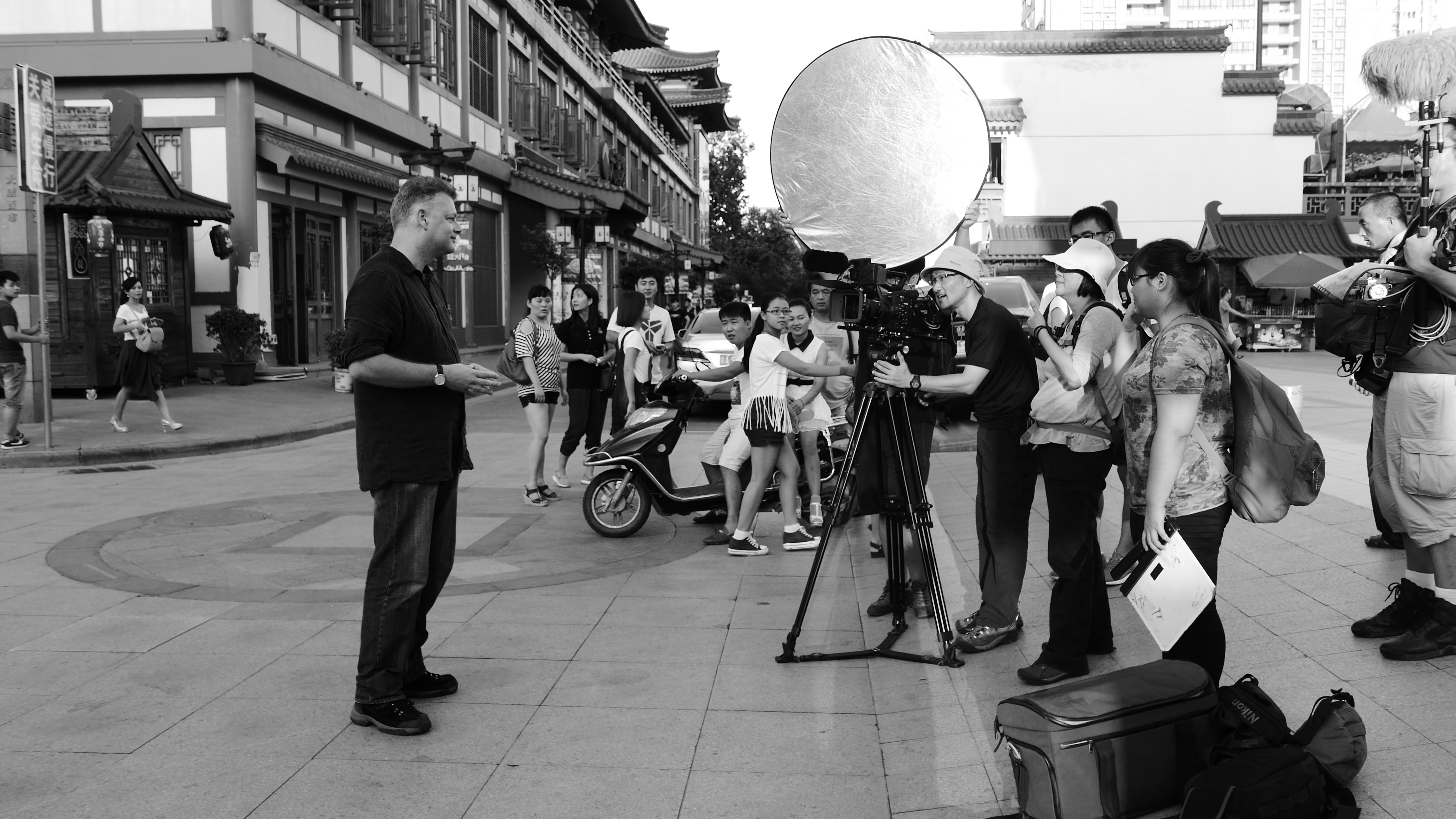
We have a van that could seat twelve, but the rear four sets are folded up for all the gear. There are nine of us today. Two drivers (one with a loaner Buick for the beauty shots), the director, the cameraman, the sound-and-drone guy, the grip, the girl with a clipboard and the fixer. Oh, and me – nearly forgot. I am the “talent”, and my talent is having to say precisely the right words, in precisely the right order, in the sole 20-second window I am liable to get in the midst of a quarter-hour’s faffery. This is harder than it sounds, because it is 77 degrees in the shade, I have to wear oddly warm clothes to fit the continuity, our very presence draws crowds of people who are both noisy and distracting, and everything I say has to be written on the fly, but also factually accurate, and verifiable by two sources – those sources not to include online editable wikis. Otherwise, anything I say can be questioned by National Geographic S&P (Standards and Practices) back in Washington, and the footage will be useless. There is no space for an umm or an err… I cannot get any proper nouns even slightly wrong. I can’t repeat any words in any given speech.
Out to the long road south of the Great Wild Goose Pagoda, so we can do some shots of the Buick driving around past Chinesey things. The car we are using in on loan from the Xi’an dealership, so we have a driver wearing my shirt just in case the clothes are visible through the window, driving through all the fiddly bits. All I have to do is drive in a straight line from one point to another on two occasions, so they can get footage of me at the wheel in a built-up area.
As the crew start to set up, the security guards assemble. First a passing lady with a red armband. Then two men with walkie talkies and red armbands. Then three men with pressure hoses, washing the nearby statues, also with armbands. One of them stands right in front of the camera, calmly and without rancour. He won’t get out of the way until he sees our pass. We don’t have one, and when the fixer rings through to the tourist office who is supposed to have given us one, they don’t know who she is. We waste nearly an hour while she faffs with them, while the red armband stands in our way. Eventually, she returns with a signed form, and he pretends to have forgotten that we are there, walking away talking to an imaginary interlocutor on his phone.
Up to the Great Wild Goose Pagoda itself for me to do a 20-second piece to camera about how it was built as a repository for Tripitaka’s Buddhist scrolls. This takes two hours, because the camera has to be set up, the sound checked, the area cleared, the script agreed upon, and then a bunch of arseholes with mopeds and plastic machine guns cleared out of the way. Our new-found filming liaison, a specky woman in a mauve blouse, frets that by walking from the south side of the tower to the north side, we have effectively walked out of her jurisdiction, and so might face more red armbands at any moment. Meanwhile, crowds of people assemble nearby, pointing their iPhones at us and trying to work out if I am someone famous.
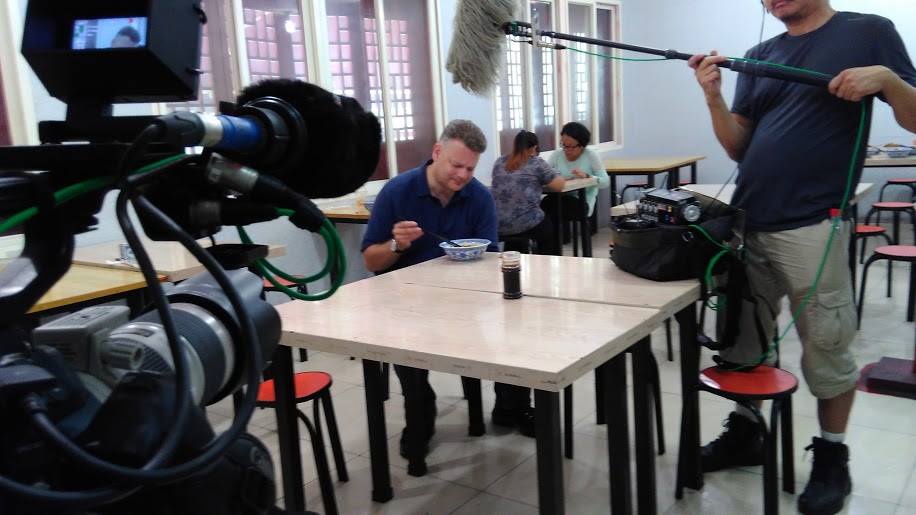
Up to the Muslim Quarter for biang biang noodles for lunch. We luck into a relatively deserted Muslim restaurant where I can talk to camera about the history of this particular dish – international as it is, with American chilis and tomatoes, carrots and cumin from westwards on the silk road, noodles made from wheat, etc. The restaurant staff are also not camera-shy at all, and keen to let the cameraman film them at work. It is a national holiday, so outside it is utter chaos. But we get lots of footage in the can.
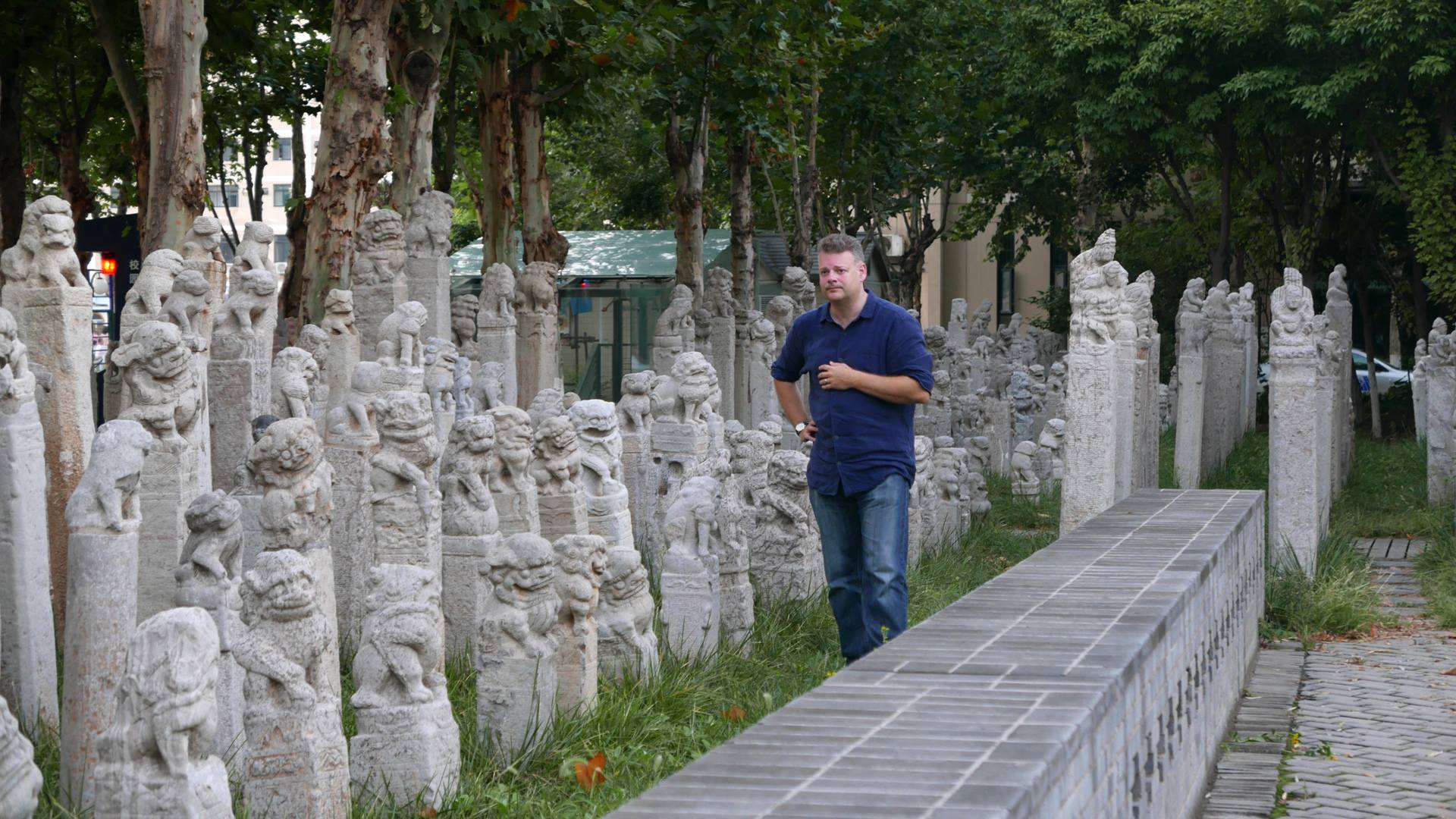
Then the Tang Western Market for me to talk about the origin of the Silk Road, and finishing up at the Forest of Lions on the campus of the Xi’an College of Fine Arts. Or is it the Arts University? Or is it the Xi’an University of the Arts? Got to get it right, and got to get it right before the light goes, and before that old lady behind me throws bread to the ducks, or we need to change a camera battery, or before someone’s car alarm goes off.
At the end of the day, I ask the director how much footage we have got of the 132 minutes we need. She thinks maybe 60 seconds. But it was our first day, the crowds were distracting, and we lost an hour to battery hunts and an hour to official interference. It could be worse, and tomorrow should be better. Although tomorrow may be a different story, because I will be in a town I have never been before, talking about puppets.
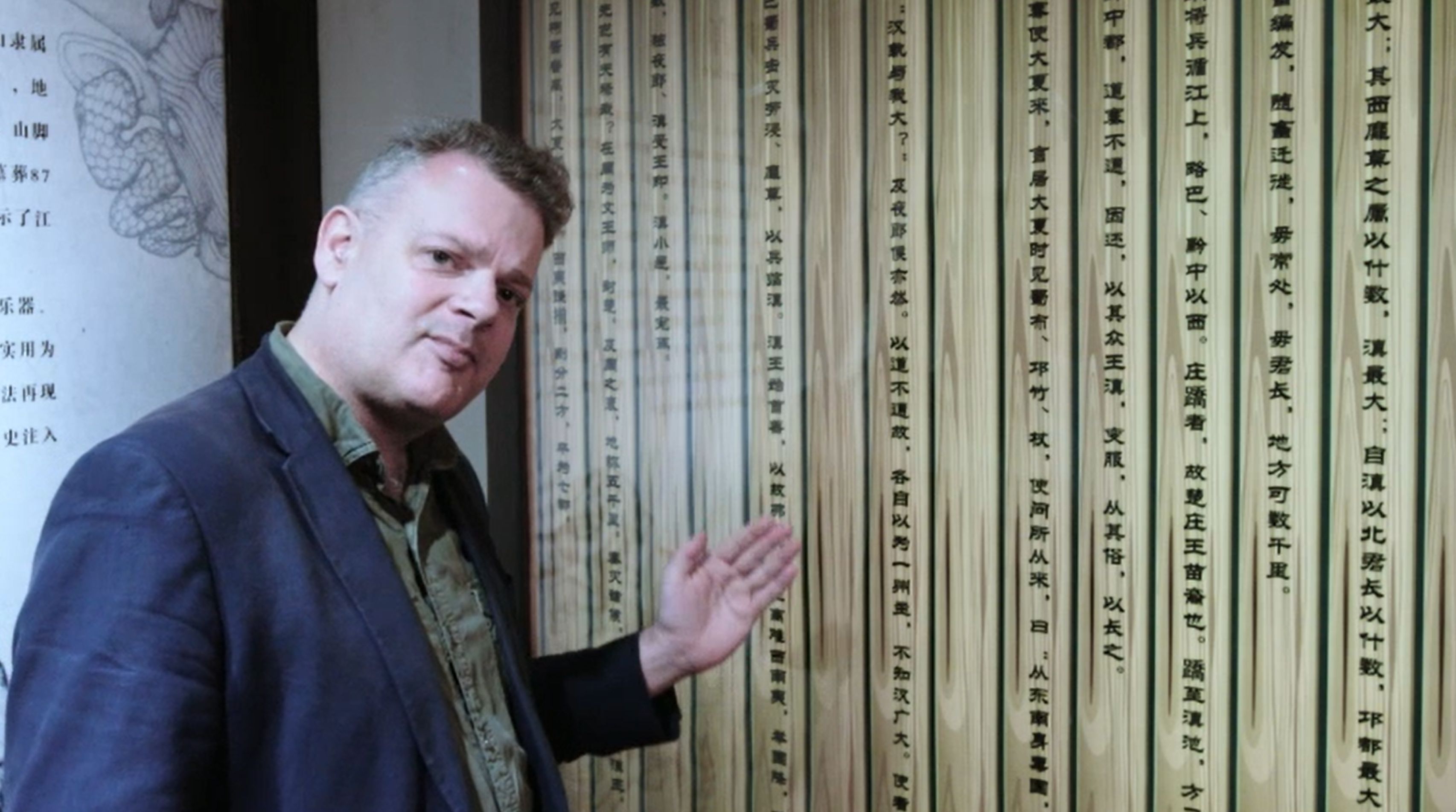
On the wall in the Yuxi Bronze Museum is a giant set of bamboo strips, engraved with classical Chinese. This is where I earn my money.
“Aha,” I say to the camera, “here we’ve got the entire text of the chapter of the Grand Scribe’s Records about the ‘south-western barbarians’. It starts with a geographical description of the region, the names of the tribes (see, here’s the Dian), and the lay of the land, and then it goes into the story of their first contact with the Chinese. Here we get the emissaries turning up from the Han Emperor, and a fantastic question from the Dian king, when he asks the ambassadors: ‘Is this Han realm bigger than mine?’ He really had no idea who he was dealing with, but when he finally submitted to the Han emperor, here it is, he is bestowed with a ‘royal seal’.”
It’s a good morning in the bronze museum, where the staff stare open-mouthed in amazement as the foreign film crew completely ignores most of their exhibits, and concentrates on the stuff they consider boring – the bamboo strips carved with Chinese, and a naff-seeming diorama of life in Dian times. Except it’s not naff, I point out. Every single element of it has been drawn directly from the bronzes we have been examining. We have seen (and filmed) the original artefacts that informed the diorama’s hunting scene, its battle scene, and the scene of human sacrifice underway on a nearby hilltop.
Lunch is a fish hotpot cooked on hot stones, with Yunnan rice, which is like normal rice but comes with fried potatoes and bits of bacon. The director allows us fifteen minutes to descend like jackals on a nearby pottery shop, where I spend all the money I have earned this morning buying a new tea set, rice bowls and two cups decorated with the Heart Sutra. I think, between us, we manage to spend about £300, which makes the owner’s day, as she only opened ten minutes beforehand.
In the afternoon, we head out to a pokey village at the bottom of a mountain, where the locals inexplicably worship a mermaid goddess, whose pert baps seem to have been designed by a sculptor who has never seen a woman’s chest in real life. A cluster of pensioners, sunning themselves in the marketplace, soon drift over like zombies to see what the film crew is up to, but they are incredibly friendly, and our cameraman gets a lovely shot of me talking to three wizened old men about topless mermaids.
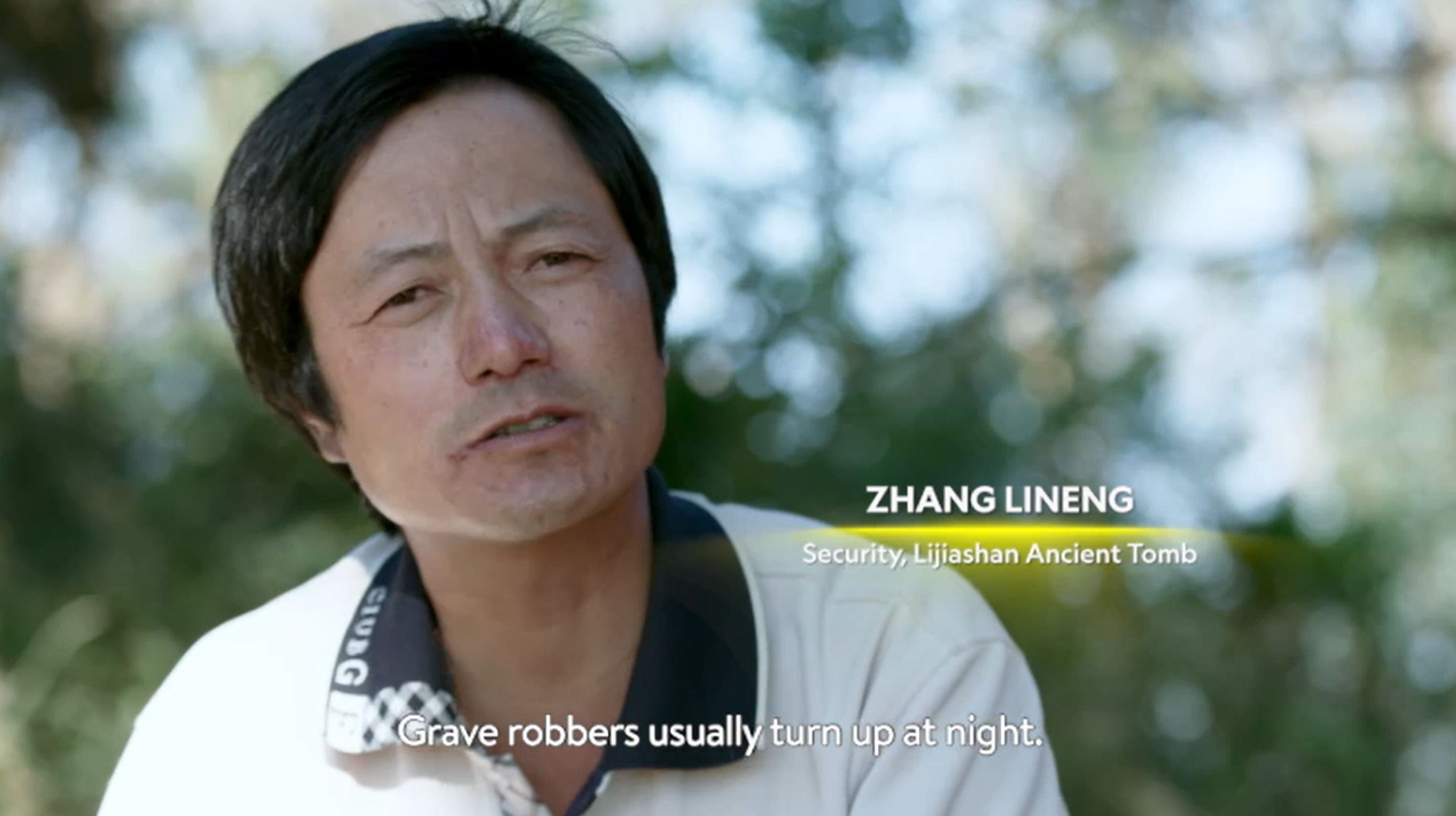
We are here to climb Lijiashan, the mountain where some eighty Dian kingdom graves were unearthed. It involves a wheezing ascent up endless steps, to a small guardhouse where we find Zhang Lineng, the watchman.
A huge part of my job, and something I am embracing with greater fervour as time goes by, lies in putting the interviewees at ease. Mr Zhang didn’t even know he was an interviewee before we showed up, and I am the first foreigner he has ever met. But I bound in and introduce myself, and get him chatting about his life.
Our fixer and Clicky the Propaganda Guy, who is still lurking around, protest that the man’s Chinese is unintelligible, and that we might need an interpreter. But he makes perfect sense to me, no more or less than anyone else. This has happened before, in Shandong, where Chinese people found locals difficult to understand, but I found them no harder to understand than anyone else. The local accent fiendishly replaces all H’s with F’s, and occasionally drifts towards Cantonese, but that’s it.
So he takes me around the pit where the Famous (not that famous) Cow Tiger Table was unearthed, and reminisces about how strange it was to the local villagers, like him, when their hilltop was suddenly deemed so important that the People’s Liberation Army sent an armed detachment to guard it.
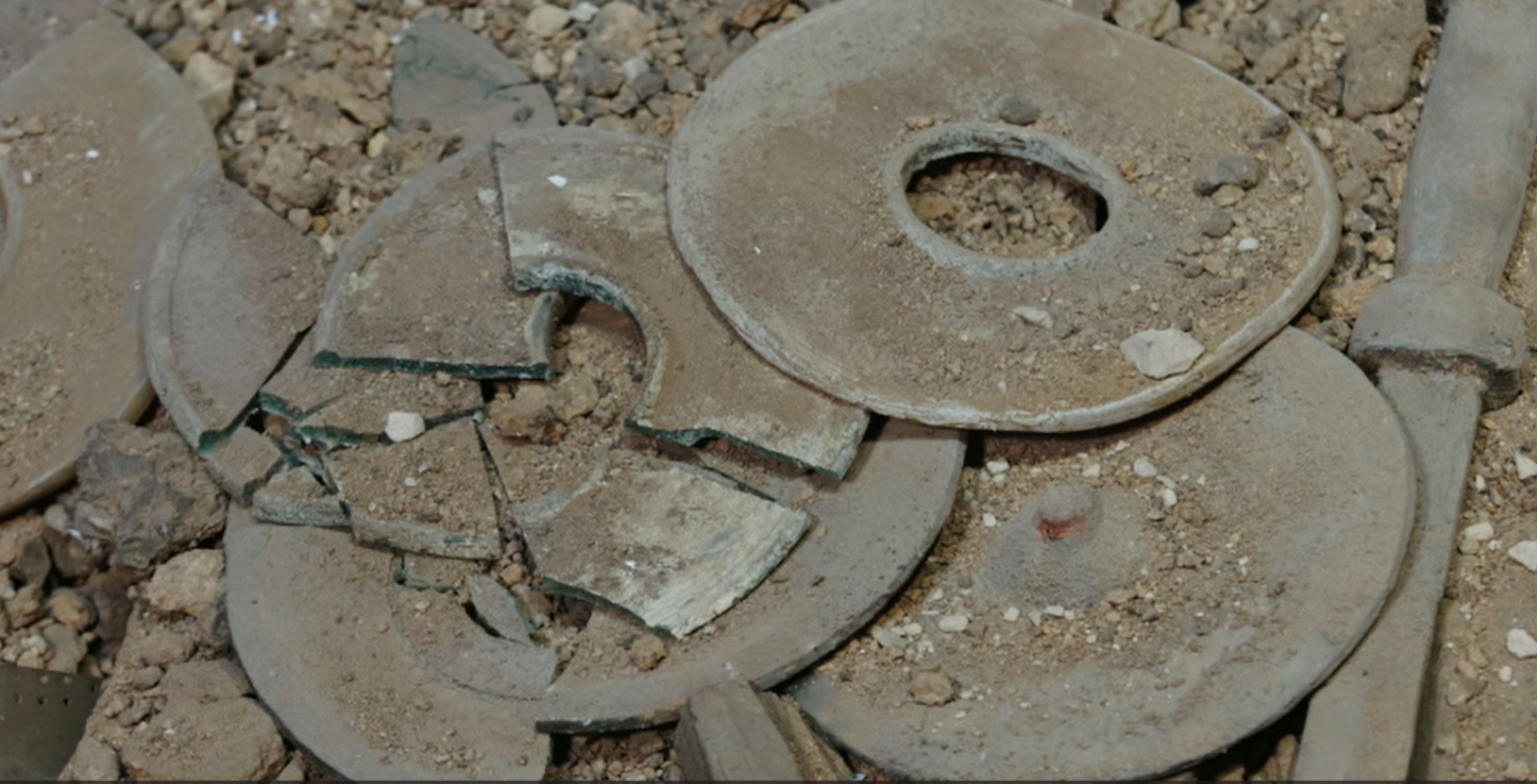
Mr Zhang is a rare kind of interviewee, because he is a Michael Wood sort of choice – not an archaeologist or a historian, but a random man of the people who happens to work near the site. So while it’s not quite the usual National Geographic experience, it is oddly entertaining. He reminisces about how weird it was when he was a boy, and truckloads of archaeologists started turning up at the village at the bottom of the mountain, and how was there, literally standing at the side of Pit 69, when they unearthed a bronze cowrie shell container, decorated with dancing Central Asian shamans. He also reveals that the grave contained two bodies, a woman and a murdered slave girl, but that the coffin the archaeologists found was inexplicably thrown away.
I ask him about life as a security guard.
“It was tough in the early days. The thing that’s made the biggest difference is the phone. If there are robbers on the site, I can call for back-up. I can call the police. Or someone who sees something suspicious can just call me. Life is a lot easier now.”
I ask if things get creepy up on the mountain alone at night.
“Well, down in the village people say that sometimes they can hear fighting. Swords clashing together and people screaming in a language they don’t understand. There was one night when I heard a real commotion outside, but when I came out to look, nobody was there.”
Clicky the Propaganda Guy is gesticulating wildly, calling a time-out on something he really doesn’t want discussed on camera. Second-hand local myths are one thing, but a self-reported experience of the supernatural will not be allowed on television in China.
At which point, the director slaps me in the face.
She had seen a mosquito on my cheek, and took extreme action in a split-second, lest it suck my blood and leave a lump on my face sure to ruin the next week’s filming. Her palm lands with an impressively loud whack, and oblivious to the reason why, all Mr Zhang sees is a small Chinese woman beating up the presenter.
“Wow,” he says. “You have a tough job.”
Our pocket drone struggles like the Little Engine That Could against the high winds on the mountain top. There is just time to rush back to the Bronze Museum, which now has the sun on its façade, to shoot the opening shot of me entering. Except the museum has closed five minutes early and the staff have scarpered, so we have to cheat by placing the camera on the other side of the street, and having me walk across the road as if it is the path leading up to the door. But we have to wait first for a marching column of soldiers to pass by. They stare at me warily, until I give the Communist Party salute, at which point they all start giggling and saluting back.
Up at 0630 for the two-hour drive around the lake to the village where Yang Shaohua has his gallery and workshop. I blunder in late, thanks to having the wrong address, and find him holding court around a posh tea table, chuffing on a water pipe like a giant bronze bong.
Mr Yang is handsome and charming, knowledgeable and talented. I know that sounds like me buttering up some Party bigwig, but he knows the bronze-casting process so well that he can give a ten-minute speech in answer to a simple question about how it’s done. He knows everything from the chemical formulae to the metallurgy mix, and he doesn’t just cast the bronze, but carves the models and draws the original concept artwork. He is also a great host, faffing with his tea paraphernalia while the crew smokes fags in his gallery, so much so, that we seem to lose over an hour during the day to tea.
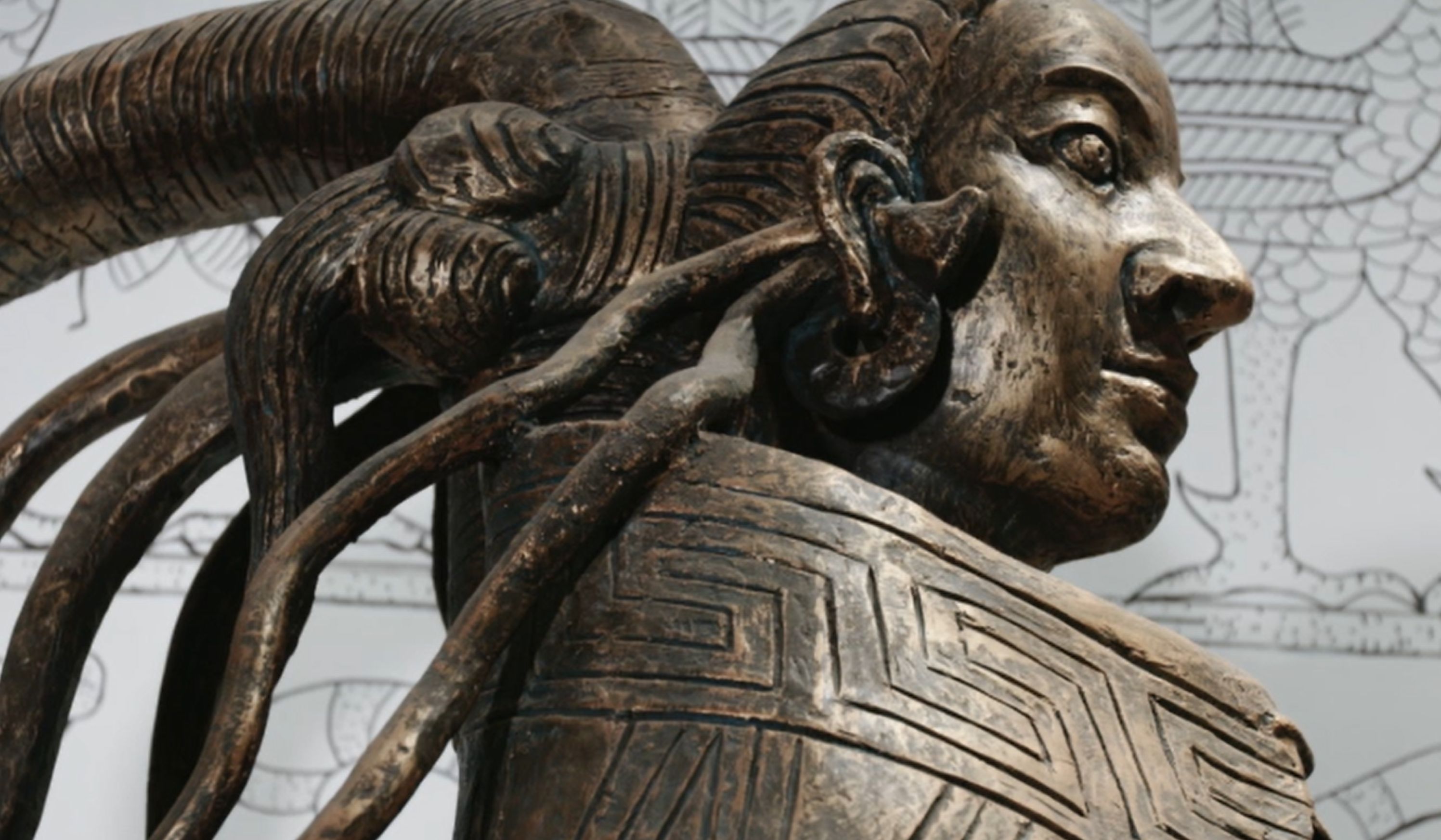
Mr Yang is responsible for a lot of the statues I have marvelled at in Chinese public spaces, including the giant golden phoenix in front of the Yunnan Provincial Museum. He tells me about the three-metre Mother of Dragons he made for a temple to the Baiyi people’s famous rain goddess, and his biggest-ever Buddha, a ten-metre effigy for a temple somewhere. At the moment, he is working on soldiers for the Songshan military memorial, although when he leads me into the modelling room, I am surprised to find four life-sized clay men standing to attention in puttees, pith helmets and Hitler moustaches.
“They are Japanese devils,” he explains. “They get a lot of Japanese tourists there, so I suppose it does no harm to give them something to take a selfie with.” The Japanese soldiers all have real shoelaces and stitching, because it’s easier to do that and let the wax mould take an impression from the real thing, than it is to painstakingly carve them.
Since he is an official Intangible National Treasure, the Propaganda Bureau are all over this one like a rash. A beaming woman in clacking heels keeps ruining the sound recording, while her minion with a clicky camera keeps wandering into the background of every shot.
“A cameraman,” mutters our director, “of all people, should know not to ruin someone else’s shot.” She is particularly annoyed because Propaganda are insisting on “entertaining” us at a lunch banquet, which gives us only an hour to shoot our interview before we are dragged off to a restaurant with eleven other people, and forced to make small talk with a bunch of local officials only there for the free boondoggle, who manage to piss me off from the get-go by asking me if I can use chopsticks.
Bearing in mind that I had walked into the room, introduced myself in Mandarin, and embarked upon a conversation about Bronze Age culture in south-west China, I think my “of course” was an object lesson in tact. The last thing I want is chili fish-head soup for lunch, and the last thing our director needs is an hour ripped out of her shooting schedule a mere hour after we started.
Mr Yang, in the meantime, is having a whale of a time talking to us about his work, which often involves reproductions of Dian Kingdom artefacts. The museum people, in fact, have so much trust in him that they have let him digitally scan all the Dian Kingdom finds, and he does a roaring trade in replicas of the Famous (not that famous) Cow and Tiger Table.
He warms to me right away when I correctly identify a taotie totem beast on a replica Shang cauldron, and immediately ask him if a stylised goat was made for Yuexiu park in Guangzhou. I am, in fact, able to tell him that I have seen several of his statues in various parts of China.
“Do you need a bronze bust of yourself?” he asks. “I can knock one up for £3,000.”
No, I say. Nobody is interested in seeing my bust.
It’s not the easiest of days, because shooting in a foundry next to a building site is a non-stop cacophony that plays havoc with the sound. Nor do we have footage of several parts of the process, including the all-important molten bronze bit – we are trusting Mr Yang to send us something shot with his phone. It doesn’t help that the gallery has three mangy guard dogs who have industriously shat everywhere. But Mr Yang shows me how to pour wax into the mould to make my very own Famous (not that famous) Cow and Tiger Table.
The wax is then wrapped in clay, and the clay mould thus formed is heated until the wax flows away, leaving space for the molten bronze.
“Of course,” he says, “back in the old times they used beeswax, but these days we use the industrial variety.”
The word for honey in Old Chinese is an Indo-European import, mjit (as in mead), implying that honey husbandry, like chariots, is something that came into China with foreign settlers sometime in the Bronze Age. And that means that the Bronze Age itself could also very likely have been something imposed on the Chinese by foreign invaders – mysterious elites like those Dian warriors.
“Oh, I’m not surprised,” says Clicky the Cameraman from Propaganda, as we sit around the tea table for yet another break. “I mean, there’s a whole foreign city under the water of the lake here. They found it when they were laying cables for the power plant, and the government banned anyone from investigating further.”
The underwater city in Fuxian Lake was supposedly carbon-dated to 250 BC, around the time of the Dian Kingdom, but our director refuses to believe it. She suspects that the whole thing was a hoax thought up by local students to promote tourism in the region. “Not really,” claims Clicky from Propaganda. “The reason there hasn’t been any news about it since 2007 is that we’ve put a blanket ban on talking about it.”
Mr Yang doesn’t want us to leave. He lures us back to the tea table for another cup, and then points out that because we have a two-hour drive home and it’s already six, we might as well stay in town for dinner.
“I know of a lovely place nearby that does traditional peasant food,” he promises. It’s only when we are standing outside that he proudly announces: “The specialties are fish-head soup and tripe.”
I’m finding it a little bit difficult to breathe. Kunming is a mile above sea level, which makes itself felt in the time it takes to boil water, the dryness of the air, and the fact that I am out of breath after racing up a flight of stairs. But it is a wonderfully clean city, there are lot more pretty girls here than in most other parts of China (our director says the boys are good-looking, too), and the people are oddly friendly. At one point today we were mobbed by ten policemen, who had not been informed that we would be filming outside the museum, but they were all very polite and smiley, and once our credentials were proven, bent over backwards to help us, stopping the traffic and even giving our sound man and his gear a lift to the entrance.
The new Yunnan Provincial Museum glows red-gold in the sunrise. It has been designed, supposedly, to resemble the famous Yunnan Stone Forest. But it is packed with materials from the culture that once flourished on the shores of Lake Dian, which had largely faded from view by the end of the Han dynasty.
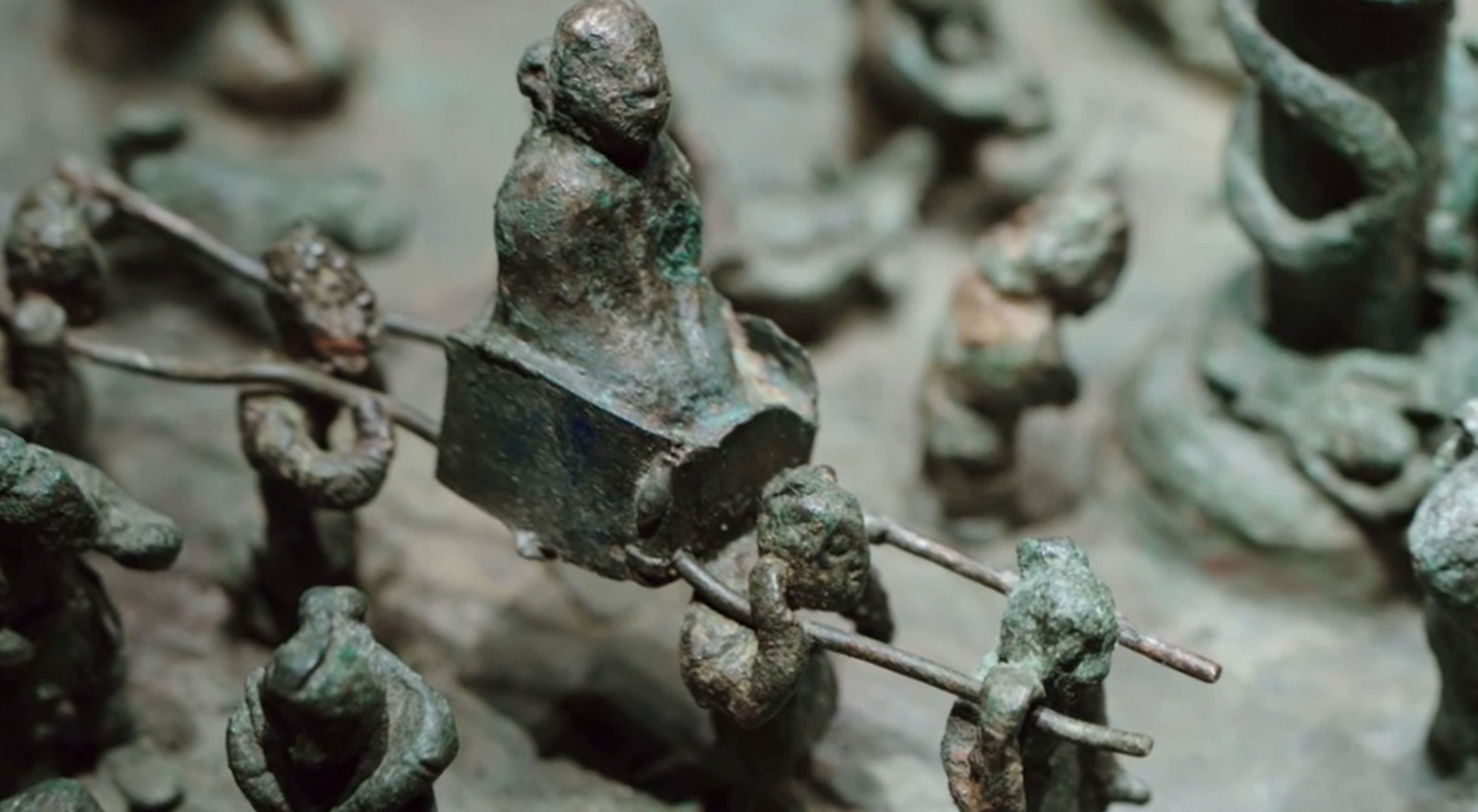
Nothing survives of the Dian people but the stories about them in the Grand Scribe’s Records, and whatever has been pulled out of their graves. And with the caveat that the graves reflect the lives and attitudes of the ruling elite, it shouldn’t surprise us if their artefacts come across as a bit, well, cruel. The Dian kingdom, at the time it was assimilated into the empire of the Han Chinese, was home to a peaceful race of cattle herdsmen, ruled over by an equestrian elite who seemed to take an odd pleasure in depictions of violence.
Their shell kettles (cowrie shells were money) come decorated with intricate battle scenes, featuring captives being dragged away for sale, victims pleading for their lives, and a wounded man crawling from the battlefield, unaware that a mounted cavalryman is bearing down on him. In one of the tableaux, an enemy soldier appears to have the upper hand, not seeing the man on the other side of the battlefield taking aim with one of those new-fangled crossbows.
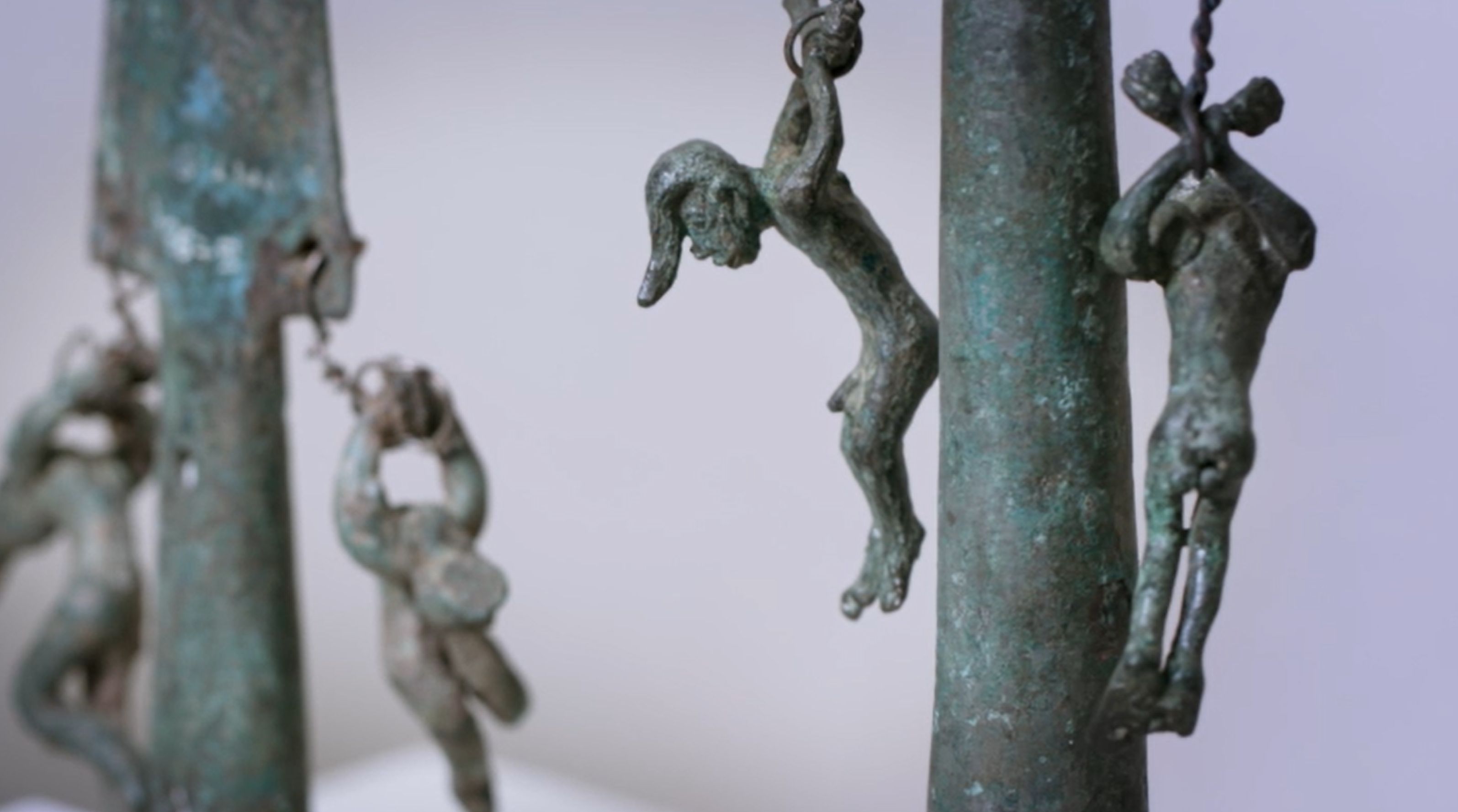
The glee in which the Dian seemed to take in the suffering of others is repeated throughout their artefacts. Twin spearheads feature decorations of dangling slaves, hanging by their wrists. Belt buckles feature scenes of boars fighting panthers, and lions locked in combat. The most famous Dian artefact is a low bronze ritual table in the shape of a cow being mauled by a tiger, and yet still standing protectively over its calf.
Several archaeologists have suggested that the Cow and Tiger Table is loaded with symbolism – that the cow represents the locals, while the tiger stands for their horrid overlords, and the calf for local traditions that refuse to be snuffed out. The rulers of Dian, it has been suggested, were originally a band of Scythians, pushed out of Central Asia around 200 BC, who lorded it over the locals in Yunnan until the Chinese turned up to turn the tables.
The Dian themselves disappeared from history around the time that the Grand Scribe’s Records wrote them up. They were invaded by warriors from Chu in the late Warring States Period, and the victorious general was just about to report home when Chu fell to the First Emperor. Rather than return to an uncertain future, he turned his army around and settled by the Expansive Lake (Dian), and his soldiers soon faded into the local population, whose former style favoured dreadlocked horsemen, barefoot in all statuary and carving, tattooed with writhing snakes. They enjoyed what UNESCO still describes as the most biologically diverse region in the world, spanning the upper reaches of the Yangtze (here known as the Golden Sands), the Mekong (here known as the Lancang) and the Salween (here simply called Nu, the Angry River). Since the Red River, which goes all the way to Hanoi, also rises here, the Dian kingdom sat the crossroads of several major cultures, trading with the Shu and Ba kingdoms of Sichuan, with what is now Vietnam, and towards the west.
Fan Haitao, who set up the Dian gallery in the Yunnan Provincial Museum, takes me through a small selection of the foreign objects dug up locally, including a buckle representing a winged lion (lions, winged or otherwise, being unknown in China back at that time) seemingly from Persia or Afghanistan, agate beads from Pakistan, and glass from India.
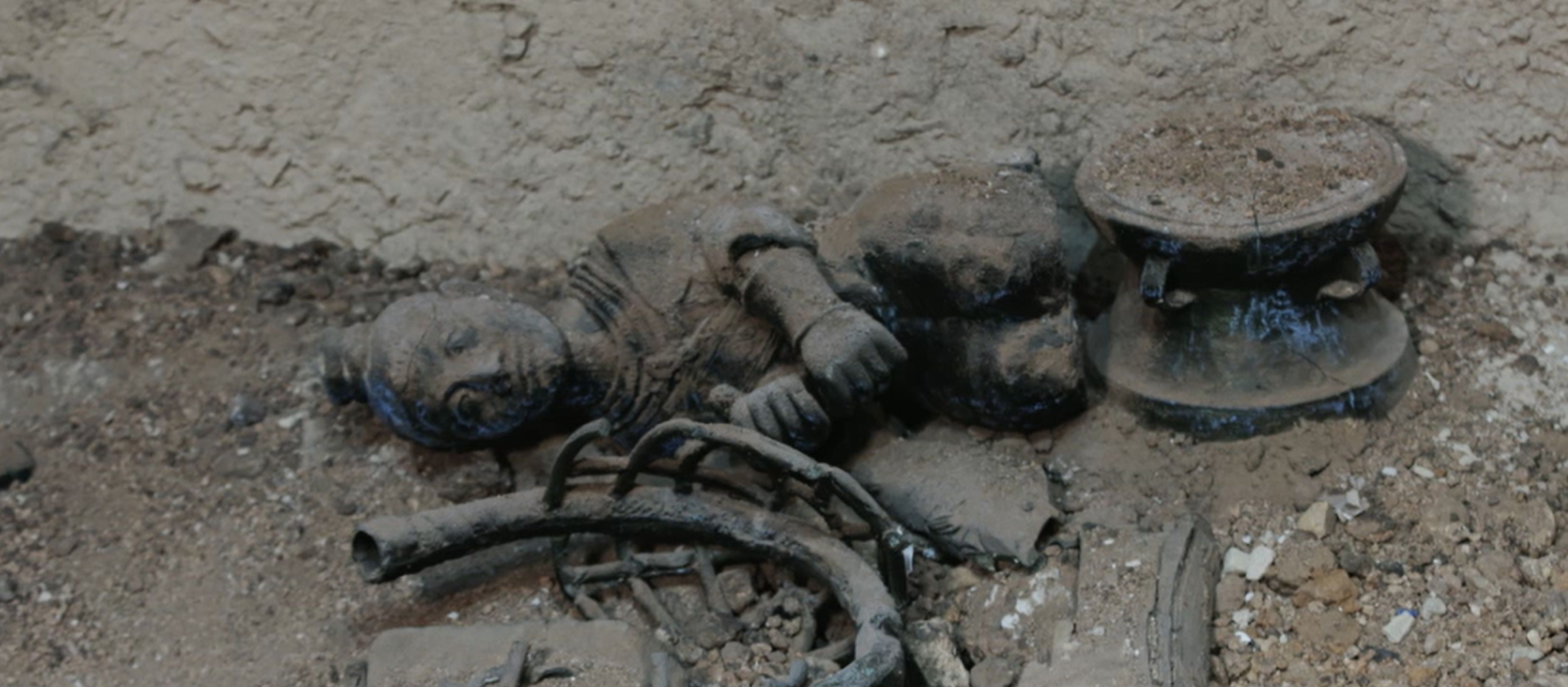
“Our biggest find,” he reveals, “was at a place called Yangfutou, which was under the flight path of the Flying Tigers.” The American mercenary airmen, famously posted to Yunnan to make life miserable for the Japanese, used to fly over a low hill near their base, and observe that it was a nice place to be buried. Yangfutou was turned into a graveyard for the Flying Tigers, which was when diggers started to unearth strange objects. It was not, however, until 1999, that Yangfutou revealed its greatest treasure, the grave of a forgotten Dian nobleman, complete with cowrie shell moneybags, bronze drums, and fiendishly decorated weaponry.
“The grave was under the water table,” he tells me, “so it was completely waterlogged. This meant that we didn’t just get the bronze, but some wooden pieces and the lacquerwork ancestors.” He points at a series of animal-headed dildos, the word “ancestor” also meaning “penis” in Chinese.
So, I ask innocently, what were they used for?
“I think,” he says carefully, “they had a… ritual quality.”
Why are they so small, I ask, pointing at the largest one, which is truly massive. But we can’t use the footage, because the crew was giggling so much at the look on his face.
Jonathan Clements is the author of A Brief History of China. These events featured in Route Awakening S05E03 (2019).
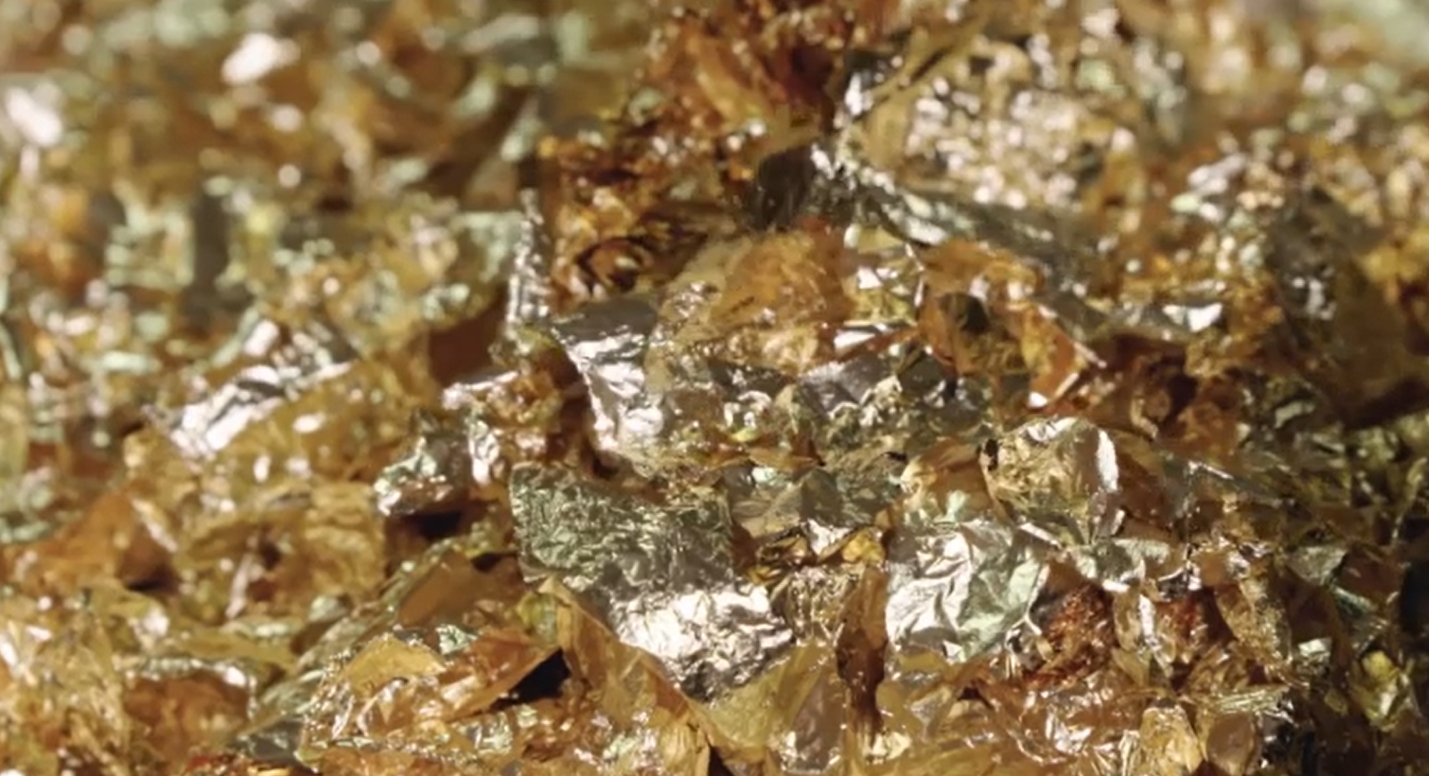
The gold ingots are roughly the size of iPhones, and the company gets them from the Nanjing bank. Then then put them through a machine that hammers them, repeatedly, until one gold ingot is nine metres long and as thin as a sheet of paper. Then they hammer them again, and again and again. And when they are small CD-sized roundels of thin gold, they cut them into squares and cut the squares into smaller squares, and then they hammer them again, until they are literally as thin as a cicada’s wings.
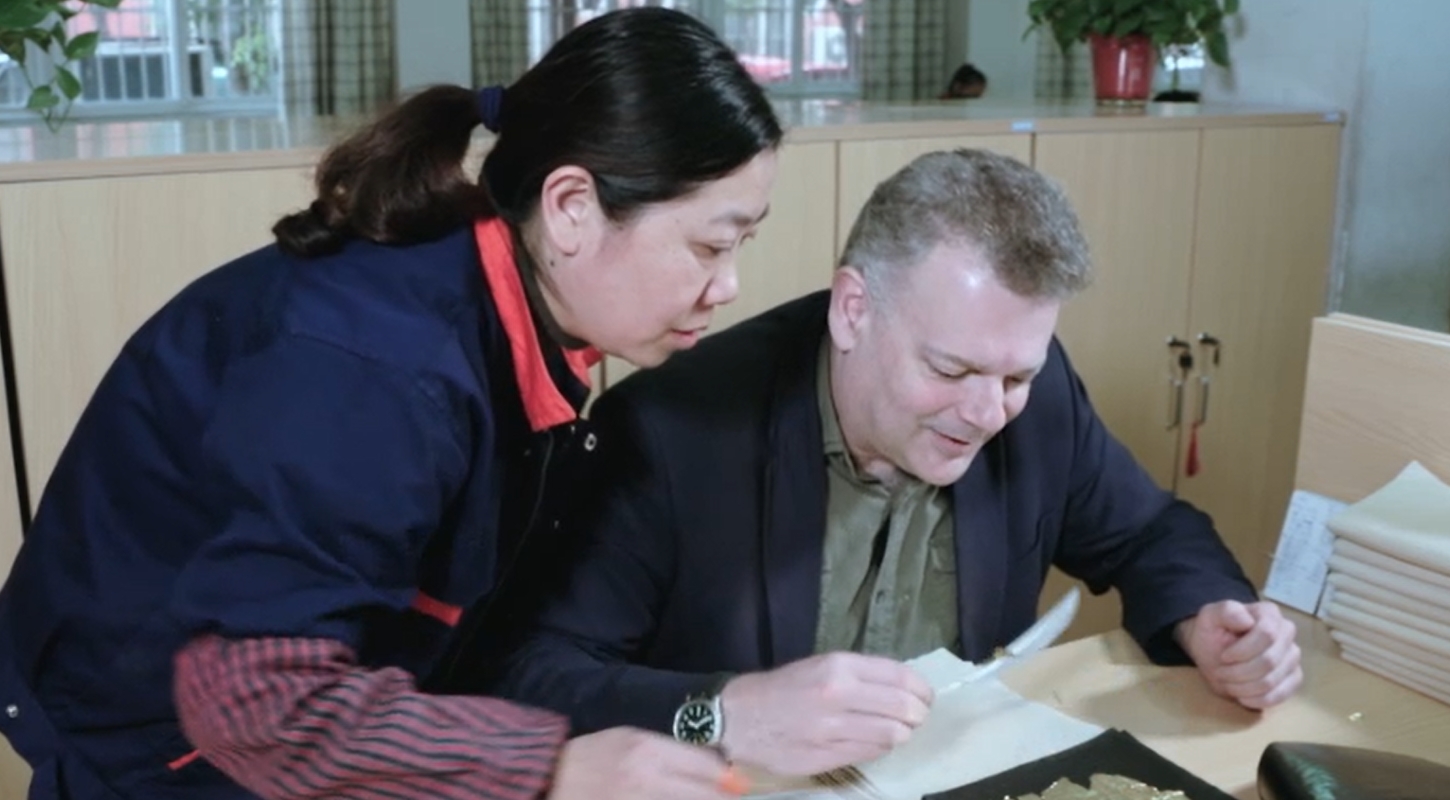
Miss Li is part of the process. She has to take a roundel of beaten gold, tease it gently off the paper with a goose feather, and then move it onto a new piece of paper, blowing gently on it to flatten it and move it around.
“It is very difficult training,” she says. “You have to pass exam where you blow middle candle out of three, without blowing out other two. Training for blow job took me eighteen months.”
I nod sagely.
Nanjing used to be called Jinling (Gold Hill), so the gold foil company based here couldn’t resist calling itself Jinling. Mr Ge, who is the sixth generation of his family to oversee Miss Li and her colleagues, takes me around the factory, and we have fun banging on an anvil with hammers, which was the way things were done before they automated so many elements of the process.
He takes me to the showroom, which is a Trumpish extravaganza of gold leaf on everything – gold leaf pianos, gold leaf Buddhas and other tat. Waiting for us there, unexpectedly, is his foreign liaison Viviana, a young Italian artist of some renown, who works with gold leaf in some of her paintings, and has ended up as a part-time greeter for foreign bigwigs who come to talk about painting their toilets gold, or something.
Viviana is very easy on the eye, and I think she would make a striking interviewee as both artist and employee, a welcome change from our usual run of middle-aged men, but the director immediately assumes that she works in another capacity and shouts at me to “stop chatting up the Russian” and to get on my marks ready to interview Mr Ge. He talks for a while about the history of gold leaf in Nanjing, and delicately describes his customers as devout religious believers, and not, say, ghastly billionaires. And that is another day done.










 The Official Schoolgirl Milky Crisis Blog