Pirating the Straw Hat Pirates

To Ghent, Belgium where conceptual artist and provocateur Ilan Manouach has thrown the cat among the pigeons with a new artwork that reprints 21,450 pages of Eiichiro Oda’s One Piece manga as a single, unreadable book in a slipcase, with the word “D’oh!” prominent in Japanese on its end.

“Online participatory culture and the medium’s new networked possibilities have intensified the nature of comics beyond the scope of professional, established expertise with new and disruptive forms of entrepreneurial fan culture,” writes Manouach on his website. “Readers now actively scan, translate and distribute online their favourite manga series. ONEPIECE is a product of this expanded digital production belt.”

I think what he means to say is that his artwork has been made in reference to the glorious world of scanlation, but if that’s his intention, he is walking right into a copyright minefield. Japanese publishers are unsurprisingly unsupportive of scanlations, since they amount to copyright theft. Nor can Manouach trot out the facetious old saw about “exposure”, because the worldwide bestseller One Piece does not require his help in finding readers.
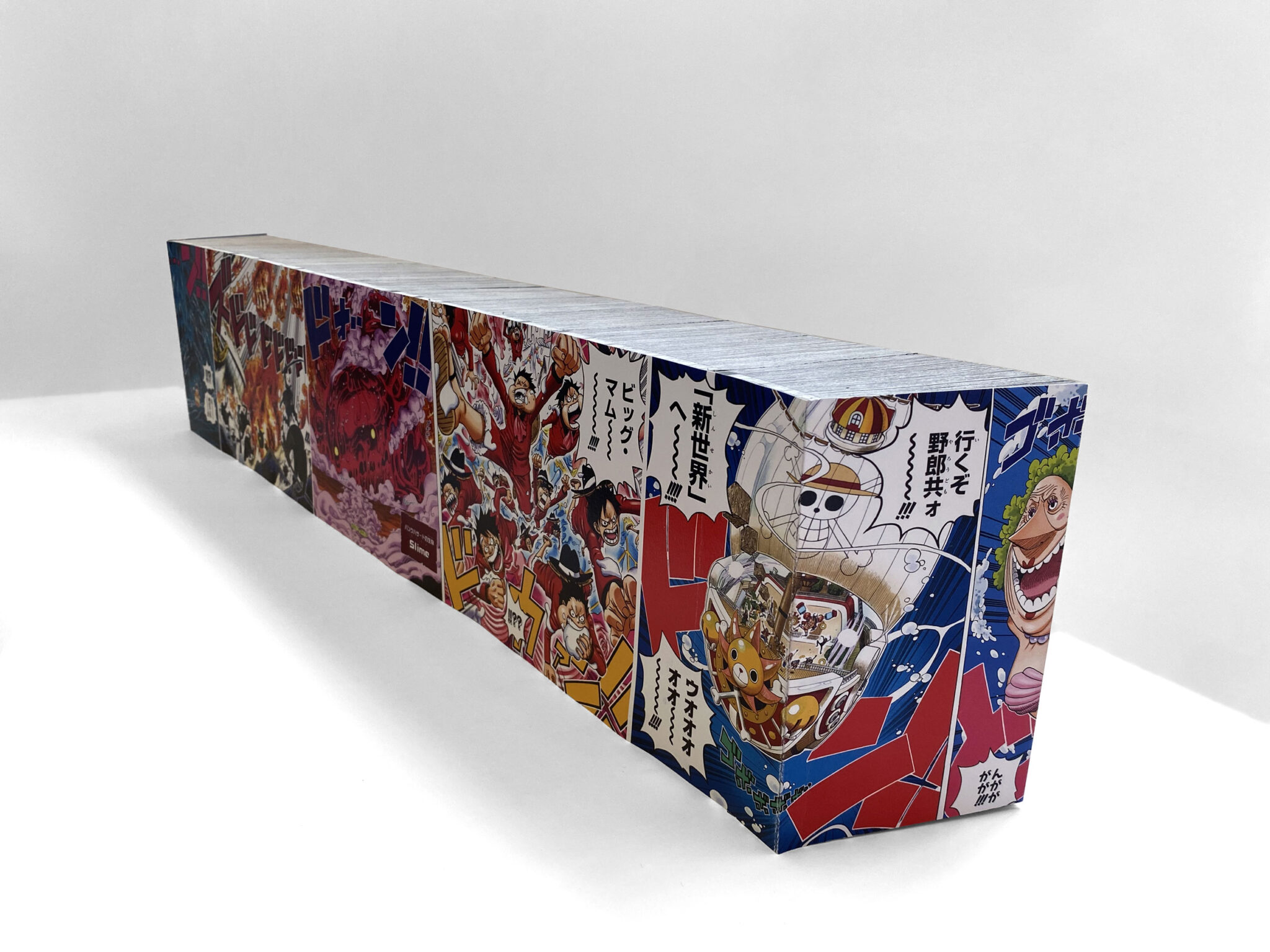
In a thorny legal area, he implies that his artwork is safe because it is unreadable, and therefore not infringing anyone’s copyright. Except nothing has stopped manga publishers selling “unreadable” books before (don’t get me started…!), and Manouach is offering copies of his supposedly unreadable book for €1900 a throw, in a very limited print run of 50.

“The product you mentioned is not official,” said Keita Murano of the rights department at Shueisha, One Piece‘s publisher. “We don’t give permission to them.” Or in other words, if Manouach expects to coin in €95,000 from selling an unlicensed edition of One Piece, unreadable or not, Shueisha is going to come down on him like a manga hammer.

As a work of art, ONEPIECE is fantastically thought-provoking – a material evocation of what it means today for a single “story” to run on into multiple volumes, which either clutter up one’s bookshelves or sit, unnoticed on e-readers. Manouach, who recently earned a PhD in comics epistemology from Aalto University in Finland, adds it to a list of similar intellectual stunts, including his Topovoros books, which are designed, printed, bound and distributed exclusively within a single district of Athens, and Tintin akei Congo, an edition of Tintin in the Congo translated with anti-colonial verve into the Congolese language. You have not heard the last from him, I guarantee it, but he has not heard the last from Shueisha.

Jonathan Clements is the author of Anime: A History.

Blue Thermal

“I want animation to be something that enriches the lives of its audience,” he said. “In this work, I wanted to emphasise the value of having a positive attitude even if life throws you into situations you don’t like. Now I’m a grown-up, I can appreciate that some people go to the movies to escape things they don’t like about their lives, so I guess that what I really want is that you come to see this movie, and for a while afterwards, you feel good about yourself.”

Over at All the Anime, I write up Masaki Tachibana’s Blue Thermal, the first of the movies in competition at next month’s Scotland Loves Anime.

Staged Data

Last month’s big news might have been about Crunchyroll shutting down free simulcasts, but there are other ructions in the streaming world that have drawn less comment from the anime world. In part, that’s because right now, it doesn’t seem to be anime’s problem.

Amid press speculation about a drop in subscriber numbers, Netflix has suddenly started cutting back on some of its animation projects in development. So, that isn’t like shutting down the live-action Cowboy Bebop after twenty days; that’s choosing not to make a bunch of shows at all, as if someone at Netflix woke up one morning and decided: “Wow, that Meghan Markle cartoon series was a bad idea. What was I thinking!?” So out goes Markle’s Pearl, along with an adaptation of Roald Dahl’s The Twits, Lauren Faust’s Toil and Trouble, and the actual head of animation development at Netflix, Phil Rynda, fired along with a bunch of his staff, before any of the projects can see the air.

Netflix is feeling the pinch, as its model of presumably infinite expansion starts to hit a wall. People are sharing accounts. People are not signing up by the million any more, because they already have. And that means that the money train risks coming off the tracks unless the channel stops throwing cash at everything and starts focussing on real money-spinners.

Elizabeth Ito, the director of City of Ghosts (pictured), griped that Netflix manipulated its own stats to prove whatever it wanted to, a phenomenon that she called “staged data.” I’ve noted in the past that it’s difficult to work out what Netflix means when they say something oddly worded like “at least one anime watched a year by every household in x territory.” Those are vague comments – one whole series of a Netflix exclusive, for example, is a bit more of a guarantor of blue-chip value then ten minutes of a Miyazaki film that someone didn’t finish. And “household” is a vague thing as well – it would mean that because my son inexplicably likes Moomins, my whole household, including its Moomin-hating Dad, would somehow be tagged as Moomin lovers.

But Ito’s complaint was that Netflix were similarly evasive behind the scenes, carefully labelling pie charts or cutting off graphs in order to tell people like her that their show wasn’t doing as well as they thought it was, and that hence they had to cut corners, even if someone was winning awards.

The irony is, however, that this news tells us one thing we couldn’t be sure of before. Anime really is doing well for Netflix. We know this because, so far, the anime shows on Netflix have been largely untouched by the long knives. For now, at least.

Jonathan Clements is the author of Anime: A History. This article appeared in NEO #221, 2022.

My Friend’s Sister…

“…even as the characters bumped into each other, stammered their true feelings, walked in on each other on the loo and obsessed about boobs, several of them were ready to pop their heads over the parapet and suggest that this was all nonsense.”

Over at All the Anime, I review Ghost Mikawa’s My Best Friend’s Little Sister Has it In For Me.

Japanese Food in America

“…the fatty parts of tuna, vital for high-class sashimi, were once discarded in the United States as only suitable for cat food, while the ‘bloody-red flesh’ of tuna was ‘considered too strong-tasting and smelly.'”

Over at All the Anime, I review Gil Asakawa’s breezy Tabemasho! Let’s Eat! A Tasty History of Japanese Food in America.

The Flying Knives

If you need to avenge yourself against your enemies, you will need a basin filled with water and two knives used for killing pigs. Place the knives in the water and get your sorcerer to chant the correct incantation over the bowl. If he’s doing his job right, the knives will turn into fish and the water will turn into blood, and you will know that your enemy is not long for this world, because he will be killed by the “flying knives”.

Alternatively, stick pins in a doll and bury it on his birthday. Or kill a rooster, and stick pins in its head, on his birthday. Kam people don’t like to tell you when their birthday is.

Eric the camera assistant likes to say we are among the “Southern Barbarians”, an oddly medieval construction that recognises so much of this part of China is a very different culture. The Kam are just one of the peoples in this area, who plainly migrated from somewhere else, pushed south by the Han Chinese themselves, and who have only partly got used to the idea of huddling on remote hillsides. They are all incredibly short, quite dark and often quite impassive. Pan, our local fixer, has taken two days to come out of his shell, and only then revealed to the director that he was married with a kid, and that he would be taking us to meet his family.

Pan’s village is called Tang-an. To get there involves a 40-minute drive from Congjiang, the nearest big town, through Zhaoxing, the “capital” of the Kam, because it has five drum towers – any more than one in a Kam town is liable to be a family tower to mark the presence of several households with the same surname. And then out into the mountains beyond Zhaoxing, along a winding mountain road, up into the heights, when Tang-an is stretched out on the slopes above the rice paddies.

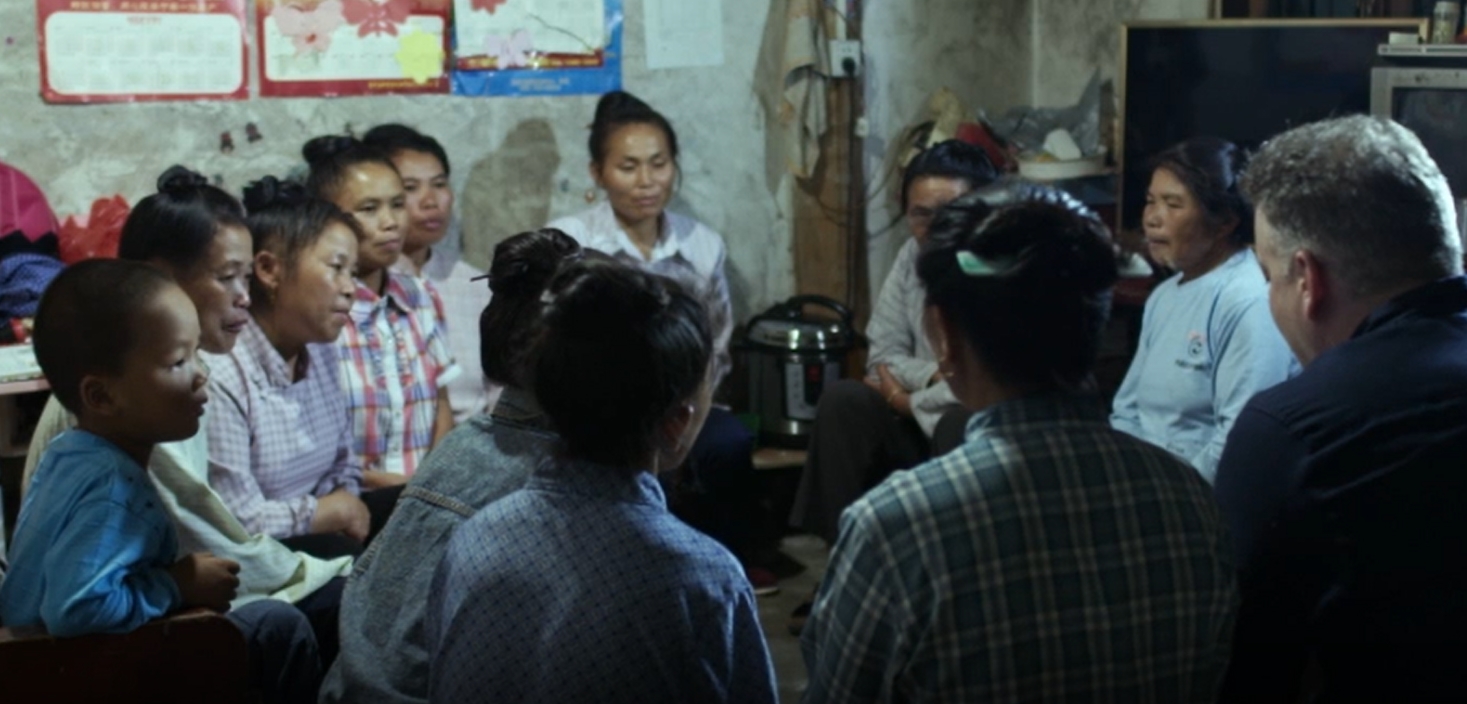
In the evening, we lurk around until half past nine, waiting for a practice session for the song contest that is coming up in the village. But none of the people who are supposed to be involved appear to be doing anything. Eventually an old lady called Lan Big Sister says she will take me to meet her friends, a bunch of cackling grannies who are singing a song in Kam in a dilapidated house near the fish pond. Matters are somewhat confused because Lan doesn’t really speak Mandarin.

“Here is some guy from Yinland,” she says, apparently not knowing where that is.

“Come in, come in!” shout the grannies. “We are singing a song in Kam about the benefits of government subsidies for pensioners.” So I try to sing along in a nine-tone language which sounds like the Bulgarian Shepherdesses falling down some stairs, while a heifer in the stalls next door keeps on letting out long farts that are picked up by my microphone.

Halfway through, a granny who has gone out for a dump comes back in to find the squalid room brightly lit with lamps, and a National Geographic film crew crouched in the corner while I perch on a little stool and try to sing a chorus that has two glottal stops.

“What the actual fuck is going on?” she gasps.

“Just pretend we are not here,” says the director.

It is past eleven at night before we struggle back through the streets, pausing only to help a villager carry a moped over a large pile of bricks that has been left in the middle of the narrow mountain road. My limbs are aching. I have a headache from our landlord Mr Wu’s moonshine, and we still don’t know what we are supposed to be filming tomorrow.

The director reveals that there is possible a mass slaughter of oxen at midday tomorrow. And before that, I shall apparently be jumping into the fish pond to hunt carp with my bare hands. What could possibly go wrong?

Jonathan Clements is the author of The Emperor’s Feast: A History of China in Twelve Meals. These events featured in Route Awakening S03E01 (2017).

Galway, JFK and Roger Moore

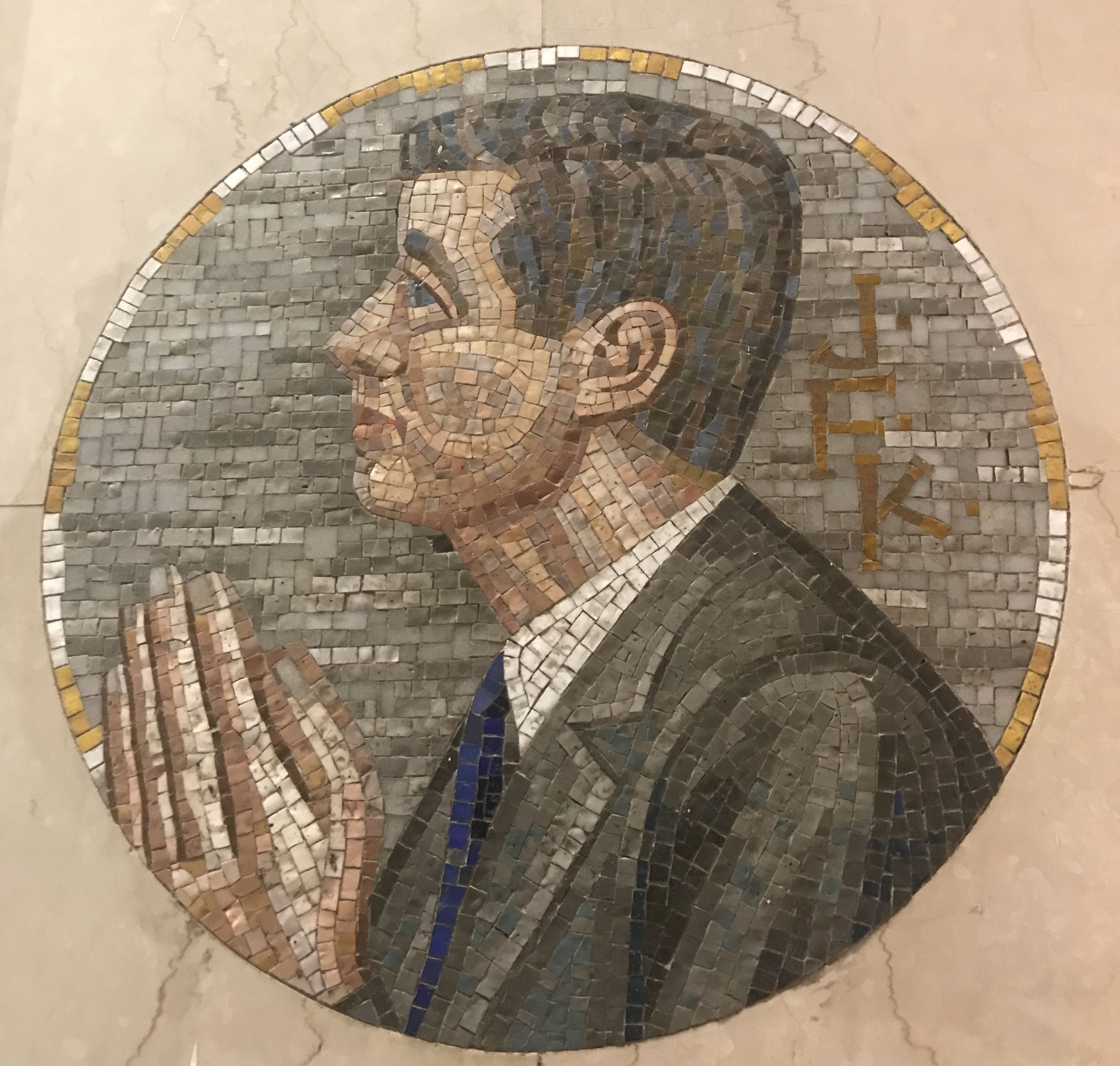
I’m in Galway, Republic of Ireland on a secret mission (Codename Blackbird) and today I stopped in at the cathedral to be confronted in the Chapel of the Resurrection with a mosaic depicting John F Kennedy, at prayer with the Irish martyr Pádraig Pearse, shot during the Easter Rising.

Lunch a block or so away at Re’Nao, a Chinese restaurant serving Xi’an food, which was authentic when I ordered it because I knew what was supposed to be in it. The restaurant offers so many customisation options on its food that it is possible for the overly picky client to turn everything into something completely different. I also had an authentic roujiamou meat bun (“rogermoores” as they are known in our house), although there were so many Have It Your Way options that I could have easily transformed it into a chicken bap with ketchup.

Re’Nao was one of three Xi’an establishments withing spitting distance of one another in Galway, all owned by the same Xi’an expat. For more about Chinese food in Ireland, particularly the never-ending quest for authenticity, you can click on my interview with Sean Moncrieff on Newstalk.

Jonathan Clements is the author of The Emperor’s Feast: A History of Chinese Food in Twelve Meals.

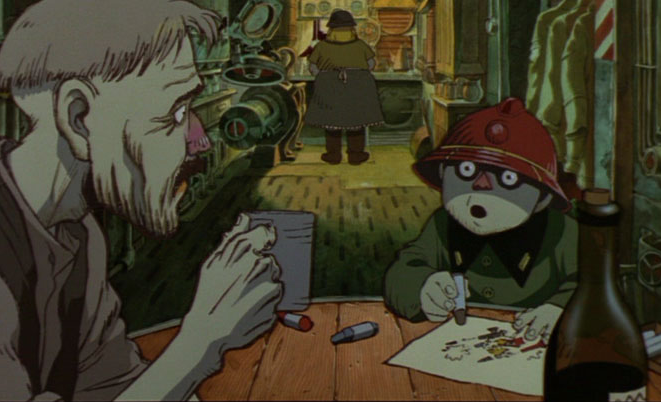
Cannon Fodder

Memories, released in the year of Windows 95, was made on a technological cusp of the expansion of computing power and the rise of digital processes. Some of the techniques included in the final print were literally impossible to achieve three years earlier when the film commenced production, throwing Otomo and his staff into a constant game of catch-up with new developments in processing and materials. In a sense, his celebrity in the anime world forced him into the role of an early adopter, tinkering with new technologies when they were still expensive and untried.”

Over at All the Anime, I write up Katsuhiro Otomo’s “Cannon Fodder” in the Memories anthology.

Stink Bomb

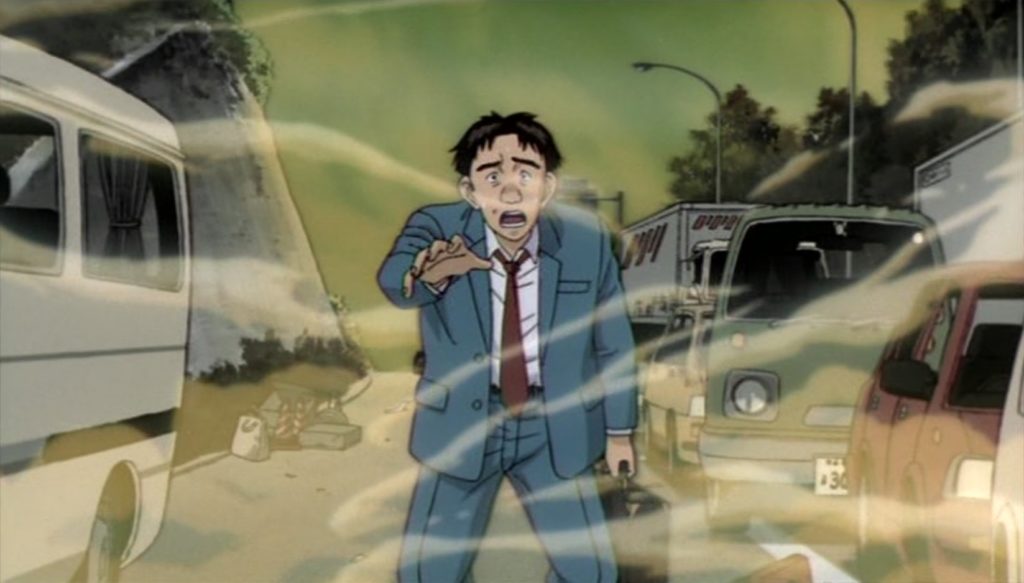
“Revisiting the film in the middle of the COVID-19 pandemic, it’s surprising how many resonances seem very much of our time. Stink Bomb begins in a doctor’s surgery, as the sniffling Tanaka gets his flu jab, and locals grumble about the virus that’s going around. He walks out into the snowy streets wearing a face mask – an entirely everyday sight in 2022, but something of an Asian peculiarity in 1995. The custom of wearing a medical mask when ill to protect others, was commonplace in Japan, China and South Korea, but had yet to spread around the world.”

Over at All the Anime, I cover “Stink Bomb”, the often-overlooked second story in Katsuhiro Otomo’s Memories anthology movie.

The Singing Tree

The Kam say that the first songs grew on a magic banyan tree in one of their remote villages. The birds ate the fruit, and that is what made them sing themselves. But the tree itself put out songs all the time, until an old woman, the legendary equivalent of those people who buy a house near a nightclub and then complain about the noise, decided that she hated the sound of all the songs and cut the tree down. She threw it in a river, and the songs washed away, but a Kam man grabbed them in a bucket and carried them to his village. He tripped while crossing some rapids, and some of the songs washed out and into the world, but most of the best ones stayed with him, and he took them to the Kam people. This is why the Kam people always sing.

This is presumably news to Pan, our driver, who is a Kam man, but whose musical taste only seems to run to dreadful disco tunes, seemingly played by an orchestra of kazoos. He subjects us to them all the way to Congjiang, which is the gateway to the Kam region. The mountains loom all around us, serrated with rice terraces up to the heights, with tiny villages clustered on the slopes, each dominated by a conical pagoda that looks like a fir tree – the drum towers of the Kam, where they still gather to sing.

Pan is glum most the time. The Kam people are slowly fading away beneath an onslaught of mainstream culture. Their young people marry out or move to the big cities, and there are less people around to sing in the moonlight choruses that make them famous. Only tourism seems to keep them alive. The gateway to the valley of the Kam is guarded by police who charge 100 kuai per visitor simply to get in, as if their entire community is a theme park of dark-clad people with silver headdresses.

Except for Pan, who wears a baseball cap, backwards, with the words London Fresh written on it. We pause outside the valley to film the terraces and send our new drone, a black buzzing 3D Robotics Solo 2, across the sky to photograph the picturesque bridges and the men carrying sheaves of rice. The director is still not sure what we are actually going to film here, but we have maybe four more days to get an episode out of it. Pan is the village chief’s nephew but he is cagey and sullen when we ask him about his traditions. We are not sure that he knows what they even are.

The big national myth of the Kam begins with a boy saving a girl from a tiger. But the story isn’t really his, it’s hers. Her name is Xingni, and she was busy trying to live happily ever after with her newfound husband, when an evil Chinese landlord saw her and wanted her for his fourth wife. That’s a nice touch, right there. He already has three other wives, but needs Xingni to complete the set. Why stop at four, she says, how about I come over to your place tonight with two of my friends, and we will sing to you till your ears drop off.

Singing, for the Kam, seems to come accompanied with a bunch of other activities. The landlord says that sounds great, but just as his three new teenage Kam girls are singing the shit out of him, his barn catches fire (this is not a euphemism), and he runs out to deal with it. When he comes back, the Kam have scarpered.

They run off to a remote village called Luosi where they dig a fish pond. While digging, they find an ancient magic sword. Inevitably, the landlord hears what’s going on, and sends some men to steal the sword. Once they steal it, the landlord himself wields it in a subsequent attack, killing Xingni’s husband. She gets the sword back by paralysing the landlord with a magic fan, then she cuts his head off.

The landlord’s son whines to the emperor about this apparent injustice, and an army arrives to punish them. Xingni tries to throw herself off a cliff, but is saved by the spirit of a pool at the bottom, who gives her a magic charm that will repel the army, on the understanding that she will turn to stone if she uses it. She uses the magic to destroy the Chinese invaders, and then she and her four daughters fling themselves from the clifftop, turning to stone as they fall.

Also don’t point at rainbows, because it’s rude to dragons. This is what I have learned today about the Kam.

Jonathan Clements is the author of The Emperor’s Feast: A History of China in Twelve Meals. These events featured in Route Awakening S03E01 (2017).