Another Manchuria

I have to spend a lot of money on Amazon Japan – sometimes I remember to write down my better discoveries, so that other researchers don’t have to take pot luck with cripplingly expensive postage.

For the last five years or so, I have been eschewing English-language guidebooks and relying on Japanese ones, not only in Japan, but also in parts of China. My favourite are the beautifully comprehensive Rurubu magazine-format tourist guides, that have helped me navigate the wilds of Amakusa and Hokkaido, Shanghai and Taiwan. But sometimes, you need something a little more specialised…

Manchuria Off the Tourist Track, by Keiji Kobayashi is a marvellous idea – a travel guide to Manchuria that highlights the region’s past as a Japanese puppet state. Kobayashi mooches about the modern-day Chinese provinces of Heilongjiang and Jilin, poking around odd monuments, and old buildings that are leftovers from the days when Manchuria was Japan’s own little exercise in imperialist expansion. This is where Mannerheim led a cavalry charge through the city centre of Mukden, against Japanese gunners, although Kobayashi also has time for the obscurer historical individuals, such as the grave of Verda Majo (1912-1947), the Japanese revolutionary who wrote books in Esperanto arguing for the freedom of China.

Some relics are long gone. The Japanese who remained behind have largely faded into the local population, and three generations of Chinese history have added their own artefacts. Shenyang train station is still there, but the nearby memorial to the fallen of the Russo-Japanese War has now been replaced by one of the ubiquitous statues of Chairman Mao. Kobayashi, ably aided by his photographer Ribun Fukui, chronicles the ghosts of Manchuria’s Japanese past, including the brutalist monuments to Japanese aggression, and carefully preserved sites of Japanese atrocities, some of the skeletons left in piles where they were found.

Manchuria is such a fascinating place, and includes the former capital of the Manchu dynastic founder Nurhachi; the great monumental tower built by General Nogi and Admiral Togo to honour their fallen men; Harbin, a Russian city on Chinese territory. They even dig up the old Man’ei Studios, once the largest film studio in Asia, that cranked out films in Japanese for the local population, now largely forgotten in film archives. Once the “cockpit of Asia”, Manchuria is now far off the tourist trail, but seems like one of the most exciting places for anyone in search of a glimpse of yesterday’s tomorrow. It is a sci-fi future that failed, and all the more interesting for it.

My Book of the Year

And so we come to the Book of the Year round-up. I’m not waiting till the holiday season this time, as I realise that many readers would prefer to hear my thoughts now, just in case it inspires their Christmas shopping. And why not? Buy someone a book for Christmas this year. It’s more fun than socks.

Well, your mileage may vary. Runners-up from my reading this year include the utterly filthy Decadence Mandchoue: The China Memoirs of Edmund Trelawney Backhouse, rescued from obscurity by Derek Sandhaus in a beautiful hardback edition by Hong Kong’s Earnshaw Books. I was left thoroughly depressed by Paradise Found, an informative account of the American ecology on the eve of the arrival of European colonists. Also, sped to me on the day of its publication, Matthew Sweet’s West End Front: The Wartime Secrets of London’s Grand Hotels.

Sweet’s previous books changed the way I wrote history; I have come to love his persistence in tracking down testimonials rather than memoirs, a dogged quest that often seems to find him sipping tea in old people’s home while the spivs, movie stars and spies of yesteryear struggle to recall their glory days. West End Front is a carnival of (largely) ghastly people, often described with Wodehousian glee, and Sweet presents a superb angle on the culture of WW2, from the switchboard operator who overheard of the war’s arrival before the rest of the country, to the huddle of ousted politicians listening on a hotel radio to the news of Japan’s surrender. Kings in exile, hookers on the make, and Marxists in search of a bespoke bomb shelter all rub shoulders in Sweet’s vivid account, some under the mistaken impression that the solidly built hotels of London were “bomb-proof.” I would say more, but Simon Guerrier already has.

For the second year running, my fortnight at Scotland Loves Anime found me raiding the Glasgow Waterstone’s, coming away with the wonderful Lore of Scotland and The Faded Map, a run-down of the various kingdoms once found in Caledonia. The focussed, localised Faded Map has been overshadowed somewhat by Norman Davies’ sprawling Vanished Kingdoms: The History of Half-Forgotten Europe, which offers potted histories of continental also-rans such as the Byzantine Empire, Aragon, Burgundy and Tolosa. But through no fault of Davies, I was left slightly more satisfied by The Faded Map, partly because it set its sights very small, on Scotland, and hence was able to be far more comprehensive. There is a picky, ungrateful sense of entitlement that comes over the reader of Davies’ larger work, as one starts to wonder about all the vanished realms he’s left out – what about al-Andalus? The Danelaw? The Austro-Hungarian Empire…? His book is popular enough and has made it onto many other best-of lists this winter, so perhaps it will soon gain a companion volume. If it does, may I plead with his publishers to make a better book. For £30, I would prefer one that doesn’t start shedding its pages before I’ve even got halfway in. By the time I finished, it was less of a book than a sheaf of papers.

Lost Colony by Tonio Andrade is an impeccably researched account of the fall of Fort Zeelandia in Taiwan to the “pirate king” Koxinga, a.k.a. Zheng Chenggong, Coxinga, the Knight of the Imperial Surname, etc. Barnacled with grants and fellowships, and aided by four research assistants, Andrade reframes the story of Fort Zeelandia in terms of the popularly-held idea of the inherent superiority of the modern west. He points out that when the Chinese first met with European military might, the Chinese won, and ponders if the victimhood of the 19th century was an anomaly. Entertainingly, Andrade is not above arch comments about the Dutch disaster as it unfolds, and has the odd achievement of including a chart that made me laugh out loud. It’s a list of defectors in each direction between the Dutch and the Chinese, but is set up with such mathematical precision that it allows for the possibility of half a defector. A lower torso, perhaps? For reasons I don’t quite follow, this playfulness also extends to the book’s cover, which shows a picture of Batavia, not Taiwan at all.

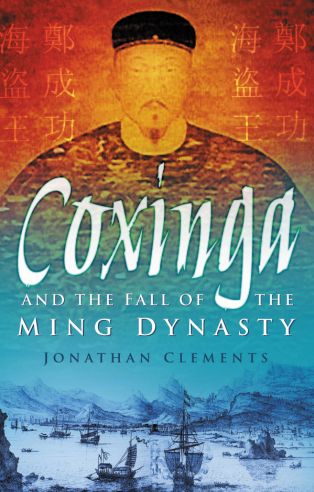
When I clicked a copy of Andrade’s book into my shopping basket, Amazon kindly informed me that “people who bought Lost Colony also bought Coxinga and the Fall of the Ming Dynasty by Jonathan Clements”. This is somewhat ironic, since Coxinga and the Fall of the Ming Dynasty is entirely unmentioned in Lost Colony, which has the gumption to bill itself as an “untold story.” There’s some half-hearted hand-wringing in Andrade’s acknowledgements about his “scholar’s discomfort” with this claim, but it apparently didn’t bother him enough to actually do anything about it. Which is a shame, because Lost Colony is an excellent book, and now many would-be readers will be confronted its spurious “untold” assertion every time they browse an online bookseller.

It is, one presumes, because academic presses do not wish to dirty themselves with citations from the garish world of commercial publishing, a reluctance which, to some extent, I do understand, particularly if someone has inconveniently told your “untold” story eight years previously – and I, of course, was not even the first. But if you are going to dismiss popular predecessors as beneath your notice, please don’t succumb to the hucksterish allure of misleading, grandstanding titles. Untold, my arse.

Which brings me to my actual book of the year, which I doubt very much you could buy even if you wanted to: China on the Western Front, by Michael Summerskill. Untold? No. Unread? Seemingly. Unloved? Absolutely not. It’s an amazing book about the Chinese Labour Corps, nearly 100,000 men who came from China to dig trenches and unload ships in a Europe starved of manpower during WW1. Eight hundred of them died, mainly from the influenza of 1918, although several dozen died in bombing raids and German attacks. It was published in 1982, and is so obscure that the School of Oriental and African Studies library doesn’t have a copy. It’s a paperback of less than 250 pages, acquired for the princely sum of £85 from a second-hand bookseller who knew exactly how much it was worth to me. I bought it because I’m considering writing a book of my own about WW1 in the Far East, and the fact that 100,000 Chinese put a girdle round the Earth in order to drag corpses from the trenches at Verdun is simply fascinating. Summerskill plainly found his obsession so odd, so unique, that no publisher would touch it. He published it himself, in numbers so tiny that I doubt there are three copies left in Europe. But nevertheless, thanks to the interwebs, I was able to find a copy. And if Summerskill’s family ever want to republish it, they could have it available on the Kindle in days. Has its time come? I hope so.

Instead, the most accessible book on the subject is another product of the modern age, an obscure 1919 account by a white officer in the Chinese Labour Corps, brought back into print by the Imperial War Museum, and maintaining its cheerily racist original title: With the Chinks. It doesn’t hold a candle to Summerskill, but was a fun read. [Time Travel Footnote: John Watson points out that this book came out this year.]

We stand on the verge of a sea-change in publishing. Summerskill’s book, still a great rarity in 2011, might easily be a similar print-on-demand or e-Book commonplace by this time next year, easily rushed to your door or to your tablet. I have two books coming out in 2012, and for what is for me the first time, both will be in dual paper and electronic versions as my publishers wake up to the potential of new media. My reading this year has been skewed more than ever by the technology that delivers it to me. Amazon, in particular, reminds me to put money down on books I forgot I once wanted, or hunt down obscurities that might have eluded me in a bookshop. I have also noticed with increasing regularity, the number of books from academic presses that have clearly been printed on demand, to meet my order and not in anticipation of it. Nothing, however, quite competes with the joy of poking around a real-world Foyle’s or a Waterstone’s, where acres of new worlds are waiting to be discovered, analogue style.

I’m not one of the publishing doomsayers. There is certainly a paradigm shift in the way that books are sold and consumed, but if anything it makes the field more financially rewarding for writers, not less so. I have certainly benefited from both paper and e-sales this year. I suspect that within the decade, the default condition of all books will be electronic, and that old-fashioned people like me who want it on paper can pay to have their digibook made real, much as 18th century bibliophiles popped down to the printer to have their papers bound. But there will be a transitional phase when electronica dominates, and when that comes, you’ll have a lot more trouble putting a ribbon around it and giving it to your dad.

So buy someone a book for Christmas this year. Next year you might have nothing to give but electrons.

Don't You Know Who This Is?

mito komon

I wander a traditional Japan of backstreets and stone lanterns, with wooden buildings and paper walls. I think I took a wrong turn somewhere by the blacksmith’s, and need to retrace my steps if I want to get back to the pleasure quarter. As I head back towards the Yoshiwara, I bump into a samurai leading two associates across a stone bridge. We bow at each other curtly and he rustles onwards with a scowl. The lower-ranking lieutenant behind him rolls his eyes at me playfully, pointing at his sullen associate as if to say, “Bad Agent Day.”

Toei’s Kyoto studios, a series of nondescript warehouse buildings in a long line by the railroad tracks, is closed to the public, but literally anyone can walk in off the street to wander the neighboring Movie Village backlot. Comprising several blocks of period housing, the Movie Village stretches from a Victorian-era town square complete with trams and coffee house, to a sector of samurai-era Tokyo that includes an attractive replica of Nihonbashi bridge, a pleasure quarter, merchant housing, a courthouse, and a prison. Wait for a gap in the milling school children and tourists, and the opportunity presents itself for a snapshot of the Japan of two centuries ago — a situation helped greatly by the many samurai, artisans, and geisha wandering the lot in full costume.

The Movie Village isn’t so much a theme park as a working studio. Sure, there’s a museum to the Power Rangers and their greatest enemies, some of the houses have been turned into snap joints where you can have your photo taken in samurai get-up, and there’s a ninja booth where you can throw shuriken at targets to win prizes, but all the minor attractions play second fiddle to the Movie Village’s true function, as a giant location set for samurai dramas.

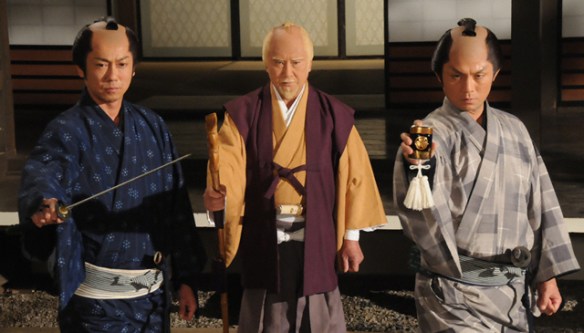
Attend the Movie Village on any given day, and you can easily find that the courtroom area has been cordoned off to shoot a finale for next season’s Toyama no Kinsan. Don’t bank on always seeing the robotic sea monster that pops out of the SFX lake, since there remains an eternal possibility that it will have been turned off for the day so that someone can film a dockside sequence for Ooka Echizen. On the day I’m there, they are recording the latest episode of Mito Komon, a series that has been running intermittently since 1969. Mito Komon is the apocryphal tale of Tokugawa Mitsukuni, uncle of the Shogun Tsunayoshi, who wanders seventeenth-century Japan in disguise, observing criminals as they prey on the innocent. At the right moment towards the end of each forty-five-minute episode, Mito’s retainers will stop proceedings and brandish the Shogun’s seal. They point at the unassuming old man and bellow: “Don’t you know who this is!?” and Mito throws off his disguise.

A runner with a loud speaker tries with increasing panic to control a group of bewildered kids from San Francisco, who still think this is your average run-of-the-mill theme park, and don’t understand why they can’t cheer every time the samurai on the other side of the square fight each other.

There is a rustle among the Japanese crowd and a series of excited “Ooohs!” as a man in peach-colored robes and a white goatee rides onto the set on a small silver scooter ready for his next scene. It is Kotaro Satomi, the latest of several actors to play Mito Komon, who has been with the series for so long that he also played one of Mito’s young companions during the 1970s and 1980s. He stares in bewilderment at the San Francisco school kids, who stare in bewilderment back. As the seconds tick by, it becomes obvious that if someone were to brandish the Shogun’s seal at this moment and ask the 64,000 yen question, these kids wouldn’t have the faintest idea who he was.

“This man is very famous,” explains their tour guide desperately. “He’s a very famous actor who plays a very famous person in a very famous series.” He says this all with the characteristic vagueness of many Japanese tour guides, who have long since given up trying to get foreign tourists to remember people’s actual names.

The Americans nod excitedly and immediate start demanding to have their pictures taken with Satomi. Perhaps realizing that this is celebrity snapshots for the sake of it, and that none of them know who he really is, Satomi agrees with a weary smile. But he has the magnanimous charisma of a true professional, and the tourists go away happy, ready to tell all their friends that they met “someone really famous” while they were in Japan, and that he was “really nice”, whoever he was.

The peak rating for Mito Komon is 43.7 percent — a night in 1979 when almost half of all the TV sets in Japan were tuned to the show. Satomi knows that there are already plenty of people in Japan who know exactly who he is. San Francisco’s chance will have to wait.

This article first appeared in Newtype USA, July 2003, and was reprinted in Schoolgirl Milky Crisis. Mito Komon finishes its decades-long run on Japanese television this month.

Coxinga on the Kindle

My book Coxinga and the Fall of the Ming Dynasty is suddenly available on the Kindle. I can only guess that the History Press, who inherited it from the now defunct Sutton Publishing, realised they were onto a good thing when the National Geographic documentary came out. No complaints here: I’m immensely pleased that people can zap it onto their tablets in seconds. Here’s hoping the rest of my books are fast behind.

London Loot

On the night of 8th August, youths ran through the streets of London, throwing petrol bombs at the police, setting fire to stuff, and stealing things. That’s the best I can do for you, as I don’t particularly trust the original protestors, the police, or the press in their reporting of what happened.

One of the casualties was the Sony DADC distribution facility in Enfield, which burned to the ground, taking with it the bulk of the Beez Entertainment DVD backlist, the entire UK print run of the Arrietty soundtrack CD, and the entire stock of Lace Digital Media Sales, which includes the backlists of Revelation, ADV and 4Digital Asia.

One wonders what this tells us about the tastes of the average looter. Were masked hoodies with baseball bats smashing their way into Sony DADC, intent on burning the UK supply of the Dogtanian box set in fiery vengeance for the lack of extras? Were selfish savages taking the torrenting/piracy ethic to its logical conclusion, by “borrowing” Arrietty CDs by the box-load, and then setting fire to the warehouse to hide the evidence?

Although I don’t own a PlayStation or a cell phone, the name “Sony” conjures up images of such things in the mind of thugs who have grown up thinking that they can steal whatever they want from its rightful owners. I imagine that’s why “protestors” happened to set fire to the Sony building, but not before gutting it in search of the latest models. How disappointed must they have been if all they came away with was a box of Overfiend III DVDs?

But ironically, this could prove to be the most lucrative trading week in the history of UK anime. Insurers will have to pay out for those ruined or stolen DVDs. Anime fans might have displayed no interest in paying for Shadow Skill or King of Bandit Jing, but in an odd form of entertainment seppuku, these titles may have finally monetised through the act of being destroyed. A silver lining, perhaps, for some distributors, but what if they can’t be bothered to replace them? Worse news for the real fans.

Jonathan Clements is the author of Schoolgirl Milky Crisis: Adventures in the Anime and Manga Trade. This article previously appeared in NEO #90, 2011.

The Thread-Free Sky

Her eyes were green. Her hair was silver, and she freckled. The rest was subject to change without notice.

To a jaded cynic, the work of Anne McCaffrey (1926-2011) was little more than a science fictional repackaging of well-worn tropes from the world of fiction for adolescent girls. She had an entire stable of protagonists modelled on Cinderella or Lisa the Lonely Ballerina, and a whole paddock of tales about ponies and horses, which she rewrote as dragons. I was a ten-year-old boy in 1981; I didn’t know that. If I had, I might have turned away with a sneer and bought something about space marines.

Instead, I discovered that Pern was a place where elegant, terrible, wonderful creatures sought out the purest of heart. Passions and yearnings could wake worlds, knowledge was passed on through songs… imperfectly, poetically… warning that something called Thread would fall from the sky. Old songs, forgotten songs, whispering of apocalypse, ignored, belittled, dismissed. Until the day the songs came true.

The series, as it existed when I first came to it, comprised twin trilogies, one for adults, and one for younger readers, often offering different perspectives on the same scenes and events. And it all came to an end with this:

The dragons on the fire-heights rose to their haunches, bugling their jubilation on this happy day while fire-lizards executed dizzy patterns in the Thread-free sky!

What a sentence. As a teenage would-be author, I fixated on that last phrase. This day, the sky was free of Thread, the awful alien spores that brought ecological disaster. And already, the Dragonriders had found a way to neutralise Thread on contact with the ground. The Dragonriders had rendered themselves obsolete. Their whole world was about to fall apart, and nothing would be the same again. F’lar and Lessa, the reluctant first couple of Pern, walked out of the narrative with smiles on their faces, but they stood at a momentous moment in history, thick with melancholy and pregnant with loss.

Opening my battered, much-read, much-loved copy of the The White Dragon this morning, I turned once more to the sentence I thought I knew so well. Just try reading it out aloud. It is breathless and giddy, arguably missing a comma and ending in a grandstanding exclamation point. You would need to be an opera singer to belt that sentence out and get it in all its passionate, gabbled glory. Anne McCaffrey, who once was an opera singer, and often wrote as if translating music into prose, ended her masterpiece on a crescendo and a descant.

Sadly, perhaps, it wasn’t the end. I would read the first six Pern novels on an almost annual basis, but I had little time for the diminishing returns of the later bolt-ons. I liked Dragonsdawn, with its revelation that McCaffrey’s world was a sci-fi acronym: Parallel Earth Resources Negligible. I was intrigued by Moreta: Dragonlady of Pern, and not only for its glimpse of a legend only whispered in the main saga, but also for its engagement with something only obliquely referenced in earlier books – the fact that a number of the dragonriders were gay. But I had no time for the rest of it: the Celtic whimsy and the pointless dolphins, the previously unmentioned gipsies and the inevitable aging and changing of the characters I loved.

As I protested to my fannish friends, all largely aghast at my passion for a girl’s book, it’s all there in the last sentence of The White Dragon. They’re dancing in the Thread-free sky. Game over. Do we really want to see them building factories and laying roads? Must we watch them bickering, growing old, dying? The tale is told.

When All the Weyrs of Pern was published in 1991, I was living in Taiwan, and had no hope of finding a copy. In early 1992, I met an American girl in Japan who had the audio book. After resisting for weeks, I put the tape in my Walkman, and lay there in the dark, listening to the big finish. It was read by McCaffrey herself.

She stumbled over the voices of minor characters. She blundered around in a forest of adverbs. I seethed, throughout, at the clear proof of my Thread-free Sky thesis. Like all fans, I wanted more, more, more, even though I knew that more was not necessarily for the best. And then she got to a moment when a major character, a unifying figure in the saga as a whole, a mentor to many and father-figure to a few, died. McCaffrey was having trouble reading her own book, her breathing came in weird places, and I realised that she was trying not to cry. When death finally came, she stopped reading and wept.

I love Anne McCaffrey, for loving her own story so much that it moved her to tears. I will always be grateful to her because I went into the Boxall’s newsagent next to Prittlewell railway station, on my way home from school in 1981 and came out with a book about men riding on dragons, instead of the previously desired bar of chocolate. I love her because I adored Dragonflight so much that I dragged my stepmother into That Fancy London to buy the rest of the books at the hallowed Forbidden Planet – a store I had never been to before.

I learned from Pern that it was okay to take what you wanted from an author and leave the rest. I learned the joys of hunting for the next book in a series and staying up late to find out what happens to imaginary people you’ve come to care for. I learned to describe a particular colour as Harper Blue. That it was okay to grow up and move on, and look fondly on books you treasured as a child. When The Skies of Pern came out, I decided I was not going to read it. I had my Pern, and I kept it. I read the first six books again, because they had a real something, and that something ended with the Thread-free sky.

Ron Moore saw it. In Pern he saw a metaphor for a nation under siege, a hopeless, doomed conflict against an implacable enemy, a mid-holocaust tale of humanity on the brink of extinction. When his Pern TV series was announced sometime around the turn of the century, I was a twenty-something editor at Titan, a company bidding for the rights to do the tie-in magazine. David Bailey had already decided that he was going to be the editor. I immediately volunteered to be his deputy. We began addressing each other as D’vid and J’nathan, using McCaffrey’s honorific median apostrophes, much derided among serious SF fans, and to the great irritation of our colleagues. But the TV series never happened. In conflict with his bosses, Moore walked off it with the sets already built, proclaiming that he would do it right or not at all. Instead, he made Battlestar Galactica.

James Cameron may have seen it, too. Even if he didn’t, I did. Now a professional author of ten years’ standing myself, I sat through Avatar with a giant, stupid grin on my face, not seeing the film that he had made, but the film that was to come. This is it, I thought as men on flying lizards fought in the air. We can finally do it. We can do Pern.

You can keep your sparkly vampires and your boy wizards. One day, Pern is going to wipe the floor with them. But today there is an eerie, hair-raising, barely audible, high keening note, that signifies the passing of one of our kind.

There You Go, Astro Boy

It’s taken me a while to get to Astro Boy and Anime Come to the Americas, thanks largely to a £30 cover price. But I got there in the end, and my review of it is now up on the Manga UK blog. It’s great to have such solid information from Fred Ladd about the first ten years of the anime localising business, although I can live without the latter half of the book and its vague hand-waving about what happened next. That said, it’s still worth every penny, if only for the 100 pages of golden testimony about the way in which Japanese cartoons were treated in the TV industry of the 1960s and early 1970s.

Hello, Sailors

The Mariner’s Mirror, or to give it its fantastic full title, The Mariner’s Mirror, wherein may be discovered his art, craft & mystery after the manner of their use in all ages and all Nations, has just published a glowing review of my Admiral Togo: Nelson of the East. Alessio Patalano, lecturer in War Studies at King’s College London and a specialist in East Asian security issues, really gets the book, noting its concentration on “the multiple applications of naval power, from diplomatic to constabulary and military functions.” This is particularly important in the case of Togo, as there was considerably more to his life than his sudden appearance in 1905 as the hero of the battle of Tsushima. He’d first encountered the British as a teenage samurai, and watched swordsmen standing knee-deep in water on the shores of Kagoshima, angrily brandishing their blades at “retreating” Royal Navy vessels. He’d studied for several years in Victorian England, and been part of dockside politics and naval espionage in China, Korea, and Hawaii before he saw military action against China and Russia. Patalano thinks, rightly, that I have romanticised Togo, but also notes: “This book is a refreshing account of a defining figure of modern Japan. It is well written and deals with themes such as leadership, individual commitment, social transformation and cross-cultural understanding of great contemporary relevance.”