By the time we reach the drum tower, the men underneath are on their second bull. They have slit its throat and are bleeding it from its carotid artery into the skin of its own neck, scooping out cup after cup of warm blood and throwing it into a basin with peppers and coriander. The bull’s feet are tied but still twitching spasmodically, a spray of warm shit spattered across the flagstones. Before long, the men with cleavers have set about the carcass, skinning it and hacking out gobbets of meat. Villagers are waiting nearby with carrier bags, ready to take home something to cook for tomorrow’s festival.
A cow is up next, tied to a pillar for safe-keeping. When her time comes, the men tie her feet to poles so she can’t struggle, and then smack her three times in the top of the head with the back of an axe. This is where we came in, as with the bull from before, her carotid artery is slit and the blood scooped out.
What everyone is really waiting for are the intestines. The Kam, for reasons known only to their selves, regard niubie, the half-digested grass of the cow’s last meal, to be a true delicacy, and they are soon fighting over it. The smell is appalling, but our fixer Pan doesn’t seem to mind, and has managed to grab a fistful of the stuff that will apparently be sufficient to feed seven tomorrow. Lucky us.
The director has unfortunately mixed up the words for intestine and pizzle, and consequently tells Pan’s shocked uncle that she would be interested in nibbling on a bull’s penis, “just for the experience.”
We drive down into Zhaoxing, the largest concentration of Kam people, and their de facto capital – a township that boasts five drum towers and three Wind and Rain bridges. The idea is for me to do a piece to camera about what a quiet sleepy place it is, but although the town is still mercifully traditional in appearance, it is packed with roaming Chinese gawping at everything, as well as a musical garbage truck that insists on barging back and forth along the main street.
Meanwhile, as I am attempting a piece to camera for the tenth time, an old lady half my height rushes up and starts plucking at the hairs on my arm, leading to piece that goes something like this:
“I’m in Zhaoxing, which has been the spiritual and cultural capital of the Kam people for centuries, but today it – OW! – what are you doing? You take as much hair as you like, love, I’ve got plenty. OW!”
She then wipes my body hair from her hands onto my shirt, and starts trying to fish in my pocket, while I go on. By this point, even the cameraman, who pretends that his digital camera is still running film stock and refuses to shoot anything that is not vital to the production, has turned his camera back on while I am molested by this ancient crone. The director claims that the encounter will never make it into the final series, but she said that last year, and ended up using a bunch of my outtakes in the trailer. Thanks to our height difference, it looks like I am being assaulted by an Ewok.
Just back from the British Museum, where I dropped in on the China’s Hidden Century exhibition, the Chinese name of which is “The Late Qing in 100 Objects.” It’s a popularly aimed introduction to the long 19th century, in which the Manchus slowly lost their grip on power, and China was plunged into disasters, wars and ultimately revolution. But rather than concentrate on the more obvious narratives– China’s grasping 17th century expansion in Central Asia, in which the Manchus doubled the size of their empire, or the enslavement, drugging and plundering of the country by foreign imperialists even better at imperialling than the Manchus – it instead concentrates on the material culture and social history of the area. Big events did indeed happen, and do indeed occur at the sidelines here, but China’s Hidden Century is more concerned with the everyday life of the people – the elaborate garments of the Manchu princesses and the actresses that entertained them; a child’s dragon hat; the silly porcelain replicas of ancient Bronze Age artefacts.
One of the most striking pieces is something many visitors pass by without a second glance: a portrait of a wealthy merchant that at first appears to be a photograph, but turns out to be entirely made of silk threads – an artwork in Suzhou kesi that would have taken months to complete. I once visited a kesi artist in Suzhou, and observed that she spent most of her time snapping at the passing tourists that no, that was NOT ink calligraphy, it was silk. No, that was not a painting, it was silk. And so on.
As the story progresses, the sound picture changes. We first hear background speeches in Manchu, the cant of the ruling class, that segues as the years pass into Mandarin, the lingua franca of the general population. By the final gallery, the words have transformed into Cantonese, reflecting the increasingly southward focus of the drama and events as political and economic forces were felt in China’s far south, where all the foreign contacts were.
At the very end, just before the doors open to the gift shop, there is triple image of the same woman – dressed in Chinese garb, in Japanese kimono, and man’s clothes with a sword. It is Qiu Jin, the fiercely revolutionary poetess who was arrested and executed in 1907 for plotting a bombing campaign to overthrow the Manchus. She appears here, at the very end, presumably as an indicator of just how much had changed in the previous hundred years, how all the seething princesses and bitchy courtiers were suddenly trumped by a new, ardent kind of woman with a heartfelt desire for radical transformation. The tumultuous 20th century begins here, and that is where the exhibition ends.
I was a trifle baffled by the lack of commentary around the imagery of Qiu Jin, which seemed to be intended (as it was in my own coverage of the late Qing) to be the grand flourish of the early republican movement – a glimpse of just how far China had come during the long century of colonial contacts. It was only when I got out of the museum, and saw the recent storm on Twitter, that I realised what had happened.
Qiu Jin might have originally been the big finish for the exhibition, but the installation that visitors pass through has been eviscerated in the last couple of days, shorn of much of its explanatory signage after the British Museum was called out by Yilin Wang, whose translation of Qiu Jin’s work had been used without permission or attribution in the exhibition materials.
Wang pointed out that the exhibition, which hoovered up £719,000 in funding and charges £18 for admission, had simply harvested her work without asking. The BM swiftly responded by stripping it out of the exhibition proper, and informing her that there was no need to credit her because it was no longer there.
I have been thinking back through the last few times I have been approached for permissions to use my own work. A composer in Ireland wants to read out some of my haiku translations as part of a concert. An actress in Canada wants to include some in an audio book. An Australian exam paper wants to quote from my biography of the First Emperor. In each case, I thanked them for asking and said that they were free to go ahead with no fee required. But that was my decision.
Wang was not consulted, and such rights are the translator/author’s to grant, not the museum’s to take with impunity. What has made matters worse is that while the Qiu Jin materials have been flensed from the exhibition space, they understandably persist in the PDF guide available to visitors and indeed in the £45 exhibition brochure. I might also observe that none of the mob I have seen assembling on Twitter seem to have been to the exhibition themselves, so don’t realise quite how important the Qiu Jin imagery is – as a Manchu-denying terrorist and revolutionary icon, she shows up at the end, when you think it’s all over, with all of the wow-factor of [REDACTED] in the post-credits sequence of Fast X. She’s not a thing you walk past on the way to the gift shop, she’s the big bang at the end.
Which only makes the BM’s response all the more scandalous. “We’ve rubbed out evidence of our mistake, so now we don’t have to acknowledge it” is only something you can get away when the evidence really has gone. It’s not much of an apology, and I suspect that the fees Wang feels entitled to demand, which might have been zero in good faith, or the price of a nice dinner in everyday publishing practice, are now climbing ever higher as the BM doubles down on what we shall charitably call its mistake.
I dare say that Wang has already made more out of the publicity in pre-orders for a forthcoming book than the BM might have ever offered in acknowledgment for the use of a poem in a museum, but that’s not the point. The point is the principle of the thing: that whoever was at the trough for the £719,000 grant didn’t see fit at any point to push any money in the direction of Wang, whose work not only formed a part of the experience of the exhibition, but also seems to me to have been an integral part of its capstone.
Jonathan Clements is the author of A Brief History of China. China’s Middle Century is running now at the British Museum, London.
One of the most illuminating moments in Scott Simon’s Truly Human comes with the account of a sister and brother on opposite sides in Taiwanese politics. Igung is protesting against the local cement factory, which is on tribal land. Her brother Kimi thinks that the cement factory is a good thing, because it gives him a job that helps pay for his tribal tattoo website, and the managers are happy to look the other way when he goes hunting, which is otherwise illegal on former Truku territory. Eventually, the sibling stand-off becomes so strident that both of them run for political office on rival tickets, fatefully splitting the local clan vote between two members of the same family.
The title “truly human” derives from the term seediq bale, a native term that can be unpacked in multiple directions. Simon begins his book with a kindly villager who points out that everyone is human, really, including the nice anthropologist. But this gesture of cordial friendship rather ignores that fact that almost all the Taiwanese indigenes have terms for themselves in their own languages that simply mean “people” – and woe betide those non-people from the next valley if they wander onto our hunting grounds. Simon gets a sense of this himself when villagers start feeding him morsels of food, joking that in times past they would be doing so as part of the ritual to welcome his disembodied skull.
In chapters that focus on several crucial terms of indigenous language, Simon investigates how they have been misunderstood by the Taiwanese government. Across seven decades under the Republic of China, indigenous people have shifted in state consciousness from being idle savages, to suspiciously Japanese-speaking yokels, to “mountain compatriots”, to an invisible underclass “passing” as Han Chinese, to a weaponised minority that helps bolster the voting register. Simon is particularly compelling on their voting record, pointing out that contrary to the image fostered by the media, many of them skew “blue” towards conservativism, on the grounds that only the Nationalist (KMT) party is Chinese enough to appease the People’s Republic, and hence keep them out of their hair.
Seediq Bale, of course, was also the title of the 2011 film better known abroad as Warriors of the Rainbow (pictured), an account of the 1930 Musha Incident in which aggrieved tribesmen massacred Japanese colonists at a school sports day. Simon winningly investigates the way that story has spun out, noting for example that being “truly human” for tribal youths meant finding an excuse to be worthy of their ancestors by taking a human head. “It is no longer practised,” observed Simon wryly, “and thus can no longer be directly experienced through participant observation.”
Such a belief is part of the indigenous habitus known in many native languages as gaya – the same set of beliefs and taboos that regulated hunting, tattooing, weaving, marriage customs and funerary rights. Simon is ideally placed to examine what gaya seems to mean, not only for historical Truku and Atayal peoples, but for their modern descendants, one of whom confides in him that it was “really terrible.”
At some level, Simon’s account sits uneasily within the frameworks of academic publishing. So much of this material might have been better presented as a memoir, rather than snippets of fieldwork, leavened with historiographical commentary. But this is a common factor of much writing on indigenous peoples – many of the books on my shelves about Australian Aborigines and Canadian First Nations struggle to defy the tropes and traditions of the Euro-American structures that have been imposed on them. The further to the philosophical left one goes, the more such dialectics turn into endless nit-picking and hand-wringing, but mercifully Simon steps back from a precipice of self-doubt that might have stopped him writing anything at all.
In the process, he refers to Glen Sean Coulthard’s Red Skin, White Masks, which confronts the language of indigenous rights, noting that it is hardly a victory when native people win “concessions” from the state, since the very concept tacitly accepts that those rights were ever the state’s to concede. Simon applies this with particular value to the drawn-out spats over hunting in Taiwan, in which the Republic of China piously turned the Truku homeland into a national park (Taroko Gorge, spelled as per the Japanese mispronunciation) … and then announced it was illegal to hunt there.
Hunting is of vital importance to the Truku. As with many other indigenous people, it forms not only the basis of acculturation, but also a form of bonding, socialisation, and education – Simon’s accounts of the what he learns from the sounds (bird divination) and smells (there are cobras nearby) of a hunting expedition are a snapshot of thinning native knowledge, lost to a younger generation working in urban convenience stores and on factory assembly lines.
Forbidding the Truku from hunting deprives their menfolk of a rite of passage, emasculating them in the eyes of their potential brides. Nor is it a simple matter of telling the troublesome Truku to just go and hunt somewhere else. As Simon learns, hunting is not merely a matter of wandering through the forests taking pot-shots at deer. It is a matter of careful, long-term husbandry of the local environment – the carving of passages and blinds, even the local year-on-year cultivation of plants that will lure prey to specific spots.
Simon brings up several landmark cases in hunting law, particularly the cause celebre of Talum Sukluman, a 54-year-old Bunun man arrested in 2013 for poaching, but also for using the wrong sort of gun. It’s this latter charge that is the most illustrative, since as Simon points out, indigenous people can go hunting, but only if they use an antiquated and home-made musket design – which, as one tribesman points out, is technologically inferior to the matchlocks that the Dutch carried in 1634! Simon argues that such laws literally force indigenous people to place themselves in physical danger by using jury-rigged explosives.
Talum’s case was finally resolved when he was pardoned by the newly elected president Tsai Ing-wen in 2016. But his freedom did nothing to allay the frustrations and criminal charges brought again uncountable other hunters, nor the fact that many hunting laws were introduced in reaction to dwindling wildlife habitats and populations – a 1990s problem now at least partly resolved by eco-policies and rewilding. In one telling incident, a meeting flies into uproar when told that tourists in Taroko Gorge have complained about the sounds of occasional gunshots – “We are killing squirrels,” shouts an angry Truku tribesman, “not people!”
As a technological determinist, I was particularly won over by the way that Simon relates such issues to the evolution of available weaponry. In the good old days, he suggests, hunting of both heads and hogs was a visceral, dangerous, immediate experience. The colonial-era arrival of better-quality knives increased the efficacy and frequency of what were once “sustainable” once-in-a-life-time expeditions, while improved gun technology turned hunting trips into forest massacres. But it’s the imposition of outsiders’ law that has most transformed local life.
“In the past,” complains one elder, “they would bring back the animal openly, with loud calls of joy, to share the meat with their neighbours. Nowadays they must conceal the animal in a canvas bag, kill it secretly in their home, and share the meat only with the immediate family and most intimate friends.” I was struck by this comment, not merely for the image it presents of thinning tribal traditions, but of the way that criminalising such actions can drive such people into associations with true criminals. It is, after all, the bushmeat (ye-wei) trade that forms one of the cornerstones of organised crime across east and south-east Asia, and which has been implicated in recent years in geopolitical scandals that stretch far above the heads of mere forest hunters, even into the murky origins of the Covid pandemic.
There is much more in Simon’s book – my weightless Kindle copy of which belies a main text of over 400 pages. But I’ll leave you with one of his many illuminating insights into the world and life of Taiwan’s indigenous inhabitants. Much as the French began referring to British football hooligans as “les fuckoffs”, the Atayal and Seediq called the Chinese settlers kmukan (“motherfuckers”) on account of their readiness to refer to the taboo sexual activity of a relative in one of their most common swear-words.
On 24th May 1957, a Chinese widow and her daughter began an angry vigil outside the US embassy in Taipei. Ao Tehua held up a bilingual sign protesting at the decision by a US court martial to find her husband’s killer innocent. Asked to move on, she pointed out that the street outside the embassy was Chinese territory, and it was her right to stand wherever she pleased. By the time a force of twenty-two police officers arrived to persuade her, a mob of 400 onlookers had gathered. A local reporter interviewed the tearful widow on tape, and then broadcast her words through a loudspeaker to an increasingly fractious crowd.
By the afternoon, the crowd had grown to more than 2,000 people, storming the embassy gates. They smashed the windows, ransacked the offices, and patrolled ominously outside the iron door protecting the staff in their panic room. The Stars and Stripes was torn down and shredded, and the flag of the Republic of China raised on the embassy flagpole in its place, to loud cheers from a crowd that now numbered six thousand.
In a moment of gripping cinematic tension, eight men bolted from the embassy through a gauntlet of “clubs, stones [and] fists.” They reached their escape vehicle, a military jeep, only to discover that one of the rioters had stolen the keys. As the mob charged towards them, their Chinese driver tried to hotwire the car with a pair of pliers and the tinfoil from a packet of cigarettes. Police officers started to push the car down the street, at an excruciatingly slow walking-pace, as the driver tried frantically to jump-start the motor. As the rioters caught up with the still-unstarted vehicle, the men reached the safety of evacuation buses, while the crowd yelled at them: “You killed Chinese. We kill you.”
Stephen Craft’s book American Justice in Taiwan is a fascinating snapshot of Cold War politics in Taipei, during the era that the US government vainly attempted to prop up the exiled government of Chiang Kai-shek, in the forlorn hope that it would one day retake the Mainland from Chairman Mao’s Communists. He starts with the shooting that precipitated the embassy attack, a fateful evening two months earlier, when the 41-year-old Master Sergeant Robert Reynolds had rushed out of his house after his wife Clara claimed to have seen a man peeping through the window as she took a shower.
Giving chase in his yard and the street outside, Reynolds apprehended and fatally shot Liu Ziran, an officer in Taiwan’s army and a member of the Institute of Revolutionary Practice. When the authorities arrived, Reynolds confidently admitted to having shot the man whose body was lying in park 200 feet from his house, noting that he had done so in self-defence. That was his next mistake.
In the case of the Reynolds incident, the real issue was a huge disjuncture between Chinese and American legal practice. American law recognised that “a man’s home is his castle” – if Reynolds could prove that the intruder was a threat, he might get away scot-free. Chinese law, however, regarded all violence as a crime that needed to be answered, even if committed in self-defence or without malice. This, observes Craft in an illuminating aside, was why British diplomats were not allowed to drive their own cars in China, as “accidents became incidents.”
So, when Reynolds immediately announced that he had shot the intruder in self-defence, under American law this an argument for his innocence, whereas in China it was an admission of guilt. In similar cross-cultural misunderstandings, the Reynolds inquiry seemed more ready to accept the testimonies of white interviewees, who swore to tell the whole truth, than those of Chinese ones, who were not obliged to swear on a Bible. Following Reynold’s controversial acquittal, it was suggested that he follow Chinese custom in paying compensation to Liu’s family, but his representatives refused, on the grounds that in American eyes it would make him look guilty.
The result was an escalating tension on Taiwan, in which the mob stormed the embassy, and armed military police escorted American children on their school buses, while the authorities warned that “rumour agitation” was a capital offence. And there were rumours galore, enough for a whole mini-series of alternate facts, with claims in the Chinese press that Liu and Reynolds had been secret love-rivals duelling over the same woman. Meanwhile, American intelligence pointed to a number of incredibly suspicious coincidences and happenings, that suggested Ao’s protest sign and the embassy attack itself might have been orchestrated with the help of the secret police, run by Generalissimo Chiang Kai-shek’s own son.
Trying to mollify feelings on both sides, Chiang Kai-shek gave a broadcast in which he called it “one of the most shocking and most regrettable things” that had happened in the last five decades – something of an overstatement, considering that the period included two World Wars. As for the embassy staff, they felt “they have been kicked contemptuously by friends for whom they have risked and spent much.”
Craft’s book is a whodunnit, poking around in Reynold’s testimony, and the forensics of Liu’s death. He delves into gendered arguments in both the court and the press, in which commentators seek to question the evidence on the basis of the attractiveness of Liu’s Chinese wife. Why on Earth, they argued, would he want to look at a naked American woman, particularly the frumpy Clara Reynolds – their words not mine! Why, the very idea was an insult to Chinese womanhood, while the argument in Liu’s defence was an insult to Clara Reynolds.
But Craft also turns the story into an examination of the history of justice for Americans in East Asia, all the way back to the Terranova Incident of 1821, in which a naturalised American sailor killed a boatwoman by throwing a pot at her. He talks through numerous similar moments in the record, where illegal foreign activities have gone lightly punished or even unpunished, as well as similar cases in Japan, which were resolved very differently. For a century, Americans and other foreigners enjoyed the umbrella protection of “extraterritoriality” – the right to be tried by a court of their countrymen, rather than the Chinese. The Americans finally renounced their extraterritorial status in 1943 as part of wartime concessions, only to start re-asserting it in a new form by rushing to claim “diplomatic immunity” every time they needed to. But as Craft notes, in a lovely anecdote, the attitude of the US military was still occasionally tin-eared when it came to local issues.
In February 1957, a visiting American general made the error of asking his Taiwanese hosts why the locals were not celebrating the birthday of George Washington.
“We are not a colony yet,” came the beautifully understated reply.
This is a movie waiting to happen, unravelling from two midnight gunshots in a Taipei suburb, into a consideration of the history of justice itself, the Cold War, and the very real possibility that everyone – Reynolds, Liu, the mob and the embassy staff – were all unwitting pawns in a power-play between Chiang junior and his father the Generalissimo. Craft’s narration expertly zooms in on tiny moments of human interest, like Japanese vagrants scavenging for shell casings on a military shooting range, or junior officers pleading with their jeep drivers to use their horn less into order to make more friends, out to grand pivots in geopolitics. With a winning grasp of historical context, he closes with the October 1957 launch of Sputnik, setting the Soviet Union ahead in the space race, and pushing the US and the Republic of China to entrench even deeper in their reluctant alliance.
Rewarding on many levels, American Justice in Taiwan is a book that offers a sweeping view of thorny issues in international justice, which continue to reverberate today.
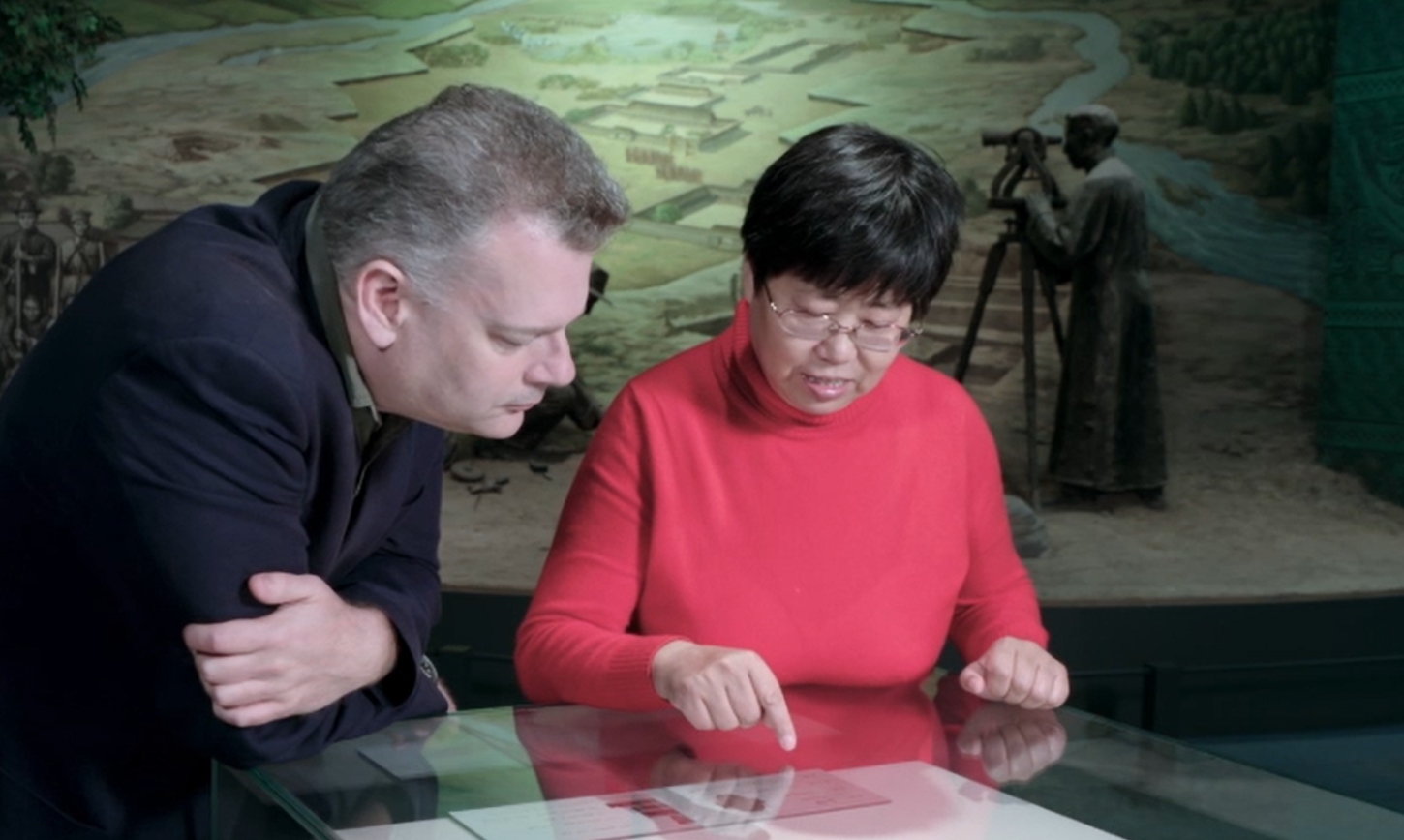
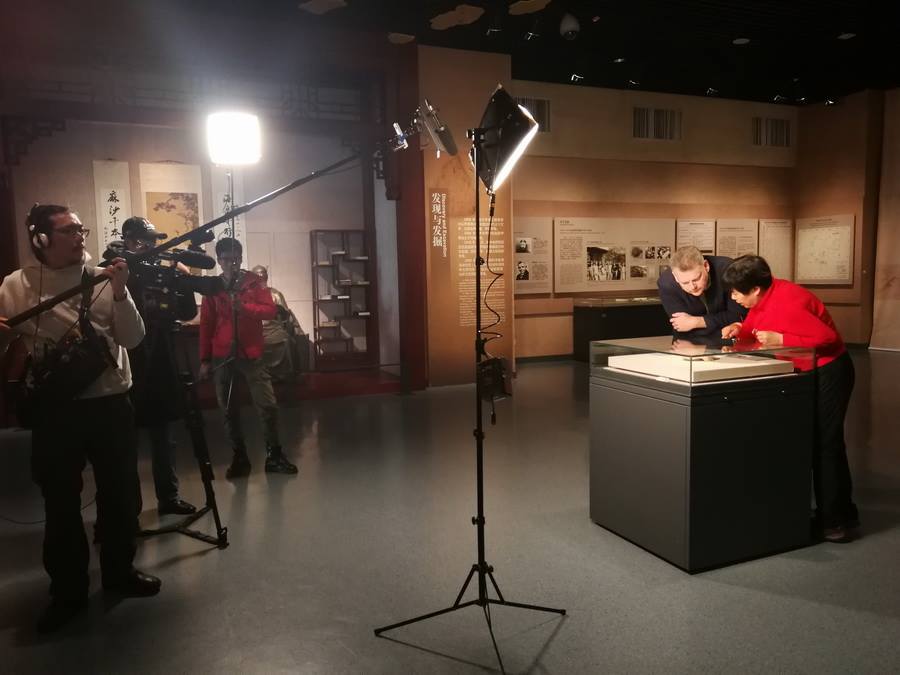
Today, we will log five minutes of footage. The day starts at 0500 and finishes for me at 2200. Every single moment takes a million negotiations, as the English director struggles against jet lag, and the Chinese director, who looks 12 but is actually 34, struggles to continue to make the documentary that he has been unchallenged about for the last few weeks before the foreigners arrived.
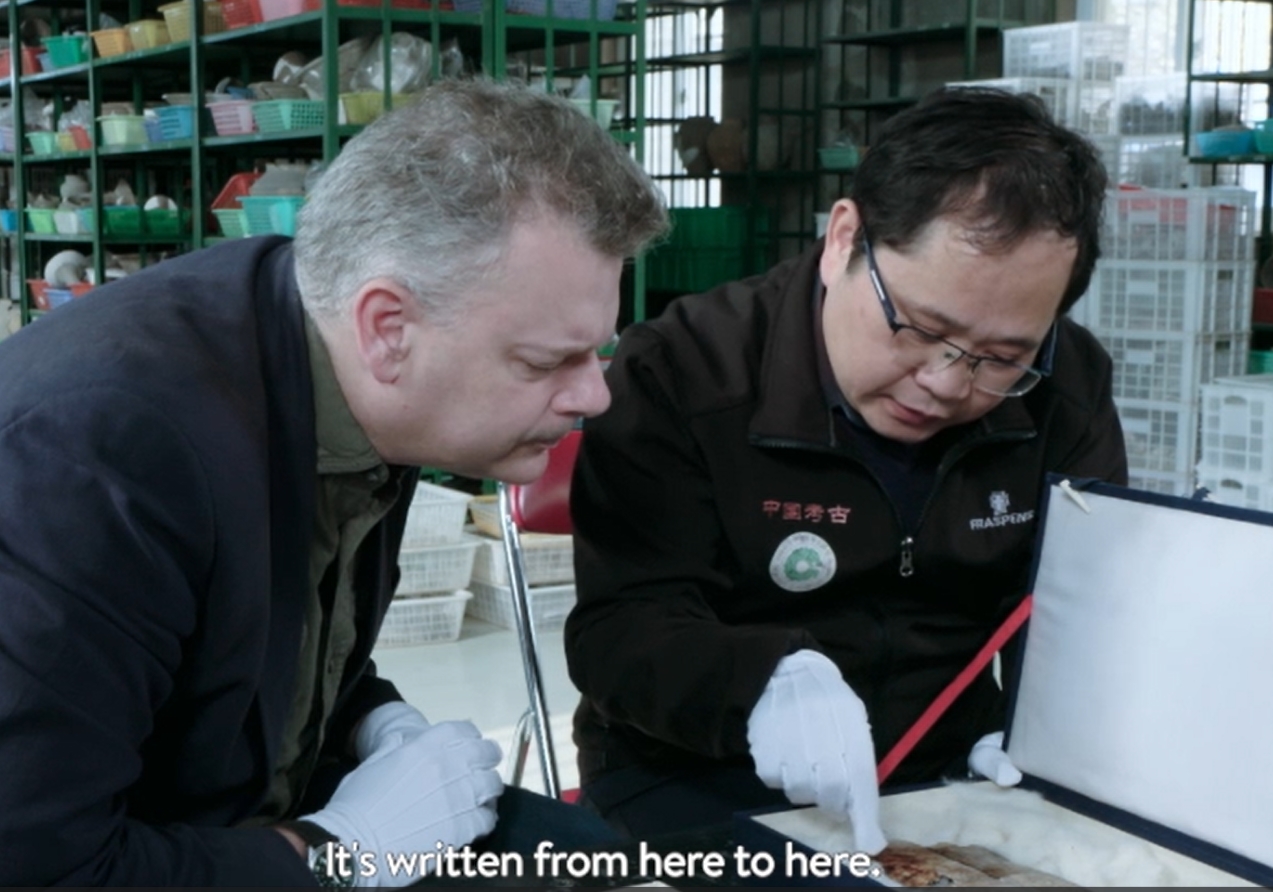
Today, all we have to do is film Yan Weixing, who looks uncannily like George Takei, make a deep-fried sweet and sour fish in his kitchen. But the lights have to come from the van, and the sound man has to mic me up, and then the director wants me to change my shirt, and then the B cameraman needs to change his battery, and the filmic world’s ever true cliché of Hurry up and Wait comes true again and again. I read the entire works of Confucius while waiting for my next call on the sheet, and Mr Yan smokes his way through an entire packet of Nanjing fags.
Meanwhile the Chinese director has his own ideas of what things should be, and really doesn’t want foreigners to interfere. Mr Yan and I are in the kitchen, and he is scraping the scales off a carp and slicing a series of incisions into it before rubbing it with salt. The heat in the kitchen is ridiculously high, and the sweat is pouring off us. He makes a batter for the fish and a delicate sweet and sour sauce. This is Lu-cai, one of the “Eight Great Cuisines of China“, and while Cantonese, and Sichuan and the like have made it abroad, nobody really knows much about the delicate flavours of the land of Confucius. Lu-cai used to be all the rage in Beijing until the 1950s, when Mao’s fetish for chilis and an entrepreneur’s willingness to open a Sichuan restaurant in the capital changed the world of Chinese cooking.
A bunch of diners are waiting for us to bring the fish. They have been waiting for three hours. They want to put a mini GoPro camera on the fish as I bring it into the restaurant so that we get a fish-eye view. I open the door and enter, proclaiming in Chinese to much applause: “Here is your Yellow River Carp!” The director makes me do it another six times. Then we have to do the sitting with the diners, six times. Then me asking about the seating arrangements six times. Then they offer me some Sea Cucumber Liqueur. We need to film it again, six times. I have drunk half a liquidised sea cucumber by this point.
We need to shoot the whole scene again, without lights, because the drone team will shoot it from outside the window in the dark. We have a drone team? Yes, they are three guys who have been sitting outside all day waiting for their moment to shine. We drink more sea cucumber liqueur and the drone crashes into a nearby balcony. But they have the shot.
It is 2200. Tomorrow’s call is 0515. I am in a hotel where prostitutes put business cards under the doors. Tomorrow I will be somewhere else by dinner time.
To America, where a group of high-profile voice actors, many with a firm footprint in the anime world, have declared war on artificial intelligences. Or rather, artificial intelligence’s meat masters, noting that many actors performing “voice performance replication work are unaware of or do not fully understand their rights regarding employment contracts.”
Vocal Variants, a pressure group including Yuri Lowenthal, Stephanie Sheh and Matt Waterson, outlined a set of simple demands and stipulations. The group aims to inform companies and actors, chiefly to warn actors off inadvertently signing away all their rights to exclusivity in their own voices.
Any voice actor with a significant body of work inadvertently creates an audio bank of their voice. This is particularly true in the gaming world, where actors are often less reciting a script than delivering “barks” and soundbites. Sakura Wars even made a big deal out of its audio component, for which the Japanese voice actresses recorded themselves saying all 100 syllables in the language, thereby allowing the audio software to address the (Japanese) player by name, and, in theory, to say anything the computer wanted.
Give an AI enough material to play with, and it can generate dialogue as if the actor is saying it themselves. It was Steve Blum, the voice of Cowboy Bebop’s Spike Spiegel, who first poked his head above the Twitter parapet to ask who had the right to make him say things he never said. It started up a social media storm that led to the formation of Vocal Variants, and its statement that voice actors were entitled to safe storage of their voices, clear stipulation of what those voices might be used for, approval on the use of their voices to generate synthetic dialogue, and appropriate payment for use.
Stephanie Sheh noted on Twitter that although many of the AI apps agree to take down unsanctioned audio files, the actors are often obliged to police them themselves, and often don’t even know their voice has been uploaded unless they join each specific app service.
“As AI/Synthetic voice work now covers much uncharted territory,” says the Vocal Variants website, “it’s imperative that we collaborate to create and amend laws and contracts to protect both laymen and professional performers against deep fakes, improper use and exploitation of recorded performances.”
Jonathan Clements is the author of Anime: A History. This article originally appeared in NEO #229, 2023. Since its publication, Vocal Variants has become a division of the National Association of Voice Actors.
The distance from Puli to Hualien is 40 miles as the crow flies. You can drive it in just three hours, although, tellingly, today’s bus and train routes still take seven, edging all the way around the north of Taiwan, rather than making a beeline across the towering central mountains. But there was a time when it was a track unknown to all but a few aboriginal hunters, until one brave Japanese frontiersman, Katsusaburo Kondo, led a surveying party through the jungle.
That, at least, is what Kondo claimed, in a series of 1930s newspaper articles in which he chronicled his experiences among the tribesmen of the Taiwanese hinterland, a life-long association that led him to acquire the nickname “Kondo the Barbarian”. His memoirs have now been published by Camphor Press, a small publishing house that punches way above its weight in Taiwan Studies, responsible for much of the best and most original material in the field in recent years.
In October 1930 a group of Taiwanese Seediq tribesmen infiltrated the sports day at a Japanese-run high school and massacred over 130 Japanese, as well as two Chinese observers who had fatefully decided to cosplay in kimono. The “Musha Incident” became a touchstone of Japanese-aboriginal relations, and would lead to a brief colonial war that claimed hundreds of Seediq lives. The Musha Incident was a shock to the Japanese system, but has also been framed as a form of indigenous apocalypse, as the last generation of Seediq warriors, deprived of their traditional manhood rituals, went hunting for their colonial oppressors in a last, desperate attempt to merit the killers’ tattoos that would entitle them to join their ancestors in the afterlife.
Suppressed for decades under the Kuomintang government, the story of Musha sprang back into life in the 1990s, as the Taiwanese media gained increasing interest in indigenous issues. It was adapted into a comic by a native artist, which itself became a major source for the film Seediq Bale: Warriors of the Rainbow (2011, pictured), an epic action movie that reframed the story along the lines of Braveheart or the Native American “ghost dance” cult.
The Musha Incident, in fact, remains such a huge presence in reports of Taiwan under the Japanese that it still accounts for 10% of all the material published in Japanese relating to the fifty years of colonial rule. Paul Barclay’s new book digs down into one of the ur-texts that inform so many of these stories, the reminiscences of an unreliable narrator who tried to place himself at the centre of the story.
Katsusaburo Kondo is that most dangerous of conmen: an evocative and persuasive writer. He begins his story with the aftermath of the Musha school massacre, when he visits his estranged aboriginal stepdaughter, who confides to him the true reason for the war, before hanging herself in her prison cell. He then leaps back in time to tell the story of his relationship with Taiwan’s indigenous people, as an interpreter, explorer and trader.
In particular, Kondo is keen to insert himself into the narrative of the Fukahori Expedition, an ill-fated platoon murdered by head-hunters in the Taiwanese hinterland. He frames much of his subsequent adventures as a quest to avenge the lost soldiers, and to retrieve their bodies and possessions, finally striking it lucky when he stumbles across their skulls on display in a tribal longhouse. But as Barclay notes in his meticulous annotations, Kondo’s life-long claim that he, too, would have perished on the expedition were it not for a fortunate bout of malaria, was part of his ongoing attempt to appear far more involved than he really was.
The scene of the Musha massacre, 1930.
“Despite… many inconsistencies, falsehoods and implausible claims,” observes Barclay, “Kondo’s writings wedged their way into discourse, by hook or by crook.” However, they are also loaded with tantalising and convincing glimpses of aboriginal culture, including a chilling account of the “guardian of heads” (the crone priestess who welcomes a new skull to the tribal shrine), and a charming anecdote in which an indigenous girl confides to Kondo that her people are “afraid of the Japanese people who tick-tock.”
It takes Kondo a while to realise that she is frightened of his pocket watch, which makes him, too, seem like an otherworldly creature bearing haunted devices. This is catnip to the historian in search of local colour, but Barclay is on hand to warn that it seems suspiciously close to another story told by one of Kondo’s associates, and was quite possibly something that he ripped off. In another part of the tale, he recounts a horrifying attack by several tribal youths, who decide to lynch him for his skull. He fights them off, but is so grievously wounded that he writes his will… except he is “fully healed” within two weeks. Well, which is it?
And yet, and yet, there are moments in Kondo’s story, translated here in full, that are truly illustrative of the stand-off between the aborigines and the Japanese, such as the sight of tribesmen going cap-in-hand to the local police station to plead for meagre parcels of gunpowder and a couple of bullets, merely so they can continue their livelihoods. Kondo tells tales of the Seediq hardening the soles of their feet by walking on hot iron rods, and of the strict lumber merchants whose insistence on unmarred timber is the cause of much misery among tribal log-carriers. Finding a corpse on their mountain mission, he asks his tribal companions if they want to eat it, and they look at him in horror – cannibalism being taboo among them, despite claims to the contrary made by the foreign media. These observations are so mundane, so everyday that they have to be true. Right?
Taiwan as imagined in a 1930s Japanese tourist poster.
With Barclay as our guide, Kondo’s tall tales become an object lesson in text-critical analysis, as we get to grips with the lies he tells others, the lies he tells himself, and some of the truths that are still revealed. His account of his divorce from his common-law wife, in which he delivers a pig’s head and a keg of rice wine to her father, seems faithful to tribal traditions, although one wonders just how happy the former Mrs Kondo was with it – Kondo claims she waves him away with a laugh. Barclay even gently makes Kondo more relevant to modern historians, by redacting some of his hand-waving racist dismissals of everyone as “savages”, replacing his blanket descriptions with more exacting classification of tribes and sub-groups.
Sometimes, one thinks, the tribesmen have the last laugh. Kondo writes sneeringly of a moment on his expedition when he convinces his tribal companions that he has a magical amulet that will turn a single grain of rice into a full belly for each of them. “So simple-minded,” he scoffs when they appear to fall for it. And yet he also tuts in annoyance when they attempt to delay the mission by waiting for a new-born baby to grow up so that its mother is free to accompany them. Kondo decries this as a moment of savage sloth, but one wonders if the tribesmen weren’t concocting an excuse to delay the city boy’s dangerous mission for another season.
Resistance to the Japanese authorities was futile. Barclay has some winning data on the nature of colonial wars, pointing out that the Musha Incident was such an embarrassment to Tokyo that the soldiers who avenged it were handed the most desultory of medals and rewards. Even as the Hague Convention attempted to limit the savagery of modern warfare, colonial campaigns were somehow exempt, subjecting the Seediq to some of the very worst of modern weaponry, including aerial bombardment of their forest hideouts.
Kondo writes vividly of some of the attempts to get the aborigines to understand how pointless it was for them to fight back, with a tribal delegation brought to visit Japan itself to show them the power and might of the Land of the Rising Sun. Put aboard a train for the journey to Keelung, the Seediq scream in fear, protesting at the dizzying speed, pointing in terror at what appears to them to be “dancing trees” beside the tracks. It is a beautiful image, but Barclay points out that while Kondo’s early writings describe the aborigines as brave, hardy trackers and hunters, his later work transforms them into clueless, whiny man-children, reflecting Japan’s own drift towards imperial condescension. In Barclay’s hands, Kondo the Barbarian transforms from an account of the Taiwanese indigenous people to an even more revealing narrative about the Japanese who were writing about them.
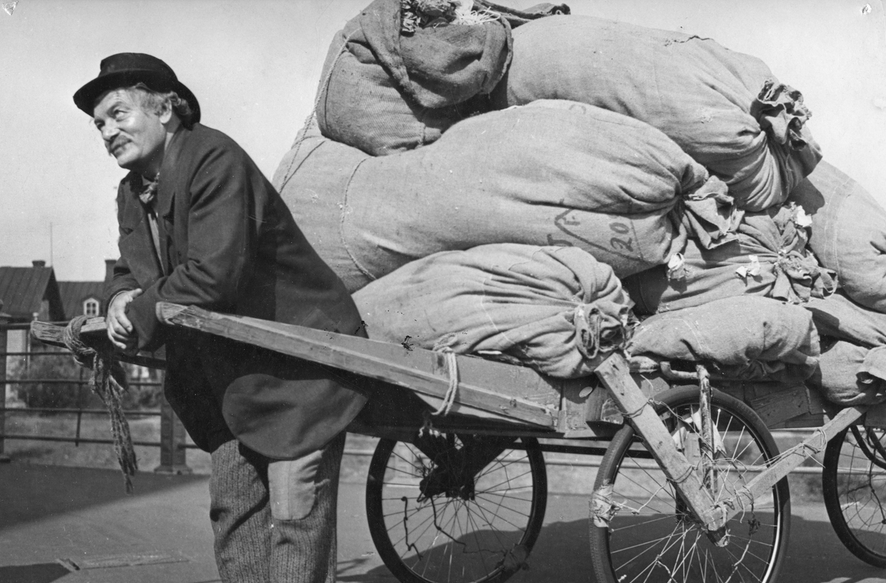
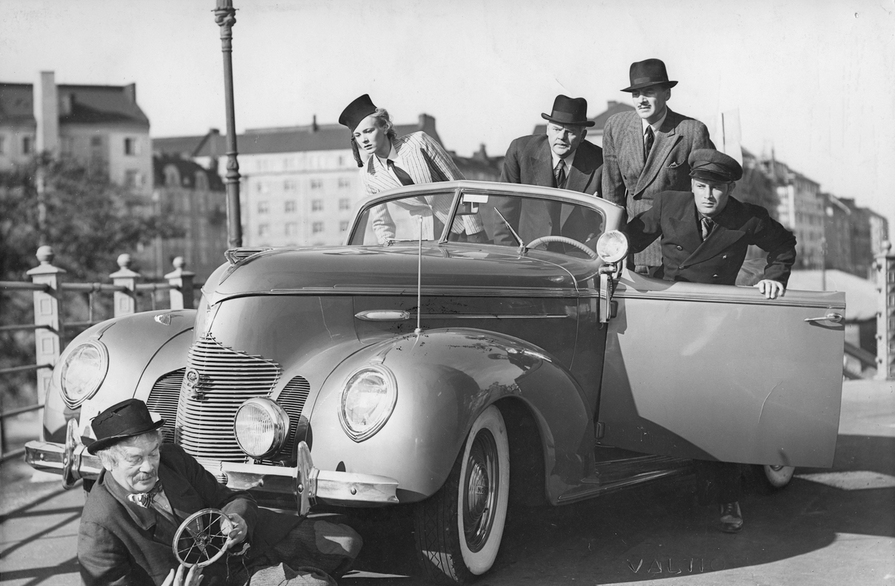
Carefree Finnish nobleman Arnold (Tauno Palo) makes the mistake of beating a Russian prince at cards, and is challenged to a duel over the attentions of a lady. Fearing he is wanted for murder, he flees from St Petersburg back to his native land, switching clothes and identities on the train with a violinist. Hiding out among circus folk, he becomes the unwitting centre of a love triangle between an acrobat and a strongwoman, and has to flee once more, throwing in his lot with a band of gypsies who love his violin-playing.
He soon charms local lady of the manor, Helena (Ansa Ikonen), who is torn between the man she believes to be little more than a tramp, and local rich boy Eric (rent-a-cad Jorma Nortimo, sneaking back in front of the camera after many months directing behind it). Arnold plays up his vagabond status, wriggling out of an illegal fishing charge by pretending he can’t read the sign, and eventually accepting Helena’s charitable offer of a low-ranking job at her mansion in order to “better himself”. The two would-be lovers are surprised by the apparently justifiably jealous Eric, leading to a tense wedding in which Arnold and his gypsy band dominate proceedings. Arnold and Helena elope, only for him to drive her up to his own family mansion, and reveal that he has, somewhat cruelly, been lying to her all along.
All’s well that ends well, because he’s rich.
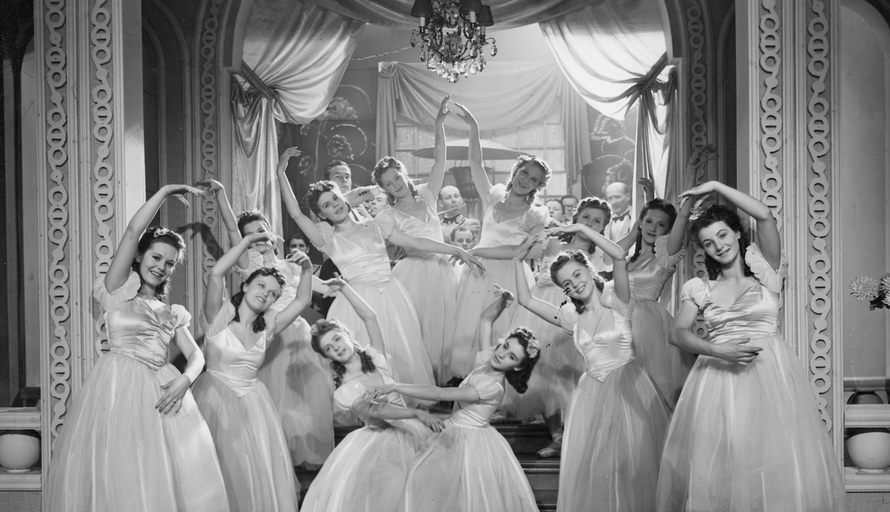
Leading man Palo is initially unrecognisable beneath a 19th-century moustache, in a film that comes loaded with baroque, imperial sets, hearkening back to the Bad Old Days when Finland was but a Grand Duchy within the Tsar’s Empire, and even posh Finns were little more than servants to the Russians. Much of the fun derives from the slurry of women that Arnold leaves spattered in his wake, including Athalia (Lida Salin), the incredibly enthusiastic circus strongwoman, and Cleo (Laila Jokimo), the lithe acrobat. Regina Linnanheimo in a black curly wig is uncharacteristically joyous and smouldering as “Rosinka the beautiful gypsy girl” for whose affections Arnold briefly wrestles, before being told something borderline racist about how “gypsies should keep to their own kind.”
Of course, he’s also “keeping to his own kind,” pursuing the usual wet-lipped and grasping Finnish film romance of a woman with pots of cash, although one imagines that the producers would plead that, at the time she elopes with him, Helena doesn’t believe he has two pennies to rub together. Ansa Ikonen’s face, in the final scene, is a picture of wounded pride, as she gets a happy ending, but only through a deception that has been perpetrated on her for the entire movie. She genuinely looks like she’s going to slap him, and then she actually does. Their romance is only saved at the last moment by Arnold’s fearsome mother (Elsa Rantalainen), who literally commands them to kiss – a dramatic device we have seen before in The Regiment’s Tribulation and Did Emma Laugh at the Sergeant.
The “Vagabond’s Waltz” was originally a Swedish tune written in 1909 by J. Alfred Tanner. It was the film director Toivo Särkkä who decided that such a well-known ditty deserved a film built around it, in a sort of precursor to modern juke-box musicals. He threw 50,000 marks at the writer Mika Waltari, whose summery script was then lensed in the dark and rainy days of a Finnish autumn, leaving the cast looking somewhat drab and bedraggled when they are supposed to be having fun.
Despite such tribulations, the film became one of the most popular ever at the Finnish box office, circulating in a dozen prints and making it as far afield as Bulgaria and Turkey. “One of the finest products of the Finnish film industry,” enthused the unimpressable Paula Talaskivi in the Ilta Sanomat. “A beautiful, glossy picture,” agreed Olavi Vesterdahl in Aamulehti. “The viewer is happy to forget all the impossibilities of the plot for a couple of hours and surrender to the flow of events when they happen quite effortlessly and in a brisk good-natured way.”
“The film is the Finnish counterpart to the melodrama Gone with the Wind,” wrote Antti Lindqvist in Katso magazine in 1990. “Both works nostalgically describe the idyll of a bygone era that never existed.”
The real stand-out star, however, is Regina Linnanheimo, usually a bored-seeming and often sulky blonde onscreen, suddenly transformed into a vivacious dancer with flashing eyes. Maybe it was the wig?
Jonathan Clements is the author of A Short History of Finland. He is watching all the Finnish films, so you don’t have to.
Zibo is famous for glass. It’s where they make the glass vases with paintings on the inside, and the ones with the different coloured coating that’s carved into the outside. The glass flowers that form vast corporate installations, and the horrible little paperweights and dust-collectors beloved of many a mad old lady.
Li Daxi loves glass. He loves its malleability and the speed with which he can put together a vase or a figurine. This wiry, friendly man shoves a metal pole into a furnace at 1400 degrees, withdrawing it with a hot blob at the end, and he sits at a chair made of scaffolding where he can roll the blog and pat it with a trowel, where he can blow into it and tap it.
“Today,” he says, “we’re going to make a fish.” He taps and rolls the first blob, and as it cools to 800 degrees, the white hot gunge congeals to a bright red. Belatedly, I see the signs that hang on each of the furnaces – “Tea”, “Red”, “White Jade.” The true colours only manifest as it cools, but while the red blob is still too hot to touch, he dunks it into another molten bucket marked as Transparent.
I roll the hot blob for him on the scaffold chair while he sets about the clear outer layer with tongs and clippers, teasing it into fins, shaping a fish’s head and poking two little eyes into it. It’s done in less than five minutes, and yours for thirty pounds. He lets me have a go and my first fish looks more like a dinosaur. The second is more like a teapot. The third is a fish.
Li Daxi is a certified master of glass, and he leads me around the gallery in the factory, in the company of four eager students. They have been scooped up from the local polytechnic, and arrived unaware that they were going to be on television. It’s only as we stand there waiting for a lens change that I decloak as a Chinese speaker, and they suddenly burst into animated conversation about what this show is, and why we’re here. Belatedly, they realise that Li Daxi’s comments on their hand-drawn designs, and my tin-eared questions about them, are going to be broadcast in 30 countries. Everybody is very excited, and intrigued by the process of television, and boggled to discover that their taxes are being funnelled by their local government into putting a film crew in their factory to make a five-minute advert for it.
“Your job is so hard,” says Li, whose arm I have just watched tan in front of me as he holds his pole in the furnace for slightly too long. “So much standing up, and repeating yourself, and running backwards and forwards.”
But his job is hard, too, as he attests, revealing that the youngest student he has is in his thirties.
What about those nice young men this morning, I ask.
“Oh, they were all designers. They come with ideas for vases and jugs, but they still expect someone else to make them. They come to me and I tell them the handle won’t support the weight, or that the whole thing will have to be exterior-cut or interior-painted, but they won’t do any of that themselves. Nobody wants this job. The heat is incredible, every day. We wear asbestos gloves, we’re throwing around molten glass…”
The day started at 0530. By sunset, we are filming the pick-ups of me arriving at the factory and doing a rushed piece to camera in front of a sunset that we are hoping will pass for a sunrise. Then it’s back indoors after the light fails, to film me and Mr Li looking around the gallery and talking about his favourite pieces. We wrap at 1830, then there’s just time for a rushed dinner before the four-hour drive to Qufu, the home of Confucius.