Walking the Pattern

Nuo opera, claims the ebullient Qin Falai, has been around for 6,000 years. It is a theatre that has grown out of shamanic dances, maybe of the ancient Ba people who once lived in Sichuan, and preserves many elements of ancient culture, quite possibly the Yelang culture that once flourished in ancient times in what is now Guizhou, where we are today.

Or quite possibly not. He talks me through a long mural detailing the greats of the tradition, and his own ancestors, and it becomes plain that whatever Nuo used to be, it has undergone cataclysmic transformations over the centuries. Originally a ritual pattern of steps designed to cast out demons in the New Year, it was changed beyond recognition by its encounters with Daoism and Buddhism, which dumped a whole load of new stories and concerns on top of it. The Tang dynasty, notably the age of Empress Wu, threw in female practitioners for the first time, and may have been when Nuo was exported to Japan as No, with which it has many striking similarities. In the Ming dynasty, it supposedly became more theatrical, incorporating skits and stunts, and thereby becoming so intertwined with the usual Chinese opera that my bumper Dictionary of Chinese Theatre doesn’t actually have an entry for it.

The last figure on the mural is a wizened old man blowing a cow-horn trumpet, and Mr Qin’s breezy lecture falters. “This is my father,” he says. “He was my father and my teacher, and he suffered so much. In the Cultural Revolution, they broke into our house and destroyed everything we had spent three hundred years trying to preserve. We were beaten and we were persecuted.”

Tears begin to roll down his face as he recounts his family’s sufferings for being regarded as religious or superstitious in a time when China crusaded against the “Four Olds”. I pat his arm in vain as he weeps.

“I put him here, on this wall of gods,” he says, “not because he was my father. Not because he was my teacher. But because of everything he went through.”

I console him in the shadows and see that we are still filming. But the director is shaking her head. There is no way we will be allowed to broadcast much of this footage, mainly because it soon becomes clear that the most recent attacks on the QIn family were in the supposedly enlightened 1980s.

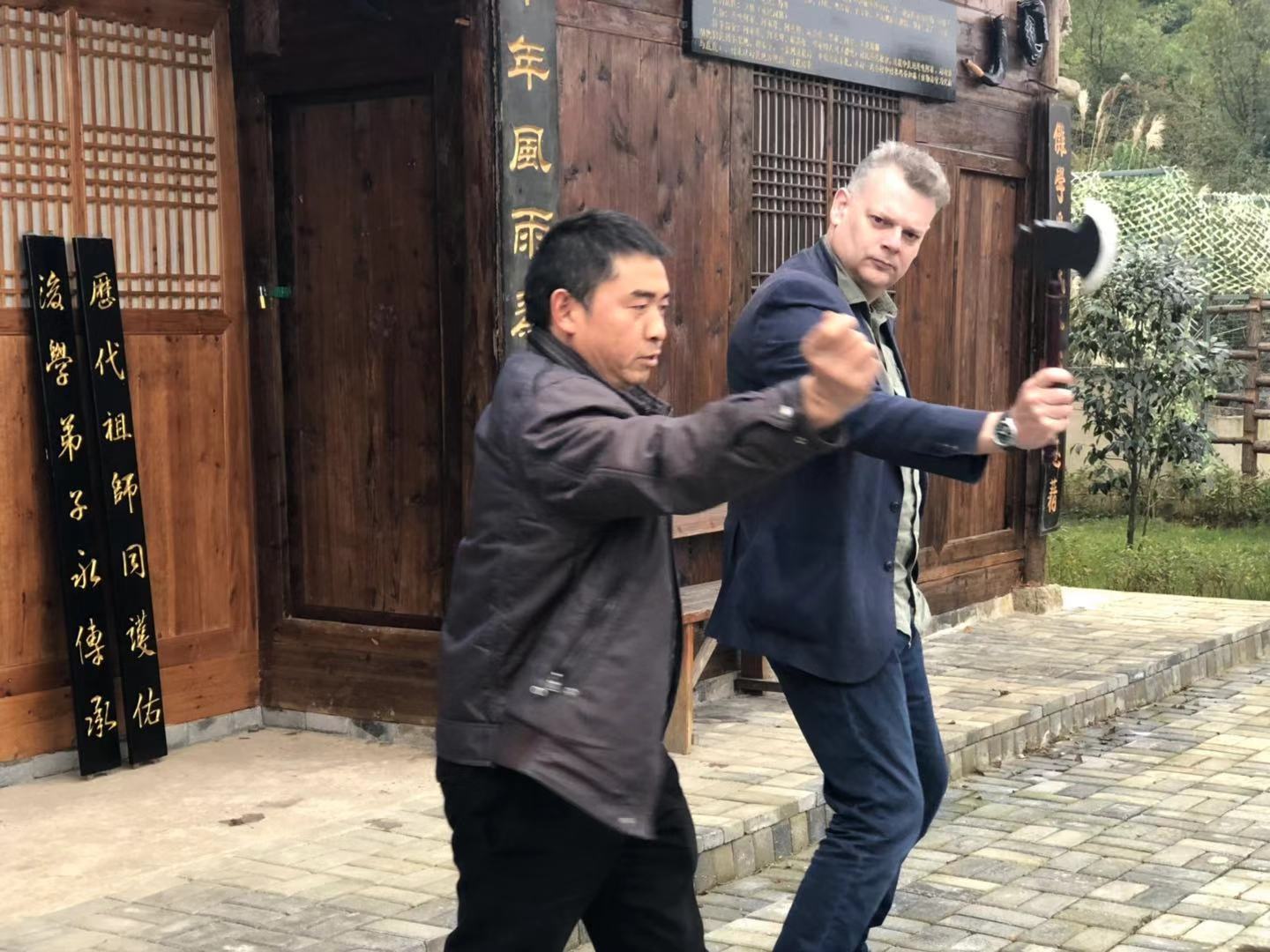
Mr Qin wants to teach me the Pattern of the Eight Directions, a mystic dance of footsteps designed to lock a shaman in some sort of protective force-field. You must enter from the north, step to the middle, then the south, then north, then east, then west, then… maybe the middle again, then diagonally to the… I already forget. But this goes on for a while, and once you have started into the Pattern, you can’t stop, and you can’t get down.

Oh, right, I forgot to mention that. In order to train pupils to step at the correct length of pace, the training for the Pattern of the Eight Directions is conducted on top of a set of nine stubby pillars, so the crew have a good laugh watching me teeter and trip, while Mr Qin stands at the side with a pointy stick, shouting “NOW LEAP TO THE PILLAR OF THUNDER! LEFT, YOU IDIOT! NOW LEAP TO THE PILLAR OF WIND. NO! NOT THAT, THAT’S THE PILLAR OF FIRE!”

Having thus had my brain thoroughly scrambled, we move onto a performance, which is apparently is the World-Creating Dance of Kaishan, Divider of Mountains. This involves donning a mask unsurprisingly like that of a Noh demon, waving an axe around and proclaiming that one is going to Open the Mountains in various directions, and possibly fly about a bit. Mr Qin confuses things a bit by dropping into Guizhou dialect on occasion, but the text seems confused already. “Opening the Mountains” (kaishan) is sometimes a reference to the Pangenitor deity of Chinese folk religion, and sometimes a reference to the arrival of Buddhism in the sticks, but sometimes also a reference to Yin Kaishan, one of the faithful lieutenants who supported the grab for power of the first Tang Emperor, and whose alleged grandson was the famous Tripitaka. So we’re mixing two religions and one historical figure, while spinning in circles and pretending to be a bird. It’s all in a day’s work for a Clements. I’ve had weirder Tuesday afternoons.

“You’ll stay for dinner, of course,” he says. “I’ve already killed a chicken.”

Jonathan Clements is the author of A Brief History of China. These events featured in Route Awakening S05E05 (2019).

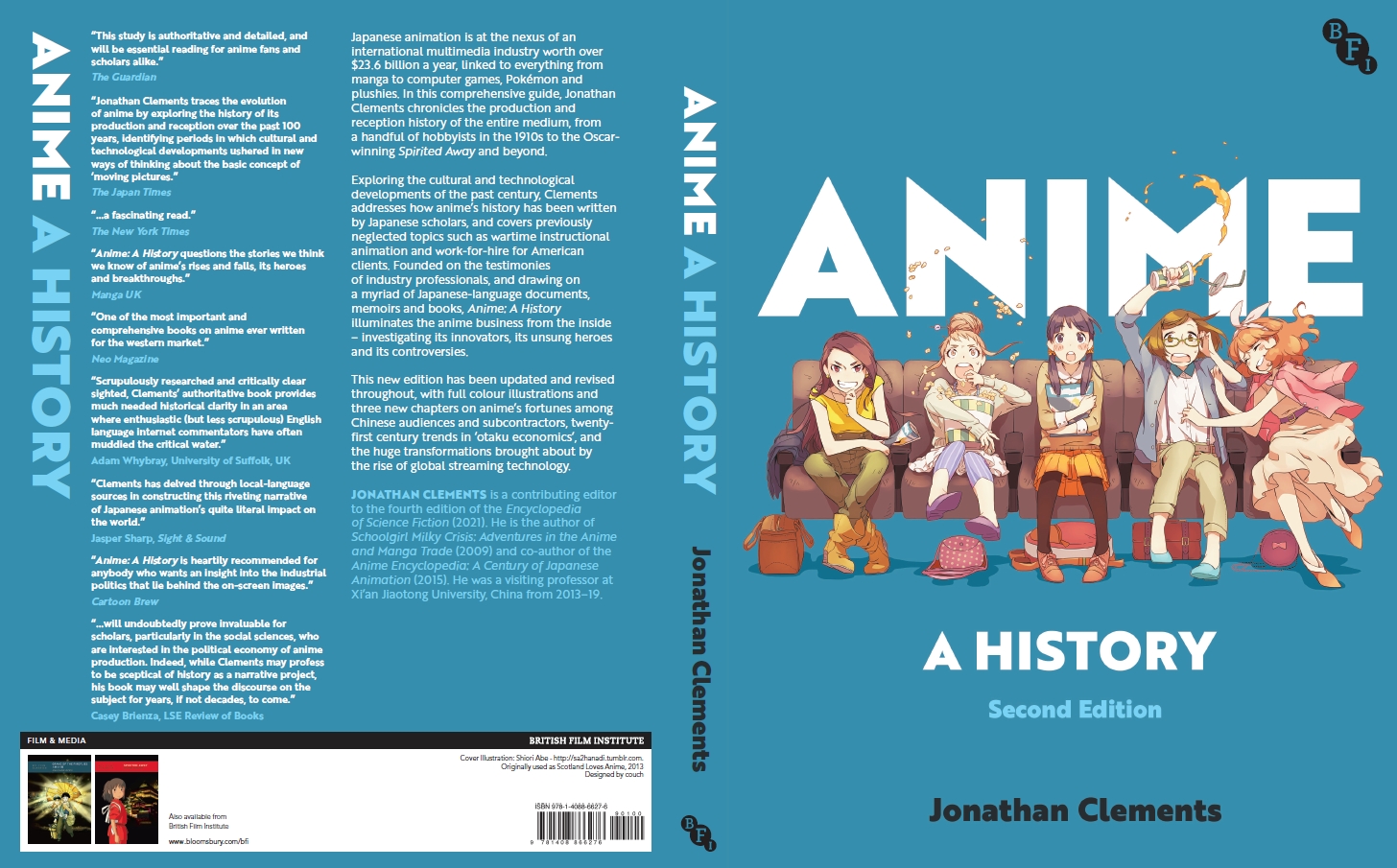
Second Edition

Now available to pre-order from Amazon US and Amazon UK.

“This new edition has been revised and updated throughout, with full colour illustrations and new chapters addressing the rising economic power of otaku subcultures, the development of anime in China, and the transformation of distribution and exhibition accompanying the dominance of Netflix and other globalised streaming platforms.”

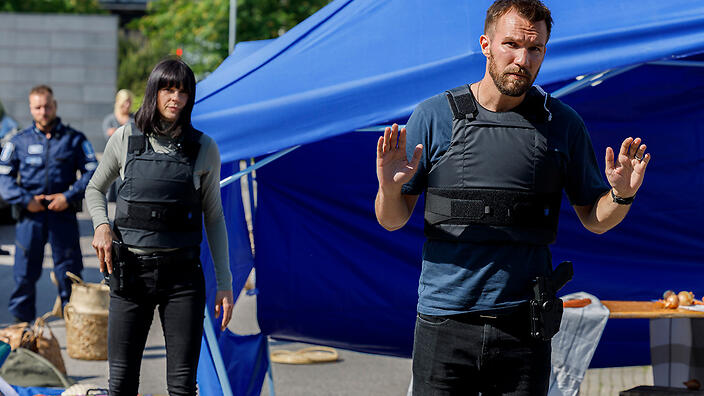
Helsinki Crimes (2022)

Timo Harjunpää is a dour, distracted detective who commutes into work on the train from the Helsinki suburbs. He has to deal with a series of quirky crimes, including a policeman’s son on a killing spree, a millionaire pushed over the edge by aggressively woke tormenters, and a male prostitute accused of murder. Meanwhile, Harjunpää’s wife hectors him about “never” spending time with his family, but does so while they’re at the beach, and continues complaining about it while they are sailing around in a yacht.

Sneaking without fanfare onto Netflix, the Finnish crime series Harjunpää is based on the novels by Matti Yrjänä Joensuu, retitled Helsinki Crimes for the international market, on the grounds that there is no point in having a hero whose name nobody can pronounce in the Home Counties. The character has appeared before in multiple adaptations, including a Swedish-language TV series in the 1980s and a Finnish series in the 1990s. Here, he is dusted off once more for the Scandi Noir generation, with adaptations of four of the Harjunpää novels, carefully dragged into the 21st century. Harjunpää and the Policeman’s Son, for example, was originally published in 1983, but here gains a subplot about online identity theft that would never have even occurred to the original author. Harjunpää and the Bullies, originally published in 1986, is here entirely transformed into a story of net stalking and catfishing.

The original novels were written between 1976 and 2010 by a serving police officer with a deep interest not only in the police procedural, but in the psychological grind of police work. Harjunpää himself was named in honour of a fellow cop, killed in the line of duty in 1968. Joensuu’s original novels focused on the damage done to Harjunpää by his encounters with crime and criminals. As noted in Sally Wainwright’s Happy Valley, police officers tend to encounter people on “the worst days of their lives”, and the series zeroes in on Harjunpää’s troubles reconciling his day-job horrors with his distant family life.

Much of the appeal to Finnish viewers surely stems from the way that forty-year-old thrillers are updated for a new generation, but none of that will be visible to audiences overseas. Instead, they are liable to see an oddly well-off, reticent detective, blundering through a series of crime scenes, with a will-this-do? theme tune and a touchy-feely boss.

The subtitling team push their translation to the redline of acceptability, throwing in a bunch of policier slang (all “vics” and “K-9 units” and “broads” and even saying “911” when the emergency number in Finland is actually 112), which makes the script sound a lot cooler than it really is. The best scene in episode one, however, is completely wordless, as a father identifies his daughter’s body at the morgue, and the entire thing is played in Finnish silence.

Some truly interesting local nuances may slip past the casual foreign viewer, such as the calm and conciliatory behaviour of the police, who often seem to treat the criminals as if the crime they have just committed is something that has happened to them. Harjunpää has none of the “YOU’RE A LOOSE CANNON!” spats we might expect with his captain, who is, instead, a kind-hearted matron who asks him if he is fulfilled at the workplace. His conflict with his partner Onerva is not about the usual buddy-cop tensions, but about her unreconstructed opinion that criminals cannot possibly be reformed, and are only learning enough psychobabble to gain parole.

The filming schedule appears to have made the most of the short Finnish summer, although one sequence may play differently with foreign viewers. It looks at first as if someone is doing a terrible job of shooting day-for-night, but is in fact naturalistically filmed at midnight in July, which truly has an eerie teal pallor, like some otherworldly twilight.

Jonathan Clements is the author of A Short History of Finland.

Ryuichi Sakamoto (1952-2023)

“I would really like to work with people who understand music,” he once said. “Film directors can just cut out a couple of frames to make things fit, but I have to rearrange an entire song if they do that. One director could cut out an entire scene, just after I’d finished writing the music for it.”

Over at All the Anime, my obituary for the composer Ryuichi Sakamoto.

Getting Wood

The carpenter is not available until 6pm, so Mack the Fixer and I entertain ourselves by challenging six of the village children to basketball in the schoolyard. I say we entertain ourselves; Mack entertains himself and the director makes me join in because the director of photography was on the balcony with his camera. The kids are a bit like Imperial Stormtroopers – they run around a lot but can’t shoot straight to save their lives. I haven’t seen the footage, but if we were shooting on 50fps, the opening credits sequence should include a slow-motion picture of me slam-dunking a basketball while half a dozen Chinese boys try to wrestle me to the ground, in the well-known tradition of Clements sporting achievements.

Finally, we get to Mr Wu, yes, another Wu – it’s complicated.

In the 18th century, the Kam tribal areas were conquered by a general called Wu, and everybody adopted his surname. They only diversified a little bit a few decades later when Chinese prefects were shocked that people with the surname were marrying each other among the Kam. So they split the names again, although there do seem to be a hell of a lot of Wus around. And this one is going to teach me how to make a little stool that looks a bit like a chunk of Stonehenge.

It is quite boring for everybody involved, since making a stool hardly constitutes amazing television. Mr Wu is also preoccupied with another appointment, possibly discombobulated by the camera crew, and has somehow misjudged his sawing lines, so that the stool we are making has uneven legs that not even a lopsided contortionist could sit on. After an hour, we have lost the light and are shooting in the street with the LED lamps to bump up the luminance. Mr Wu’s stool looks like it’s been designed by MC Escher, and I can’t help but notice that he only has nine fingers, having presumably sliced one of his off at some point while making a stool that looked almost, but not quite, entirely unlike Stonehenge.

Eventually, he pleads that we should come back later when he can sneak away and re-measure his planks. I do a piece to camera claiming that I have built the terrible, mis-shapen two-legged stool, and we pack up for dinner. Mack slips Mr Wu 100 kuai (£10), at which point Mr Wu suddenly realises that he doesn’t have another appointment after all, and he is happy to stand around sawing all night if necessary.

No, that’s all right, we’ve got what we need, insofar as what we needed was three minutes of footage of me smacking stuff with a hammer while making lewd double-entendres that will hopefully slip past National Geographic and make the show vaguely more entertaining.

Jonathan Clements is the author of A Brief History of China. These events featured in Route Awakening S03E02 (2017).

Cyberpunk Peach John

“Even Rootport’s afterword account of working with Midjourney is now a historical document in the rapid pace of AI development. His experience, his achievements and his complaints all relate to a version of Midjourney that was superseded last autumn. In the time it has taken his book to make it to the bookstores, the AI has evolved another generation.”

Over at All the Anime, I write up Cyberpunk Peach John, the “first manga drawn by an A.I.”

Rice Rice Baby

Two years after Japan seized Taiwan from imperial China in 1895, the government in Tokyo had started to wonder if it was worth the hassle. The local people were notoriously difficult to control; the anti-Japanese resistance continued to bubble away in the hinterland, and the infrastructure was a mess. Some wag in the Japanese parliament even made the modest proposal that, all things considered, Japan had been sold a lemon, and should probably consider off-loading the whole thing for a bargain price on the first mug to come along… probably France.

Toshio Watanabe’s The Meiji Japanese Who Made Modern Taiwan is a study of those Japanese engineers, politicians and scientists who refused to give up, turning Japan’s newly acquired colony into a testing ground for some of the grand schemes that would later be unrolled all across the Japanese empire.

Watanabe zooms in on Shinpei Goto, the administrator whose thoughtful approach to researching his new posting led to the commissioning of invaluable, multi-part scientific surveys, including a 4000-page report on tribal traditions among the indigenous inhabitants – often the first time such matters had been documented. It was Goto who dragged the island out of almost a decade of infrastructural decay, setting up the Bank of Taiwan to disburse investment funds for roads and railways, and declaring a Twenty-Year Plan to make the island a net contributor to the imperial Japanese economy.

Watanabe focuses on several linked elements of Japanese colonial development in Taiwan, particular­­­ly the creation of a new strain of rice, optimised not only for local conditions, but also for the Japanese palate. The result was a strain named for the ancient Chinese isles of the immortals, Penglai Rice (a.k.a. Horai Rice or Ponrai Rice), and Watanabe takes the story of this miracle crop out of both Taiwan and the Meiji era, to demonstrate its wide-ranging impact overseas, particularly in India in the 1950s. Even today, it and its descendants represent up to 93% of all the rice grown in Taiwan – Watanabe’s chapter on Horai Rice scales way, way out, making a bold claim to it as the saviour of millions of twentieth-century lives. This has, however, done some damage to crop diversity on the island – a fact alluded to in Crook and Hung’s Culinary History of Taipei, which notes the extinction of certain other rice strains in the wild.

But the crop was only half the story. Watanabe also delves into the history of the fields where it grew, particularly the plains between Chiayi and Tainan, the agricultural capabilities of which were multiplied a hundred-fold during the Japanese colonial era. For this, we have to thank a Japanese hydraulic engineer, Yoichi Hatta, who designed an irrigation system covering hundreds of square miles, holding back floodwaters and saving them to re-use in dry spells, to turn the Chia-Nan plain from a farming disaster-area into a rice-producing power-house with three crops a year.

Hatta was justly celebrated as one of the icons of Japanese Taiwan, and enjoyed a vibrant afterlife, particularly at the turn of the the 21st century, when a Japanese prime minister, Yoshiro Mori, turned out to come from the same part of Japan. The result was a veritable Taiwan-Japan love-in, with diplomatic visits, high-level glad-handing, and even the release of a worthy-minded dramatization of his life, Noboru Ishiguro’s animated film Batian Lai – well, Batian Lai (“Here Comes Hatta”), is how I translated the title in the Anime Encyclopedia, but the Japanese original Patten Rai, has a stab at replicating the way his name would have been pronounced by the actual Hokkien-speaking locals. The anime film concentrates on Hatta’s obsession with the irrigation system, and his pride and joy, the Wushantou Dam, which for six years in the 1930s was the largest in the world. Hatta’s most recent appearance in the media was in 2017, when a crazed politician in search of clickbait decapitated his commemorative statue at his gravesite beside the dam.

After Japan lost Taiwan in 1945, the new Kuomintang government adopted a scorched-earth policy towards the fifty years of Japanese rule. They played up colonial atrocities (of which there were many), deported thousands of Taiwan-born “Japanese”, banned the Japanese language from public life, and did everything they could to wipe out the Japanese colonial legacy. Watanabe’s book is a celebration of the oft-forgotten achievements of Taiwan’s Japanese era, although in pushing to recognise the achievements of the Japanese, he might occasionally have forgotten the Taiwanese who did much of the hard labour, and the occasional European who might have helped a little bit, such as William Kinnimond Burton, the Scottish engineer who designed many of the island’s Meiji-era sanitation systems.

But Watanabe’s book is more interested, naturally, in the Japanese, whose lives he describes with empathy and occasional melodrama. Nowhere is this more obvious than in the tragic end to Hatta’s story, when he dies aboard the Taiyo Maru, a ship torpedoed by an American submarine. His body lies in the water for a week, in which time the flesh is so picked clean by marine scavengers that he can only be identified by his clothes and personal effects.

His wife, Toyoki Hatta, held on until the 15th August 1945. On hearing the news of Japan’s surrender on the radio, she calmly walked through the rain to the Wushantou Dam, took off her shoes, and threw herself into the waters.

Jonathan Clements is the author of A Brief History of Japan. The Meiji Japanese Who Made Modern Taiwan is published by Rowman & Littlefield.

Human Fallback

It’s been more than twenty years since Peter Jackson’s Lord of the Rings trilogy used the newly made Multiple Agent Simulation System in Virtual Environment (MASSIVE) software to create and animated armies of orcs and elves. MASSIVE famously took much of the misery out of big battle scenes, generating thousands of sprites that would battle among themselves. Well, they were supposed to. Early prototypes had trouble getting the sprites to fight each other – they had to literally make them more stupid and foolhardy before they’d get into it.

Regardless, MASSIVE had plenty of other obvious uses, and as processing power ramped up, would be purloined by Mamoru Hosoda to generate schools of self-aware fish in Mirai. Soon after, Yuhei Sakuragi would use similar “deep learning” algorithms to get the crowd scenes in his Relative Worlds to effectively animate themselves.

Such applications were just the tip of the iceberg. As demonstrated recently by Dwango’s Yuichi Yagi, now we have A.I. software packages that can be trusted to generate the in-between animation that goes between key frames, putting a big chunk of the animation business out of work. A.I. software like DALL·E 2 can now take a photograph and turn it into a 3D environment, or take a portrait and make it come to life. It can even guess what might be off-screen or out of frame, like predictive text, but for images. When faced with such leaps in abilities, it’s not hard to see that the next generation of animation labourers could be reduced to “human fallback” – the supervisor minions who pop their heads in every now and then to click an approval or reject a bodged model, based on a Stable Diffusion scraping of Every Anime Ever Made.

But how long will we have to wait before A.I. worms its way into other areas? Surely there’s already enough content to process, and expectations low enough in certain genres, for an A.I script writer to plot out an entire anime show? Feed a hundred light novels into a hopper, and see if the Plototron 3000 comes up with a world-beating idea for… I don’t know, a teenager in another world with a sentient smartphone.

I’m not one of the doomsayers, yet. Yuhei Sakuragi estimated that human fallback was required on almost half the working hours of his deep-learning scenes. “The conclusion was that you should probably aim for 50 or 60 per cent of completion, then shape it with human hands afterwards,” he said. Computer animation itself was once decried as a poison that would destroy anime… instead it made it anew, and gave us unexpected talents like Makoto Shinkai.

Jonathan Clements is the author of Anime: A History. This article first appeared in NEO #227, 2023. A month after this article first appeared Rootport’s Cyberpunk Peach John was hailed as the first manga drawn by an A.I.”

Takahiro Kimura (1964-2023)

“Basically, if you’re just drawing stuff, there’s no particular inconvenience. I could have a meeting on the phone and send stuff off by courier. There was no producer to worry about because all we had to do was draw. It was fine. But once you start working as a character designer, suddenly you find that you can’t just ask: ‘What about this?” So after I’d finished GaoGaiGar, Betterman and Brigadoon, I thought it was time to go to the source and actually move to Tokyo. So that’s what I did.”

Over at All the Anime, I write an obituary for Code Geass designer Takahiro Kimura.

Ghost Master

Lu Great Uncle arrives, a bent, wizened figure half my height, 82 years old, with a straggly mystic’s beard and teak-tanned face. He is clutching a long-stemmed pipe and looking around him in a faintly baffled manner, as if he went to sleep in 1896 and is taken aback by the sight of horseless chariots. This figure is the local guishi, or ghost master – a herbalist, feng shui consultant and exorcist.

“What do you make of the building outside?” I yell over the noise of the cement mixer. “Good or bad feng shui..?”

“Good it is,” he beams. “Feng shui’d it I did.”

We relocate to the relative silence of Lu Great Uncle’s house, which is right next to the drum tower. We squat uncomfortably around his fire pit in a grey, cement room, and he talks me through his life, including his poverty-stricken teens, the inheritance of his gift for second sight from his father, and the various elements of parapsychology that he taught himself from books he got on a rare trip to Hong Kong. He speaks Mandarin, but occasionally slips into Kam without realising it. But, oh, he can talk. I have a list of seven questions to ask him and I talk him through them before we start. But when I begin with “So, Lu Great Uncle, tell us a little about yourself…” (using the nin particle for respect that I rarely ever bother with when talking to the Chinese), he gives a 15-minute reply that manages to answer all seven questions in an unceasing oration.

Despite having previously claimed he was not able to tell my fortune, he then proceeded to tell my fortune. He took note of the date and time of my birth, counted on his fingers and thumbs for a while, ruffled through a book, and then began reading out a series of poems and portents, which amounted to: “You are smart, you are diligent, you have a good heart. You have a golden life with few hurdles. At 42, you were sick at heart. You will never want for anything. Your parents are still alive. It is known. You have a son? You will have another. And you will die at 81.”

This all takes a lot of calculation and book-flipping through his meticulous hand-written notes, so much so that the director is already bored and moving the cameraman around us to get cutaways and close-ups. But Lu Great Uncle continues to look at his notes and write observations on a scrap of paper. Suddenly, he leans over to me and whispers: “When you were born, the sun came out.” And my fortune is told.

Jonathan Clements is the author of A Brief History of China. These events features in Route Awakening, S03E01 (2017).