Over at the Encyclopedia of Science Fiction I write up The Adam Project.
“The relatively simple changewar plot of The Adam Project thinly disguises a much deeper and more heartfelt investigation of family ties, grief and generational friction, to which the genre elements play second fiddle.”
“This is the story of a girl / Who cried a river and drowned the whole world.” Over at the Encyclopedia of Science Fiction, I write up the delightfully absurdist Everything Everywhere All At Once, which repeatedly quotes the Nine Days song “Absolutely (About A Girl)”, but also comes loaded with references steeped in the Chinese language.
“The film subtly celebrates its liminal place between cultures, specifically those of Anglo movie-goers and bilingual Asian-Americans, each a wainscot society of the other. Its alternative title, displayed onscreen in untranslated Chinese, is Ma de duochong yuzhou, literally “The Multiverses of Mother”, but also a Mandarin pun meaning “F*cking Multiverses.”
“Animeta is a fascinating worm’s-eye view of the animation business in Japan, happy to spend a chapter literally focussing on the way to draw a line, drawing the reader into the physicality of working in an anime company. Hanamura covers everything from finger cramps to the studio canteen, the differing ranks of various workgroups, all in the process of assembling a cartoon from the first pencil to paper to the final broadcast product. It is no surprise to me that the book has become mandatory reading at Studio Trigger, recommended to new staff as a glimpse of the horrors that lie ahead.”
Over at All the Anime, I review Yaso Hanamura’s manga about the anime business.
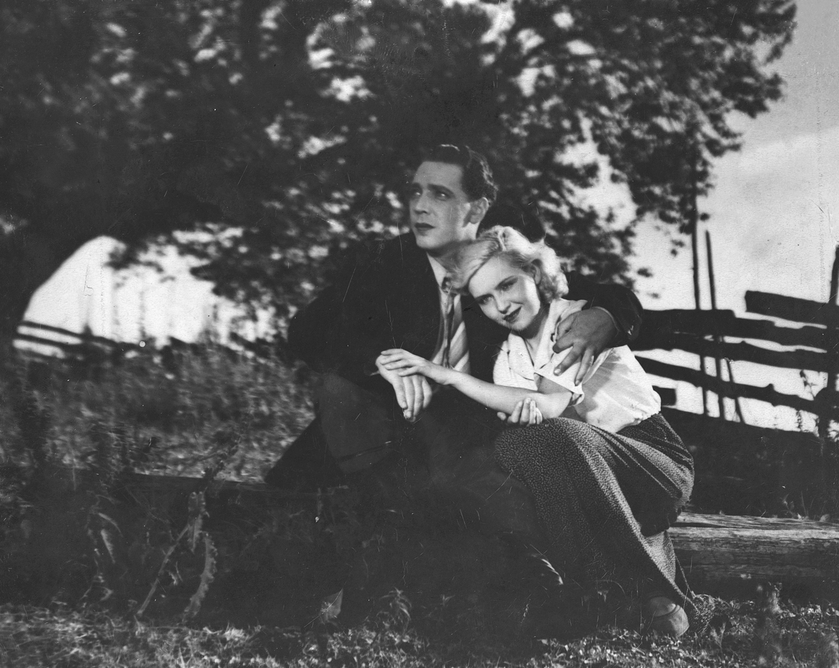
Teenage orphan Sirkka (Sirkka Salonen) meets local rich boy Aarne (Kille Oksanen) when he almost runs her over with his horse. The couple begin a flirtation that leads to a relationship, in which Aarne risks his family name by forging cheques in the name of his elder brother in order to help cover Sirkka’s family debts. When Sirkka inevitably becomes pregnant (this happens so often in Finnish films that one is surprised anyone cares any more), Aarne fights with his brother and leaves the manor. Sirkka gives birth to a son, but the boy is stolen by a gipsy (no, really – Evald Terho in a nameless and off-handedly racist role) in revenge for the poor treatment he received at the manor house. Kirsti (Kirsti Hurme), her former rival for the attentions of Aarne, piles on her troubles by accusing her of having murdered Aarne, for which she goes to prison for six years.
Returning in disgrace to her home town, Sirkka gets work back at the manor house as a maid for Aarne’s elder brother Urho (Kyösti Erämaa), who has always believed that she was framed. Her innocence is finally proven when Aarne shows up in a motor car, announcing that he has merely been away working hard, and the lovers are reunited. Meanwhile, the dying gipsy tells his adopted son (Timo Jokinen) to seek charity at the nearby manor, where the boy is identified by a distinctive birthmark, and reunited with his real parents.
Based on a Swedish film from 1933, itself based on Henning Ohlson’s play Hälsingar (1922), Unelma karjamajalla was already a creature out of time by the time it had its September 1940 premiere, notably not in That Fancy Helsinki, but out in the provinces in Kuopio, Lahti and Pori. This was not a production from the majors, but from the relatively small Tarmo-Filmi company, but it was one of the first movies to make into cinemas after the Winter War, and hence seems to have been unjustly praised by movie critics starved of content. Olavi Vesterdahl in Aamulehti called it “content with the old customary style, and this is perhaps its strongest point.”
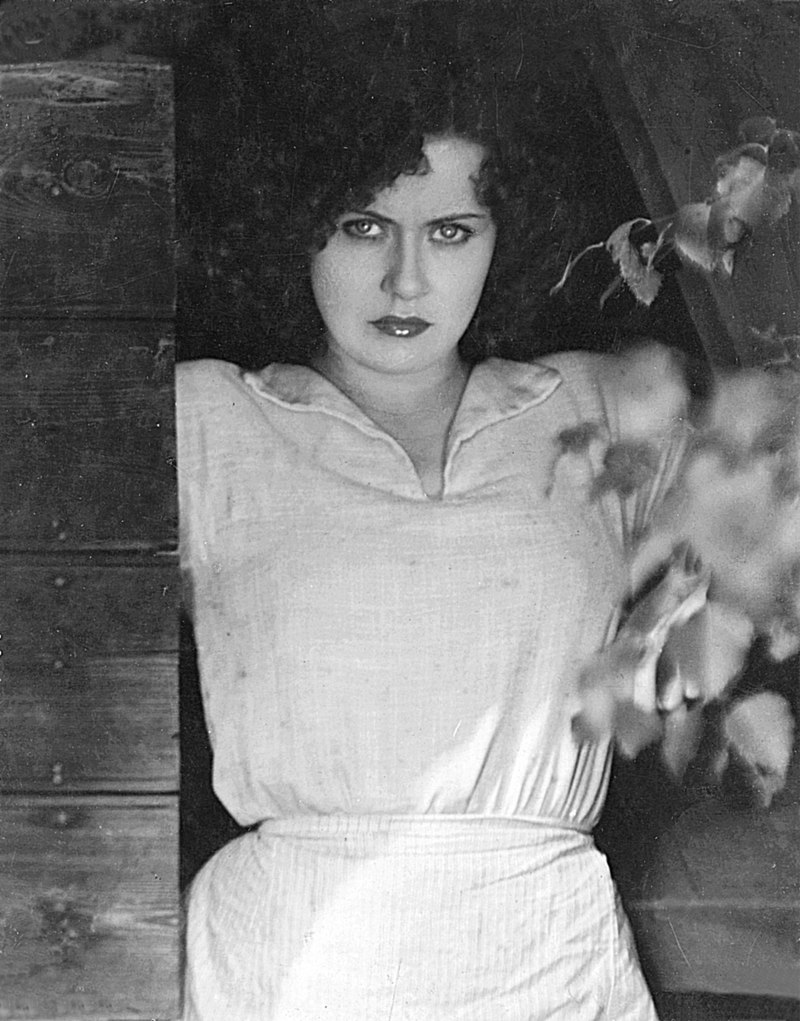
Eighty-two years later, the most striking thing about this film is the naturalism of its low-budget exteriors, as director Teuvo Talio snaps windswept location work among the farms of Nurmijärvi and Hämeenlinna, and shoots a tense scene by a ravine as Sirkka Salonen (a former beauty queen in her only feature role) rescues a fallen lamb, accompanied by Bach’s “Toccata & Fugue”. There is also the powerful shadow of class differences. Sirkka Salonen and Kirsti Hurme are fierce, strong presences on the screen when they are bickering with each other, but shapeshift into downcast, timid wallflowers when addressed by the lord of the manor.
Hurme in particular is a striking femme fatale, stealing the show in a role that would propel her out of the theatre and into a brief but remarkable movie career, poached in 1941 by Suomi-Filmi, and effectively becoming the forces’ sweetheart of the Continuation War – her public appearances for the troops were apparently very popular. She appeared in numerous vampy roles over the war years, fading briefly from the public eye after marrying her first husband in 1944, and almost completely after marrying her second, the industrialist Leo Martin, in 1951.
It’s not that Oula Seitsonen is opposed to what he calls “book history”. It’s just that as he poked around Lapland cataloguing Stone Age archaeological sites for his day-job, he became increasingly aware that a more modern historical presence, that of German soldiers in the 1940s, was slowly fading away. There were, true enough, written records of the Nazi troops who arrived in Finland to hold almost a thousand kilometres of borderlands against the Soviets, but these were subject to recurring reversals and re-interpretations.
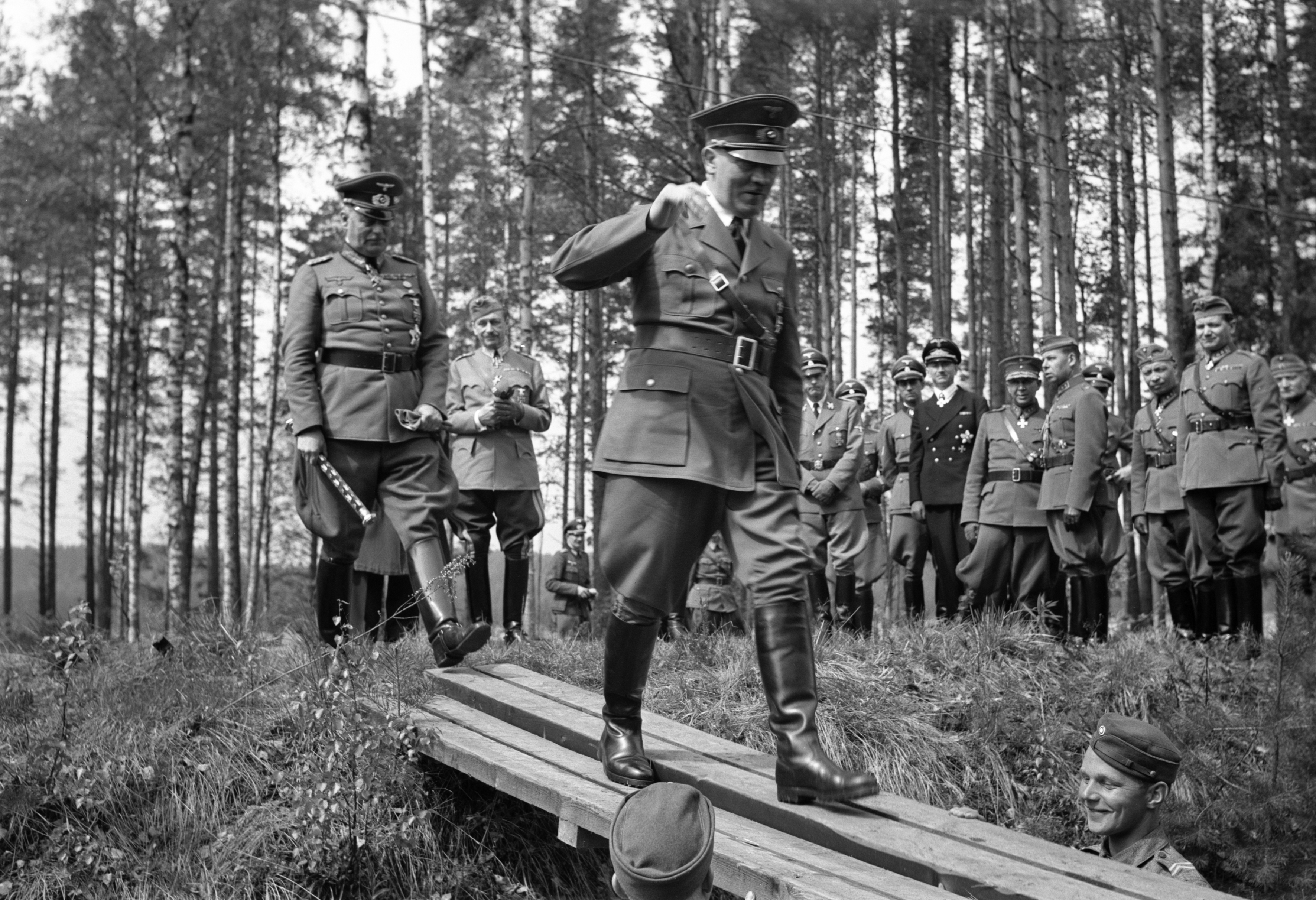
Drawing on what would eventually turn into his doctorate, Seitsonen’s Archaeologies of Hitler’s Arctic War chronicles the tangible and intangible heritage of the German presence in Lapland, where, at its peak, German soldiers outnumbered the locals, and its ebb, every single German was hounded from the country when the Finns turned upon them in the Lapland War of 1944-5. On their way out, a scorched-earth policy famously ensured that almost no building was left standing north of Rovaniemi, which is why the locals still sometimes shake matchboxes pointedly at German tourists. Seitsonen specialises in ruins and fragments, and tirelessly hunts down ditches that were once trenches, hillocks that were once middens, and ramshackle sheds that were once machine-gun posts. In this, he is hampered by the fact that one man’s research material is another man’s “war junk”, often at odds with the earnest wishes of the Keep Lapland Tidy movement to “clear up” detritus that has been clogging up forest paths for decades.
Seitsonen begins with an account of the Waffenbrüderschaft against the Soviets, that uneasy cooperation between the Finns and Germans that the Finns insisted was not an alliance, but merely a “co-belligerency pact.” In doing so, he wades through some of the obfuscations and hand-waving that characterise Finnish feelings on the subject, for which, in an understandable fudge common to all nations, nobody really wants to be told a negative story about their own relatives. If one does meet a Finn whose granddad was in the SS, one is liable to be told he was in that special division that got cats out of trees or helped old ladies across the road. He notes that most of the concentration camps established in Finland are now conveniently outside the modern borders, left behind in Karelia when it was lost to the Soviets – the National Archives did not open their photograph collection to researchers until 2013, and even then, many materials lack temporal or geographic metadata. Seitsonen does, however, visit Miehikkilä, still on the Finnish side of the border, and observes that someone is still leaving flowers and tending the mass graves of Soviet civilians there.
The German presence, he writes, has been “largely ignored in national-level narratives,” although I would like to point out that this is not merely a feature of WW2. The German presence in Finland’s own revolution and civil war, for example, was carefully edged out of the national narrative as early as the victory parade in 1918 for the newly independent Finns. An exhibition that ran in 2015 at the Museum of Lapland was movingly titled Wir Waren Freunde: We Were Friends, neatly encapsulating another fact that often eludes modern historians, that the Germans in 1941 were welcomed with open arms as the one power prepared to really help Finland in its time of need, and not for the first time. Imagine, if you will, 67,000 German soldiers suddenly showing up in Ukraine tomorrow, and saying they were there to help, and the kind of impact that would have on the hard-pressed locals.
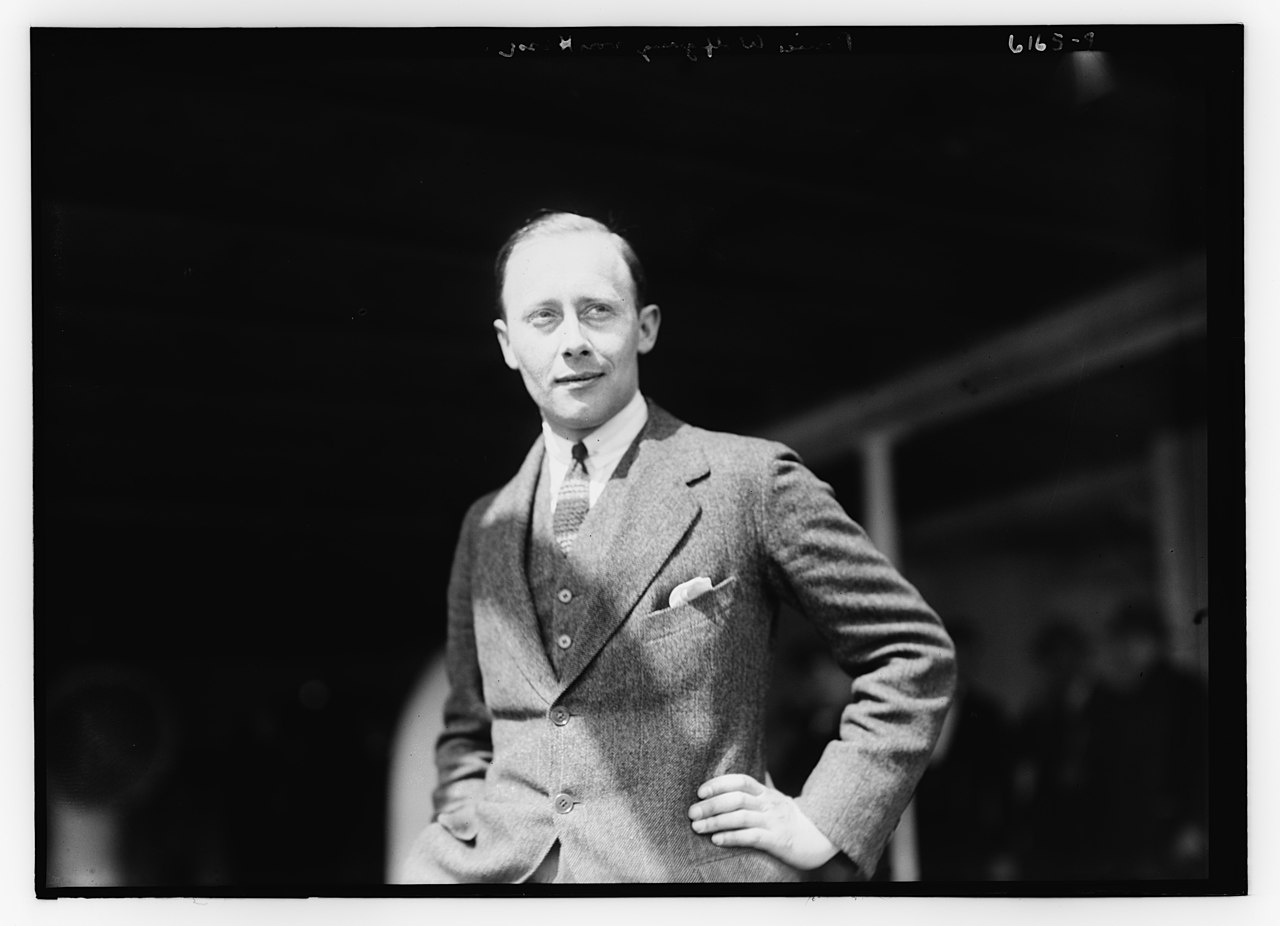
There are a bunch of military memoirs written by both Finnish and German soldiers, which offer some useful context. But Seitsonen frets about the lack of “experiential perspectives” that would offer a broader sense of what like was like for common soldiers, local people, labourers, lovers and prisoners. Then again, he uncovers Wolfgang von Hessen’s Aufzeichnungen (Records), privately published in 1986, a candid memoir by the major who oversaw transportation on the Arctic Ocean Road. It might sound like no great shakes, except von Hessen was the son of Prince Frederick Charles of Hesse, who had been mooted but then booted as the prospective King of Finland in 1918. For a few months in 1918, Wolfgang had been briefly hailed as the heir to the “throne” of Finland… he returned twenty years later to the country that was almost his, where Gustaf Mannerheim would pin a Freedom Cross on him in 1943. Why has this not already been a movie!?
The honeymoon did not last long. The “Hermans”, as the Finns called them, featuring a strong contingent of Austrian mountain jägers, were ridiculously over-confident about the difference they could make in the north, proclaiming “Arktis is nicht” (The Arctic is nothing). Nein, Herman. The Arctic is definitely something, and while German commanders proclaimed that the area was “completely unsuitable for military operations,” the Finns became increasingly disenchanted with the dug-in, advance-averse nature of their co-belligerents. The Germans ridiculed the Finns as a bunch of messy-haired yokels who held up their trousers with string, but it was the Finns, intimately familiar with the landscape and its conditions, who were the most successful against the Soviets. Echoing the sort of “colonialist Othering” that Seitsonen derides in his introduction, the Germans proclaimed that the Finns’ orienteering skills were nothing short of “supernatural”, and before long, they were adopting the locals’ low-tech clothing to keep out the cold, and building fake tanks out of snow to distract Soviets from the fact that whole ten-mile stretches of borders were guarded by little more than a dozen nutters on skis.
“Small girls,” wrote one Captain Ilander, about the full-service teenage ‘cleaning ladies’ draw from the local population, “but hard-bitten, drink alcohol and smoke like real men.” That’s Finnish women for you, who were soon fraternising with the Hermans at many an occasion – the mind boggles at the thought of Albert Speer, the noted Nazi architect, living for a while in a Finnish shed, and coming out to make merry with a bunch of Finns at a Rovaniemi Christmas party. Amid such frivolity, Lapland was in thrall to a series of terror attacks, as roaming platoons of Soviet partisans sought to tie up the troops in the most heartlessly economical way possible, by targeting random civilian settlements. Seitsonen’s archival research includes a picture of a mutilated girl, no older than seven, being carried from a log cabin by a glum soldier. Here, too, there is an issue with “book history”, as most of these partisan atrocities went carefully unreported in the Finnish media – to have given them publicity would have given the Russians what they wanted.
The Russians are another undocumented presence in the history of Lapland. Nine thousand Soviet prisoners of war were drafted as slave labourers to make up for the lack in the region’s manpower, in order to help the Germans create the infrastructure that they required to fight in the manner to which they had become accustomed. Conditions in the nearly 200 camps scattered around Finland ranged from “tolerable” to “inhuman”, but Seitsonen argues that the shadow of this unmentioned labour can still be seen in modern times: “many of the modern roads in Lapland trail the… Second World War tracks, and the cadastral plans of several northern towns follow those of the German barrack villages.” There was, Seitsonen suggests, also a ‘punishment camp’ for Jewish prisoners of war somewhere in Finland, although his researches have yet to officially locate it. It was, presumably nowhere near Syjärvi, where in one of the most absurdly unlikely incidents of WW2, Finnish Jews serving in the army set up the only field synagogue on Nazi front-lines, and held services attended respectfully by their SS comrades. Even so, the Jews fighting alongside the Nazis did so amid recurring rumours that when the war was over, ‘the ship would be waiting’ to take them away to an unknown fate. One of them, the Jewish field doctor Leo Skurnik, was even awarded the Iron Cross after fearlessly carrying wounded SS men out of harm’s way during an attack. He then bluntly refused to accept it, with the words: “I wipe my arse with the Iron Cross.”
Offended by this for some reason, the Nazi authorities demanded that he be handed over, only for his commanding officer to refuse to give up his best doctor. Two other Finnish Jews also refused a German medal, although not quite so colourfully. Having encountered Jewish soldiers on a trip to inspect the Nazi lines, Heinrich Himmler buttonholed the Finnish prime minister, asking him what he was going to do about the Jewish question.
“We have no Jewish question,” was the fantastically Finnish response.
Seitsonen is just as informative concerning the “Ragnarok” that was the Lapland War, as the Germans fled towards the safety of the Norwegian border, leaving behind a hellscape of burning buildings, a rain of burning papers falling from the sky, and a land strewn with mines. For years to come afterwards, there was a risk of exploding reindeer – as is his wont, Seitsonen points out that the grim truth, that hundreds of local people also lost their lives to mines after the war, and some 2,000 were injured, was only really publicised in 2012. A year later, arguably explaining why it had been kept quiet for so long, a metal detectorist looking for Nazi memorabilia in Kemi was killed by a grenade he was cleaning.
The church bells went missing from the burned Kuusamo church in 1944, and were only recovered in 1959, when a German visitor revealed that they had been saved by an SS officer who had fallen in love with a local girl to the sound of those bells, and had consequently hidden them in the local graveyard.
Seitsonen’s excavations of fragments of stoves, cutlery and smashed Nazi crockery prove to be utterly fascinating. He demonstrates with cunning didactic power how easy it is even for modern archaeologists to read too much into simple materials – Were those binders burned to hide evidence? Was that smashed Pelikan ink bottle used to tattoo prisoners? Or was it just a bottle of ink. He draws a logistical map of Europe, to show where the artefacts in Finnish ditches were manufactured in the Nazi empire, and tabulates the diet of the soldiers based on whatever he can dig out of their middens – not merely a predictable 30% local reindeer component, but Danish cattle and Argentinian corned beef.
He points out the many subtle shifts and redactions of local history that shield and obscure the wartime era. Sometimes, they are in plain sight, like the Alppimaja (Alpine Lodge) district on Oulu’s Tirolintie (Tyrol Street), named for the Austrian jägers once quartered there. Others are less well-known. The patriotically named Kalevalankartano (Estate of the Kalevala), for example, was originally built as the Oulu SS Officers’ Club, and come to think of it, does look rather Teutonic. And there’s comedy gold as it turns out that the world-famous Santa Claus Village, in Rovaniemi, is built on the site of a former Luftwaffe airbase, and that the year-on-year expansion of the Village threatens to wipe out many archaeological materials from its previous existence.
Seitsonen finishes with an observation about the nature of history and memory, and how even memorials carved in stone can be fungible. In a school in Vuotso, outside Sodankylä, there is a standard 1939-1944 Isanmaa Puolesta (For the Fatherland) memorial, which features a death in 1959 – a local boy, killed by an unexploded bomb. Such tragedies are included by the Finns in official accounts of the “war dead”, for a war that is still not over until the last of its materials cease to kill.
Amidst all of this, the Sámi watch, unmoved. For them, the Germans were just one more colonialist power tearing up the countryside, and their voices in Seitsonen’s book can be entertainingly gruff. One comments that it’s all very well mourning accidental casualties as war-dead, but he has little sympathy for the trophy hunter who got blown up in 2013. “Stupidity has its price,” he scoffs. “They shouldn’t go around taking things from our land.”
Jonathan Clements will examine the life and achievements of one of Japan’s first modern international celebrities, Admiral Togo Heihachiro (1848-1934), from his teenage participation in the “Anglo-Satsuma War” of 1863, through his youth as a student at a British maritime school, and his long career in the Imperial Japanese Navy. In 1905, after Tōgō’s defeat of the Tsar’s fleet at the Battle of Tsushima, he was hailed as the “Nelson of the East” and an honorary Englishman; his flagship, the Mikasa, can still be found at the Yokosuka dockside.
“Whereas The Muppets was garlanded with awards, including an Oscar for Best Song, The Happytime Murders was only recognized by the Houston Film Critics Society as ‘Best Worst Film’, while at the Golden Raspberries it was nominated for, among others, Worst Director, Worst Picture, and Worst Screenplay. Considering that much of the film’s raison d’être was to disrupt the imagery and memes of viewers’ childhoods… such brickbats seem somewhat over-compensatory and possibly vengeful. The Golden Raspberry dished out to Melissa McCarthy as Worst Actress seems particularly unjust, since whatever one may think of the sullying of puppet icons, her deadpan and dedicated performance throughout is a lynchpin that anchors the ludicrous and revolting images onscreen.”
The East Wind said: “I have just come from China, where I danced round the porcelain tower till all the bells jingled again. In the streets an official flogging was taking place, and bamboo canes were being broken on the shoulders of men of every high position, from the first to the ninth grade. They cried, ‘Many thanks, my fatherly benefactor;’ but I am sure the words did not come from their hearts, so I rang the bells till they sounded, ‘ding, ding-dong.’” – Hans Christian Andersen, The Garden of Paradise (1838).
The Porcelain Tower is famous, you see. The Chinese keep on telling me how famous it is, although to be frank, I had never heard of it until I got to Nanjing. It was featured in a Dutch traveller’s account of China in the 17th century, and ended up becoming the centrepiece of many blue-and-white china plates, a cute little pagoda that itself was supposedly made of porcelain.
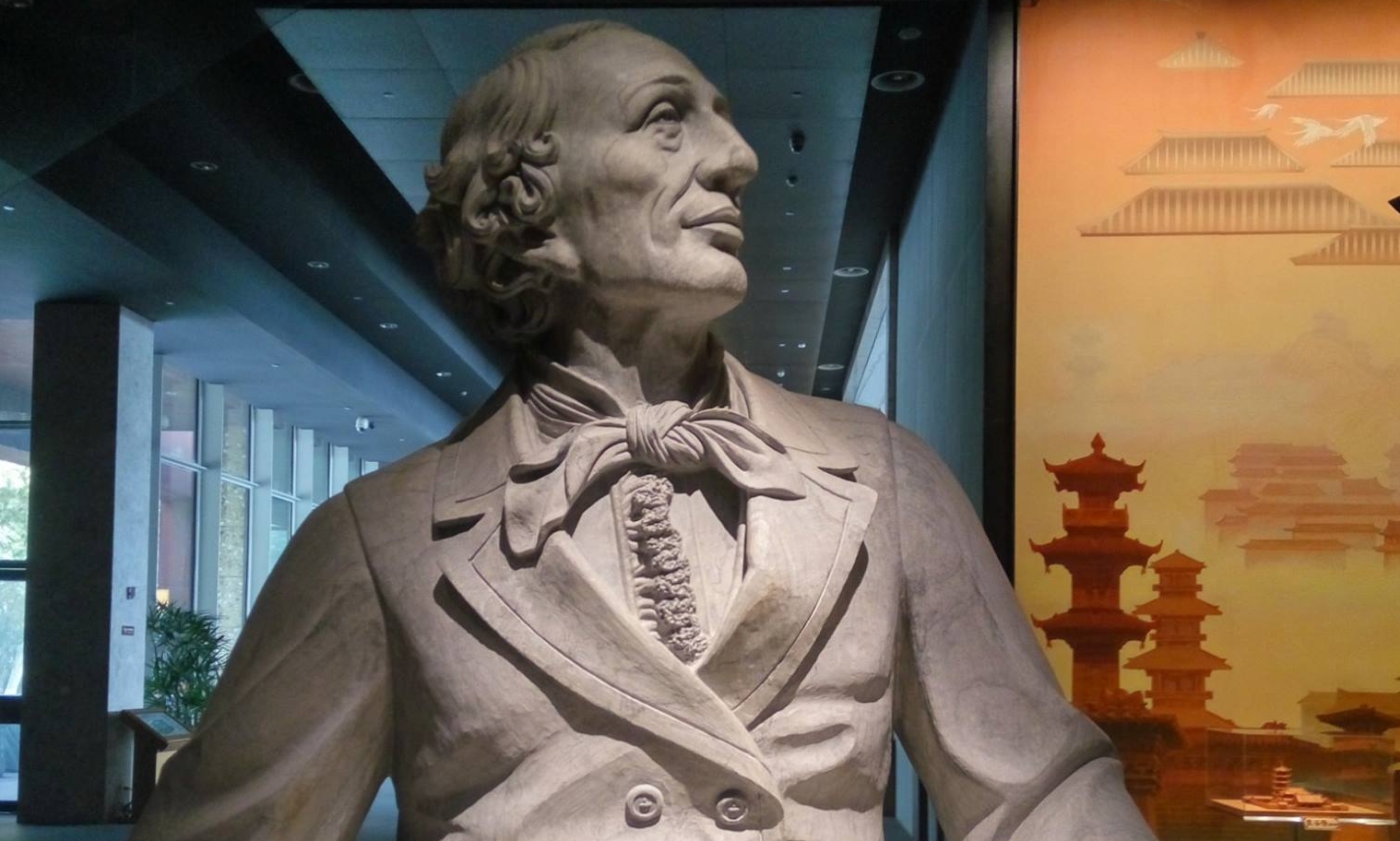
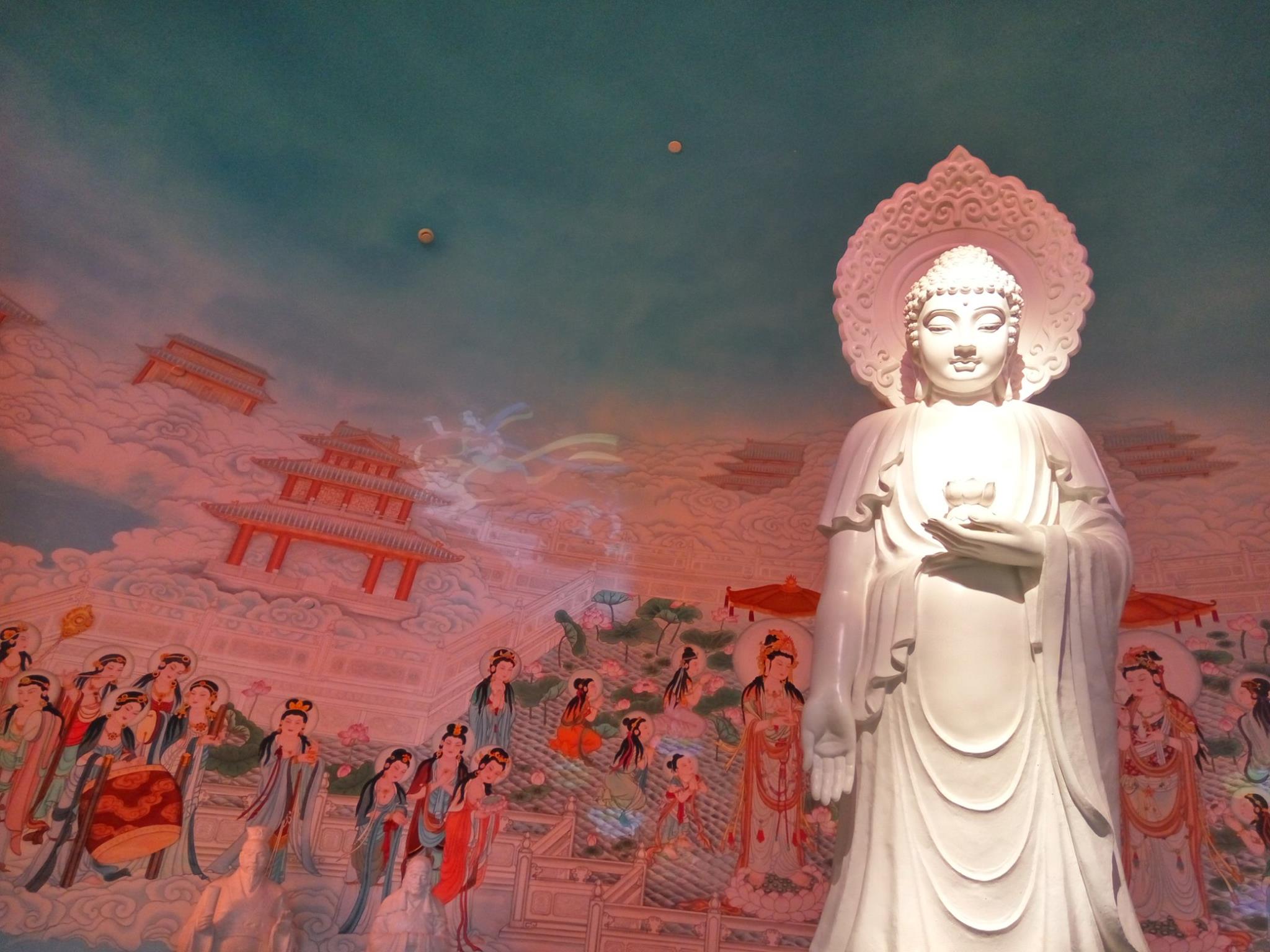
In fact, the Porcelain Tower was simply decorated with glazed bricks – sumptuous in golds and greens and yellow, lit at night with dozens of lanterns, and impressively tall. Its construction was begun in the era of the dastardly Ming emperor Yongle, and completed under the supervision of his long-time lieutenant, the faithful eunuch admiral Zheng He. It was vandalised by the Taiping rebels in the 19th century, who smashed up the Buddhist statuary and demolished the staircase to prevent their enemies using it as a reconnaissance platform, and was eventually completely destroyed. In 2010, the billionaire owner of the Wanda corporation paid to have it rebuilt, and a posher than posh museum stands on the site, including a statue of Hans Christian Andersen, tableaux from Buddhist history, and lavish exhibits of Buddhist largesse.
The restored tower itself is a glass affair of no real merit, but it sits above a vault that contains the Ashoka Reliquary, which was found in the foundations. Well, to be fair a stone vault was found in the ruins, containing an iron casket, which contained a gold reliquary, which contained a silver box, which contained an iron box, and so on, and so on, like a bunch of Buddhist matrushka dolls, until in the centre of it all was a piece of Buddha’s skull, donated by the Indian king Ashoka as one of hundreds of relics sent by him throughout the known world to prove how cool he was.
There are lots of things to shoot in the museum below, including other Ashoka Reliquaries from other parts of China, so many in fact that I declare it is a veritable Build Your Own Buddha game, and that a religiously minded app developer could turn every iPhone-using Buddhist in China into a Pokémon freak, racing around pilgrimage sites trying to reassemble Shakyamuni from all the bits of him that are apparently stashed away in temples all over the place.
Qi Haining is the man who found the piece of Buddha’s skull. He is cagey at first, having been burned before by Chinese television, who set him up as some sort of Indiana Jones figure.
“That was all nonsense,” he complains. “We always knew that there was a relic somewhere down there. We just didn’t bother to look until they told us they were going to put up a shopping centre. So that’s when we dug it up.”
But he is being economic with the truth. Nobody was really expecting to unearth something of quite the magnitude of Buddha’s skull fragment. The first time they knew what they had was when they read the provenance carved on the outer casket.
He likes the thought of us letting him tell the true story, and once again, is one of those interviewees who lights up when he realises I am not some nodding donkey. I can pinpoint the moment when he realises I’m not new to this.
“This is a find,” he says, “of a magnitude equivalent to the Famen Temple.”
“Well, the Famen Temple’s only got a finger bone!” I point out, and his eyes light up.
“YES! That’s right! You’ve seen it? In their underground palace? Just a little finger, right. And no magic crystals. We’ve got magic crystals, what about that, Famen Temple!”
Truth be told, the “magic” sarira crystals found in the remains of cremated Buddhist saints look awfully like gallstones, but far be I from one to interfere.
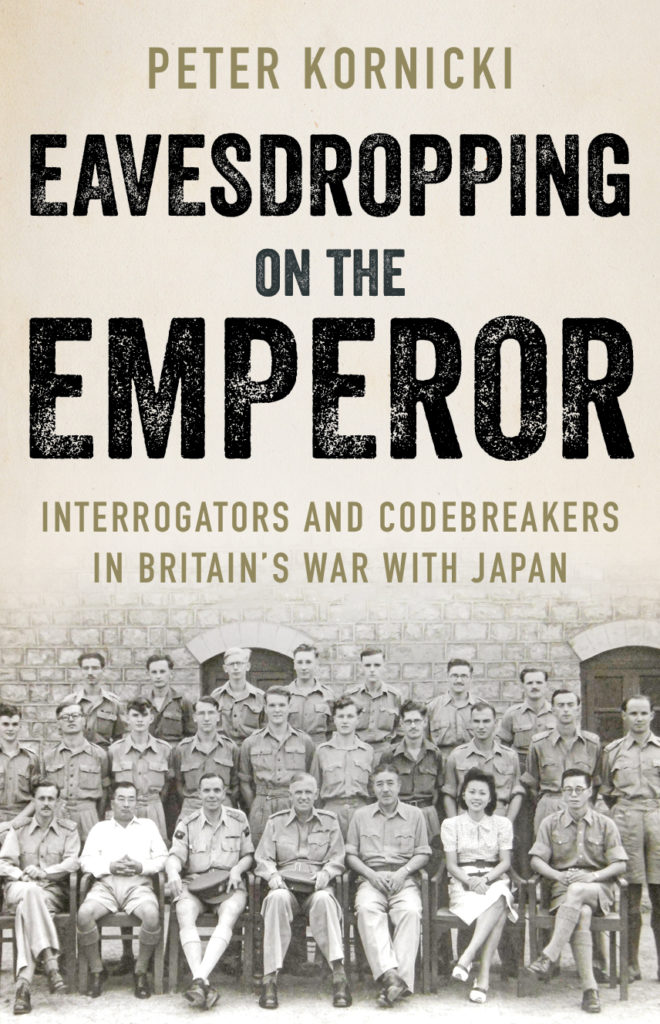
‘In the first 23 years of its operation, the institution then known as the London School of Oriental Studies (today’s SOAS) only produced two graduates in Japanese. This was despite repeated pressure from policy wonks like one Colonel Grimsdale, begging the establishment to have a ready supply of linguists to hand in case of any trouble in the East. The problem was, Grimsdale noted, “a number of chaps just can’t take these languages, and either take to drink or go a bit potty.”’
Over at All the Anime, I review Peter Kornicki’s Eavesdropping on the Emperor.
“Vital documents about the rebel state of mind were ignored until after the Rebellion because they used terms in Latin, the secret cant of the Christians, unintelligible to non-believers. Biblical allusions in rebel correspondence and rhetoric sailed completely over the heads of their enemies. Jerome Amakusa held his army together through a long siege that lasted through Lent 1638, only to discover that his most trusted lieutenant was plotting to betray him on Easter Sunday. This irony escaped the notice of the government troops, who did not know what Easter Sunday was.”









 The Official Schoolgirl Milky Crisis Blog