“On top of the usual information about cast and crew, Clements provides useful historical and cultural context to the film and its setting. It’s a wonderfully informative and engaging track. Clements is becoming one of my favourite commentators, and I hope to see him get the opportunity more often.”
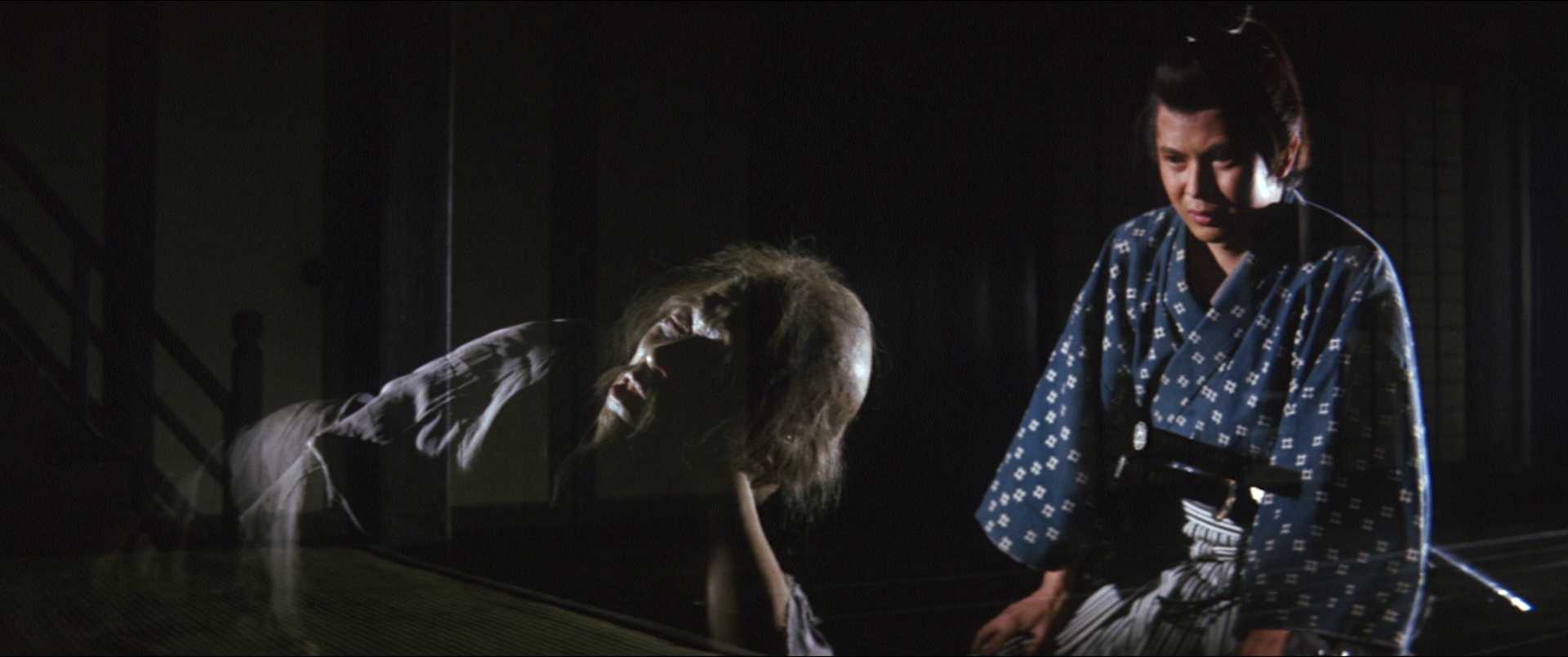
David Brook at Blueprint review goes looking for The Invisible Swordsman from Arrow Films.
“Among the new politicians voted into office, a stand-out was Freddy Lim Tshiong-tso, a man who might reasonably be described as the Nationalists’ worst nightmare. Born in 1976, and hence growing up with no memory of the martial law era, Lim ceased to follow the KMT party line during his school days, instead becoming an enthusiastic supporter of Taiwanese independence. He initially entered the public eye as the convenor of pro-independence rock concerts, and would eventually serve as the head of Taiwan’s branch of Amnesty International, and a key figure in the Sunflower movement.
“Throughout the late 1990s and the early years of the 21st century, he was also the lead singer of the death-metal band Chthonic, releasing a series of politically charged works, including a concept album about the 1930 Musha Incident (2005, Seediq Bale), allusions to the February 1947 unrest as an earthly manifestation of Hell (2009, Mirror of Retribution), and an album dedicated to the conflicted loyalties of indigenous soldiers serving in the WWII Japanese military (2011, Takasago Army).
“Donning a suit instead of his habitual leathers and tribal face-paint, Lim became one of the founders of the New Power Party, and proved to be enough of a diplomat to shoo away other DPP-leaning candidates in a western Taipei suburban district, where he defeated the KMT incumbent. He then aligned his New Power Party, its emblem in stark Sunflower-yellow, broadly within the ‘Green’ policies of the victorious DPP.”
– excerpted from Rebel Island, by Jonathan Clements.
And now he is Taiwan’s new envoy to the world’s most metal country, Finland.
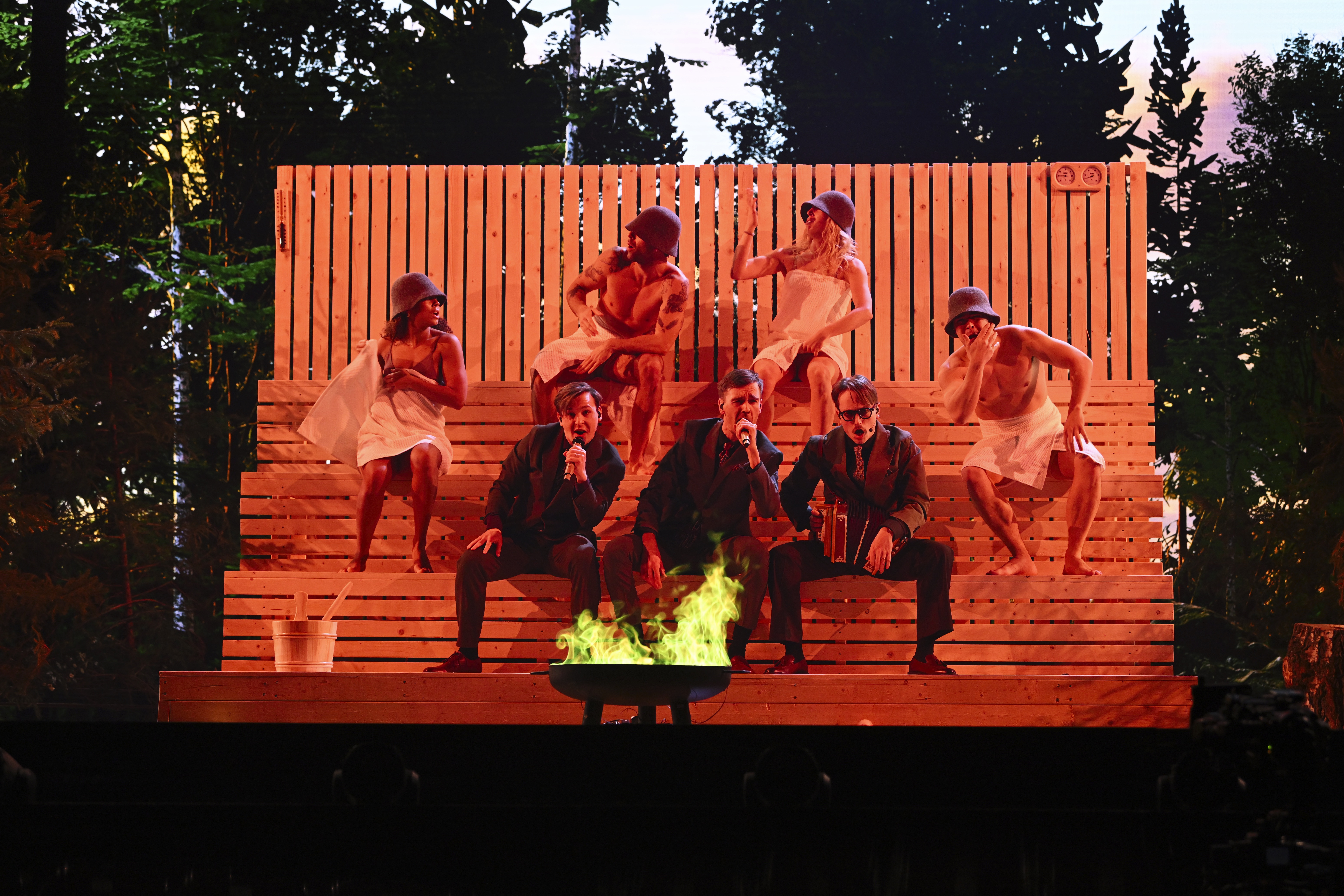
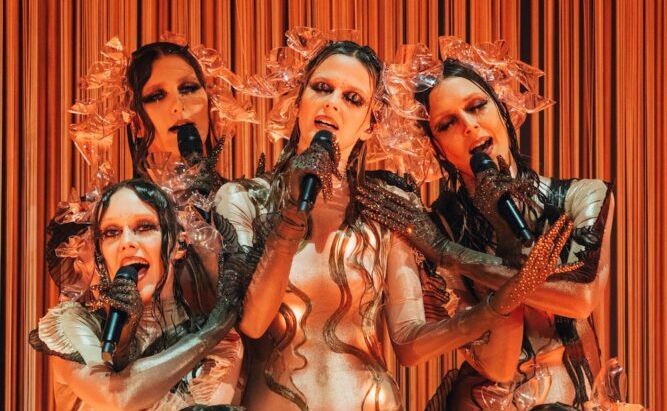
“Yksi, kaksi, kolme, SAUNA!” And we’re in Switzerland, the “Home of Eurovision” for this year’s festival of nutcases. We’ve already lost Belgium’s Red Sebastian, a man who at one point appeared to be straddling himself, and Azerbaijan’s unexpected falsetto beneath the Eye of Sauron. We’ve also lost singular words from Malta’s entry, after broadcasters for whom Eurovision goes out pre-watershed objected to her risqué use of the word “kant.” This being Eurovision, the audience is going to shout it out anyway wherever it should appear, so be ready for that.
This year there are a lot of pop-up violins, not all of them actually played, but waved around. Sweden is the bookies’ favourite, with a quirky song about saunas, sung by three Finns. Sweden is so smug about their chances of winning this year that their various city councils are already arguing about who should host the 2026 competition. Malmö doesn’t want it again, because of all the extra costs of policing those anti-Israel demonstrations. One thing is certain, if “Bara bada bastu” does perform as expected, then the newspapers in Helsinki on Sunday morning are going to say “FINNS WIN EUROVISION” (and Sweden has to pay for it…).
Switzerland was the site of the first ever Eurovision Song Contest in 1956, so you can expect the presenters to crow about that at least half a dozen times: shout it out every time they say “Home of Eurovision.”
Step One: you will probably need to be quite drunk. Step Two: The following sights and sounds will occur during this Saturday’s Eurovision Song Contest. Can you spot them first? Remember to shout it out. As ever, there is more than one key change, and plenty of orbital cleavage. Keep your eyes (or ears) open for any of the following. And when you notice it, SHOUT IT OUT! Points can be scored all through the contest, on and off stage, including during the voting and in the greenroom, and there are quite a few to look for in the background video, too.
She says “Serving”; you say “Kant!”
glittery eyes
onstage boat (this happens twice!)
flying paper boat
one violin
two violins!
three violins!!!
mouth glitterball
big sausage
KEY CHANGE!
Costume change
giant golden microphone
SPLITS!
singing in a sandpit
She’s brought her own dragon!
Look for the word: ZARGO
onstage woodwork
man in a mask
David makes a face
He’s upside down!
hands make a heart
wiggle dance
walking on humans
digital birds
lots of beans
they’ve all got tails!
lumberjacks
topless man
Dangle singing
pearl necklace
pointy shoulders
skirt made of dancers
LOOKALIKEY: Alan Davies on guitar
drummer’s heart train
he’s running on his own travelator
birch microphones
very long piano
onstage swimming
rotating monoliths
THREE! GOLDEN! RINGS!
mirror heart
Winking
Bimbling* ORBITAL CLEAVAGE** Buddha Jazz Hands***
Someone says “Jaja Dingdong!” — An oldie but a goodie, liable to crop up during the voting.
Greece awards 12 points to Cyprus / Former Yugoslavian Republic awards 12 points to
Former Yugoslavian Republic.
(*swaying one’s head from side to side in a snakey fashion) (**ostentatious cleavage sufficient to see from a satellite in orbit, which, according to Eurovision bra consultant Tom Clancy, requires a minimum of C-cup)
(***the dancers all pile behind the singer in a line and then fling their arms out, creating a multi-limbed oriental deity-look)
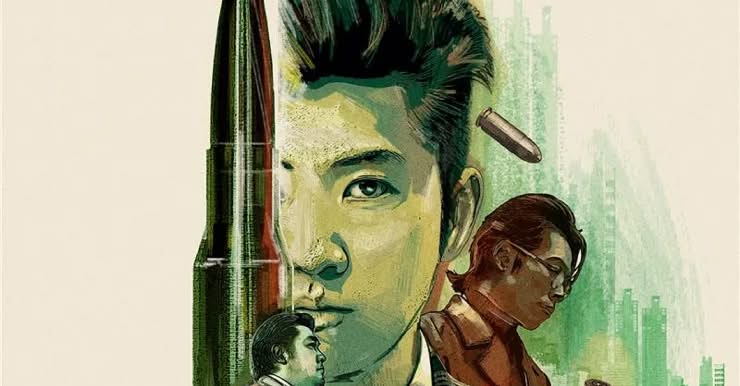
“Every title in the set includes some kind of extra content, and they are all very good. I found them fascinating; I particularly adored the video essay by Jonathan Clements for Carlos, especially his breakdown of the film’s title.”
Robert Ewing at The People’s Movies pokes around the extras on Arrow’s V-Cinema Essentials box set, which is loaded with heavy-hitters in the world of Japanese pop culture, including Samm Deighan, Patrick Macias, Tom Mes, Mark Schilling and a dozen others. And me. I haven’t actually got to my copy yet myself, but it looks to me like the video essays and creator interviews are easily the length of one or two whole extra movies.
As for what I said: “There are plenty of Portuguese names that are easily pronounced by a native Japanese speaker. Carlos isn’t one of them. Japanese has trouble differentiating the letters R and L, and doesn’t end naturally on a sibilant. The title KARUROSU is hence a deliberate, rather malicious tongue twister for the Japanese, accentuating its alien nature.”
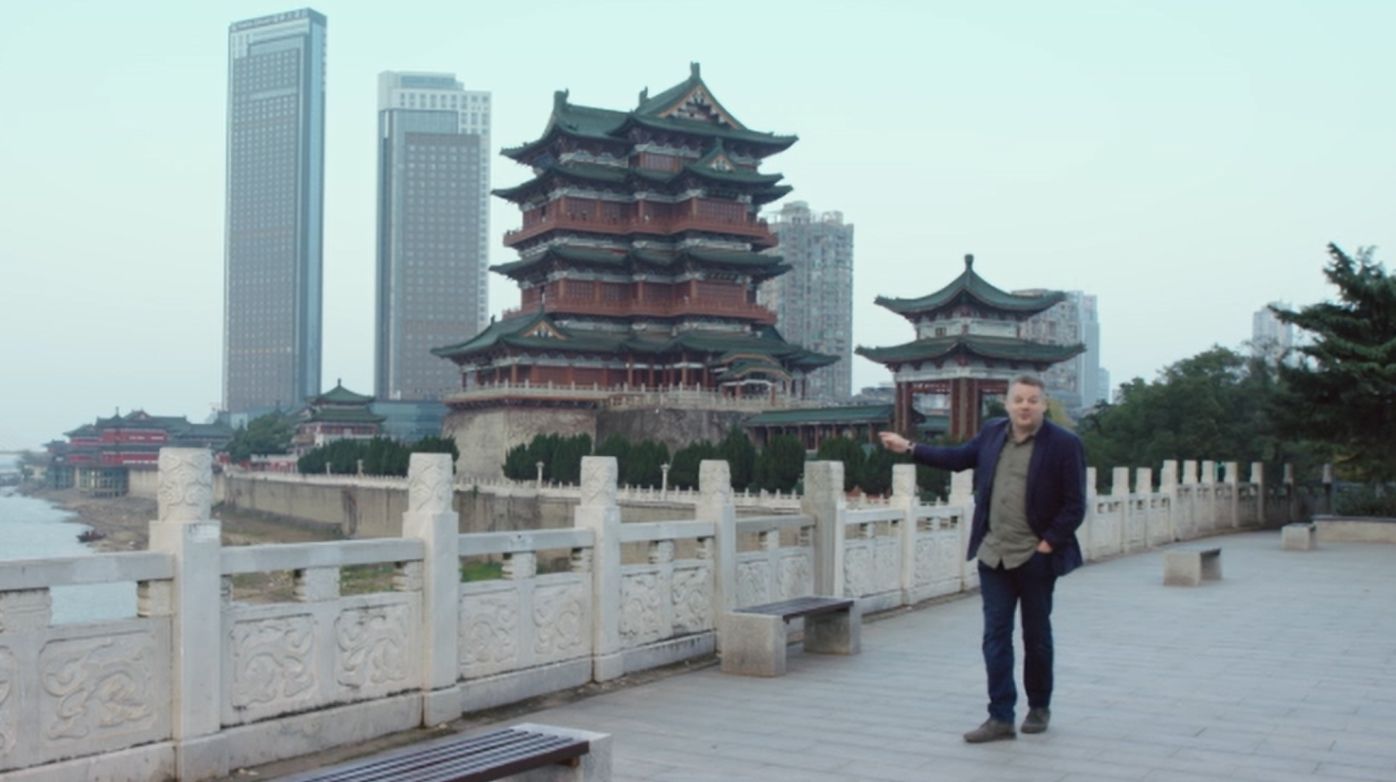
We’re in Nanchang on the trail of Liu He, the grandson of the great Han emperor Wudi. Born in 92BC, when the Han empire still farmed out control of its outlying regions to subordinate kinglets, he inherited his father’s Shandong satrapy when he was still a child. Famously uncouth and uncooperative, he soon turned into a troubled, ridiculously wealthy youth, and was presumably as surprised as the next man when the sudden death of his uncle led to him being crowned emperor at the age of 19.
His reign lasted an impressively short 27 days, during which time he notched up over a thousand infractions, including refusing to weep on command at the sight of the capital, buying a chicken on the way to his uncle’s funeral, and ordering hookers at a roadside tavern. His entourage got the blame for at least some of this, but Liu He seems to have blundered, quite obliviously, into the middle of a power game way beyond him. His dead uncle had only been a year older than him, a puppet for his “chief minister”, the Machiavellian Huo Guang, who had been running things behind the scenes for over a decade; Within weeks of appointing his new boy-emperor, Huo Guang realised he was onto a loser, and asked the “Empress Dowager”, his own fifteen-year-old grand-daughter, to issue a decree that Liu He was unfit for the throne. Armed ministers threatened to stab anyone at the council meeting who disagreed, and Liu He was packed back off to the provinces, a wealthy but powerless teenager.
There it should have ended, although a few years later he was ordered to move to the Yangtze region, modern Nanchang, where he was given the new title of Marquis of Haihun. He ran things there for a couple of years, and was implicated in a new scandal when he admitted to a flunky that he really could have handled things better at court by having Huo Guang beheaded for treason before anything kicked off. For saying so, he was docked 75% of his domain, and reputedly spent a lot of time scowling towards the setting sun, calling everybody back in the capital a bunch of bastards.
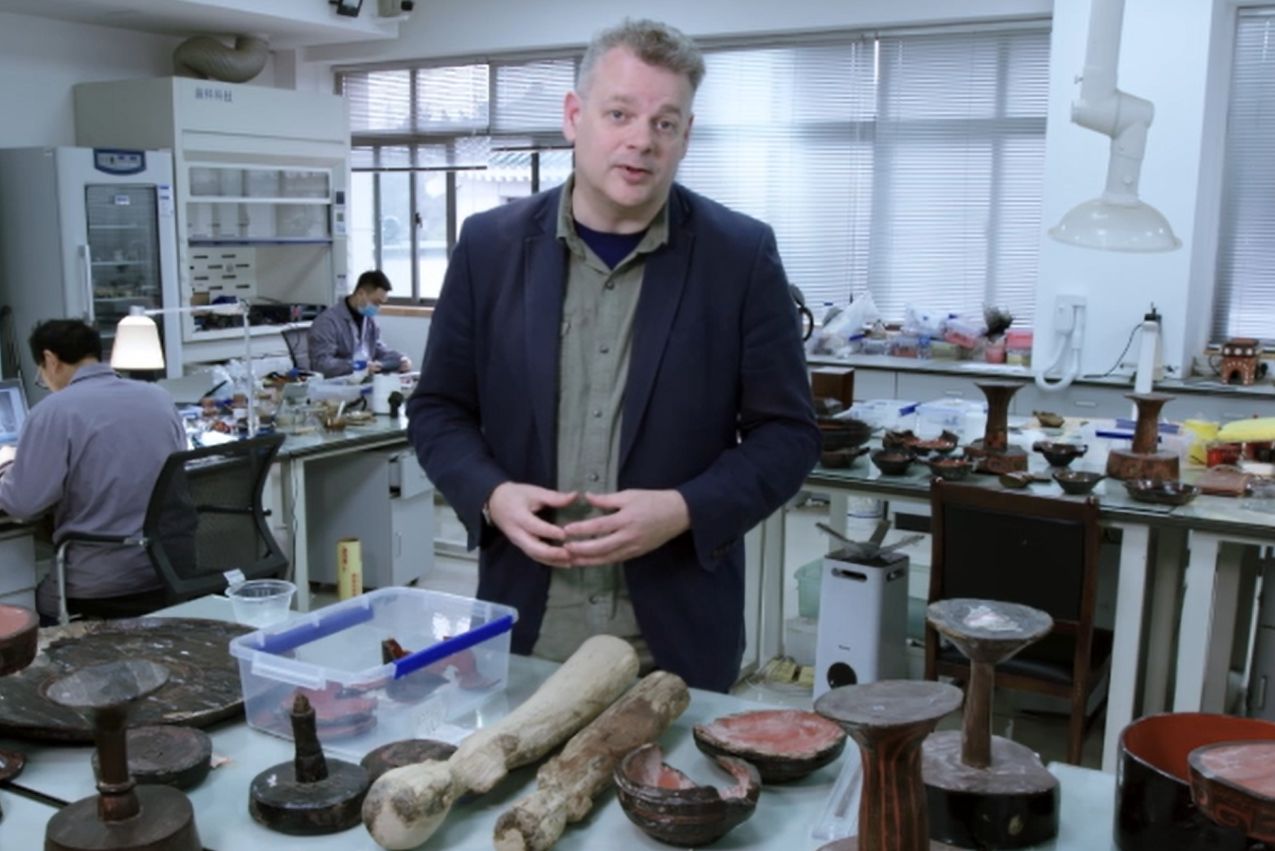
When he died, he was still only 33. And that would have been the end of it, until 2011, when grave robbers were caught trying to break into a tomb in Nanchang. Archaeologists took over, eventually announcing that the tomb in question was that of the Marquis of Haihun, that it has been miraculously untouched, and that it contained all sorts of fun stuff, including a copy of Confucius’Analects with two chapters unseen anywhere else.
But there’s something fishy about the Marquis of Haihun story. As I’m sure you have already worked out, he was a pawn in a power-game that had been going on for longer than he had been alive, expected to be a malleable figurehead while the Huo family got on with really running things. But if he was such a playboy and a wastrel, what was he doing reading Confucius? Was it just something he kept lying around to impress the builders, or was he a much more thoughtful person?
At least the Marquis of Haihun outlived his persecutor, Huo Guang. Huo predeceased him by ten years, and his intrigues soon unravelled. He was alleged to have been banging his slave master, a man who repaid the favour by banging Huo’s widow, a woman who was soon accused of having murdered the former empress in order to find a husband for her own daughter. The entire Huo clan was implicated in this scandal, and they were all dead within a couple of years. I’m just saying, why would I watch I’m a Celebrity… when this is going on? And more to the point, if your relatives and in-laws are murdering each other and shagging the staff, what’s the deal with exiling some kid just because he bought a chicken?
It’s taking forever to get permission to film in the museum, but there are all sorts of revelations awaiting, I hope.
Jonathan Clements is the author of A Brief History of China. These events featured in Route Awakening S05E04 (2019).
‘Can it be a coincidence that the girls’ schoolteacher, Miss Ayumi, has a hairstyle recalling that of the magical girl Creamy Mami? Is it possible that Mari, the hulking warrior-schoolgirl, is a feminised take on Kenshiro, the titular Fist of the North Star? Is that Captain Harlock’s vessel, the Arcadia, stuck to the prow of an alien battleship? When the girls go to the cinema, are they watching a pastiche of the recent hit Harmageddon? And when they leave the cinema, do we get a momentary glance of the words “Spartan X-ko” on the marquee, referring to Spartan X, the Japanese title of Jackie Chan’s Wheels on Meals? Yes, yes, yes, yes and yes.’
Almost a year after I handed in my 12-page article on Project A-ko, the Anime Limited collectors edition of the Blu-ray that contains it is finally coming out.
On a visit to see her aunt on the Finnish side of the border, Eliisa Raaska (Irma Seikkula) falls for local boy Mikko Vanhala (the decidedly unboyish Joel Rinne). She would very much like to marry him, but her father (director Wilho Ilmari, sneaking into his own film) refuses to leave his home on the Soviet side, where he is clinging to the memory of his late Ingrian wife. Mikko is unaware that his mother (Emma Väänänen) has promised his hand in marriage to Helka (Senja Lehti), the daughter of the local landowner Meller (Eino Jurkka), in settlement of a debt. But Mikko has already crossed to the Soviet side to ask for Eliisa’s hand, and when she accepts, brings her to his Finnish home.
In Finland, Eliisa meets with a frosty reception, since her presence puts Mikko’s mother back into financial straits. She stomps off to her aunt’s house, while Mikko arranges a loan to pay off the debt. Her father, meanwhile, was lying when he said he would follow her to Finland. Instead, he sets fire to his house and shoots himself. Mikko finds a distraught Eliisa and persuades her to return to Finland with him before the border-crossing loophole is permanently shut down by Soviet soldiers. Their friend, the border guard Gregor (Santeri Karilo), helps them escape by shooting Ivan (Vilho Siivola), the dastardly Soviet officer who covets Eliisa for himself. As Eliisa and Mikko reach safety on the Finnish side, they hear another gunshot, as Gregor takes his own life.
Suomi-Filmi’s big release for autumn 1942 was a film that tapped right into the zeitgeist, an adaptation of Urho Karhumäki’s 1938 novel about life on the Karelian isthmus, where the locals have repeatedly found themselves branded Russian or Finnish, Finnish or Russian, depending on where politicians in distant capitals are drawing lines on a map. With a mordant, contemporary topic and a score by Uuno Klami, Over the Border was Finland’s entry in that year’s “Venice Film Olympics”, where it won a minor medal, which the press regarded as something of a consolation prize.
“Over the Border was a deep, vivid and psychologically believable portrayal of humanity,” said the film critic of Uusi Suomi. “There was a real sense of the border in the air.” Meanwhile, Olavi Vesterdahl in Aamulehti thought it was a bit slow and lacking in action, but conceded that it did artfully demonstrate the way in which geopolitical concerns far above the heads of two people on either side of a humble barbed wire fence might suddenly render them unable to cross it – a matter of pregnant meaning to Finns in 1942, who were busily re-taking Karelia from the Russians who had stolen it, and would shortly have to hand it all back again. Deep down in Martti Larni’s script is a repeat of the idea that also surfaced in The Activists (1939), that people were people, and that there were surely good Russians like Gregor, too, although it was heavily implied that the bad ones like Ivan were hounding them to their deaths.
It was, perhaps, too tied to the zeitgeist. Delayed from its original release in April 1942, it enjoyed a brief moment in the sun and on theatre re-runs. When the Continuation War came to an end in 1944 and everybody started tiptoeing around the Russians like they were, well, a thin-skinned super-power with a penchant for false-flag attacks and land-grabs, it was very suddenly whipped out of cinemas, and was not seen again in Finland until the post-perestroika 1990s – compare to similar fates for The Activists and The Great Wrath (1939).
Jonathan Clements is the author of A Short History of Finland. He is watching all the Finnish films so that you don’t have to.
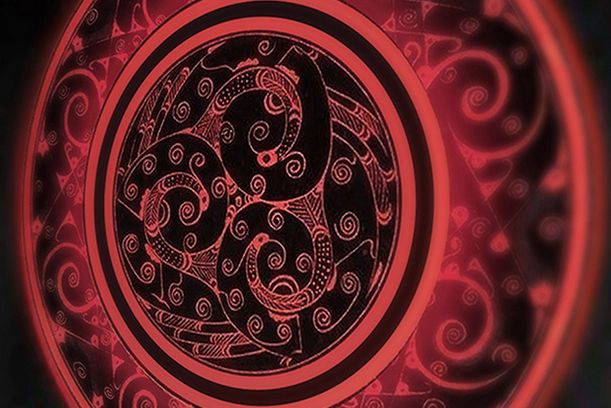
Liang Taihe is showing me a big copper pot. We don’t quite understand what it was for, he says. They must have performed some ritual purpose. This one has carbon-scoring at the bottom, so it was previously used for cooking something, but the thing about the ancient Yelang people was that when they buried someone of great importance, they would stick one of these on their heads.
Right then, so they were nutters.
I think, he says, that they put them on their heads in the ceremonies as well. Like magic hats.
I have my own theory, which is that since many scholars have argued that these pots served some sort of ritual purpose in life, possibly the leaders of the Yelang were shamans, and that in life they would boil up some sort of trance-inducing concoction and stick their heads in to breath up the steam.
Professor Liang looks at me as if I am mad.
And then, I say, they see the spirits. And when they die, they put the pot on their heads because they will be with the spirits always.
Okay, he says gingerly, let’s put that one on the back burner, shall we?
Like the Dian people of Yunnan, with whom they shared a border, the Yelang people left no written records, and much of what we have to go on about them is only divinable from the metalware in their graves. The archaeological record shows a bunch of pot-headed burials, particularly in a village called Kele two hours outside Hezhang. It also shows bronzeware with multiple influences from outside, including a ge dagger-axe with a taotie design clearly from the Central Plains of China, and a short sword with a hilt made in Yelang, but a blade shipped in from Sichuan.
Late in the Han dynasty, the Yelang rebelled. The access to silk that they were promised turned out to be the thin end of an imperialist wedge, and when they tried to fight back against the Han, they finally discovered just how much bigger and better prepared the Chinese were. The last king of Dian was beheaded, and many of his people fled south. Archaeologists in the hills of Laos and Cambodia have found graves occupied by lone figures with pots on their heads.
There’s a lot of argument about where Yelang actually was. It’s widely believed that it was in Guizhou, and the fact that the pot-headed burials show that there was a culture of some sort here seems to suggest that it was the Yelang heartland. “Heartland,” however, isn’t good enough for the tourist authorities, who ten years ago tried to bribe Professor Liang to proclaim that Hezhang was the “capital” of Yelang. He took their money, went onstage, and told them all that the notion of a capital in those times was a free-floating concept. People moved around, populations were lower, and frankly, “capital” is a modern term and with that in mind, they could have their bribe money back. Then he walked off the stage.
I associate Guizhou with discomfort. Two years ago, I spent a miserable week up a mountain here, washing in cold water and eating unmentionables. The food is much the same – since arriving here I have been assailed by pig’s ears and chicken foot soup. You should try our bowl-covering pork, says the Propaganda man. It’s a slab of pork so large that it covers the whole rim of your rice bowl.
Which sounds nice, except that half the slab is pure fat.
Have a pig’s trotter, he says, shoving one in my face.
The new Guizhou Provincial Museum is supposed to look like something famous, but none of us can work out what it is. Possibly a pile of Lego. We’ll be filming here tomorrow with Professor Liang, when it’s closed to the public, but the museum is oddly under-attended, even on a Sunday, so we get pick-up shots of all the things he is liable to be pointing at.
He is aghast at the displays, and claims to have sent the curators a list of 200 points of contention.
“These bracelets are wrong,” he says. “I found them all on the arm of one skeleton. They need to be put together in a series to understand them, but they’ve just stuck them under glass separately, like we’re in some kind of shop. And this sign says that pot is bronze, whereas it’s clearly copper. Who are these idiots?”
Professor Liang is kvetching about the inaccuracy of the signage, which mixes up the chronological order of the artefacts, and can’t tell bronze from copper or stone from clay. But he is having a whale of a time, getting to summarise his career for a film crew, and talk through impact and outreach, two of his favourite topics.
“Archaeology is impenetrable to the lay reader,” he says, “and Chinese archaeology is often impenetrable to other archaeologists. I’ve done everything I can to get our stuff translated into English so it actually gets cited outside China, but also to write in clear, simple language so that people don’t want to kill themselves when they are reading it.”
We’ve been shut out of the archives by his successors, who bluntly proclaim that if it’s not in the gallery, it’s not in the vaults.
“That’s not true,” he says. “I know we’ve sent some pieces off to an exhibition in Chongqing, but I dug these bronzes out of the earth with my own hands, and I know there are hundreds of them back there.” But the authorities have spoken, and he’s called in all the favours that he can, so our last few questions need to be moved to an empty coffee shop.
We put on a brief comedy routine of two men with five degrees between them, unsuccessfully attempting to get two lattes out of a coffee machine, and I get him on the record about what happened to the Yelang people, who either fled across the border to the south, or were swiftly assimilated within the Han population.
I ask him about the Chinese proverb “Yelang zi da” (Yelang thinks too highly of itself), and he relates it to the Han dynasty, when the shutting off of the Silk Road by barbarian incursions led the emperors to suddenly start pushing into the south-west in search of a trade route to India. This brings us back to where we started, with the Han ambassadors demanding the submission of the local peoples, the Dian king musing whether the Han realm is all that bigger than his own, and the Yelang king fatally refusing to let trade through his kingdom without a toll.
Lunch is at a Hmong restaurant where the waitresses proudly show us a plate of writhing, bloody catfish, deep wounds hacked in their sides, still in their death throes. The TV on the wall is showing a video loop of Guizhou tourism, including many sites we have visited, including the village where I once accidentally married a local girl for a couple of hours. I think there is supposed to be a romantic narrative, suggesting a foreign back-packer who runs into a Eurasian supermodel on the bullet train, and that they fall in love among the terraced rice fields and dancing girls in pewter head-dresses. Except, because it’s a loop, it’s entirely possible to walk in halfway and assume it’s a video about a couple who somehow fall out on their trip, drifting apart among the waterfalls and forests, until they return home sitting far apart on the bullet train, with her displaying a greater interest in her guidebook than in him.
“Your work is very hard,” notes Professor Liang. “I never had any idea. About all the sound interference, and the background noise, the lighting issues and the equipment required.” But I think today has been one of the best days of his life, and he regrets that it won’t go on forever.
The director films the pair of us getting into the car, ready for the journey to Kele that we have already shot, and after I rev past the camera and into the sunset, she pronounces that we are done.
Jonathan Clements is the author of A Brief History of China. These events appeared in Route Awakening S05E05 (2019).
ABC Radio in Australia takes the chance to repeat my October 2024 interview about Taiwan, “one of our favourites from last year,” on the grounds that I said a lot about semiconductor chips that has become more relevant today in these tariff-obsessed times.
Yes, because the Old Summer Palace is a thousand miles away in Beijing, so it is unlikely that I would want to be driven there, although presumably he could just buy a new car with the proceeds if I did.
I am in Zhuhai, a city on the Pearl River Estuary that, if foreigners have heard of it at all, is known largely for being one of the factory satellites of Hong Kong in the late twentieth century. But the Chinese Academy of Social Sciences once proclaimed it to be the Most Liveable City in China, it shares a border with Macao that you can literally walk across, and its relentlessly modern focus conceals some fascinating historical stories, such as the time that the locals fought off British opium smugglers, not to mention a floating seafood restaurant the size of an aircraft carrier.
Many readers of this parish will already be aware of the Old Summer Palace (the Yuanming Yuan, or the Garden of Perfect Brightness), which lies in carefully curated ruins in north Beijing. It was infamously the site of a mass looting and burning by the British and French during the Second Opium War. The Chinese keep it in pieces as a reminder, although I am by far not the only person to point out that much of the damage done to the site was done to it by the Chinese themselves over the ensuing century, when it was raided for building materials, converted into market gardens, and used to herd pigs. Sixteen areas of it, in fact, were left untouched by the foreigners, and later destroyed at leisure by the Chinese, who cut down the ancient trees for lumber and sold off the brickwork.
The ruins of the original in Beijing (Wikimedia Commons)
Ever in search of something to lure in visitors the city of Zhuhai has built a replica of the Old Summer Palace in its glory days, piling up the hillside of a local mountain that conveniently resembles the feng shui of the original location. It’s probably the nicest park I have ever been to, full of little pop-up exhibits and installations and the usual tat sellers and snackeries. It was a lovely place to spend an afternoon, marred only by a few ill-judged frills, such as ghastly rubber-duck themed pedalos in the lake.
Visitors are also encouraged to dress up by costume rental stalls, which in one sense adds to the ambience when one runs into a Ming princess or a Manchu cavalryman, but also clogs the byways with the usual cosplayer entitlement. Now that they have put on a posh frock, they expect the world around them to stop while their boyfriend takes an ill-framed picture into the sun with a camera he doesn’t know how to use, which is something of an imposition on everybody else who has just as much a right to walk along the path and among the temples.
I’ve less come to see the Chinese architecture than the recreation of one of the sites from the original that has most caught my imagination. Annihilated during the looting, one sector of the original comprised an ornate baroque folly intended to recreate the look and feel of Versailles. The Xiyang Lou (“Mansions of the Western Ocean”) were an occidentalist dream – an imagined imperial Europe designed in the 1740s by the Italian Giuseppe Castiglione, with fountains and water features created by French Michel Benoist, both of them Jesuits trying to amaze the Qianlong Emperor with visions of the Far West.
The Zhuhai park recreates the mansions and their most famous feature, Benoist’s “water clock” comprising a fountain edged with bronze effigies of the twelve animals of the Chinese zodiac, designed so that each would vomit water from its mouth for each doubled hour of the Chinese day. I was there in the early afternoon, so really ought to have seen the change-over from the Hour of the Goat to the Hour of the Monkey, but none of the fountains were operating on the day I was there.
You’ll notice here the perennial problems of the travelling author in search of pictures. Ever since acquiring the photographs for the first edition of my Confucius biography cost me more than I was paid to write it, I have tried my best to secure my own images. Sometimes, however, what you are paying professionals for is not merely framing, but also opportunity. You can see here my bad luck with the lack of a blue sky on the one day in my life that I am present to take a picture, and the annoyance of a modern building poking out behind the baroque architecture — the replica Mansions of the Western Ocean are in the south-west of the park, close to the entrance and the modern streets outside.
But the park in Zhuhai is also unexpectedly educational, packed with recreations of court life in the Qing dynasty, and, for some reason, scattered with statues of dozens of obscure figures from Chinese medical history. For the visitor who can read the plaques, these include Mi Huangfu (215-282 AD), the inventor of acupuncture, the Ming dynasty gynecologist Tan Yunxian (1462-1556), and Hua Tuo (145-208), the Han dynasty pioneer of anaesthesia. I have no idea why the replica Old Summer Palace also serves as an open-air museum of Chinese medical pioneers, but I was intensely interested in the implied narratives not of “Traditional Chinese Medicine”, but of medicine medicine, with characters such as Bian Que (407-310 BC), the “father of pulse theory.”
Jonathan Clements is the author of A Brief History of China. The New Yuangmingyuan in Zhuhai is free to enter duing the day, and 120 yuan in the evenings.






 The Official Schoolgirl Milky Crisis Blog