Walking the Pattern

Nuo opera, claims the ebullient Qin Falai, has been around for 6,000 years. It is a theatre that has grown out of shamanic dances, maybe of the ancient Ba people who once lived in Sichuan, and preserves many elements of ancient culture, quite possibly the Yelang culture that once flourished in ancient times in what is now Guizhou, where we are today.

Or quite possibly not. He talks me through a long mural detailing the greats of the tradition, and his own ancestors, and it becomes plain that whatever Nuo used to be, it has undergone cataclysmic transformations over the centuries. Originally a ritual pattern of steps designed to cast out demons in the New Year, it was changed beyond recognition by its encounters with Daoism and Buddhism, which dumped a whole load of new stories and concerns on top of it. The Tang dynasty, notably the age of Empress Wu, threw in female practitioners for the first time, and may have been when Nuo was exported to Japan as No, with which it has many striking similarities. In the Ming dynasty, it supposedly became more theatrical, incorporating skits and stunts, and thereby becoming so intertwined with the usual Chinese opera that my bumper Dictionary of Chinese Theatre doesn’t actually have an entry for it.

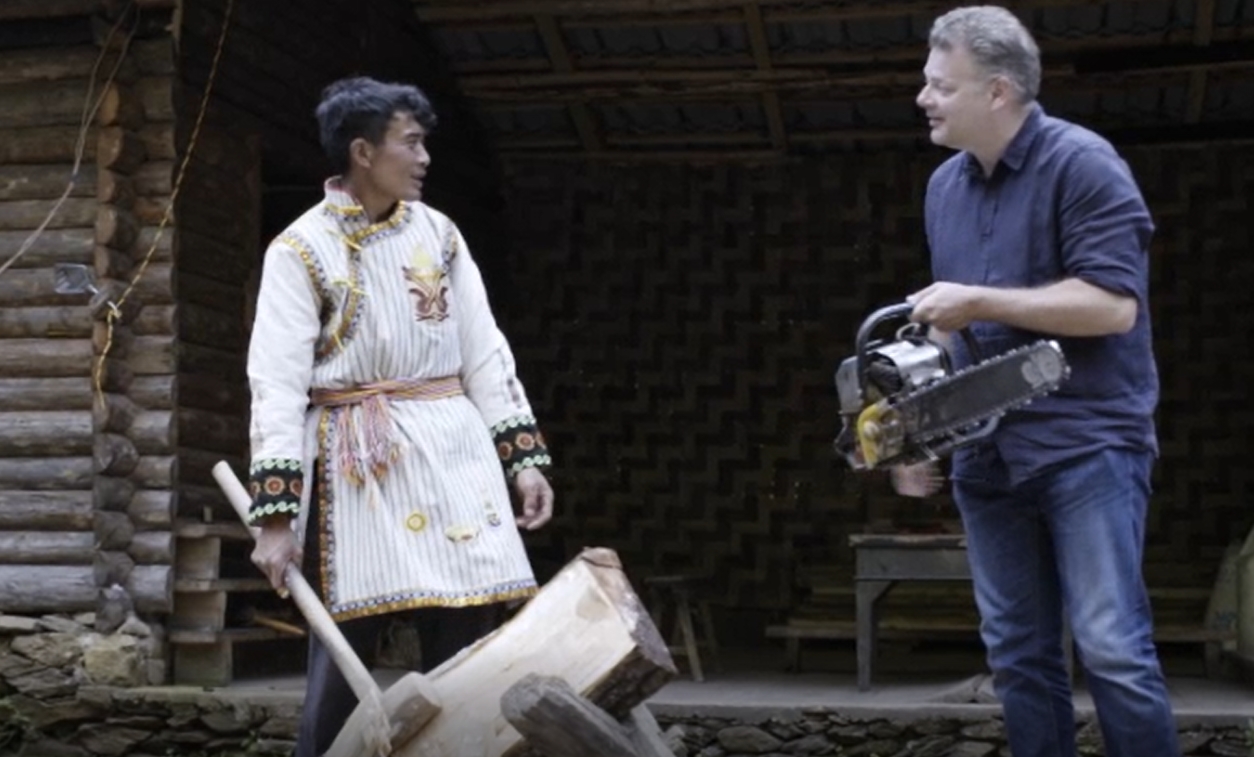
The last figure on the mural is a wizened old man blowing a cow-horn trumpet, and Mr Qin’s breezy lecture falters. “This is my father,” he says. “He was my father and my teacher, and he suffered so much. In the Cultural Revolution, they broke into our house and destroyed everything we had spent three hundred years trying to preserve. We were beaten and we were persecuted.”
Tears begin to roll down his face as he recounts his family’s sufferings for being regarded as religious or superstitious in a time when China crusaded against the “Four Olds”. I pat his arm in vain as he weeps.

“I put him here, on this wall of gods,” he says, “not because he was my father. Not because he was my teacher. But because of everything he went through.”

I console him in the shadows and see that we are still filming. But the director is shaking her head. There is no way we will be allowed to broadcast much of this footage, mainly because it soon becomes clear that the most recent attacks on the QIn family were in the supposedly enlightened 1980s.

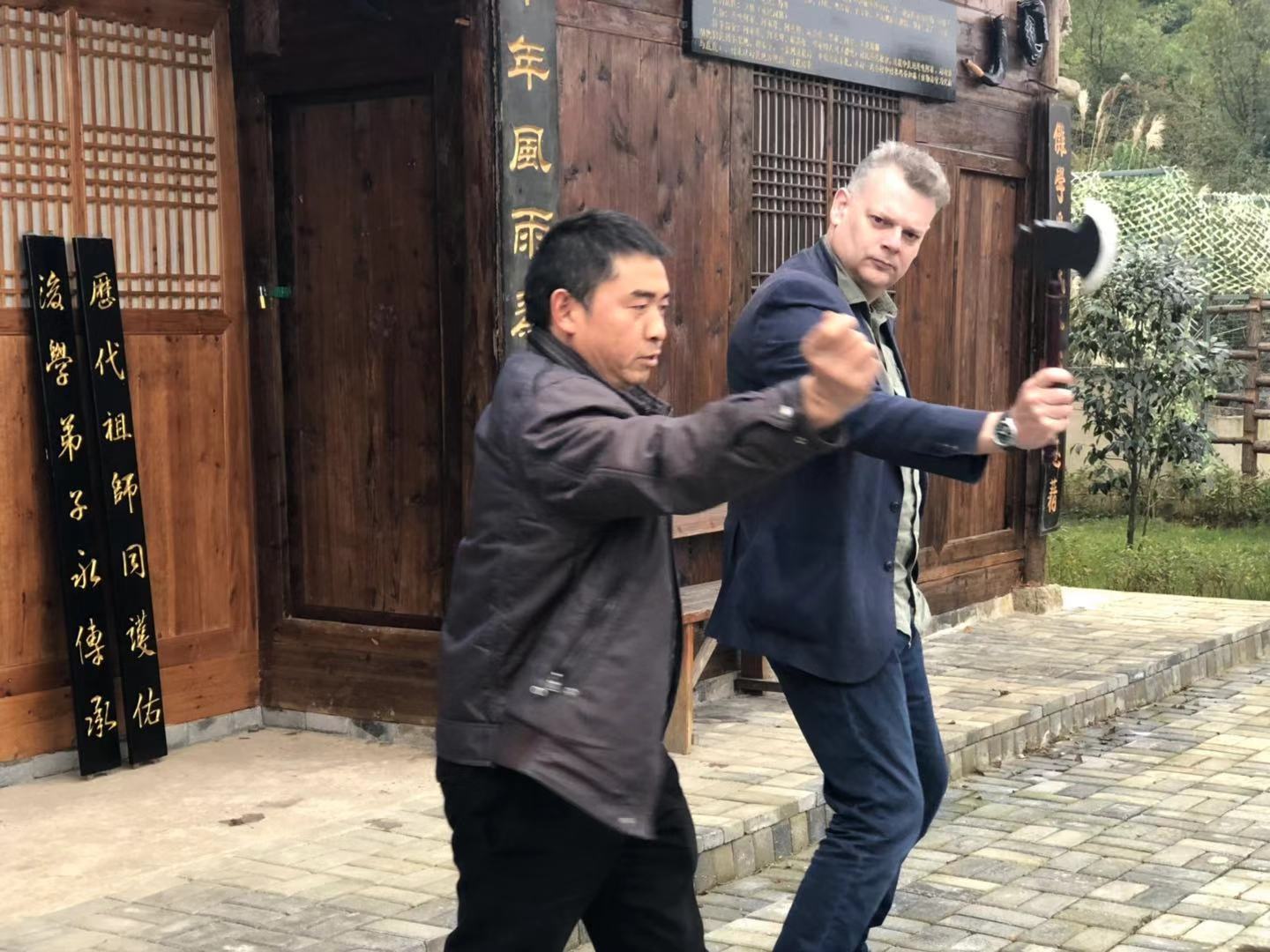
Mr Qin wants to teach me the Pattern of the Eight Directions, a mystic dance of footsteps designed to lock a shaman in some sort of protective force-field. You must enter from the north, step to the middle, then the south, then north, then east, then west, then… maybe the middle again, then diagonally to the… I already forget. But this goes on for a while, and once you have started into the Pattern, you can’t stop, and you can’t get down.

Oh, right, I forgot to mention that. In order to train pupils to step at the correct length of pace, the training for the Pattern of the Eight Directions is conducted on top of a set of nine stubby pillars, so the crew have a good laugh watching me teeter and trip, while Mr Qin stands at the side with a pointy stick, shouting “NOW LEAP TO THE PILLAR OF THUNDER! LEFT, YOU IDIOT! NOW LEAP TO THE PILLAR OF WIND. NO! NOT THAT, THAT’S THE PILLAR OF FIRE!”

Having thus had my brain thoroughly scrambled, we move onto a performance, which is apparently is the World-Creating Dance of Kaishan, Divider of Mountains. This involves donning a mask unsurprisingly like that of a Noh demon, waving an axe around and proclaiming that one is going to Open the Mountains in various directions, and possibly fly about a bit. Mr Qin confuses things a bit by dropping into Guizhou dialect on occasion, but the text seems confused already. “Opening the Mountains” (kaishan) is sometimes a reference to the Pangenitor deity of Chinese folk religion, and sometimes a reference to the arrival of Buddhism in the sticks, but sometimes also a reference to Yin Kaishan, one of the faithful lieutenants who supported the grab for power of the first Tang Emperor, and whose alleged grandson was the famous Tripitaka. So we’re mixing two religions and one historical figure, while spinning in circles and pretending to be a bird. It’s all in a day’s work for a Clements. I’ve had weirder Tuesday afternoons.

“You’ll stay for dinner, of course,” he says. “I’ve already killed a chicken.”

Jonathan Clements is the author of A Brief History of China. These events featured in Route Awakening S05E05 (2019).
Getting Wood

The carpenter is not available until 6pm, so Mack the Fixer and I entertain ourselves by challenging six of the village children to basketball in the schoolyard. I say we entertain ourselves; Mack entertains himself and the director makes me join in because the director of photography was on the balcony with his camera. The kids are a bit like Imperial Stormtroopers – they run around a lot but can’t shoot straight to save their lives. I haven’t seen the footage, but if we were shooting on 50fps, the opening credits sequence should include a slow-motion picture of me slam-dunking a basketball while half a dozen Chinese boys try to wrestle me to the ground, in the well-known tradition of Clements sporting achievements.

Finally, we get to Mr Wu, yes, another Wu – it’s complicated.

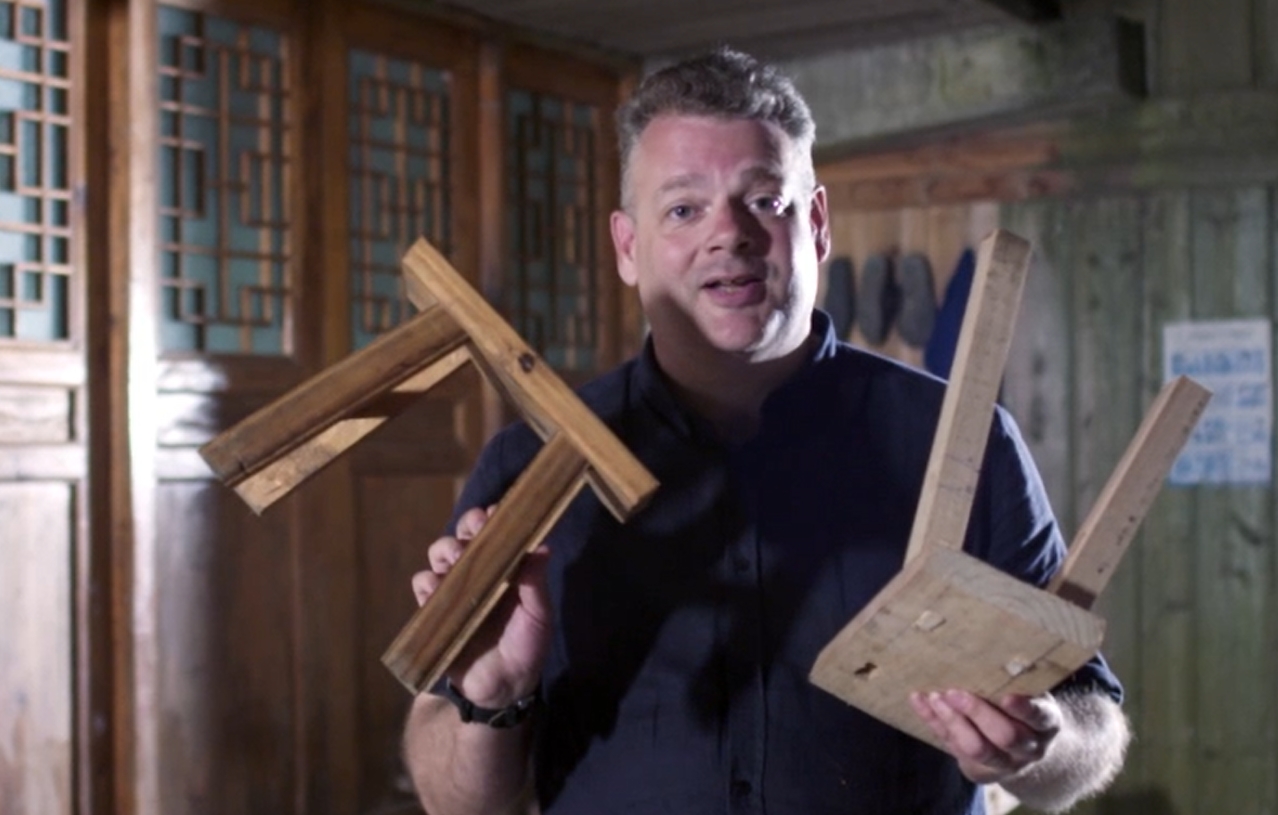
In the 18th century, the Kam tribal areas were conquered by a general called Wu, and everybody adopted his surname. They only diversified a little bit a few decades later when Chinese prefects were shocked that people with the surname were marrying each other among the Kam. So they split the names again, although there do seem to be a hell of a lot of Wus around. And this one is going to teach me how to make a little stool that looks a bit like a chunk of Stonehenge.

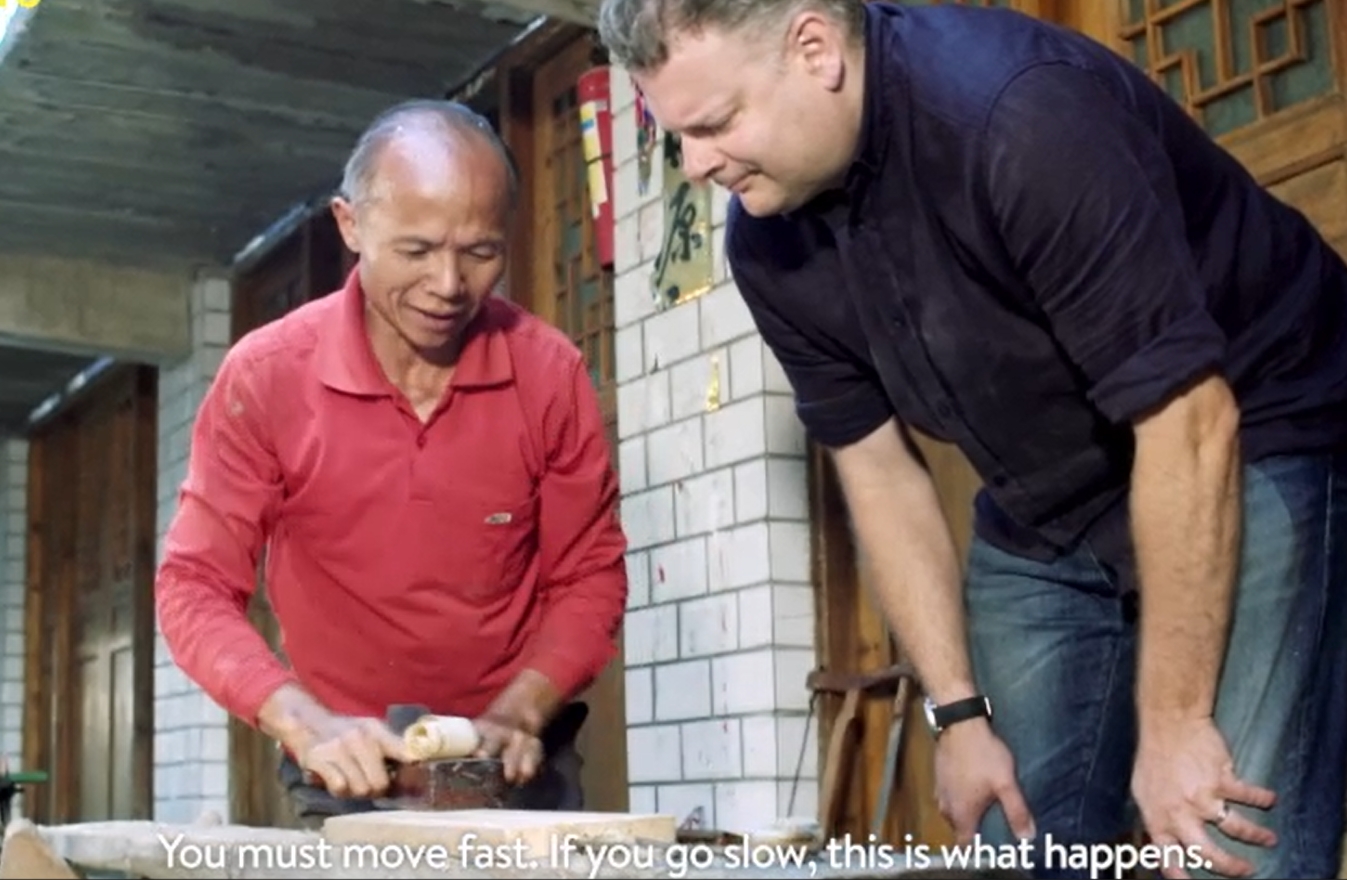
It is quite boring for everybody involved, since making a stool hardly constitutes amazing television. Mr Wu is also preoccupied with another appointment, possibly discombobulated by the camera crew, and has somehow misjudged his sawing lines, so that the stool we are making has uneven legs that not even a lopsided contortionist could sit on. After an hour, we have lost the light and are shooting in the street with the LED lamps to bump up the luminance. Mr Wu’s stool looks like it’s been designed by MC Escher, and I can’t help but notice that he only has nine fingers, having presumably sliced one of his off at some point while making a stool that looked almost, but not quite, entirely unlike Stonehenge.

Eventually, he pleads that we should come back later when he can sneak away and re-measure his planks. I do a piece to camera claiming that I have built the terrible, mis-shapen two-legged stool, and we pack up for dinner. Mack slips Mr Wu 100 kuai (£10), at which point Mr Wu suddenly realises that he doesn’t have another appointment after all, and he is happy to stand around sawing all night if necessary.

No, that’s all right, we’ve got what we need, insofar as what we needed was three minutes of footage of me smacking stuff with a hammer while making lewd double-entendres that will hopefully slip past National Geographic and make the show vaguely more entertaining.

Jonathan Clements is the author of A Brief History of China. These events featured in Route Awakening S03E02 (2017).

Rice Rice Baby

Two years after Japan seized Taiwan from imperial China in 1895, the government in Tokyo had started to wonder if it was worth the hassle. The local people were notoriously difficult to control; the anti-Japanese resistance continued to bubble away in the hinterland, and the infrastructure was a mess. Some wag in the Japanese parliament even made the modest proposal that, all things considered, Japan had been sold a lemon, and should probably consider off-loading the whole thing for a bargain price on the first mug to come along… probably France.

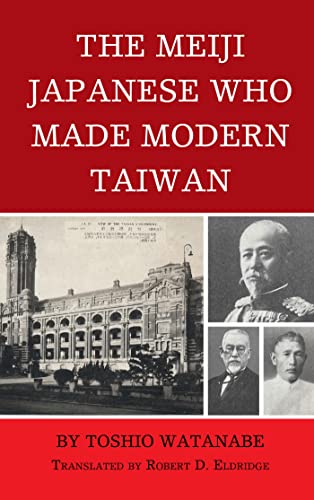
Toshio Watanabe’s The Meiji Japanese Who Made Modern Taiwan is a study of those Japanese engineers, politicians and scientists who refused to give up, turning Japan’s newly acquired colony into a testing ground for some of the grand schemes that would later be unrolled all across the Japanese empire.

Watanabe zooms in on Shinpei Goto, the administrator whose thoughtful approach to researching his new posting led to the commissioning of invaluable, multi-part scientific surveys, including a 4000-page report on tribal traditions among the indigenous inhabitants – often the first time such matters had been documented. It was Goto who dragged the island out of almost a decade of infrastructural decay, setting up the Bank of Taiwan to disburse investment funds for roads and railways, and declaring a Twenty-Year Plan to make the island a net contributor to the imperial Japanese economy.

Watanabe focuses on several linked elements of Japanese colonial development in Taiwan, particular­­­ly the creation of a new strain of rice, optimised not only for local conditions, but also for the Japanese palate. The result was a strain named for the ancient Chinese isles of the immortals, Penglai Rice (a.k.a. Horai Rice or Ponrai Rice), and Watanabe takes the story of this miracle crop out of both Taiwan and the Meiji era, to demonstrate its wide-ranging impact overseas, particularly in India in the 1950s. Even today, it and its descendants represent up to 93% of all the rice grown in Taiwan – Watanabe’s chapter on Horai Rice scales way, way out, making a bold claim to it as the saviour of millions of twentieth-century lives. This has, however, done some damage to crop diversity on the island – a fact alluded to in Crook and Hung’s Culinary History of Taipei, which notes the extinction of certain other rice strains in the wild.

But the crop was only half the story. Watanabe also delves into the history of the fields where it grew, particularly the plains between Chiayi and Tainan, the agricultural capabilities of which were multiplied a hundred-fold during the Japanese colonial era. For this, we have to thank a Japanese hydraulic engineer, Yoichi Hatta, who designed an irrigation system covering hundreds of square miles, holding back floodwaters and saving them to re-use in dry spells, to turn the Chia-Nan plain from a farming disaster-area into a rice-producing power-house with three crops a year.

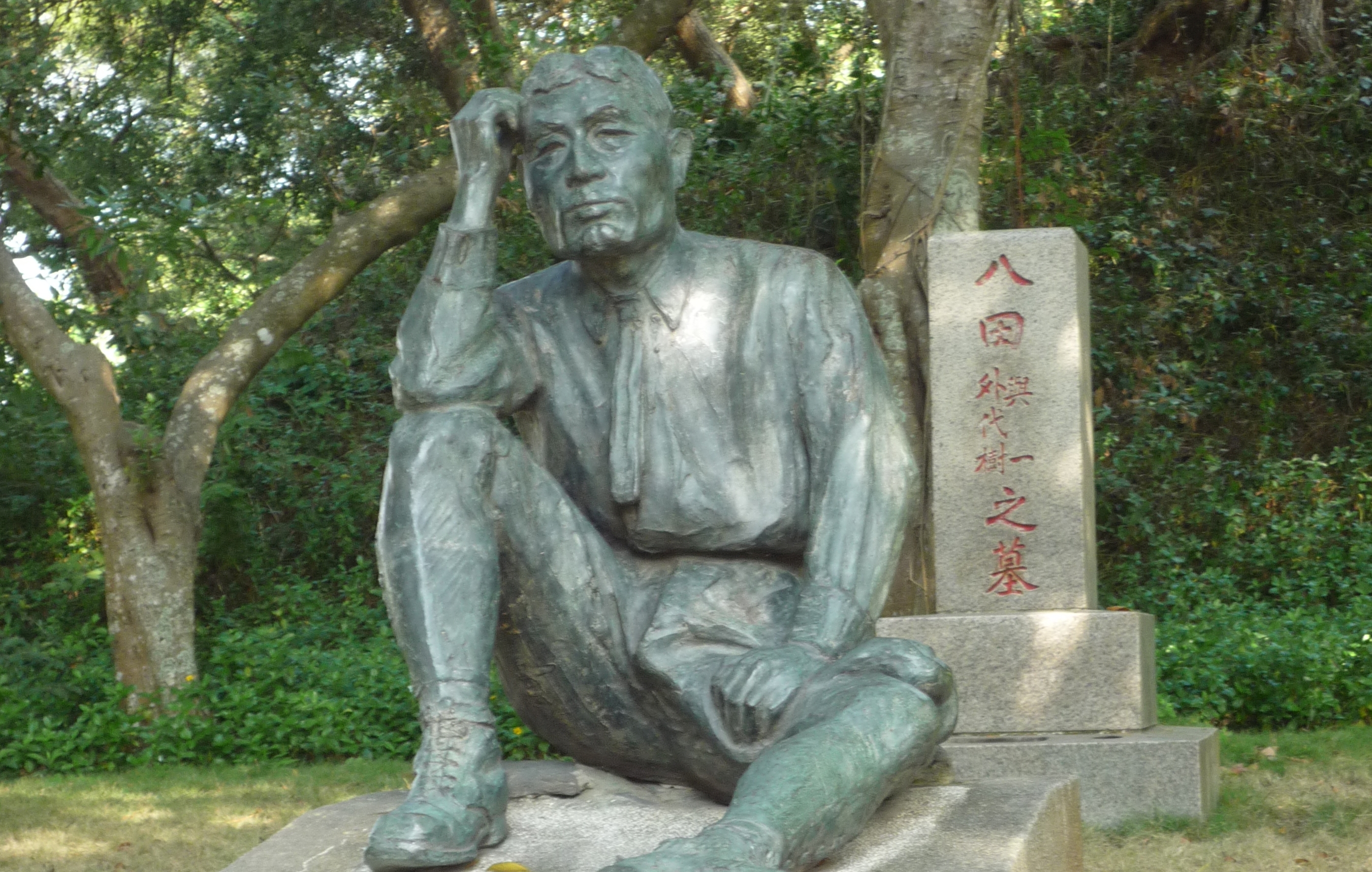
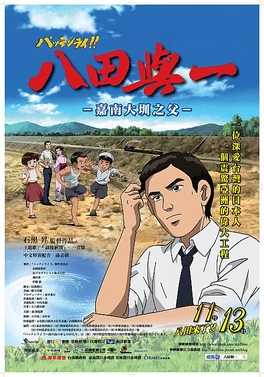
Hatta was justly celebrated as one of the icons of Japanese Taiwan, and enjoyed a vibrant afterlife, particularly at the turn of the the 21st century, when a Japanese prime minister, Yoshiro Mori, turned out to come from the same part of Japan. The result was a veritable Taiwan-Japan love-in, with diplomatic visits, high-level glad-handing, and even the release of a worthy-minded dramatization of his life, Noboru Ishiguro’s animated film Batian Lai – well, Batian Lai (“Here Comes Hatta”), is how I translated the title in the Anime Encyclopedia, but the Japanese original Patten Rai, has a stab at replicating the way his name would have been pronounced by the actual Hokkien-speaking locals. The anime film concentrates on Hatta’s obsession with the irrigation system, and his pride and joy, the Wushantou Dam, which for six years in the 1930s was the largest in the world. Hatta’s most recent appearance in the media was in 2017, when a crazed politician in search of clickbait decapitated his commemorative statue at his gravesite beside the dam.

After Japan lost Taiwan in 1945, the new Kuomintang government adopted a scorched-earth policy towards the fifty years of Japanese rule. They played up colonial atrocities (of which there were many), deported thousands of Taiwan-born “Japanese”, banned the Japanese language from public life, and did everything they could to wipe out the Japanese colonial legacy. Watanabe’s book is a celebration of the oft-forgotten achievements of Taiwan’s Japanese era, although in pushing to recognise the achievements of the Japanese, he might occasionally have forgotten the Taiwanese who did much of the hard labour, and the occasional European who might have helped a little bit, such as William Kinnimond Burton, the Scottish engineer who designed many of the island’s Meiji-era sanitation systems.

But Watanabe’s book is more interested, naturally, in the Japanese, whose lives he describes with empathy and occasional melodrama. Nowhere is this more obvious than in the tragic end to Hatta’s story, when he dies aboard the Taiyo Maru, a ship torpedoed by an American submarine. His body lies in the water for a week, in which time the flesh is so picked clean by marine scavengers that he can only be identified by his clothes and personal effects.

His wife, Toyoki Hatta, held on until the 15th August 1945. On hearing the news of Japan’s surrender on the radio, she calmly walked through the rain to the Wushantou Dam, took off her shoes, and threw herself into the waters.

Jonathan Clements is the author of A Brief History of Japan. The Meiji Japanese Who Made Modern Taiwan is published by Rowman & Littlefield.

Ghost Master

Lu Great Uncle arrives, a bent, wizened figure half my height, 82 years old, with a straggly mystic’s beard and teak-tanned face. He is clutching a long-stemmed pipe and looking around him in a faintly baffled manner, as if he went to sleep in 1896 and is taken aback by the sight of horseless chariots. This figure is the local guishi, or ghost master – a herbalist, feng shui consultant and exorcist.

“What do you make of the building outside?” I yell over the noise of the cement mixer. “Good or bad feng shui..?”

“Good it is,” he beams. “Feng shui’d it I did.”

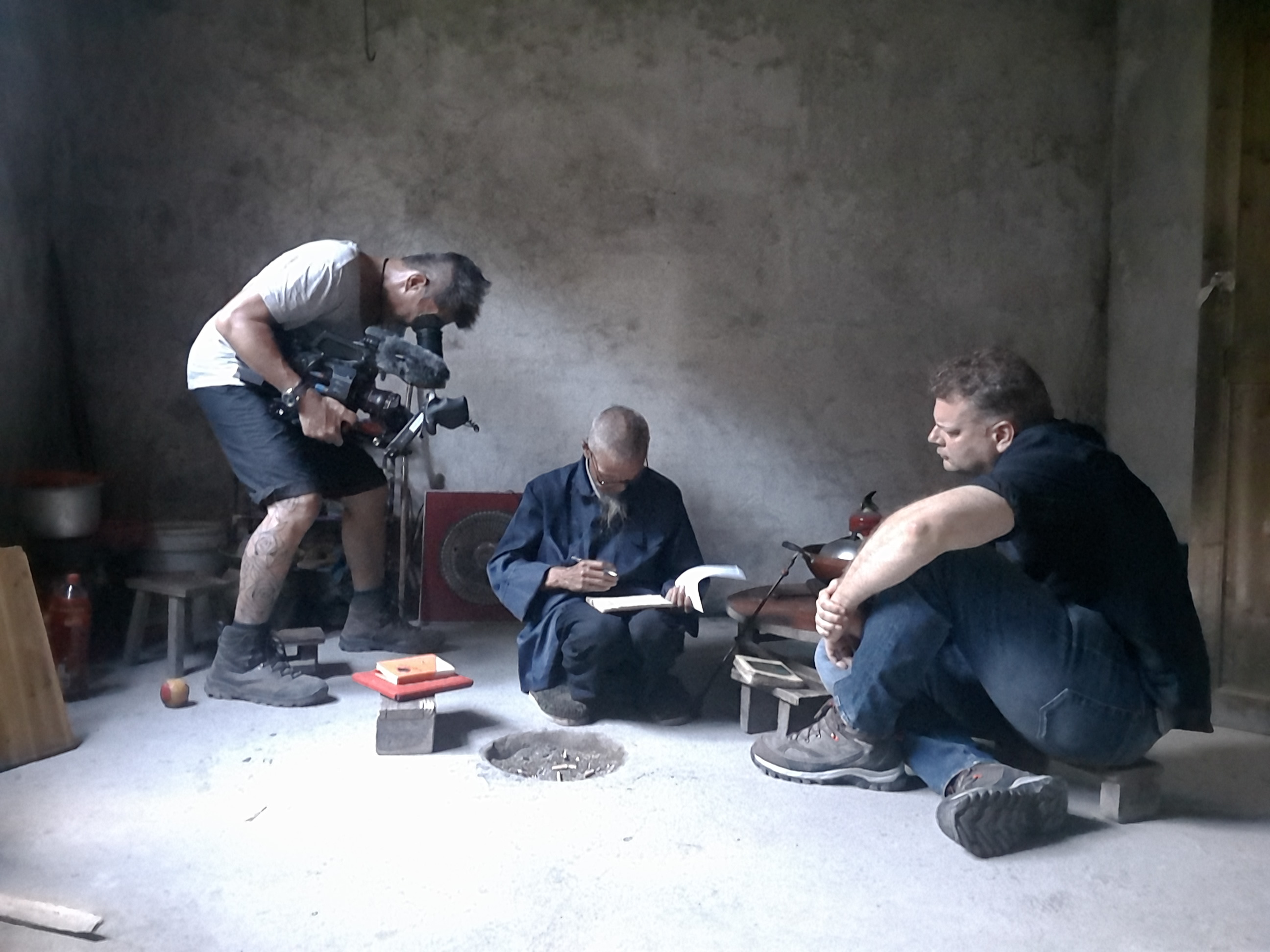
We relocate to the relative silence of Lu Great Uncle’s house, which is right next to the drum tower. We squat uncomfortably around his fire pit in a grey, cement room, and he talks me through his life, including his poverty-stricken teens, the inheritance of his gift for second sight from his father, and the various elements of parapsychology that he taught himself from books he got on a rare trip to Hong Kong. He speaks Mandarin, but occasionally slips into Kam without realising it. But, oh, he can talk. I have a list of seven questions to ask him and I talk him through them before we start. But when I begin with “So, Lu Great Uncle, tell us a little about yourself…” (using the nin particle for respect that I rarely ever bother with when talking to the Chinese), he gives a 15-minute reply that manages to answer all seven questions in an unceasing oration.

Despite having previously claimed he was not able to tell my fortune, he then proceeded to tell my fortune. He took note of the date and time of my birth, counted on his fingers and thumbs for a while, ruffled through a book, and then began reading out a series of poems and portents, which amounted to: “You are smart, you are diligent, you have a good heart. You have a golden life with few hurdles. At 42, you were sick at heart. You will never want for anything. Your parents are still alive. It is known. You have a son? You will have another. And you will die at 81.”

This all takes a lot of calculation and book-flipping through his meticulous hand-written notes, so much so that the director is already bored and moving the cameraman around us to get cutaways and close-ups. But Lu Great Uncle continues to look at his notes and write observations on a scrap of paper. Suddenly, he leans over to me and whispers: “When you were born, the sun came out.” And my fortune is told.

Jonathan Clements is the author of A Brief History of China. These events features in Route Awakening, S03E01 (2017).

Fifty Shades of Brown

Out today to a world-famous series of valleys of Mesozoic rock, known in Chinese as the “Rainbow Ridges” for their beautiful multi-coloured strata. Do not believe everything you hear.

“It’s just fifty shades of brown,” says the director.

Our driver, who has been supplied by the marketing office, answers her with a weary and hostile tone, which makes me think that he has to say this rather a lot.

“Don’t you have eyes? Can’t you see the subtle gradations? Anyway, the many colours only really show up after a rainstorm, but in the sunshine, at the sunset, in springtime…” He continues to list an absurd set of parameters for the valley looking the way it does in the pictures. We soon discover that even the publicity shot that brought us here, taken in the valley, was in a location that was impossible for a car to reach, and had been created with the magic of Photoshop.

I start to realise why the visitor centre has three windows: one for information, one for tickets, and one for complaints.

Four locations in the park are set aside for scenic views, but all of them have been thoroughly ruined, festooned with toilets, construction sites, visitor centres, and in one place, a permanent loud-speaker loop of a man singing a song about horses. Also, mirabile dictu: camel rides. So the director gets the driver to drop us off at a secluded spot where I can wander along the base of the mountains, while our drone buzzes above me.

“Don’t actually climb the mountains,” warns the driver, “because there’s a fine.”

We walk a couple of hundred metres across the plain, and start to set up the drone. Immediately, a jobsworth on a moped beeps his horn and drives onto the plain with us, gouging up deep tyre tracks in the soft wadi.

“You can’t go off the road,” he shouts.

“We can’t go up the mountain,” says Clarissa the fixer. “We can go off the road.”

“No you can’t!” The security guard is quite adamant about this, despite the fact that he has no trouble riding his motorcycle into the middle of it, and from the tracks all around, he is not the only one.

“Yes we can!”

“On whose authority?”

Clarissa waves a pink piece of paper from the Marketing department, who have given us access at the request of the Ministry of Foreign Affairs. But this isn’t good enough, because the security guards only answer to the Head Security Guard, and he is having lunch, while the Head of Marketing is somewhere in the park that doesn’t have radio reception. Clarissa and the security guard argue for so long that we could literally have done our drone shot and left again. Meanwhile, a group of Chinese women see us standing on the plain and decide that if we are there, they can go off the road, too, and start climbing the slope. This results in the surreal sight of the security guard bellowing at us that we are not allowed in, while three Chinese women cavort behind him, taking selfies on the supposedly forbidden ridge.

As far as the guard is concerned, he is doing his duty by obstructing us until his superiors confirm otherwise. Clarissa makes a point of taking his uniform number. He makes a point of setting his mobile to record, and placing it in his top pocket. After half an hour has been wasted, the director announces that the park can shove its publicity up its arse, and Clarissa pointedly rings the marketing department to tell them after travelling a thousand miles to get their rocks on film, that we have wasted our allotted time waiting for a man on a moped to get out of the way, and that their rocks will consequently not be appearing in the National Geographic documentary, even though they boast on all their signage that National Geographic decreed them to be one of the ten wonders of the natural world. We stomp off back towards the car park, from where we sneakily film some footage over the fence, after the director sees a nice view when she goes into the bushes for a piss.

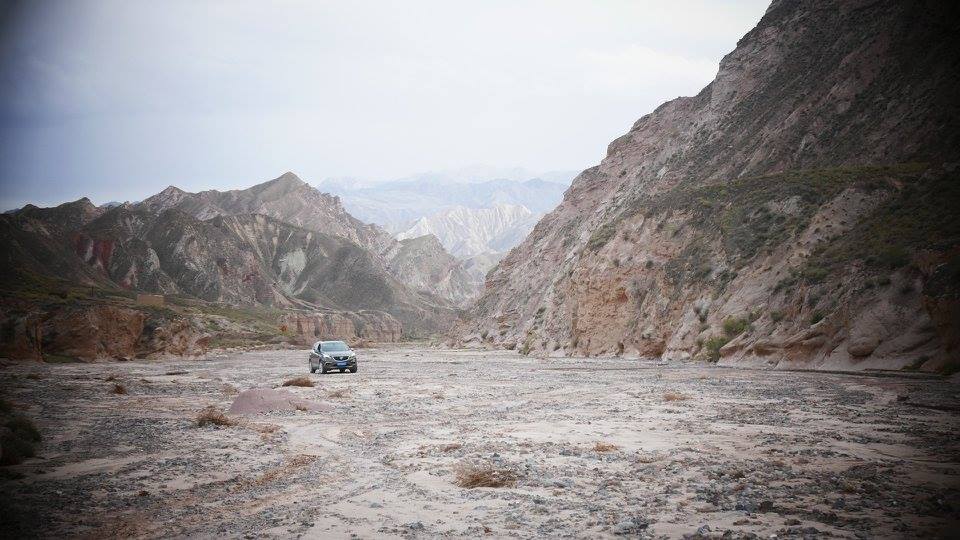
Our driver, however, who seems to know everybody and everyone, knows another place where he can get us in. The mountains there are sort of like the ones in the park, he says, and he knows a dry riverbed between them, where we can get some good shots.

Which is why I find myself driving a Buick, wheel-spinning my way along a wadi, sending flints and quartzes flying, bumping along the ridges and gullies carved by spring streams, as the Yuneec Q500 Typhoon buzzes overhead, and our spare camera, bolted to the dashboard, films me at the wheel.

Jonathan Clements is the author of A Brief History of China. Some fragments of these events made their way into season two of Route Awakening.

The Bump and Grind

After days of pleading, the director is persuaded to let us get the cable cars up the mountain. There are two stages, which eventually put us at 2800 metres, or in other words, the same height we were at last week in Lijiang. But now we have a vista below us that looks like the Grand Canyon, if the Grand Canyon’s lower flanks were green with trees and shrubs.

The tourist office had claimed that the place would be rammed with travellers today, but it is surprisingly quiet. It takes until 11am for the yammering Chinese to make it to the summit and yell “MY NAME IS WANG! HELLO!” into the abyss, as if anyone will be impressed with that. Earnest notices inform passers-by that the cliff opposite is known as the Two Elephants Paying Homage to the Dragon or The Sleeping Buddha, and we launch our drone from the top of Thousand Turtle Mountain, the peak of which is criss-crossed with domes and lines like a cluster of tortoise shells.

This is the most breathtaking scenery I have seen in China, and it is still relatively unspoilt. Stern notices forbid smoking anywhere at the summit, and for once the Chinese seem to be obeying, leaving the area mercifully free of fag ends and forest fires. The peaks dip sharply into the valley below. In more developed parts of China, this would surely all be rice terraces by now, but it is still clad with wild forest. I am glad I have seen it before someone puts advertising hoardings and a shopping mall on it.

I am still not at 100%. Last night I dined on a packet of crisps and two cans of beer. I tried to eat something at lunch, but had to run for the bathroom when we returned to the hotel. Skipping a few meals will do me no harm, and it is preferable to being caught short out in the wilderness where the only toilet makes my in-laws’ shed in the forest look like a five-star hotel.

The director is better, but miserable about the state of the footage we have. So far we have one good episode, about the Kam and Death, and scattered fragments of three others, none of which really have any rhyme or reason to them. Tonight, we are pinning all our hopes on the Lisu Courtship Dance, which promises to be an evening of song, dance and booze, in colourful costumes, and will hopefully hold this episode together. But we have no interviewees so far, as the only person we have had any contact with who speaks Mandarin is the tourism officer, and he is a Naxi.

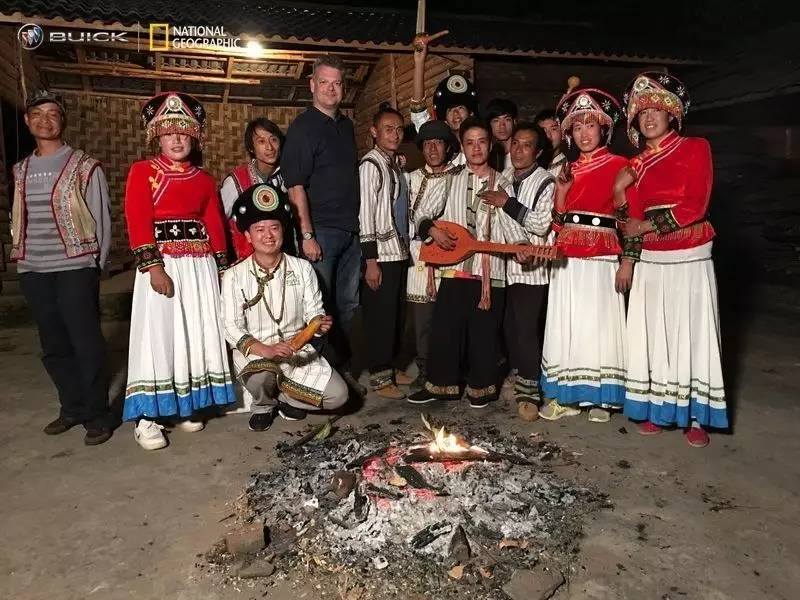
Wang Yonggang has arranged a tribal get together at his shed. He turns out to be something a big name in the world of lusheng-playing and climbing ladders of knives, and has even been whisked away to Paris to perform. Tonight he has rounded up a dozen of his mates, their wives and children, and stages a series of Lisu songs and dances for the camera, the men in their white tunics adorned with career-related patches, the women in their ornate red skirts, topped by jangly headdresses.

Overhead, there are more stars than I have ever seen before, so many in fact that I can barely recognise any constellations. Cassiopeia, which is a simple, recognisable W-pattern of five stars, has about thirty new members.

The first performance is the Welcome Dance, a ring-a-roses performed around the fire, into which I am dragged. I am not however, informed just how fast it’s going to get or how close to the fire, and I am left wheezing and coughing from the smoke. The director then announces that the cameraman was changing lenses at the crucial moment when the tempo switched up, and that consequently we have to do the whole thing again. On both occasions, the giggling Lisu flee for the shadows the moment the music stops, leaving me standing, dazed and panting, on my own by the fire, which ought to make for a good shot.

Then there is the Back to Back Dance, an important component of Lisu socialisation, and once in which I am fortunately not asked to participate, since it also comprises holding hands boy-girl-boy-girl, dancing around the fire once more, and energetically rubbing your arses together, first to the left, then to the right, repeat. “Back to Back”, I would suggest is probably a modern spin on what I would call the Arse Rubbing Dance, which ends with everybody piling into the shed, around another smoky fire, and singing at each other about their requirements for a mate.

“I would really like a girl with brown eyes,” sings one man, which is a low-level boss in China.

“I want a man with at least five cows,” sing the girls in response and one of the Lisu men gets up and glumly leaves.

This goes on until only a single boy and a girl are left in the shed, at which point he sidles over to her bench and they sing together softly, before sidling out into the night. The couple in question are actually married, and the director asks them how they met.

“We were doing the Arse Rubbing dance,” laughs the man, “and at the end she wouldn’t unlace her fingers, she just kept hanging on to me!” Sadly we don’t get their little love story on film, because the cameraman is already pacing outside waiting to leave, but the rest of the crew are encouraged to socialise for a while in the shed, sipping on crappy Xuehua beer and gnawing on baked potatoes from the fire.

There is a drinking song with much clinking of glasses, which goes something like:

I invite you to drink with me

I invite you to drink with me.

If you won’t drink with me.

Fuck you.

One of the dancers reveals that he can speak a little English, having graduated from a police college in the nearest big town. He is only the third person from the valley to get a bachelor’s degree (our tourist liaison was the first). The Lisu, he says, rarely think about tomorrow, and that includes their planning for education. They are usually married shortly after high school, a fact attested by the ages of the women present. One of the dancers, a leggy model who takes off her tribal dress to reveal denim hotpants over black tights, is not only married to one of the men, but appears to be the mother of a teenage daughter, not quite old enough to join in, who hovers in the shadows in a yellow sweater, mouthing the lyrics to herself and practising the steps.

We don’t leave until half past eleven; the director is still miserable, but the footage required to make this an episode about Courtship, and hence to fulfil our “Circle of Life” brief, is in the can, along with clean audio of the songs.

Jonathan Clements is the author of A Brief History of China. These events featured in Route Awakening S03E04 (2017).

Innocents Abroad

You can forget Sun-Moon Lake. It’s so last season, darling. “It’s pretty but I don’t go there anymore,” says one of Ian Rowen’s interviewees. “If I wanted to feel like I am in China, I’d just go to China,” she adds.

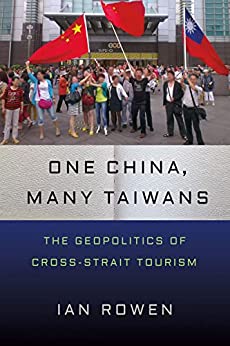
Rowen’s new book, One China, Many Taiwans, delves into what it actually means when Taiwanese tourist officers and mainland Chinese entrepreneurs tried to rustle up tour groups to come to that famous island across the Taiwan Strait – an island with tourist attractions that can actually be seen among the watermarks of a People’s Republic passport. What would they see? What would they not see? He ends up lifting an idea from the science fiction of China Miéville, particularly The City and the City – that the Taiwan where people actually live is a reality that phases in and out of existence in tandem with the Taiwan experienced by mainland visitors.

Rowen’s account of the geopolitics of cross-Strait tourism starts with the long decades of no contact at all, and the slow thaw that saw a few veterans and exiles granted compassionate leave to visit long-lost family members or attend funerals. But he swiftly dives feet-first into the sudden boom in actual tourism that saw thousands of mainlanders boarding planes to see the island that still claimed to be the Republic of China.

The centrepiece and tour-de-force of Rowen’s book is his fourth chapter – a diary of his adventures on a ghastly package tour for Chinese visitors around Taiwan’s major tourist sites in August 2014. Along with his fellow inmates, he schleps dutifully around the edges of Sun-Moon Lake, sees Alishan, and almost gets into Taroko Gorge (closed due to landslides), mopes joylessly around the shopping centre at the base of Taiwan 101 (because a trip to the observation gallery costs extra), soaks up some culture at the National Palace Museum, and refuses to buy over-priced tea shilled at him by pushy girls in aboriginal costumes.

Recalling the arch commentary of Mark Twain in Innocents Abroad, Rowen chronicles the miseries of his fellow passengers, the local factionalism among two very different tour groups lumped in together, and the careful language of their put-upon guide. He also interviews hotel managers and tea-sellers, restaurateurs and bus drivers, in order to get a sense of what high-falutin’ scholars might call the political economy of Taiwanese tourism.

Rowen is fascinated by the degree to which attempts to depict Taiwan as just another Chinese province repeatedly backfire, everywhere from the booking office where secretaries tut at his very inclusion, to passport control, where a small boy doesn’t understand why the visa form has a different flag on top of it, and indeed why his mainland family needs a visa at all.

He is particularly good on nuances within nuances – the market traders who have learned, without official directives, to rephrase their language in order to avoid ruffling the feathers of sensitive mainland visitors. Sometimes this can result in intriguingly counter-intuitive approaches, as in the case of a tour guide who studiously avoids mentioning the 228 Incident and the ensuing “White Terror”. You would think something like that would be catnip to visitors from the People’s Republic, but the tour guide regards Chiang Kai-shek and his Nationalists as “people from the mainland” too, and hence doesn’t want to insult customers that he regards as their cousins.

Rowen also notes a recurring complaint among his fellow tourists that the Taiwan tour experience is too xiaoqingxin – a difficult term to translate, but immediately evocative for me of the last twenty years of Japanese tourism aimed at office ladies and empty-nest housewives – I say twenty years, but Japanese media theory has related it to the last fifty, ever since women with disposable incomes were identified as an exploitable travel niche. I suspect that a lot of the experiences that the Chinese chafe at were first concocted to impress Japanese ladies who lunch, with history thrown out of the window in favour of gourmet experiences, photo-ops and kawaii.  

For years, I have cherished the idea of booking myself into one of the coach tours advertised in London’s Chinatown, taking in Bath and Stonehenge, Harry Potter’s supposed childhood home and the Bicester freeport. They are not officially Chinese-only, but you need to read Chinese to know they are even there. And I have been fascinated by the implications, and curious about the information imparted. Are they, to steal the lyrics of a satirical Chinese song, a case of: “Get on the coach and sleep / get off the coach and pee / go home knowing nothing”?

Rowen unpacks his own experience within a far broader context – that of the immense bargaining power wielded by Chinese tourists since the opening up of their country and the enrichment of its middle class. This is a concept that has exercised me on many occasions, not the least in my travels with National Geographic, where my attempts to chronicle the dying customs of a remote hill-tribe were once compromised by the invasion of an entire coach party of amateur photographers from Guangzhou, come to do the same. In the case of Taiwan, he points to what he unflinchingly calls weaponised tourism, which is to say a massive ding-dong between Beijing and Taipei, particularly after the landslide win of the Democratic Progressive Party in 2016 called into question the status quo that had existed across the Taiwan Strait for the previous two decades. Rowen argues that this political event jeopardised many years of lucrative cross-straits tourism, particularly after the torrent of PRC tourists in Taiwan slowed to a trickle, putting thousands of people’s livelihoods and businesses at risk.

Such big-picture politics helps put things like China’s own interest in internal tourism – e.g. the cynical creation of a new holy mountain – in perspective. Rowen also relates it to local political infighting in Taiwan, especially the Sunflower movement of 2014, ably demonstrating how supposedly parochial issues over language and policy can escalate into empty Arrivals halls and deserted hotels… themselves the cause of a massive protest march by Taiwan’s hospitality sector in 2016, which Rowen gleefully joins.

He also takes the time to ask, very pertinently, if amidst all this cross-Straits hoo-ha, the Chinese tourists are actually getting value for money, or are they being ground up in a relentless money-making scheme that shunts them around a bunch of non-descript hotels and maroons them for hours on end in shops trying to sell them tat? “Chinese tourists are getting up earlier than roosters,” comments one tourism official, “eating worse than pigs, and are totally exhausted from spending most of their days on intercity buses.”

Jonathan Clements is the author of A Brief History of China. Ian Rowen’s One China, Many Taiwans: The Geopolitics of Cross-Strait Tourism is published by Cornell University Press.

Absolutely Fabless

Chris Miller’s Chip War begins with a stirring account of US Navy operations in the Taiwan Strait in 2020. With China lobbing missiles into the sea, the USS Mustin toughs it out by flying the Stars and Stripes. The US government had recently revised its Entity List – previously a set of limits on exporting materials or technology with military applications, so, you know, please don’t send uranium to Iran or missiles to North Korea. But now the Entity List had been significantly tightened, and included a ban on shipping computer chips to China, itself a warning shot fired at Huawei, the Chinese manufacturer that was drastically under-cutting the international competition.

Miller links all this bluster to the “must-have” commodity of 2020, the Apple iPhone 12, an item crucial to the profits of its manufacturers in China and its distributors in the United States and all around the world. The iPhone 12, it turns out, is unable to function without something called the A14 chip, which at the time was exclusively made by the Taiwan Semiconductor Manufacturing Company (TSMC), a company that is responsible for 37% of the planet’s annual computing power. The Taiwanese chip fabrication market has a stranglehold on global commerce, and the power to shut down most modern production lines. It comes as no coincidence that the sabre-rattling in evidence began in the middle of the COVID-19 pandemic, when the fragility of the global supply chain had been amply demonstrated.

TSMC was founded in 1987 by Morris Chang, a man of Chinese extraction who had served for 25 years as a prominent figure in Texas Instruments. It had been Chang, in fact, who accompanied Texas Instruments’ Mark Shepherd to Taiwan in an almost-disastrous business trip in 1968, where the chippy Texan bristled at the serving of his steak with soy sauce, and almost lumped the economics minister for saying that intellectual property was a colonialist bullying tool. Despite such potential wrenches in the works, Texas Instruments had a Taiwanese chip factory by 1969. Passed over at TI for the job of CEO, Chang was eventually lured back to Taiwan to establish TSMC, for which a bunch of Taiwanese businessmen ponied up much of the funding, after some sinister arm-twisting from the Taiwanese authorities.

Miller suggests that the People’s Republic of China was aware of the implications and importance of semiconductors as early as the 1960s, but had already shot itself in the foot by sending all its best scientists into the countryside for “re-education”. It was only with the grand reforms of Deng Xiaoping in the 1980s, particularly the massive investment in high-tech industries around the soon-to-be-handed-over Hong Kong, that China really got going in high technology at all. But even then, its integrated circuits turned out to be sub-par, sometimes with only one in a thousand functioning as planned. Instead, China’s high-tech industries started to fudge the science part.

This, as Miller chronicles, turned many of them into “fabless” manufacturers – companies that lacked fabrication facilities to buy their own chips, but instead bought them in from somewhere else. As computer chips became crucial components in everything – not just computers, but also cars, fridges, and children’s toys (not to mention missiles), the PRC even leaned on its ideological enemies, bending over backwards to let Chang establish a Shanghai division of TSMC in 2000, even to the extent of allowing special permission for an on-site Christian church. But that was then; this is now, and the 2020s see a number of enclosures sweeping the world – of borders, of supply chains, and even of data. Xi Jinping is now scrambling to bring China’s chip manufacture up to a global standard.

“World War II was decided by steel and aluminium,” writes Miller, “and followed shortly thereafter by the Cold War, which was defined by atomic weapons. The rivalry between the United States and China may well be determined by computing power.” With Taiwan stuck in the middle.

Jonathan Clements is the author of A Brief History of China. Chris Miller’s Chip War: The Fight for the World’s Most Critical Technology is published by Simon & Schuster.

The Smoking Guitar

The valleys are so narrow that they are usually in shadow even when the sun is scorching on the red cliffs above. Then, the sun moves into the right position, and suddenly the moisture bakes off the wooden roof slats in clouds of steam, as if the building has caught fire.

The Lisu derive their surnames from their former tribal designations, which were moieties of Snakes, Lions and sundry other animals. Which is how I come to spend the morning with Mr Pheasant, who is here to teach me how to make a crossbow, and who arrives wearing a goatskin that makes him look like a troll doll. He starts with a log, and whittles it swiftly down into the shape of the body with an axe and a machete. Any wood will do for the body, but the bow has to be wild mulberry – domestic mulberry is never flexible enough. The string is made from hemp bark, and is sharp enough that I cut my fingers trying to draw it back. The quarrels, or darts really, are bamboo dowels the size and shape of a chopstick, fletched with a twist of bamboo leaf.

Mr Pheasant only speaks Lisu, so is not a whole lot of fun as an interviewee, but he has been well briefed by the Naxi town tourist adviser, arriving not only with all his raw materials, but with “one he prepared earlier”, so that we can leapfrog ahead in the tiresome sanding scene to get everything done before lunch.

There are so many comedy opportunities for the target. A Chairman Mao poster? A picture of Jason Statham (inexplicably found on the front of a giveaway sexual health magazine). The camera assistant suggests a plastic bottle of water, which might entertainingly spurt out its contents if shot. But in the end we plump for a boring mat with a target daubed on in charcoal. Both Mr Pheasant and I hit it with ease, while the director of photography cowers behind his camera, worried about the likelihood of me shooting him in the head.

At lunch, the tourist officer observes with astonishment that “the Foreigner” is able to use chopsticks, rather ignoring the fact that (a) everybody else around the table is also a foreigner, from Singapore, and (b) I have been eating Chinese food since before he was born. Nothing puts things in perspective after your third academic degree like some hayseed expressing surprise that you can use cutlery.

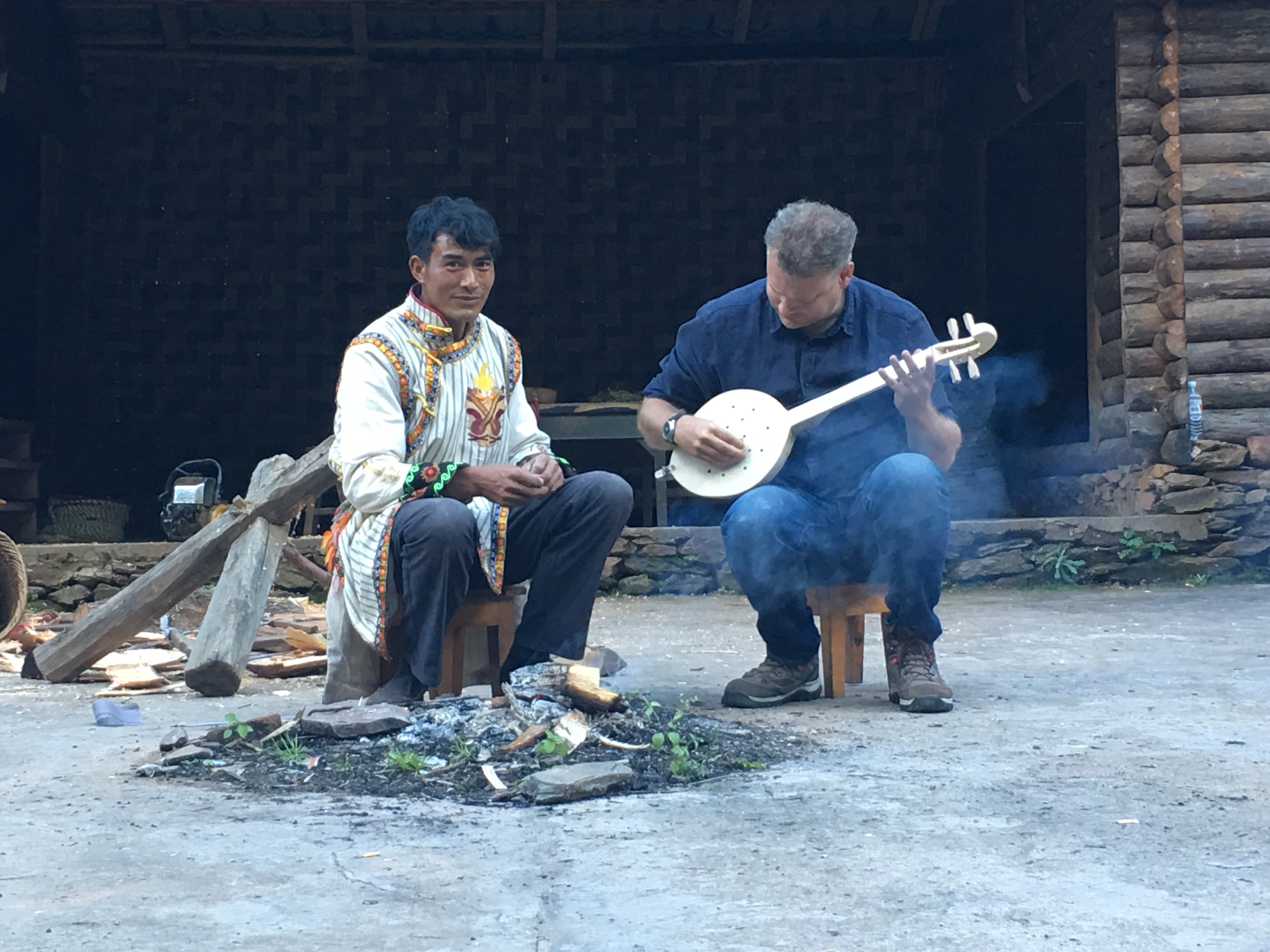
After lunch we are dragged back to the same courtyard in the hills. The tourist office has plainly decided it is convenient, as indeed it is, but it creates headaches for our director of photography as he tries to shoot it so that half the episode is not spent looking around the same shed. This also involves a log, from which the neck and body of the si xian qing are carved in a single piece. Mr Bee, however, is persuaded to hurry things along after a few axe blows, by lighting up his smoke-billowing chain saw, and making swift work of the difficult bits. He hollows out the base, and sands it down, before fixing the front to it using bamboo pins that turn out to be the remnants of the morning’s crossbow darts.

I don’t seem to be doing a lot today, but I don’t know if that’s because the director has lost the will to live, or if I am just getting better at this. Certainly, I haven’t had to take 20 takes to get something right this week. Instead, I pop up my head, do a piece to camera in one or two takes, and then go back to the sidelines for another twenty minutes until some other stage in the process is reached. It feels like I am not doing enough, but I counted back through my appearances on camera today, and I am still saying plenty of stuff.

Mr Bee ties guitar strings to the body by looping them through a bent piece of fence wire, and then makes a bridge out of a spare piece of wood. Then he heats a poker in a fire and starts burning through the balsa-like wood of the front, tuning and strumming, then poking another hole, and repeat. Moment by moment, the sound becomes fuller and the resonations stronger. Suddenly, he drops the poker and begins to play a tune, and the guitar is finished, smoke still curling up from the newly-bored holes.

Our sound man is ready with his boom mike to pick up clean audio of the new instrument’s first tune, as the alien Lisu melody fills the courtyard, wisps of smoke rising from the guitar along with the music. This gives us a segment from our Lisu episode complete, but hopefully something that will lead into the dance ceremony shooting tomorrow, and also a music track that we don’t have to pay for.

Jonathan Clements is the author of A Brief History of China. These events featured in Route Awakening S03E04 (2017).