And That’s a Wrap

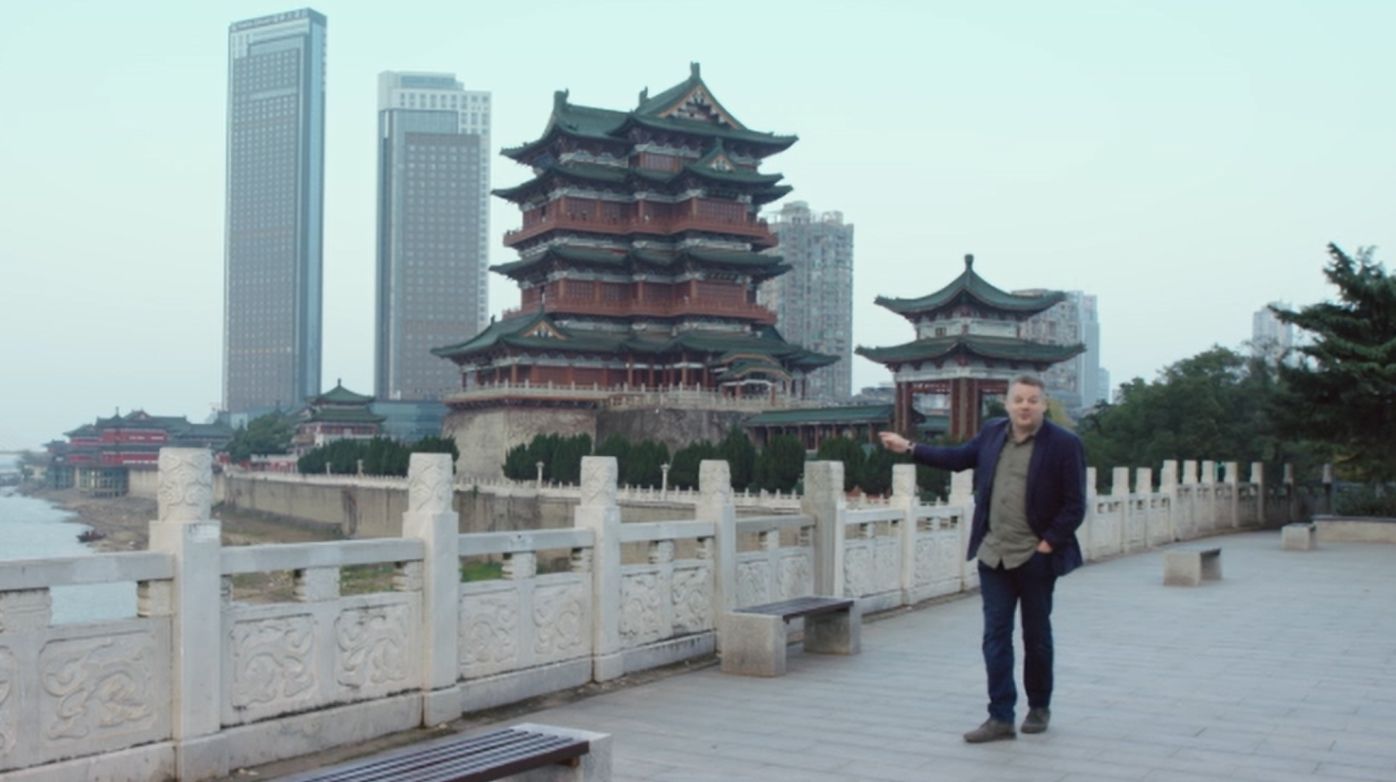
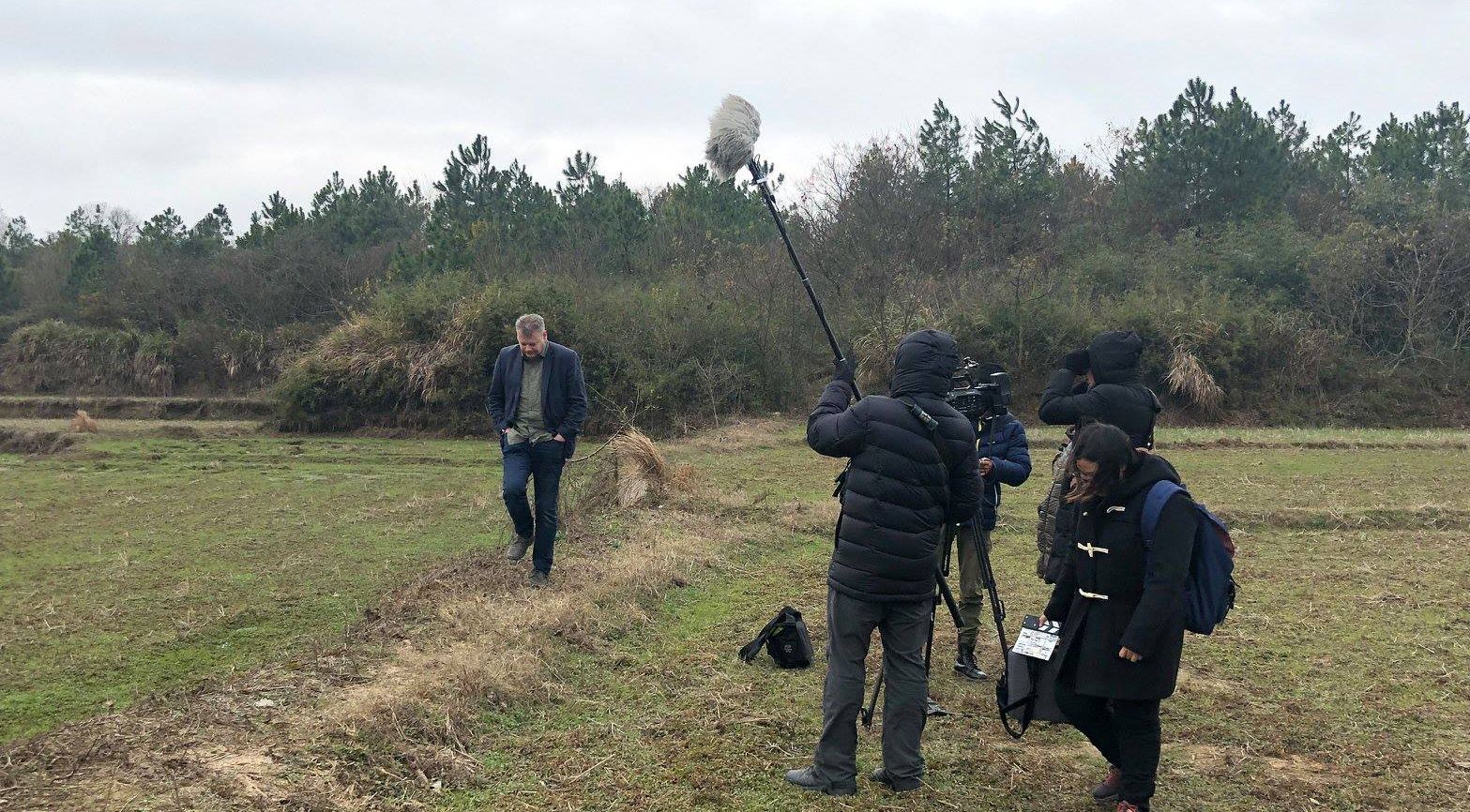
Unexpectedly, we have been given access to the site of the Marquis of Haihun’s tomb. The museum there is still a year away from opening, and we are not permitted to film the tomb next door that is still being excavated, but since we are meeting Yang Jun, the propaganda office can’t really say no.

In a windswept Chinese village strewn with inquisitive chickens, we meet Qiu Zongren, the happy security guard who is our morning interviewee. He grew up locally, and was there to witness the find, and ended up becoming a guard on the dig site, so has some handy stories to tell about what the locals made of the tomb.
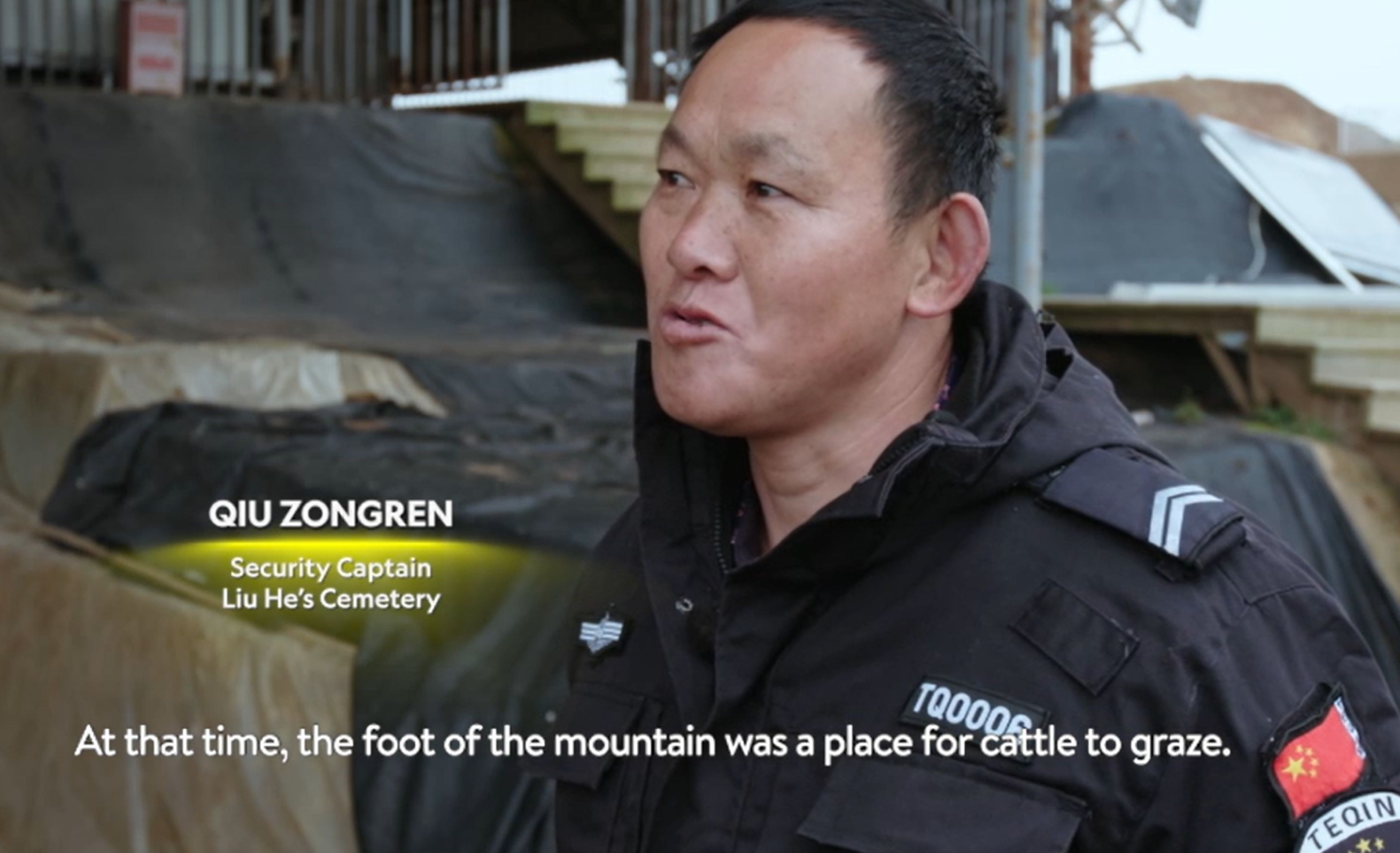
“Before the discovery, we never went there,” he admits. “Everybody said it was haunted. But then there was a night in 2011 when we saw lights on the hill, and realised that whatever was under the ground, someone was trying to rob it. We didn’t know what to do, so we called Jiangxi Television, and they called the police and the archaeologists. After that, I ended up in the guardhouse on the site all through the dig. I’d come home every night, and my mum and dad would ask me what was going on at work, and I couldn’t tell them. Because we weren’t just bringing up old pots and bits of bronze. We were bringing up so much gold, so it all got classified. We tried to make it all sound as dull as possible. ‘Just a few pots today, mum. Very boring. No gold. Definitely not.’”

We head off to the rice paddies where the Marquis’s mansion used to be, now only vaguely recognisable by the rammed earth walls that now form a low, wooded hill around the perimeter. It is cold and windy, and I am supposed to sound enthusiastic about standing in a field.

The last event of the shoot is scheduled at the tomb itself, a hole in the ground topped by a garish bright blue Dutch barn.
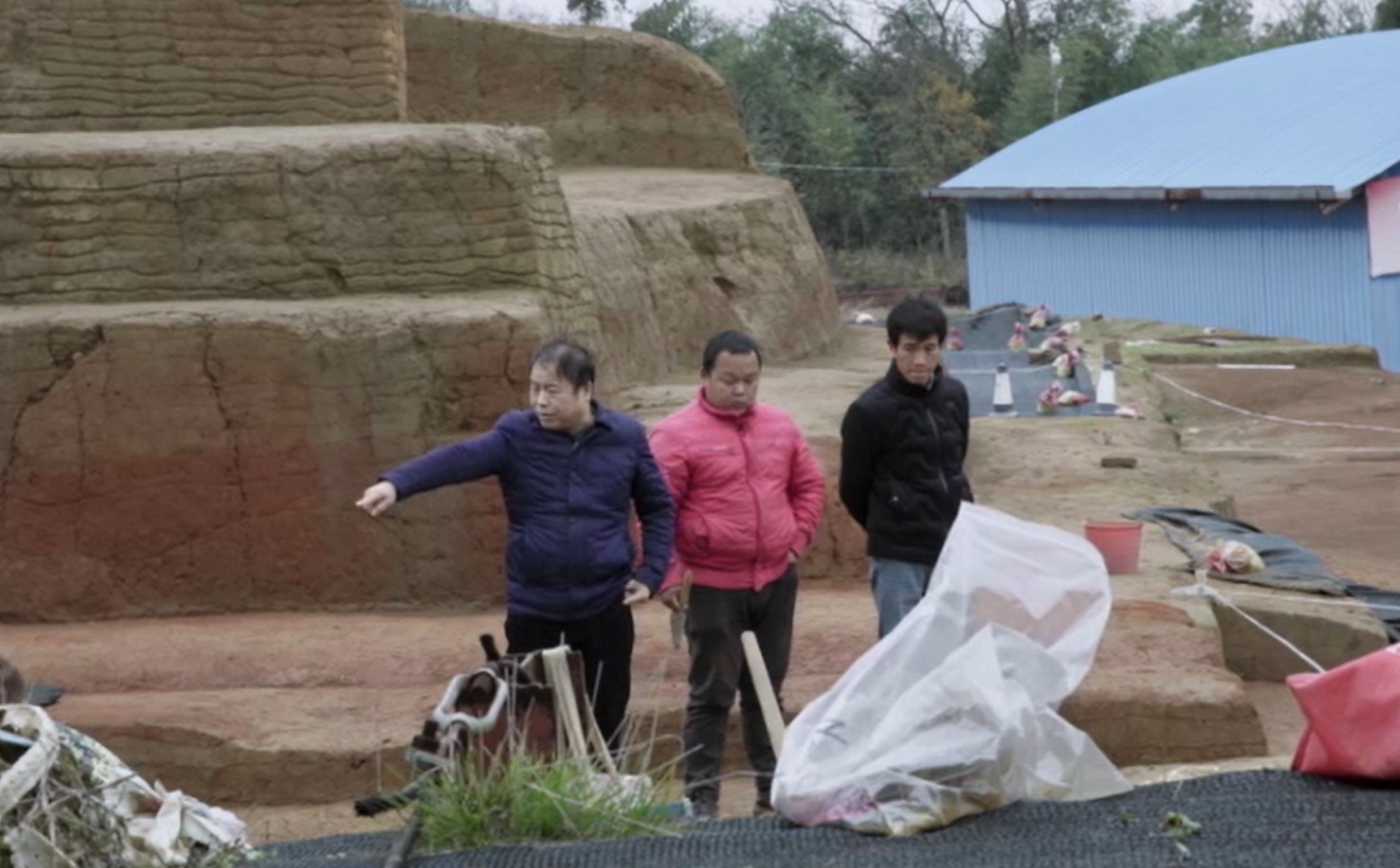
We can hear Yang Jun before we see him, because he is screaming at the technicians at the site of the tomb next to the Marquis’s. I don’t quite follow why he is so angry, but in the ten minutes before we arrive, he has idly ambled over to the new dig site and found them doing something that is apparently terrible. I don’t recognise a lot of the words he is yelling at them, except that something that should have been here is most demonstrably over there instead, and something that should be have been done one way is being done another way, and this has apparently ruined Christmas for someone. The scolding goes on for an embarrassingly long time, until the director herds the crew into a shed and tells them to stop watching. Clarissa the fixer begins to genuinely fret that Yang Jun will have lost his voice by the time we get to his interview.

But he trots down the hill towards us with a beaming smile.

“Did you get that on film?” he asks. “I thought it looked good.”

Er… no, says the director. We were giving you some privacy.

“All right,” he says. “I will go up there and shout at them again.” And before she can demur, he is running back up the hill, calling them a bunch of idiots and demanding to know if they’ve ever worked on an archaeological site before, because it doesn’t look like from where he’s standing, etc… Despite being friendly off-camera, I think he wants to cultivate an image as a tough taskmaster.
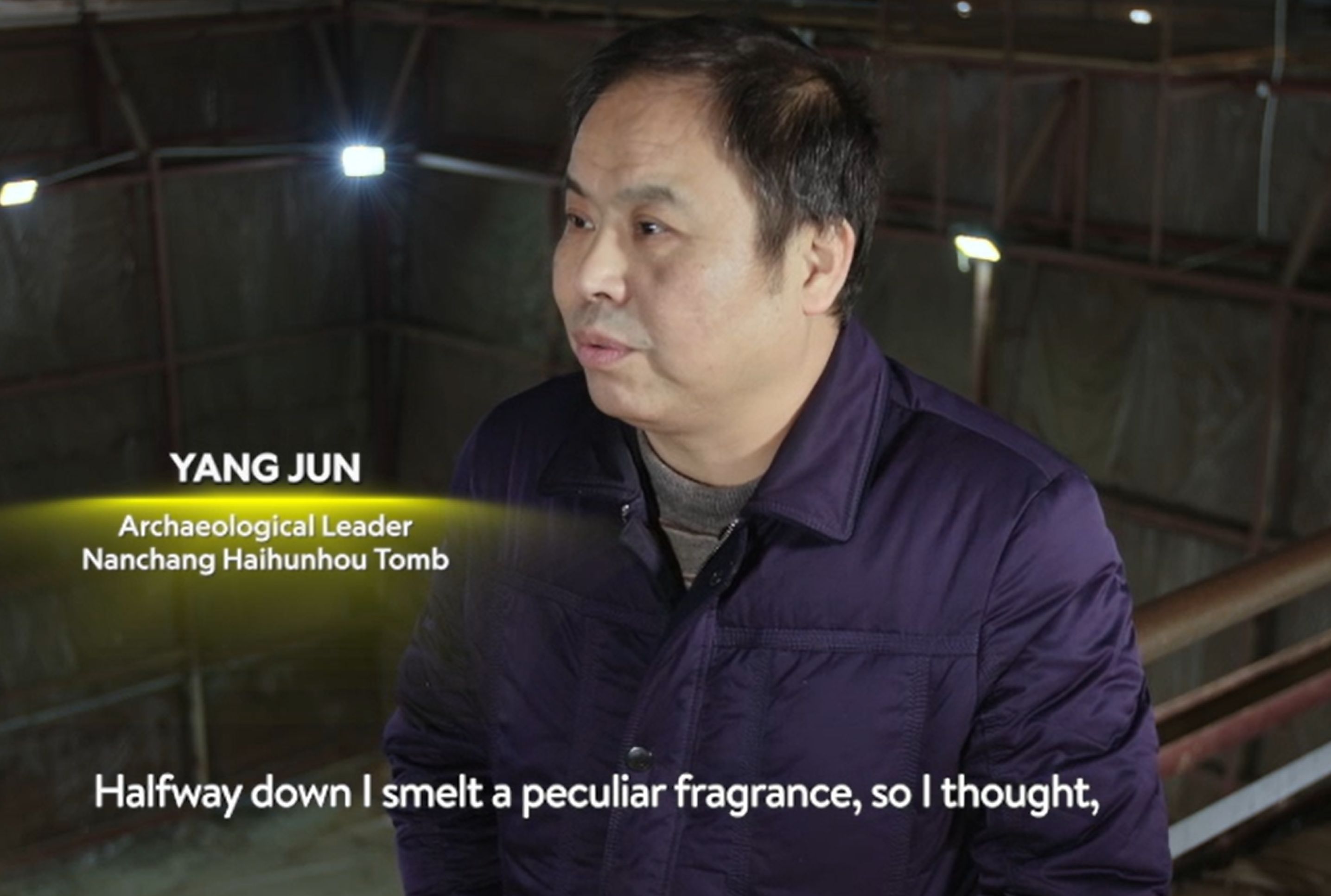
Only slightly hoarse, he assembles at the edge of the tomb to talk to me about the events of its discovery, which will inter-cut nicely with the same story heard from Qiu Zongren. You already know the story of the Marquis, so I won’t bore you with it again, except to quote Yang Jun’s explanation of why the tomb was so richly appointed. “Remember that this man started off as the satrap of a whole district in Shandong. Then he was the emperor. Then he was a marquis. And his father was the favourite son of the longest-ruling emperor of the Han dynasty, and one of the more storied beauties in Chinese history. So, yes, we have all those aspects of his life to consider in the grave.”

He then leads me into the grave itself, ten metres down on a perilous rammed-earth staircase, covered with slippery polythene. He points out the depression in the ground that marks the point where the grave-robbers had reached, and tells me of how he was lowered in the forbidding hole on a winch, down in the dark, to see what they had found.

“We were lucky,” he says. “Because people have tried to rob this tomb before. But about three hundred years after the death of the Marquis [i.e. around 300 AD] there was a massive earthquake in Jiangxi, and this whole area dropped down below the water table. It flattened the coffin and damaged some of the site, but it also left most of the tomb waterlogged. That put off robbers, and it also preserved the lacquerwork.”

The director and the crew come down to film us at ground zero, but Yang Jun reveals that he is only happy with us being shot from above. If the camera actually goes into the tomb space, it will notice how ratty it all is, and Yang Jun has already had a second eppy of the day after tripping over a pile of dog turds by the ramp. So we all have to head back up to the balcony, by which time it has started raining, drumming on the tin roof until we can barely be heard.
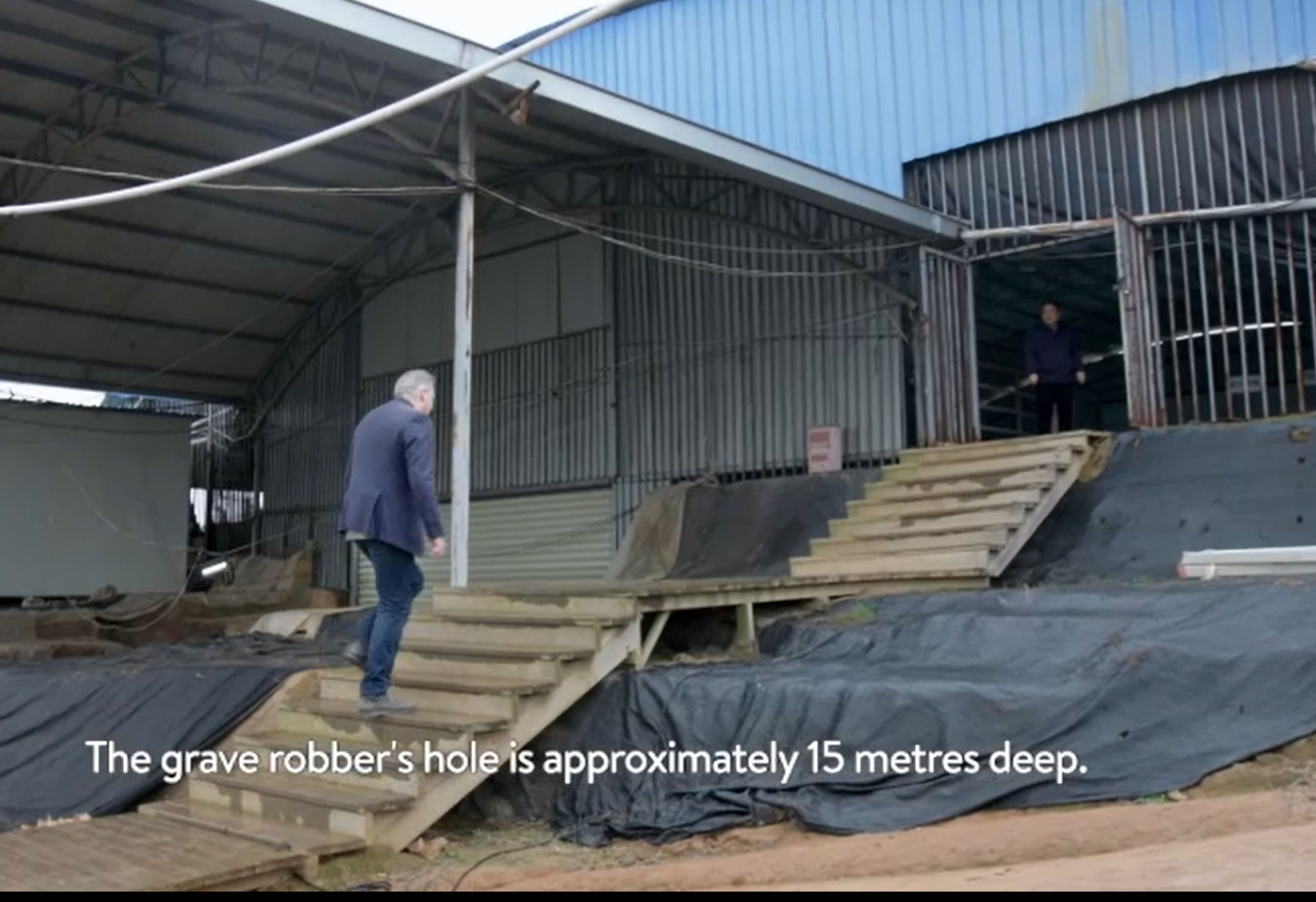
My last shot of the series is “meeting” Yang Jun, bounding up the wooden steps to shake his hand, and him leading me into the upper levels of the grave. As we move out of sight of the camera, I point into the gaping pit of the Marquis of Haihun’s tomb and say: “So, is this your house?”

He laughs, and the director calls cut.

Jonathan Clements is the author of A Brief History of China. These events featured in Route Awakening S05E04 (2019).
Horse Hoof Gold

There is an edgy staff dynamic at the Nanchang Museum, which has three times the usual number of security guards because of all the gold in it. This makes them jumpy at the best of times, but one also suspects that they are already all too aware that when the new Marquis of Haihun museum opens in the hinterland [it is now open], they will be surplus to requirements. Or rather, they will be offered a chance to keep their jobs, but only if they are prepared to commute an hour each way to what is currently a slum in the countryside.

This helps explain why the curator is so arsey with Clarissa the fixer, initially refusing to cooperate, then only ringing her back with oleaginous solicitude after he gets a bollocking from his boss. But he is still obstructive, refusing to allow us in to film on Monday, when the museum is usually closed to the public. Everywhere else we have shot, the staff have happily let us film on Mondays, when a Chinese museum is blissfully free of people, give or take the occasional cleaners. Clarissa even offered to pay overtime for the security guards if they would come in, but no, the curator would hear nothing of it.

So we are obliged to fit in my pieces to camera around a huddle of bumbling old couples who have inexplicably turned up with their week’s shopping in rustling bags; breathless girls who giggle at the sight of a film crew and insist on repeatedly taking selfies in the camera’s line of sight, and the constant jabber, key-jangling and walkie-talkie interference of the security guards themselves, who seem blissfully unaware that the harder they watch us, the longer we will take.

I only have a few pieces to do today, but each of them has to be carefully tailored to deal with the available information. One is about a boiler uncovered from the tomb, seemingly an object of zero interest, but suggesting that the Han Chinese had alcohol distillation more than a thousand years before it supposedly arrived in China. The fact that a whole film crew has set up next to an unassuming metal drum soon brings throngs of tourists over, crowding to read the signage and trying to work out why we are filming this and not the gold ingots.

Another piece is about a goose-shaped lantern that contains an ingenious smoke absorption chamber. Here, I earn my money by refusing to call it ecologically friendly, as it is still burning carbon, just not filling the room with smoke.

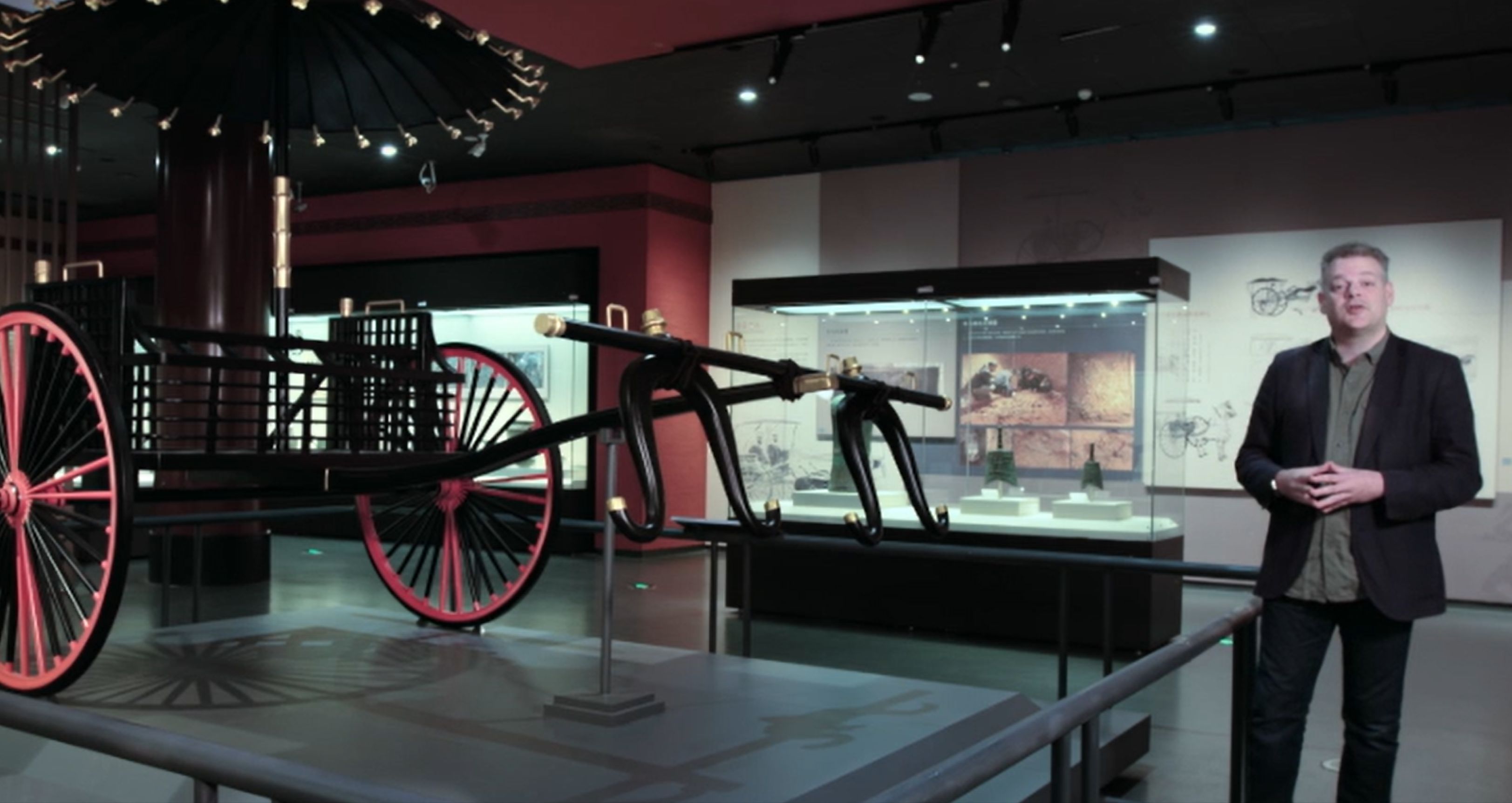
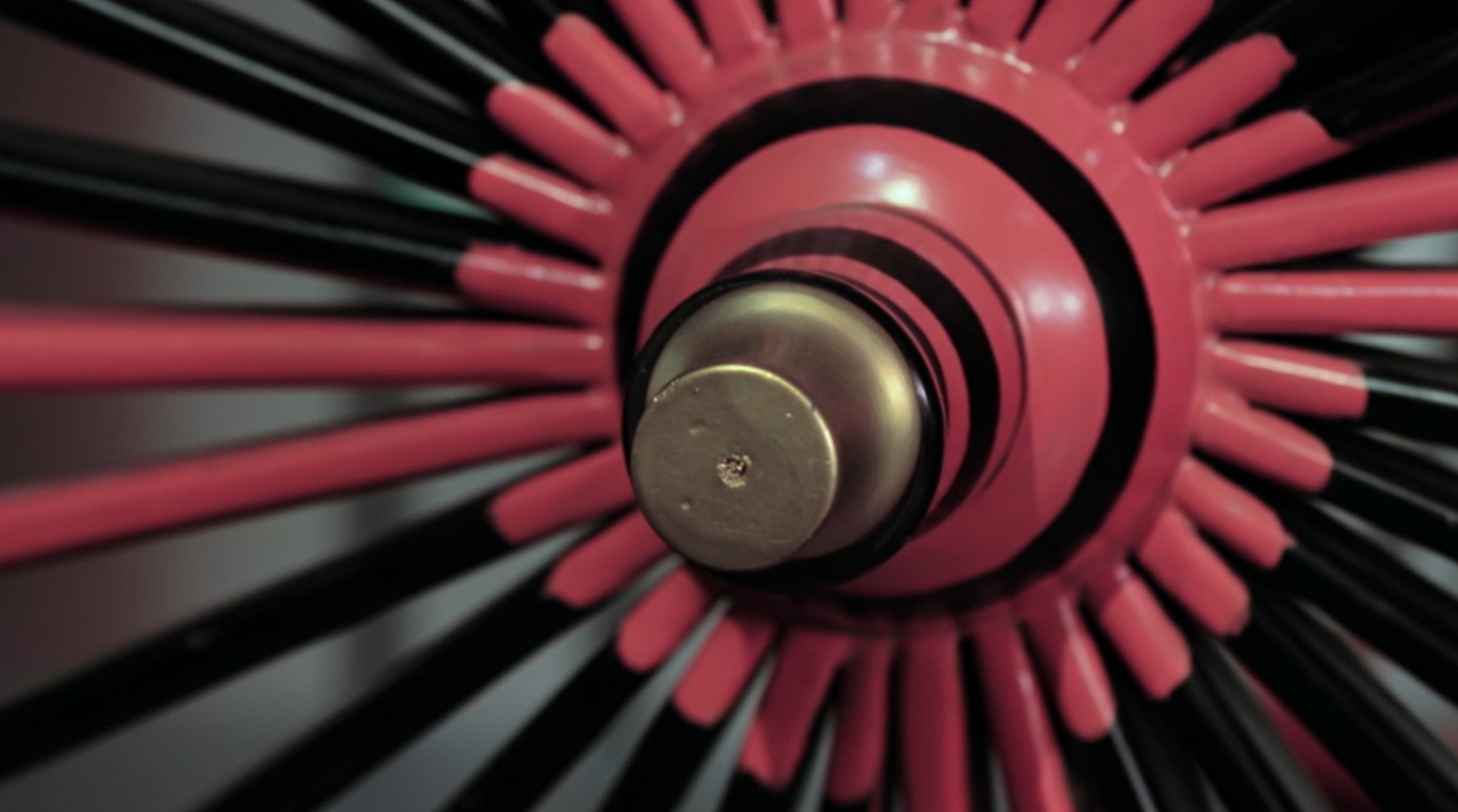
And in a scene that I, and I alone, regard as a hilarious Top Gear parody, I put on my best Clarkson impersonation and discuss the Marquis of Haihun’s pimped-out ride, the Well-Dressed Chariot, a “top-of-the-line sports utility vehicle with gold trimmings, a roaring four horse-power and a built-in drum to annoy the neighbours.” I have to think up this speech on the fly, rehearse it while the director is getting pick-ups elsewhere, and take the assstant producer to one side to photograph the signage for certain terms, so that our Chinese broadcast, when back-translated, matches what the museum says. I pace around the chariot, shuffling the words of my speech to avoid repetitions and redundancies, triple-checking facts and figures and terminology, shadowed by a glaring security guard, who plainly believes that I am just about to vault the fence and hotwire it, presumably driving it away with magic horses. After a while, I decide to see how many times I can walk around the same display before he stops following me. It takes thirty-three circuits.

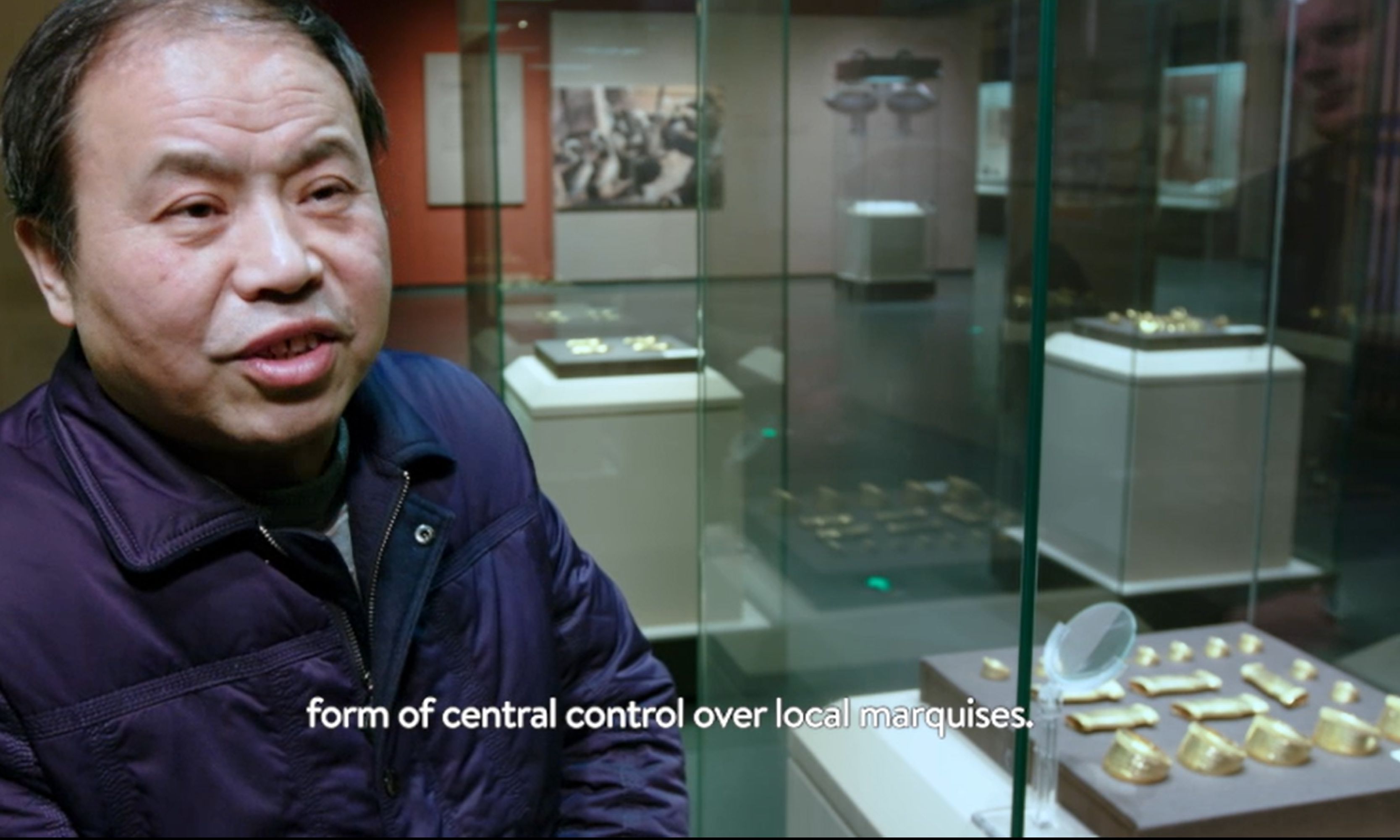
Today’s interviewee, the archaeologist Yang Jun, hasn’t helped by kiting his arrival time from morning to lunchtime, to afternoon, such that a good two hours of my fee today was earned sitting on a bench reading a book. But when he turns up, he is chubby, happy man, ready to talk about how funny it is for him to revisit the Haihun artefacts, separated from him now by bulletproof glass, whereas when he first saw them he was digging them out of the ground with his bare hands.

You would think that the arrival of the man who, to all intents and purposes, found the Haihun tomb, would cause the museum staff to prick up their ears, lean in for some gossip, or otherwise chill out, but they regard him with the same sneering disdain that they have for everybody else.

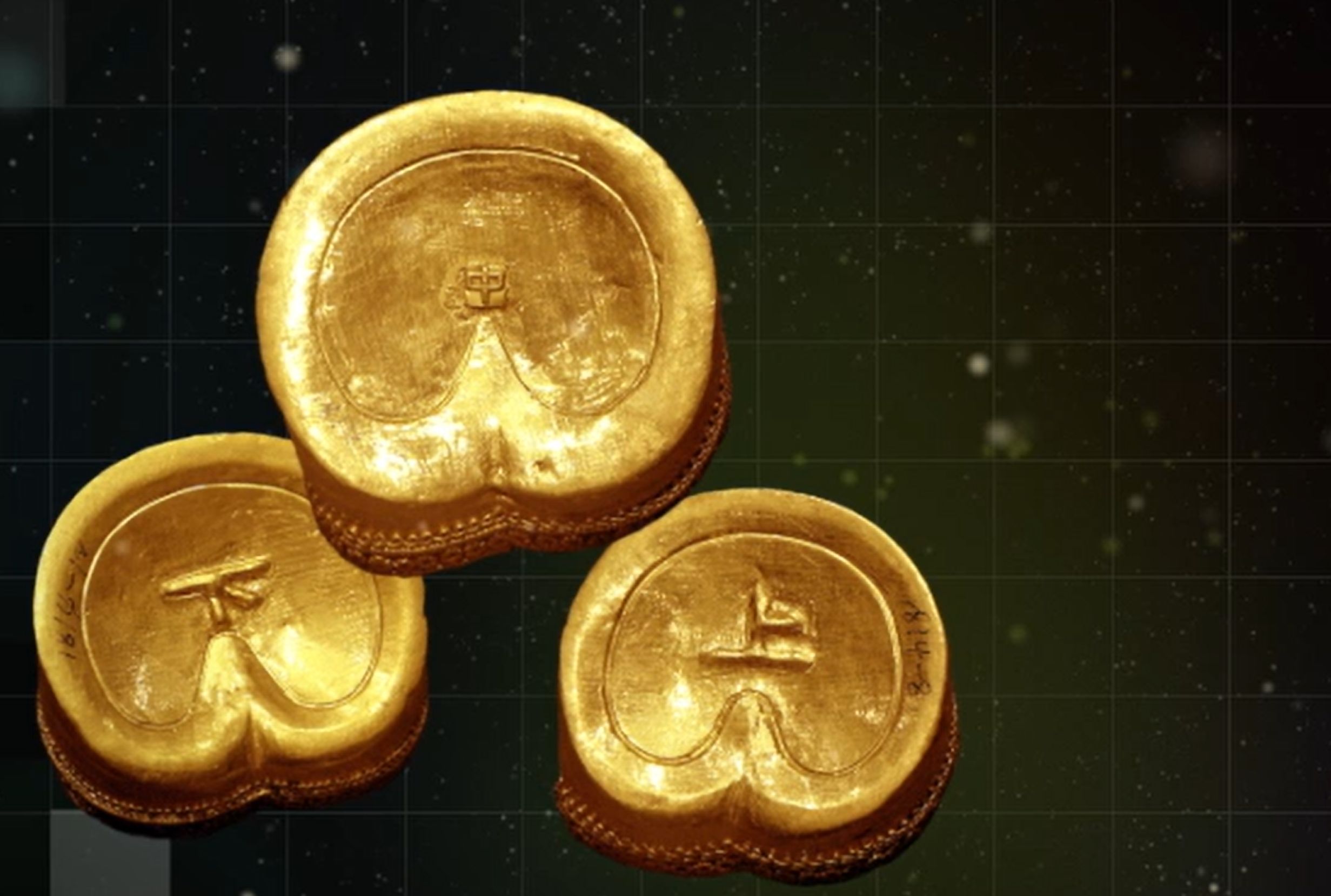
We’re here specifically to talk about the matijin (Horse Hoof Gold), a collection of odd-shaped gold ingots, some filled with Roman glass, that were buried with the Marquis of Haihun. “They weren’t money, as such,” explains Yang Jun, “because he couldn’t spend them. They were imperial gifts, really a reflection not of him, but of his dad, who was the favourite son of the Han Emperor Wudi, and Wudi’s most beloved consort, the Lady Li.” Lady Li was a famous beauty, of whom it was once said that “one look would make a city fall, a second would bring down a kingdom.”

“The thing is that we already know that there was a precipitous decline in the amount of gold in China during the Han dynasty, and I’ve got three theories for that. One is the rise in Buddhist statuary and accoutrements, that hoovered up all the gold around. Another is that trade with Rome was eating away at it.* But the most obvious explanation is that funereal customs changed to the extent that people were buried with their wealth, which the Marquis of Haihun’s grave seems to bear out.”

(*I find this one hard to believe, as the ‘trade with Rome’ was really all about silk going west, and the flow of silver out of Europe into Central Asia. As regular readers of this parish know, there were indeed commodities travelling from the Mediterranean to China, but it’s hard to believe that the Chinese were paying anyone for them in gold).

Although literary finds rarely make for good television, I also bullishly insist on quizzing him about the books found in the tomb. It’s one of those rare moments when the director is sure to dump the footage, but I want to know. Is it true that the tomb includes a copy of the Confucian Analects with the fabled two bonus chapters only found in the state of Qi, and believed lost for the last 1800 years?

“Oh yes,” says Yang Jun, eyeing me curiously as if I am a hamster that has suddenly started discussing Brecht. “So we’ve got the Qi Analects, which has two ‘new’ chapters of Confucius: they’re called Wen Wang (Asking the King) and Zhidao (The Knowledge). But we’ve also got some classics of the Yellow Emperor that people haven’t read before. But everything you see around you is only a part of the find. The gold might be shiny and impressive, but it’s also relatively easy to get out of the ground and put on display. I think the real treasures will take years to become manifest – the previously unseen books, for example, or all the exquisite lacquerware.”

Ah, there it is. The lacquerware, which when this episode airs will be the thing I go looking for more information on. We’ve finally shot the early scene that will send me off to other places, even though chronologically we have already shot those parts. And tomorrow, in fact, will be our final day of shooting, six weeks and 1,500 miles after we started.

Jonathan Clements is the author of A Brief History of China. These events featured in Route Awakening S05E03 (2019).

Money Laundering

The Chinese are building a posh, modernist museum near the grave site of the Marquis of Haihun. The nearby village has been sinisterly evacuated, the houses already fallen into ruin. The archaeological site is closed to the public, and the museum is just a hole in the ground, but we are here to visit the preservation office, where wood and lacquer items are prepared for restoration.

It’s the closest thing I have ever seen to a prison. A police station stands incongruously in the field outside. The facility itself is a squat white former factory, surrounded by a wall, razor wire and an electric fence. It boasts an inner and outer gate, as well as a guard dog. Inside there are over three hundred motion sensors that beep enthusiastically whenever you try to go out for a wee, as well as uncounted security cameras and a separate echelon of security guards.

“It’s about the gold,” says Xia Huaqing, the head restorer. “Well, sort of. The grave site is famous for all the gold that was found there, so naturally anyone with a criminal intent is going to assume that this place is piled with it. But all the gold’s in the museum.”

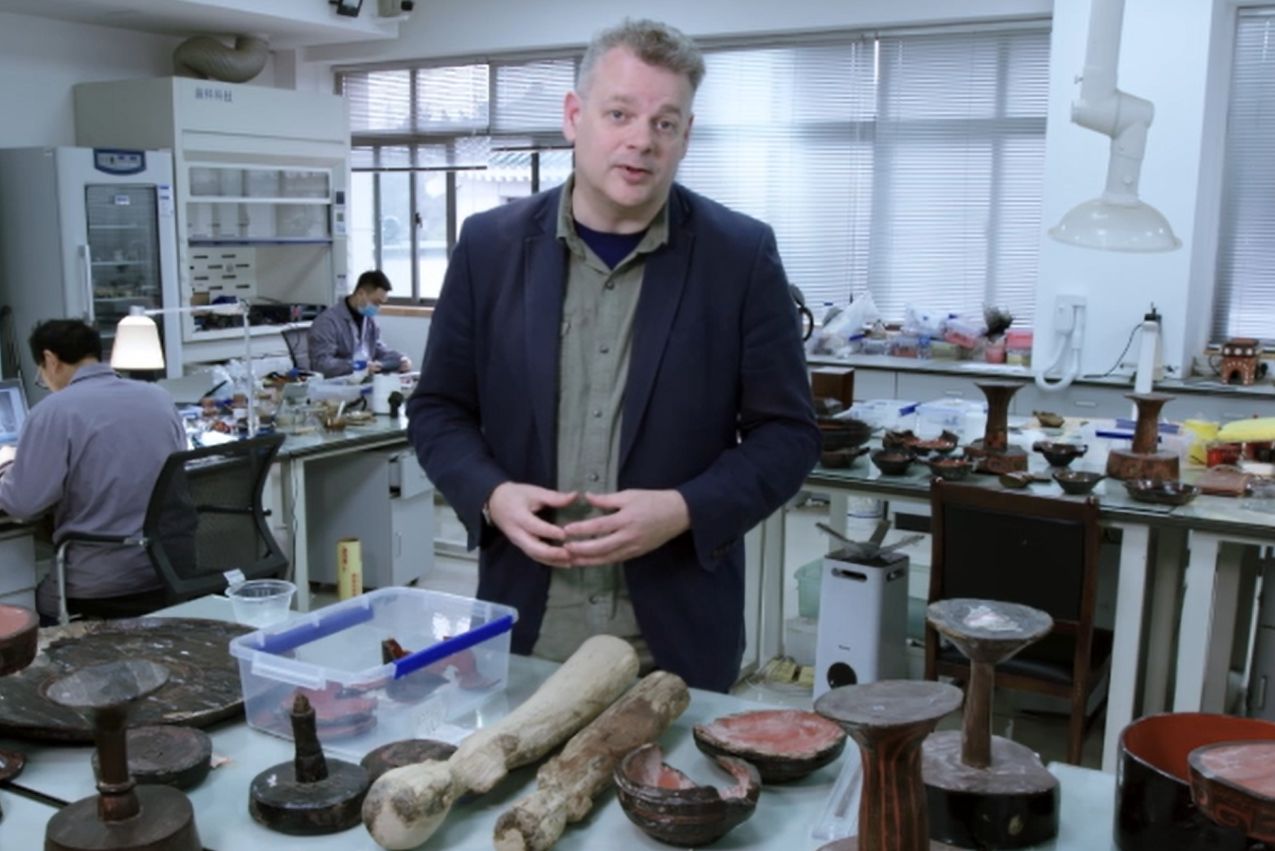
Instead. Mr Xia’s facility patiently hosts shelf after shelf, in room after room of lacquer objects. Endless rows of tupperware containers hold goblets, tables and bowls, suspended in a chemical solution that is apparently so toxic that we cannot be in the room with it for more than thirty minutes, even wearing protective gear. Another larger chamber holds the wooden outer slats of Liu He’s sarcophagus, which need to soak for four or five years before they can be allowed to dry… only then will they be ready for restoration.

The longest room, packed with a couple of hundred sealed Tupperware trays that each seem to contain a dozen decayed chopsticks, contains the bamboo slats of the books unearthed from Liu He’s tomb, including the Qi Analects. We are there on the day that one of the archaeologists who uncovered the tomb turns up with two super-watt lamps and a digital camera. Wearing a face mask and googles, his trouser legs wrapped in cling-film against accidental splashes, he straddles each box, trying to get a super high-definition photograph so that his people can start to translate it. I suggest that maybe these two missing chapters from the Analects are the ones that have all the jokes in, but nobody is interested.

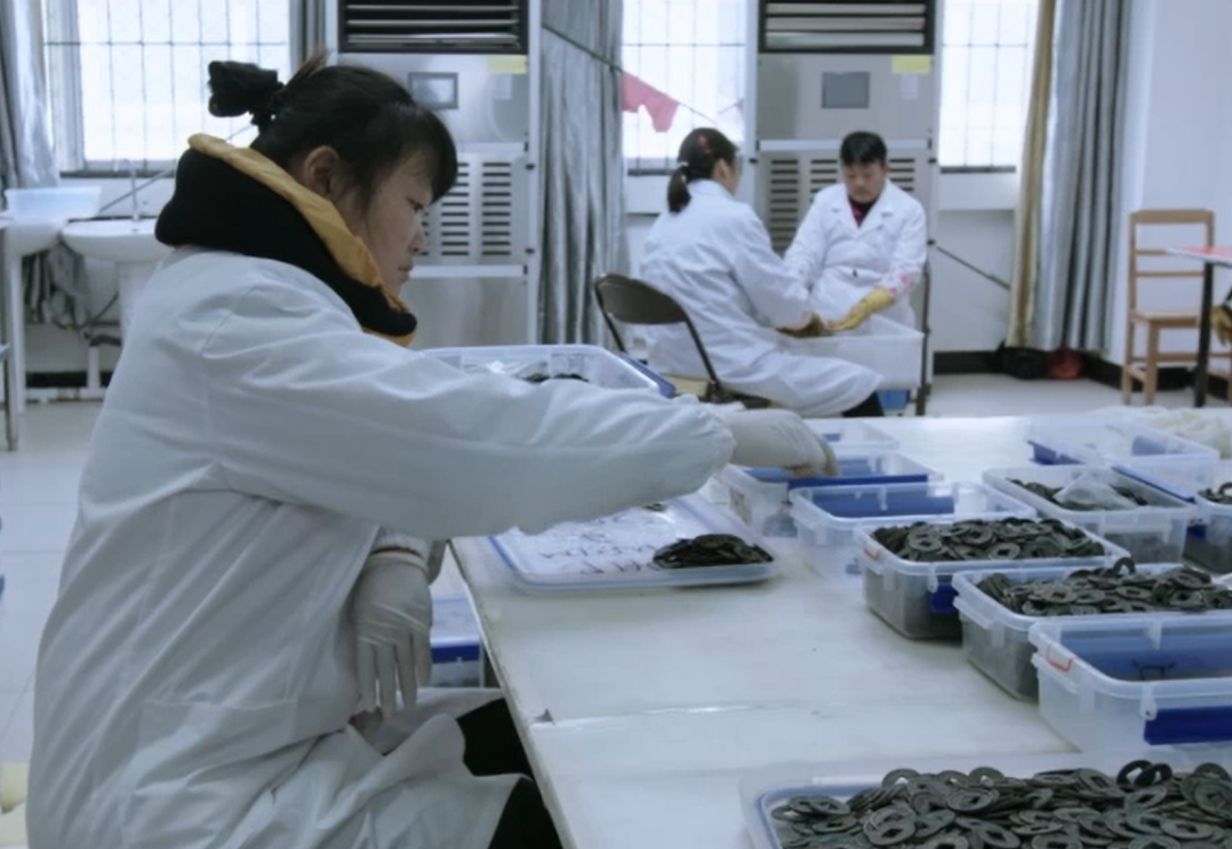
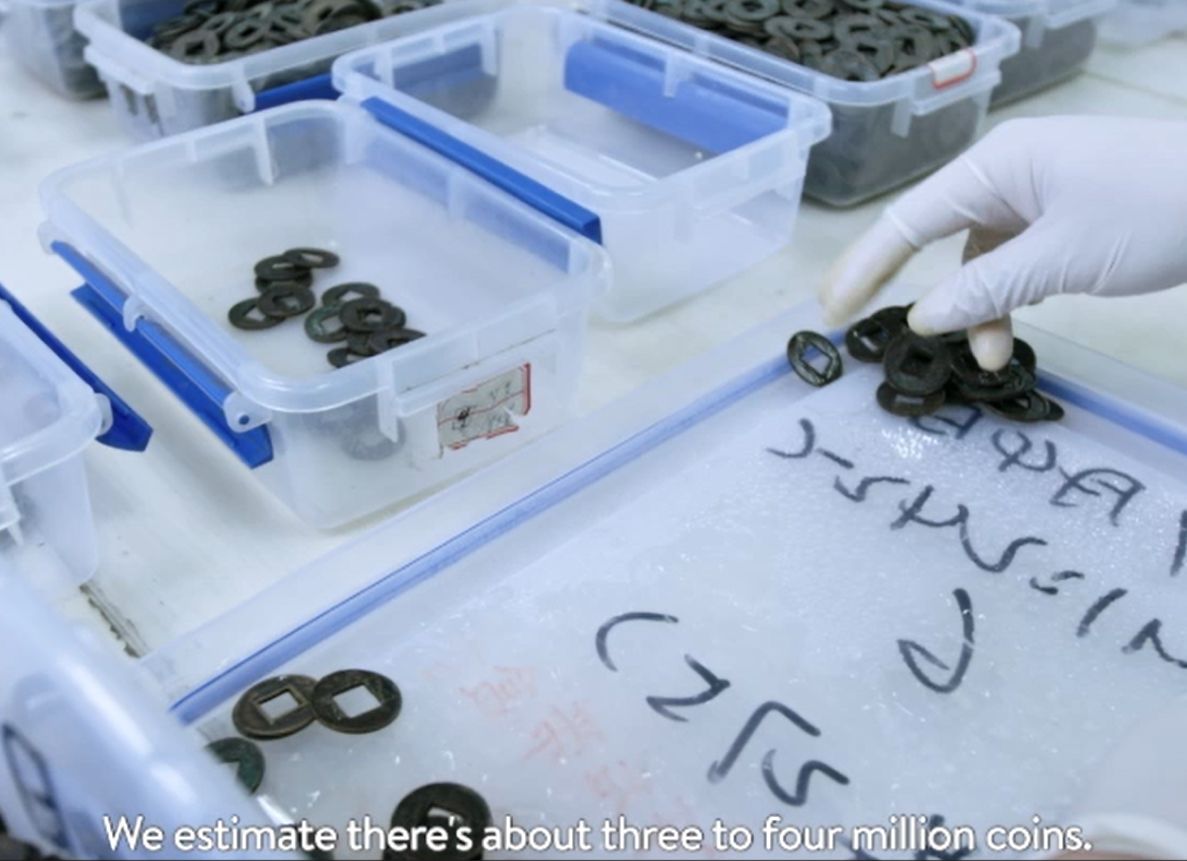
And there are the coins, piles of bronze coins, normally the wuzhu variety, named for weighing the same as 500 grains of millet. Entirely unassuming, everyday bronze Chinese coins that you see all over the place, except the Marquis of Haihun’s tomb contained at least two million of them. Two stern-faced women sit in little aprons, wearing rubber gloves, grabbing a couple of wuzhu coins from a bucket and giving them a desultory scrape with a hard-bristled brush.

“I see you’ve got a pair of scrubbers on the job,” I say to Mr Xia.

“Oh yes,” he says, “they’re at it all day, every day. In fact, this place is so remote, and the security is so tight, that we usually just come here for a whole week, and just live inside the facility. That’s why we’ve got the little allotment.” Little vegetable patches are all over the ground, and in the most unappetising sight apart from the guard dog’s loose bowels, slices of daikon radish are stretched out all over the basketball court and the bins to dry.

It’s Christmas Eve, and so the crew are squired out to the Shangrila Hotel for a Cantonese meal, which includes a roast piglet, its eyes gouged out and replaced by Satanic glowing lamps. Christmas Day, if my memory serves me correctly, begins in a drunken haze at a karaoke bar, with the director and I murdering Ice Ice Baby while the rest of the crew look on aghast.

Jonathan Clements is the author of A Brief History of China. These events featured in Route Awakening S05E04 (2019), although mercifully not the karaoke.

Marquis Mark

We’re in Nanchang on the trail of Liu He, the grandson of the great Han emperor Wudi. Born in 92BC, when the Han empire still farmed out control of its outlying regions to subordinate kinglets, he inherited his father’s Shandong satrapy when he was still a child. Famously uncouth and uncooperative, he soon turned into a troubled, ridiculously wealthy youth, and was presumably as surprised as the next man when the sudden death of his uncle led to him being crowned emperor at the age of 19.

His reign lasted an impressively short 27 days, during which time he notched up over a thousand infractions, including refusing to weep on command at the sight of the capital, buying a chicken on the way to his uncle’s funeral, and ordering hookers at a roadside tavern. His entourage got the blame for at least some of this, but Liu He seems to have blundered, quite obliviously, into the middle of a power game way beyond him. His dead uncle had only been a year older than him, a puppet for his “chief minister”, the Machiavellian Huo Guang, who had been running things behind the scenes for over a decade; Within weeks of appointing his new boy-emperor, Huo Guang realised he was onto a loser, and asked the “Empress Dowager”, his own fifteen-year-old grand-daughter, to issue a decree that Liu He was unfit for the throne. Armed ministers threatened to stab anyone at the council meeting who disagreed, and Liu He was packed back off to the provinces, a wealthy but powerless teenager.

There it should have ended, although a few years later he was ordered to move to the Yangtze region, modern Nanchang, where he was given the new title of Marquis of Haihun. He ran things there for a couple of years, and was implicated in a new scandal when he admitted to a flunky that he really could have handled things better at court by having Huo Guang beheaded for treason before anything kicked off. For saying so, he was docked 75% of his domain, and reputedly spent a lot of time scowling towards the setting sun, calling everybody back in the capital a bunch of bastards.

When he died, he was still only 33. And that would have been the end of it, until 2011, when grave robbers were caught trying to break into a tomb in Nanchang. Archaeologists took over, eventually announcing that the tomb in question was that of the Marquis of Haihun, that it has been miraculously untouched, and that it contained all sorts of fun stuff, including a copy of Confucius’ Analects with two chapters unseen anywhere else.

But there’s something fishy about the Marquis of Haihun story. As I’m sure you have already worked out, he was a pawn in a power-game that had been going on for longer than he had been alive, expected to be a malleable figurehead while the Huo family got on with really running things. But if he was such a playboy and a wastrel, what was he doing reading Confucius? Was it just something he kept lying around to impress the builders, or was he a much more thoughtful person?

At least the Marquis of Haihun outlived his persecutor, Huo Guang. Huo predeceased him by ten years, and his intrigues soon unravelled. He was alleged to have been banging his slave master, a man who repaid the favour by banging Huo’s widow, a woman who was soon accused of having murdered the former empress in order to find a husband for her own daughter. The entire Huo clan was implicated in this scandal, and they were all dead within a couple of years. I’m just saying, why would I watch I’m a Celebrity… when this is going on? And more to the point, if your relatives and in-laws are murdering each other and shagging the staff, what’s the deal with exiling some kid just because he bought a chicken?

It’s taking forever to get permission to film in the museum, but there are all sorts of revelations awaiting, I hope.

Jonathan Clements is the author of A Brief History of China. These events featured in Route Awakening S05E04 (2019).
Pot Heads

Liang Taihe is showing me a big copper pot. We don’t quite understand what it was for, he says. They must have performed some ritual purpose. This one has carbon-scoring at the bottom, so it was previously used for cooking something, but the thing about the ancient Yelang people was that when they buried someone of great importance, they would stick one of these on their heads.

Right then, so they were nutters.

I think, he says, that they put them on their heads in the ceremonies as well. Like magic hats.

I have my own theory, which is that since many scholars have argued that these pots served some sort of ritual purpose in life, possibly the leaders of the Yelang were shamans, and that in life they would boil up some sort of trance-inducing concoction and stick their heads in to breath up the steam.

Professor Liang looks at me as if I am mad.

And then, I say, they see the spirits. And when they die, they put the pot on their heads because they will be with the spirits always.

Okay, he says gingerly, let’s put that one on the back burner, shall we?

Like the Dian people of Yunnan, with whom they shared a border, the Yelang people left no written records, and much of what we have to go on about them is only divinable from the metalware in their graves. The archaeological record shows a bunch of pot-headed burials, particularly in a village called Kele two hours outside Hezhang. It also shows bronzeware with multiple influences from outside, including a ge dagger-axe with a taotie design clearly from the Central Plains of China, and a short sword with a hilt made in Yelang, but a blade shipped in from Sichuan.

Late in the Han dynasty, the Yelang rebelled. The access to silk that they were promised turned out to be the thin end of an imperialist wedge, and when they tried to fight back against the Han, they finally discovered just how much bigger and better prepared the Chinese were. The last king of Dian was beheaded, and many of his people fled south. Archaeologists in the hills of Laos and Cambodia have found graves occupied by lone figures with pots on their heads.

There’s a lot of argument about where Yelang actually was. It’s widely believed that it was in Guizhou, and the fact that the pot-headed burials show that there was a culture of some sort here seems to suggest that it was the Yelang heartland. “Heartland,” however, isn’t good enough for the tourist authorities, who ten years ago tried to bribe Professor Liang to proclaim that Hezhang was the “capital” of Yelang. He took their money, went onstage, and told them all that the notion of a capital in those times was a free-floating concept. People moved around, populations were lower, and frankly, “capital” is a modern term and with that in mind, they could have their bribe money back. Then he walked off the stage.

I associate Guizhou with discomfort. Two years ago, I spent a miserable week up a mountain here, washing in cold water and eating unmentionables. The food is much the same – since arriving here I have been assailed by pig’s ears and chicken foot soup. You should try our bowl-covering pork, says the Propaganda man. It’s a slab of pork so large that it covers the whole rim of your rice bowl.

Which sounds nice, except that half the slab is pure fat.

Have a pig’s trotter, he says, shoving one in my face.

The new Guizhou Provincial Museum is supposed to look like something famous, but none of us can work out what it is. Possibly a pile of Lego. We’ll be filming here tomorrow with Professor Liang, when it’s closed to the public, but the museum is oddly under-attended, even on a Sunday, so we get pick-up shots of all the things he is liable to be pointing at.

He is aghast at the displays, and claims to have sent the curators a list of 200 points of contention.

“These bracelets are wrong,” he says. “I found them all on the arm of one skeleton. They need to be put together in a series to understand them, but they’ve just stuck them under glass separately, like we’re in some kind of shop. And this sign says that pot is bronze, whereas it’s clearly copper. Who are these idiots?”

Professor Liang is kvetching about the inaccuracy of the signage, which mixes up the chronological order of the artefacts, and can’t tell bronze from copper or stone from clay. But he is having a whale of a time, getting to summarise his career for a film crew, and talk through impact and outreach, two of his favourite topics.

“Archaeology is impenetrable to the lay reader,” he says, “and Chinese archaeology is often impenetrable to other archaeologists. I’ve done everything I can to get our stuff translated into English so it actually gets cited outside China, but also to write in clear, simple language so that people don’t want to kill themselves when they are reading it.”

We’ve been shut out of the archives by his successors, who bluntly proclaim that if it’s not in the gallery, it’s not in the vaults.

“That’s not true,” he says. “I know we’ve sent some pieces off to an exhibition in Chongqing, but I dug these bronzes out of the earth with my own hands, and I know there are hundreds of them back there.” But the authorities have spoken, and he’s called in all the favours that he can, so our last few questions need to be moved to an empty coffee shop.

We put on a brief comedy routine of two men with five degrees between them, unsuccessfully attempting to get two lattes out of a coffee machine, and I get him on the record about what happened to the Yelang people, who either fled across the border to the south, or were swiftly assimilated within the Han population.

I ask him about the Chinese proverb “Yelang zi da” (Yelang thinks too highly of itself), and he relates it to the Han dynasty, when the shutting off of the Silk Road by barbarian incursions led the emperors to suddenly start pushing into the south-west in search of a trade route to India. This brings us back to where we started, with the Han ambassadors demanding the submission of the local peoples, the Dian king musing whether the Han realm is all that bigger than his own, and the Yelang king fatally refusing to let trade through his kingdom without a toll.

Lunch is at a Hmong restaurant where the waitresses proudly show us a plate of writhing, bloody catfish, deep wounds hacked in their sides, still in their death throes. The TV on the wall is showing a video loop of Guizhou tourism, including many sites we have visited, including the village where I once accidentally married a local girl for a couple of hours. I think there is supposed to be a romantic narrative, suggesting a foreign back-packer who runs into a Eurasian supermodel on the bullet train, and that they fall in love among the terraced rice fields and dancing girls in pewter head-dresses. Except, because it’s a loop, it’s entirely possible to walk in halfway and assume it’s a video about a couple who somehow fall out on their trip, drifting apart among the waterfalls and forests, until they return home sitting far apart on the bullet train, with her displaying a greater interest in her guidebook than in him.

“Your work is very hard,” notes Professor Liang. “I never had any idea. About all the sound interference, and the background noise, the lighting issues and the equipment required.” But I think today has been one of the best days of his life, and he regrets that it won’t go on forever.

The director films the pair of us getting into the car, ready for the journey to Kele that we have already shot, and after I rev past the camera and into the sunset, she pronounces that we are done.

Jonathan Clements is the author of A Brief History of China. These events appeared in Route Awakening S05E05 (2019).
Gold Seal

“Do not open your mouth,” hisses Clarissa the fixer at the director, whose Teochew-accented Chinese sometimes risks getting us into trouble. “The man we are going to meet is Mr Lŭ, third tone.”

“Mr Lú,” says the director.

“That’s second tone,” says Clarissa. “You just said ‘Mr Donkey’. Just call him Professor, for Christ’s sake.”

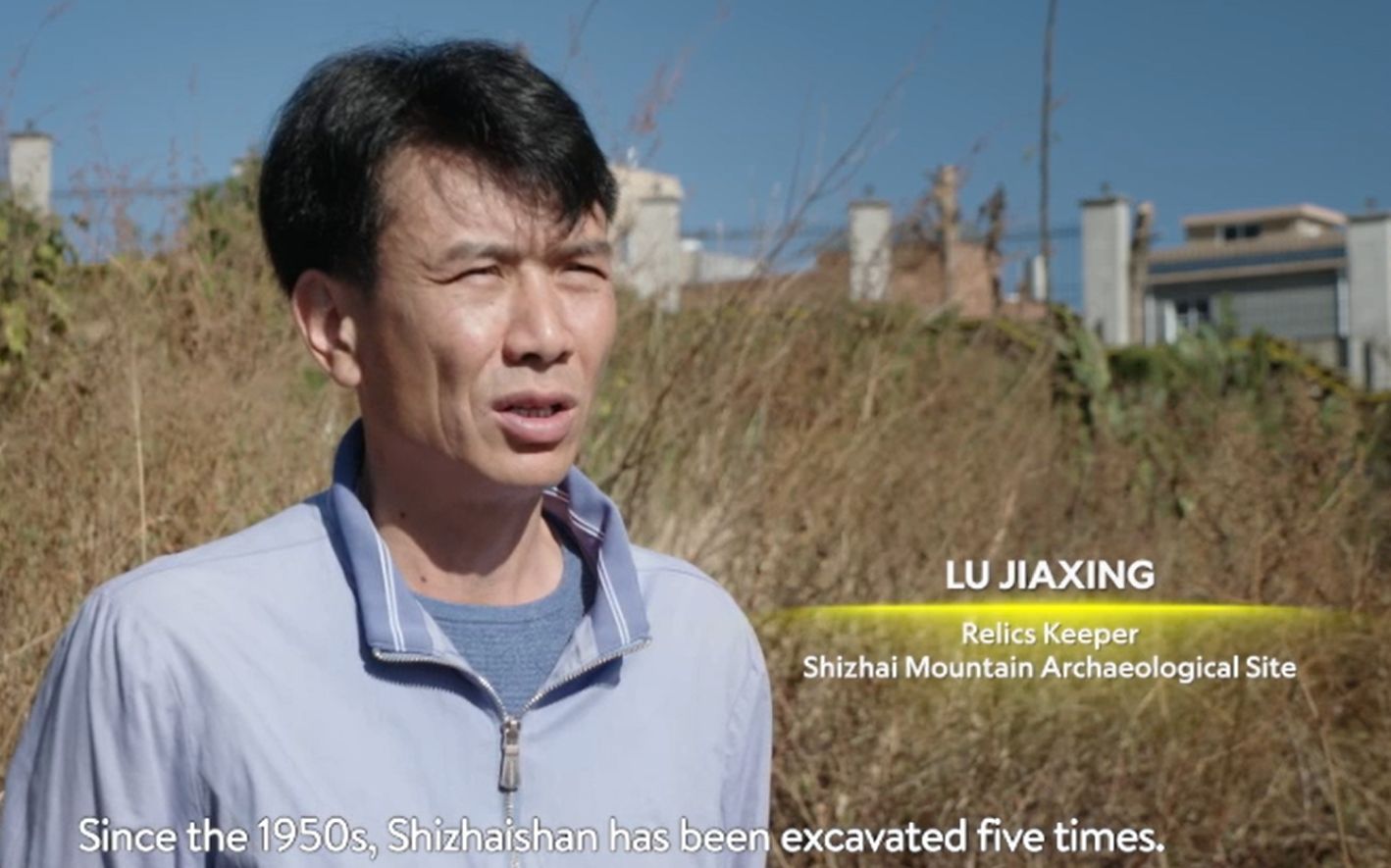
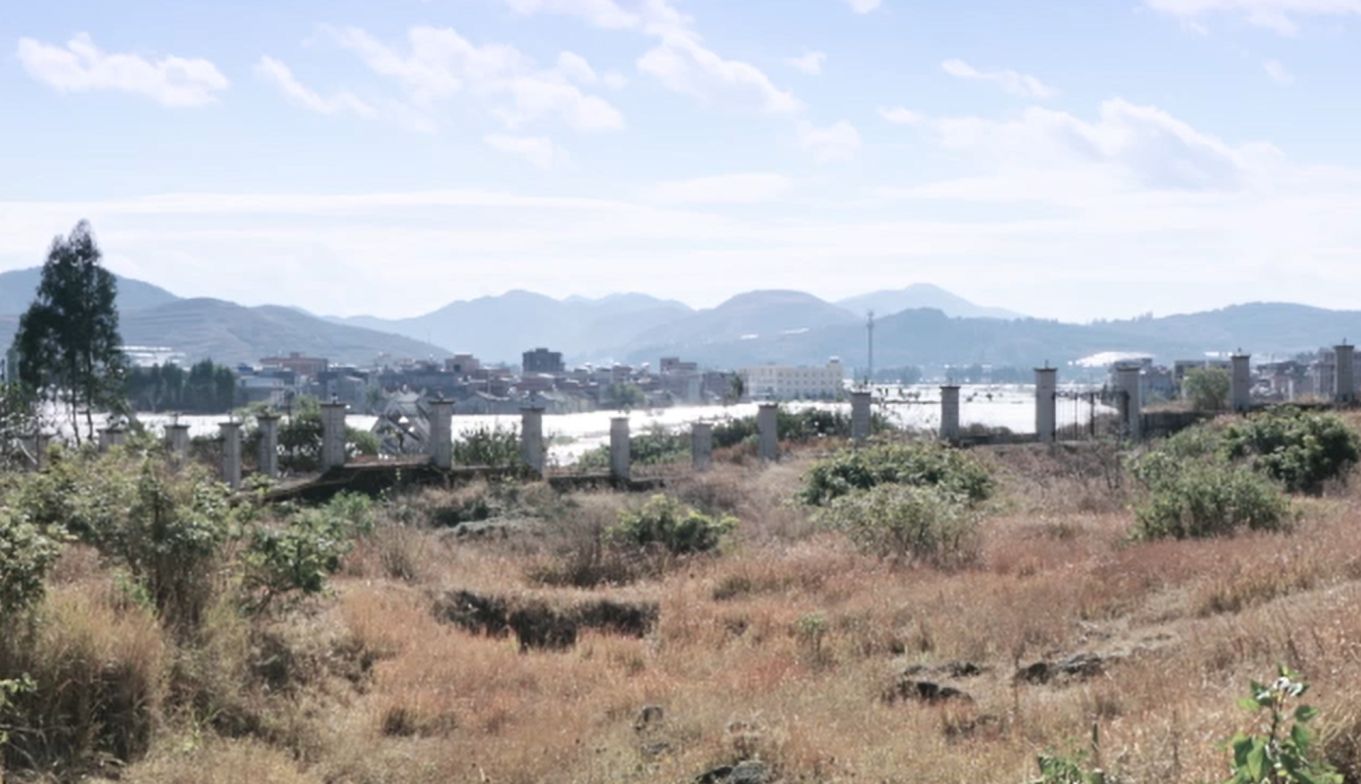
We are interviewing Mr Lu at Shizhaishan, a desolate hillside in Yunnan that once would have had a commanding view of Lake Dian below. These days, it’s blocked by high-rise buildings, and the hillside is walled off by an imposing fence, because it is one of the most important sites in Dian history.

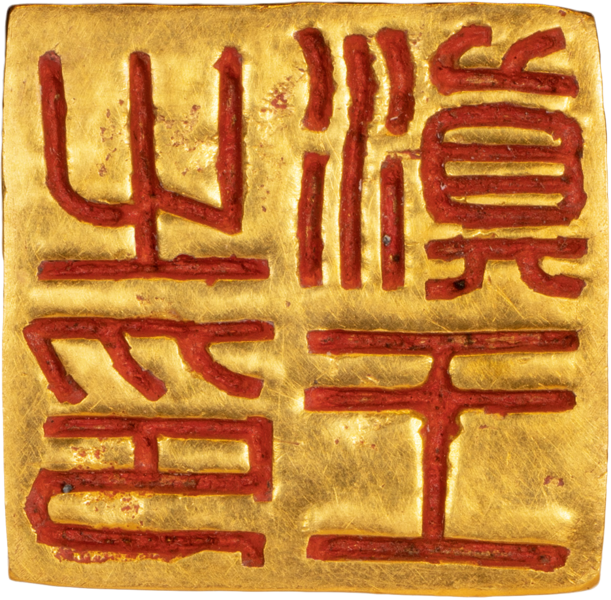
In 1954, archaeologists at Shizhaishan uncovered dozens of graves of the Dian nobility, including one containing a golden seal that bore the Chinese words: KING OF DIAN. A similar seal, denoting the KING OF NA, turned up long ago in Japan, where locals claimed that it had been conferred upon a barbarian kingdom by the Han Emperor Wudi. Nobody took this seriously until the Shizhaishan find, when it became apparent that Wudi had indeed had uncharacteristic gold seals made for the kings of borderland regions that had recognised his authority.

The King of Dian’s seal is in the national museum in Beijing – it officially marks the moment when Yunnan became part of China. The locals in Yunnan have to make do with a replica; just one of several political issues that clearly still needle Mr Donkey.

It is a difficult interview. Our arrival is bodged, because it takes us half an hour longer than planned to negotiate the tight, winding rural roads, and Mr Lu has been waiting by a dunghill with a nameless woman from the Propaganda bureau whom we soon dub the Jawa. Her facial features are entirely covered by a hoodie, mirrored sunglasses and a full-face breathing mask, which is oddly sinister, and turns out to be because she has a streaming cold, and keeps coughing during the interview and ruining the takes.

When we arrive, the director isn’t sure who this odd couple are, and entirely ignores them, and we only identify Mr Lu when I walk up and introduce myself. But that’s only the beginning of our problems, because he is everybody’s second choice. The archaeologist who actually led the 1954 dig, and a subsequent find in 1999, has refused to talk to the media, because of a bad experience with an earlier crew, and Mr Lu is reluctant to discuss several important issues.

Interviewees have to be managed, anyway. It’s part of my job to come in at the start, speak Chinese like a performing dog, and make it clear that I am not some clueless puppet, but someone who has read the Grand Scribe’s Records, knows my Han dynasty from my Tang dynasty, and is here to make the interviewee heard and understood. As regular readers of this parish will already know, it can be discombobulating to have an English-speaking film crew unload a literal tonne of gear in a remote village, and start pushing them around, hectoring them to stand on various unsteady hillocks, and badgering them to repeat themselves, answer leading questions, and film things out of order. I am quite used to having the director yelling at me to take three paces forward and stare into the sun, but the people I have to put at their ease are often facing a camera for the first time.

The Jawa doesn’t help by lurking at the sidelines with a camera of her own, documenting our visit for official reports and local media. When the director jokingly suggests that somebody cooks a nearby yappy dog to shut it up, Clarissa rails at the crew to stop laughing, “because someone from Propaganda is pointing a camera at us, and I don’t want them to think we are not taking this seriously!

“So,” I say, “are there still artefacts buried here?”

“I don’t want to answer that question,” he says, reddening, because the last thing he wants is literal gold-diggers breaking in with shovels. He knows we don’t have time to explain that an “artefact” is just as likely to be a midden or a cow bone as “treasure”, and that’s all some viewers will hear. Nor does he really want to talk about the progress of the site, because funding is not forthcoming. The site has fallen into disrepair, the duckboards around the edge are rotting, and the “guard house” is staffed by a gurning old lady and the aforementioned yappy dog.

Media people refer to “sit-up-and-beg questions” – simple, rather vague queries designed to give the interviewee the chance to say whatever they feel like. But Mr Lu is deeply cagey about his site, and reluctant to describe “his” discoveries in the first person because he is a stand-in for the real boss. I try to get him to talk about simple issues, like backfilling the soil (in Chinese hui tian, literally “returning the field”), but this is a touchy subject for him, because they only backfilled the site because their funding has ended, on what appear to be five stops and starts, including the 1950s dig curtailed by the Great Leap Forward, and the 1990s dig funded by a relics bureau that lost interest once they’d airlifted the gold seal to the capital. I have mentioned before the intricate politics of the Terracotta Army site, where the archaeologists are deliberately taking years to poke around the edges, because if they dig out the central mound and don’t find buried treasure, their gravy-train funding will be over. Shizhaishan seems to prove my point for me.

Eventually, he relaxes. I assure him that “I don’t want to answer that question” is a valid response, and that we will just ask him something else, but we do run into a large number of dead ends with him, and it’s difficult to get anything out of him. We eventually get enough to fill a segment, and by the end he is starting to enjoy himself.

As so often happens, we film our “first meeting” last of all, by which time he is all smiles, and he doesn’t blink at the fact that we do it in reverse order. On the final cut, he will greet me at the Buick, lead me up the hill and through the gate, and down into the pits of the dig site, while the drone soars up above over our heads. But on location, where we are moving the gear back down the hill to the van in stages, we first film us walking into the pit, then walking through the gate into the site, then up the hill to the gate, then meeting each other at the car, and then the drone shot.

The crew’s behaviour can look weird to an outsider. Just because we correctly walk up a hill, it doesn’t mean that a farmer hasn’t wandered into shot behind us, or the sun has gone behind a cloud and ruined the continuity for the lighting, or the cameraman has forgotten to run the film. We take our positions for a third take, and the director nods to begin.

“You can start walking,” I hiss to him out of the corner of my mouth.

“But the director hasn’t said ‘Action’,” he points out.

While we get our drone footage, Mr Lu smokes fag after fag by the cars, and jokes with the crew. Our driver starts chatting up the Jawa, whose mask turns out to hide an attractive and friendly young girl ready to discuss the pitfalls of local television, and not the terrifying figure we had assumed her to be.

Our backwards shooting schedule continues as the sun climbs. I am dragged off to film an even earlier shot, of me driving through the village to meet him in the first place, and by the time I come back, he and the Jawa have gone. I got the impression with him, as I do with many interviewees, that by the time he came round to appreciating that he was going to be on telly showing off about his life’s work, it was all over.

Spooling through the footage six years later for this article, I realise that Mr Lu didn’t even get his fifteen minutes of fame. There was so little material we could work with that he’s there and gone in thirty seconds, just long enough to point across some waste ground at the place where they found the gold seal.

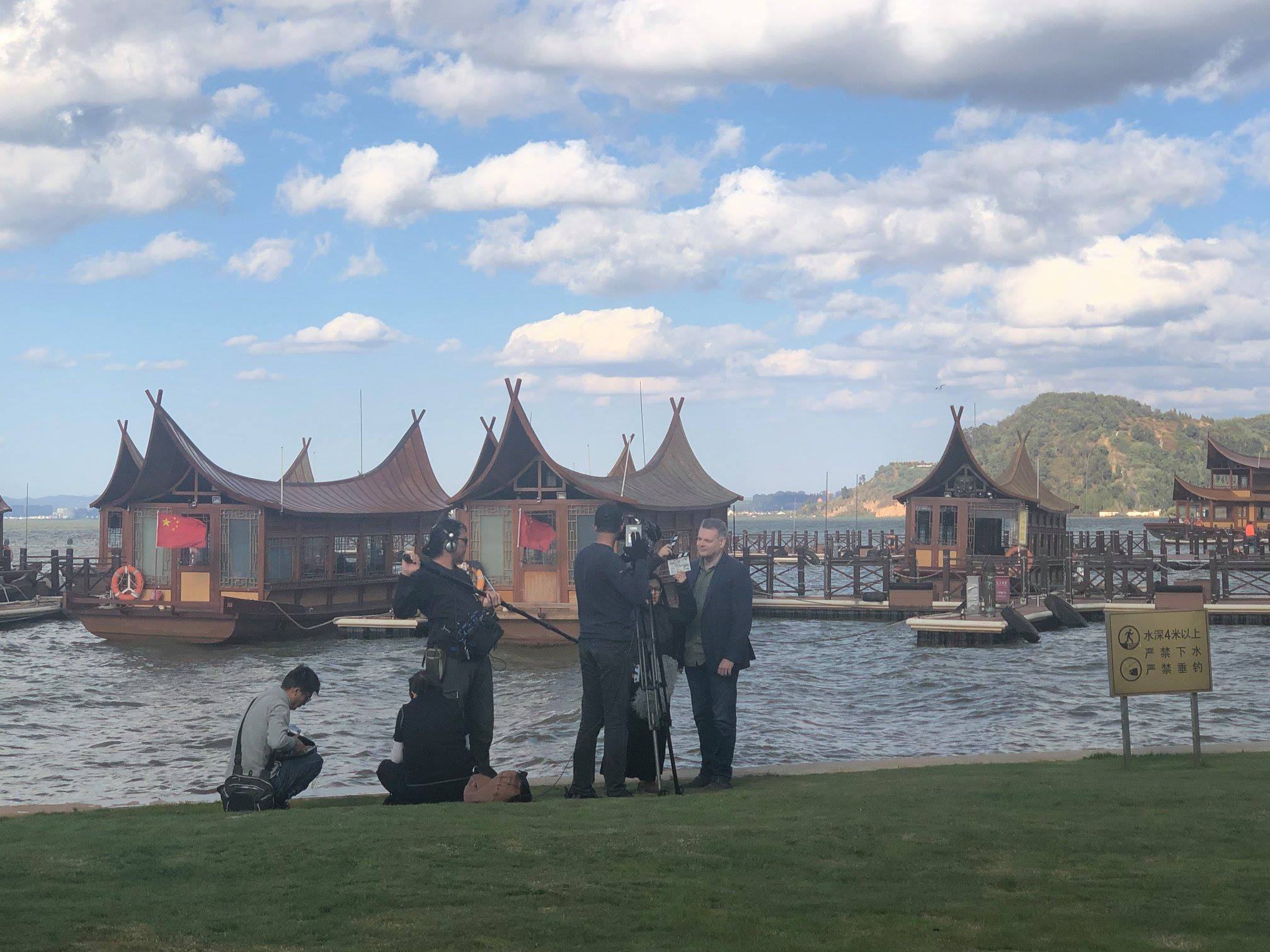
The afternoon is spent filming the modern legacy of the Dian kingdom. Remember that we knew almost nothing about it until the 20th century. But the archaeological evidence uncovered in the last 60 years has allowed us to discover their clothing, their architecture and their bronzes, enough to supply suitable material for an entire Dian Kingdom theme park by the side of the lake, complete with houseboats, statuary, and a Ferris wheel. I yell a piece to camera in the wind by the lakeside, surrounded by screaming seagulls, and observe that the Dian warriors of old would be aghast at such a use of their culture, particularly since the theme park seemingly lacks a Human Sacrifice Experience.

Jonathan Clements is the author of A Brief History of China. These events appeared in Route Awakening S05E03 (2019).

Let Us Pray

I have developed a new-found respect for Michael Wood, who I have always liked, but whose Story of China I have been looking at again recently. His episodes on the early dynasties found him visiting not only the same places as us, but interviewing some of the same people in Luoyang and Anyang, but what’s striking is how hard he tries to get the grass-roots opinions of the common folk. Always one for social history, Wood happily hangs out with a bunch of farmers’ wives, and asks them what they think of the discoveries at Erlitou or the Wastes of Yin. History has long been divided between the approaches of the high-brow Thucydides, who wants everything cross-checked and assessed, and the low-brow Herodotus, who doesn’t mind repeating gossip as it is a fair reflection of what people believed to be true. Herodotus is often more fun.

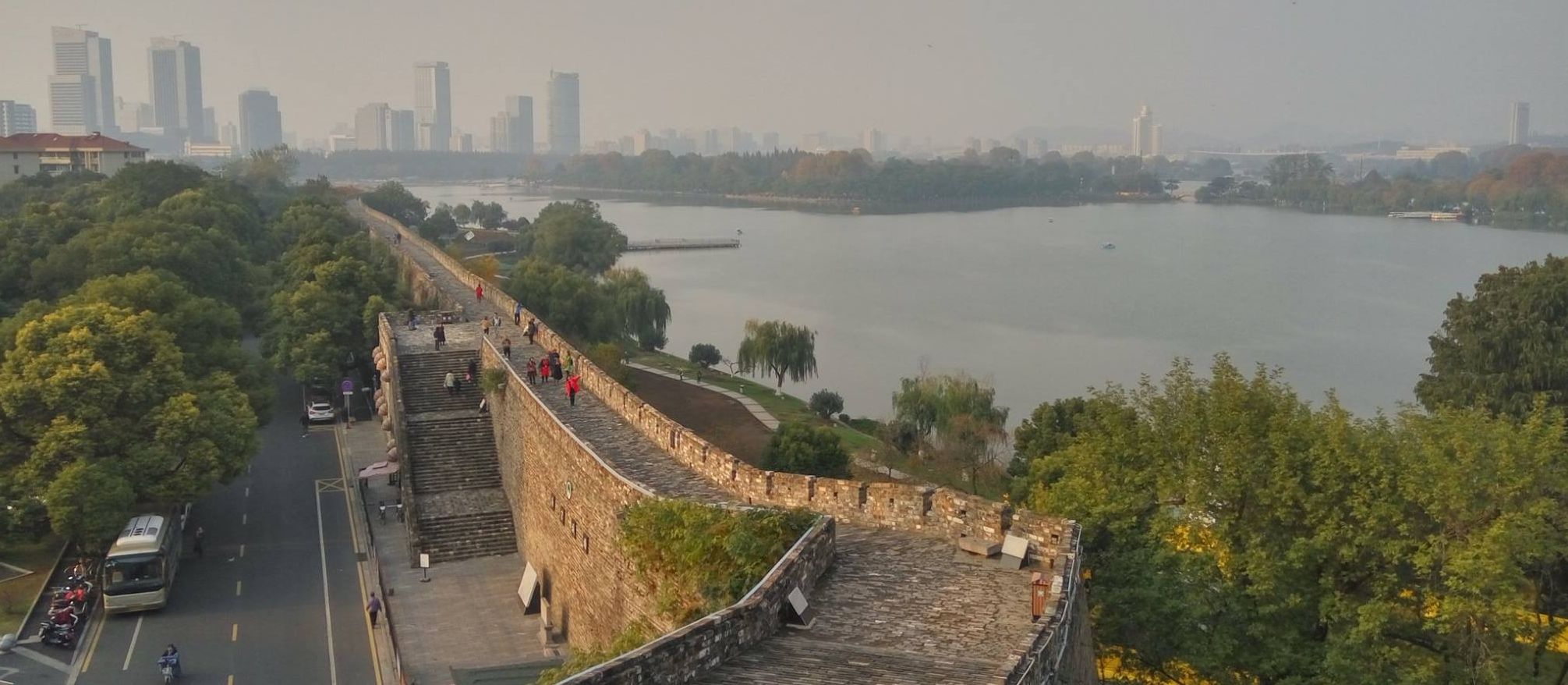
It is cold and damp today. Raining. Almost impossible to film anything, and we can’t get indoors at the museum until tomorrow. And so the director half-heartedly rules that we will try to get some footage at the Jiming-si (Temple of the Crowing Rooster), one of the oldest temples in Nanjing, founded in the Middle Ages, destroyed before the Ming dynasty, destroyed in the Taiping Rebellion, and rebuilt once more. It is the location of the Rouge Well, so named because concubines of the Southern Tang emperor hid from rebels during the fall of that short-lived dynasty, and left traces of their make-up smeared on the sides.

Unlike many other temples, a trio of incense sticks is part of the admission fee, leading to baffled crowds of Communist-era Chinese, bumping into each other and squinting at the instructions posted on the wall that tell them how to pray. I light my sticks at the votive candles, blow them out so they start to smoke, and then bow to the four directions before placing them in the censer. That’s more than we can say for The Human Torch, a woman in a mustard yellow puffa jacket who lights her large incense sticks, doesn’t blow them out, and then wanders aimlessly around the courtyard like a roving fire hazard, flames rising a foot into the air.

The director tries to film at the city wall and at the nearby “old” town, which, as ever, is chock full of snack stalls and little else, but the rain is pretty miserable. I spend less than five minutes on camera today, and even that is just walking from point to point through crowds. So an easy day to me, although we will have to make up for it later in the week.

The people in room 1806 are having very athletic sex. Clarissa the fixer and I, whose rooms are on either side, are scoring them on WeChat for volume and achievement.

Jonathan Clements is the author of A Brief History of China. These events (apart from room 1806) featured in Route Awakening S05E06 (2019).
The Luoyang Shovel

It is the afternoon and I am in a fallow field an hour outside Luoyang. I kneel down in the grass in front of what appears to be a large, football-sized pile of firm turds and announce that I am on an archaeological quest. I then pick up one of the turds and start breaking it apart with my hands.

They are the core samples from a Luoyang Shovel, a device originally developed by medieval grave-robbers for testing the land beneath their feet in search of treasure. Guo Zhenya’s is a three-metre pole, terminating in a long, curved trowel. You push it into the ground, wiggle it around, and withdraw a sausage-sized cylinder of earth, before plunging it in for another go, pushing deeper and deeper.

Mr Guo has an eye for subtle changes in colour. One trowel down, he is pointing to loose yellowish earth that is nothing but common topsoil, churned over every year by the plough. Another trowel down and we’re in darker more compacted earth, backfilled after the local archaeologists had finished excavating Erlitou. Another trowel down, and the backfilled earth reaches a line of sand, which marks the lowermost point of the dig. After this point, we are looking at terra incognita.

“The soil is turning reddish,” he observes. “We could be looking at a Han dynasty tomb. Yeah, this looks like shentu – disturbed ground.” Another few trowels, and we are almost all three metres of the Luoyang Shovel into the ground.

“No,” he says with a shrug. “False alarm. This darker soil is undisturbed. No human being has dug this deep in the last few thousand years. Nothing to see.” Mr Guo was one of the excavators in the Erlitou excavation that stripped this entire field wide open, uncovering a city from some 2,800 ago, laid out in a familiar square pattern, with a royal enclosure, a bronze foundry, and a temple. This was, people still believe, the likely site of the capital of the Xia, the earliest known Chinese dynasty, a people who had only just discovered bronze and seemed to lack any real writing. All we know about them we have got from legends collected in ancient Chinese classics.

Although the Erlitou site was discovered in 1959, excavation there was shut down a few years ago, one suspects because it failed to yield anything as photogenic as the Terracotta Army. It did produce “China’s First Dragon”, a staff or ceremonial item, the wood long rotted away, but retaining an intricate mosaic of turquoise stones, curling like an elephant’s trunk and terminating in a square, symbolic head. I’ve seen a picture of it, but the dragon is in Beijing, propping up an exhibit of ancient Chinese culture in the capital.

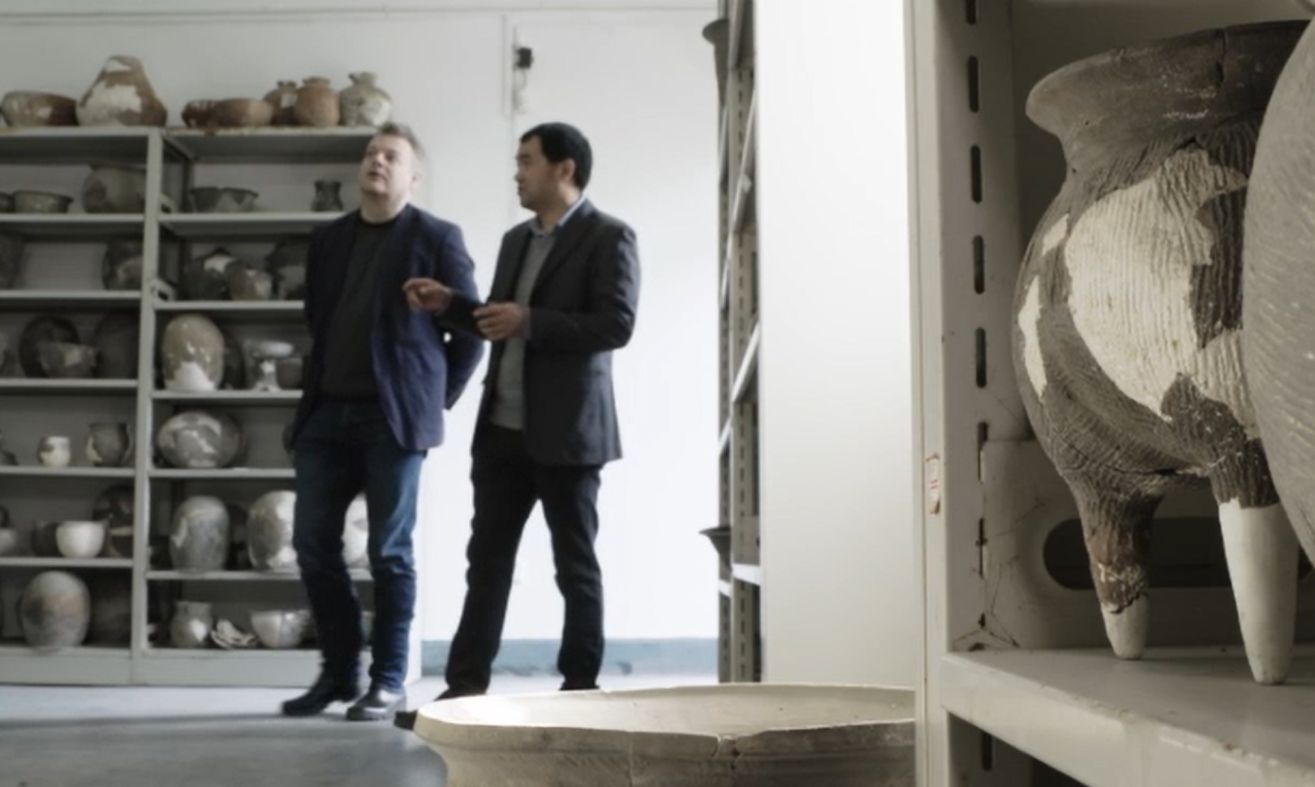
At the research institute, an army of workers are poring over the crates and crates of shards from the site, piecing together its pots, and trying to work out the nature of the bronze ceremonial artefacts that Erlitou seems to have supplied to the rest of the Yellow River floodplain. I’m here to interview the second most important man in Erlitou archaeology, the foremost authority having sworn off television appearances after a bad experience on someone’s late-night comedy chat show.

Zhao Haitao is soft-spoken and twitchy. It takes a while for me to draw him out of his shell, by asking questions about the site that make it clear I know what I am doing – the apparent trade value of turquoise, and the mystery that they have found cart tracks at Erlitou, but no evidence of horses.

“If you ask me,” says Dr Zhao, “the chariots here were pulled by slaves,” thereby literally putting the cart before the horse. I get him talking about pseudomorphs on Erlitou pottery, the potential for other finds on nearby sites, and the likely damage done to the north of the site by a shift in the flow of a nearby tributary of the Luo river, until he is laughing and joking, and holding out ancient ceremonial pots for me to touch.

I’ve noticed several times already on this trip that this is a new and unexpected service that I now perform – simply making it clear to the interviewees that there is someone on the other side who is listening to them and understanding what they are saying. That we are not a gaggle of uncaring camera-pointers with a fat white sock-puppet, but an award-winning crew with a public face who know the difference between the Sui and Tang dynasties; who understand the problems with rescue archaeology, and who don’t blink uncomprehendingly when hit with Chinese terms like liusongshi (turquoise) or renlache (man-pulled cart). I know these things because I was up at 4am reading the Erlitou chapters in the Cambridge Introduction to Chinese Archaeology on my Kindle, but that’s what I am paid for.

Another long day that comprises standing around for interminable hours, before being dragged by a shouty director to stand in front of a tree and extemporise a 30-second piece to camera about sustainability in the Tang economy. But I am doing my job, and coming up with several ideas for actual bits, including a semi-jokey bit where Mr Guo and I take the Luoyang Shovel out of the back of the Buick, its three-metre length seemingly never-ending, like people leaving a clown car.

Jonathan Clements is the author of A Brief History of China. These events formed part of Route Awakening S05E01 (2019).
Shaking That Arse

Early morning interview with our landlord, Tubby (his real name is Yu), a jolly little man half my height who will shortly become the village chairman. This makes him something of a heavy-hitter with the locals, and he truly appreciates the value of TV coverage, so he is ready and willing to talk about the history of the Miao, their affection for the pheasant as their totem animal, and sundry other organisational issues to do with the village. He even obliges us by running down the hill to tell the singing competition, which has been running right through the night, to bloody shut up for half an hour so we can film him in relative quiet. When they get shirty with him, he literally steals their microphone, strolling back to the house with it and telling us all will be well.

The Tubby interview is swift and efficient, and it gives us ample material to cover our B-rolls and cutaways. Despite the misery of filming here in what is now our fourth day of impenetrable fog, we have enough in the can now for this episode to work. The fog has become part of the story, as have the armies of amateur photographers getting in the way. There is even a rival Chinese film crew, dubbed Mr Osmo and the Neckbeards, since their chief cinematographer is wielding an Osmo – a tiny steadicam like a gun on gimbals, allowing for running shots and action.

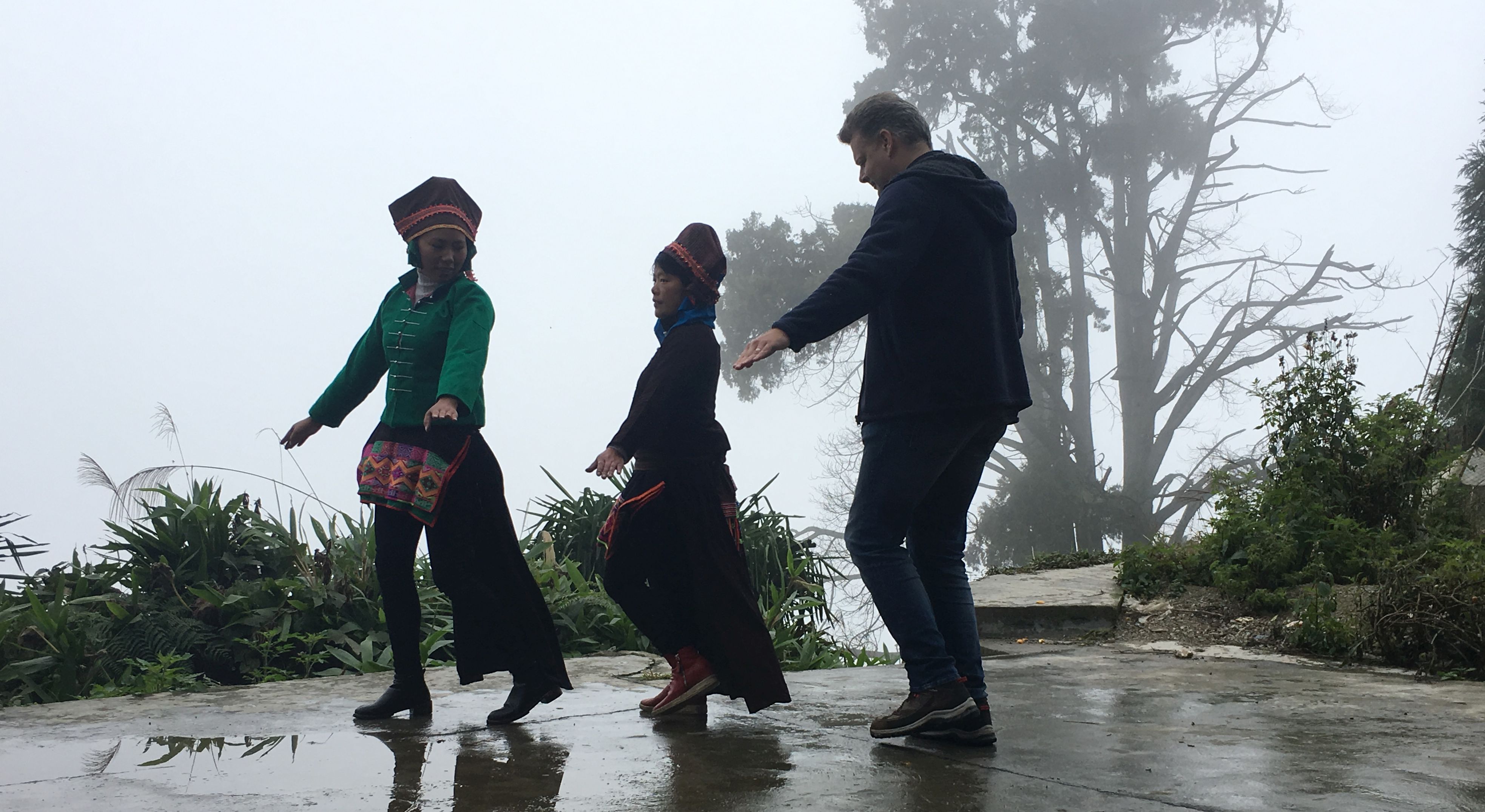
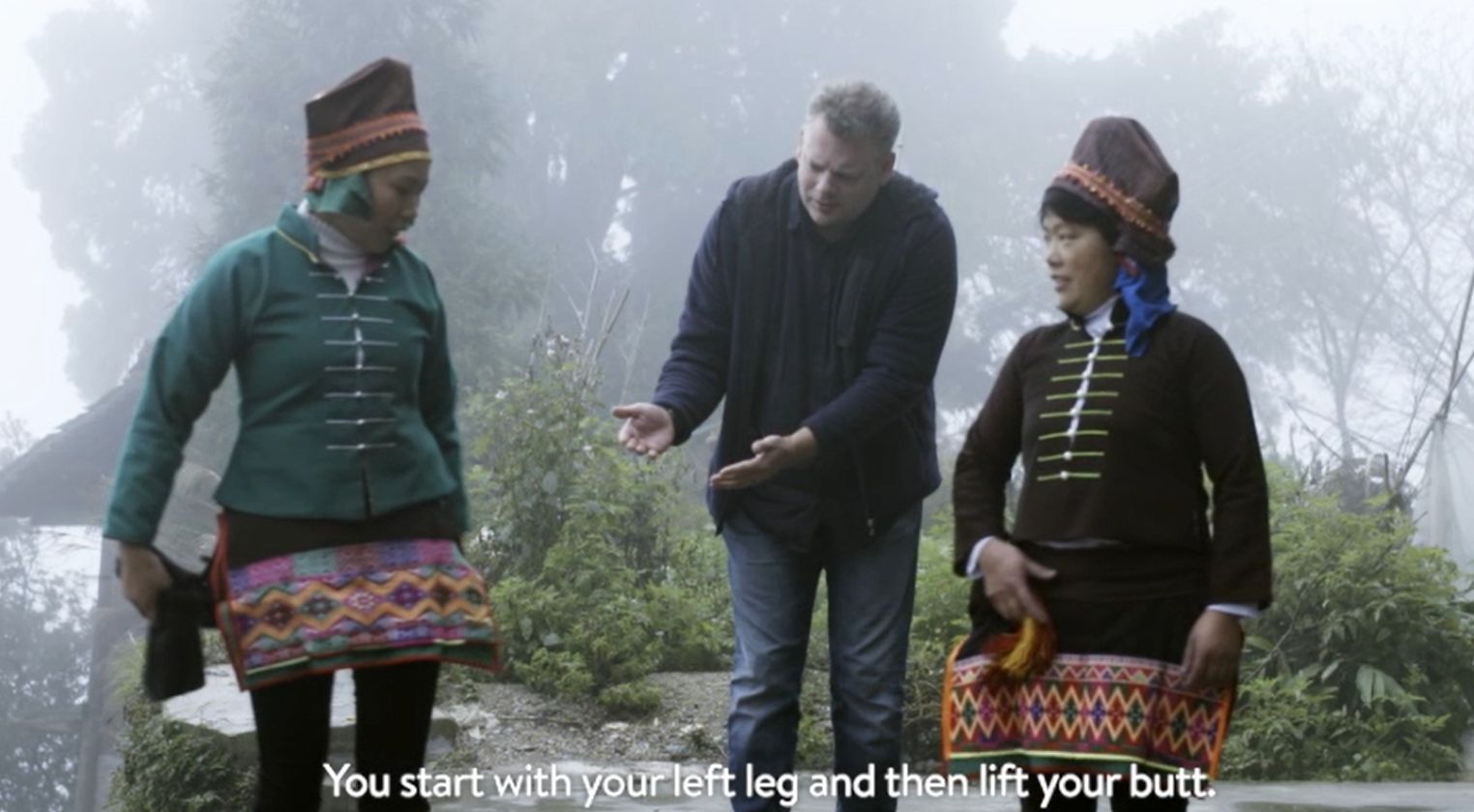
Mrs Yu (Tubby’s wife) and Miss Yu (Tubby’s sister) take me out onto a clifftop to teach me how to walk like a woman. This takes longer than expected, as they have to put their glad rags on and do their hair, and then we have to wait for the air-raid sirens to stop. Today is the anniversary of the Japanese invasion of China, and sirens all over China are going off to remind people of who the enemy is.

“Left foot forward,” says Mrs Yu. “Now watch my arse. I wiggle it this way, and then that way, then this way, then that way.” It’s only when the cameraman reframes for a close-up that she realises she is volunteering to wiggle her bottom on camera for viewers in 30 countries.

The sisters-in-law then move onto the Phoenix Dance, that slow-motion invisible skipping rope motion that combines their wiggly walk with flapping arms and steps that go left-right-left-right-right-left-right-left-left, over and over again.

“Do you think they enjoy doing this?” wonders our fixer.

“I hope so,” I reply. “Because this lot don’t seem to do anything else.”

Mrs Yu is very excited about the electric kettle we have acquired in a vain attempt to have some warm water to wash in every day. She walks around the house caressing it like an adored pet. I have not washed properly for four days now. It is theoretically possible to barricade the door to the combined toilet-shower, strip off and use a kettle, but such an enterprise would require washing the floor first, and drying off afterwards, which since we are literally living inside a cloud, would be a futile exercise. As for going to the toilet, don’t get me started. I am happy if I manage to hit the hole and remember toilet paper.

“When we get to the Congjiang hotel tomorrow,” says the director dreamily, “I’m going to turn the lights low, put on some ambient background music, light some aromatic candles, and have a massive dump.”

Jonathan Clements is the author of A Brief History of China. These events featured in Route Awakening S03E06 (2017).

The Very Slow Motorcycle Race

One of the photographers staying in the same building as us seems different from the rest. She is a slim Chinese girl in a bobble hat, dubbed “Alice” by Mickey the sound man because we are living next door to her – one of many obscure 20th century pop references in Mickey’s everyday banter. He noticed her because she alone seemed to know how to operate her camera, and it turns out that she is a genuine professional. She sells prints of her photos, but is wandering China, somewhat aimlessly, in the help of selling a book about it, because “foreigners don’t know anything about any tribe apart from the Han.” I resist the urge to point out that even if it were true, there are thousands of pre-existing picture books about China, none of which she appears to have heard of.

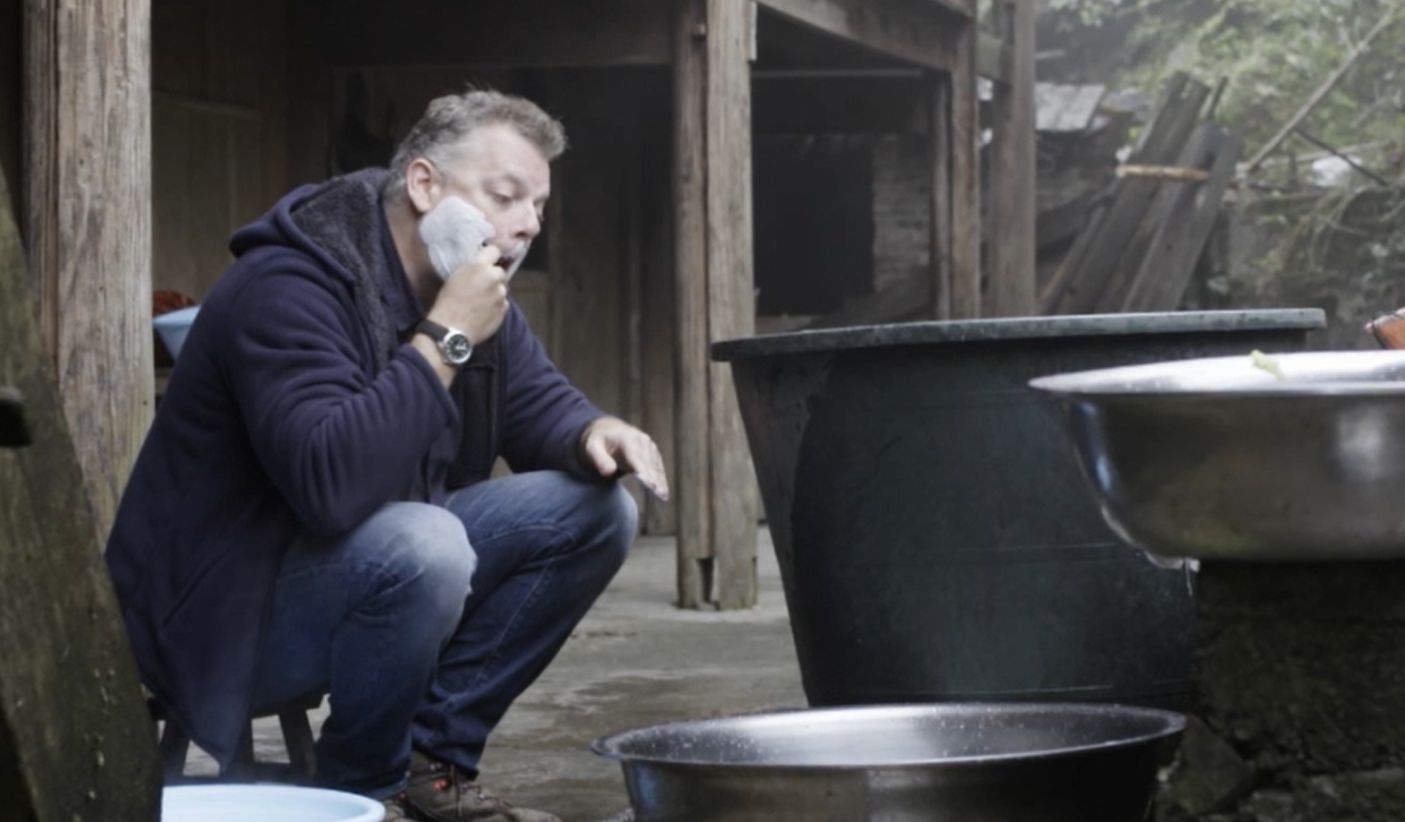
Alice was born in Hong Kong and now lives in New York, and is one of those Chinese girls who believe that being Chinese is the sole qualification required for understanding China, that she has learned everything she needs to know solely through her DNA, and that foreigners are all clueless. She has already pegged me as a high-maintenance idiot after overhearing half a conversation between me and the director the day before, about the best time for me to shave when there is no hot water.

Yes, I say, we were going over what kind of timing was needed to make my face look presentable in 4K digital. If you’re behind the camera, you can look like shit warmed up and nobody will care. But if you’re in front of it, you need to look like you’ve run a comb through your hair, or it is distracting.

“Oh,” she says in surprise, “you appear to understand quite a bit of Chinese.”

Behind their porridge bowls, the crew snicker and snort.

“Have you been to China before?” she asks, and the snorts turn to giggles.

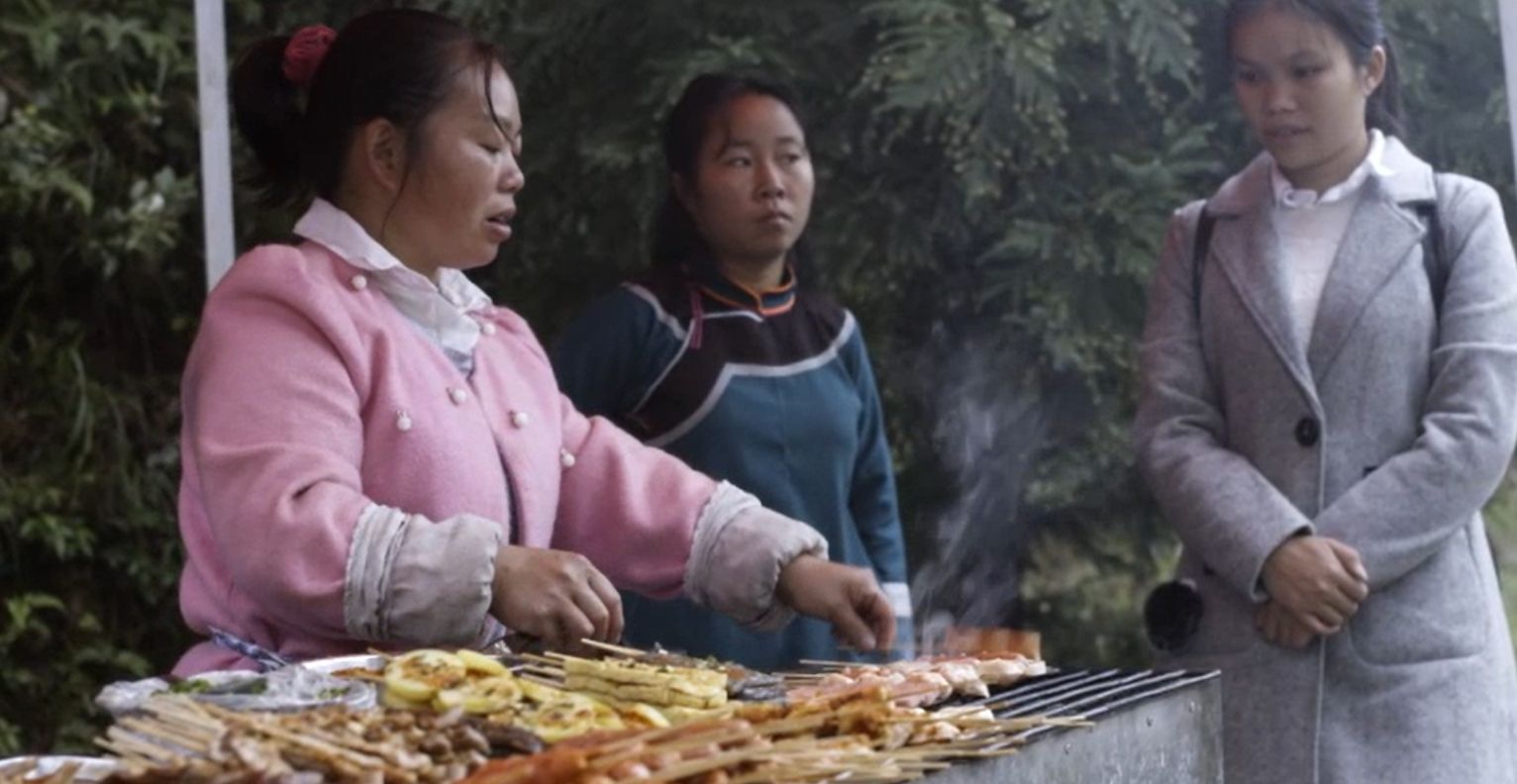
A village fete of some sorts has sprung up around the village gate. There’s a mobile convenience store on the back of a truck, a fruit seller, a lady selling gristle on sticks, a lucky dip and a spin-the-wheel stall where you can win a live terrapin in a cup.

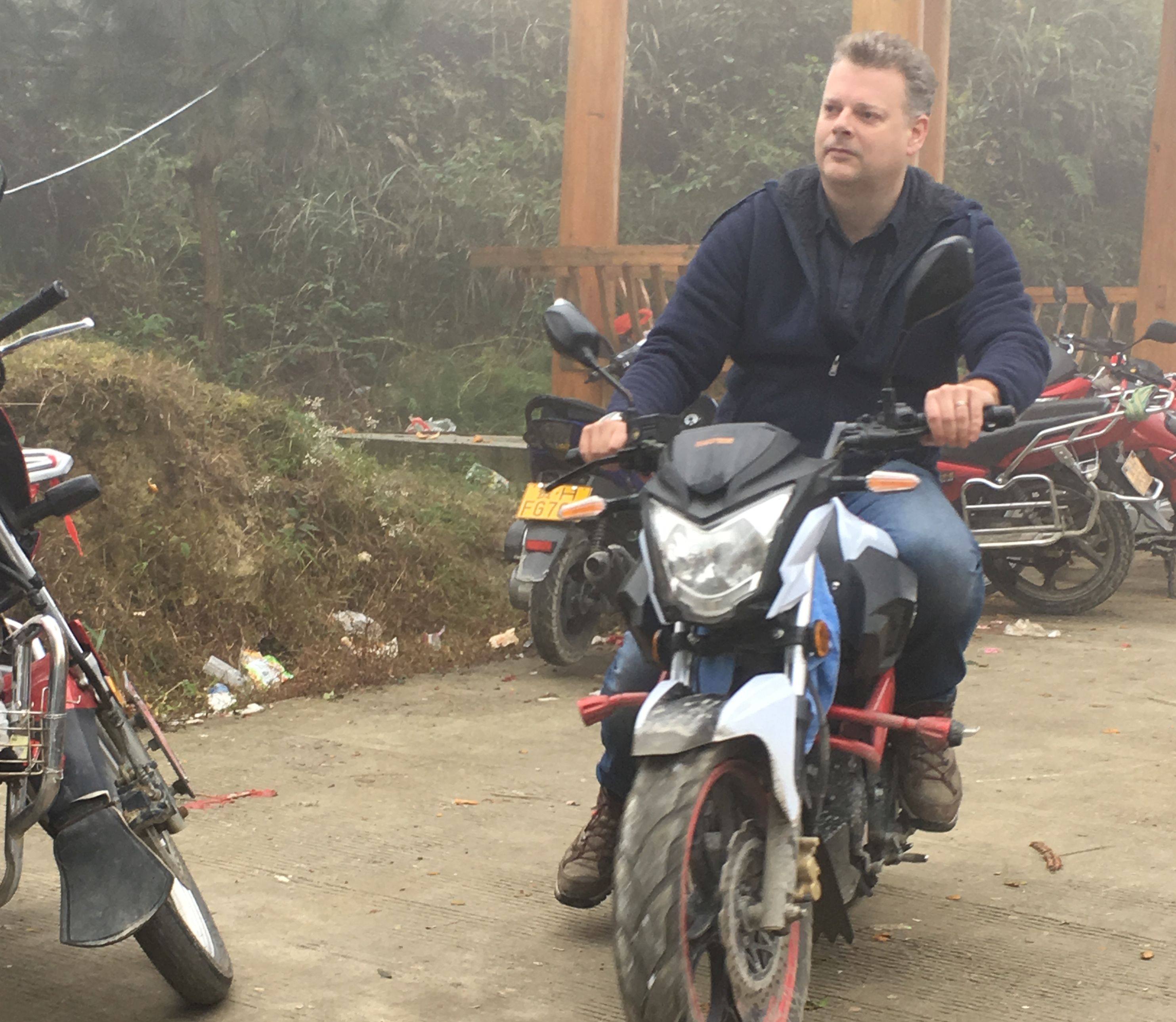
The Very Slow Motorcycle Race is another of the town committee’s attempts to keep the young people interested. Chalk marks in a wavy chicane are drawn across the car park, and the local bikers are made to traverse the path in the slowest time possible. Not that that is much of an issue, because only two bikers actually make it all the way along the fiendishly winding path at all. The director decides that I shall have a go, and purloins a bike from a passing man.

It is a 250cc white Chinese model, and as I sit astride it with entirely misplaced confidence, I remember that I haven’t actually sat on a motorbike for 25 years. The locals immediately cluster around with helpful advice, including “Starting in second gear is a stupid idea, mate”, and “If you rev it that much, you’ll go over the cliff.”

Luckily, I have vague memories of the five minutes I once spent in a Taiwanese car park on Gilbert Mackay’s little 150cc bike in 1991, so at least I know that what would be the left brake on a bicycle is actually the clutch on a motorbike. I know where the gears are to shift it down into first (they’re by your left toe), and I know that pulling too hard on the front brake will pitch my head over the handlebars.

I gingerly wheel it to the starting line with only two stalls, and then head off when Tubby, our landlord, blows his whistle. It’s all over in barely a second, as I careen along the opening leg, fail to correctly take the first corner, and whirl off into the crowd, through a screaming flock of onlookers, and around the car park, coming to a juddering halt a couple of feet away from the precipice that leads down into the rice paddy.

The camera catches not just my comedy performance, but all the Chinese laughing at me at the starting line, as well as the fleeing onlookers as I charge through them. It’ll look good.

I chug the bike over the man we got it from, and thank him for letting us use it.

“Oh, it’s not mine,” he says. “I have no idea whose bike you just stole.”

Jonathan Clements is the author of A Brief History of China. These events featured in Route Awakening S03E06 (2017).