On several occasions in recent months, I have been approached by journalists demanding to have the meteoric success of Demon Slayer explained to them. The film has, after all, become the highest-grossing movie ever in Japan, taking just under 40 billion yen (£266 million) beating not only Spirited Away and Your Name, but Titanic and Frozen.
However, I refused to comment, on the grounds that I didn’t really know. I had some guesses, certainly, particularly regarding unique pandemic conditions. One imagines a weary Dad, on the one day that a family can actually go somewhere together saying: “All right, we can all go out today, but we are not sitting through the last Evangelion movie, and your sister doesn’t want to see Josee and the Tiger and the Fish, and your mother has already seen Fate/Grand Order: Divine Realm of The Round Table: Camelot- Wandering; Agateram twice, and besides, it takes so long to say the title that by the time we get our tickets, the film will be half over…”
And then there are the otaku. When reporting Japanese box office, particularly for anime, it is disingenuous to talk about ticket sales as if each has gone to an individual, because some of those tickets are being bought by the same guy – once for the lucky gonk, once for the giveaway poster, once for the action figure he will keep in its box. And with limited choice in Japanese cinemas, such merch speculators are out in force with more money to spend on a single film.
There has been some talk among pundits of some sort of unique synergy among voice-acting talent (nope), or music (not really). There has been some mildly persuasive commentary on the fact that the manga itself is popular with Japanese readers (yes… but that popular?), hitting some sort of spirit of the age.
But as to why Demon Slayer is the top of the Japanese box office, my honest answer is “I don’t know”. As the months go by, I realise now that I should have said so, in public, much earlier on. Someone should have stuck their hand up in December and said: “No idea, sorry. If we knew how this worked, we’d all be millionaires.”
Jonathan Clements is the author of Anime: A History. This article first appeared in NEO #208 (2021).
The sun is bright white overhead, and in the distance there are the red striated rocks of the Flaming Mountains, where the Monkey King once fought Princess Iron Fan, or as the Uyghurs tell it, where a hero once felled a dragon, causing its still-simmering body to break up into seven pieces.
Our van stops at the side of the road to look down a ravine at ancient Buddhist grottoes, cut into the rock. They were once by the bank of a river in a green valley, but are now marooned a hundred feet up, above a wadi that only has water in it maybe once a year. This isn’t part of our scheduled filming, but I do a piece to camera about the retreat of the waters from Xinjiang, and we get to give the Yuneec Q500 Typhoon a quick run along the valley to shoot it from the air. We only attract eight passers-by, which is a miracle in China.
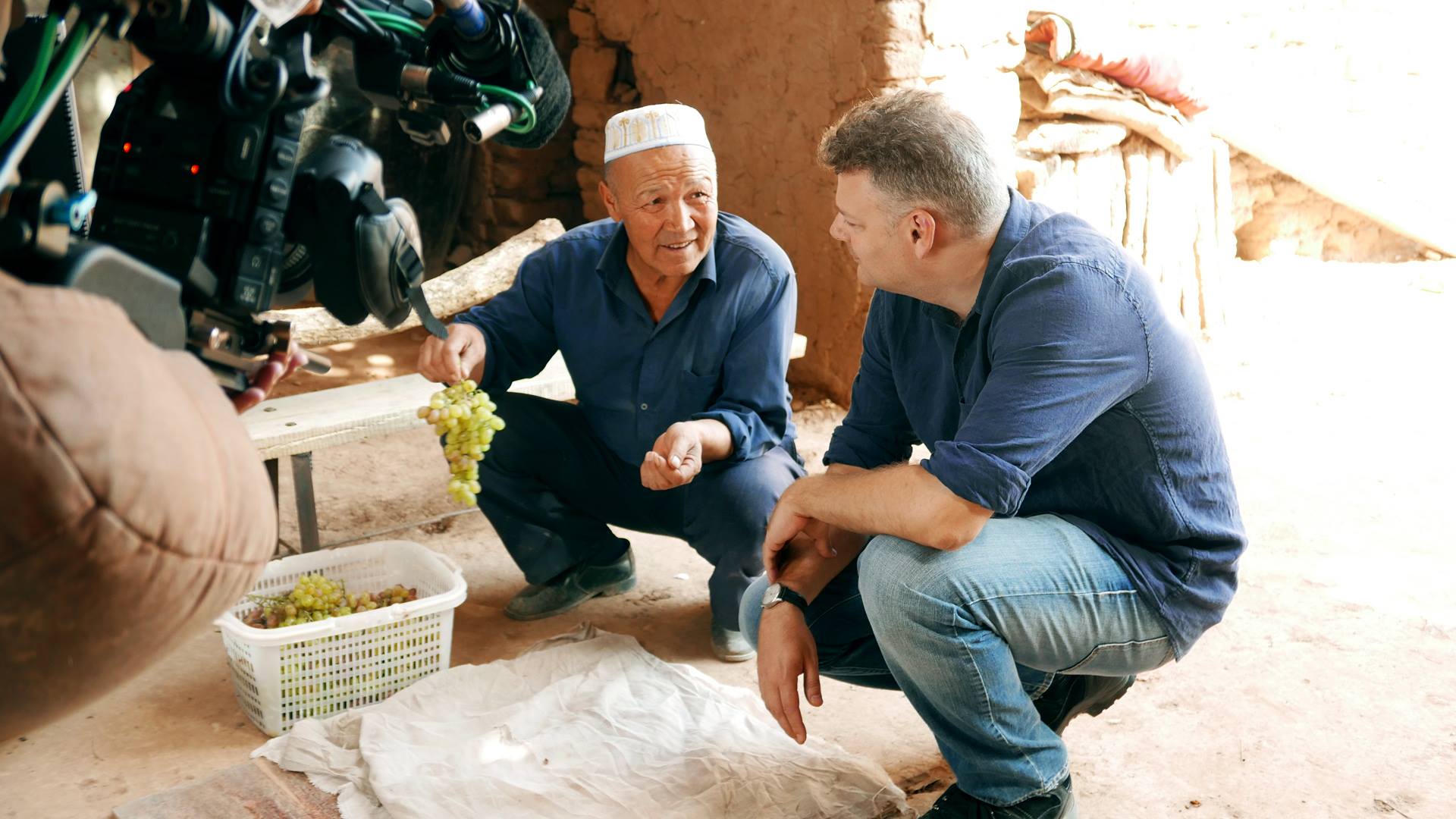
We have come to Tuyuk village, a Muslim community out among the vineyards, where the locals dry grapes in the sun until they become raisins. There are five thousand people living here, spread out in single-storey huts across a swathe of land in the shadow of the Flaming Mountains.
Ismayil is an old man who makes merceles, a fermented grape juice that uses the wine production methods of Ancient Greece, but with no alcohol content. The Quran only forbids “intoxicants”, you see, whereas merceles is officially medicine. We have to shoot all the stages of its manufacture, from the grape picking, to the crushing, to the sieving, to the boiling and the adding of kebabs.
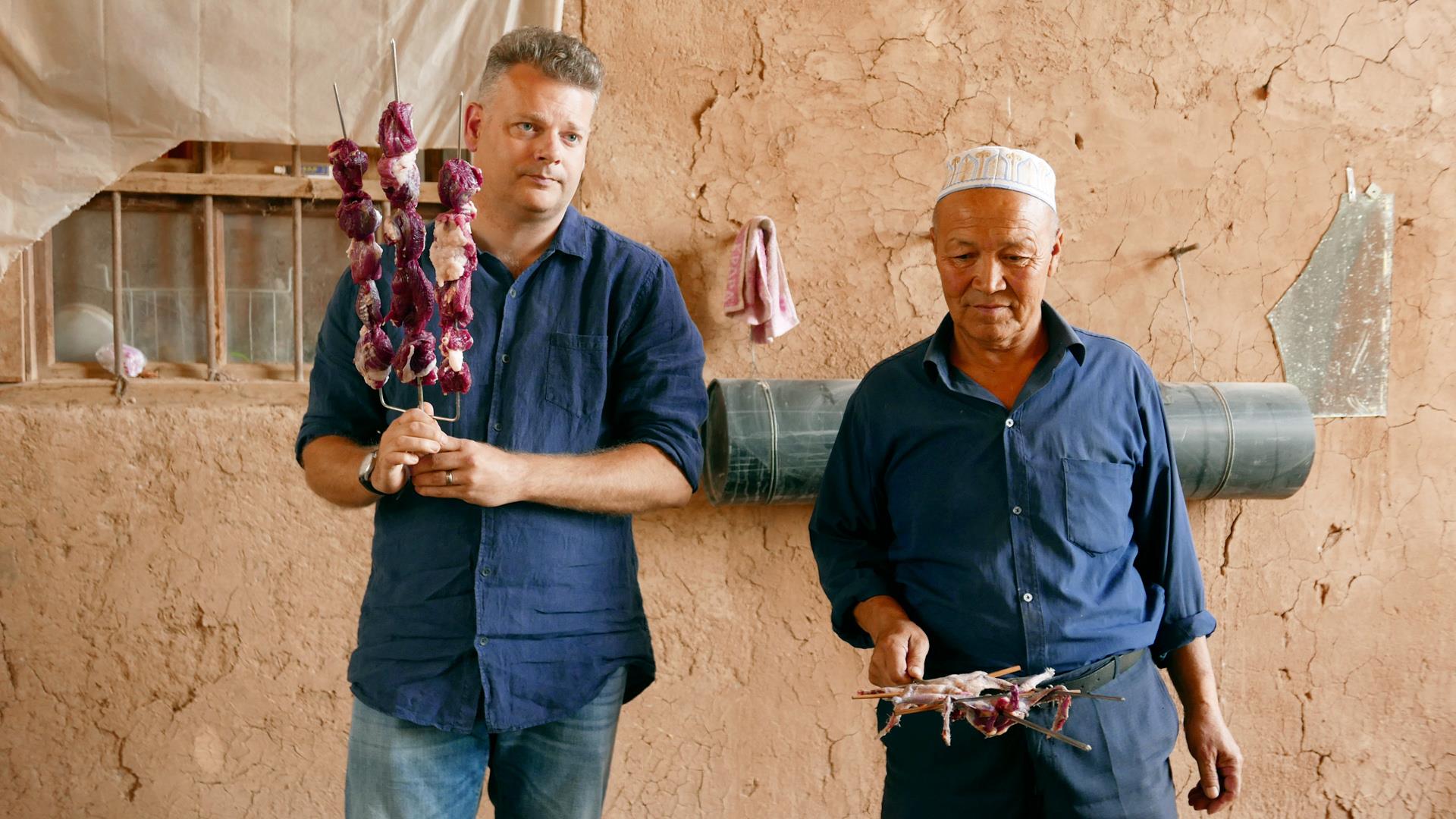
No, wait, what? Kebabs. The grape juice is boiled with hunks of meat, and then left to set for 40 days until it is drinkable. Then it apparently puts hairs on your chest. While I am trying to interview Ismayil about his herbal ingredients, a butcher is dragging a sheep behind me and slitting its throat, letting its blood drain into a hole in the ground. And while I am talking with him about the history of grapes, the same butcher is shoving a hollow tube up the dead sheep’s leg, and then inflating it like a lilo to push the skin away from the flesh. In fact, the whole day is taken with the slow dismemberment and cooking of a sheep, with some bits going onto kebab skewers, and the rest of them being boiled in a pot to make our lunch.
We sit gingerly on the divan and poke at the big hunks of meat. A neighbour (all Ismayil’s neighbours have come to gawp) hands me a cut-throat razor to saw flesh off the shank. It tastes remarkable – mutton this fresh turns out to taste the way lamb tastes for everybody else. I realise that Ismayil has had his flies undone all day, but that if I point this out, it will ruin the continuity. His granddaughter smiles at me experimentally, and two grandsons ask me if I am an American.
None of the interlopers speak particularly good Mandarin, which means we are all mercilessly taking the piss out of each other in our own little linguistic alleys. Viewers of the finished product should look out for the moment when Ismayil and I first greet each other, shot, for reasons not worth going into, late the day after I have already knocked back several bowls of his supposedly alcohol-free medicine. I come in through the carved wooden door in his courtyard, and he runs laughing to shake my hand. I greet him with an enthusiastic: “Ismayil! Big up your bad self!”
He replies with something unintelligible in Uyghur, which probably means: “Why didn’t you tell me my flies were undone, you arsehole?”
There is a knock at the door, and a very short woman in a green headscarf comes in.
“My legs are giving me jip,” she says, “and I heard there was a slaughter today. Can you do me a couple of pigeons.”
Oh yes, says Ismayil, and gets her to sit down and lift her skirt. Then he slits the throat of a spare pigeon and spatters her legs with blood, while the film crew look at their watches.
Right, says the director, if we can now get to the bit where we sieve the grape juice…?
There is another knock at the door.
“Hello,” says a man in a knock-off Armani T-shirt. “I heard there was a slaughter today, and I’ve got these pains in my legs. Can you spare me a pigeon or two?”
But of course, says Ismayil decapitating two more pigeons and spraying him with blood, before ripping out feathers and dropping them onto the result. His patient starts to look like a zombie version of Foghorn Leghorn, and we get back to the business at hand.
By the time I get to taste some merceles, I am ready for the worst, but it tastes like Ricola, and I am quite happy to drink it all day. You would never know that there was half a sheep and four dead pigeons in it.
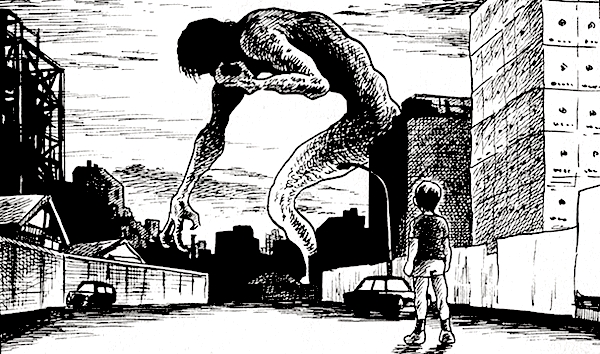
“His influence upon Japanese fantastika cannot be overstated, and has been cited in multiple creators’ accounts of their inspiration… In particular, it is possible to discern visual and thematic borrowings from Mudmen in Hayao Miyazaki’s Princess Mononoke (1997), and from Yōkai Hunter in Shinseiki Evangelion (1995-1996)…”
“Foods and local dishes can be a welcome window into history, attached to folklore or some sort of interesting bit of trivia. Staying at an old-fashioned inn in Shimabara, I was once served guzoni, a local dish said to replicate the grim, spartan broth that Christians under siege at Hara Castle scraped together from seaweed and shellfish. Outside the navy base at Yokosuka, I was nearly defeated by a military-grade curry, introduced, it was said, by the Royal Navy. Many such oddities, however, are more like ‘invented traditions’, recent initiatives designed to give local hawkers something to sell to tourists. The authors note, for example, that Atsumori Noodles might be named for a famous samurai killed at the battle of Ichinotani, but actually have sod-all to do with him, having been dreamt up by a couple of café owners near the battle site.”
Over at All the Anime, I review a new book about transformations in Japanese food, including a conspiracy that goes to the highest level… and involves soup.
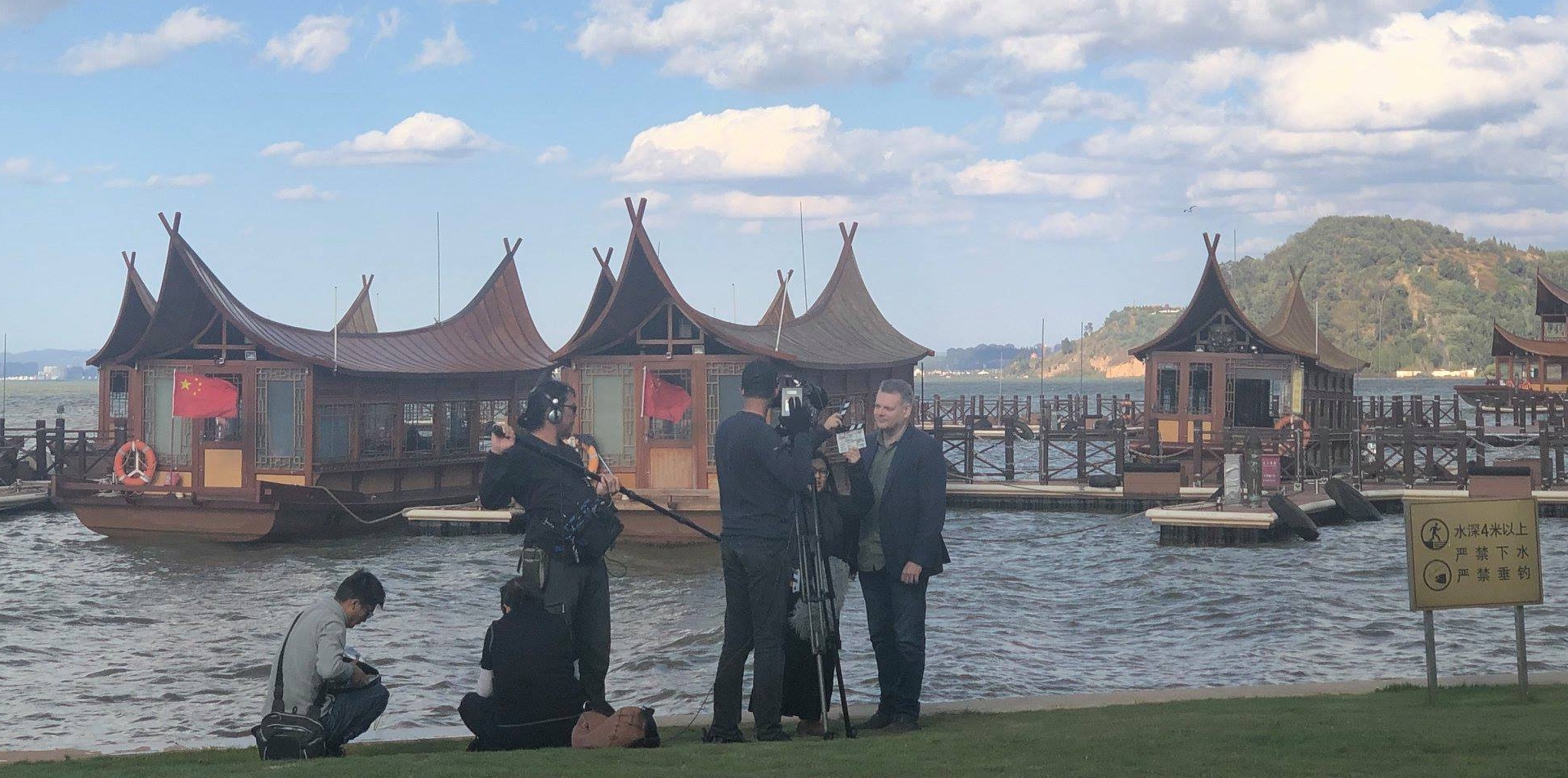
I am informed this morning that National Geographic’s Route Awakening season five has received a Gold Remi award for History and Archaeology at Worldfest Houston. A wonderful acknowledgement for the crew that schlepped across China in two long road trips, from Luoyang to Nanjing and from Kunming to Nanchang, to document some of the most amazing new museums in China, showcasing the histories of the Dian Kingdom of Yunnan, the Shang dynasty in Anyang, Luoyang’s history as a Chinese capital, the lost state of Yelang, and the golden treasures of the Marquis of Haihun.
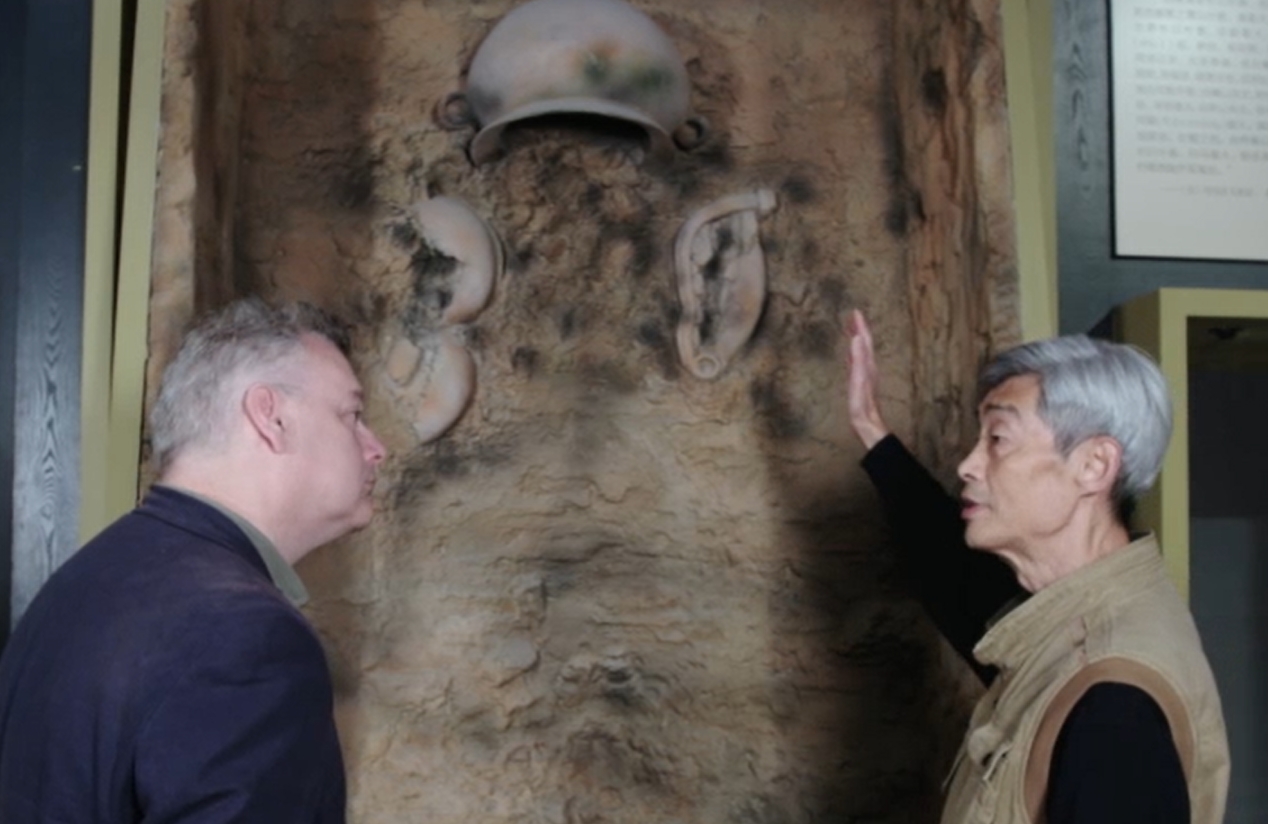
Season five was my third with the series, and gave me a real chance to put my experience to proper use, quizzing archaeologists on their latest finds, some of which are still in the process of being restored, delving into evidence in the Grand Scribe’s Records, and in one moving episode, returning with a retired historian to the place where, in his younger days, he had uncovered game-changing ancient graves.
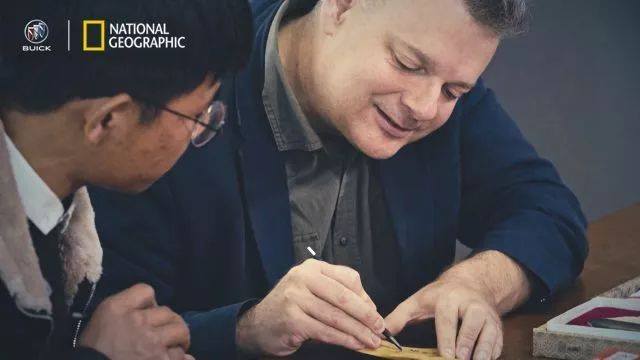
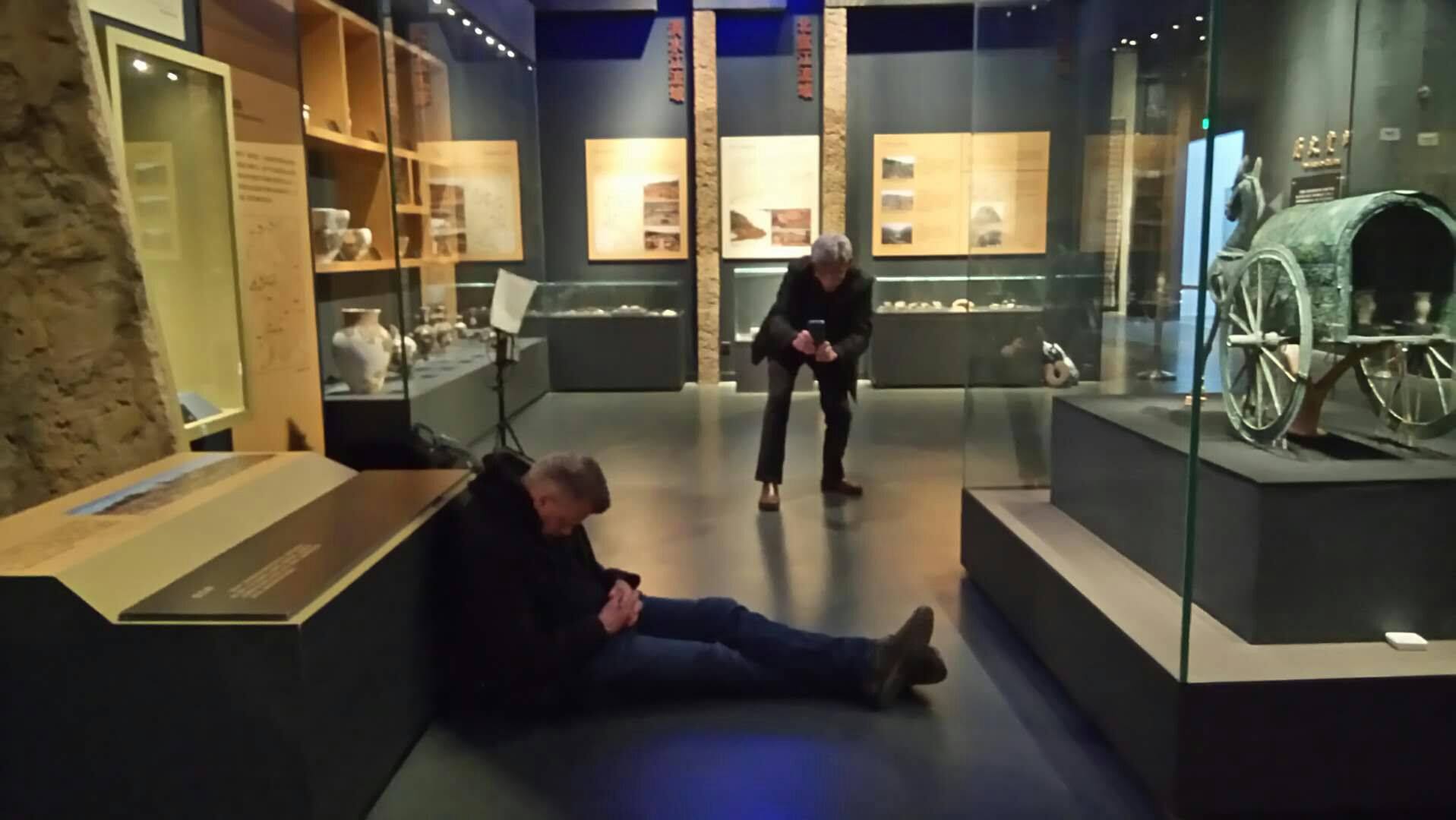
Professor Liang Taihe was the happiest interviewee I can remember having, a tall, grey pensioner with nothing to lose, who spent his whole career arguing with his peers that archaeology shouldn’t be impenetrable to outsiders. In modern, Western terms, he was all about impact and outreach, so we were ideally suited for each other. The picture below shows me at my lowest and him at his most playful — after a dawn start and a three-hour drive to a fantastic new museum in Guiyang, there was still a day’s filming to do. At one point, I nodded off in the Yelang gallery, a floor crammed with the materials that Professor Liang had painstakingly assembled during his career. Unable to resist, he snapped a picture of me so Chinese academia could have a good laugh.
“We are afraid of the media,” he confessed over a boozy dinner. “They try to turn everything into an adventure story. They want everything to be solved in 22 minutes. They make us out to be breathless idiots, and then our colleagues laugh at us because we fell for it. So it’s lovely to meet a bunch of people like you, who really care about what we do, and want to tell people.”
We drove through karst hills rippling with the signs of abandoned farm terraces, and huge caves torn out of the bare rock. The flat ground was reserved for market gardens, and the road too narrow for two cars to pass each other. At one point, when market day caused a jam at a junction, Professor Liang bounded out of the car and began directing traffic.
He hadn’t been back for 18 years, and was shocked at the sight of new buildings, including a temple-like structure intended as the entrance to the Yelang Capital Experience, a theme park under construction. While our cameraman filmed B-roll in the market, and our fixer argued with a woman whose food stall had been accidentally ram-raided by the crew’s van, Professor Liang stood with me on a windswept heath and swore at the picturesque scene down below.
“Where the hell did that lake come from? This used to be the Kele river. On that hill, over there, I found a really big roof tile, which makes me think it came from a really big roof. I think that was where the Han people built their offices.”
We edged through a trash-strewn pathway next to a car repair works, to stand in a field scattered with dead plants.
“This was where I found it. That copper pot-head burial that was the earliest in the record. Some king or warrior or great shaman from Yelang. In that hill over there, we found more than a hundred graves, ten percent of them with pots on their heads. Weapons, malachite and agate beads, and bells.”
An old lady comes out of the house nearby and stares at him while he stares back. They charged across the field to each other and embraced, switching into Guizhou dialect, reminiscing about their lives a generation earlier, and asking about each other’s families. He told her about his daughter, also a historian, who works in the Forbidden City in Beijing. They embraced again, and hold the pose a little longer than expected. She went back into her house. And then she came out again to wave him off watching us until we turned a corner and were out of sight.
“Nothing has really changed,” he said to me back in the car. “Not really.”
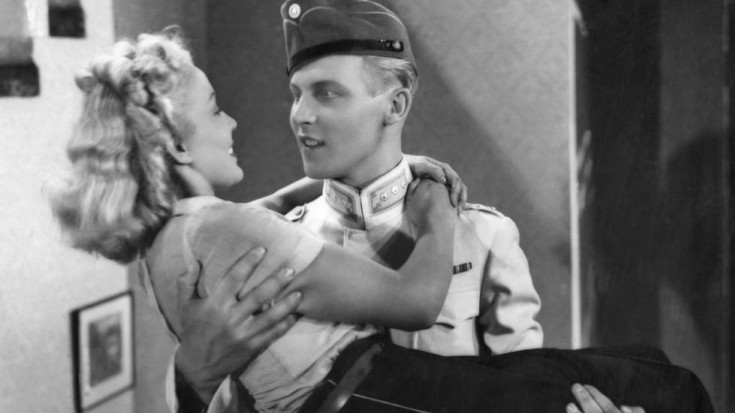
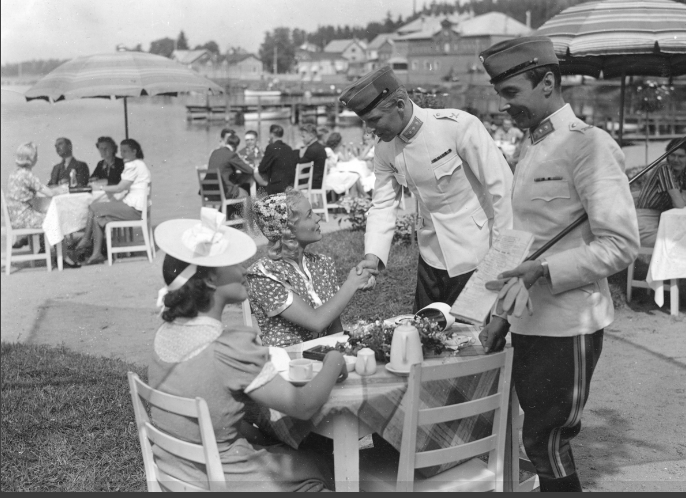
Irja (Helena Kara) breezes through town in an open-topped sports car, a carefree blonde loving life, until her car breaks down in the road and blocks the path of an entire column of cavalrymen. Luckily for her, the handsome Kyrö (Kullervo Kalske) is there to give her a push in more ways than one. He drives off in her Bantam Roadster, and she retaliates by stealing his horse.
Like The Regiment’s Tribulation (1938), which similarly made light of the reasons why a country might have an escalating military presence in the first place, Red Trousers plays the soldier’s life for laughs and glamour. Much is made of Kyrö’s cavalry band playing their instruments as they ride, an effect almost immediately ruined by the sight of the drummer enthusiastically bashing away despite there being no drums on the soundtrack. First-time director Ilmari Unho wastes miles of film in lavish beauty passes of the cavalry, as if their mere presence should be enough to excite us, and has plainly badgered entire mobs of extras to act as if it excites them.
The extras, in fact, are the most hypnotically awful thing to watch in this film – happy crowds who are plainly not happy, and old ladies who talk excitedly to thin air as if they are providing walla for an audio-only production. Deep down, the script, adapted by Unho and Aarne Orri from Valfrid Ahonen’s 1934 radio play The Dragoons Arrived (Rakuunat tulivat), seems to want to grapple with the tensions brought about by the arrival of a military unit in a mundane town. There are attempts to document the clashes in expectation and flirtation – the local girls who swoon at soldiers, the local boys who feel threatened by the presence of men in uniform, and the older townsfolk who just wish they wouldn’t put their freshly polished boots on the furniture.
For the modern viewer, it is interesting to see how little has changed. Location footage has been shot near the castle and waterfront at Lappeenranta, which has retained many of its early 20th-century buildings to this day. I recognised the streets immediately. A year after he was ogling the talent on the beach at Hanko in For the Money (1938), Kullervo Kalske is back for another instalment of his Summertime Chat-up School, flirting shamelessly with Helena Kara amid the waterfront cafés. Local women, depending on their mood and situation, either giggle helplessly or sneer contemptuously at the randy soldiers, while both town and fort have to negotiate compromises in acceptable behaviour.
Although, I have to point this out: Lappeenranta is a town with a giant military base in the middle of it. It’s not like they’d never seen a soldier there before, which makes the choice of filming location slightly problematic, particularly because all these soldiers ever do is play musical instruments and chase girls. There seems to be a definite disconnection between the original performance for a non-visual medium and the images on screen, many of which often seem as if they have been stuffed up there merely to fill space. In particular, at the 30-minute mark, we are subjected to three pointless musical interludes. Well, they seem pointless, now – perhaps in 1939 they were the ideal chance to nip out for a piss and a pastry. Within a year, the impetus towards variety would see films that were nothing but musical interludes, such as S-F Parade (1940) and Foxtail in the Armpit (1940) – we’ll get to those soon enough.
There’s also an element of class consciousness. Kyrö and Irja, an officer and a lady, seem destined for an acceptable onscreen romance, whereas a similar mutual attraction between their underlings – his squaddie and her maid – is greeted with scowls and scoldings. Meanwhile, Hannes Häyrinen, an actor fated to go on to great things, is here saddled with the role of Uuno, the hapless, bespectacled, stuttering milksop, presumably intended as an allegory of everything that a Finnish fighting man is not, but played here so savagely that it borders on mockery of the afflicted.
The media reaction to its November 1939 release was one of muted praise, with many a reviewer commenting with a resigned shrug that anything bringing a note of joy in difficult times should be welcomed. But seen with the eyes of posterity, Red Trousers feels like an ill-judged carnivalisation of serious matters, an attempt to laugh off the escalating approach of war. Everybody has a laugh about the soldiers in their midst, as if genteel ladies are taking tea and attempting to ignore the elephant in the room.
Eleven days after it was released, military matters descended on Finland for real, with nearly half a million Soviet troops mustered at the border, and 61 Finns killed in a bombing raid on Helsinki.
“When the red trousers go on,” decrees Kyrö, presumably referring to his dragoon jodhpurs, “nobody can resist.” Except this film is in black and white, so I have no idea what colour his trousers are at any given point, and it might as well still be radio.
“Chi has argued that discrimination and stigma are forms of societal self-harm, a position that gained substantial weight after a Taiwanese scandal in which donor organs from a dead man were transplanted into five Taiwanese recipients, along with the AIDS virus, because the donor’s family had been unaware of his condition or its implications.”
Siamo fuori di testa, ma diversi da loro (We’re out of our minds, we’re different from them). We’re back for the game of the year, the Eurovision Song Contest hosted this time by the Netherlands, who won with Duncan Laurence in 2019 – you remember him, right? It’s hosted by three normal-sized people and A Giant.
We’ve already had to say goodbye to North Macedonia’s glitterball waistcoat, Slovenia’s half-cloak and whatever the hell Australia thought they were doing, but there are still plenty of mentalists remaining, in what appears to be a year in which multiple performers have decided to wave their hands in the air like they just don’t care.
The bookies are claiming that it’s all down to a stand-off between Italy (love their bass player, and their drummer’s name is Ethan Torchio) and France (a shouty woman in a basque), but be ready for some outliers – Iceland hoovering up the nerd vote, and several appeals to the woke generation, most notably the Netherlands’ rather sweet anti-colonial my-lovely-horse, featuring Captain Crunk the Crazy Bendy Dancer, who looks on the verge of throwing up.
Step One: you will probably need to be quite drunk. Step Two: The following sights and sounds will occur during this Saturday’s Eurovision Song Contest. Can you spot them first? Remember to shout it out. As ever, there is more than one key change, and plenty of orbital cleavage. Keep your eyes (or ears) open for any of the following. And when you notice it, SHOUT IT OUT! Points can be scored all through the contest, on and off stage, including during the voting and in the greenroom.
In no particular order, in Saturday’s final you should be ready for:
KEY CHANGE! (every time you hear one)
E(uro) V(ision) finger-signals (Roop will start it but people will copy)
Tap-dancing in trainers
Two giant trumpets
An unnecessary number of belts
The Invisible Man backing dancers
The prancing, dancing pair of glowing ringpieces
Dalek dress
Those fateful words “JAJA DINGDONG”
LYRICS: “Excuse my French.”
Sitting on a man chair
Big Golden Ball
Big Golden Ball with a Snake in it
The Mondrian Brass Section
Tix takes his sunglasses off
Tix puts his sunglasses back on
Lyrics: “Hear my body talk talk talk”
“WHO!?” – every time someone says “Duncan Laurence”.
LYRICS: “Every psycho on the scene…”
Dancing German Victory V
Walk like an Egyptian (every time)
Keyboard Circle!
Vulcan hand signal (Live Long and Prosper)
Necklace that says: “ANNOYING”.
Trinity from The Matrix wearing a dead muppet
Shoulder dancing
Liberty Jazz Hand (wiggling fingers at the back of the head in an attempt to imitate the Statue of Liberty)
Eclipse!
Look for the word “JOIN”
Glitterball leotard
Holy shit, it’s LORDI!
Ukulele throwing
Pointing
LYRICS: “I really don’t care dat you vant to bash me.”
Hands make a heart
Red middle finger
FLAME ON! (every time there’s pyrotechnics)
WINKING
COSTUME CHANGE
Bimbling*
ORBITAL CLEAVAGE**
Buddha Jazz Hands***
Our optional bonus categories are:
COVID BINGO – which entry will be suddenly withdrawn from competition owing to a plague scare?
THE PALESTINIAN PROTEST SWEEPSTAKE – can you guess the time of the inevitable Palestinian protest? It could be a flag, it could be a speech, it could be a stage invasion, but you know someone’s going to try it on.
HOLA OLA! Surprise sighting of former supervisor Jon-Ola Sand. Can he really stay away?
Denmark awards 12 points to Italy, whose band has a Danish bass player and a Danish name / Greece awards 12 points to Cyprus / Cyprus awards 12 points to Greece / Former Yugoslavian Republic awards 12 points to Former Yugoslavian Republic.
(*swaying one’s head from side to side in a snakey fashion) (**ostentatious cleavage sufficient to see from a satellite in orbit, which, according to Eurovision bra consultant Tom Clancy, requires a minimum of C-cup)
(***the dancers all pile behind the singer in a line and then fling their arms out, creating a multi-limbed oriental deity-look)
“I used to have the final moves planned out, but lately I’ve been thinking I’d rather figure them out when I come to it, so now it’s hard to say what could happen. Being the sort of person I am, though, I actually don’t think I could let such a long grim story end with a grim ending – like, say, having him suddenly die. I don’t really like that kind of entertainment.”
My obituary for the manga artist Kentaro Miura, creator of Berserk, is now up on All the Anime.
I’ve long given up expecting decent oriental food in the small town where I live, but sometimes even I get riled about the low expectations of the customers and the cooks. Exhibit A: the monstrous abomination that shuffled into view at the local sushi buffet, when the mainland Chinese who used to run it sold out to a bunch of Thais, and within days they were putting processed cheese on the maki rolls and leaving out platters of tuna sandwiches!
There are limits, and if there was such a thing as the Sushi Police, I would definitely have called them. In the anime series directed by Tatsushi Momen, Honda, Suzuki and Kawasaki are enforcers for the Japanese government, making sure that restaurants around the world are serving proper, traditional sushi, and none of these madcap overseas inventions. First screened in Japan in 2016, Sushi Police was commissioned amid a certain braggart mood in Japan that the Olympics were coming soon, and that the world was sure to become so obsessed with Japan that its far-flung corners would need an inspectorate to slap any slipping standards out of them.
One wonders, however, about where cultural policing disappears so far up itself that it becomes a cure that’s deadlier than the disease. Sushi started off as an utterly commonplace snack food in samurai-era Tokyo, slung together with fresh ingredients and a dash of sauce, no weirder than a hot dog… albeit usually not actually hot. And this wouldn’t be the first time that an “authentic” food had evolved abroad. As the name implies, one of my favourite varieties, the California Roll, has origins far away from bay-side Tokyo, and is all the better for it.
But in Japan there are super-high-end establishments for people much posher than you and me, which have a whole set of rules of their own. There are sushi bars that only run two sittings a night, where seats are booked months in advance, where you pay in advance and forfeit your money if you are five minutes late. There’s no reaching for the soy sauce here – the chef decides on the flavouring you need, not the flavouring you want. And in order to avoid offending the fine palates of your fellow diners, you are not allowed to wear any form of perfume.
Would the Sushi Police crack down on them, too, for being ridiculously snooty, or would they secretly approve of such white-collar crime?