China Crisis?

To Wuhan in China’s Hubei province, where prime minister Wen Jiabao had some words of complaint for animation students.

Your work is meaningful. You should play a leading role in bringing Chinese culture to the world,” he told students at Jiangtong Animation. “Let Chinese children watch more of their own history and own country’s animation.” But this was meant less in praise than in criticism. After spending time with a grandson we shall call Wen Junior, the prime minister was shocked to discover that the boy preferred Japanese imports to China’s homegrown animation.

“He always watches Ultraman,” complained Wen. “He should watch more Chinese cartoons.”

Wen says this like it’s the animators’ fault. I fully believe the Culture Ministry’s statement that there are 200,000 animators at work in China today. It’s just that a big chunk of them are working on The Simpsons, or Family Guy, or take your pick. And while that’s great for Chinese industry and keeps people in employment, it doesn’t automatically translate to a rich local creative culture.

The Chinese animation industry, according to its Deputy Culture Minister, produces 41 hours of content a week, a number that appears to even top the output of Japan, which was 35 hours per week at its 2006 height, and is probably more like 20 hours a week today. But statistics are never the whole story. In many cases, those cartoons are being counted twice. When the Japanese broadcast a cartoon (let’s call it Schoolgirl Milky Crisis) on TV Tokyo, that’s 25 minutes of animation claimed on the Japanese figures. But if the same show is a Chinese co-production, and broadcast in China as Exemplary Scholar Heroines of Dairy Production Problem-Solving, then those same minutes will also go on the Chinese slate. Meanwhile, Chinese in-betweeners and colourists doing the dogwork on a bunch of Japanese or American serials, will be surely registering that as even more “Chinese” hours. None of that is going to help them make the Greatest Chinese Cartoon of All Time, although one day it might help pay for it.

Moreover, discussion of media in China often suffers from significant vagueness in definitions. There is often an infuriating unwillingness to distinguish between movies and TV shows, or pirates and legal imports, which in turn leads to woolly thinking and bizarre non-facts. Shows are “banned” that are not actually available. Fan-bases develop for titles that haven’t been sold. We can see this at work here, as well. Wen Jiabao’s thoughts are certainly relevant, but Ultraman isn’t a cartoon at all. There was, true enough, an Ultraman anime, but it’s difficult to imagine that Wen Junior is watching a cartoon that’s older than he is. Although if he is, and he still prefers it to homegrown product, then Chinese animation is in even bigger trouble than Wen Jiabao thinks. But if, as I suspect, his complaint was correctly translated but perhaps misinterpreted, and Junior really was watching a recent live-action Ultraman TV show, then Wen is being awfully unfair on China’s creatives by comparing apples and oranges. The cost of live-action TV is an order of magnitude above the cost of animation. He’s asking them to make an impossible leap.

(This article first appeared in NEO 64, 2009)

The Usual Suspects

(This article first appeared in NEO #33, 2007, and was subsequently reprinted in the book Schoolgirl Milky Crisis)

An attractive English teacher, apparently strangled by a student stalker, Lindsay Hawker was front-page news. As I write, Hawker’s murderer is still at large, and her grief-stricken father proclaimed that the death had “shamed” Japan. Hawker’s murder is heartbreaking and horrifying, but if Japan should feel ashamed, it is at the fact that a fugitive, barefoot homicide suspect can elude trained police. Somebody knows where he is, and I don’t know how they sleep at night.

The Hawker case has other elements to occupy pundits. She worked at a language school that discourages its teachers from ‘fraternizing’ with students after hours — a controversial policy that led a disgruntled employee to seek legal action in 2005, but which could have saved her life. The school’s motives revolved around its simple desire to control the purse-strings for the lessons and to avoid classroom romances that might turn sour through misunderstandings, but such things are easy to say on paper. When I lived in the Far East, I often went to teach at strangers’ houses — back then it seemed innocent and everyday, now it seems silly and sinister. I was just as trusting as Lindsay Hawker, but not so unlucky.

What does this have to do with manga? If you’re lucky, nothing at all. But there are already whispers that Hawker’s alleged killer fancied himself as something of an artist. Supposedly, he had a collection of ‘manga’, although reporting has been so vague and full of insinuation that it has been unclear so far if journalists are referring to hentai games or pornography or, you know, comics.

None of which automatically turns anyone into a killer. The usual tabloid suspects have been quick to dust off their anti-manga tirades, going so far as to suggest that the killer may have been inspired by a comic, without a shred of evidence.

By the time you read these words, maybe he’ll be in custody. If he says “manga made me do it”, get ready for the backlash. If they haven’t caught him, yes, shame on Japan.

(Tatsuya Ichihashi was apprehended by the Japanese police in November 2009. Press coverage immediately began circling his apparently dangerous love of One Piece and Bleach, which is sure to turn anyone into a killer).

Bad Luck

In New York for a meeting with Ari Messer, publicity guy for Stone Bridge Press. At least, that’s the official excuse. Unofficially, I am here to drop in on the New York Met, whose exhibition on the Art of the Samurai features a whole bunch of old friends.

Well, I am not sure we would have been friends in real life, but after spending many months writing the Brief History of the Samurai, I feel I already know them. A suit of bright crimson armour with golden horns dominates the entranceway, and belongs to the Ii clan, whose legendarily “accidental” charge against orders kicked off the regime-changing Battle of Sekigahara. There are sword-guards and daggers, signalling-fans and arrows, but amidst it all is Exhibit 96.

Exhibit 96 is a sword. Others on show are deemed more expensive. There are older and newer blades, many with airtight provenances that they were held by this general or that general, conferred as gifts by the great movers and shakers of history. But this one has mottled blotches of dark mist on the blade, as if the metal is alive but somehow rotting, clouds boiling on the steel as if it is not a sword but a silver abyss. Etched into the tang with characteristically choppy handwriting are two simple characters: Mura Masa.

It isn’t the first time I have seen a Muramasa. I do have a habit of hunting them down whenever I get a chance. As a child, I found one in London, sitting on a rack at the Toshiba Gallery at the V&A. In 2003, I found another, in pride of place in a Tokyo Museum. This one at the Met comes with a sign that readily acknowledged the badly-kept secrets of the Muramasa blades: that in the 18th and 19th century they were believed to carry a curse against the family of the Shogun.

Muramasa swords, it was said, were cursed. In 18th century kabuki theatre, acquisition of a Muramasa did the same for one’s well-being as building a hotel on an Indian burial ground. The swords were indubitable works of art, but brought such awful woes upon their owners that people did everything they could to get rid of them. Many were destroyed.

In the late 19th century, as the tide turned against the Shogun, Muramasa swords acquired an unexpected, rebellious frisson. Suddenly, they were the thing that all the coolest samurai wanted to carry, and as a result, there were many fakes. Exhibit 96, however, is the genuine article.

Pimpage

“Jonathan Clements is one of the rare commentators who writes for the English speaking anime enthusiast without resorting to supposition. .. Clements’ work stands as an effective testament to the value of print commentary in anime. Personally, I couldn’t be more pleased to have more of this work captured in a shelf-suitable bound edition.” (Ain’t It Cool News)

Tomorrow, this blog is a year old. It’s been twelve whole months since the Big Giant Heads showed me the negatives, and assured me that they would release them to the press unless I updated this blog twice a week with titbits from a writer’s life, rants at the injustices of the world, and pictures of cats. Although I talked them round about the cats.

In the process, I’ve uploaded a whole bunch of things that didn’t quite fit in Schoolgirl Milky Crisis, as well as many more articles that might well turn up in a sequel, should I ever be able to talk the Big Giant Heads into printing it. With that in mind, nothing sways a publisher like a massive spike in December sales, so do please consider Schoolgirl Milky Crisis as a Christmas gift for an anime fan in your life. Or an eccentric uncle. Or anyone on an award committee who complains that there are too many books on the market about women who “find” themselves or men who like blowing stuff up. Every little helps.

Huomenta Suomi

Jet lag be damned, I shall be up before I go to sleep on Monday morning, to appear on Finnish breakfast television. For the thousands of Finnish readers of this blog, that’s MTV3, Huomenta Suomi at 0805 Finnish time. I shall be talking about my new book, Mannerheim: President, Soldier, Spy, the Finnish rights for which were sold before the English edition was even fully delivered.

It’s the true story of an officer in the service of the Tsar’s cavalry in the late-19th/early-20th century, who fought in the Russo-Japanese War before volunteering for a daring undercover mission to spy on the Chinese while crossing Asia on horseback, disguised as a Swedish anthropologist. Later on, he became the president of Finland, and then the subject of a malicious puppet show, but that’s another story.

Just a note for US readers, particularly if you are one of the 500,000 Americans of Finnish ancestry (yes, I was a bit surprised by how many there were, too), or one of the two million American-Swedes. The Mannerheim book won’t be in American shops until the New Year, but if you can’t wait, or want to impress Grandpa Jussi this Christmas, you can order it direct from Amazon UK right now.

Copper Handles

On to Vancouver, where I have spent several days amassing an insane amount of material on the First Nations, particularly the Inuit, Kwakwaka’wakw and Haida. Still not totally sure what I am doing with it, but I’ve already written about Native Americans a couple of times, both as part of the history of Vinland, and in my Doctor Who short story “Nonsense Songs of the MicMac Indians.” I can feel a new story beginning to form on a similar topic. It has been bubbling away for several years, but this trip has finally allowed the pieces to fall into place.

At the University of British Columbia’s Museum of Anthropology, I listened to Kwakwaka’wakw expert Jennifer Kramer talking about the politics of repatriation, and the pains taken by the museum to treat First Nations artefacts with respect. The textile drawers in the museum’s new gallery all have copper handles, because copper is a precious, sacred metal to the peoples of the North-West coast. Such a weird, hypnotic detail to the ruminating author…

Metal is so scarce in the frozen north. Nails from European ships have severely muddied the waters of scholarship when it comes to estimates about early explorers. Ripped from wrecks or traded at the periphery for furs and food, they have travelled far to the south and west, a much greater distance than the ships on which they arrived.

And the words… oh, the words. So few languages are alien enough for me these days. But here in Canada, I get to hear words like Nunavut. Nuu-cha-nulth. Kwakwaka’wakw. Nuxalk. I am lost in arcane euphonies, and loving it.

Exquisite Bastards

I couldn’t go to San Francisco without dropping in on Toren Smith, founder of Studio Proteus and major mover of the manga scene in America. Despite only getting in on a plane from Canada that afternoon, he made sure he and his lovely wife Tomoko were available to help Mrs Clements and me chomp through a curry fit for six.

There is a universal language within the anime and manga business. I haven’t mentioned my trip to see Madman Entertainment in Melbourne a couple of weeks ago, because I am sure that it probably merits an appearance first in Neo magazine. But for the record, I did drop in on Madman, and we did spend a merry lunch comparing horror stories from the anime industry. This is because no matter what country we are in, no matter what titles we are selling, no matter what job we have within the medium, we all have the same experiences. Madman’s designer had licensing terror-tales that matched exactly those I’d heard from his opposite number at ADV in the US, and MVM in the UK. French translators have the same woes as their compatriots in German or English. When anime and manga are the things that put food on the table, we all have a lot more that unites us than divides us.

Toren has been in manga for more than twenty years, with a long-term durability that’s hard to beat. He knows I’m not just saying this because it cropped up several times in Schoolgirl Milky Crisis, when discussing issues in translation, print quality and the economies of manga publishing. His specialist area, it often seems, is speaking unwelcome truths. Perhaps you can see how we might get along quite well.

In particular, I owed him a Guinness or three in thanks for taking the time to write his glowing review of Schoolgirl Milky Crisis. When we were soliciting cover quotes for the book, I deliberately left him out of the loop because he was mentioned several times in it. Hence, his recent praise for SMC is not that of a paid shill, but of an independently minded Amazon punter who paid for the book with his own money. I particularly liked the bit where he said he went off and bought five copies to give away… if only every reader did that!

While our wives nattered about dogs and headlocks, we chortled and guffawed about the state of the manga market like two grumpy old men. I gave him a sneak preview of some of the material that might just lose its legal toxicity in time for publication in a putative Schoolgirl Milky Crisis 2, and he called me an “exquisite bastard.” High praise indeed, Toren: you’re an exquisite bastard, too.

Mostly Harmless?

Just stopped off for a week in Hawaii finalising materials for my forthcoming book on Admiral Togo, who spent a tense time there during the Hawaiian Revolution, and accidentally inherited an escaped murderer who claimed asylum aboard his battleship. I am sure I will write more about it here next spring.

In the meantime, on to San Francisco, spiritual home of anime and manga in the United States, where I have been staying with Frederik L. Schodt and poking around the alleyways of Chinatown. Friday was the official release date of the Astro Boy movie, so we were unable to resist the temptation to grab tickets and sneak unnoticed among the evening punters.

The audience in downtown San Francisco seemed split evenly between anime fans and families. Many of the children did not seem to have the faintest clue who Astro Boy was, which is the ideal way to approach this modern upgrade. The kids seemed to like it, apart from one little girl who started yelling “MOMMY I’M SCARED!” when Donald Sutherland started acting crazy… this is not an unknown reaction, even among adults.

There were a few tips of the hats to fans — a cameo for Tezuka himself, and occasional walk-ons for some of his other cast members — but the Astro Boy movie was largely and resolutely a reboot, toning down the death of Professor Tenma’s son Toby, but otherwise staying remarkably true to the spirit of the original. It was, in short, exactly what I would have expected a Hollywoodised Astro Boy remake to be, redolent in many places of Wall-E, although considering Tezuka’s influence on the world of cartooning, that might well be a case of putting the cart before the horse.

I sat there counting the number of Japanese names in the crew, and didn’t have to stretch my fingers too far. Astro Boy’s real influence, and its real future success, will not rest on the contribution of Hollywood — the likes of writer/director David Bowers and composer John Ottman already have resumes they can call on. It rests on Hong Kong, and on the many hundreds of Cantonese names that dominate the crew. Astro Boy might have a Japanese origin and an American sheen, but perhaps this film is better regarded as a work of Chinese animation. In American terms, it appears mostly harmless — a kiddie friendly, Saturday afternoon cartoon that is unlikely to make Pixar worry. But in Chinese terms, it could be seen to represent an incredible leap in talent and technique, lifting the capabilities of Chinese animators so high that they could now be positioned to give American cartoons, and indeed anime itself, a serious run for their money. And if money is the key, then this release is sure to be regarded in China as a “local” production, evading import quotas and heading out into the world’s largest market.

Astro Boy famously speaks more than 60 languages, but the only one he may really need is Mandarin.

Cattle Call

yuri-lowenthal-tara-platt-voice-actors-588x600“Actors,” said Alfred Hitchcock, “are cattle.” You control them with a pointy stick. You tell them where to stand. You leave them in a field all day, chewing regurgitated grass. You pull on their teats when you need a drink. No, I am not entirely sure where he was going with that. But actors should definitely do what they’re told, otherwise how will the director’s vision make it to the audience? Actors are the vital conduit between text and audience. And they make empty, melancholy mooing noises with bovine regularity.

I have had to sit, powerless in a studio, while actors droned on about how I had made factual mistakes in my script for their bewilderingly popular, 30-year-old franchise. In the recording booth, I reminded the director that we had copies of the DVD on site that would prove the actors wrong. He shrugged and said it was too much trouble. It was then I started wishing for a cattle prod. Continue reading

Titipu

opera_1469582i

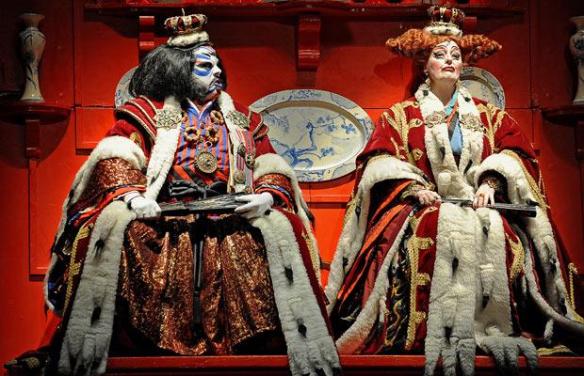
The inside of the Sydney Opera House is controversially unfinished; the original architect stormed off in a huff during construction, leaving the building looking nice on the outside but a sub-Barbican mess of concrete and tubes within. He supposedly came back to consult on the finish, but the toilets still seem like an afterthought.
Jacqueline in the bar was an accomplished saleswoman: “I would like to point out that we are 100% full, so it’s a good idea to order your drinks for the interval so you don’t have to elbow your way through people who can’t make up their minds. You can have them in the North Foyer, with a lovely view of the harbour. So lovely, in fact, that that’s where we put all our ugly bar staff. Or you can have them here in the South Foyer, where the view is not so nice, but the staff are prettier.”

It often felt just like the Barbican. A trillion miles away from London, there were the same cardigans and snorting fat girls; the same impossibly long walks to a dead end; the same scrubbed children politely trying not to admit they are bored out of their minds; the same smattering of youthful, preppy drama students who have to be there for their homework, and the same herd of doddering tosswits who seem to be confused by the sight of a staircase, but give it a go anyway with ponderous, meandering slowness while a crowd backs up behind them.

The Mikado was exactly what I was expecting from Gilbert and Sullivan – a twee pantomime. As with their previous Pirates of Penzance, the Australians did everything they could to liven it up with comedy business and pratfalls, and put a charismatic local in the role of the Lord High Executioner: Anthony Warlow, former Pirate King and Phantom of the Opera, who stopped the show in act one to impersonate Michael Crawford. In keeping with local ideas of what an ex-convict would sound like, he kept an Australian accent and made occasional sarcastic asides about how ludicrous everything was. The “Little List” song of things that piss him off was altered to include a bunch of Australian malaises, achieving the writer’s desire of ensuring that there were belly laughs in the first half, although to be honest, they were the only ones.

The wet romance of dull Nanki-Pu and self-absorbed Yum-Yum did not interest me in the slightest, but the costumes were nice, and the audience was, I am mortified to report, better behaved than the English equivalent. There was a rustle of excitement among the Australians when the Lord High Executioner began singing “Tit Willow”, as this appears to be a song known to them out of context, and many had no idea that it was from the Mikado. I certainly first heard it on the Muppet Show sung by Sam the American Eagle, so there perhaps some Australian vaudeville artist has crooned it out for no apparent reason as well.

I was far more interested in the aims of the original Mikado, written in 1885 at the height of Japanesquerie, when the impoverished samurai class of Japan, left behind by the onrush of modernity after the Meiji Restoration, sold off so much of their family treasures, dumping them on the European art market where they were snapped up by the likes of Arthur Liberty. The opening chorus speaks of being the men of Japan, familiar from “many a vase and fan”, and alludes to the mystery and awe felt towards the Japanese, so recently forced to open their doors to the world after 200 years of isolation, revealing an entirely alien country stuck in an oriental time warp.

1877 saw the revolt of Saigo Takamori, a doomed war in the south led by the fabled “last samurai”, a man who refused to kow-tow to the new order and paid for it with his life. It was the events of this uprising that inspired Madama Butterfly a generation later, with its talk of a teenage girl whose family must sell her because of their own poverty, itself caused by her father’s hapless participation in an unspecified samurai revolt. In 1884, when Gilbert and Sullivan were working on their operetta, Japan was briefly plunged into another conflict, when peasants in the famous silk-weaving region of Chichibu rose up in themselves. In the days before Hepburn romanisation, this would have been written Titipu, and no doubt the English found it dreadfully amusing.

Meanwhile, a bunch of Japanese set down in Knightsbridge and constructed what was referred to at the time as a “Japanese village” – some sort of ghetto and/or theme park where the English went to gawp at performers and buy tat. I am fascinated by this event – who were the Japanese who turned up in Knightsbridge, and how long did they stay? Knightsbridge is still crawling with Japanese to this day, as it’s where the Japanese embassy staff all seem to live. Were the people in Knightsbridge really representatives of central Japan, or were they early emigrants from Satsuma and Choshu, those two fractious southern domains who were instrumental in the Meiji Restoration, and who sent so many early students abroad to study foreign ways – including the future Admiral Togo, in England from 1871-8. I do find it spooky that amid all the cod-oriental, willow-pattern nonsense and whimsy, a fragment of real Japanese music should suddenly burst out of the performance, as the Mikado himself arrives and the chorus briefly sings a recognisable shard of the Satsuma battle hymn: “Miyasama, Miyasama…”, the Japanese broken and garbled, but still recognisable, the tune exactly reconstructed. Someone, it seems, has heard real Japanese people singing a real Japanese song, and has attempted to faithfully transcribe the lyrics, managing to salvage about six short lines.

Prince, 0 Prince!
What is it
Fluttering there
In front of your horse?

The next verse, which they didn´t include, should go:

Don’t you know that that
Is a royal brocade flag
Signifying our resolve
To defeat our enemies?

The royal brocade flag, of course, was knocked up by the Meiji Restorationists to shame their opponents into surrender, when the only other option is to charge against the imperial banner. There is something thrilling about hearing pieces of real history poking through a throwaway English operetta, thousands of miles from home, and thousands of miles even further away from the battlefields where it was first sung.

Jonathan Clements is the author of A Brief History of the Samurai.