 The Big Name Toy Company designed everything from the ground up, creating toys and cartoons in tandem. They had me working on six concepts for a TV series, that would be whittled down to three, then two, then one single idea that would be taken to the central office. There, it would compete with ideas from six other offices around the world, until the company put maybe a billion dollars factory time, animation, and advertising behind a single winning concept. They planned four years ahead. The toys in your stores this Christmas? They were decided in 2002.
I got to see The Book, a giant tome of psychology reports some six inches thick, containing what amounted to racial profiling of children around the world. Children in South America were more likely to play outside, German kids liked mechanical things earlier, and so on. When I turned to the Japanese section, two words jumped out at me: “Solitary Play”.
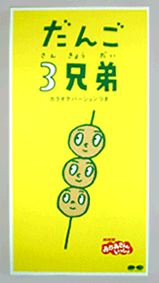
I started hearing a strange little tango song in my head, a Japanese novelty hit from 1999 about three dumplings on a stick. It began as a joke by commercial director Masahiko Sato, but for some reason it took off. Kids liked the catchy tune, but the main audience for it was the parents. The single sold more than three million copies in Japan, and before long, an anime followed. It, too, was only little — three-minute inserts as part of the series Watch With Mother. But The Dumpling Brothers anime ran for five years, only coming to an end in 2004. Let’s put that in perspective — an anime for the fan audience is considered a roaring success if it lasts for five months.
The Dumpling Brothers caught the mood of the time. Japan doesn’t have a draconian one-child policy, but sometimes capitalism can exercise its own constraints. Single offspring are increasingly common, and that severely limits family dynamics. After two generations of belt-tightening and downsizing, fewer Japanese children have brothers or sisters. Moreover, they are increasingly less likely to have any uncles, aunts or cousins. Much of the interest in The Dumpling Brothers seemed born of parental nostalgia, looking back to when they had siblings to play with, and with a sense of regret that their own children would never have the same experience.
The same period saw I Love Bubu Chacha, an anime series about a boy who discovers that dead pets and circus animals have been reincarnated as his toys. The only ‘human’ friend he has is a neighborhood girl who pretends to be his sister, although she is actually a ghost. The viewers who watched these shows as children are now old enough to buy Angel Tales.
Some modern anime seem made specifically for viewers that are not part of any community; solitary shut-ins with few if any friends. But anime toys have always been ready to fill the breach, and to exert pester-power on a workaday dad returning home to his nuclear family, and searching for a way to buy his kid’s affections. You hear it several times a day in anime for children.
“My father gave me a robot. My father gave me a robot. My father gave me a robot.”
Jonathan Clements is the author of Schoolgirl Milky Crisis: Adventures in the Anime and Manga Trade. This article first appeared in Newtype USA in 2006.

 I tried to say it politely. The Japanese author had spelt two names wrong, misdated a crucial release, and assigned a famous quote to the wrong director. For no extra charge, I had footnoted those problems on the translation and sent it off.
 The Official Schoolgirl Milky Crisis Blog