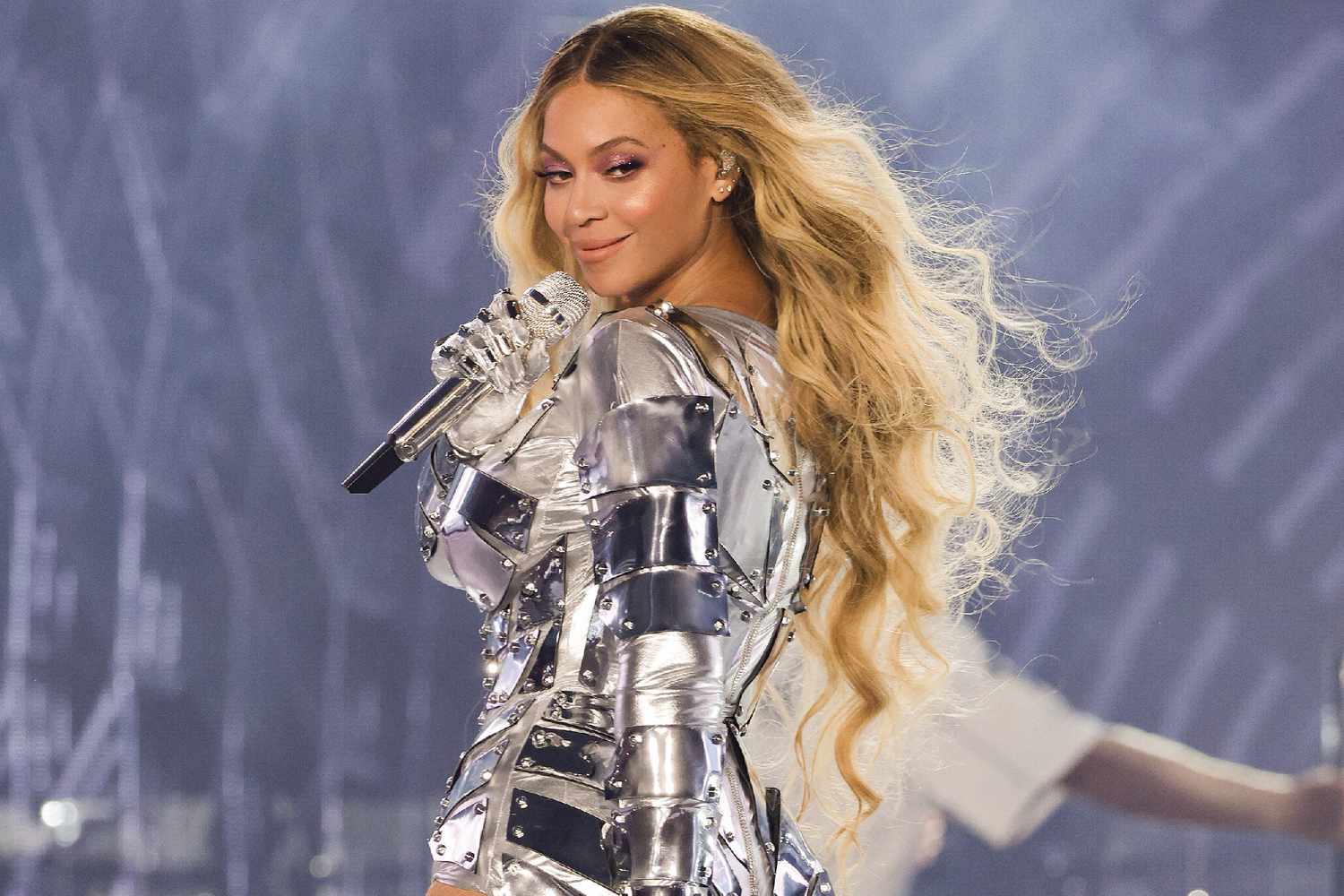
No, not radiation. Not the struggles of war and the agonies of constant trauma, transforming into a rampaging, city-stomping beast. Because that would be the trailer for a Godzilla movie, and those words are spoken by Beyoncé Knowles in the advert for her concert movie Renaissance. And both of them are fighting for space on IMAX screens.
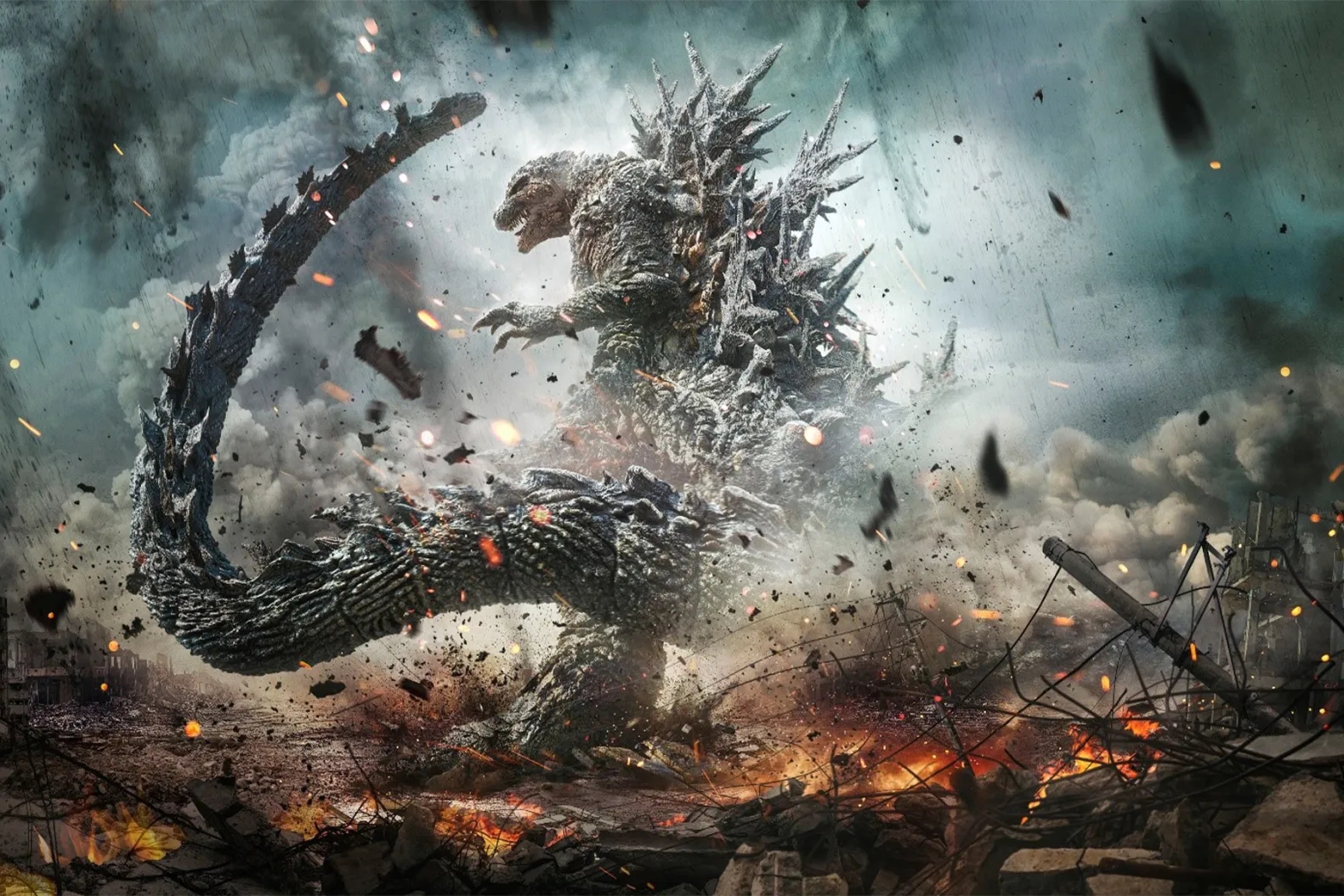
Takashi Yamazaki’s Godzilla Minus One is a stark reboot of the monster franchise, playing upon the idea that Japan in 1945 has already been reduced to “zero”, and that an attack by an unstoppable beast just makes everything so bad that we go into negative numbers. But whereas Minus One hit many cinemas outside Japan at the beginning of December, its UK release waited a critical couple of weeks, in a business decision that might end up benefiting absolutely everybody.
The UK has 52 IMAX screens, while Ireland has another two, with the majority of the screens being part of Cineworld/Odeon cinemas. That’s substantially less than the United States of America, where presumably Godzilla Minus One and Renaissance would be able to jostle for audience attention without wrecking the theatres.
I put the question to Anna Francis at Minus One’s UK distributor, Anime Limited, who conceded that Beyoncé’s Renaissance had already been booked into a number of IMAX screens before Godzilla began clambering out of the sea to smash stuff. But Beyoncé, she states, “was only part of the picture… the main reason was that we wanted to avoid the busier film period at the start of December.”
So, it’s not that the King of Monsters was scared of going head-to-head with Queen Bey, more like the presence of multiple distractions as the holiday season got going. Instead, Minus One got its UK release on 15th December, gaining a fortnight’s respite before yet another monster blockbuster landed in cinemas on Boxing Day: Hayao Miyazaki’s The Boy and the Heron.
But wait a minute, Minus One dropped on 1st December not just in the USA, but also in Canada, France, Italy, Spain, Poland, Australia, New Zealand and even Belgium. Could it be that all those places were confident there was no cross-over, whereas British audiences demonstrated an equal love for both the Big G and the Big B that had to be accommodated? At least they are spared a Barbenheimer decision…
Jonathan Clements is the author of Anime: A History. This article first appeared in NEO #237, 2024.
“The ability to buy into the ‘ownership’ of a new anime while it is being made can save a canny investor hundreds of thousands of dollars at the distribution end.”
Over at Variety, Mark Schilling interviews me about the pitfalls of international animation co-productions between Japan and other Asian countries — a good chance for me to quote from the China chapter added to the second edition of my Anime: A History.
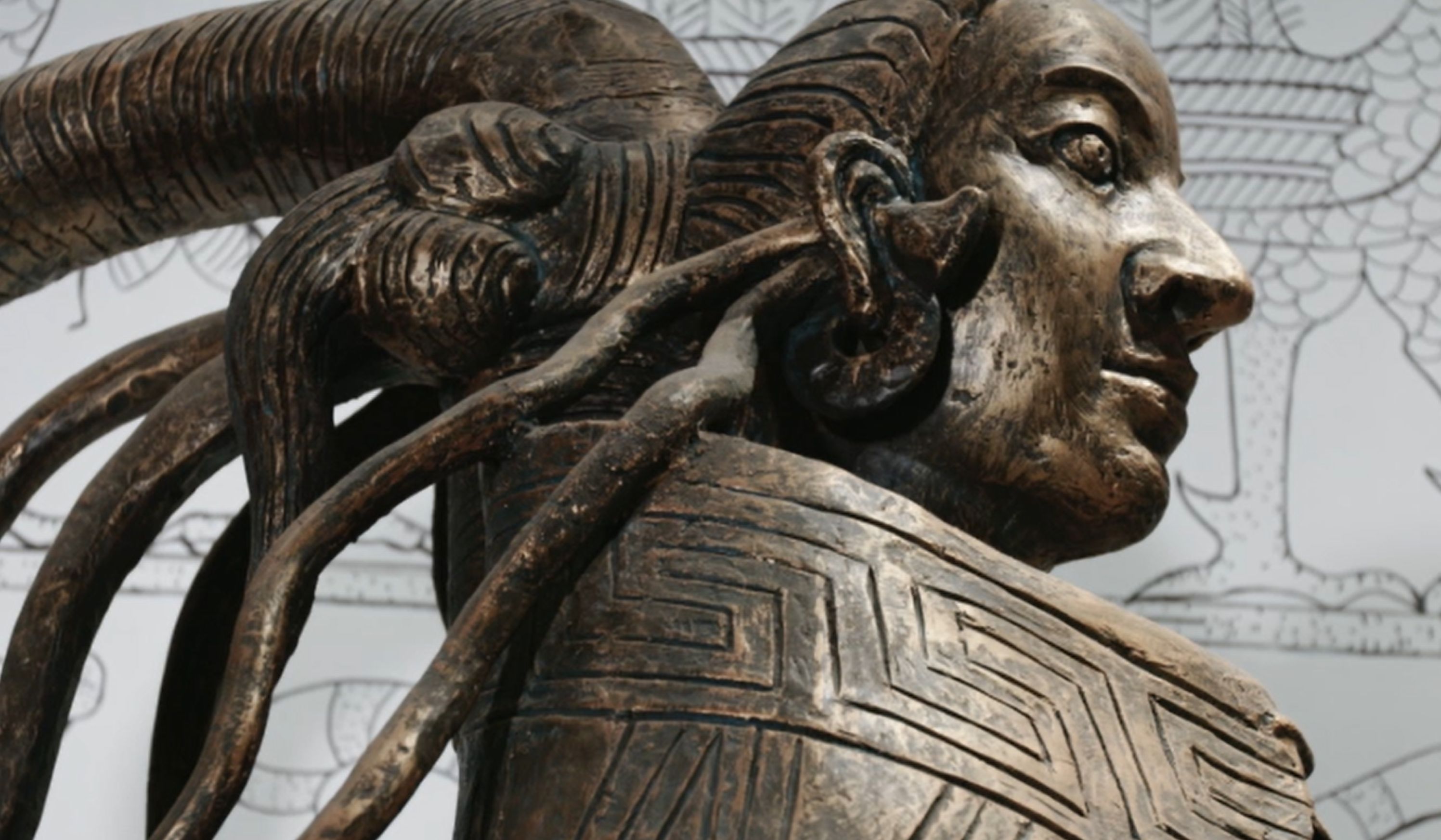
Up at 0630 for the two-hour drive around the lake to the village where Yang Shaohua has his gallery and workshop. I blunder in late, thanks to having the wrong address, and find him holding court around a posh tea table, chuffing on a water pipe like a giant bronze bong.
Mr Yang is handsome and charming, knowledgeable and talented. I know that sounds like me buttering up some Party bigwig, but he knows the bronze-casting process so well that he can give a ten-minute speech in answer to a simple question about how it’s done. He knows everything from the chemical formulae to the metallurgy mix, and he doesn’t just cast the bronze, but carves the models and draws the original concept artwork. He is also a great host, faffing with his tea paraphernalia while the crew smokes fags in his gallery, so much so, that we seem to lose over an hour during the day to tea.
Mr Yang is responsible for a lot of the statues I have marvelled at in Chinese public spaces, including the giant golden phoenix in front of the Yunnan Provincial Museum. He tells me about the three-metre Mother of Dragons he made for a temple to the Baiyi people’s famous rain goddess, and his biggest-ever Buddha, a ten-metre effigy for a temple somewhere. At the moment, he is working on soldiers for the Songshan military memorial, although when he leads me into the modelling room, I am surprised to find four life-sized clay men standing to attention in puttees, pith helmets and Hitler moustaches.
“They are Japanese devils,” he explains. “They get a lot of Japanese tourists there, so I suppose it does no harm to give them something to take a selfie with.” The Japanese soldiers all have real shoelaces and stitching, because it’s easier to do that and let the wax mould take an impression from the real thing, than it is to painstakingly carve them.
Since he is an official Intangible National Treasure, the Propaganda Bureau are all over this one like a rash. A beaming woman in clacking heels keeps ruining the sound recording, while her minion with a clicky camera keeps wandering into the background of every shot.
“A cameraman,” mutters our director, “of all people, should know not to ruin someone else’s shot.” She is particularly annoyed because Propaganda are insisting on “entertaining” us at a lunch banquet, which gives us only an hour to shoot our interview before we are dragged off to a restaurant with eleven other people, and forced to make small talk with a bunch of local officials only there for the free boondoggle, who manage to piss me off from the get-go by asking me if I can use chopsticks.
Bearing in mind that I had walked into the room, introduced myself in Mandarin, and embarked upon a conversation about Bronze Age culture in south-west China, I think my “of course” was an object lesson in tact. The last thing I want is chili fish-head soup for lunch, and the last thing our director needs is an hour ripped out of her shooting schedule a mere hour after we started.
Mr Yang, in the meantime, is having a whale of a time talking to us about his work, which often involves reproductions of Dian Kingdom artefacts. The museum people, in fact, have so much trust in him that they have let him digitally scan all the Dian Kingdom finds, and he does a roaring trade in replicas of the Famous (not that famous) Cow and Tiger Table.
He warms to me right away when I correctly identify a taotie totem beast on a replica Shang cauldron, and immediately ask him if a stylised goat was made for Yuexiu park in Guangzhou. I am, in fact, able to tell him that I have seen several of his statues in various parts of China.
“Do you need a bronze bust of yourself?” he asks. “I can knock one up for £3,000.”
No, I say. Nobody is interested in seeing my bust.
It’s not the easiest of days, because shooting in a foundry next to a building site is a non-stop cacophony that plays havoc with the sound. Nor do we have footage of several parts of the process, including the all-important molten bronze bit – we are trusting Mr Yang to send us something shot with his phone. It doesn’t help that the gallery has three mangy guard dogs who have industriously shat everywhere. But Mr Yang shows me how to pour wax into the mould to make my very own Famous (not that famous) Cow and Tiger Table.
The wax is then wrapped in clay, and the clay mould thus formed is heated until the wax flows away, leaving space for the molten bronze.
“Of course,” he says, “back in the old times they used beeswax, but these days we use the industrial variety.”
The word for honey in Old Chinese is an Indo-European import, mjit (as in mead), implying that honey husbandry, like chariots, is something that came into China with foreign settlers sometime in the Bronze Age. And that means that the Bronze Age itself could also very likely have been something imposed on the Chinese by foreign invaders – mysterious elites like those Dian warriors.
“Oh, I’m not surprised,” says Clicky the Cameraman from Propaganda, as we sit around the tea table for yet another break. “I mean, there’s a whole foreign city under the water of the lake here. They found it when they were laying cables for the power plant, and the government banned anyone from investigating further.”
The underwater city in Fuxian Lake was supposedly carbon-dated to 250 BC, around the time of the Dian Kingdom, but our director refuses to believe it. She suspects that the whole thing was a hoax thought up by local students to promote tourism in the region. “Not really,” claims Clicky from Propaganda. “The reason there hasn’t been any news about it since 2007 is that we’ve put a blanket ban on talking about it.”
Mr Yang doesn’t want us to leave. He lures us back to the tea table for another cup, and then points out that because we have a two-hour drive home and it’s already six, we might as well stay in town for dinner.
“I know of a lovely place nearby that does traditional peasant food,” he promises. It’s only when we are standing outside that he proudly announces: “The specialties are fish-head soup and tripe.”
Jonathan Clements var ikke helt så tweedklædt og stiff upper lip en brite, som jeg havde forestillet mig. Han var tværtimod en utroligt imødekommende herre i T-shirt og med gråt strithår. [“Jonathan Clements was not quite as tweed-clad and stiff-upper-lip a Brit as I had imagined. On the contrary, he was an incredibly welcoming gentleman in a T-shirt and with gray stubble.”]
This is why you should always dress up for Zoom conferences. Over at Zetland, I discuss Hayao Miyazaki and Pippi Longstocking, as part of Marie Carsten Pedersen’s beautiful article about what Totoro means to her. Well worth a read (and a listen), even if you need Google Translate to navigate the Danish.
A weeping young emperor is escorted to his palanquin by a stern-faced warlord, on the grounds that there are “bandits everywhere.” The warlord in question has already burned another prince alive, and the “bandits” are his own, sinister men.
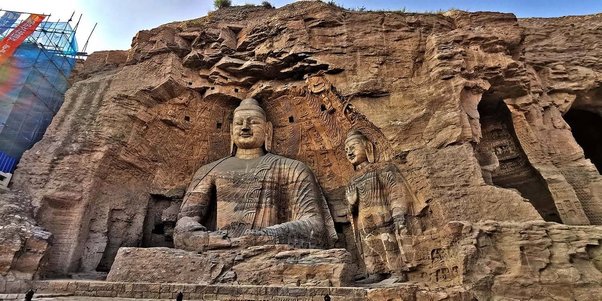
For two hundred years from the fourth to the sixth century AD, northern China was over-run by a group of nomads. Much like many others in Chinese history, they leeched off the locals, established themselves as the new aristocracy, and soon began to squabble about whether to hang onto their “barbarian” ways or go completely native. By the end of their reign, they had moved in to the former capital of the Eastern Han dynasty, filling it with newfangled Buddhist temples and statuary. Their “Northern Wei” dynasty, in only ruling part of China, is one of those that are often edged out of histories, despite its idiosyncratic and original works of art and culture, and its larger-than-life rulers, who stick out in Chinese museums like an alien invasion.
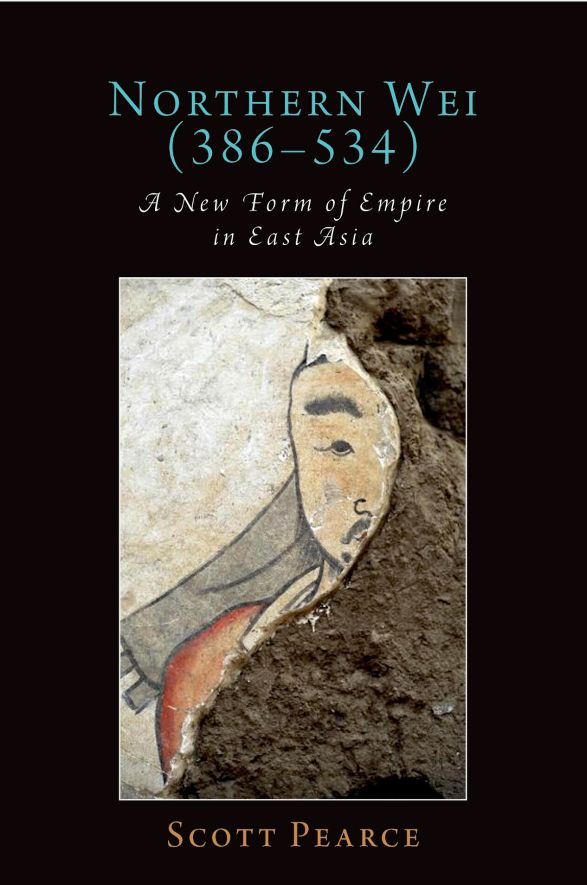
Dzyip-yip-ken, for example, the “crimson lord” stands six feet six inches, with hair that trails on the ground. He’s by no means the weirdest character in Scott Pearce’s delightful new book, The Northern Wei: A New Form of Empire in East Asia.
A nomad ruler claims to be the son of a maiden who descended from heaven in a glowing chariot. Discredited nobles live in fear of being assigned to the Wuhuan, a “vanguard suicide unit” that defends the border. A war band gains a new leader when they sacrifice a horse to a dragon, and the fearsome beast transforms into a young boy.
Pearce is gleefully aware that his diligently referenced and entirely accurate account of the dynasty that ruled north China from 386 to 534 AD reads more like a fantasy novel, noting on one occasion that he is describing “a tableau that seems scripted for a B-movie.”
“The brutality,” Pearce writes, “the barbarism of this age is almost unspeakable.” A minister “solves” a refugee crisis by drowning 8,000 people. A court lady smuggles an infant crown prince out of a harem massacre by shoving him down her trousers. An emperor is driven mad by the Daoist potions he is drinking as an aphrodisiac. Another manages the remarkable feat of siring over a dozen sons on a dozen women before dying, presumably of exhaustion, at just 23. A fallen minister is taken to his place of execution in a caged carriage, and before he dies, is urinated on by an entire company of guardsmen.
The world Pearce describes is joyously alien, where people have names like Bjij, Xae-ljen and Jijlej of the Bulwukku. They called themselves the Taghbach, although the term, like all the others, was elided and sanitised by Chinese historians, turning them into the Tuoba. Spears trail “toad streamers”, and prospective empresses must demonstrate their ability to forge a golden statue. Baffled Chinese chroniclers attempt to make sense of spats, vendettas and blow-ups between the aristocracy, which often lapse into Taghbach slang, while the Taghbach themselves prey upon the people of northern China like a coterie of elegant vampires. The Northern Wei was a regime that turned China upside down, often scandalously privileging the role of women in its society. It was, notably, the era that gave us The Ballad of Mulan, and which began to establish the rise to prominence of women as leaders and political actors. Two centuries later, its legacy would turn into the backlash against the “transgressive typologies” of an era of women in power.
At the start of the era, the Taghbach are dismissive of Chinese ways. One scoffs: “Try putting on Han silks and then riding around on your horses through the brush and brambles.” But as the regime wears on, the “braidhead caitiffs” (as they were called by their southern enemies) are slowly assimilated into Chinese ways. They are lured into Chinese customs, take Chinese wives, and eventually, with their original capital at Datong creaking at the seams and unsustainably large, relocate off the steppes to Luoyang, the former capital of China.
On the way, they pack local culture with new and unusual differences, some of which would endure ever after. As attested to by their magnificent statues and carvings at Luoyang and Datong, they fervently embraced the foreign religion of Buddhism, (founding, for example, the Shaolin Monastery) jamming it so deep into Chinese culture that it never left. Pearce notes many other influences, including the increasing presence of women in social and political life. He points out that imagery of Han dynasty banqueting shows womenfolk peeking in from a balcony while the men enjoy themselves. By the Dark Ages, the ladies were dining in their own separate chamber. But it’s under the Northern Wei that women come to control the feast – overseeing the menu and the food, and even leading the diners in song.
As for the Northern Wei, it fizzles out in a cataclysm of bed-hoppings and stabbings, as the shadowy families behind the scenes fight to put one of their own on the throne in a time of climate crisis, interpreted by soothsayers as heavenly displeasure, manifesting in droughts, diseases and crop failures. Marital politics dominates the court, in a “complexity that is perhaps wearisome for the modern reader” writes Pearce, who is entirely sorry-not-sorry about a history book that ends with an Empress Dowager proclaiming that her hostile teenage son’s newborn daughter is really a boy, and therefore the new emperor… before grudgingly changing her mind.
It actually gets even crazier after that. For Pearce, this amounts to a book-length prologue to his 1987 Princeton doctoral thesis, The Yü-wen Regime in Sixth Century China – which outlines the even more bonkers rise and fall of the short-lived successor dynasty, the Northern Zhou, but that is another story…
“The city had been destroyed before,” he writes of the glorious Luoyang, “and would of course be destroyed again.”
Today’s Sunday Times (paywall) picks my Rebel Island as one of its Five Essential Books on Taiwan.
“Jonathan Clements’s Rebel Island: The Incredible History of Taiwan takes a concise journey through the island’s complex history and all the different ethnicities, refugees, mavericks and nationalities that have come together to make modern Taiwan.”
“I had a pretty tough life until I became popular with Maruko. I had so many part-time jobs, and even when I debuted as a voice actor, I was good at being poor, but… I was happy because my voice was similar to Momoko-chan’s.”
Over at All the Anime, I write the obituary for the actress singer-songwriter Tarako.
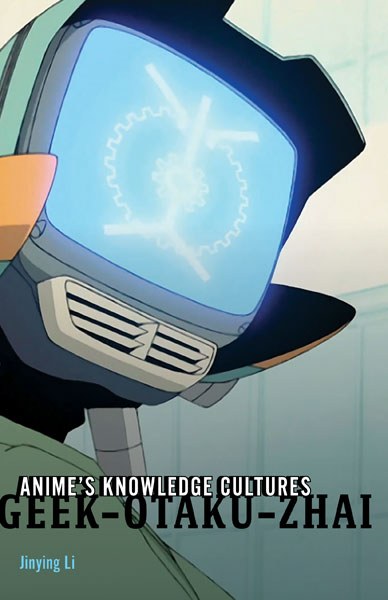
“There was… an initial explosion of Japanese animation on Chinese television, spearheaded by Osamu Tezuka’s Astro Boy, which Li characterises as a delivery system for adverts for Casio watches and calculators. It, like many others – including Transformers, and outside anime, Mickey Mouse and He-Man – was practically given away free to the Chinese networks in order to seize control of the all-important advertising space in between the programmes. In the case of Astro Boy, he even starred in the commercials, bragging that Casio used the same technology that made him (presumably without the arse-mounted machine guns).”
Over at All the Anime, I review Jinying Li’s new book Anime Knowledge Cultures: Geek – Otaku – Zhai.
I’m finding it a little bit difficult to breathe. Kunming is a mile above sea level, which makes itself felt in the time it takes to boil water, the dryness of the air, and the fact that I am out of breath after racing up a flight of stairs. But it is a wonderfully clean city, there are lot more pretty girls here than in most other parts of China (our director says the boys are good-looking, too), and the people are oddly friendly. At one point today we were mobbed by ten policemen, who had not been informed that we would be filming outside the museum, but they were all very polite and smiley, and once our credentials were proven, bent over backwards to help us, stopping the traffic and even giving our sound man and his gear a lift to the entrance.
The new Yunnan Provincial Museum glows red-gold in the sunrise. It has been designed, supposedly, to resemble the famous Yunnan Stone Forest. But it is packed with materials from the culture that once flourished on the shores of Lake Dian, which had largely faded from view by the end of the Han dynasty.
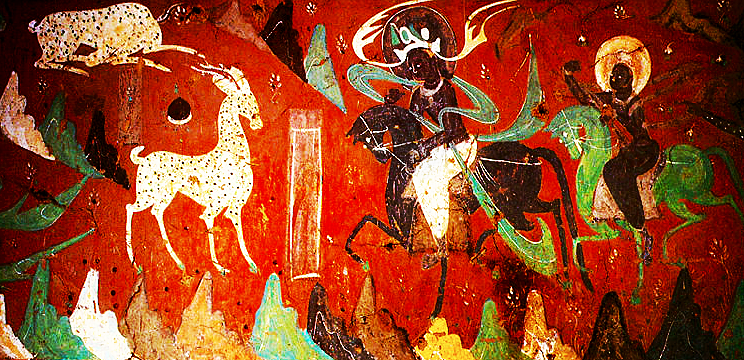
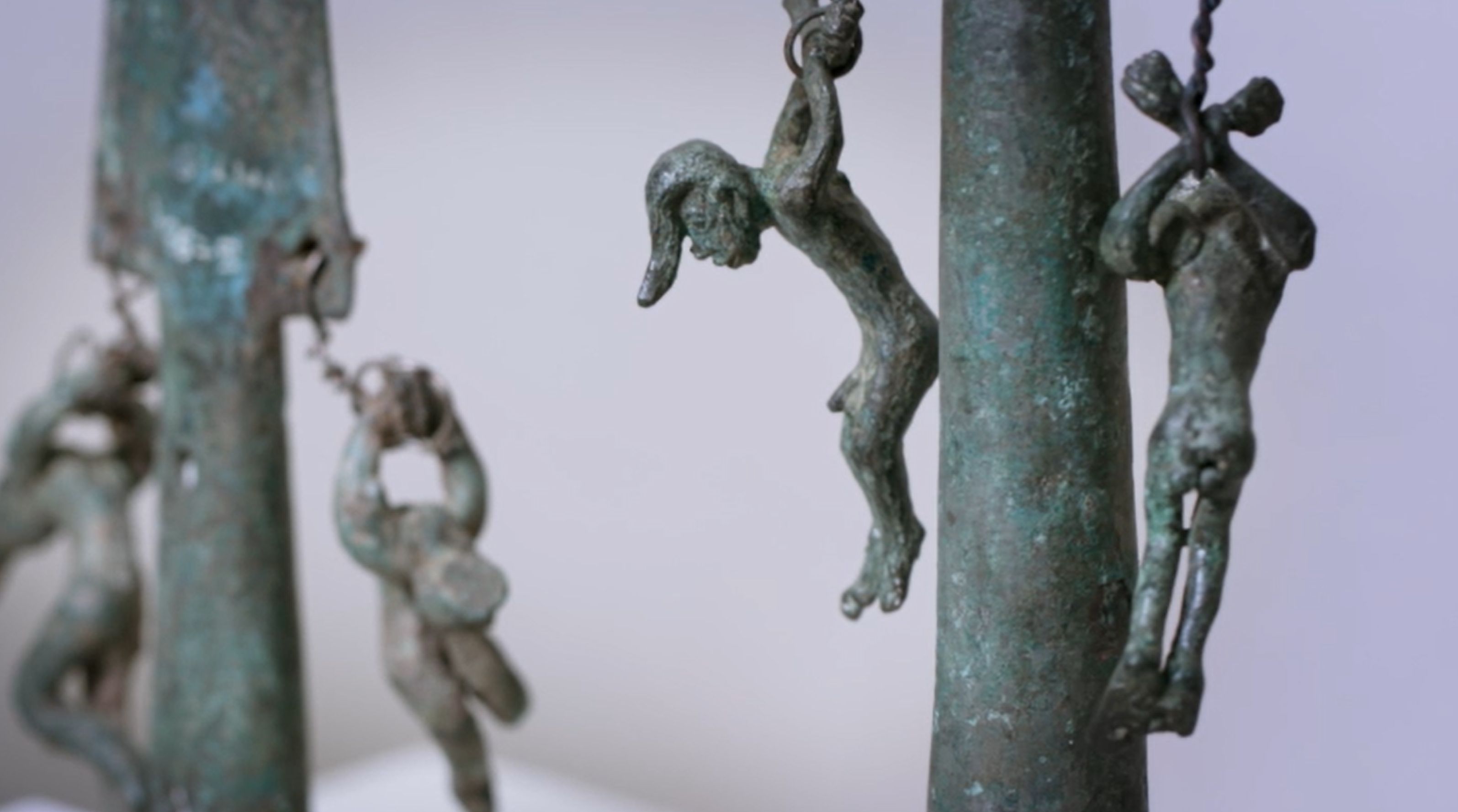
Nothing survives of the Dian people but the stories about them in the Grand Scribe’s Records, and whatever has been pulled out of their graves. And with the caveat that the graves reflect the lives and attitudes of the ruling elite, it shouldn’t surprise us if their artefacts come across as a bit, well, cruel. The Dian kingdom, at the time it was assimilated into the empire of the Han Chinese, was home to a peaceful race of cattle herdsmen, ruled over by an equestrian elite who seemed to take an odd pleasure in depictions of violence.
Their shell kettles (cowrie shells were money) come decorated with intricate battle scenes, featuring captives being dragged away for sale, victims pleading for their lives, and a wounded man crawling from the battlefield, unaware that a mounted cavalryman is bearing down on him. In one of the tableaux, an enemy soldier appears to have the upper hand, not seeing the man on the other side of the battlefield taking aim with one of those new-fangled crossbows.
The glee in which the Dian seemed to take in the suffering of others is repeated throughout their artefacts. Twin spearheads feature decorations of dangling slaves, hanging by their wrists. Belt buckles feature scenes of boars fighting panthers, and lions locked in combat. The most famous Dian artefact is a low bronze ritual table in the shape of a cow being mauled by a tiger, and yet still standing protectively over its calf.
Several archaeologists have suggested that the Cow and Tiger Table is loaded with symbolism – that the cow represents the locals, while the tiger stands for their horrid overlords, and the calf for local traditions that refuse to be snuffed out. The rulers of Dian, it has been suggested, were originally a band of Scythians, pushed out of Central Asia around 200 BC, who lorded it over the locals in Yunnan until the Chinese turned up to turn the tables.
The Dian themselves disappeared from history around the time that the Grand Scribe’s Records wrote them up. They were invaded by warriors from Chu in the late Warring States Period, and the victorious general was just about to report home when Chu fell to the First Emperor. Rather than return to an uncertain future, he turned his army around and settled by the Expansive Lake (Dian), and his soldiers soon faded into the local population, whose former style favoured dreadlocked horsemen, barefoot in all statuary and carving, tattooed with writhing snakes. They enjoyed what UNESCO still describes as the most biologically diverse region in the world, spanning the upper reaches of the Yangtze (here known as the Golden Sands), the Mekong (here known as the Lancang) and the Salween (here simply called Nu, the Angry River). Since the Red River, which goes all the way to Hanoi, also rises here, the Dian kingdom sat the crossroads of several major cultures, trading with the Shu and Ba kingdoms of Sichuan, with what is now Vietnam, and towards the west.
Fan Haitao, who set up the Dian gallery in the Yunnan Provincial Museum, takes me through a small selection of the foreign objects dug up locally, including a buckle representing a winged lion (lions, winged or otherwise, being unknown in China back at that time) seemingly from Persia or Afghanistan, agate beads from Pakistan, and glass from India.
“Our biggest find,” he reveals, “was at a place called Yangfutou, which was under the flight path of the Flying Tigers.” The American mercenary airmen, famously posted to Yunnan to make life miserable for the Japanese, used to fly over a low hill near their base, and observe that it was a nice place to be buried. Yangfutou was turned into a graveyard for the Flying Tigers, which was when diggers started to unearth strange objects. It was not, however, until 1999, that Yangfutou revealed its greatest treasure, the grave of a forgotten Dian nobleman, complete with cowrie shell moneybags, bronze drums, and fiendishly decorated weaponry.
“The grave was under the water table,” he tells me, “so it was completely waterlogged. This meant that we didn’t just get the bronze, but some wooden pieces and the lacquerwork ancestors.” He points at a series of animal-headed dildos, the word “ancestor” also meaning “penis” in Chinese.
So, I ask innocently, what were they used for?
“I think,” he says carefully, “they had a… ritual quality.”
Why are they so small, I ask, pointing at the largest one, which is truly massive. But we can’t use the footage, because the crew was giggling so much at the look on his face.
Jonathan Clements is the author of A Brief History of China. These events featured in Route Awakening S05E03 (2019).








 The Official Schoolgirl Milky Crisis Blog