Toshio Suzuki has spent the last 20 years carefully steering late-era Studio Ghibli, a company that arguably cannot really function without the input of its three greats – Hayao Miyazaki, the late Isao Takahata, and Suzuki himself. In 2008, Suzuki appointed Disney Japan’s Koji Hoshino to take over as company president – a smart move, finding a man with world-class knowledge of running a cartoon company’s legacy.
But now Hoshino has resigned, claiming that the completion of Miyazaki’s How Do You Live?, is a good time to go, particularly since Hoshino’s going to be 67 in May. An alternative version of the story in the Japanese tabloids has Hoshino leaving under a cloud because his predecessor needed to “properly separate his public and private life.” Suzuki might have stepped down as president in 2008, but never quite went away, functioning instead as a general manager, whatever that means.
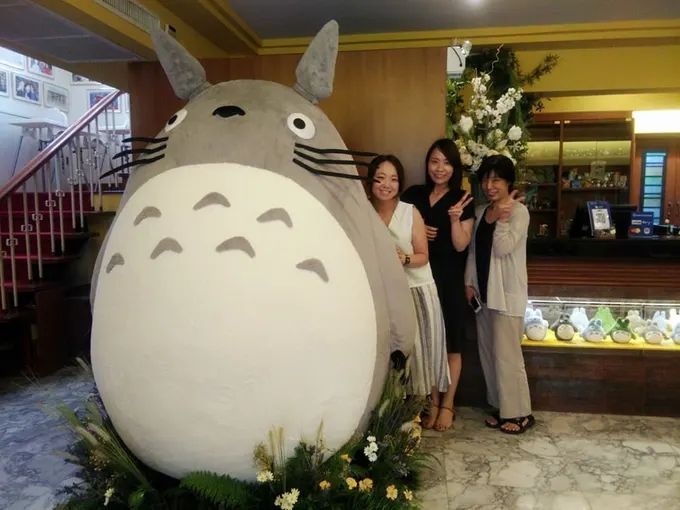
Suzuki, whose memoir of working at Ghibli carried the winning title Mixing Work with Pleasure, has been dishing out jobs to his Thai girlfriend Kanyada “May” Phatan. The two have allegedly been an item since she sold him some roadside chicken wings in 2013, after which Suzuki invested in her spa and restaurant. When those businesses went under, Suzuki steered Ghibli itself into authorising a Totoro café in Bangkok in 2018, May’s Garden House Restaurant, which shut down the following year just ahead of COVID.
Not to be deterred, Kanyada resurfaced as the mononymic photographer for The Ghibli Museum Story (2020), and for a book the same year of Toshio Suzuki quotations. She also writes a monthly poem for the Ghibli in-house magazine Neppu, and last month was feted at an Iwate exhibition of her photography, to tie in with a new, rather thin, compilation book.
In the era of Boris Johnson and Donald Trump, this barely moves the needle on the scandalometer. Some Ghibli staffers might bristle at the whiff of privilege, but it’s not like Suzuki hasn’t got form. He literally put a landscape gardener in charge of Tales from Earthsea because the guy was Hayao Miyazaki’s son. And nor is it all that unusual for people to get hired on the basis of personal connections, like that guy Roy Disney at Hoshino’s old company. Le Monde, of all places, fumed that Suzuki took the chance at the Iwate exhibition to “enjoy the hot springs with his girlfriend” which hardly seems like a crime.
If there’s any impropriety at work, it’ll be up to Hoshino’s replacement to clear it all up. That would be Toshio Suzuki, back as president after a 15-year absence.
Jonathan Clements is the author of Anime: A History. This article first appered in NEO #230, 2023.
My great-grandfather was one of the men that Tim Burrows writes of in his new book, one of the grime-smeared workers toiling in the Essex brickyards. He literally dug up the mud around him, compacting it and firing it into uniform rectangles of baked building material, shipping it west out of the county to build that ever-growing metropolis of London. Even as London looked down upon the people of the low-lying marshes to the east, those same people were working long hours, digging up the very ground they stood on, in order to raise their masters ever higher.
“Many nations have an Essex,” writes Burrows, “a much-mocked place that has grown up in the shadow of a major city to become the supposed spiritual homeland of the nouveau riche.” His book, The Invention of Essex is a well-told history of how this vaste swathe of what was once regarded as a “Home County” somehow became the butt of national jokes.
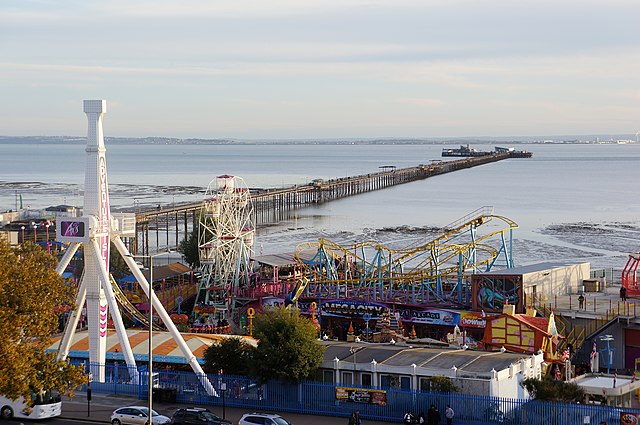
Burrows is in love with his birthplace. He recognises the many criticisms directed against it, but also takes infectious pleasure in recounting its tall tales and grotesque historical figures. In a gesture of heart-stopping romance, he chooses to marry his bride at the end of Southend Pier, transforming its mile-long stretch into the Thames Estuary into “the longest aisle in the world.”
Southend Pier forms a recurring topic in his narrative, not the least for the way in which it encapsulates the county’s long-running class warfare. Affronted at the sight of steamers passing the town by, Southend’s inhabitants built the first structure into deep water in 1830, extending and improving it repeatedly in the decades that followed. But just as Southend created a new anchorage for respectable middle-class travellers, the opening of the railway in 1856 suddenly brought the town within the reach of working-class day-trippers from the East End of London.
A local councillor, Alderman Brightwell, even made the modest proposal that Southend should practice some sort of class-based apartheid, with the hallowed pier as the line of division. In a demarcation that still can be glimpsed today, he suggested that the west of the pier should comprise the pursuits and habitats of Victorian ladies and gentlemen, while the east of the pier – today’s “Golden Mile” of amusement arcades and chip shops that stretches down to the remnants of the Kursaal amusement park (now a rough council estate), should be the playground of the shit-shovellers, factory-workers, barrow boys and slappers of the London “excursionists”.
But Burrows has a winning sympathy for that same underclass, taking the time to observe the awful conditions of their London lives, and the transformative effects that a trip to the “Essex riviera” might offer them. His history of Essex county thrills in the technological determinism of new inventions that transform daily lives and of new laws (such as the invention of the Bank Holiday in 1871) that create new opportunities.
Modern history is his main interest – particularly the two hundred years that saw Essex as we know it “invented” – but he also harks back to many earlier moments. There’s time for the bold Saxon noble taking a stand against the Vikings in Maldon; for the Boleyn family whose daughter Anne was the first infamous and defamed Essex girl; the experiments in social housing and new lifestyles, many of which were subsequently perfected elsewhere with no credit given to the pioneers. There’s the King of Bling whose Saxon grave put my own native Prittlewell on the map, and the historiography of Essex as a place “much-maligned”, from several centuries in the past to the year 2020, when the Oxford English Dictionary tardily removed the term “Essex girl” from its lists.
Burrows offers fascinating glimpses of the changes in the landscape, from its prehistoric origins in meltwater and retreating ice, to its many centuries of malarial swampland – no wonder the locals love their G&Ts, since the medical use of quinine was also discovered here. But before the marshes were drained of their mosquito-harbouring ponds, the “ague” fever was so notorious that the churchmen began to dread an ill-starred posting to “Killpriest Country.”
His book has a nobility to it, and a sympathy for its subject, as well as a ready eye for those moments in history and literature that have a poetry all of their own. In William Morris’s News from Nowhere, a time-traveller arrives in the 19th century to warn its inhabitants of the perils of the future.
“I come not from heaven,” he says, “but from Essex.”
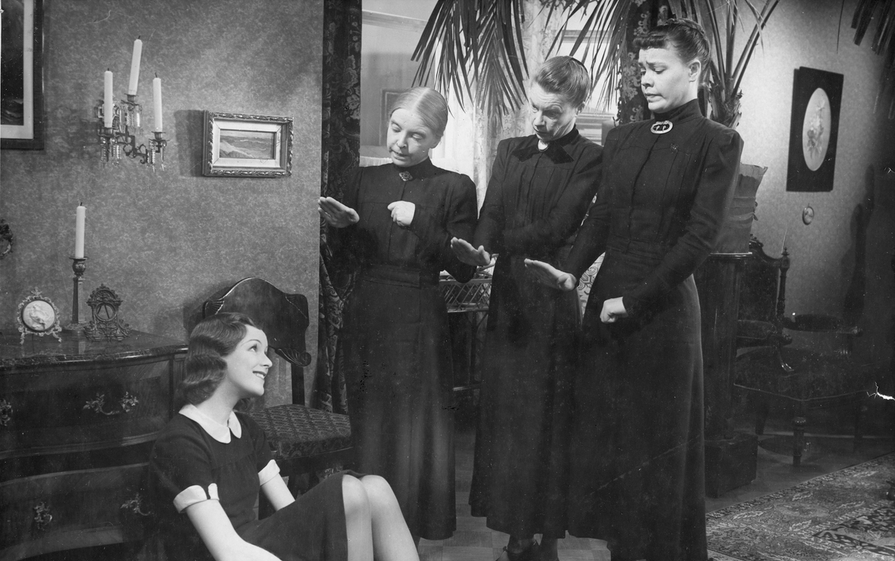
After what has plainly been a long, long wait through her teenage years, enthusiastically modern orphan girl Raili Wirma (Sirkka Sipilä) collects her inheritance and prepares to flee the stern supervision of her maiden-aunt guardians – a terrifying trinity of scowling women, who glower at her as she joyfully packs. They warn her that she might be biting off more than she can chew, but she laughs it off and skips out the door, ready to make her fortune as a secretary in That Fancy Helsinki.
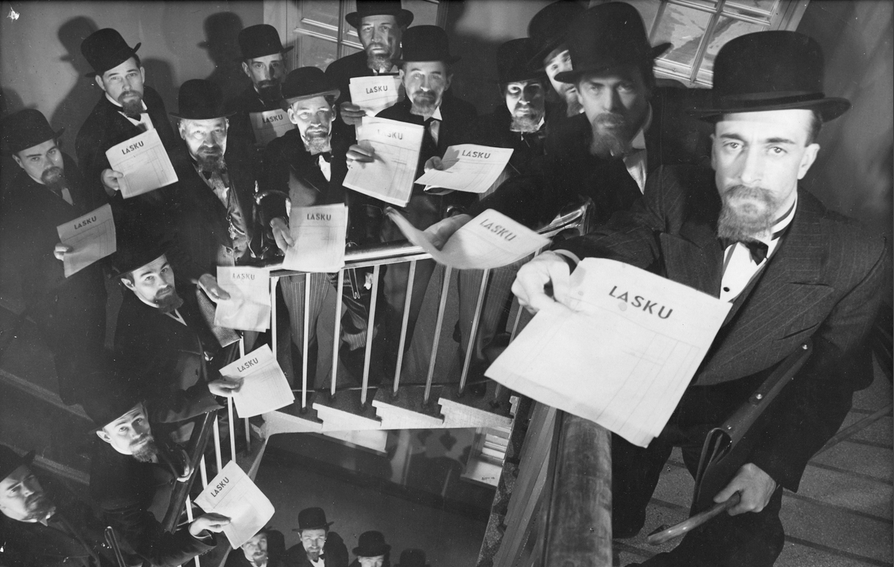
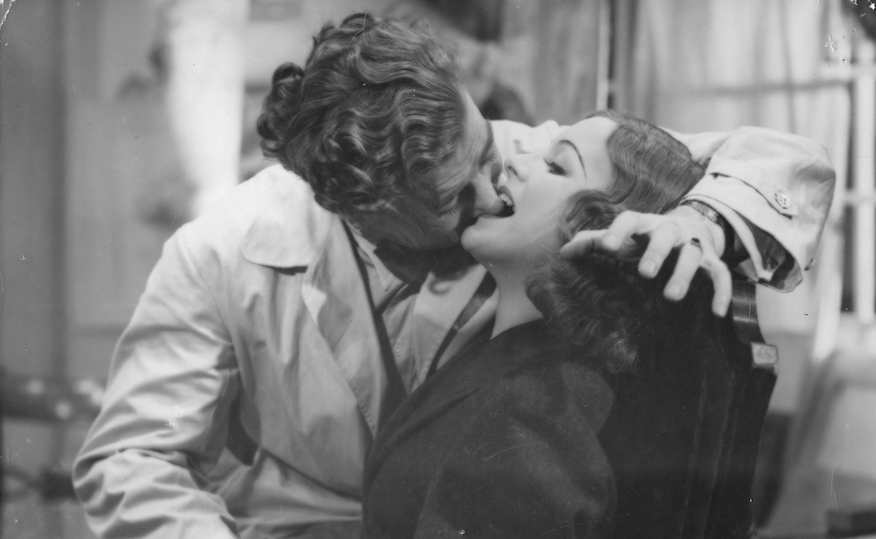
Before long, she is overwhelmed by the mounting costs of her bachelorette apartment, literally crowded by men on the staircase proffering bills. She is vanquished in office politics by Saara (Kaisu Leppänen), the boss’s favourite who even appears to be winning the flirtatious attentions of eligible bachelor Topi (Jorma Nortimo, directing himself, in his own script adaptation). Attempting to drown her sorrows at a “bachelor boy” party where all the girls dress up as boys, she becomes trapped in a series of misunderstandings, ejected from Topi’s house after she catches him a clinch with Saara, and roped into helping the drunken Captain Nilsson (Jalmari Rinne) find his way home.
Kindly offered a floor for the night by Mrs Nilsson (Lilli Sairio), Raili repays her kindness by delivering a package for her to the Femme Belle beauty salon. Since she is still dressed as a boy, she is a hit with the lusty proprietor Mrs Schmitt (Elsa Rantalainen) who laments that if only Raili were a girl, she would offer her a job. Seeing the chance to get back on the employment ladder, Raili announces that “he” has a twin sister who would be ideal…
Now living a double life as “Risto” the delivery boy and “Tytti”, Risto’s twin sister, Raili must keep switching disguises to evade the police, who want to arrest her for defaulting on her debts. The creepy artist Erkki (Joel Rinne) witnesses one of her elevator quick-changes, and uses the information to blackmail her into becoming a model. When he badgers her to take off more clothes (there is, in fact, a wholly gratuitous nude shot, much appreciated by your correspondent), she throws herself on the mercy of the deputy judge Olli (Finland’s Shatner, Eino Kaipainen), who inevitably falls for her himself.
Raili soons runs into trouble at the salon, where she avenges herself on the oblivious Saara by agitating her delicate skin and giving her indelible mascara freckles. Fired by Mrs Schmitt, she returns, dejected to the family home, where her day is brightened by the news that some other relative has died, leaving her enough money to bail herself out of her self-made problems as if she is an American conglomerate or a British politician. She invites Erkki to a restaurant to tell him that his blackmailing no longer works, only for the lovelorn Olli to see them together and assume the worst. Donning her Risto disguise for the last time, Raili arrives at Olli’s house, ostensibly to deliver a painting of herself. Olli recognises her for who she really is, and proclaims that for her “crime” he will sentence her to life imprisonment.
Marriage… he means marriage. To which Raili replies that his punishment will be to be her jailer.
She accepts… that means that she accepts.
Unmentioned on this blog since her welcome state of undress in Dressed Like Adam and a Bit Like Eve (1940), Sirkka Sipilä lights up the screen with her modern charm, bopping to jazz and wearing a skirt scandalously above the knee. Like her counterpart Helena Kara in The Bachelor Patron (1938), she is a creature that we can only in hindsight understand to be out of her time. Nowhere is this more obvious than at Topi’s naff party, where a singer with crimped hair warbles through a dance number, and revellers in tuxedos and frilly ballgowns seem inexplicably excited by the sight of paper streamers. There are times, in fact, when Raili parades around in deco chic, while the other actresses seem largely clad in tablecloths and animal pelts.
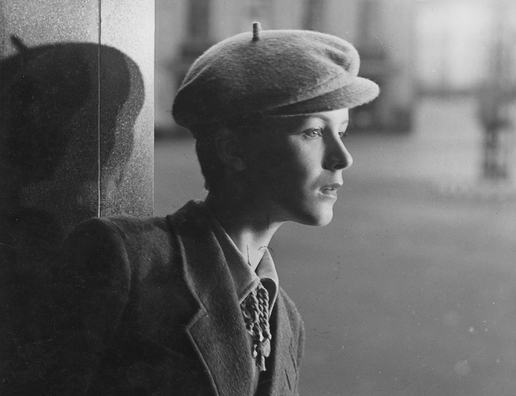
Of course, once she turns up the androgyny as “Risto”, she becomes even more anachronistic, tucking her hair under a flat cap, and drifting ever closer to a French gamine look that would be regarded as the height of sexiness a generation later. In part, this is because she isn’t actually very good at playing a man – compare to Tauno Palo’s similar cross-dressing exploits in Dressed Like Adam and a Bit Like Eve.
Based on the young adult novel Mörk punkt (Black Spot, 1934) by the Swedish-Finn Melita Tång, Perheen musta lammas replays the cross-dressing comedy of The Man from Sysmä (1938) in a contemporary urban setting. Eino Palola, writing for the Helsingin Sanomat, damned it with the faintest of praise, calling it “different in a nice sort of way”, albeit lamenting that “a little cutting and gluing here and there” would have streamlined the film’s dramatic cul-de-sacs and lagging pace. “The film lacks focus,” agreed the critic for Uusi Suomi, “taking the second step before the first.”
Right at the end, the film writes itself into and out of a veritably queer spot, as Olli’s housekeeper looks on in tight-focus horror as her boss appears to be passionately fondling a teenage boy. But when we cut back to the young lovers, Olli waves the housekeeper away, his fiancée now magically transformed back into her feminine self, dress and all. Phew, that’s a relief.
Jonathan Clements is the author of A Short History of Finland. He is watching all the Finnish films, so you don’t have to.
I see in today’s Times that the family of Robert Elegant have placed a notice of his death — frankly I am rather surprised that he doesn’t warrant a larger official obituary. Thrice nominated for the Pulitzer Prize for his Asia reporting, a confidante of both Nixon and Kissinger and the biographer of multiple Communist Party bigwigs, he will be most remembered for his many novels on East Asian historical subjects, particularly the brick-sized Imperial China series, Manchu, Mandarin and Dynasty, that inserted outside observers into the tumultous history of China from the fall of the Ming dynasty up to the rise of the People’s Republic.
He was often described as the author who did for China what James Clavell did for Japan (although that rather ignores Clavell’s multiple China works), and it’s certainly true that there were many times when his was the only China-specific material you could find on the bookshelves at the average WH Smiths. “Fiery, witty, kind and generous in equal measure,” write his family, “he was a loving rather, grandfather, brother and uncle.” One hopes that the various newspapers that carried his acclaimed journalism for so many decades might get around to memorialising him, rather than leaving it to his relatives to wedge in a paid advertisement of his lifelong achievements.
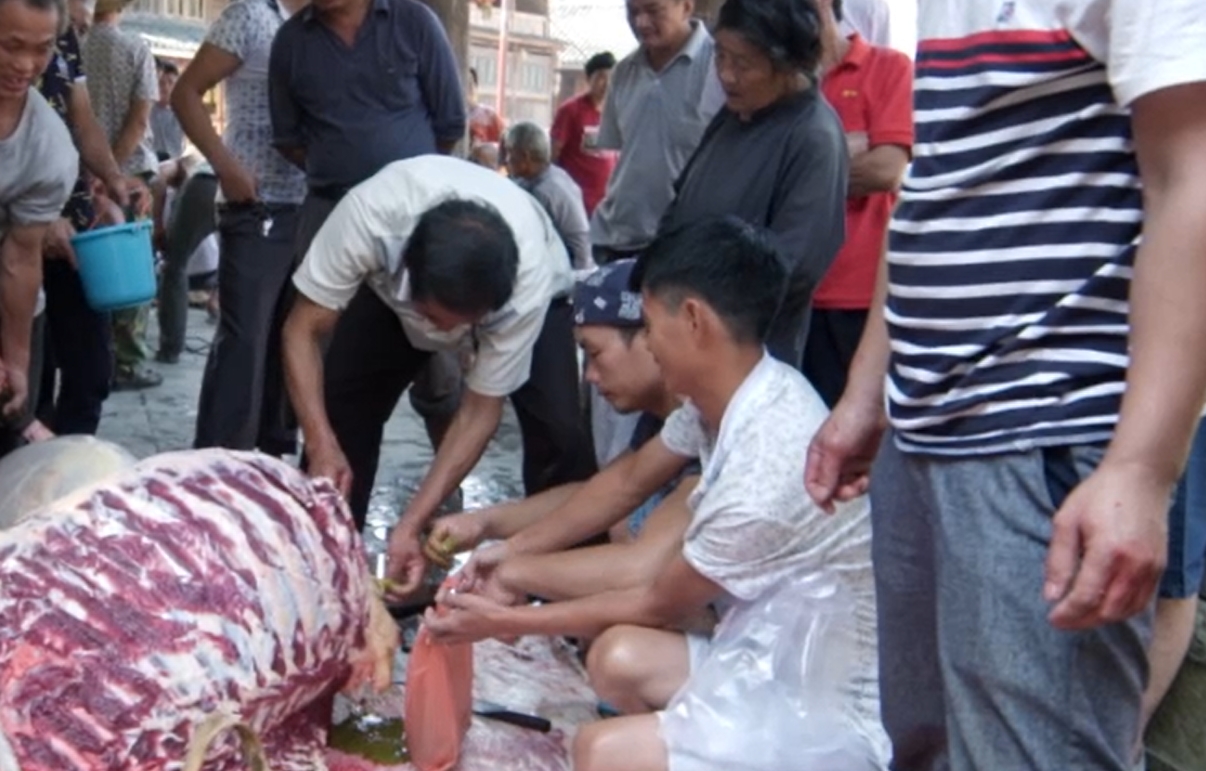
By the time we reach the drum tower, the men underneath are on their second bull. They have slit its throat and are bleeding it from its carotid artery into the skin of its own neck, scooping out cup after cup of warm blood and throwing it into a basin with peppers and coriander. The bull’s feet are tied but still twitching spasmodically, a spray of warm shit spattered across the flagstones. Before long, the men with cleavers have set about the carcass, skinning it and hacking out gobbets of meat. Villagers are waiting nearby with carrier bags, ready to take home something to cook for tomorrow’s festival.
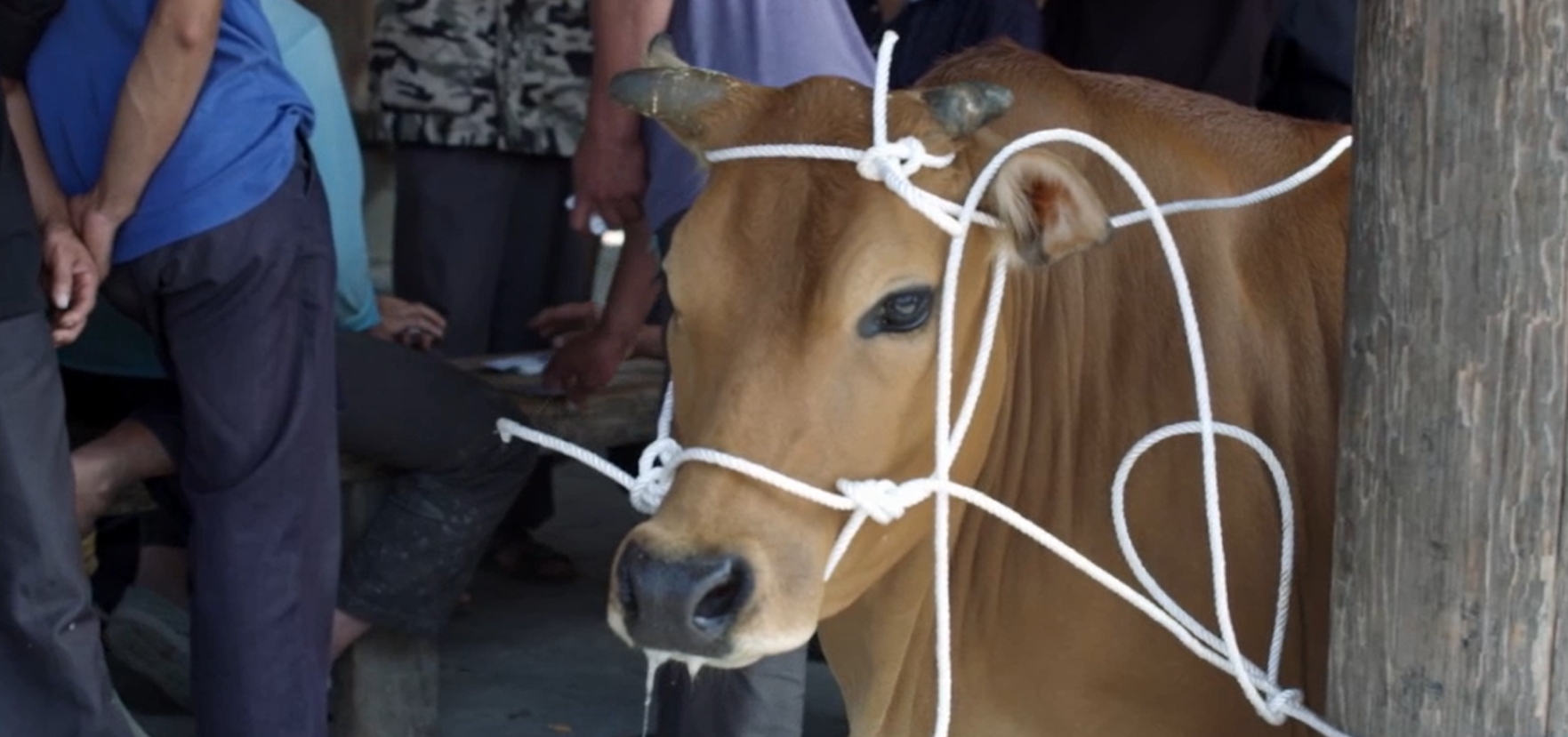
A cow is up next, tied to a pillar for safe-keeping. When her time comes, the men tie her feet to poles so she can’t struggle, and then smack her three times in the top of the head with the back of an axe. This is where we came in, as with the bull from before, her carotid artery is slit and the blood scooped out.
What everyone is really waiting for are the intestines. The Kam, for reasons known only to their selves, regard niubie, the half-digested grass of the cow’s last meal, to be a true delicacy, and they are soon fighting over it. The smell is appalling, but our fixer Pan doesn’t seem to mind, and has managed to grab a fistful of the stuff that will apparently be sufficient to feed seven tomorrow. Lucky us.
The director has unfortunately mixed up the words for intestine and pizzle, and consequently tells Pan’s shocked uncle that she would be interested in nibbling on a bull’s penis, “just for the experience.”
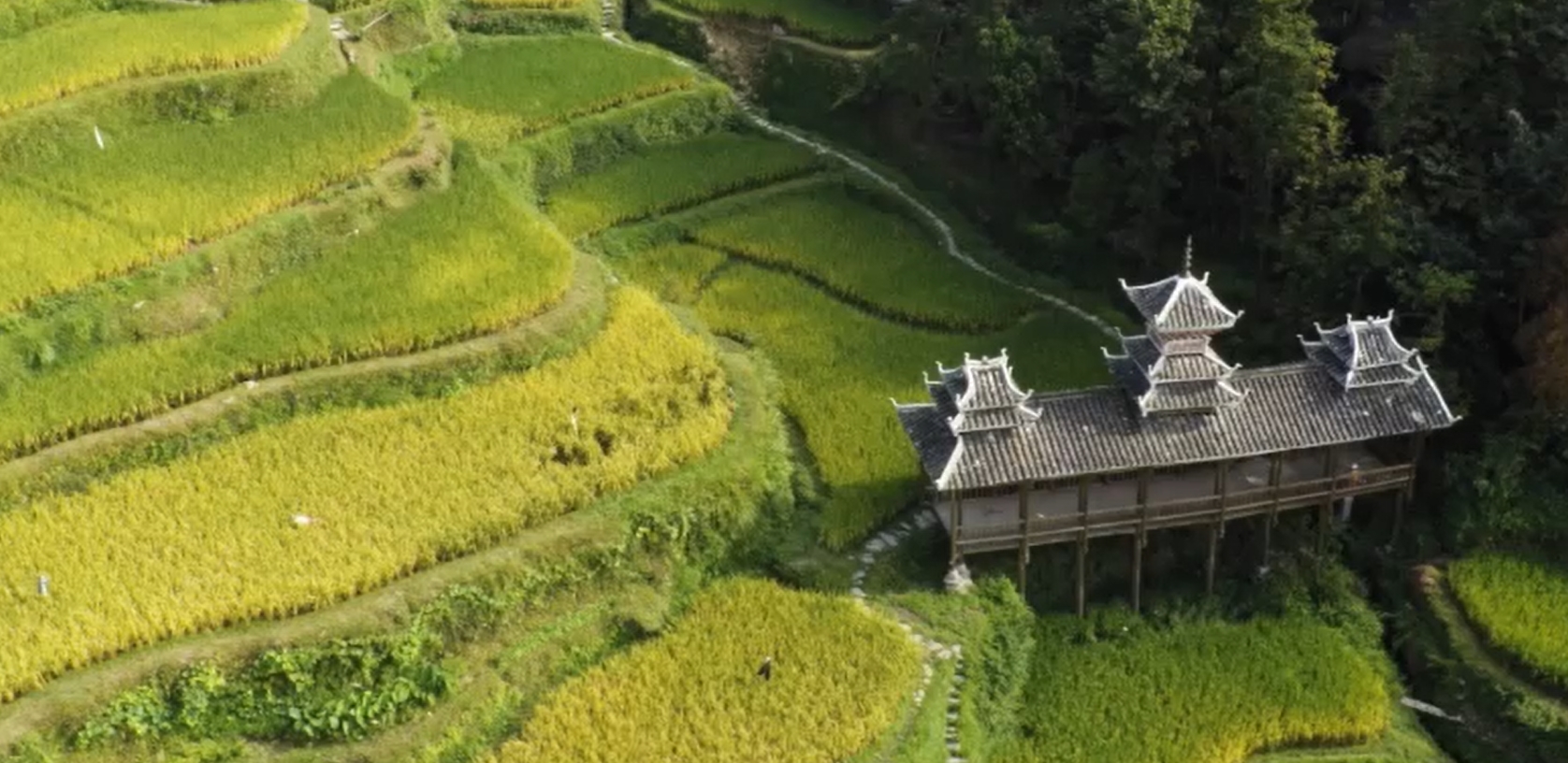
We drive down into Zhaoxing, the largest concentration of Kam people, and their de facto capital – a township that boasts five drum towers and three Wind and Rain bridges. The idea is for me to do a piece to camera about what a quiet sleepy place it is, but although the town is still mercifully traditional in appearance, it is packed with roaming Chinese gawping at everything, as well as a musical garbage truck that insists on barging back and forth along the main street.
Meanwhile, as I am attempting a piece to camera for the tenth time, an old lady half my height rushes up and starts plucking at the hairs on my arm, leading to piece that goes something like this:
“I’m in Zhaoxing, which has been the spiritual and cultural capital of the Kam people for centuries, but today it – OW! – what are you doing? You take as much hair as you like, love, I’ve got plenty. OW!”
She then wipes my body hair from her hands onto my shirt, and starts trying to fish in my pocket, while I go on. By this point, even the cameraman, who pretends that his digital camera is still running film stock and refuses to shoot anything that is not vital to the production, has turned his camera back on while I am molested by this ancient crone. The director claims that the encounter will never make it into the final series, but she said that last year, and ended up using a bunch of my outtakes in the trailer. Thanks to our height difference, it looks like I am being assaulted by an Ewok.
Just back from the British Museum, where I dropped in on the China’s Hidden Century exhibition, the Chinese name of which is “The Late Qing in 100 Objects.” It’s a popularly aimed introduction to the long 19th century, in which the Manchus slowly lost their grip on power, and China was plunged into disasters, wars and ultimately revolution. But rather than concentrate on the more obvious narratives– China’s grasping 17th century expansion in Central Asia, in which the Manchus doubled the size of their empire, or the enslavement, drugging and plundering of the country by foreign imperialists even better at imperialling than the Manchus – it instead concentrates on the material culture and social history of the area. Big events did indeed happen, and do indeed occur at the sidelines here, but China’s Hidden Century is more concerned with the everyday life of the people – the elaborate garments of the Manchu princesses and the actresses that entertained them; a child’s dragon hat; the silly porcelain replicas of ancient Bronze Age artefacts.
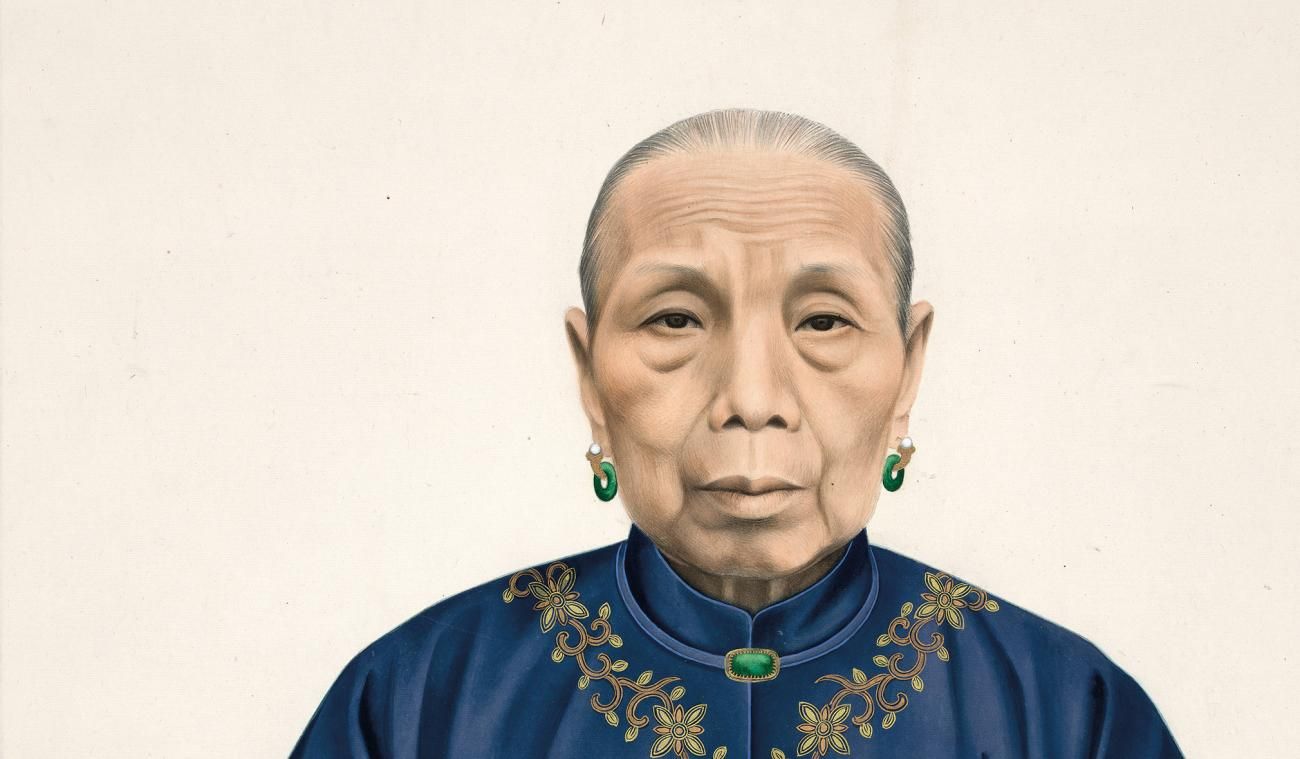
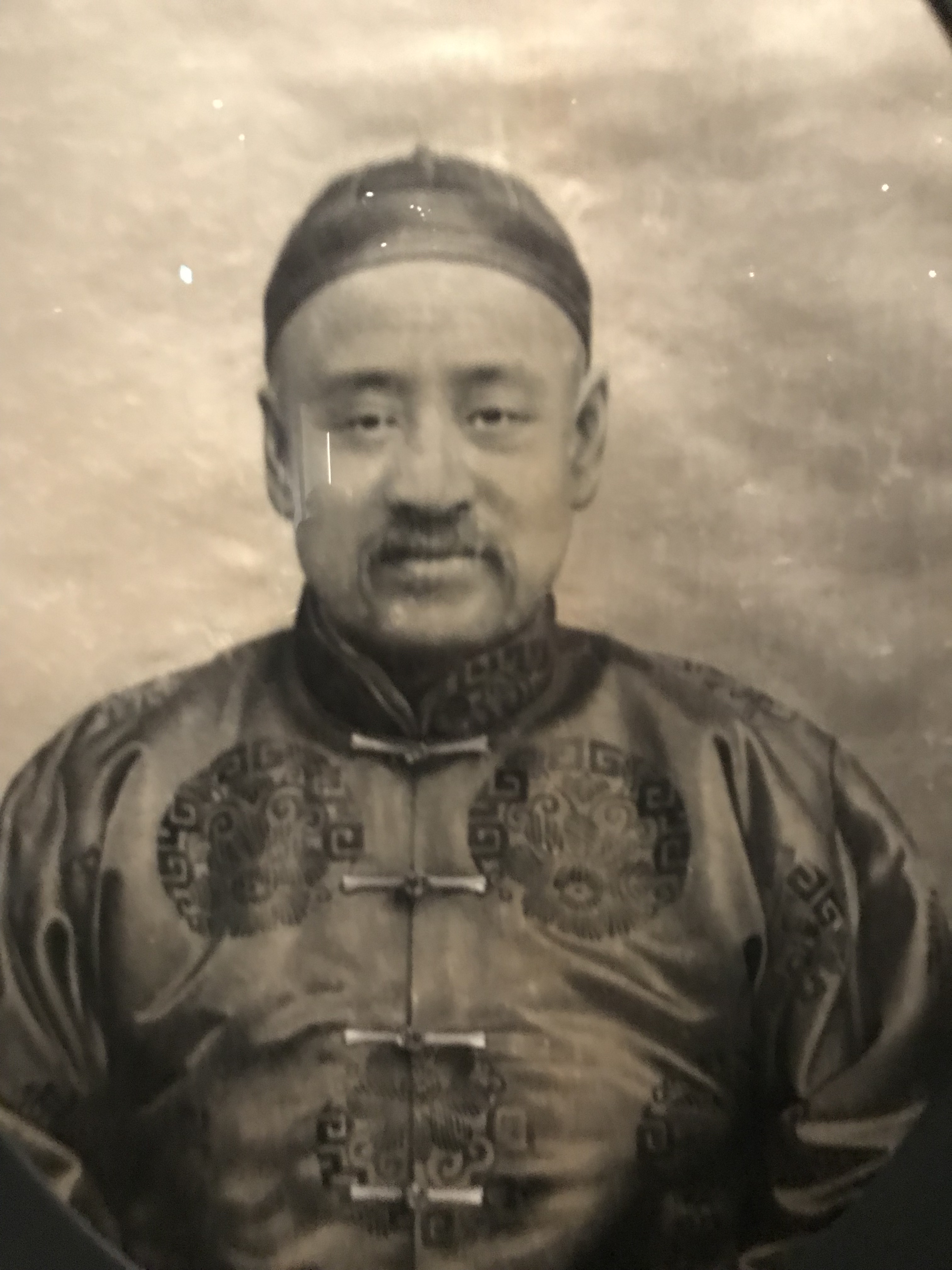
One of the most striking pieces is something many visitors pass by without a second glance: a portrait of a wealthy merchant that at first appears to be a photograph, but turns out to be entirely made of silk threads – an artwork in Suzhou kesi that would have taken months to complete. I once visited a kesi artist in Suzhou, and observed that she spent most of her time snapping at the passing tourists that no, that was NOT ink calligraphy, it was silk. No, that was not a painting, it was silk. And so on.
As the story progresses, the sound picture changes. We first hear background speeches in Manchu, the cant of the ruling class, that segues as the years pass into Mandarin, the lingua franca of the general population. By the final gallery, the words have transformed into Cantonese, reflecting the increasingly southward focus of the drama and events as political and economic forces were felt in China’s far south, where all the foreign contacts were.
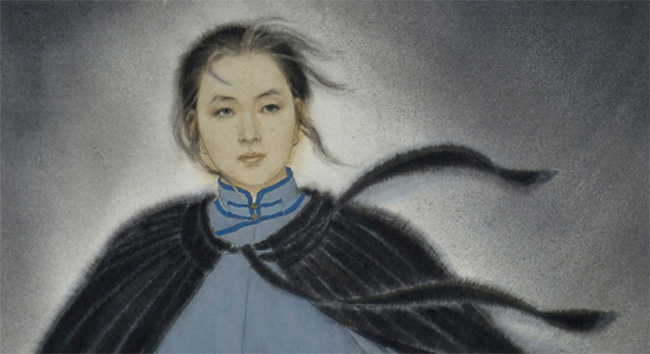
At the very end, just before the doors open to the gift shop, there is triple image of the same woman – dressed in Chinese garb, in Japanese kimono, and man’s clothes with a sword. It is Qiu Jin, the fiercely revolutionary poetess who was arrested and executed in 1907 for plotting a bombing campaign to overthrow the Manchus. She appears here, at the very end, presumably as an indicator of just how much had changed in the previous hundred years, how all the seething princesses and bitchy courtiers were suddenly trumped by a new, ardent kind of woman with a heartfelt desire for radical transformation. The tumultuous 20th century begins here, and that is where the exhibition ends.
I was a trifle baffled by the lack of commentary around the imagery of Qiu Jin, which seemed to be intended (as it was in my own coverage of the late Qing) to be the grand flourish of the early republican movement – a glimpse of just how far China had come during the long century of colonial contacts. It was only when I got out of the museum, and saw the recent storm on Twitter, that I realised what had happened.
Qiu Jin might have originally been the big finish for the exhibition, but the installation that visitors pass through has been eviscerated in the last couple of days, shorn of much of its explanatory signage after the British Museum was called out by Yilin Wang, whose translation of Qiu Jin’s work had been used without permission or attribution in the exhibition materials.
Wang pointed out that the exhibition, which hoovered up £719,000 in funding and charges £18 for admission, had simply harvested her work without asking. The BM swiftly responded by stripping it out of the exhibition proper, and informing her that there was no need to credit her because it was no longer there.
I have been thinking back through the last few times I have been approached for permissions to use my own work. A composer in Ireland wants to read out some of my haiku translations as part of a concert. An actress in Canada wants to include some in an audio book. An Australian exam paper wants to quote from my biography of the First Emperor. In each case, I thanked them for asking and said that they were free to go ahead with no fee required. But that was my decision.
Wang was not consulted, and such rights are the translator/author’s to grant, not the museum’s to take with impunity. What has made matters worse is that while the Qiu Jin materials have been flensed from the exhibition space, they understandably persist in the PDF guide available to visitors and indeed in the £45 exhibition brochure. I might also observe that none of the mob I have seen assembling on Twitter seem to have been to the exhibition themselves, so don’t realise quite how important the Qiu Jin imagery is – as a Manchu-denying terrorist and revolutionary icon, she shows up at the end, when you think it’s all over, with all of the wow-factor of [REDACTED] in the post-credits sequence of Fast X. She’s not a thing you walk past on the way to the gift shop, she’s the big bang at the end.
Which only makes the BM’s response all the more scandalous. “We’ve rubbed out evidence of our mistake, so now we don’t have to acknowledge it” is only something you can get away when the evidence really has gone. It’s not much of an apology, and I suspect that the fees Wang feels entitled to demand, which might have been zero in good faith, or the price of a nice dinner in everyday publishing practice, are now climbing ever higher as the BM doubles down on what we shall charitably call its mistake.
I dare say that Wang has already made more out of the publicity in pre-orders for a forthcoming book than the BM might have ever offered in acknowledgment for the use of a poem in a museum, but that’s not the point. The point is the principle of the thing: that whoever was at the trough for the £719,000 grant didn’t see fit at any point to push any money in the direction of Wang, whose work not only formed a part of the experience of the exhibition, but also seems to me to have been an integral part of its capstone.
Jonathan Clements is the author of A Brief History of China. China’s Middle Century is running now at the British Museum, London.
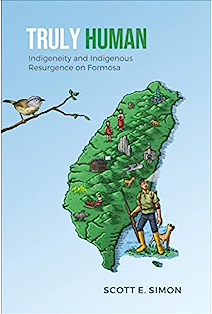
One of the most illuminating moments in Scott Simon’s Truly Human comes with the account of a sister and brother on opposite sides in Taiwanese politics. Igung is protesting against the local cement factory, which is on tribal land. Her brother Kimi thinks that the cement factory is a good thing, because it gives him a job that helps pay for his tribal tattoo website, and the managers are happy to look the other way when he goes hunting, which is otherwise illegal on former Truku territory. Eventually, the sibling stand-off becomes so strident that both of them run for political office on rival tickets, fatefully splitting the local clan vote between two members of the same family.
The title “truly human” derives from the term seediq bale, a native term that can be unpacked in multiple directions. Simon begins his book with a kindly villager who points out that everyone is human, really, including the nice anthropologist. But this gesture of cordial friendship rather ignores that fact that almost all the Taiwanese indigenes have terms for themselves in their own languages that simply mean “people” – and woe betide those non-people from the next valley if they wander onto our hunting grounds. Simon gets a sense of this himself when villagers start feeding him morsels of food, joking that in times past they would be doing so as part of the ritual to welcome his disembodied skull.
In chapters that focus on several crucial terms of indigenous language, Simon investigates how they have been misunderstood by the Taiwanese government. Across seven decades under the Republic of China, indigenous people have shifted in state consciousness from being idle savages, to suspiciously Japanese-speaking yokels, to “mountain compatriots”, to an invisible underclass “passing” as Han Chinese, to a weaponised minority that helps bolster the voting register. Simon is particularly compelling on their voting record, pointing out that contrary to the image fostered by the media, many of them skew “blue” towards conservativism, on the grounds that only the Nationalist (KMT) party is Chinese enough to appease the People’s Republic, and hence keep them out of their hair.
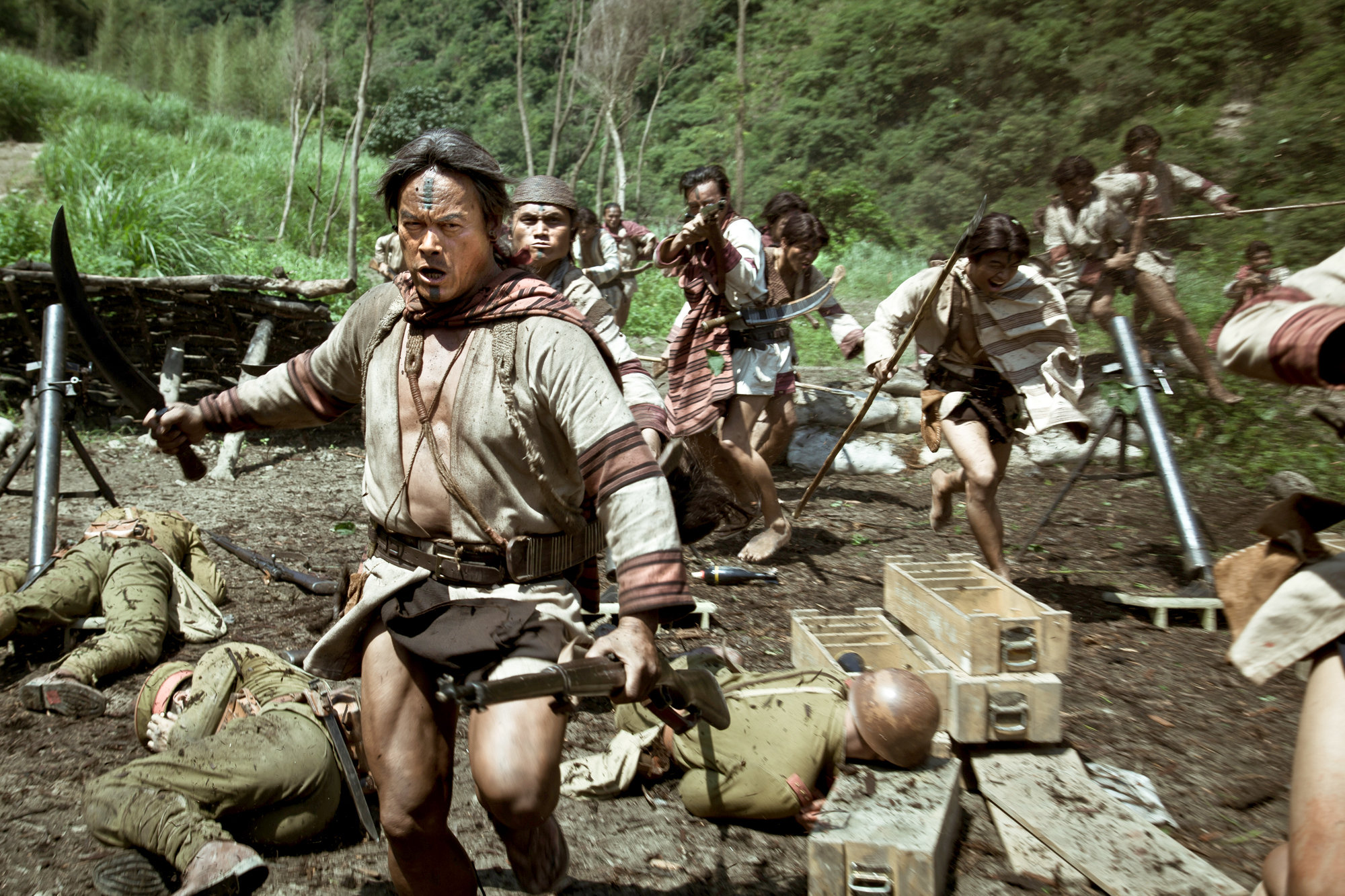
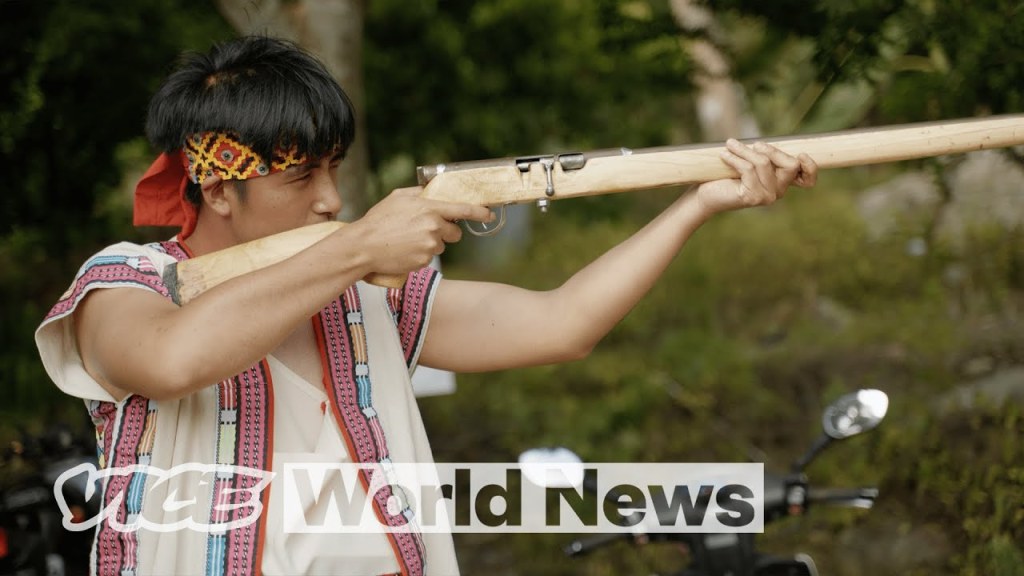
Seediq Bale, of course, was also the title of the 2011 film better known abroad as Warriors of the Rainbow (pictured), an account of the 1930 Musha Incident in which aggrieved tribesmen massacred Japanese colonists at a school sports day. Simon winningly investigates the way that story has spun out, noting for example that being “truly human” for tribal youths meant finding an excuse to be worthy of their ancestors by taking a human head. “It is no longer practised,” observed Simon wryly, “and thus can no longer be directly experienced through participant observation.”
Such a belief is part of the indigenous habitus known in many native languages as gaya – the same set of beliefs and taboos that regulated hunting, tattooing, weaving, marriage customs and funerary rights. Simon is ideally placed to examine what gaya seems to mean, not only for historical Truku and Atayal peoples, but for their modern descendants, one of whom confides in him that it was “really terrible.”
At some level, Simon’s account sits uneasily within the frameworks of academic publishing. So much of this material might have been better presented as a memoir, rather than snippets of fieldwork, leavened with historiographical commentary. But this is a common factor of much writing on indigenous peoples – many of the books on my shelves about Australian Aborigines and Canadian First Nations struggle to defy the tropes and traditions of the Euro-American structures that have been imposed on them. The further to the philosophical left one goes, the more such dialectics turn into endless nit-picking and hand-wringing, but mercifully Simon steps back from a precipice of self-doubt that might have stopped him writing anything at all.
In the process, he refers to Glen Sean Coulthard’s Red Skin, White Masks, which confronts the language of indigenous rights, noting that it is hardly a victory when native people win “concessions” from the state, since the very concept tacitly accepts that those rights were ever the state’s to concede. Simon applies this with particular value to the drawn-out spats over hunting in Taiwan, in which the Republic of China piously turned the Truku homeland into a national park (Taroko Gorge, spelled as per the Japanese mispronunciation) … and then announced it was illegal to hunt there.
Hunting is of vital importance to the Truku. As with many other indigenous people, it forms not only the basis of acculturation, but also a form of bonding, socialisation, and education – Simon’s accounts of the what he learns from the sounds (bird divination) and smells (there are cobras nearby) of a hunting expedition are a snapshot of thinning native knowledge, lost to a younger generation working in urban convenience stores and on factory assembly lines.
Forbidding the Truku from hunting deprives their menfolk of a rite of passage, emasculating them in the eyes of their potential brides. Nor is it a simple matter of telling the troublesome Truku to just go and hunt somewhere else. As Simon learns, hunting is not merely a matter of wandering through the forests taking pot-shots at deer. It is a matter of careful, long-term husbandry of the local environment – the carving of passages and blinds, even the local year-on-year cultivation of plants that will lure prey to specific spots.
Simon brings up several landmark cases in hunting law, particularly the cause celebre of Talum Sukluman, a 54-year-old Bunun man arrested in 2013 for poaching, but also for using the wrong sort of gun. It’s this latter charge that is the most illustrative, since as Simon points out, indigenous people can go hunting, but only if they use an antiquated and home-made musket design – which, as one tribesman points out, is technologically inferior to the matchlocks that the Dutch carried in 1634! Simon argues that such laws literally force indigenous people to place themselves in physical danger by using jury-rigged explosives.
Talum’s case was finally resolved when he was pardoned by the newly elected president Tsai Ing-wen in 2016. But his freedom did nothing to allay the frustrations and criminal charges brought again uncountable other hunters, nor the fact that many hunting laws were introduced in reaction to dwindling wildlife habitats and populations – a 1990s problem now at least partly resolved by eco-policies and rewilding. In one telling incident, a meeting flies into uproar when told that tourists in Taroko Gorge have complained about the sounds of occasional gunshots – “We are killing squirrels,” shouts an angry Truku tribesman, “not people!”
As a technological determinist, I was particularly won over by the way that Simon relates such issues to the evolution of available weaponry. In the good old days, he suggests, hunting of both heads and hogs was a visceral, dangerous, immediate experience. The colonial-era arrival of better-quality knives increased the efficacy and frequency of what were once “sustainable” once-in-a-life-time expeditions, while improved gun technology turned hunting trips into forest massacres. But it’s the imposition of outsiders’ law that has most transformed local life.
“In the past,” complains one elder, “they would bring back the animal openly, with loud calls of joy, to share the meat with their neighbours. Nowadays they must conceal the animal in a canvas bag, kill it secretly in their home, and share the meat only with the immediate family and most intimate friends.” I was struck by this comment, not merely for the image it presents of thinning tribal traditions, but of the way that criminalising such actions can drive such people into associations with true criminals. It is, after all, the bushmeat (ye-wei) trade that forms one of the cornerstones of organised crime across east and south-east Asia, and which has been implicated in recent years in geopolitical scandals that stretch far above the heads of mere forest hunters, even into the murky origins of the Covid pandemic.
There is much more in Simon’s book – my weightless Kindle copy of which belies a main text of over 400 pages. But I’ll leave you with one of his many illuminating insights into the world and life of Taiwan’s indigenous inhabitants. Much as the French began referring to British football hooligans as “les fuckoffs”, the Atayal and Seediq called the Chinese settlers kmukan (“motherfuckers”) on account of their readiness to refer to the taboo sexual activity of a relative in one of their most common swear-words.
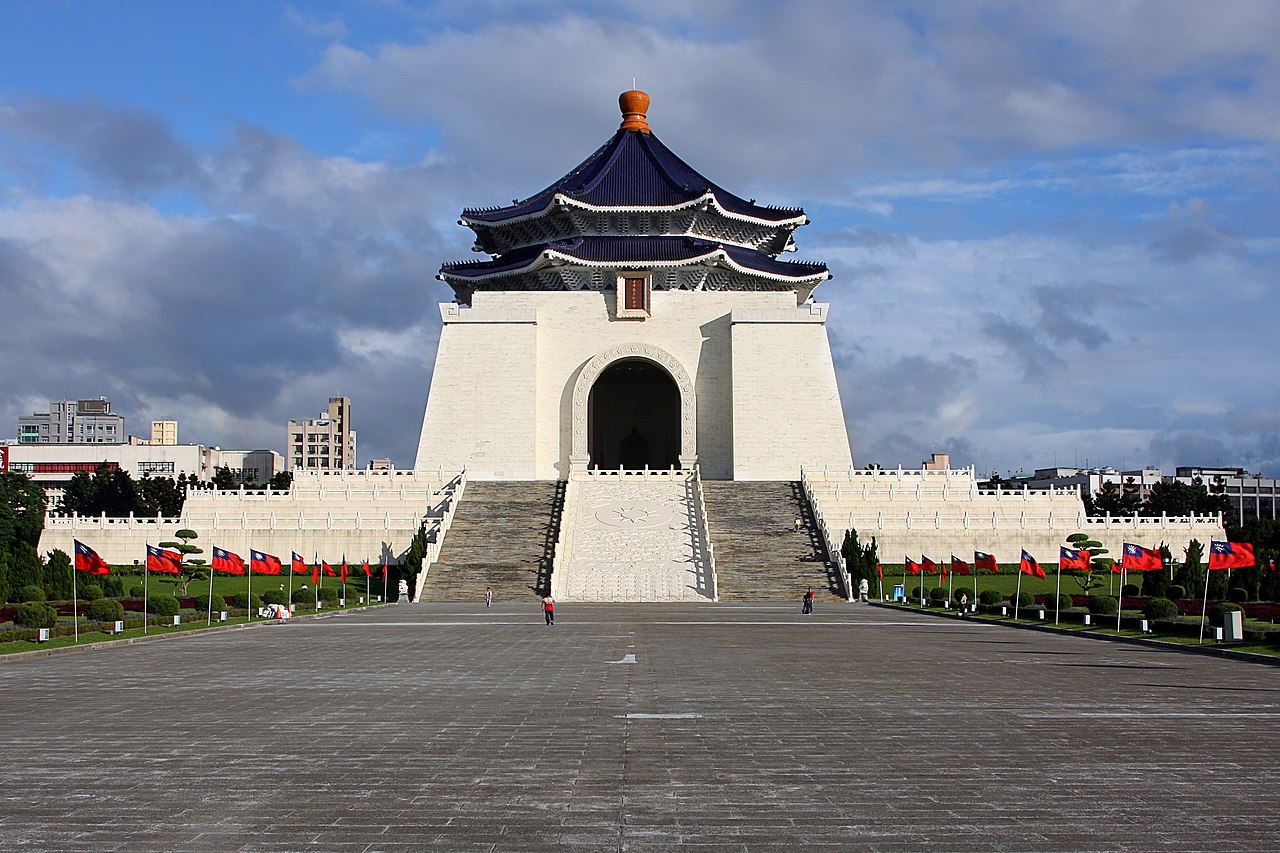
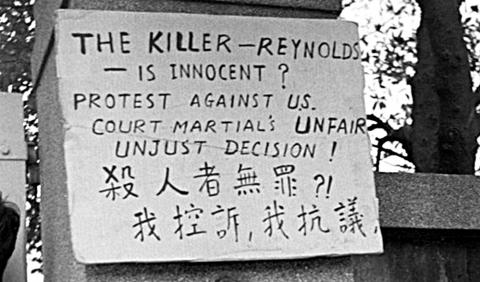
On 24th May 1957, a Chinese widow and her daughter began an angry vigil outside the US embassy in Taipei. Ao Tehua held up a bilingual sign protesting at the decision by a US court martial to find her husband’s killer innocent. Asked to move on, she pointed out that the street outside the embassy was Chinese territory, and it was her right to stand wherever she pleased. By the time a force of twenty-two police officers arrived to persuade her, a mob of 400 onlookers had gathered. A local reporter interviewed the tearful widow on tape, and then broadcast her words through a loudspeaker to an increasingly fractious crowd.
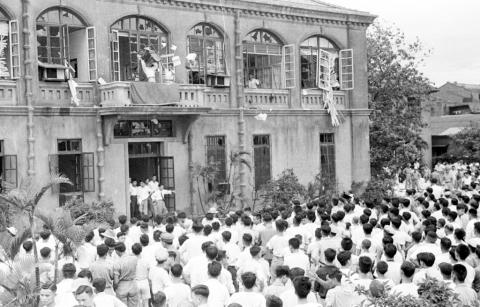
By the afternoon, the crowd had grown to more than 2,000 people, storming the embassy gates. They smashed the windows, ransacked the offices, and patrolled ominously outside the iron door protecting the staff in their panic room. The Stars and Stripes was torn down and shredded, and the flag of the Republic of China raised on the embassy flagpole in its place, to loud cheers from a crowd that now numbered six thousand.
In a moment of gripping cinematic tension, eight men bolted from the embassy through a gauntlet of “clubs, stones [and] fists.” They reached their escape vehicle, a military jeep, only to discover that one of the rioters had stolen the keys. As the mob charged towards them, their Chinese driver tried to hotwire the car with a pair of pliers and the tinfoil from a packet of cigarettes. Police officers started to push the car down the street, at an excruciatingly slow walking-pace, as the driver tried frantically to jump-start the motor. As the rioters caught up with the still-unstarted vehicle, the men reached the safety of evacuation buses, while the crowd yelled at them: “You killed Chinese. We kill you.”
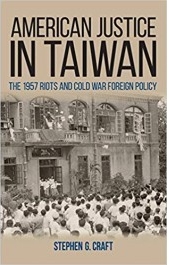
Stephen Craft’s book American Justice in Taiwan is a fascinating snapshot of Cold War politics in Taipei, during the era that the US government vainly attempted to prop up the exiled government of Chiang Kai-shek, in the forlorn hope that it would one day retake the Mainland from Chairman Mao’s Communists. He starts with the shooting that precipitated the embassy attack, a fateful evening two months earlier, when the 41-year-old Master Sergeant Robert Reynolds had rushed out of his house after his wife Clara claimed to have seen a man peeping through the window as she took a shower.
Giving chase in his yard and the street outside, Reynolds apprehended and fatally shot Liu Ziran, an officer in Taiwan’s army and a member of the Institute of Revolutionary Practice. When the authorities arrived, Reynolds confidently admitted to having shot the man whose body was lying in park 200 feet from his house, noting that he had done so in self-defence. That was his next mistake.
In the case of the Reynolds incident, the real issue was a huge disjuncture between Chinese and American legal practice. American law recognised that “a man’s home is his castle” – if Reynolds could prove that the intruder was a threat, he might get away scot-free. Chinese law, however, regarded all violence as a crime that needed to be answered, even if committed in self-defence or without malice. This, observes Craft in an illuminating aside, was why British diplomats were not allowed to drive their own cars in China, as “accidents became incidents.”
So, when Reynolds immediately announced that he had shot the intruder in self-defence, under American law this an argument for his innocence, whereas in China it was an admission of guilt. In similar cross-cultural misunderstandings, the Reynolds inquiry seemed more ready to accept the testimonies of white interviewees, who swore to tell the whole truth, than those of Chinese ones, who were not obliged to swear on a Bible. Following Reynold’s controversial acquittal, it was suggested that he follow Chinese custom in paying compensation to Liu’s family, but his representatives refused, on the grounds that in American eyes it would make him look guilty.
The result was an escalating tension on Taiwan, in which the mob stormed the embassy, and armed military police escorted American children on their school buses, while the authorities warned that “rumour agitation” was a capital offence. And there were rumours galore, enough for a whole mini-series of alternate facts, with claims in the Chinese press that Liu and Reynolds had been secret love-rivals duelling over the same woman. Meanwhile, American intelligence pointed to a number of incredibly suspicious coincidences and happenings, that suggested Ao’s protest sign and the embassy attack itself might have been orchestrated with the help of the secret police, run by Generalissimo Chiang Kai-shek’s own son.
Trying to mollify feelings on both sides, Chiang Kai-shek gave a broadcast in which he called it “one of the most shocking and most regrettable things” that had happened in the last five decades – something of an overstatement, considering that the period included two World Wars. As for the embassy staff, they felt “they have been kicked contemptuously by friends for whom they have risked and spent much.”
Craft’s book is a whodunnit, poking around in Reynold’s testimony, and the forensics of Liu’s death. He delves into gendered arguments in both the court and the press, in which commentators seek to question the evidence on the basis of the attractiveness of Liu’s Chinese wife. Why on Earth, they argued, would he want to look at a naked American woman, particularly the frumpy Clara Reynolds – their words not mine! Why, the very idea was an insult to Chinese womanhood, while the argument in Liu’s defence was an insult to Clara Reynolds.
But Craft also turns the story into an examination of the history of justice for Americans in East Asia, all the way back to the Terranova Incident of 1821, in which a naturalised American sailor killed a boatwoman by throwing a pot at her. He talks through numerous similar moments in the record, where illegal foreign activities have gone lightly punished or even unpunished, as well as similar cases in Japan, which were resolved very differently. For a century, Americans and other foreigners enjoyed the umbrella protection of “extraterritoriality” – the right to be tried by a court of their countrymen, rather than the Chinese. The Americans finally renounced their extraterritorial status in 1943 as part of wartime concessions, only to start re-asserting it in a new form by rushing to claim “diplomatic immunity” every time they needed to. But as Craft notes, in a lovely anecdote, the attitude of the US military was still occasionally tin-eared when it came to local issues.
In February 1957, a visiting American general made the error of asking his Taiwanese hosts why the locals were not celebrating the birthday of George Washington.
“We are not a colony yet,” came the beautifully understated reply.
This is a movie waiting to happen, unravelling from two midnight gunshots in a Taipei suburb, into a consideration of the history of justice itself, the Cold War, and the very real possibility that everyone – Reynolds, Liu, the mob and the embassy staff – were all unwitting pawns in a power-play between Chiang junior and his father the Generalissimo. Craft’s narration expertly zooms in on tiny moments of human interest, like Japanese vagrants scavenging for shell casings on a military shooting range, or junior officers pleading with their jeep drivers to use their horn less into order to make more friends, out to grand pivots in geopolitics. With a winning grasp of historical context, he closes with the October 1957 launch of Sputnik, setting the Soviet Union ahead in the space race, and pushing the US and the Republic of China to entrench even deeper in their reluctant alliance.
Rewarding on many levels, American Justice in Taiwan is a book that offers a sweeping view of thorny issues in international justice, which continue to reverberate today.
Today, we will log five minutes of footage. The day starts at 0500 and finishes for me at 2200. Every single moment takes a million negotiations, as the English director struggles against jet lag, and the Chinese director, who looks 12 but is actually 34, struggles to continue to make the documentary that he has been unchallenged about for the last few weeks before the foreigners arrived.
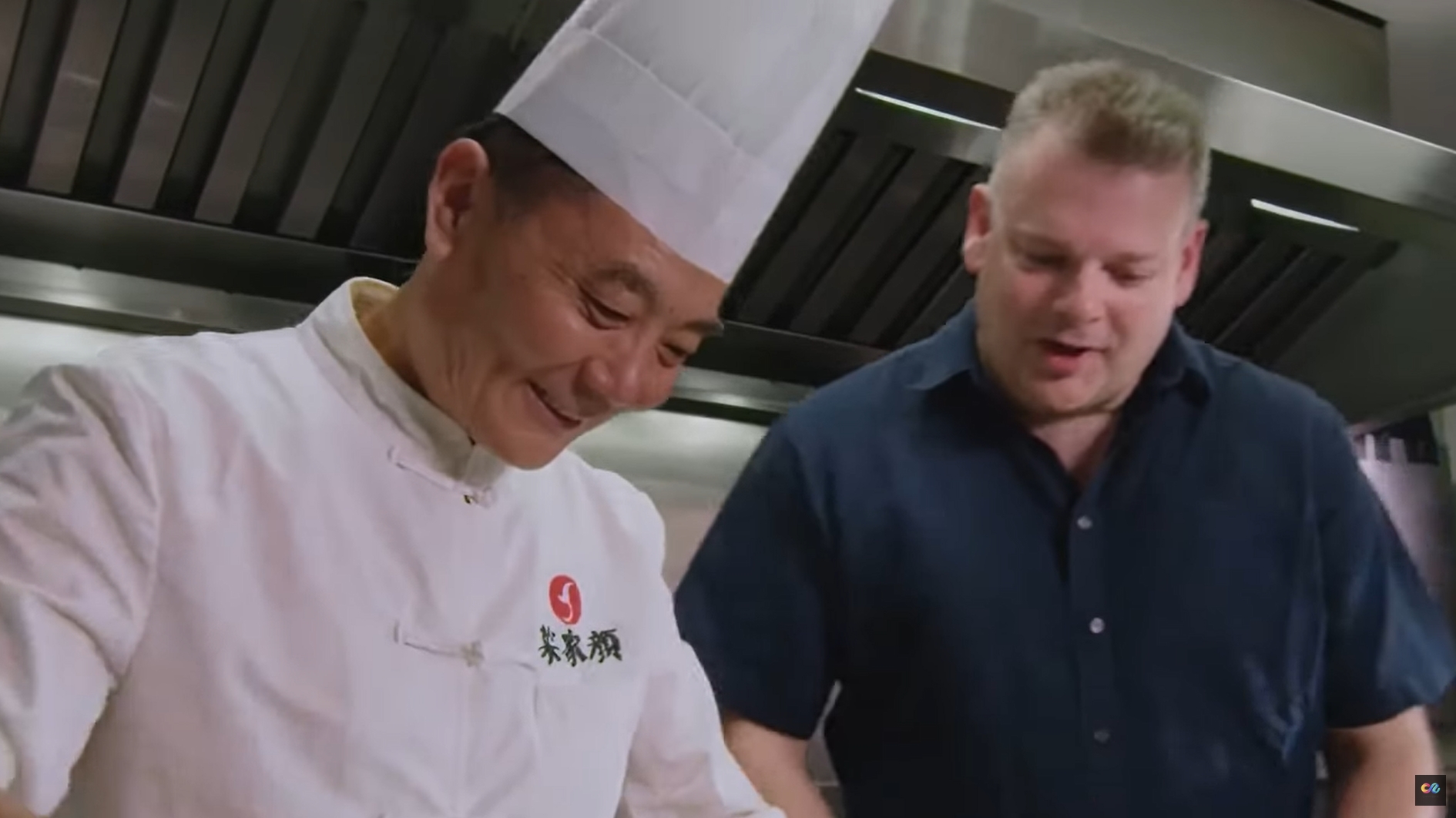
Today, all we have to do is film Yan Weixing, who looks uncannily like George Takei, make a deep-fried sweet and sour fish in his kitchen. But the lights have to come from the van, and the sound man has to mic me up, and then the director wants me to change my shirt, and then the B cameraman needs to change his battery, and the filmic world’s ever true cliché of Hurry up and Wait comes true again and again. I read the entire works of Confucius while waiting for my next call on the sheet, and Mr Yan smokes his way through an entire packet of Nanjing fags.
Meanwhile the Chinese director has his own ideas of what things should be, and really doesn’t want foreigners to interfere. Mr Yan and I are in the kitchen, and he is scraping the scales off a carp and slicing a series of incisions into it before rubbing it with salt. The heat in the kitchen is ridiculously high, and the sweat is pouring off us. He makes a batter for the fish and a delicate sweet and sour sauce. This is Lu-cai, one of the “Eight Great Cuisines of China“, and while Cantonese, and Sichuan and the like have made it abroad, nobody really knows much about the delicate flavours of the land of Confucius. Lu-cai used to be all the rage in Beijing until the 1950s, when Mao’s fetish for chilis and an entrepreneur’s willingness to open a Sichuan restaurant in the capital changed the world of Chinese cooking.
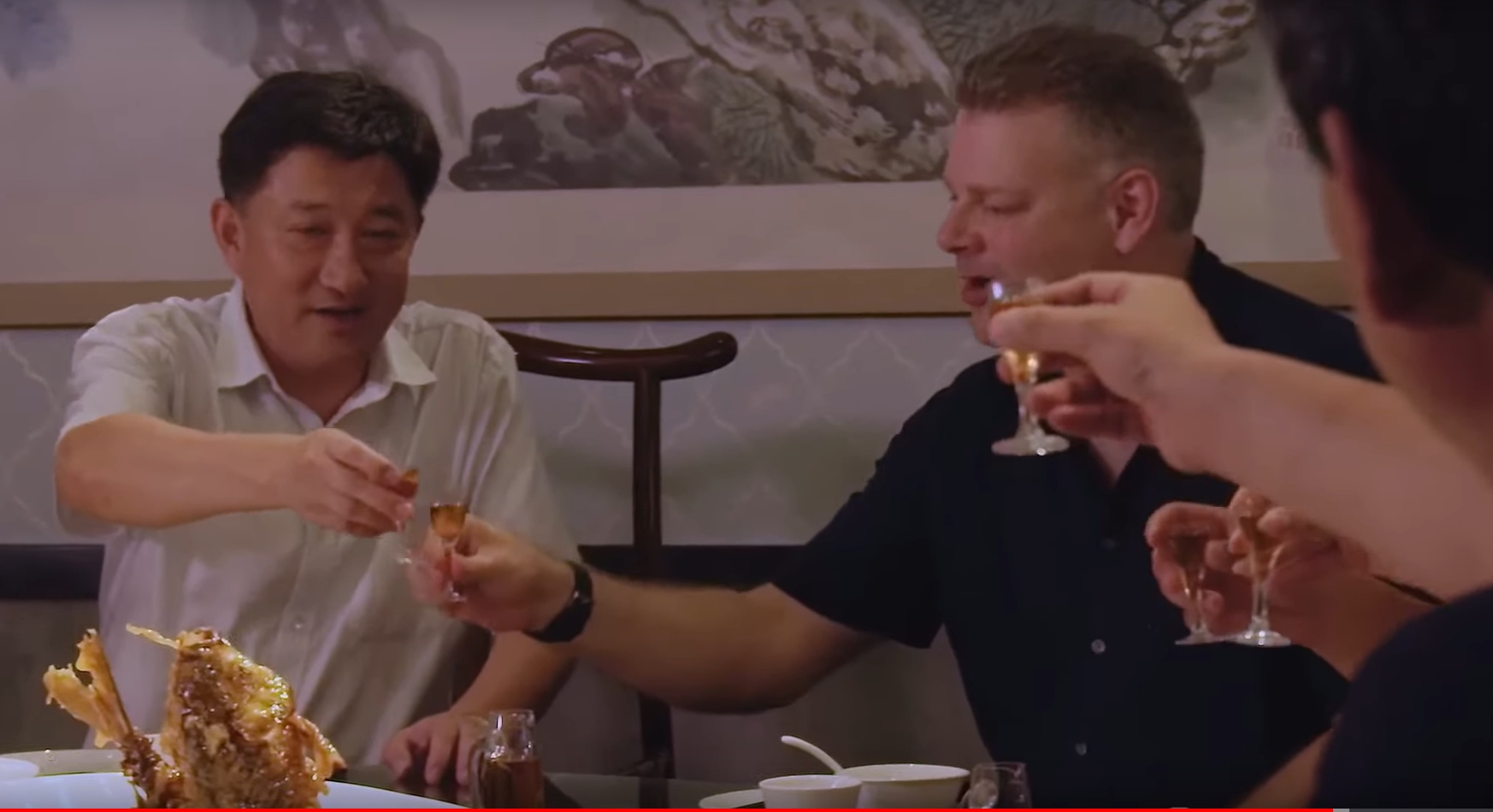
A bunch of diners are waiting for us to bring the fish. They have been waiting for three hours. They want to put a mini GoPro camera on the fish as I bring it into the restaurant so that we get a fish-eye view. I open the door and enter, proclaiming in Chinese to much applause: “Here is your Yellow River Carp!” The director makes me do it another six times. Then we have to do the sitting with the diners, six times. Then me asking about the seating arrangements six times. Then they offer me some Sea Cucumber Liqueur. We need to film it again, six times. I have drunk half a liquidised sea cucumber by this point.
We need to shoot the whole scene again, without lights, because the drone team will shoot it from outside the window in the dark. We have a drone team? Yes, they are three guys who have been sitting outside all day waiting for their moment to shine. We drink more sea cucumber liqueur and the drone crashes into a nearby balcony. But they have the shot.
It is 2200. Tomorrow’s call is 0515. I am in a hotel where prostitutes put business cards under the doors. Tomorrow I will be somewhere else by dinner time.



 The Official Schoolgirl Milky Crisis Blog
