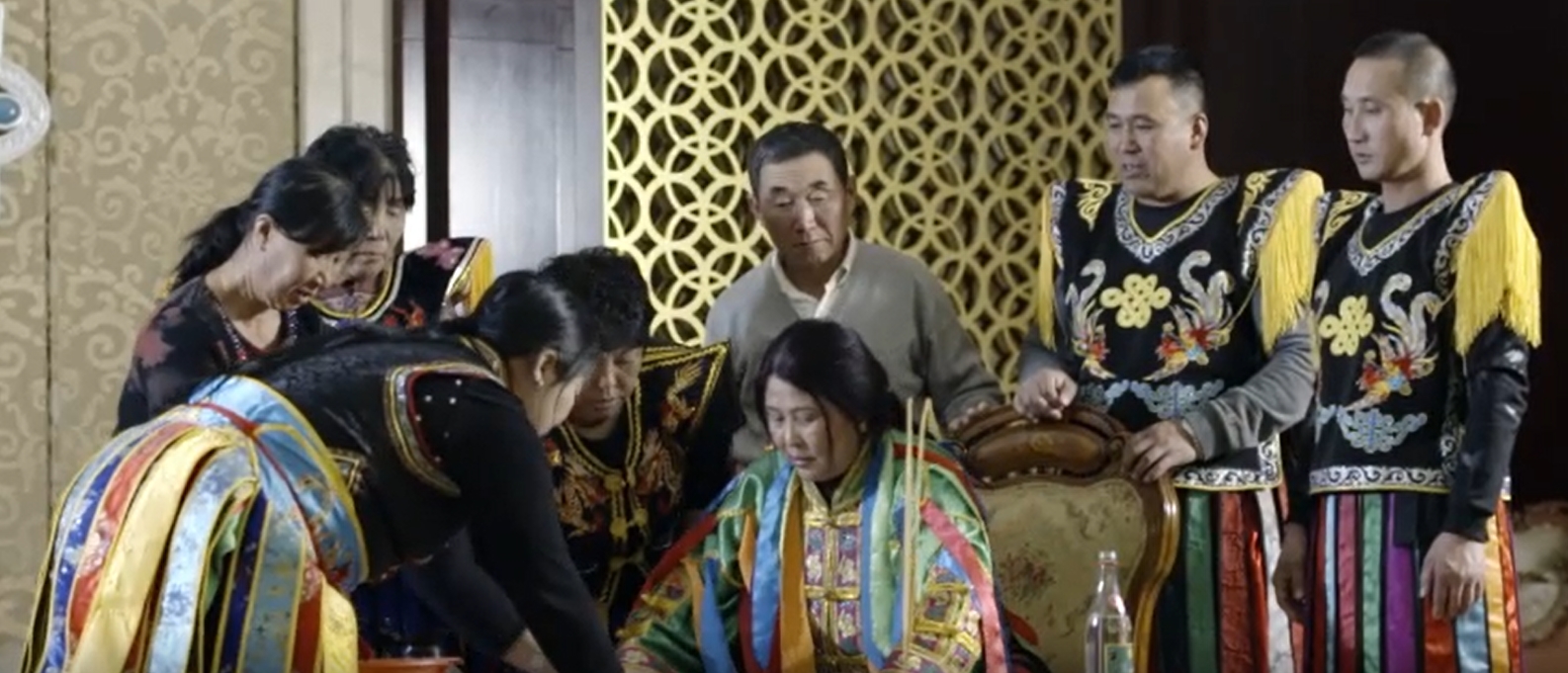
A Spoonful of Vomit

“I don’t think I want you to go in the mud fight,” says the director. “Or rather, I think contractually I can’t make you do it. The pond looks disgusting. I wouldn’t get in there. And production-wise, if you get tetanus or ringworm or something, or a rash, it will compromise the rest of the shoot.”

Yes, I say, but if National Geographic send me to the Kam mud fight and I stand at the back reading a newspaper, you might as well not have sent me at all. Isn’t this what a presenter is for? Looking like an idiot?

“We’ll talk about this later,” she says. “In the meantime, I’ve found you this nice apron with puppies on it.”

Mr Wu has fired up the stove, and thrown extra wood into the oven. The oil is crackling in the wok, and I am wearing a fetching gingham apron that has the words MY PLAYMATES written on it in large, friendly letters, above a picture of three puppies whose names are apparently Bobby, Oscar and Keith. I’m just saying: somebody had a meeting about that.

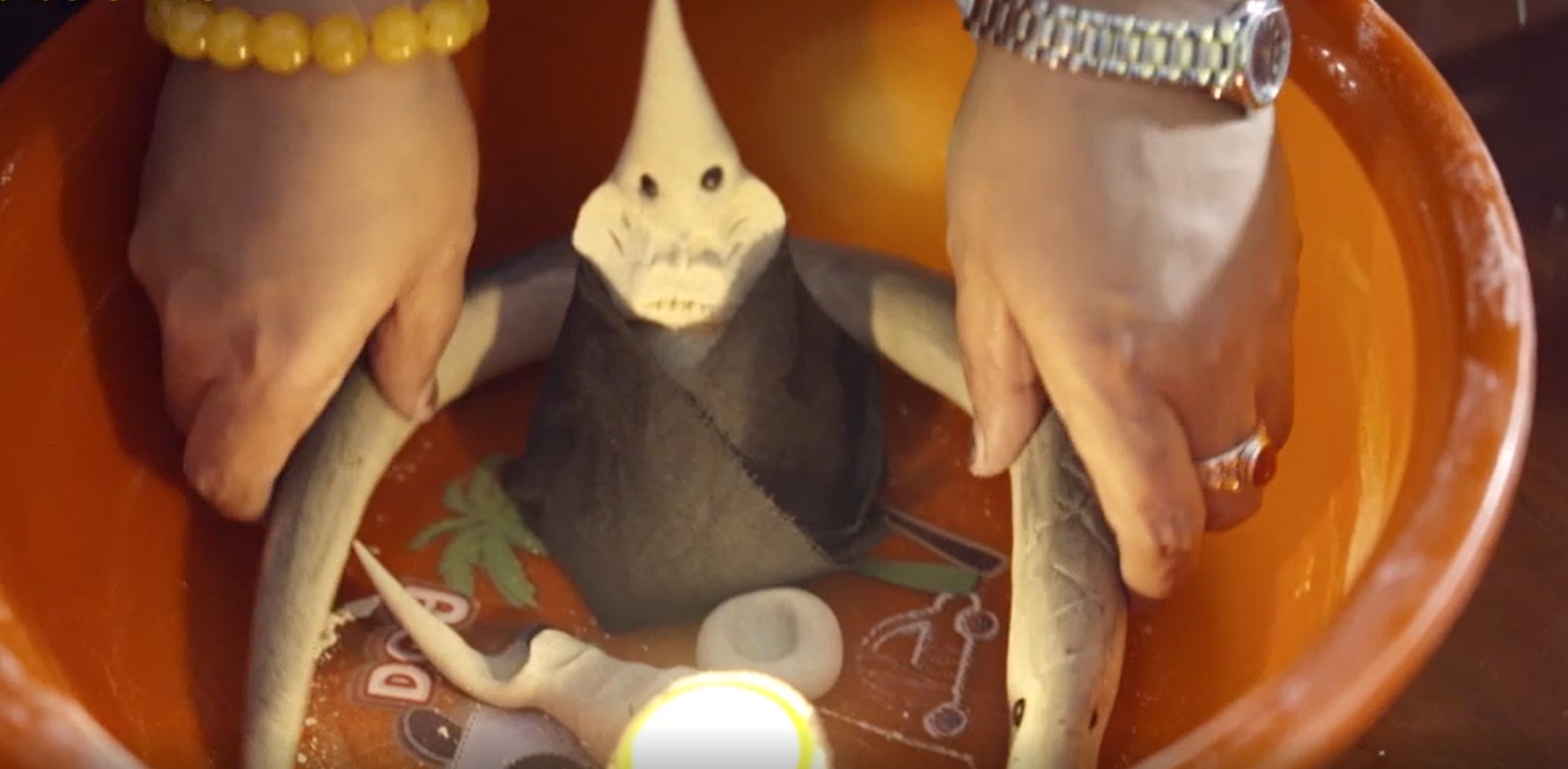
Today we shall require some roughly chopped red and green chilies, some ginger, some leek leaves, and some cubes of beef, as well as our magic ingredient: the intestinal juices of a recently slaughtered cow, wrung out from the grass of its last meal, itself ripped from the intestines in the middle of a tribal free-for-all. If you can’t find a recently slaughtered cow, feel free to use the intestinal juices of any creature in your vicinity, particularly one that eats grass, as it’s a good way to get that lovely green colouring. And I thought they only smelt bad on the outside.

Mr Wu boils up the niubie in his wok, then sets it to one side while he fries up the beef in the chilis. Then he pours the niubie over the top and dumps it all in a bowl. He offers me a spoon and I gingerly take a sip… It tastes like a soup made with chili and pepper and… oh, wait, there’s that burning aftertaste at the back of your throat like you just threw up a little bit in your mouth.

The director glares at me and I think of something else to say, vaguely suggesting that there is a Joycean uric tang.

It is only then that Mr Wu realises that he can’t find his blood.

“Where’s my blood?” he bellows?

“What blood?” squeaks Mrs Wu, who is trying to wok up a lunch for a group of eight tourists in the restaurant.

“The big bowl of blood with all the spices in it. We only scooped it out of the cow yesterday. I was going to cook xiehong for the foreigners.”

“Oh that,” says Mrs Wu, the dim dawn of realisation starting to glimmer on her face. “I thought that was waste, so I threw it out.” Mr Wu goes ballistic, since now he has to go and find some blood from somewhere else, like a five-foot vampire on a charity mission.

Jonathan Clements is the author of The Emperor’s Feast: A History of China in Twelve Meals. These events were filmed as part of Route Awakening S03E01 (2017).

The Ethics of Affect

“Two years ago, in my review of Galbraith’s Otaku and the Struggle for Imagination in Japan, I noted that the book finished with a series of slingshot ideas, as if Galbraith had more to say, but had to bow out for now as he approached the edge of his wordcount. His new work from Stockholm University Press seems to be the first of the ‘contingent articulations’” that he promised, continuing his adventures as anime and manga’s self-appointed Danger Man, perpetually poking at the hornets’ nest in search of anthropological understanding.”

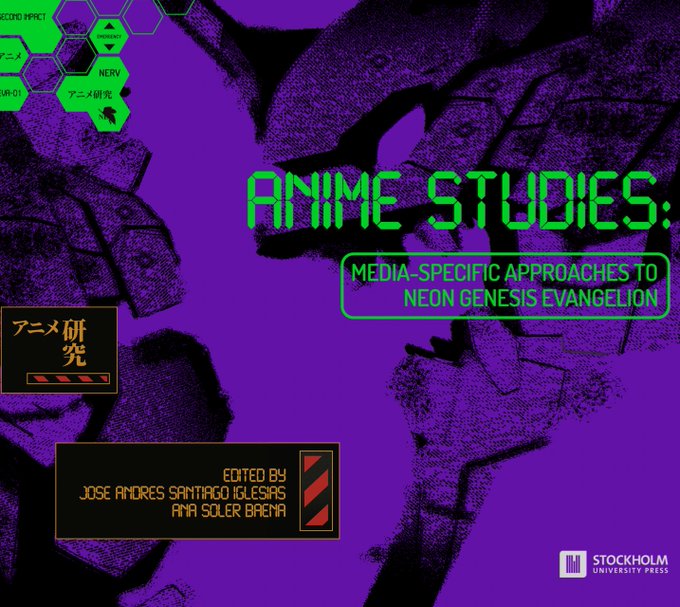
Over at All the Anime, I review Patrick W. Galbraith’s newly published anthropology of bishojo games and gamers.

Ascendance of a Bookworm

“But worst of all, worse even than the fact that her Dad is now apparently a green-haired man called Gunther, is the fact that she has found herself in a world without books.

“I know that horror. I was once a guest in someone’s home where the sole piece of visible literature, left out on the coffee table to impress visitors, was a Dan Brown novel. So, imagine finding yourself in a world where not even a Dan Brown novel is available, where despite having Swedish-Finnish names, the locals have never heard of a sauna or soap… and did I mention there were no books?”

Over at All the Anime, I write up Miya Kazuki’s novel Ascendance of a Bookworm.

Finns Find the Orient

Finland’s first Chinese restaurant opened inside the spy-infested Hotel Torni in Helsinki in 1953. With characteristic Nordic bluntness, the restaurant was called simply “China.” There, claims food historian Ritva Kylli, visitors “eagerly tasted Chinese flavours and practised how to use chopsticks.” By the end of the 1950s, some Chinese influences had crept into Finnish cooking, including restaurants with wax tablecloths, and the usual utensils of Finnish eating – plates and forks and what-have-you, haunted by the presence of a bottle of soy sauce and a jar of chili oil.

“Dishes from the Torni,” she writes, “became familiar in the Finnish home kitchen, most often chop suey, which was known to have been developed in San Francisco, and become known all around the world as a classic dish of Chinese cuisine – everywhere except China.”

Chinese food is but a sidebar in Kylli’s exhaustive Food History of Finland: From Salted Meat to Sushi [Suomen Ruokahistoria: Suolalihasta sushiin], recently published in Finnish. In it, she charts the development of a national cuisine that has been famously pilloried by other nations – most famously, according to one well-known French politician, the second-worst in the world, after British food. She takes the Finnish palate from its early, bland fumblings with rye bread and dairy products (“Our Finnish cheeses are much praised,” claimed Daniel Juslenius in the 1700s, without a shred of proof), through the introduction of Russian foodways and French bistros, the impact of Prohibition in the 1920s, wartime austerity and the turnabouts of the modern world.

As her title implies, she finishes with another oriental foodstuff, at least nominally. Finns were certainly aware of Japanese food early on – she includes a letter from a baffled diner in Hakodate in north Japan, trying to come to terms with chopsticks and drinking soup from the bowl in the 1920s. But it’s not until 1978 that Kylli uncovers an advert in a Helsinki newspaper for a place calling itself the Yokohama restaurant. Although Kylli tracks a strong upward curve in Japanese food in Finland over the next few decades, it is not really until the 2010s that sushi has become a nationwide phenomenon outside Helsinki, and not because of the Japanese, but the Chinese and the Thais.

Most of the “Japanese” restaurants in Finland are run by Chinese and Thais, ever-ready to exploit the likelihood that Finnish men are sure to stock up on rice and stodge, but Finnish women will jump at the opportunity for a sort of salad that’s also a sort of lunch. For some reason, accountants and the Finnish tax office seem to smile upon “cold” lunches as a tax-deductible expense, further incentivising a bit of fish that hasn’t actually been cooked.

Kylli’s 500-page epic history of food is meticulously referenced and wonderfully detailed, and understandably shies away from the prospect that some Finns might be their own worst enemies when it comes to gastronomy. Once in a Helsinki restaurant that would probably prefer to be unidentified, my recurring inability to remember the word in Finnish for “bowl” led me to switch into Mandarin, and for the manager to suddenly snatch away my plate.

“Oh no!” he said, “Let me make you the good stuff. The buffet’s just the crap we serve the Finns!”

Jonathan Clements is the author of The Emperor’s Feast: A History of China in Twelve Meals. A Food History of Finland: From Salted Meat to Sushi is published in Finnish by Gaudeamus.

Sanpei Shirato (1932-2021)

“I had a beggar girl set fire to herself,” he remembered, “becoming a signal beacon in order to warn the warrior who had previously saved her life. Should I only draw the beauty of her spirit? Or the ugliness of a burnt corpse? I chose not to turn away from the dead body.”

Over at All the Anime, I write an obituary for Sanpei Shirato, a key figure in the rise of the ninja, and in manga’s grittiest historical materialism.

The Tenant Farmer’s Girl (1940)

Siiri Angerkoski and Aku Korhonen are angry parents berating their daughter Helga (Regina Linnanheimo) for having a child out of wedlock. But she drops her case against Pekka (Joel Rinne), the father of her child, in order to spare him the pain of perjuring herself, leading a local family to take pity on her and hire her as a housemaid.

Helga becomes a witness to the goings on at the home of a well-to-do household, where heiress Hildur (Ester Toivonen) is due to be married to local boy Mauri (Tauno Palo). When Mauri comes to believe that he has drunkenly murdered someone (we’ve all been there), his confession causes his betrothed to reject him, only for Helga to turn up with evidence that acquits him. By that point, Mauri has decided that Helga is the girl for him – her insanely high standards of piety and righteousness trump any physical attractions of the radiant Hildur, and the two of them are married.

The opening credits boast that the film is based on Selma Lagerlöf’s “world-famous” story, presumably because earlier Swedish-language adaptations of her novella were shown in the United States. Lagerlöf was the first woman to win the Nobel Prize for Literature (in 1909), but this forgettable melodrama was surely one of her minor works. We have to view it through a series of filters – a story written originally from a Swedish perspective now dragged into a Finnish world; a story dating from 1908, suddenly forced into entertaining us in May 1940. Even at the time of its Finnish release, the press was dismissive of an old-fashioned tale about old-fashioned mores when Finns had other issues to deal with. “Particularly at a time like this,” commented Paula Talaskivi in the Helsingin Sanomat, “it’s difficult to get invested in the atmosphere required by a romantic love story.” The provincial press was more forgiving, with several reviewers commenting that a tale of simpler times was a welcome diversion.

Linnanheimo is a miserable protagonist, grizzling in the woodshed about her predicament, while the film has presumably been cranked out under understandably austere conditions – it’s shot on a limited number of sets, with exteriors largely limited to what appears to be someone’s backyard in a forest somewhere, presumably shot in the summer of 1939. Anything else interesting arrives as reported speech, read out of a newspaper at dinner or otherwise happening off-screen.

In something of a new direction for Ester Toivonen, she only appears to be the romantic lead. In fact, her character Hildur is destined to reject Mauri, thereby becoming a bit of a heel. We see her fretting at the dining table, surrounded by gossiping old wives, her wedding crown set tantalisingly before her. In this role, Toivonen becomes oddly beguiling, discovering perhaps that she enjoys being a disdainful posh girl more than she ever liked being the ingénue. At the end, it’s Hildur who drives Mauri to meet Helga on the road, where he proclaims his love for her, and the two of them rub cheeks like robots trying to attach their facial SCART leads. As Helga getting her happy ending, Linnanheimo tries to smile, but she looks like she is trying to thoughtfully pass a gallstone.

Jonathan Clements is the author of An Armchair Traveller’s History of Finland. He is watching all the Finnish films, so you don’t have to.

New Audiobooks

Out now on Audible, unabridged editions of my Brief History of Khubilai Khan and Brief History of the Martial Arts. As with the earlier audiobook of my Emperor’s Feast, I insisted on doing the recording myself, because I was getting tired of narrators who couldn’t pronounce any of the words in Chinese or Japanese… or as it turns out in these two, Tibetan, Mongol and Vietnamese as well. Some proper tongue-twisters in these two, as well as my impersonation of a London taxi driver describing the exploits of the Danish karate team.

Pattern Recognition

I recently stumbled across someone on the internet who had taken it upon themselves to try to transcribe my Death Note audio drama Pattern Recognition. I figured it would do no harm to put the actual script online for curious readers, rather than lead to the usual drifts in meaning and intent. I’d rather you saw what I actually wrote, rather than what someone thinks I did.

I wrote the 12-part audio adaptation of Death Note in 2017-2018. It was released by Audible in both German and French, and although I was contacted two years ago by an Audible producer looking for casting advice for an English version, I have heard nothing since, so I have no idea what’s going on there. But for those who might be interested in seeing the script for the first episode, here it is. I’m not sure I can get away with posting all twelve, but you get the idea.

This first episode is a good indicator of the changes that I started making to the original in order to reflect a different time and different medium. My Death Note is more of a police procedural than the anime (and yes, it was specifically an adaptation of the anime, not the manga), and also deals with certain changes in technology that would have otherwise ruined some elements of the original story — this is played for laughs in episode two, when Light goes in search of a “pocket television” and has to deal with a salesman determined to give him a smartphone. It also gender-swaps some characters and introduces some new ones, specifically Paula Virilio, the head of Interpol, who is parachuted in to help staple some scenes together, but also to add a stronger female voice to the sound mix.

Audience Award 2021

And we’re back at All the Anime for just one more podcast, as I talk about this year’s festival with Andrew Partridge, the festival director, and Andy Hanley, who managed much of the day-to-day logistics. Although mine was the main face everybody saw on stage and in the pre-recorded director interviews, there were a dozen people working all year behind the scenes to actually get everything done, whereas I was a mere sock puppet, designed to distract the crowds while projectionists were kicking projectors and blowing the dust off hard-drives and all the other arcane things that projectionists do. The SLA staff are usually much more apparent in cinemas, running crowd control in their distinctive red shirts, but were asked to stay away this year on covid grounds.

In something of a surprise, the Audience Award at this year’s Scotland Loves Anime goes to Yasuhiro Yoshiura’s Sing a Bit of Harmony, which I have unapologetically described as Ghost in the Shell meets Glee. As noted on Sunday’s podcast about the Golden Partridge award, the jury had serious misgivings about this film, which might also be parsed as Skynet: the Musical, but most punters in Glasgow and Edinburgh absolutely loved it. I, for one, really enjoyed the way that Yoshiura interrogated the tropes of teen anime by repeatedly wrecking them for comedic purposes.

Golden Partridge 2021

“After a tie in the first-round voting between two films, votes swung 5:1 for Fortune Favours Lady Nikuko, for its density of plot and incident, the heart and realism with which it addressed its blue-collar environment, and its quirky willingness to indulge in flights of animated fancy. The jury felt that, of all the works in competition this year, it best succeeded at being the film it was trying to be.”

This year’s Scotland Loves Anime jury prize, the “Golden Partridge”, controversially went not to the favourite, Mamoru Hosoda’s Belle, but to the slice-of-life dramedy, Ayumu Watanabe’s Fortune Favours Lady Nikuko. Over at All the Anime, the new podcast features Meghan Ellis, Claire Forrest and Suzanne Reilly discussing their deliberations in depth.

Or you can watch it on Youtube.