Red Women and Red Beards

Girls with Guns and Chinese Mercenaries… in Finland

ForRedPetrograd,ForRedFinland-LIn May 2008, at the 90th anniversary celebration of the end of Finland’s Civil War, organisers were surprised that the Finnish President Tarja Halonen didn’t show up. Instead, the social democrat stateswoman was at a different ceremony at Tammisaari, commemorating the losing side. Her point, subtly and quietly made, was that she was not skipping the commemoration at all, but merely a commemoration, of a history that had many perspectives and narratives, victors and victims.

The Finnish Civil War of 1918 caused 38,000 deaths in a few short months, only a third of whom fell on the battlefield. Another third were executed or murdered by kangaroo courts; the rest died in prison camps after the war was over – of disease, hunger or violence. Halonen’s attendance at a ceremony for dead POWs restated the case for the Civil War as a national tragedy, the narrative of which has been dominated for decades by the victorious Whites.

History, after all, is written by the winning side, and those Reds that did not die in the conflict often exiled themselves thereafter from the telling of the tale. Some emigrated to the United States and forgot they were Finns at all. Some flocked to the Soviet Union, where they mostly saw their socialist dreams savagely crushed – not for nothing, the spiteful Finnish joke that Stalin was a great man because he killed a lot of Commies. Others faded into the general population, while the anti-Soviet Whites dominated the government, the army and the history books.

55969In their book, The Finnish Civil War 1918: History, Memory, Legacy, editors Tuomas Tepora and Aapo Roselius chronicle the many faces of Finland’s bloody national birth trauma, in which the new republic briefly became the high tidemark of Soviet revolution in Europe, before Mannerheim and his White Guards (with the oft-redacted assistance of German allies) retook the south. This collection of academic authors regards the war as a terrible national hysteria that divided families, set neighbours at each other’s throats, and offered handy excuses for outlaws and murderers to settle petty scores. There was also, of course, the heartfelt political beliefs of the two sides – the German-supported Whites swelled with a desire for liberation from Russia, and the Reds with their faith in the Soviet dream.

It has always baffled me that modern Finland, which continues to have military conscription for able-bodied youths, does not similarly insist on women soldiers as some sort of feminist statement. I have heard multiple explanations for this from Finns, including simple logistics (lack of toilets, which I find hard to believe), demographics (there aren’t enough places even for the boys), and pedagogy (Finnish national service being seen as a last-ditch effort to smack some sense into modern milksops, and hence not necessary for supposedly no-nonsense Finnish women). But this book offers a new line of explanation, citing the arch-conservative Mannerheim on his distaste for women fighting on the front line:

“I expect help from the Finnish women for the various dreadful needs of the army like nursing, making clothes, taking care of the home and comforting those who have lost their loved ones. Whereas armed fighting at the front I regard as an exclusive privilege and duty of a man.”

Girls with guns, it transpired, were largely a Red Thing, most memorably the 15-year-old amazon Laura Alanen who favoured men’s clothes and long, flowing locks, and who was apparently a sight to behold at the head of a column of armed cavalry. In the trials and putsches that followed the White victory, Red women in trousers were treated as combatants; Red women in skirts were regarded merely as collaborators.

The book also features a fascinating chapter on the irredentist battles of the late 1910s and early 1920s, in which Finnish nationals participated in wars elsewhere. Most notable among these is the Estonian War of Independence, in which Finns fought on both sides, including a detachment of Red Finns fighting alongside Chinese soldiers at the Battle of Paju – some Chinese labourers in Tsarist Russia, shipped into Finland to fortify Helsinki at the outbreak of WW1, became mercenaries after the Russian Revolution. There are reports of some Chinese fighting in the ranks of both the Whites and the Reds in the Finnish Civil War, apparently chiefly honghuzi (“red beard”) bandits from Manchuria, that same breed of irregulars who formerly rode alongside a young Mannerheim during the Russo-Japanese War.
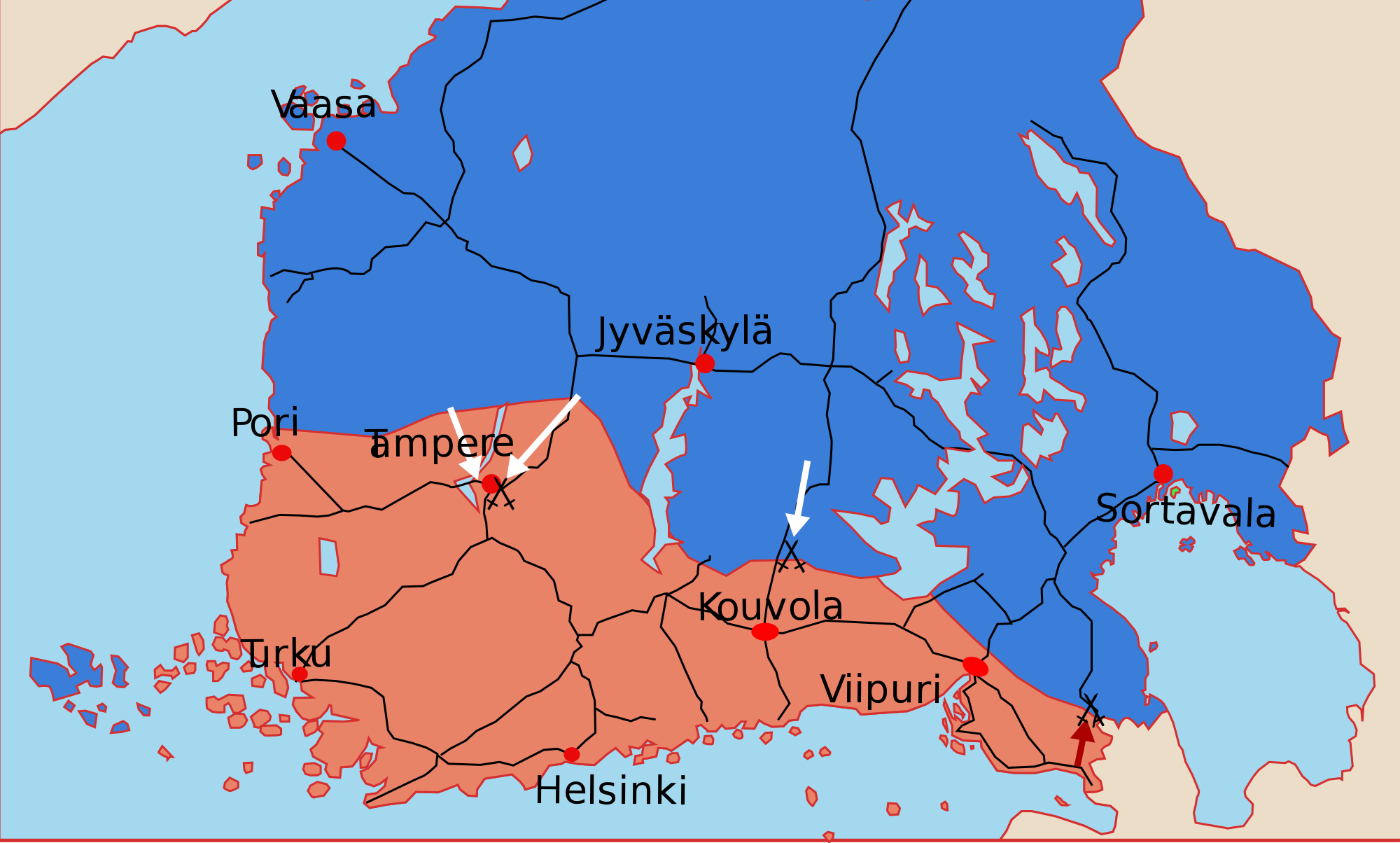
FinnishCivilWarMapMiddle.svgAs Tarja Halonen’s controversial no-show attests, the story of the Finnish Civil War continues to echo and ripple today. Tepora and Roselius’s book is particularly good on the historiography of the conflict, and the fluctuating fortunes of the combatants in national memory. I have already written much about the White story of Finland’s formation. Writing the Red version is substantially harder, not for lack of sources, but because the likely readership is supposedly dead or underground, or now carries a foreign passport and has largely forgotten its Finnish roots. Essays in this collection explain why, noting the way that the White story has not only slapped down many alternate views, but also reached into the past to retcon it. It was the post-war White Guards, for example, who changed the name of their society magazine to Hakkapeliitta, associating themselves with warriors of the 17th century and thereby implying that they were not only inheritors of Finnish tradition, but its founders. It is not until after WW2, which itself augmented the Civil War story by proclaiming both sides to be reconciled against a common enemy, that the Reds start to get their due in fiction, with works such as The Unknown Soldier and Under the North Star presenting them as humans, and more importantly, as Finns.

As for the facts, there are heartbreaking stories like that of Algot Untola, the dedicated editor of the Red newspaper Työmies (“The Worker”) who stayed in Helsinki to single-handedly edit the last edition for a readership that was already dead or fled. Captured by the Whites, he leapt from the deck of a ferry heading for Suomenlinna prison, and was shot as he tried to swim away. But there are also witty tales of daring, like the massive stone memorial to the Reds which suddenly materialised in a Turku graveyard in the 1920s. It had been dragged there overnight by cheeky stone masons, who sneaked it in by knocking down the wall and then rebuilding it before anyone noticed.

The most telling memorial of all is a lonely statue of Mannerheim, sitting in a forest. Commissioned in Whiter times, it was delivered to a newly Red-leaning council in post-war Tampere, which refused to put it in the centre of the town he had once bombarded. Instead, they dumped it quite literally in the middle of nowhere, where it stares grimly today at an audience of squirrels and sparrows.

Jonathan Clements is the author of A Short History of Finland

Chinese Stop-Motion Animation

$_1Cao Di’s Mandarin-language book Chinese Stop-Motion Animation chronicles the rise of animated films using the media of pieces of paper, marionettes and claymation. She does so in an impressively all-encompassing 336 pages, according a weighty, persuasive presence on the bookshelf to a medium that is often otherwise confined to the footnotes.

Cao does not shy away from the fact that some of the leading lights of early Chinese animation were Japanese, such as the early pioneer Tadahito Mochinaga, a Japanese animator fleeing the last days of WW2, who adopted the Chinese name Fang Ming, worked in China for the early 1950s, and returned periodically over the next two or three decades clasping new contracts and technology. However, considering his Manchurian childhood, which made him a fluent speaker of Mandarin by adulthood, Mochinaga is arguably a liminal figure that all but went native. Cao does, however, whisk away Mochinaga’s crown, suggesting that he was pipped to the post to make the first Chinese stop-motion film by the obscure On the Front Line, produced in Chongqing in 1939.

Stop-motion films largely remain short works, with concentrated bursts of artistry like the iconic Princess Peacock (1963) and the charming propaganda film Red Army Bridge (1964). China’s political upheavals made remarkably little impact on the output of stop-motion films, with only a three-year gap in releases at the height of the Cultural Revolution. In recent times, stop-motion leaps out of the arthouse into TV commercials and pop videos, where its short running times and quirky look can grab it more hits on the internet.

Cao’s book is packed with usable data – not only its narrative account of the industry, but a thorough chronology, a filmography of the works mentioned, and even an account of spin-off media – even Mao-era China had books-of-the-films. It is a valuable account of this over-looked subset of the animation medium, and a fitting companion to the same serial’s The Stories of Animation Outsourcing in China (1989-2009).

Jonathan Clements is the author of Anime: A History.

Seven Years On

milkycrisis-12It’s been seven years since the publicity junkets for Schoolgirl Milky Crisis, the book that led to this blog being started in the first place. And over on Youtube, Nozomi Entertainment have posted up their podcast interview with me from spring 2009, in which we discuss everything from the demographics of fandom to the problem of getting Chinese waiters to do backing vocals on “Help Me Rhonda”.
The God of Manga

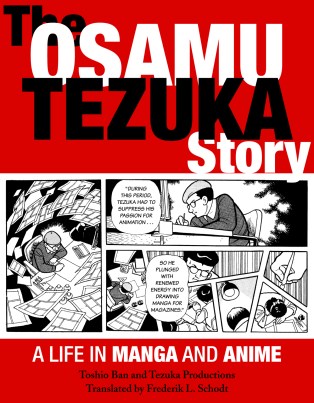
The Osamu Tezuka Story - A Life in Manga and Anime by Toshio Ban and Tezuka Productions Translated by Frederick L. SchodtToshio Ban’s The Osamu Tezuka Story: A Life in Anime and Manga is a ground-breaking manga biography of one of Japan’s best-loved and best-selling creators, the creator of Astro Boy and Kimba the White Lion. At 900 pages, it is a breathtakingly thorough sweep through Tezuka’s post-war struggles to become a comics artist, his misplaced faith in the financial returns of animation, and his pioneering efforts in setting up the studio Mushi Production.

Ban’s approach often has the relentless, linear plod of a TV movie, beginning with his leading man’s infancy, and working all the way through to his death. But in doing so, he draws deeply on Tezuka’s own memoirs, citing childhood incidents as crucial inspirations in his later work, such as the sticky-up hair that inspired the coiffure of his iconic Astro Boy. Most subjects would not warrant this intensive focus, but Tezuka is such a fundamental figure for understanding modern Japanese media that there is sure to be plenty of interest here for fans and scholars.

Ban’s artwork is deceptively simple. At first glance, it looks like the journeyman drafting of an educational comic, but actually goes much further. His depictions of many scenes are photo-real, deriving directly from documents, photographs and location hunts in the places under discussion. When Ban writes about the arrival of a letter from Stanley Kubrick, offering Tezuka the production designer’s job on 2001: A Space Odyssey, he doesn’t just tell you about it. He shows you the envelope it came in, complete with Kubrick’s return address. Translator Frederik L. Schodt almost fell off his chair in surprise when he got to a page recounting a visit by Tezuka to America, realising that the youthful hipster in one panel was himself as Tezuka’s interpreter, faithfully recreated from a forgotten photo.

fred and tez

Here we see the formative years of a young comics artist: the temptations of a career in medicine; the irresistible but risky pull of animation; the struggles of a young studio, and the confusing whirl of international attention. Tezuka is propelled to the height of the manga profession, only to risk it all with a blind-faith bet on animation. Much of the dialogue is taken, word-for-word, from his own books and speeches, including a wistful farewell in which he speculates about how the children of the future might regard the Earth from space. Cue Ban’s artwork running with Tezuka’s ideas to present a slingshot, sci-fi ending, as Tezuka’s work forges on into the future without him.

Ban also injects some subtle artistic elements. As Tezuka’s long-term assistant, he has mastered his boss’s style, drawing much of the manga in a direct pastiche of the original. Clearly channelling the idea of how Tezuka himself might have approached the project if he had been able to draw his life-story from beyond the grave, Ban presents the whole thing as a fantastical documentary, narrated by characters from Tezuka’s own works. The art-style degenerates into more amateurish cartooning when the young Tezuka is telling a story to an indulgent audience of relatives, but blossoms into richly toned artwork when recreating adult memories.

The Osamu Tezuka Story is an unparalleled gateway to Tezuka’s life and work. Many critics, myself included, warn that Tezuka and his estate have been expert curators of his memory, and that Ban’s work typically shines a spotlight so brightly on its subject that many of his contemporaries are confined to the shadows. But that doesn’t stop Ban from noting some of the low points, including Tezuka’s resignation from his own studio and his flirtation with depression. Unless you can read Japanese, this is the closest thing you’ll get to a warts-and-all portrayal, and undoubtedly the most informative, detailed and illuminating work on manga and anime to be published in English this year.

Jonathan Clements is the author of Anime: A History. This article first appeared in Geeky Monkey #10, 2016.

The Bear and the Maiden Fair

A new collection of essays on Finland in World War II.

mannerheim line

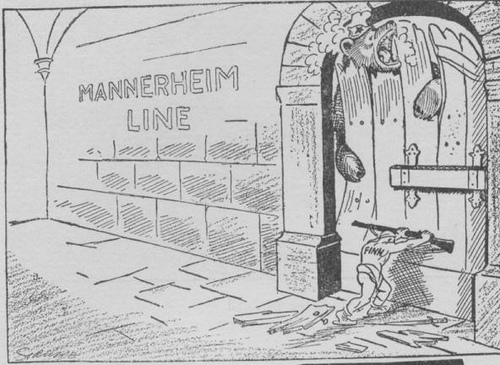
Finland fought three conflicts between 1939 and 1945. The first was the notorious Winter War (1939-40), in which the country stood alone against Soviet invasion. “Only Finland,” thundered Winston Churchill, “superb, nay, sublime in the jaws of peril – Finland shows what free men can do.” What Finland, under its famous leader Mannerheim, managed to do was put aside the festering civil strife of Red versus White, left over from the civil war of 1918, and unite against a common enemy, fighting the Russians to a standstill while the world looked the other way. In the process, the map of Finland, sometimes described as the “Maid” for its resemblance to a girl in a dress, lost an arm of territory to the Russian bear.

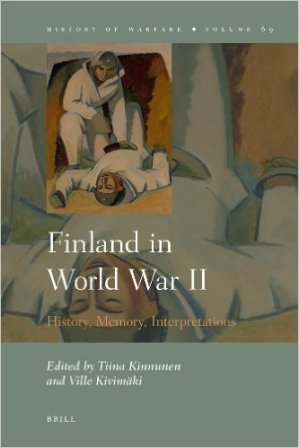
41wDEOVZcaL._SX331_BO1,204,203,200_The second was even more divisive. The Continuation War (1941-44) saw Finland joining forces with Nazi Germany in a renewed attack on Russia. As noted in Tiina Kinnunen and Ville Kivimäki’s insightful collection of academic essays Finland in World War II: History Memory, Interpretations, it was the Germans who swiftly announced this to be Waffenbrüderschaft – a “brotherhood in arms.” It was the Finns who pushily translated this into English as a “co-belligerency pact”, refusing to call themselves allies of Hitler, even as they overshot their original targets, clawing back the land lost to the Soviets and rolling onwards to the East, seizing the lands of Karelia, which had arguably never been Finnish before, creating an entire new industry in manufactured traditions and rescue ethnology, well covered in Kinnunen and Kivimäki’s book.

One might suggest that the third was even more controversial. Whereas the Continuation War was a shocking deal with the devil (a devil that, as noted here, more crucially sent the food supplies that saved the Finns from starvation), the Lapland War (1944-45) was its shocking turnabout, as the Finns turned on the Nazi troops on their territory, chasing them out of the country in a conflagration that saw almost all human habitation destroyed north of the Arctic Circle.

It never ceases to amaze me how historians can find new angles on the war, and Finland in World War II does not disappoint, with space devoted not only to geopolitics and treaties, army operations and tactics, but also to such oddities as the psychological effect of burying the fallen in their home towns (Finland today boasts 600 “heroes’ cemeteries”), the countrywide ban on dancing (an activity regarded by grim Lutherans of a betrayal of comrades’ sacrifices on the front line), and the DIY magicians’ kits sent to entertain troops in their trenches. Modern trends to conflate history with memory also lead to some interesting areas, such as accounts of the historiography of the war as told in movies and novels, as well as changing public perceptions of Finland’s attitude towards the Holocaust. The editors aim to both summarise and outline the most recent researches on the subject, with chapters firmly grounded in Finnish-language academia, and a bibliography of many obscure English-language academic papers on Finnish subjects.

Later essays include several welcome treatments of the role of Karelia in the conflict, not only as a land to be defended, but also as the new frontier of a Nazi-inspired expansion into conquered lebensraum, and a lost land ceded to Russia – source of thousands of refugees in the 1950s. One remarkable section even delves into Sain Karjalan takaisin (“I Got Karelia Back”), a 2003 account of a woman’s trips to the place of her birth, now a Russian republic where her childhood home is occupied by strangers, and where she is inspired by the landscape to stay and build a house.

Jonathan Clements is the author of An Armchair Traveller’s History of Finland, available now in print and on the Kindle (UK/US).

The Finland Station

polarbear-transpSo I have paid my membership for the Helsinki Worldcon next year. Yes, yes, there’s still a year to go, but there are Progress Reports to read, and hotel rooms to book, and plans to be made. Also, who knows how low the pound will sink in the meantime? And for those of you looking for a quick introduction to a nation with a British patron saint, a death metal band in Eurovision, a language that helped inspire Lord of the Rings and an annual wife-carrying contest, look no further than The Armchair Traveller’s History of Finland, available now from all good bookshops, and most of the bad ones.

The Elephant in the Room

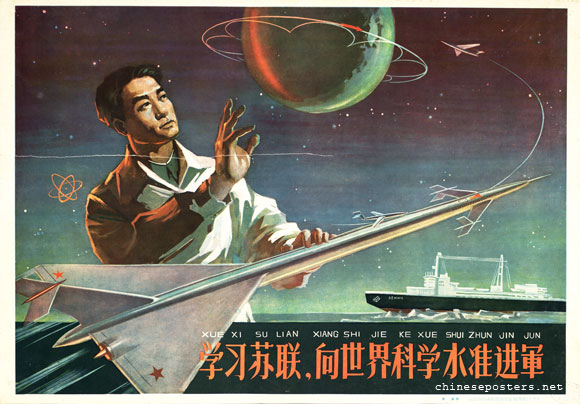
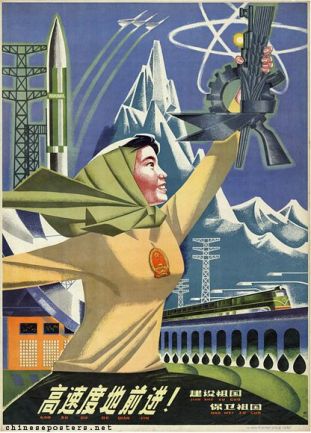
chinesePropagandaPostersLeapForward1

In The Politics of Innovation, American academic Mark Zachary Taylor grapples with the implications of Cardwell’s Law – which states scientific and technical innovation in any particular country to be a matter of a short, unsustainable burst of creativity. How can policy-makers grow a vibrant, productive science community, creating the patents, inventions and jobs that can drive a high-tech economy? Is it even possible to artificially generate a smart, inventive society? And why is it that some countries just seem to be better at innovation than others? Why is it, for example, in the post-war period, that Japan achieved such leaps and bounds? Why not France, which had better access to markets?

Taylor’s answer, easily stated but robustly defended in close and detailed arguments, is that nations are prepared to pay the price, deferring comforts and investing in research, if they are in a state of “creative insecurity”. This requires a country to perceive external threats as more pressing and important than the politics of internal tension.

1627883e69c49fe80cb06c01030dadc6Taylor argues that far too many policy-makers assume that innovation is a black box, into which a state pours money, waiting expectantly by the exit valve for patents and innovation to come tumbling out. As his title implies, politics is a vital consideration in the way that innovation is funded, assessed and implemented, with Taylor offering as one example the old proverb about the four blind men feeling an elephant. All of them are observing quantifiable elements of the animal, but in academic terms, none of them are citing each other. They are ignorant of the discoveries being made elsewhere – their own hang-ups and blind-spots are preventing them from getting to the task in hand, which is understanding the elephant in the room.

The topic, of course, is a minefield of potential triggers for racism, triumphalism, imperialism, and misguided cultural relativism – even the opening question, of why some states are better at innovation than others, is open to abuse by demagogues and bigots, leading Taylor to predict and pre-empt mis-uses of his conclusions. He is swift to point out the likely abuses of his data, starting with the suggestion that the best way to run a successful science and technology policy is to scare citizens into believing their country faces a threat from Evil Foreigners. In fact, argues Taylor with touching faith, people are not liable to be that stupid, at least not for long, and an informed population will soon see through a manufactured bogeyman. He points out, more hopefully, that there is no reason for the external threat to be human – a state is just as liable to make leaps in invention and innovation if it embraces the challenge of, say, coping with climate change.

He also has some compelling things to point out about the environment most likely to foster creativity. Taylor has no truck with the suggestion that some races are just dumber than others, discounting data from third-world countries that have more pressing subsistence priorities than, say, semiconductor research. His remaining data presents a persuasive picture of those countries that spend on scientific and technical development, and those countries that reap quantifiable rewards from doing so. The two data sets are not exact matches, and his argument focuses on possible reasons for this discrepancy.

Hollywood-style, nobody knows anything. Taylor considers the likely elements of randomness that turn some research exercises into “Easter egg hunts” with unclear objectives and unpredictable returns. But he also considers the likely effects of such strange attractors as military funding, a definite contribution to innovation in his native United States, but no longer in Russia, despite the latter country’s still-large arms budget.

Taylor’s conclusions are immediately applicable in the modern world. In fact, they are so applicable that he is prepared to conclude with predictions for the likely national success stories, disappointments and close calls on the international stage in the next two decades. He has good news for Finland and Japan… bad news for Russia and Saudi Arabia. With such careful argument and confident suggestions as can be found in his book, one suspects that he will not be in academia for long, as true politics is likely to come calling.

Jonathan Clements is the author of A Brief History of China.

Warning! Chatterley

In-the-Realm-of-the-Senses-940x460-850x416

Over at the All the Anime blog, I review Kirsten Cather’s Art of Censorship in Postwar Japan, which chronicles several landmark cases, including dodgy films, suspicious books, and tawdry manga.

“Cather’s book tracks censorship in Japan from the landmark Chatterley case, through several key cinema and literary rulings, all the way to the present day and the first manga to have its merits debated in court. Her wit and irreverence takes its cue from VS Naipaul, who quipped on the issuing of a fatwa against Salman Rushdie that the Ayatollah of Iran was offering a somewhat extreme form of literary criticism. She moves into film in the 1960s, revealing that Tetsuzo Watanabe, last seen in Anime: A History leading a group of tanks against striking special effects technicians at Toho, went on to find an even more bonkers job working for the censorship authority Eirin. Eirin saw themselves as defenders of public morals, surrounded by an ever-rising tide as erotica as Japanese cinemas increasingly chased the blue-movie market. The statistics do not lie; Cather uses big data to point to the transformation of Japanese cinema. ‘In 1963, only 37 of the 370 films checked by Eirin warranted adult ratings, whereas by 1965 the number had reached 233 of the total 503.'”