We were supposed to be in Kunming for lunch time, but a rockslide in the mountains caused us to take a four-hour detour, and we didn’t reach our hotel until 20:00. So, no chance for my plans to see the Flying Tigers Museum in town. Our final stop on the road trip was a ramshackle yellow hut, stuck behind a new shopping mall. Its paint was peeling and its plaster falling off, it was being used as a shed, but it is one of a handful of surviving French station-houses from a century ago.
My PTC (piece to camera) went as follows: “The French didn’t have a toehold in the Chinese hinterland, but they did have a colony in what is now Vietnam, and built this railroad from there to the capital of Yunnan, to exploit the local resources. This is one of only a handful of surviving station-houses, but it’s practically inaccessible, and largely forgotten.” I had three chances to say it, although one was blown by the arrival of a train. The director has two cuts to work with – hopefully the light is right on one of them, and there is no noise pollution.
I earn my money not by saying these words, but through the hundreds of little arguments I have with the director about the order the words come in. Each PTC is written on the spot, but I have to fight over tiny nuances of meaning, so that we don’t get into trouble with Standards & Practices for saying something unverifiable, or waste our footage by saying something on camera that turns out to be wrong.
So I’m there saying we have to say “Chinese hinterland”, because the French did have a toehold in Fujian and Shanghai. We have to say “what is now Vietnam” because Vietnam did not exist as a political entity at the time, and if we say Indochine, some viewers won’t know what that is. We have to say “capital of Yunnan” because nobody has heard of Kunming, but we will have already explained where Yunnan is in the episode. We have to say “the local resources” because we can’t remember what they are, except for tin, and we know there was more than tin. We say a “handful” because we only have one source that names them as three stations, and S&P insist on two sources or we can’t state any facts at all.
And we say “largely forgotten” because the Chinese will moan if we tell the truth, which is that they have left it entirely derelict because the achievements of the colonial era mean nothing to them, even as they reinvent the wheel, with a new railway line running parallel to the one that has already been there for a hundred years. Maybe I earn my money after all, because I had less than five minutes to thrash all of the above out, and less than five more to get it on camera before we were back in the bus.
Jonathan Clements is the author of A Brief History of China. These events appeared in Route Awakening S02E01 (2016).
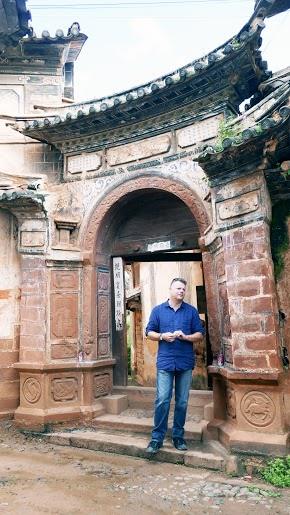
We are now in Xizhou, near Dali, in an area that is largely Bai, and which has somehow embraced heritage in a way entirely unlike the rest of China – I have not seen a skyscraper for two days. Closer to the coast, “heritage” seems to mean that everywhere gets a shopping mall and a car park, and a bunch of hawkers selling plastic machine-guns. But out here, it means that the old architecture is retained, with acre upon acre of quaint pointy-gabled houses, temples and taverns.
Green foothills loom above us on all sides – they will eventually merge into the Himalayas. This is the locus of the old Tea-Horse Route, a lesser-known trade network that sent tea into Tibet to buy ponies for the Chinese market. Salt, tea and trinkets would cross over the mountains into Burma, often carried by porters lugging their own weight or more, singing a song that went:
Six steps up and rest
Seven steps down and rest
Eleven steps flat and rest
You’re stupid if you don’t rest.
I’ve heard that someone would bang a gong at the end of each verse, signalling the next brief stop. Two hours’ drive into the mountains bring us to Shaxi, once the centre of the Tea-Horse network, now a slightly-touristed heritage town, selling wood carvings and Yunnan coffee. The place is plainly on the backpacker trail, and boasts an untold number of boutique cafes, tea houses and restaurants. Lunch is dry-fried beef in crisped mint leaves, Yunnan ham in tofu and goji berries, and tasteless mushroom fronds harvested with a sickle from the nearby canal.
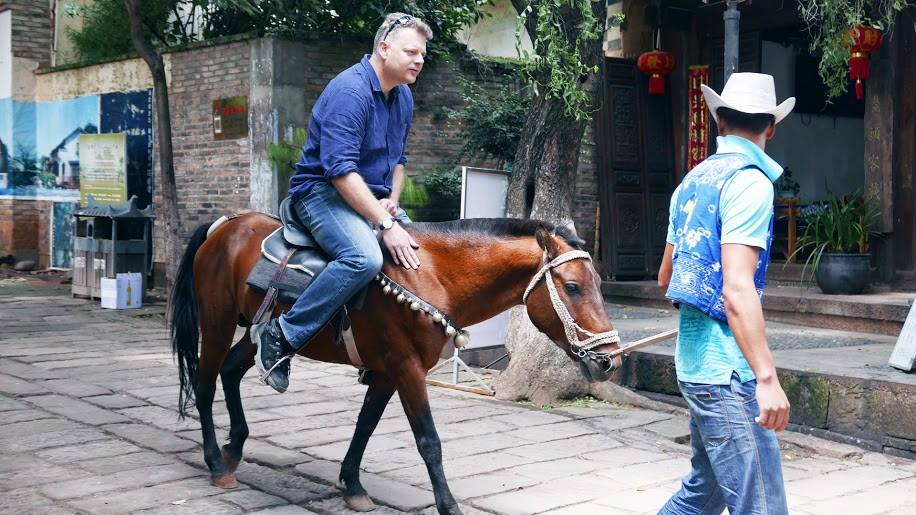
My job is to walk around town reiterating what I’ve just told you, until two Bai dressed like Marlboro Men trot past on ponies. A price is swiftly agreed, and I am hoisted up onto Zhitu (Red Rabbit), an uncomplaining little horse supposedly descended from the pack animals of the old trading routes, so that I can continue my explanation while riding along. I look ridiculous, like a gorilla perched on a sausage dog. I am taught how to say whoah in Bai, which turns out to be waah, something I would probably end up saying anyway if Red Rabbit were to bolt. But we walk through three iterations – a wide-shot, a close-up and a safety, and he doesn’t throw me, and I clamber down and tell him he is a good little horse before I kiss him goodbye.
“Why did you do that!?” asks the aghast director.
“I’m British,” I explain. “We only show affection to dogs and horses.”
Jonathan Clements is the author of A Brief History of China. These events appeared in Route Awakening S02E01 (2016).
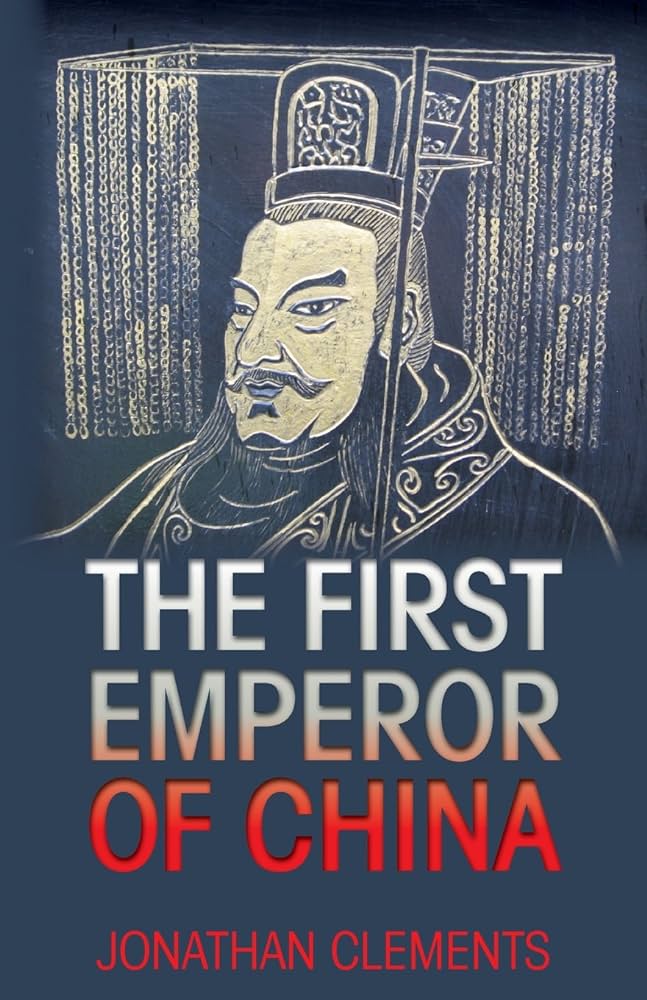
Tantor Media is releasing an audiobook version of my First Emperor of China, read by the wonderful Kathleen Li.
In 1974, Chinese peasants made the discovery of the century . . . Thousands of terracotta soldiers guarding the tomb of a tyrant.
Ying Zheng was born to rule the world, claiming descent from gods, crowned king while still a child. He was the product of a heartless, brutal regime devoted to domination, groomed from an early age to become the First Emperor of China after a century of scheming by his ancestors.
He faked a foreign threat to justify an invasion. He ruled a nation under twenty-four-hour surveillance. He ordered his interrogators to torture suspects. He boiled his critics alive. He buried dissenting scholars. He declared war on death itself.
Jonathan Clements uses modern archaeology and ancient texts to outline the First Emperor’s career and the grand schemes that followed unification: the Great Wall that guarded his frontiers and the famous Terracotta Army that watches over his tomb.
This revised edition includes updates from a further decade of publications, archaeology and fictional adaptations, plus the author’s encounter with Yang Zhifa, the man who discovered the Terracotta Army.
I meet the people I dubbed Victor and Margaret in the hotel elevator, where he is shouting at her.
“For God’s sake, woman. You have to tap the card on the thingy or it won’t go anywhere.”
She fumbles in her purse and he stares, fuming, at me, as if to say I don’t believe it.
“It’s all right,” I say. “If you’re heading down, the lift is already going that way, so you don’t need to tap your card.”
“How about that, dear?” says Margaret. “He speaks Chinese.” And she finished with a little smirk that I translate as: And he knows how the fecking elevator works.
The 260 express bus goes straight from Central, Hong Kong’s version of Liverpool Street, through the Aberdeen tunnel to the south side of the island. Where there were once skyscrapers and teeming millions, there are suddenly winding mountain roads and secluded beaches. The bus goes past Deepwater Bay, where the beach is protected by a shark net, and two superyachts lurk ominously in the roadstead, and then Repulse Bay, where what first appear to be bungalows turn out to be the tops of twenty-storey towers, reaching up the steep slopes from a tiny bit of flat land at sea level.
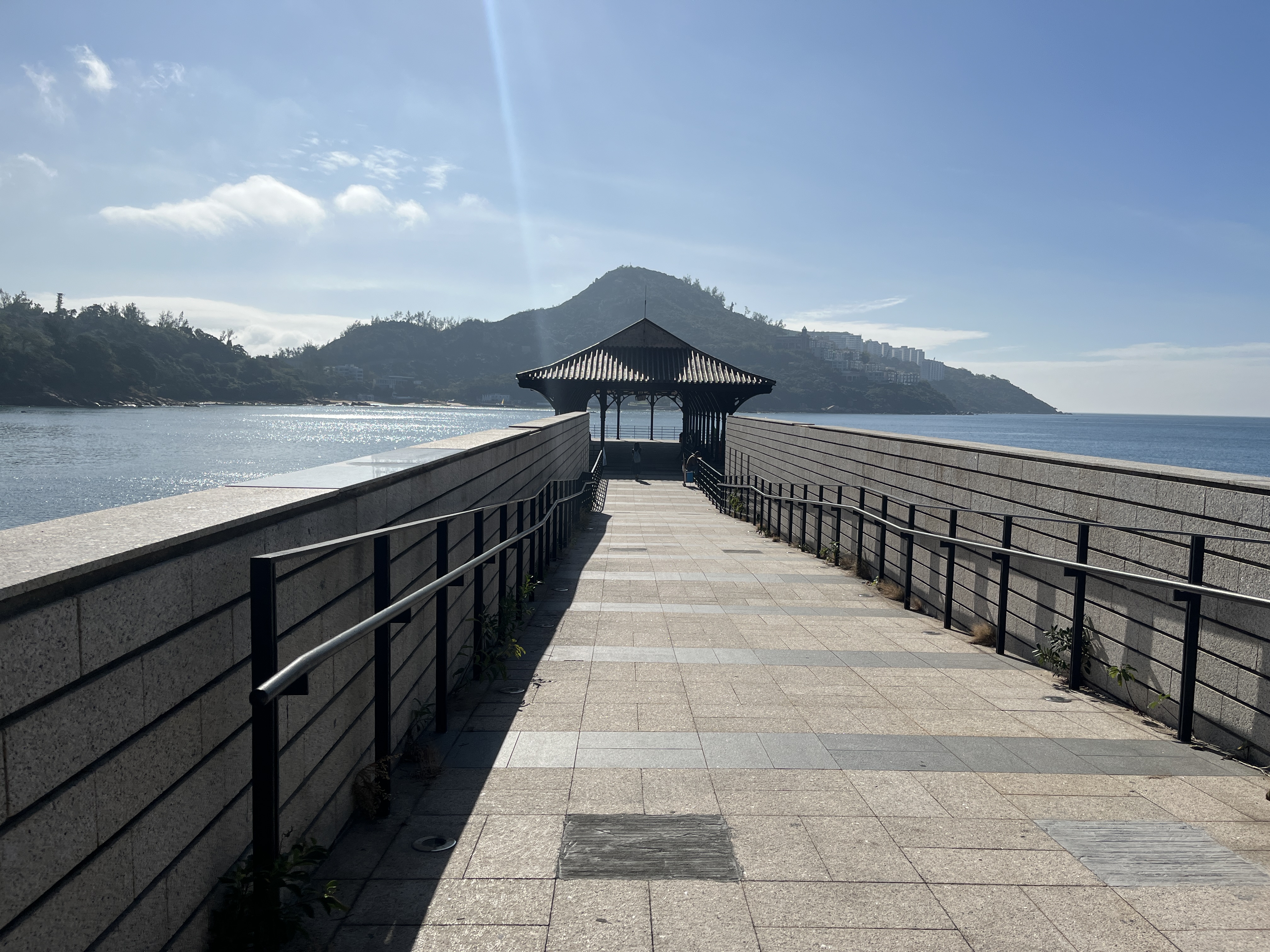
This is where the smarter bankers and brokers live, in little villas on the hill-tops. And there, at the end of the bus line, is Hong Kong’s Leigh on Sea, the seaside town of Stanley. A little shaded pier juts into the bay – it is ten o’clock in the morning and it is already crowded with half a dozen fishermen. There’s an old colonial government building now converted into a seafood restaurant, and – surprise, surprise – a pub called the Smuggler’s Rest that offers fish and chips.
I’m here because the internet makes it sound like a shopper’s paradise, “the place to buy all your souvenirs.” But it isn’t. There are exactly none of the souvenirs I want, nor is there the promised calligraphy master, as someone on the internet has confused “calligraphy master” with “guy who will write your name on a grain of rice.” There are polyester cheongsams and Bruce Lee T-shirts, and I want exactly none of it.
I share the bus on the way back with a soft-spoken broker from Edinburgh and his half-Chinese son, whose name I don’t catch, but I presume to be But Why, because it’s all he ever says. They’re off to Specsavers for But Why’s first ever eye test, and his Dad is explaining why there are men cutting down trees, and why there are cars in the road, and why the bus has stopped at traffic lights. What a life it must be, living by the sea but being able to be in Bank of China building 40 minutes away… except that is surely true of anyone who lives in Leigh as well.
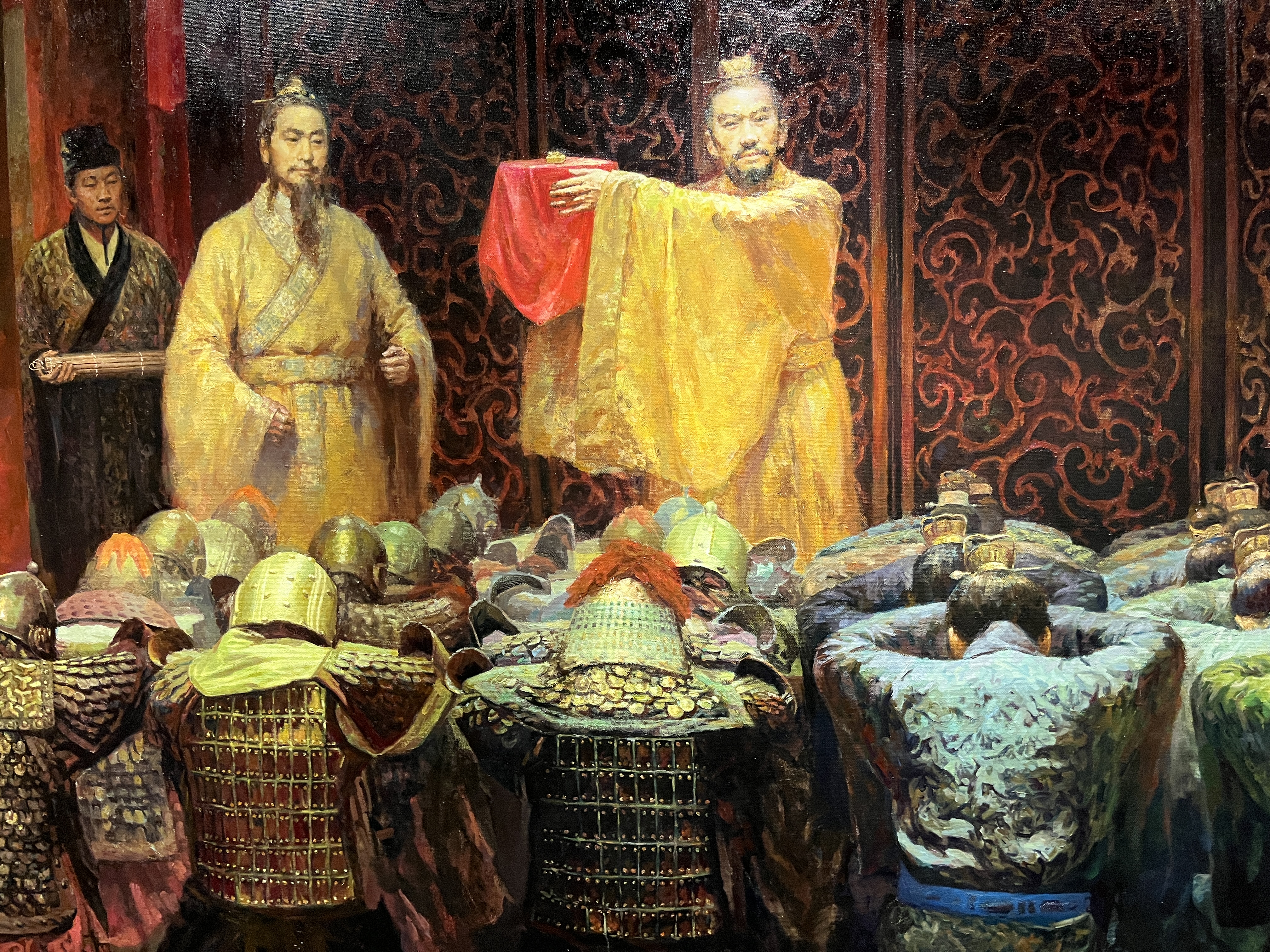
“Zhao Tuo accepting the title conferred by the Han empire” — oil painting by Pan Jiajun, Liao Zongyi, Chen Keng, Zhai Shutong and Xu Guosheng, from Guangzhou’s Museum of the Palace of the Nanyue King.
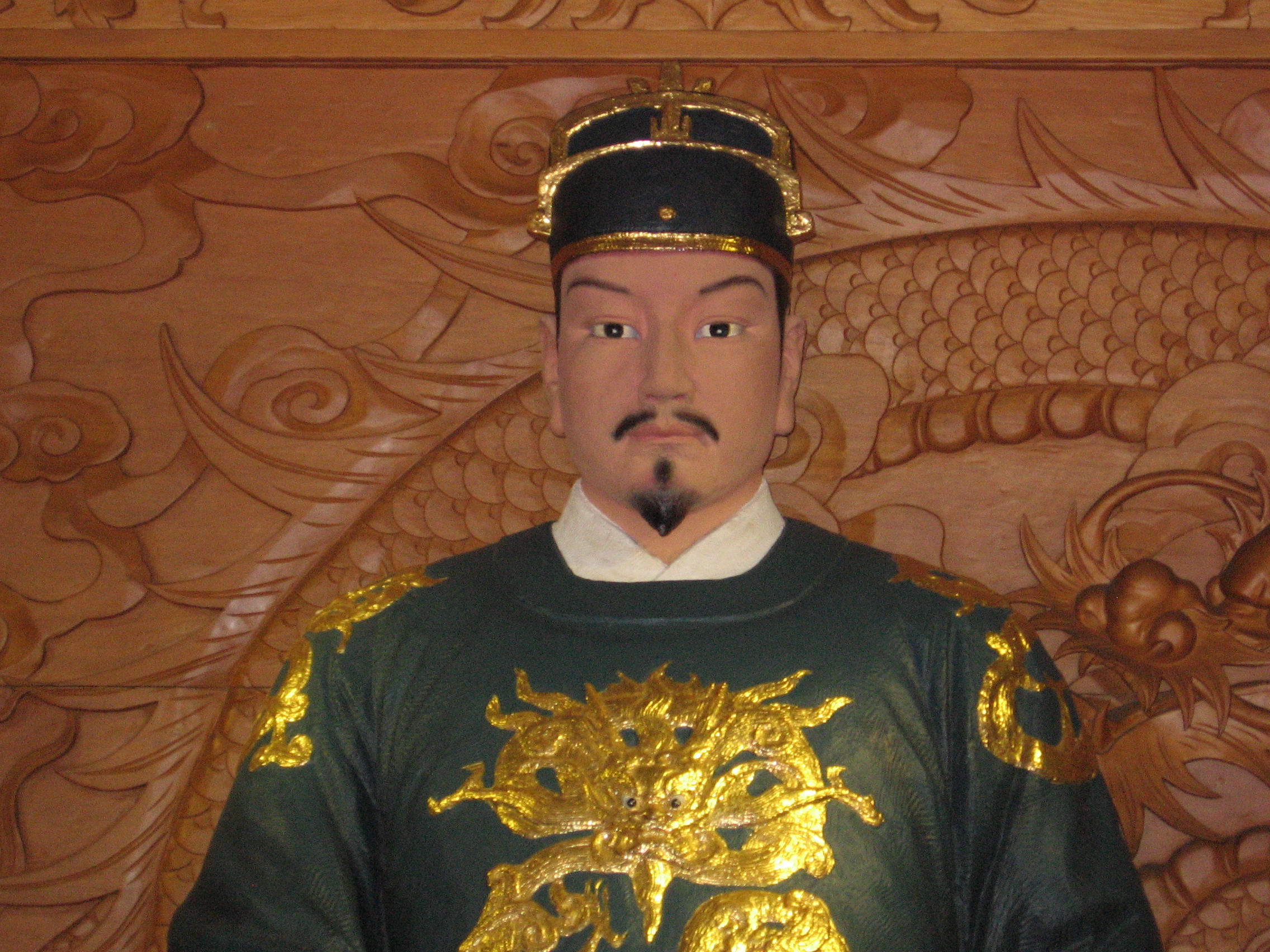
Zhao Tuo was a general in the service of the First Emperor of China, whose march south left him as the satrap of much of what is now Guangdong. By the time the Qin empire fell, Zhao Tuo had practically gone native, proclaiming himself the ruler of a newly envisioned “Nan (Southern) Yue” – a federation of several of the peoples he had conquered, sprawling across Guangdong, Guangxi and into what is now north Vietnam. For this, he is remembered in Guangdong as the first proponent of Guangdong as an independent state beyond China, and in Vietnam as the first ruler of “Vietnam” – Nanyue, in fact, is pronounced Namviet this far south, and when rulers centuries later wanted to come up with a name for a kingdom a little bit further to the south of here, they reversed the characters to make Vietnam.
Zhao Tuo lived to be 103, and he was succeeded by his grandson, who ruled for ten more years, and was himself buried in a marvellous jade suit. By then, there had been some wily diplomacy from what was now the Han empire to the north, including a diplomatic marriage to a Chinese princess, which meant that the court and royal family were all at loggerheads about whether to go even more native, or to give up and allow themselves to be rebranded as the lords of China’s southernmost province. Eventually, it all ended in tears, with a palace coup and a war with the Han, and it all came apart soon after.
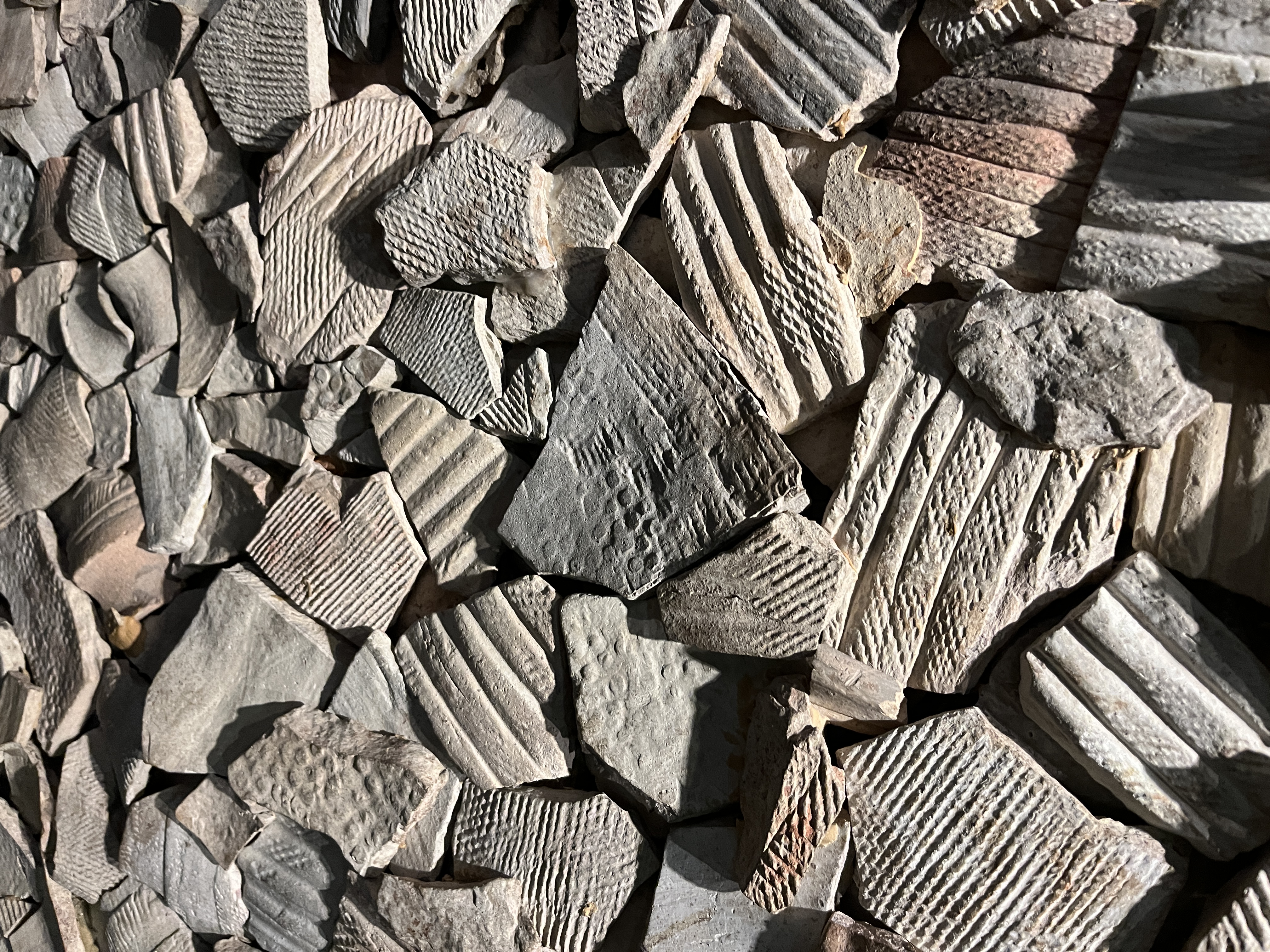
Zhao Tuo and his courtiers lived in an opulent palace, of which very little remains today except smashed pots and a few bits of wood. The museum signage tries very hard to make it sound fun, but glum Cantonese people mope around the site looking at holes in the ground. The most amazing thing for me is the king’s garden, because although none of the shrubbery remains, there is a very clear outline of his sculpted watercourse, a veritable babbling brook that snaked through the garden, and around a bend deliberately designed to create a little whirlpool. It turns out to be the first documented landscaped garden in Chinese history – I can feel the first chapter of a history of the Cantonese people taking shape.
For roughly a century, Guangzhou (Canton) was the centre of a little kingdom with its own unique style, mainly in doubled animal icons where one creature was blatantly visible, and its counterpart was twisted and hidden within the curlicues. Nanyue was known for its swords, and what appears to be evidence of sea trade with ancient Persia.
As with similar sites, like Chengdu, the presence of a quasi-independent state, however brief, and the finding of an iconic symbol to represent it – in this case, an entwined dragon and phoenix – is a hot political potato in China. Nobody wants to talk openly about the possibility of a federal China (an idea once supported by a young Chairman Mao), or of the linguistic reality that it is composed of eight separate “nations”. Ten years ago, such historical curiosities were celebrated as part of China’s glorious ethnic diversity. In the hardline 2020s, as mosques are homogenised and domestic differences denied, such discussions veer towards the Party’s forbidden realm of “historical nihilism.”
And so the museum at the Tomb of the Nanyue king tiptoes around the fact that this 1st century BC ruler, son of the long-lived first king, was the ruler of an independent southern Chinese state. Nor does the museum literature dwell on the actual history of Nanyue, instead wandering off on a time-wasting tangent about a collection of ceramic pillows that helps bulk out the museum collection.
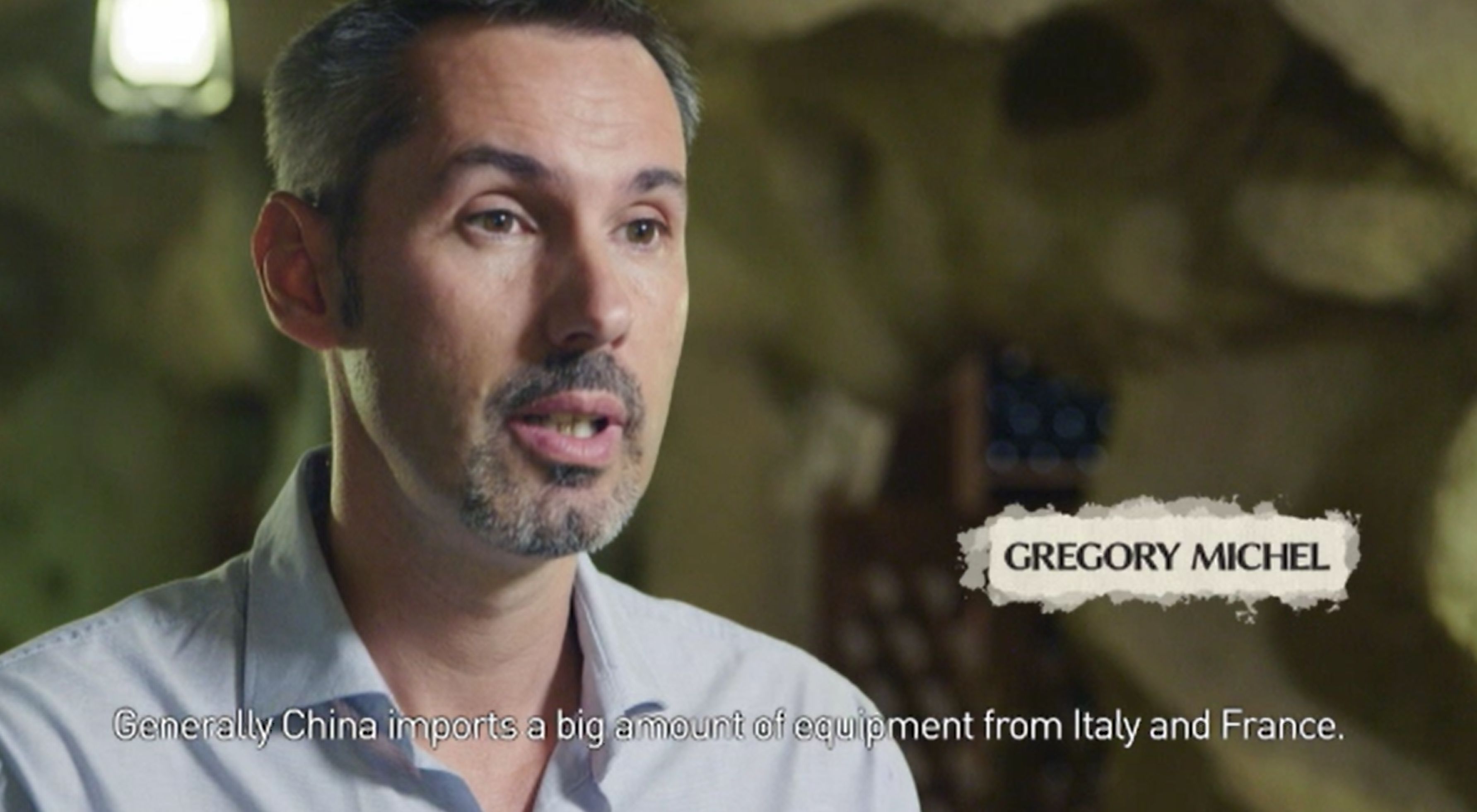
We drive an hour or so through the Xinjiang countryside and the vineyards of the Turfan Depression, to the Loulan Winery, which is not actually in Loulan at all, but has purloined its name. A private Chinese enterprise, it started up in the immediate years after the Deng Xiaoping economic reforms, transplanting French and Italian vines to Turfan soil. The chef de domaine is French: Grégory Michel, a man from Provence who could not possibly have wanted to live here, except for the handy fact that he is married to a Chinese woman and hence regards it as something of a cushy posting.
Grégory shows us around the huge factory, with giant steel vats towering thirty feet above us. We all wear little white coats, mine looking particularly petit since it is designed for a little girl, or so it seems. It’s a far cry from Ismayil’s hand-cranked meat grinder, repurposed to mash grapes. Grégory’s industrial-size, conveyor-belt macerator is big enough to throw a whole person into.
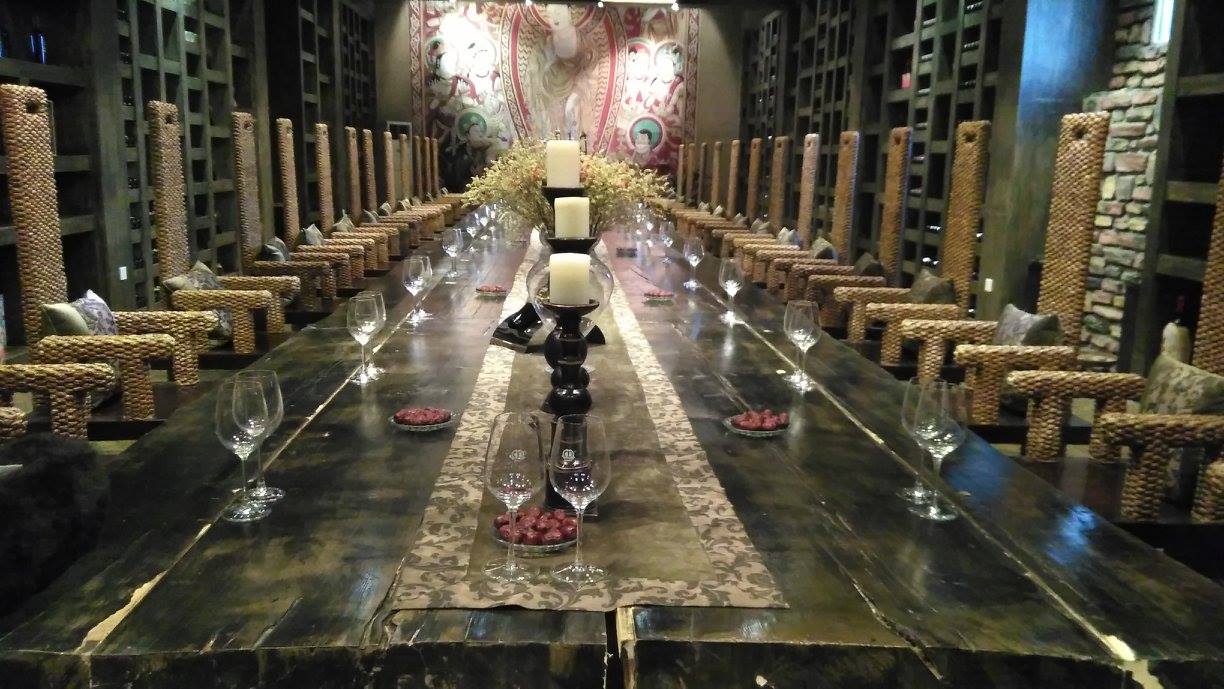
The Loulan Winery is clearly pushing for the luxury tourist market. We wander faux caves decorated with Buddhist art, and sit in an elegant VIP room, with posh chairs of knotted rope, and a giant slab of a Viking table.
Grégory plainly has no idea that a convoy of Buicks is about to descend on his factory, but brightens with each passing moment when he realises that we are the advance party for an entire posse of journalists, who are shadowing our travels in a long crocodile of cars. “I shall get zem drunque!” he promises me, as we wander the pipes and vats.
We do the interview to camera in French, which ought to help the programme look suitably cosmopolitan, and puts a smile on Grégory’s face, which is very difficult with a Frenchman.
The advance car of the convoy turns up at lunchtime, and we snatch the chance to get some shots of me driving it past some vineyards. Meanwhile, the usual too-many-cooks cacophony of the publicity team is at full throttle. Even though they approved my speech outline two days earlier, they have now decided that they wish that my speech was 20 minutes longer. Luckily for them, I am precisely the sort of guy who can write an extra page about Wine on the Silk Road in sixty minutes.
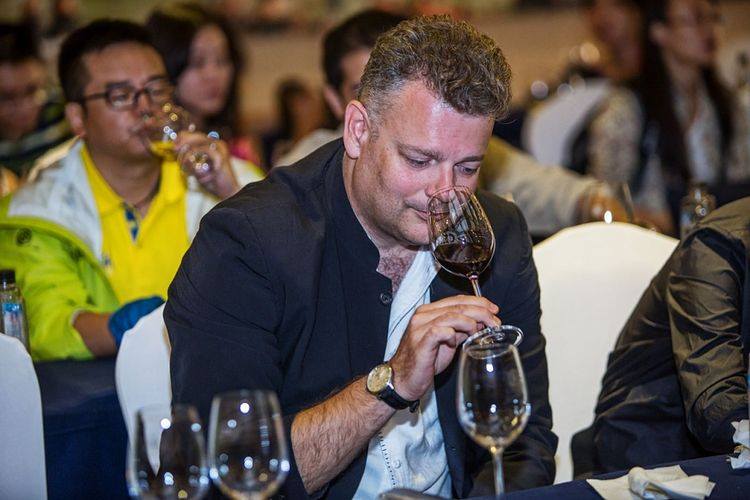
I do my speech about the stories associated with wine on the Silk Road, including the arrival of grapes in the Han dynasty, the sozzled poetry of Li Bai in the Tang, the Mongols drinking themselves to death, and so on. It fills the time nicely and gets several laughs. Grégory then takes to the stage while his minions pour samples for the crowd, and within another 20 minutes, everybody is thoroughly munted on Chinese wine.
The Loulan Cabernet Sauvignon is very nice. This being China, I have never actually been able to have it chilled before, and it is perfectly drinkable. Grégory has plainly done a good job on quality control, although it remains to be seen if he can turn a profit. He says that the cost of making a bottle of wine in China is roughly the same as making one in France, but the local market won’t bear high prices, and the country is so big that simply putting a bottle in every off-licence costs 1000 times as much. Most of the price label of a bottle of Loulan wine is taken up with marketing.
We are invited to dinner, but need to be in Urumqi for the evening, so we hitch a lift with our local fixer, Ali. Halfway to Turfan, the producer calls for a toilet break (we have long since learned not to ask for any more details), and I lurk outside the bogs with Ali, while he sucks on a cheroot that smells like someone has set fire to an old sofa.
“I realised yesterday,” says Ali, “how difficult your job is. You really have only a few seconds to get it right, and there are people on their phones, and shouting at the crew, and there are radios in the background, and people knocking on the door, and the sun moves – you actually become aware of the fact that the sun is moving and there are clouds in the sky… it’s very hard.”
He doesn’t know that he makes it worse by subjecting me to the Gipsy Kings for a two-hour drive through the desert, but I suppose it is his car.
Today, Mr Jiao is supposed to be showing me the remaining parts of the process for making hempen Bai Yi clothes. We’ve been shooting the process out of order, so it’s only on day two that we get to harvesting the hemp itself. He takes us to a tiny little patch of weeds at the edge of a cornfield – it is no bigger than a minibus, but turns out to be the only hemp in the village. The director’s plans to have us wandering through acres of it has to be rewritten on the spot.
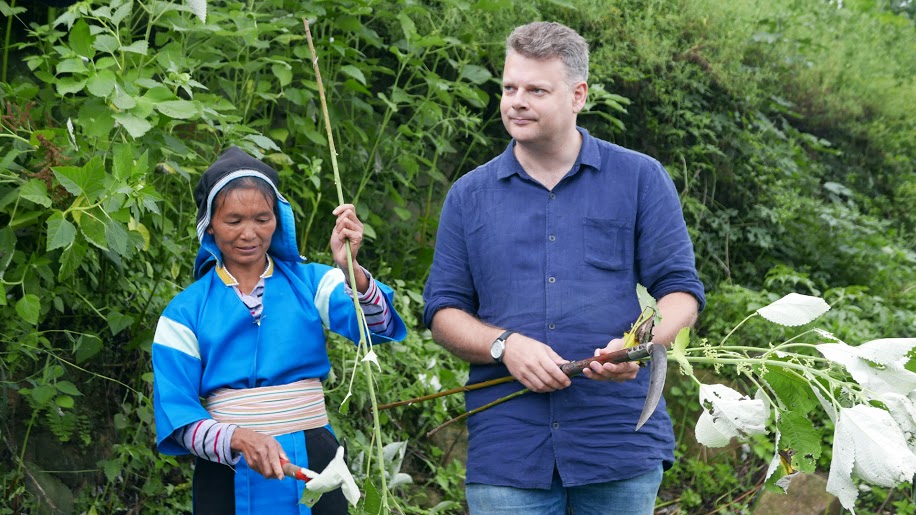
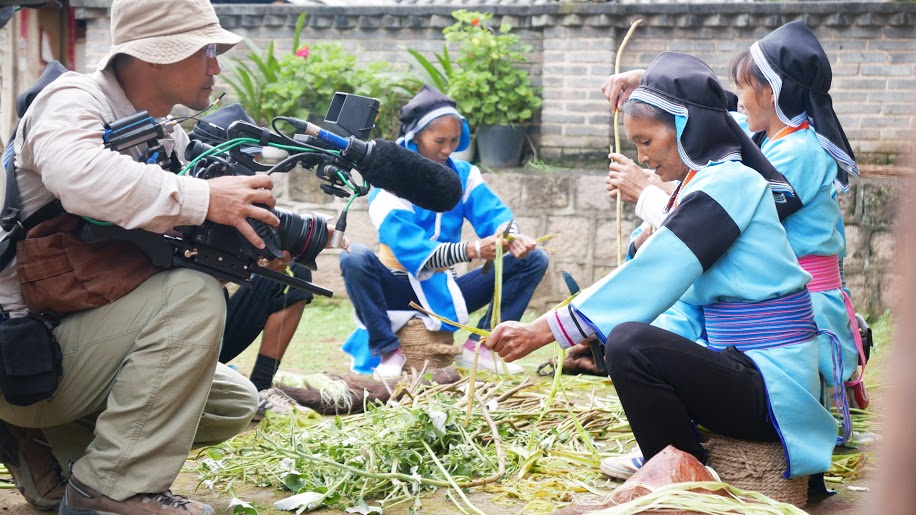
She decides instead to do an aerial drone pass of the pair of us reaching the patch, where three Bai women in their black wimples and blue tabards are hacking at the copse with sickles. But they are so quick at it that the director has to beg them not to cut it all down before we can get to the wide shot. I am told to stand in the field with Mr Jiao and talk to him about hemp, not the world’s most riveting subject. Our drone is supposed to sail over our heads, recording us and the village above us. Except suddenly I hear a sound like a hedge trimmer hitting a bucket of turtles, and realise that the overhead shot has failed to take into account the presence of terraces. Our Yuneec Q500 Typhoon has scythed its way several feet into a stand of corn before coming to a halt, meekly bleeping a distress signal. Mr Jiao fishes it out and returns it, minus one propeller. Luckily, we have spares.
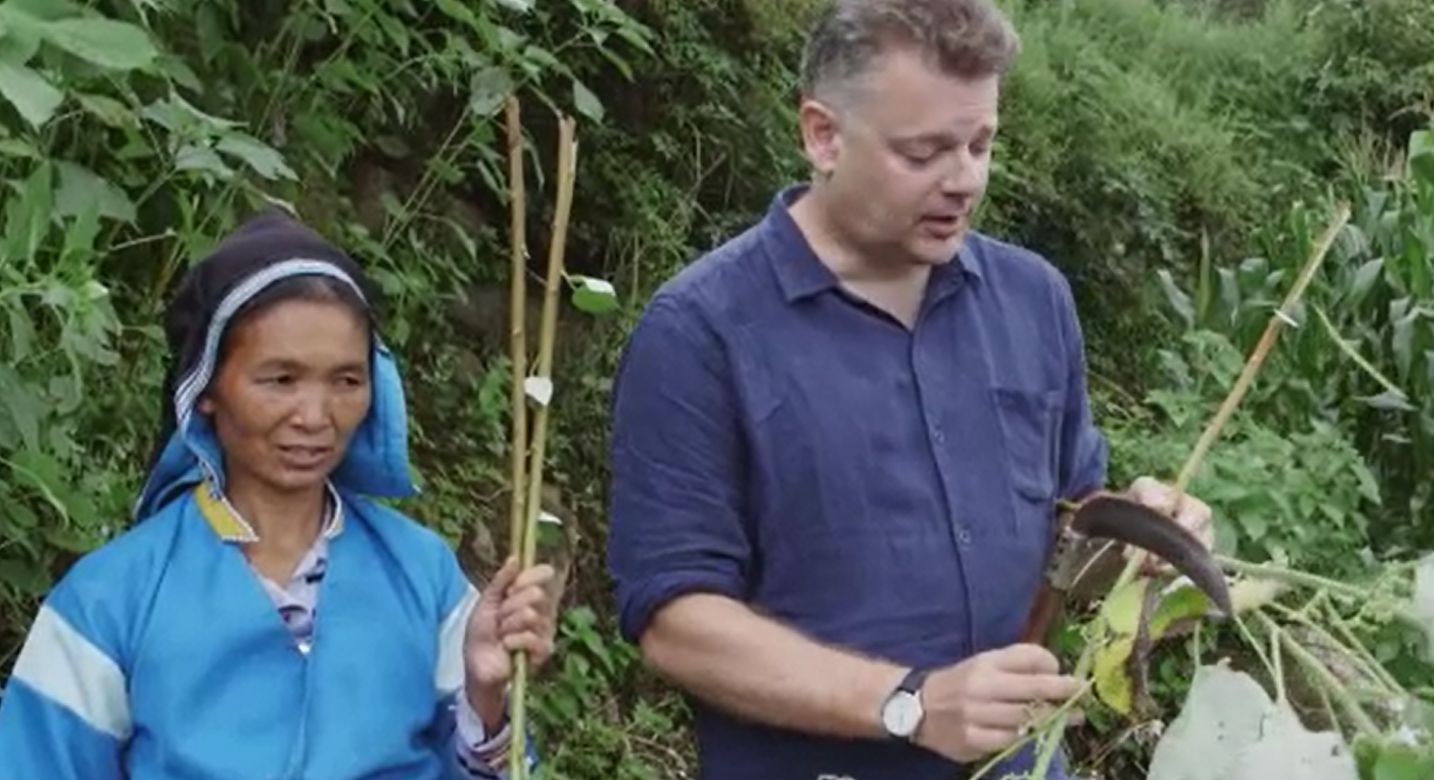
Meanwhile, the wimple-wearing sickle-girls have got bored. One has wandered off entirely, and the other two are stripping some of the hemp stalks to make a basket. They have to be herded back to work. I manfully wade in with a sickle, and hack out a bunch of hemp stalks, stripping their leaves away and casting aside the long stalks. I put the leaves in a basket and head up to Mr Jiao, feeling pleased with myself.
“What are you doing with those?” he asks.
“These are to make the thread, right?”
“No,” he says. “We feed the leaves to the pigs. It’s the stalks that we use to make the thread.”
There is the sound behind me of furious crossings-out in the director’s notebook. As we move on to the huocao stripping and the hemp bark stripping. We are running so late now that the director just puts the camera on the ever-changing numbers of women in wimples, and tells them to get on with it.
“I can’t help but notice,” I hiss to her behind the camera, “that we have basically spent two days filming a documentary about string.”
At last, we have the result, or rather, one they made earlier. To great fanfare, I hold up Mr Jiao’s Bai Yi traditional tunic, a grotty thing which has not seen a steam iron in the last decade. Making it takes up half a harvest of hemp from their little plot, which turns out not to be theirs at all, but shared by the whole village, who must now wait six months for another crop.
He proudly puts his tunic on, while explaining that it used to be daily wear, but in a common refrain, “nobody can be arsed” and so now they only wear them on special occasions. He tops the ensemble with a blue belt and a man-bag made of leather, which he keeps his phone in.
“Suits you,” I can’t help saying, and he giggles in response.
We are already two hours late for the three-hour drive to Xizhou. The director pleads that we can’t stay for dinner, so we are waved off with a sack of pomegranates, some fresh-made poppadoms, and some nan bread. There is a cup of home-made chili sauce that goes with them, but our fixer drops it in a cowpat on the climb up the hill back to the minibus.
“Clements delves into the creation myths and languages of Taiwan’s different indigenous groups and discusses their similarities with certain Pacific island peoples but also with some tribes in southern China. He describes the complexities of Chinese migration to Taiwan since the 17th century and the different settler groups’ interactions with each other and with indigenous groups.
“The reader encounters the powers that over the centuries landed on Taiwan’s shores and made shortlived attempts at setting up colonies — the Spanish and the Dutch — or otherwise exploiting its natural riches and strategic location — the British and the French.
“Clements, a British writer who has authored both fiction and history books about east Asia and benefits from his literacy in Mandarin and Japanese, makes all this come alive through the key characters whose stories he tells.”
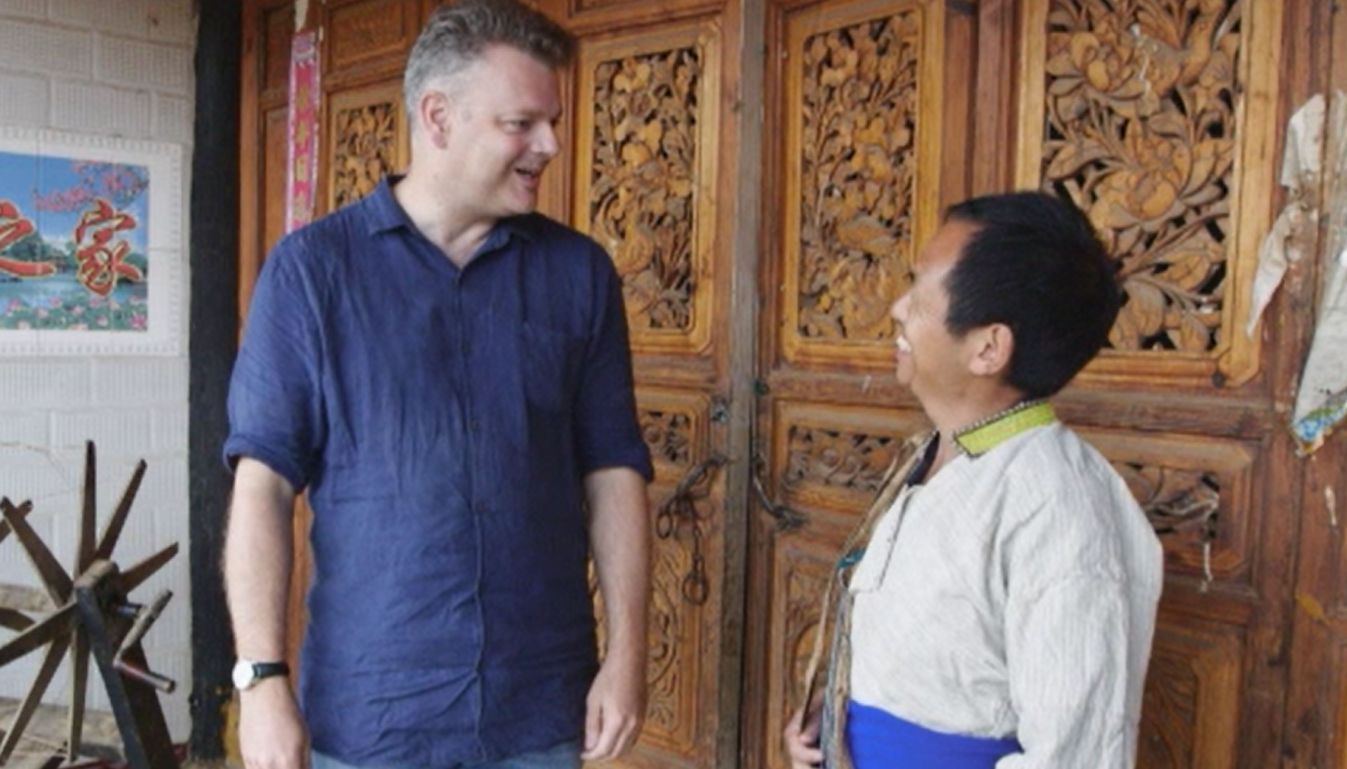
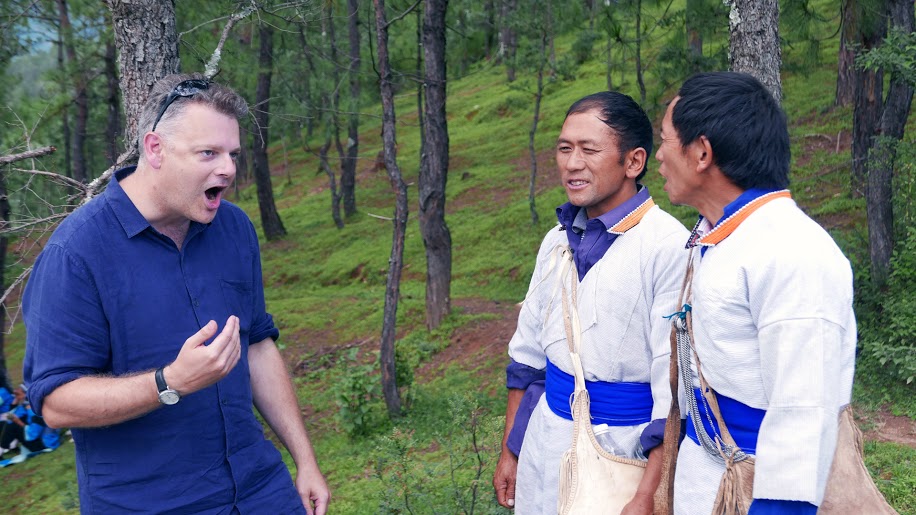
Mr Jiao, the chieftain of the Yi village, wants to have dinner with us to discuss the shooting tomorrow. I dread these occasions, but it goes very well. He turns up wearing a regulation issue tribal nylon anorak, brings his big brother, who is the designated driver. Our own driver, unlike the sullen anti-socials we have had before, joins the talk (a huge benefit having another Mandarin speaker at the table), and they are clearly pleased with the attention they are getting. The chief is a small, small man with dark brown skin, more Burmese than Chinese, and with a high-pitched voice that could easily be mistaken for a woman’s. He will be interpreting for me, because his mother-in-law, who is the hemp spinner, only speaks Yi, an antiquated version of Chinese that sounds like someone throwing a pot of alphabet soup down some stairs.
The food is Chinese, but recognisably distinct – lantern-shadow beef, fried squid, a soup of river fish and mountain greens. Mr Jiao orders a bottle of Damaijiu, a local malt firewater that is supposedly 45% proof, and from which the crew recoil in terror. It is smooth and tasty, like vodka, and between us we down the whole (small) bottle until he is red-faced and giggly.
Our director looks Chinese, but she grew up speaking Teochew and Malay, and her Mandarin is understandable but error-riddled, such that if she gets tipsy she sounds like the policeman in Allo Allo. On the last shoot, she apparently mixed up her vowels so much that she ended up wishing a departing artist “a trip in which you suffer from permanent influenza.” Our fixer pleads with her not to open her mouth at all. Tonight at dinner with the village chief, she realised that he was making his own personal documentary about his tribe’s way of life, and offered to share with him whatever drone footage we got tomorrow. However, owing to some chance mispronunciations, she ended up saying: “And tomorrow, if you like, we will masturbate all over your village.” I thought he was going to spit out his tea.
But he seems nice enough, and toasts me with a story of his international friends. “You are only the third English person I have ever met,” he says to me. “The second was an ethnomusicologist who came to study our songs. And the first was Margaret Thatcher, your Iron Lady.” Apparently, she came to see some sort of ethnic dance he was in many years ago.
Today we are shooting the collection of wild huocao, literally fire-grass, i.e. tinder. It looks like a white-backed dock leaf, and forms the weft of their traditional clothing. The warp is hemp, which we will also have to harvest.
Mr Jiao has assured us that collecting the huocao is a two-man job. But by the time we set out, we have somehow acquired a dozen Bai Yi women in black wimples and blue tabards, clutching baskets and giggling at the thought of being on telly. The director is ready to blow a gasket, because she knows what will happen next. The Yi women’s love of telly will proceed in inverse proportion to the amount of time they are to stand there, no there, no over here, no, please be quiet. Nobody say anything; please stop moving; go and do that thing again; now go and do it over there. Only one of them actually speaks Mandarin; the rest only speak Yi, which means all the spoken directions wander at a leisurely pace through several stages of Chinese whispers, and are often countermanded before they reach the last in line.
Meanwhile, two men, wearing traditional hemp clothes over their tracksuits, burst into song on the mountainside. It’s a yodelling song, about how happy one is collecting huocao, wondering if there is anyone else on the mountainside of the opposite sex, who wishes to sing a refrain in response. It’s all very idyllic for about ten seconds, but then the women’s refrain drifts up as well, ruining the immediate sound recording. We go for another take, but now the men are singing in response to the women, and by the time we have shut them up, the women are singing back. This medieval tinder hook-up continues until it starts to rain, but Alvin the cameraman grabs some footage of the women puttering around in the grass, and of them trying to teach me their song with comedy clumsiness.
Gwyneth, my name for the only woman who speaks Chinese, is determined to stand close by, because she is the one who can show me what huocao is. Meanwhile, a cowherd wanders across the back of the shot with clanging cowbells. The director is starting to regret ever saying that she was looking forward to shooting in the countryside, since there is soon just as much noise pollution as in a built-up urban area, except here we are also hot and clammy with mosquito repellent and sun lotion, and there is nowhere to have a piss. You would think there would be handy bushes everywhere, but behind every one is a black-wimpled woman in a blue tabard, singing a song about grass.
Dinner is back at their quaint farmhouse, sitting on benches in the courtyard. The women eat separately, chattering in Yi about whether or not this will make them famous. The men dish out the Damaijiu malt firewater, and serve Yunnan food – succulent local ham, chicken and garlic, pumpkins and potatoes, and punguent home-made pickles. A sullen two-year-old boy wanders between the tables, gnawing balefully on a chicken’s head. He’s teething, explains his mother, and the beak is good for him.
“I can’t help but notice,” I say, “that your tribe is called the Bai Yi, meaning ‘white clothed’, but everybody’s wearing blue.”
“Ah yes,” says Mr Jiao brightly, “making the white clothes is such a faff, we can’t be arsed any more.”
I’m popping up at London’s School of Oriental and African Studies on Wednesday 29th May (7pm at the Khalili Lecture Theatre) to talk about one of Taiwan’s most famous residents:
Jonathan Clements discusses the life, death and strange afterlife of the “pirate king” Koxinga (1624-62), the Ming loyalist and conqueror of Taiwan, variously derided as a pirate and a rebel; lauded as a resistance leader and prince, twice deified, spuriously reclaimed as both a Japanese patriot and a Chinese “People’s Hero”.
Along the way, there are some unlikely legends, some suspicious shenanigans, and his co-option into a 2010 mayoral campaign that threatened to turn into a fistfight among historians.
*All SOAS Centre of Taiwan Studies events are open to all and not needing to register.







 The Official Schoolgirl Milky Crisis Blog