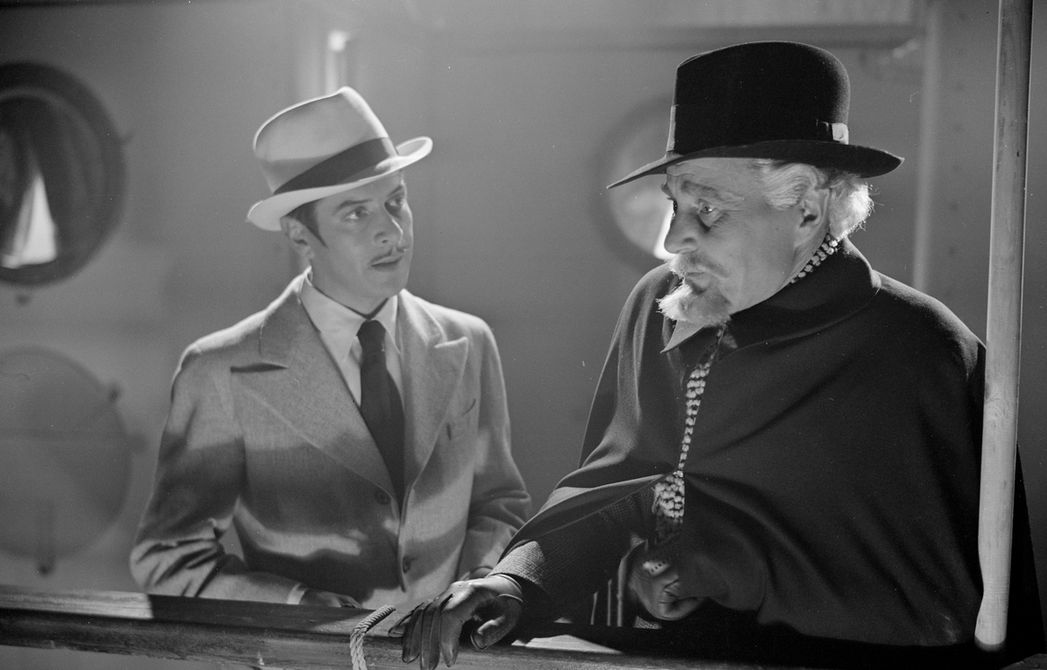
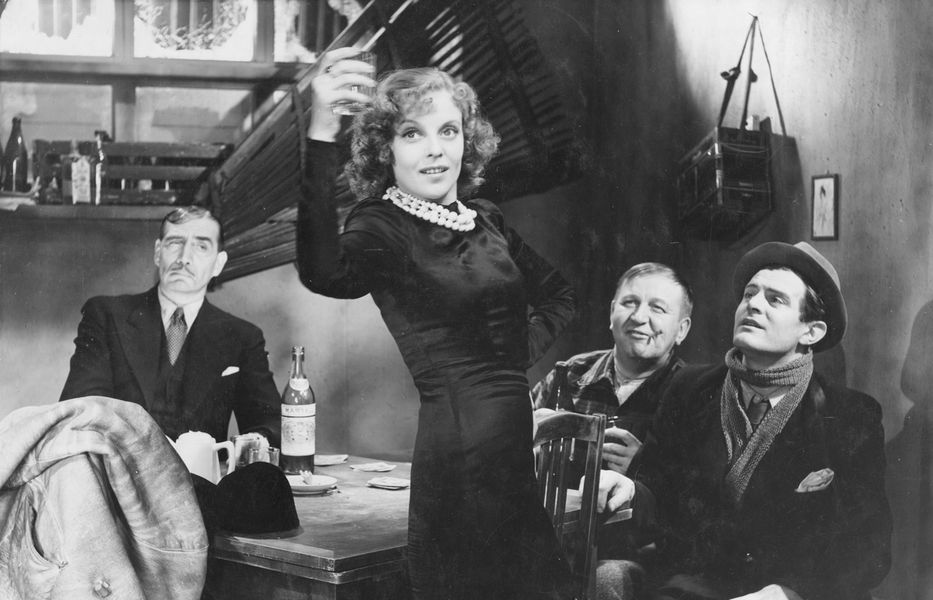
Consul Ahrman (Paavo Jännes) and his son Timo (Tauno Majuri) believe that they are being followed by enemy agents. Timo is dispatched to Muursalo with a sealed envelope, and confesses to the family’s loyal military friend Rainer Sarmo (Joel Rinne) that he might need help in outrunning would-be saboteurs. Nor are the men paranoid – it turns out that their housemaid Leena (Rauha Rentola) is indeed working for foreign powers, as is revealed when Sarmo catches her doctoring the consul’s tea so she will have time to search his safe.
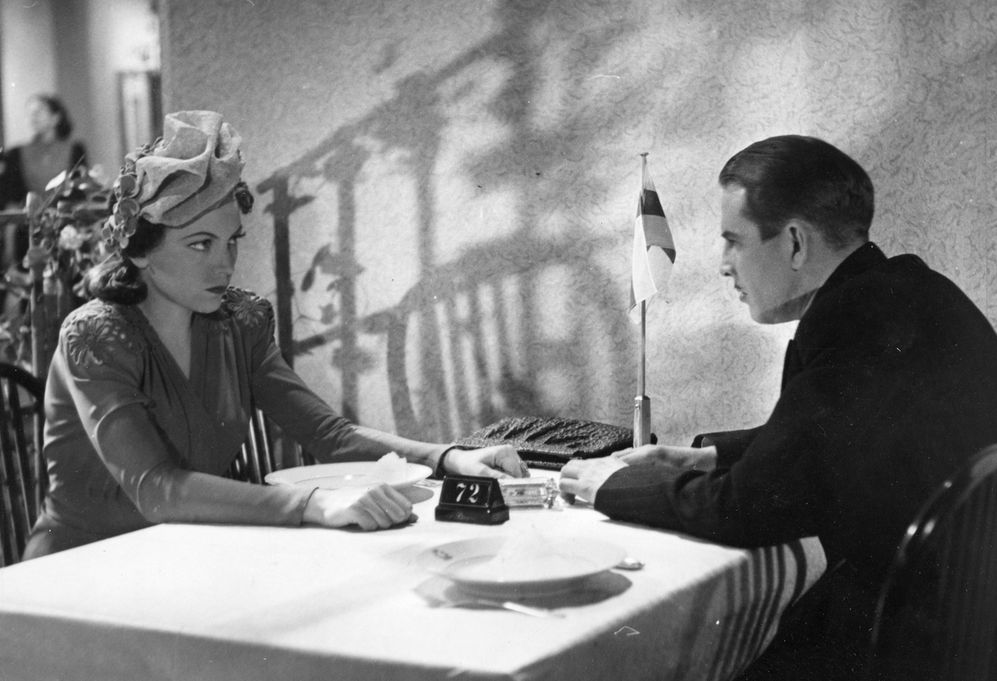
Sarmo apprehends Leena, only to be disturbed in turn by a masked agent (Hilkka Helinä), who helps her escape. Later on, Sarmo runs into Berita Lopez in a restaurant, falls in love with her, and also realises that she was the masked agent. Berita is the daughter of Luigi Lopez (Wilho Imari), once the richest man in Bueno Aires, ruined by the machinations of the enemy agent Thomas Gardner (Santeri Karilo), who is somehow also responsible for Timo’s fiancée breaking up with him.
Oh dear, what a mess, like trying to make sense of Casablanca through its reflection in a dented kettle. Believe it or not, this was the winning entry in a 1940 script competition hosted by Suomi-Filmi, netting a 50,000-mark prize for its author, the journalist Uuno Hirvonen, who would go on to pen two further adventures for Rainer Sarmo, a.k.a. Dettman, a.k.a. Deadman, in international espionage. The miracle, of course, with Casablanca, which was made a year after this, is that it, too, went into production as a forgettable retooling of the conventions of bedroom farce into espionage with papers and letters of transit and whatnot. It happened to work, in exactly the same way that this film… doesn’t.
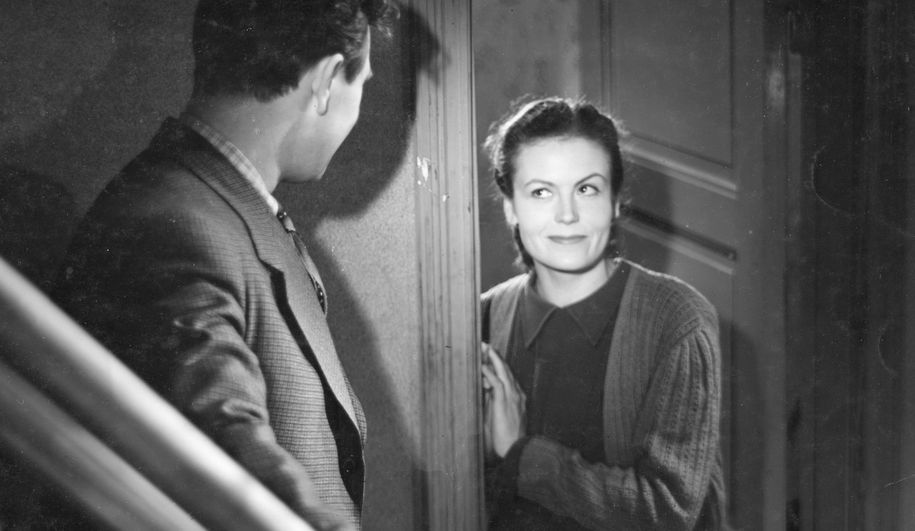
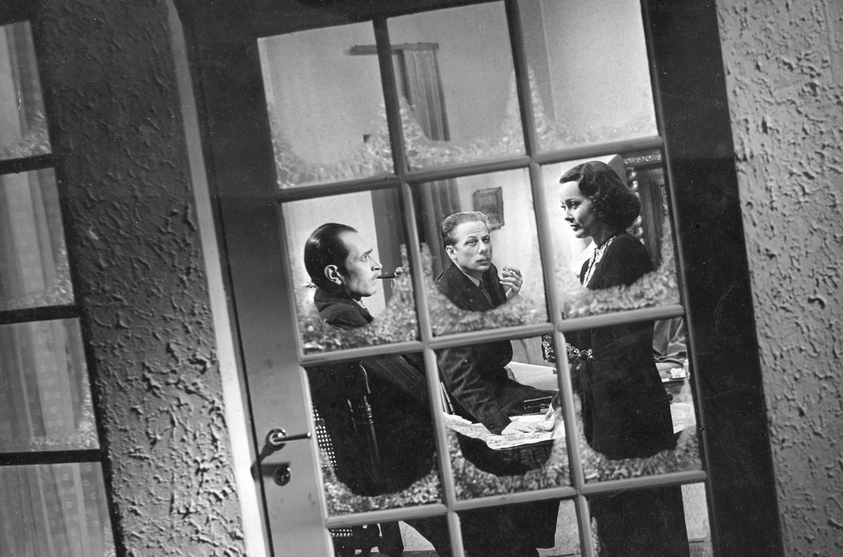
The critics, however, loved it, like a breath of freshly noir air, a worthy successor to the earlierThe Last Guest (1941). “”The suspenseful atmosphere is especially enhanced by the excellent cinematography,” enthused Toini Aaltonen in the Suomen Sosialidemikraatti. “The camera angles are varied, the lighting effects are inventive and generally the dark tone of the filming is so effective that you are startled when you come out and notice the bright daylight around you.” And, indeed, while the script might be an incomprehensible garbage fire, further compromised by the traditional coyness about revealing who the dastardly enemy power might be (Russia – it’s always Russia), the camerawork is superb. The stills from the film make it look far, far more exciting than it actually is. Hilkka Helina, in particular, is a smoldering onscreen presence, managing to make even an argument over coffee look like a battle to save the world.
Posterity has been less kind. When the film was released on television in 1989, Tapani Maskula in the Turun Sanomat let it have it with both barrels: “Watching the film today, one inevitably wonders about how bad the other stories submitted to the competition must have been when the one that won first prize doesn’t even make any sense.”
Jonathan Clements is the author of A Short History of Finland. He is watching all the Finnish films, so you don’t have to.
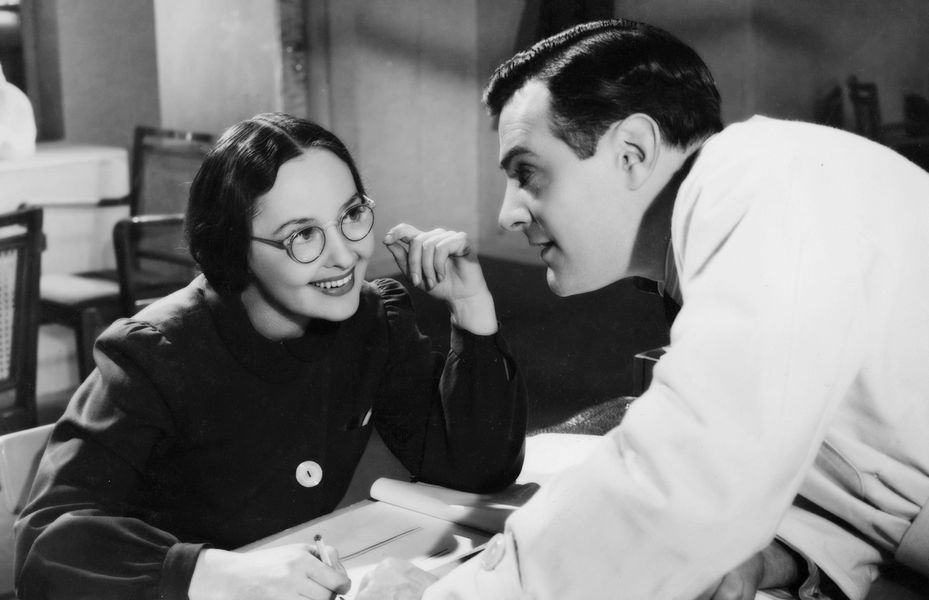
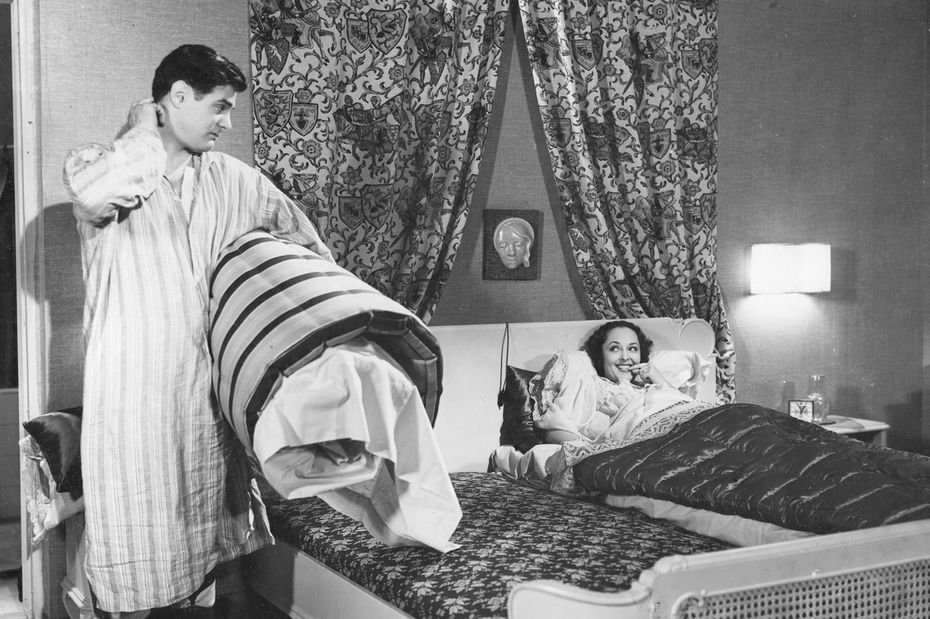
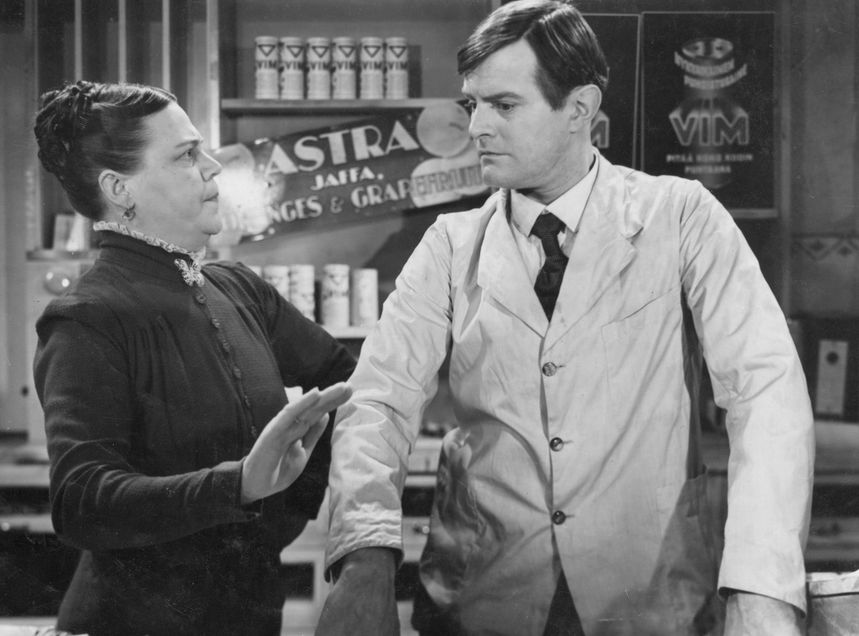
Paavo Kannas (Tauno Palo) is an architect who is struggling to get work done at his interior design office, because of the “trouble” caused by all his beautiful female assistants. His friend Professor Thorelius (Urho Somersalmi) offers to provide him with a plain and efficient girl, but since this is Finland, has to work hard to make his student Hilkka (Brigit Konström) not look like a supermodel. Hair in a bun and a pair of spectacles produce the desired look [actually, they really don’t; she ends up looking exactly like Julia Sawalha, which works for me!], and Paavo settles in for a happy life with his new efficient underling.
Inevitably, Paavo runs into Hilkka while out on the town and she is not wearing her disguise. Not wishing to lose her job, she pretends to be Miss Pallero, a Karelian girl. Smitten with “Miss Pallero”, Paavo begins to suspect that Hilkka might be putting one over on him, and schemes to put her in a position where she has to take off her spectacles and let down her hair. Eventually, they come clean with one another about their feelings, and get married.
Wait! That’s not the end! We’re still only partway through, because now Hilkka is Mrs Kannas, getting increasingly annoyed at all the pretty young women who continue to flap around her husband. Hilkka drops in unannounced at one of Paavo’s workplaces, and believes that she sees him snogging the lady of the manor, Brita (Sirkka Sipilä). Meanwhile, it turns out that Professor Thorelius has plans on nabbing Hilkka for himself and is inviting her to meet his parents as if they are already courting.
Despite a looming divorce, Paavo and Hilkka must collaborate on a fast-track remodelling job, as the returning Finnish-American Makkonens (Aino Lohikoski and Jalmari Rinne, bellowing and code-switching like a pair of nutters) turn up making brash demands to have their Helsinki residence ready in a single day. The Makkonens reveal that they have only selected the Kannas company because it is run by a happily married couple, forcing Paavo and Hilkka to impersonate their younger, happier selves. Predictably, their feelings for each other are truly rekindled.
While I might jest about how difficult it is to find an unattractive Finnish woman, Marriage, Inc. actually began life as a Swedish play, adapted for the screen in 1941 as Så tuktas en äkta man (This is How to Discipline a Real Man). Seeing its potential, but presumably also realising that it needed to be fully localised, Suomen Filmiteollisuus’ Toivo Sarkka bought the rights, mothballed it from ever having a Finnish release, and instead commissioned his own remake, directed by Hannu Leminen and written by Turo Kartto, who drowned, aged 32, near Espoo shortly before the premiere.
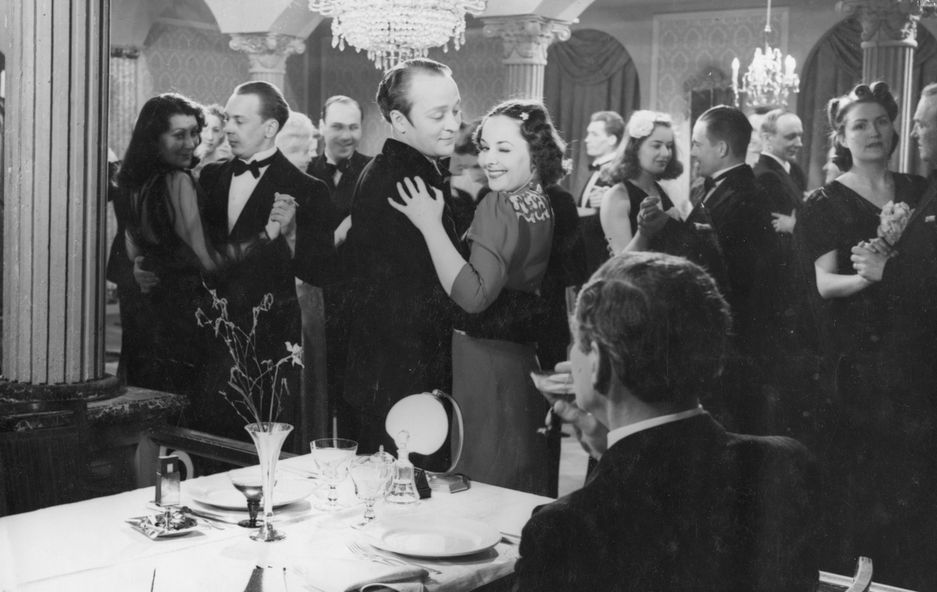
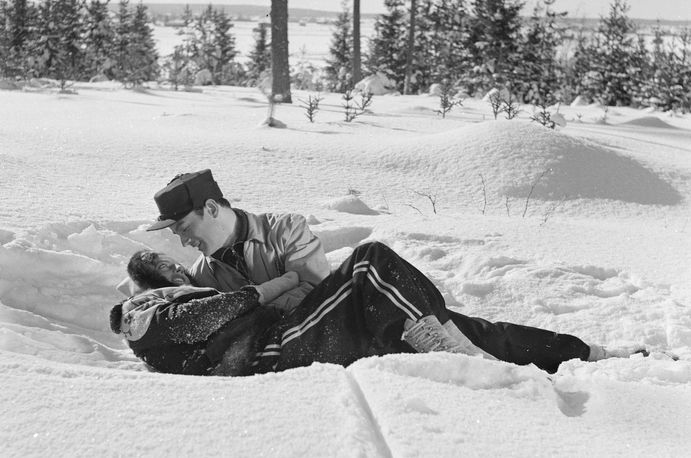
Several moments in the film point to its wartime setting – Paavo mentions that the country is in “an exceptional situation”, and there are glimpses of blackout curtains, wood-fired cars and censored mail. In fact, the film was wrong-footed in production by the drafting of several of its intended crew, leading to a filming delay that required scripted scenes of winter activities to be hastily retooled for the summer. The filmmakers, however, do not seem to have been able to bring themselves to remove a dance sequence – dancing was frowned upon in wartime as an insult to the men at the front, but here seemed vital to move along the plot. The weirdest thing about it for me is the episodic structure, which feels less like a 102-minute feature and more like four TV episodes stitched together. The way that such formatting changes the narrative course makes this film seem strangely ahead of its time, aimed at the shorter attention-spans and quicker resolutions of a television audience, years before anyone in Finland even owned a television.
As also happened during the Winter War, the Finnish press seemed to have a mixed reaction to such fripperies, with some welcoming them as a light-hearted distraction in wartime, and others harrumphing at the very idea of making light of life in troubled times. Paula Talaskivi in the Helsingin Sanomat carefully negotiated these contradictory reactions, calling it flexible, witty and sure-footed, but also decrying “the illogicality, the lack of naturalism, and tasteless scenes…. Moreover, the whole story is not particularly suitable for our environment… In addition, the development of the events is so obvious that it is not very interesting.”
Birgit Konström’s acting is much broader than usual, as if she is playing to the cheap seats in a stadium rather than performing for an intimate camera. Nevertheless, Marriage, Inc. still made me laugh eight decades on, not the least for Tauno Palo’s double-take when a breathless lady customer starts thrusting her boobs under his flustered eyeballs, or the way that Konström feverishly begins rootling around in her handbag to avoid his gaze at the restaurant, and the unintelligibly bubbly Karelian accent she puts on to throw him off the scent.
The movie’s stand-out song “Shamppanjakuhertelua” (Champagne Party) notes the fact that the farce is playing out on both sides of the gender divide, pointing out that men and women can be as shallow as each other when it comes to only noticing surface appearances, and that “men can miss beauty / repelled by spectacles” a somewhat Finnish take on Dorothy Parker’s more concise turn of phrase: “Men seldom make passes at girls who wear glasses.”
Jonathan Clements is the author of A Short History of Finland. He is watching all the Finnish films, so you don’t have to.
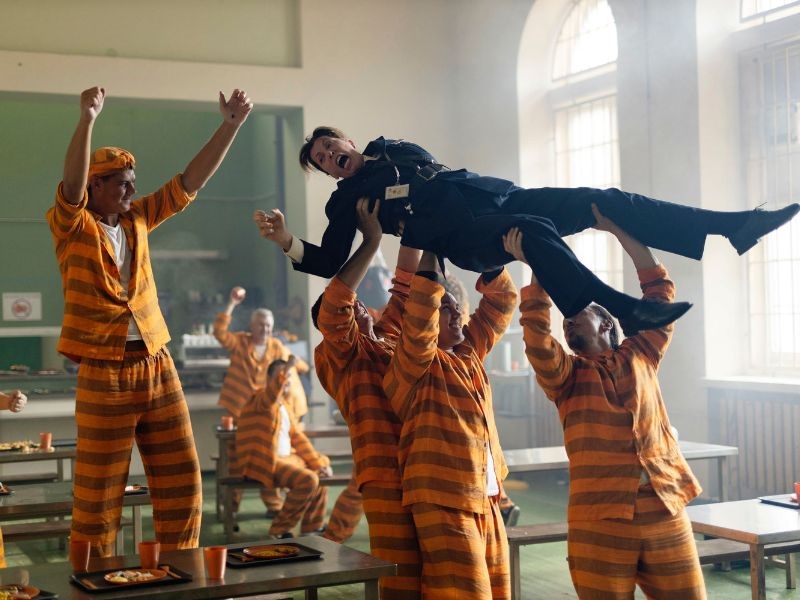
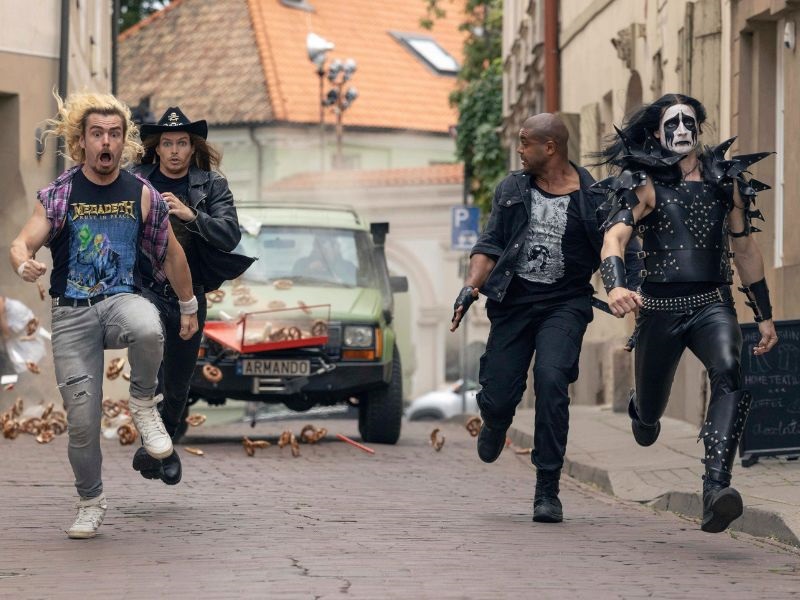
Convicted of starting a minor border war between Norway and Finland, the symphonic post-apocalyptic reindeer-grinding Christ-abusing extreme war pagan Fennoscandian metal band Impaled Rektum serve their time in an island prison, where they are forbidden from playing anything but dance music but get to enjoy a highly regarded salmon buffet.
When bank foreclosures threaten the reindeer farm owned by lead guitarist Lotvonen’s dad, the band bust out of prison and run for Lithuania, where they have been promised a literally Faustian record deal by the impresario Fisto (Anatole Taubman). They cross the Gulf of Finland by stowing away in the tour bus of Blood Motor, a once-great band now in unstoppable decline, fronted by the doleful, leonine Rob (David Bredin).
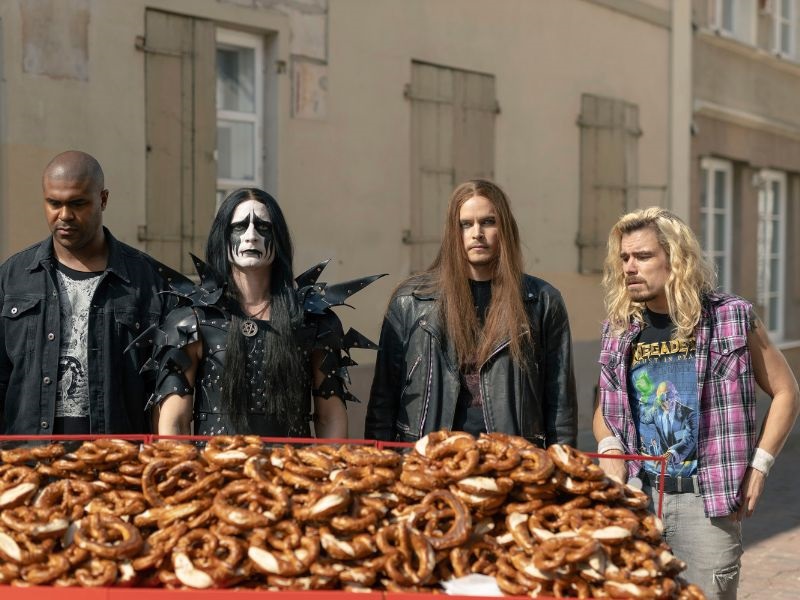
Bass player Xytrax (Max Ovaska) sees Fisto for what he really is, and refuses to have any truck with his desire to dumb down Impaled Rektum’s sound by adding… urgh… synthesisers and friendlier fonts. He even wants to put drummer Oula (Chike Ohanwe) in lederhosen, which only a psychopath would ever do. But lead singer Turo (Johannes Holopainen) is eager to please and tempted by the allure of fame, prepared to repeatedly compromise and even forgetting that the band are supposed to be in this for the money to save Lotvonen’s farm.
Partway through Juuso Laatio and Jukka Vidgren’s joyous Heavier Trip (a sequel to 2018’s Heavy Trip), German news reporters descend on a crime scene in Rostock, where a museum of priceless rock memorabilia has burned to the ground during a fight started by a Finnish death metal band. They push a microphone into the face of a dazed Norwegian witness, who mumbles: “Monarch to the kingdom of the dead, infamous butcher, angel of death.” All the Slayer fans in the cinema cheered.
So… just me, then. Not for the first time at a Finnish comedy film, I was the lone laugher at many of the jokes: the eternally flaming guitar of Jimi Hendrix; Lou Reed’s old liver, preserved in a jar; Dave Mustaine’s six-fingered hand; Lemmy from Motorhead’s hat (“If hats could talk, this would be a very traumatised hat”), and the sight of a very small Stonehenge.
But it’s the music that is the real star of Heavier Trip, with composer Mika Lammassaari presiding once more over truly loving, thumping recreations of rock classics, from the “found” sounds of a malfunctioning washing machine, to full-blown death-metal epics. I was left alone in the cinema as the credits rolled, waiting for the closing list of song titles and arrangements, sure that somewhere in there was a thrash metal cover of Barry Manilow or something equally crazy (sadly, no), as well as a bunch of bands that I thought were throwaway joke names, but turned out to be real. The (fictional) Blood Motor’s performance is fantastic, until the ailing Rob is dragged into the crowd by shrieking groupies, and Turo has to step up to the microphone to finish his song for him.
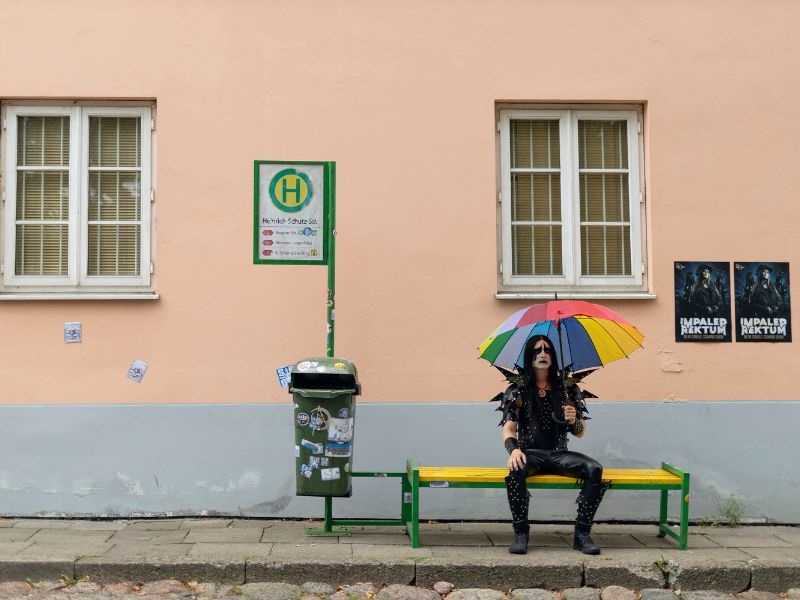
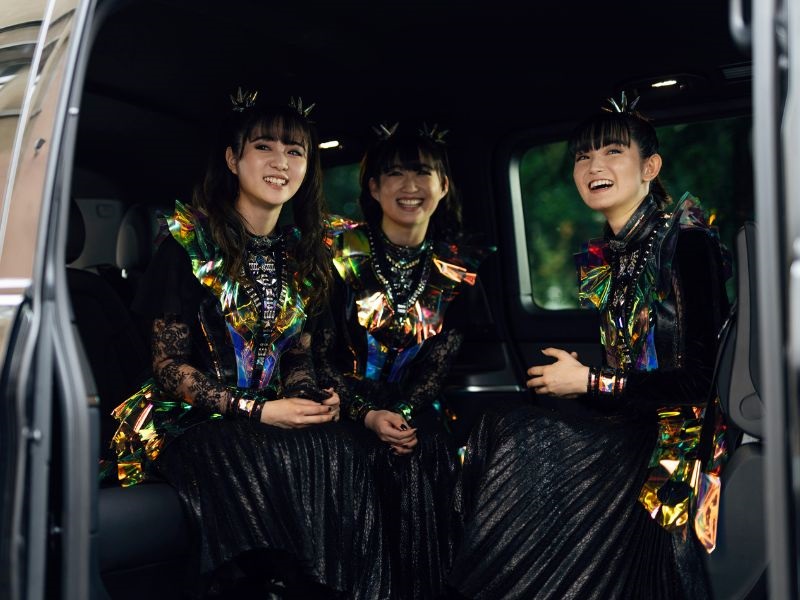
Heavier Trip is unapologetic in its celebration of heavy metal, both the bombastic, pompous form of, say, Celtic Frost’s Into the Pandemonium, and the sell-out, commercial folly of…. well, Celtic Frost’s Cold Lake. Xytrax struggles with his disdain for the perky Japanese rockers Babymetal, despite overwhelming evidence that they are just as hardcore as he is, just in a different way. As he sits, dejected at a bus stop, mirroring the set-up for a famous scene from My Neighbour Totoro, he encounters not a Catbus, but Babymetal’s tour van – the real life Babymetal play a pivotal role in the film, but seem to leave it a scene too early, as if they were afraid of turning into pumpkins.
Many of the gags will fly over non-metal heads. Fisto takes separate phone calls from someone called James and someone called Lars, which only Metallica fans will understand. Turo gains a pair of bat wings modelled on those of the Eurovision game-changer Lordi, and nobody asks why Norwegian rockers Abbath seem to require a fresh corpse backstage as part of their performance conditions. But there are also some lovely little gags that will only hit home with Finns, such as the moment that Mrs Lotvonen (Sinikka Mokkila) respectfully tries to address Xytrax by his preferred band name, but instead calls him Zyrtec, the name of an over-the-counter anti-histamine.
Few of the small-town supporting cast from the first film are to be seen here – there is no sign of Turo’s lounge-singer nemesis, or florist would-be girlfriend. Apart from the reindeer-farming Lotvonens, who provide the McGuffin that gets the band out of jail, the only other holdover from Heavy Trip is Ms Dokken (Helén Viksvedt), unconvincingly demoted from border guard to prison guard in order to give the film someone to chase the band across Europe.
Sometimes, it does seem that there’s rather a lot going on – including the chase plot as Dokken pursues her escaped prisoners and the gotta-save-the-farm plot that is largely forgotten and resolved in a hurry over the credits. But the real heart of Heavier Trip is the band’s clash with the world beyond the small-town fame of the original film, in the dog-eat-dog struggle of bands that have found success, but don’t know what to do with it. It is quite literally the “difficult second album” of the saga of Impaled Rektum. Surely a Heaviest Trip awaits in the future…?
Jonathan Clements is the author of A Short History of Finland, the country with the largest number of metal bands per capita in the world.
Orphan Kauko (Tauno Palo) dreams finding his place in life and marrying his childhood sweetheart Ulla (Ulla Ilona). He is dispatched to the big city of Helsinki to work for the stern shop manager Mrs Kankkunen (Siiri Angerkoski), who soon “educates” him about the double standards of the city – he is expected to be fawningly obliging to the rich, and brusquely dismissive to the poor.
An innocent buffeted along by the company in which he finds himself, Kauko learns to flirt and dance, but also gets dragged into conflicts not of his own making, and is thrown in jail after an altercation with a youth in a park. The fact of his incarceration is used to blame him for missing company funds that are actually the fault of his boss. Down on his luck, he ends up at the Salvation Army, where the grey-bearded Urho (Hugo Hytönen) comforts him with the words: “Fate is a wheel, the wheel spins and it spins beautifully.”
These sentiments echo those of “Väliaikainen” (Temporary) the popular song that Kauko sings at several moments in the film, which encapsulates the recurring message that whatever fates befall him in the film, they, too, shall pass: “Life with human worries and sorrows / It’s only temporary Moments in life that shine with joy / Are only temporary, too / This joy and richness of our life / And the love raging in the chest / And that disappointment, really / Everything is temporary.” If the song seems familiar, it’s because it was already used in The Two Vihtors (1939), a similar tale of fluctuating fortunes, but here it is so integral to the story that it is credited as being the inspiration for the entire movie.
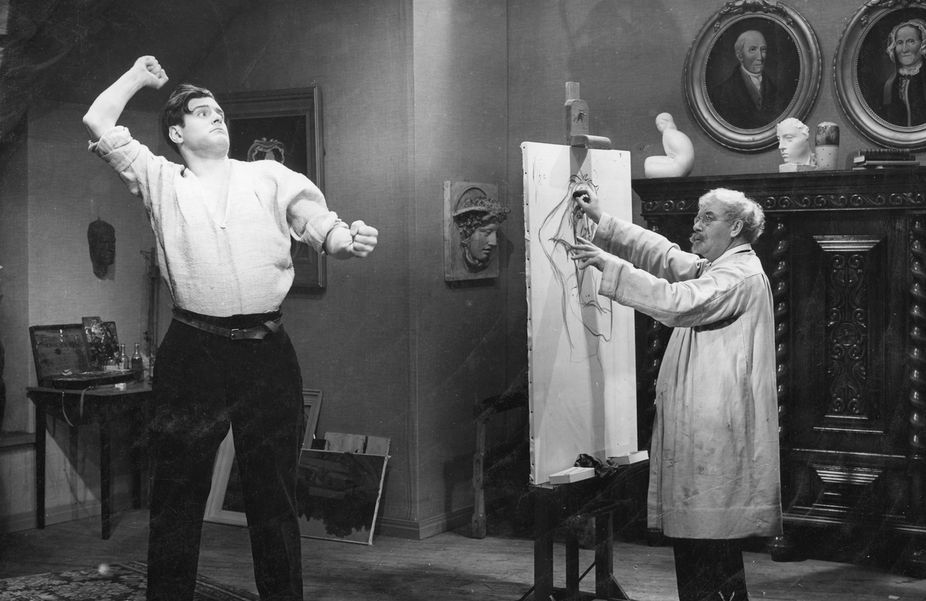
Trying to work his way back up the ladder, Kauko takes a job at a sawmill, but at a dance he meets the vivacious and bewitching Eeva (Regina Linnanheimo), who drags him into the orbit of her gang of thieves. Kauko is drafted into a big heist at a furriers, but flees the scene when the police arrive, throwing away the gang’s takings. In punishment, the criminal boss orders him to “take a walk with the Bear and the Butterfly,” two heavies whose ministrations are interrupted by Clauson (Aku Korhonen), a painter who nurses Kauko back to health and intends to use him as a model for his new depiction of the tragic hero Kullervo.
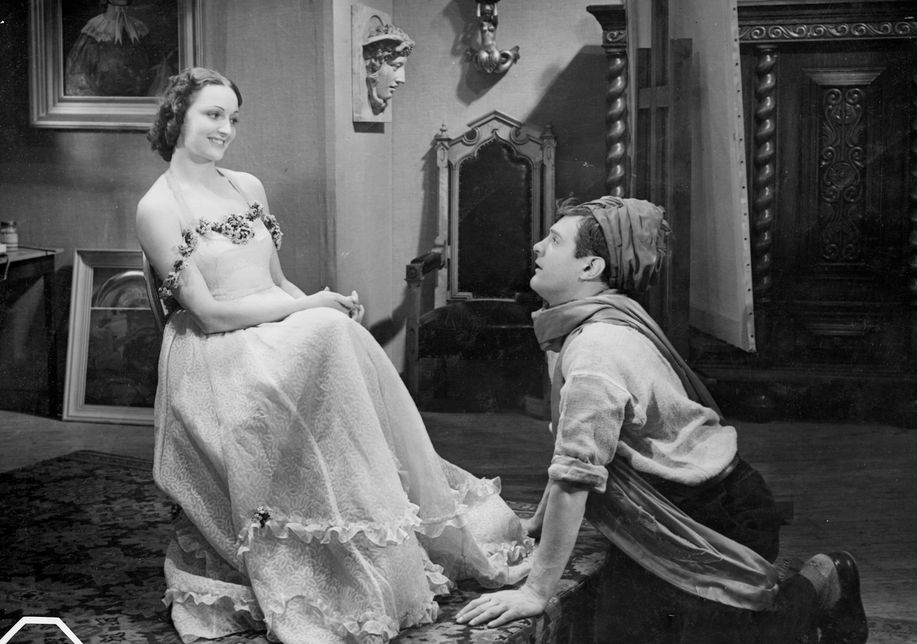
Meeting the elegant Mrs Heimonheimo (Hanna Taini) at the studio, Kauko is smitten, but Clauson warns him that: “She has no heart, only money.” A similarly blunt assistant is delivered to Kauko by his would-be singing teacher, who tells him that he has no real prospects as a professional, but real talent for singing with his heart. Kauko gives up on improving his singing, but nevertheless finds that his raw, untrained voice has a certain folk appeal, and soon leads to a bestselling record.
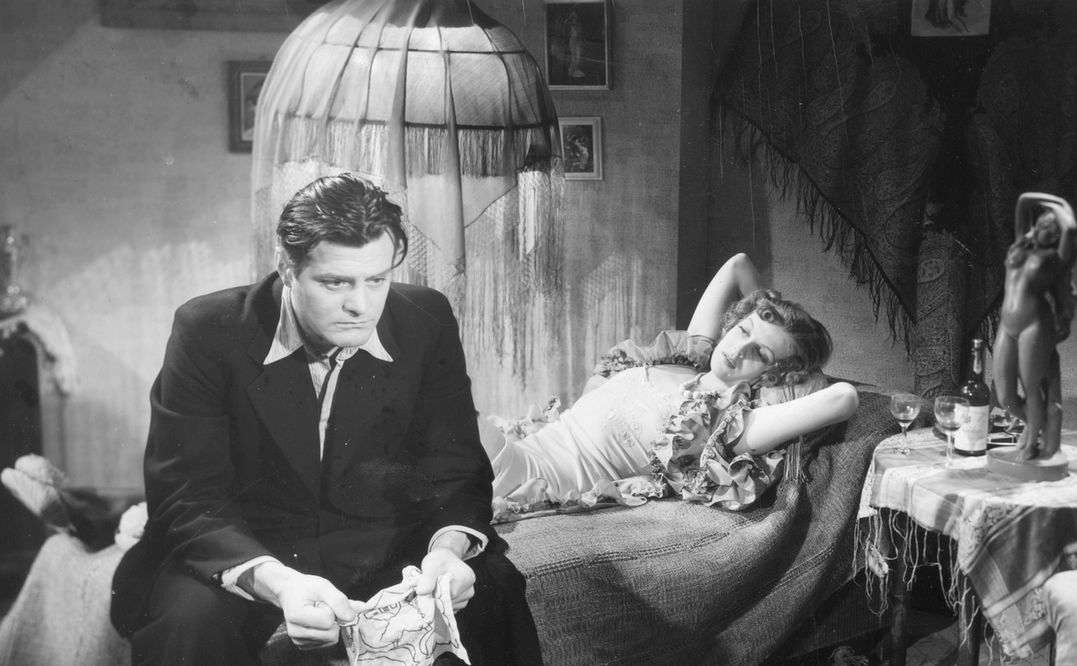
Kauko is well aware that his fame and fortune is equally fleeting and delivers an embittered performance of “Väliaikainen” at the unveiling of Clauson’s portrait of Mrs Heimonheimo, intending it as a warning to the smug and wealthy patrons that their fortunes, too, might fall at any moment. He falls in with theatre folk who, not for the first time in Finnish cinema, are portrayed as holy fools with some sort of appreciation of life denied mere civilians. He rediscovers the handkerchief gifted to him by the faithful Ulla, and returns to marry her, announcing that she alone brings him true joy.
The cast gather around the table to sing a reprise of “Väliaikainen”, which is supposed to be a happy ending, although the song is probably the last thing you want to sing at a wedding: “The gentle beauty of your girl / As well as the purple blush on her lips / And her smile, really, really / Everything is temporary.” Except the version of the song as used in the film includes new lyrics by Mika Waltari that speak directly to the matter of Finland in 1942: “War, poverty, hunger and anxiety / It’s only temporary / Famine, illness, lack and longing / It’s also temporary.”
The Finnish film world is full of rural innocents facing up to the big city (everywhere fromJuurakon Hulda to Forbidden Fruit), but since this is a script by the peerless Mika Waltari, The Wheel of Chance clicks together with clockwork precision. Shot in the winter of 1942, where the requisitioning of snow ploughs to the war effort has led to markedly higher snow banks in the Helsinki streets, it amounts to a rather obvious retread of the earlier Tauno Palo vehicle, The Vagabond’s Waltz (1941), which similarly deconstructs a song into its component stories.
Finnish critics were not so impressed. Paula Talaskivi in the Helsingin Sanomat thought that The Vagabond’s Waltz did a much better job of telling an “airy fairy tale” and found Wheel of Chance (Onni pyöri) disappointingly jejune. Toini Aaltonen in the Suomen Sosialidemokraatti similarly decried it as a throwaway diversion for a “naïve and simple” audience, and blamed Waltari himself for cynically assembling a set of triggers that would distract the groundlings without delivering any artistic merit.
Olavi Vesterdahl in Aamulehti also put the boot into the poor writer. “It seems incomprehensible how Mika Waltari has allowed his name to be published in connection with such a film,” he fumed, “a film that summarises almost all of the awkwardness of domestic cinema so far, a film that does not even satisfy even a mediocre Finnish viewer, but drops to the level of the most basic comedy and the cheapest means of making people laugh.”
While it’s certainly not Waltari’s best work, I still think it displays a greater awareness of its time than its contemporary critics allowed. Waltari’s script zoomed in on the wainscot society of Helsinki’s spivs and wartime wheeler-dealers, in a creative decision a year ahead of a boom in similar movies – by 1943, everybody was doing it.
Jonathan Clements is the author of A Short History of Finland. He is watching all the Finnish films, so you don’t have to.
Liisa Harju (Lea Joutseno) is a quick-witted, vivacious girl from Savo who has been posted to Ostrobothnia, the uppity west coast of Finland where the locals think that she is no better than she ought to be. She thinks she is just being friendly to the handsome local doctor Eino Korpinen (Tapio Nurkka), but their increasingly flirtatious interactions meet with umbrage and annoyance from local womankind, who regard Eino as theirs to fight over. In particular, her arrival seems to irritate the school principal Mr Iipo (Eino Jurkka), whose snooty wife Kristiina (Elli Ylimaa) expects Eino to propose to her insufferable daughter Ester (Rakel Linnanheimo, sister not only to the more famous Regina, but also to the woman who is playing her own mother!).
We have, in a sense, been here before. The tensions and conflicts in Varaventtiili are almost exactly the same as those in Suomi-Filmi’s earlier The Women of Niskavuori (1938), and indeed, Niskavuori’s fearsome matriarch Olga Tainio has a far less substantial role here as a sulking matron. Both films are based on novels written two decades after Finnish women won the right to vote in 1907, grappling in their own way with the impact and attitudes of the first generation to grow up in such an environment. Whereas The Women of Niskavuori ultimately presented its go-getting lady teacher as a clueless, home-wrecking hussy, Safety Valve is more sympathetic to the fact that times are changing. True enough, Liisa doesn’t turn up and steal another woman’s husband, but in the eyes of the townsfolk, she pretty much steals another woman’s potential fiancé. The difference is that Eino is there for the wooing, and if the local girls don’t like it, they’d better up their game and bring something to the party.
Safety Valve wonderfully encapsulates the town-versus-country issues that lie beneath many a Finnish movie of the era, here landing firmly on the side of urban urbanity. The Ostrobothnians think of the people of Savo as uncultured hicks, whereas the Savonians find themselves in close proximity to the growing new towns of Kuopio and Tampere, and Jyväskylä, the “Athens of the North”, the site of the first Finnish-speaking teacher-training college, and hence the engine that churned out thousands of women like Liisa to go out into the world and force gurning farmers’ children to learn about stuff.
The children are the low point of the film – listless child-actors bored by their own lines in the scenes where Lea Joutsena is obliged to pretend to be teaching them. Meanwhile the locals harp on about “traditional values” and the “way things are done” to a ridiculously obsessive degree, acting as if they are preserving the heritage of Western civilisation, but coming across like drunken tramps fighting over a cardboard box in a skip – much of the drama circles around whether the teaching staff are allowed to use the school sauna.
An intriguing subtext of the film revolves around the application of reading and writing. Eino’s true love is destined to be the woman who reciprocates his bizarre interest in “a volume of Chinese poetry, translated into German”, while Liisa’s constant companion is her “safety valve” – the diary that allows her to blow off steam about some of the outrageously dismissive things that the local women say to her.
At least Liisa isn’t left alone to face the yokels. Her fellow teacher Rauha is played by the lovely Irma Seikkula, still displaying the vim and poise that brought her fame as the similarly pro-active Juurakon Hulda (1937). There are moments when the film threatens to break out into genuine humour, with Liisa and Rauha as a pair of icon-busting jokers, like Melissa McCarthy and Sandra Bullock telling everyone to go eff themselves, but sadly that potential never quite manifests.
Safety Valve was based on Hilja Valtonen’s debut novel The Safety Valve of the Young Teacher (1926), a roman à clef about the life of a young woman transplanted to a distant Ostrobothnian town, that had somehow made its way into eight reprintings. This adaptation by scriptwriter Yrjö Kivimiehen sets the action in a timeless rural setting entirely untroubled by the rumblings of the Continuation War that clearly concerned the production team. While the cast of Valentin Vaara’s film go about their business without a care in the world, the backstage crew are dashing feverishly to get the film in the can and into cinemas before wartime austerity bites again – a behind-the-scenes panic that can largely be held responsible for some rushed shots, shaky camera work from a moving train, and substandard location work, clearly shot on cloudy days.
Jonathan Clements is the author of A Short History of Finland. He is watching all the Finnish films, so you don’t have to.
A caption in a newspaper in 1938 causes unexpected ructions when its editor Marja Kauria (Helena Kara) lists herself as the daughter of the late philanthropist Walter Timelius (Hugo Hytönen). His spinster sister Agda (Salli Karuna) marches down to the editorial office to demand a retraction. Marja, however, sticks to her guns, and announces that she is, indeed, Timelius’ secret daughter.
A series of flashbacks reveal the whole story – that in 1914, Marja was the product of an affair between Walter and his housekeeper, Iida (Emma Väänänen). Refusing to marry Walter, Iida instead accepts a proposal two year later from the artist Eemel (Oiva Luhtala), who dies in 1927 after the couple have a son, Marja’s half-brother Ville (Lauri Mehto). When Walter dies in 1931, he leaves a large sum of money to Iida, and his family agree to sweep the matter under the carpet.
Marja develops a strong attraction to Hans Timelius (Olavi Reimas), her cousin. Aunt Agda does everything she can to keep the pair apart, eventually funding Hans’s postgraduate research in America in order to keep him away from her. Eventually, when she discovers that Marja and Hans are still keeping in touch, she confronts Marja, claiming that Hans is not her cousin, but her half-brother, yet another illegitimate child of Walter, who had been adopted by his relatives. This however, is not true, because Hans is really Agda’s son, born of a liaison with an artist (it’s always an artist) and adopted by family members to spare her blushes. Finally, Marja and Hans are reunited, and all is… er… well…
Well, I should say, marrying your cousin is not the brightest of ideas, particularly in Finland where it appears to happen rather often. Your correspondent can only imagine yet another time-jump, this time to an allergy-prone Finnish milksop in the 21st century, complaining through his sneezes that his family had a lot of consanguinity in it.
Preserving the pointlessly complex flashbacks and time-jumps of Seere Salminen’s original 1938 stage play, the production of Neljä naista was disrupted by the Continuation War, so much so that scripted summery activities had to be switched for skiing and snowball fights. But there’s no accounting for taste – the Finnish press loved it, and was even prepared to forgive the scatty structure.
Helena Kara is strikingly strong-willed and confident as Marja, in what would be her last film role with Suomi-Filmi before she defected to Suomen Filmiteollisuus with her husband, the director Hannu Leminen.
Jonathan Clements is the author of A Short History of Finland. He is watching all the Finnish films, so you don’t have to.
A bunch of old college friends assemble in Helsinki on the thirtieth anniversary of their graduation, revealing many of them to have gone down different paths from the one they expected. United by their “least” successful classmate Joonas (Urho Somersalmi, later the only prominent Finn in Sampo), it turns out that Esko the investor (Yrjö Tuominen) has been diddled out of his savings by a corrupt agent; doctor Risto (Hugo Hytönen) and judge Paavo (Ture Ara) have had a falling-out, unaware that their children have fallen in love with one another. Meanwhile, Paavo’s wife Agnes (Elsa Turakainen) is considering leaving him for the poet Seppo (Pentti Viljanen), a shady sort who is unaware that the father of the woman he has just impregnated is on his way to Helsinki to deliver some rough justice.
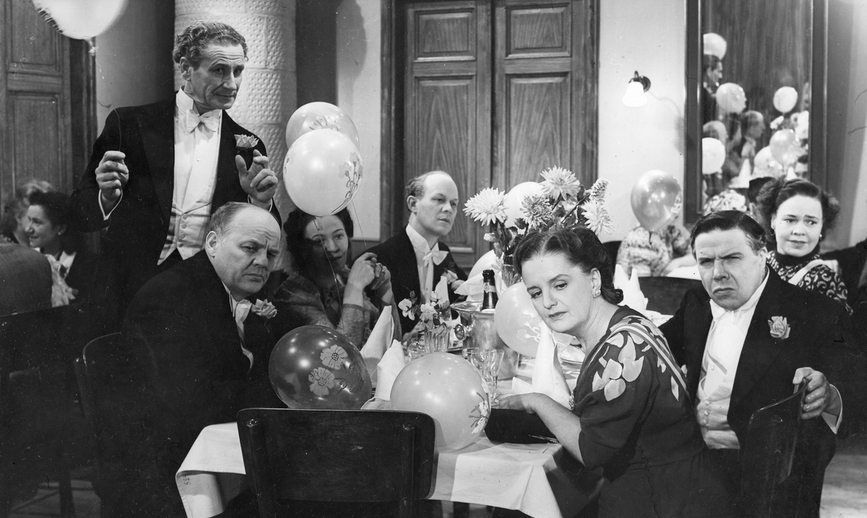
Despite supposedly never having made much of himself, it’s Joonas the everyman who fixes everyone’s problems, arranging a “courtroom” only partly in jest to adjudicate the dispute between his friends, making sure that Agnes is aware of Seppo’s craven nature, and badgering Esko’s swindler to return the money that he took in bad faith. At a celebratory party, Joonas sings of love and friendship, and the menfolk pile off home in a semi-drunken state, whereupon their taxi driver reveals that they still owe him for the fare thirty years ago, when they were also too busy singing the praises of their classmate Maj-Lis (Ruth Snellman) to remember to pay.
Maj-Lis is a bit of an afterthought, as is the seventh classmate Berta (Aino Lohikoski), because they are merely the wives of the guys, and this college reunion fable is really about how the menfolk have done for themselves. Setting aside that sexist implication, entirely understandable for the time, Oi, aika vanha, kultainen is an intriguing forerunner of the sort of Hollywood movies of latter years like Return of the Secaucus Seven and The Big Chill, which similarly revisit youthful dreams in middle age, and ask what went wrong… or right.
For a film that celebrates student days, it is strangely anti-intellectual, focussing on Joonas the rural gentleman, and the common ground of ylioppilas, which is to say, high school graduation, rather than the more rarefied air of university, to which several of the characters plainly went on to. But such a low-level achievement remains a sweetly egalitarian feature of modern Finnish society. Almost everyone can say they finished high school, which is why the nation still chooses on Mayday to invite everyone to put on their white graduation gaps and be smug about it together, as if the entire population was running through the streets wearing T-shirts that bragged they had once sat for some A-levels or a City & Guild in woodwork.
Adapted by Nisse Hirn from a Mätti Hälli novel that was still in galleys at the time, and would limp out some time after the movie that was based on it, Those Golden Days of Yore was regarded by director Orvo Saarikivi as his best work. Shot in the summer and autumn of 1941, but delayed in post-production by the outbreak of the Continuation War, it juxtaposes the youth of today with what would have been the youth of 1912, which is to say, the generation tthat had to live through the Revolution and Civil War. Hirn’s rumination on what had changed, and what hasn’t, hence has a melancholy turn to it, as one generation forged in war is forced to watch its children face it all over again. That, in fact, may even have been a factor in the production, allowing a middle-aged cast to dominate while the studio’s younger leads were presumably off making an entirely different film, possibly the same year’s The Wheel of Chance.
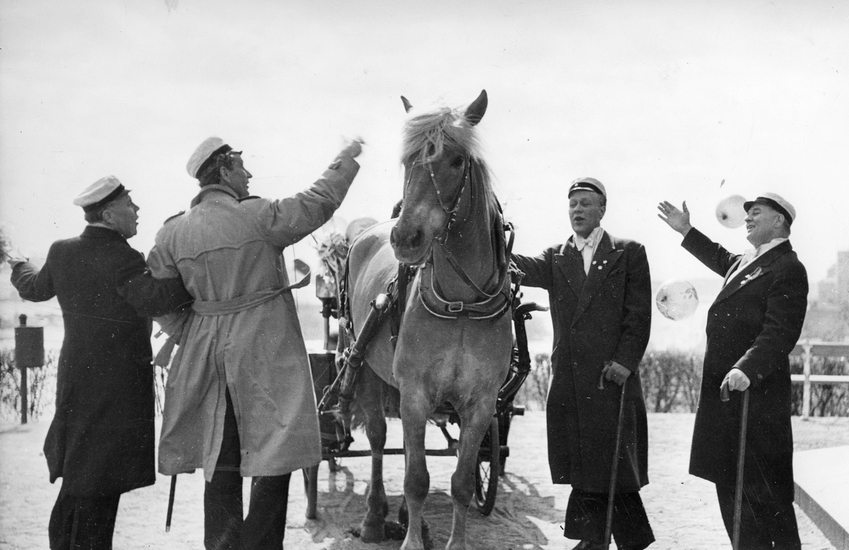
The anonymous reviewer in Ajan Suuta saw in it another aim, which was to educate rural audiences about the life and traditions of urban Helsinki, such as the vivid Mayday celebrations, captured here on location, and the student culture of compulsory bier keller sing-alongs, which I have always found unsettlingly regimented and Germanic. Much as such songs are inflicted on diners in Finnish restaurants by exuberant graduates, they similarly lurch unwelcome into the film here.
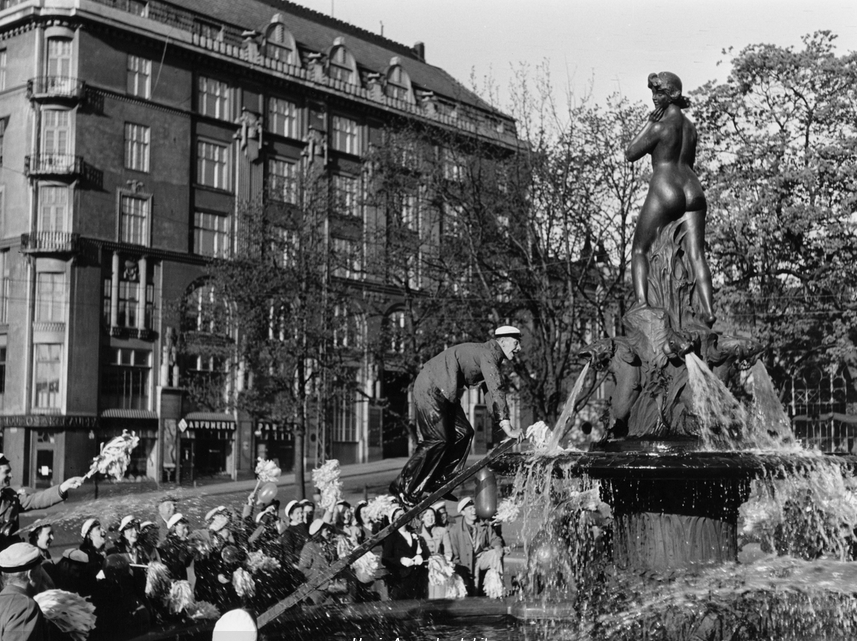
There is also footage of such new-fangled devices as a phone booth, the likes of which presumably had not been seen before out in the sticks. Amid the staged scenes of the cast’s celebration there also appears to be actual location work, snatched on the run, of such events as the traditional crowning of Havis Amanda, the naked statue on the Esplanade, with a student’s hat. Many critics were clearly in the sweet spot for such nostalgia, and grew misty-eyed at the restaging of songs from their own student days. The reviewer from Uusi Suomi, however, was having none of it, and observed: “Everything that is interesting in the story, ends already at the beginning, and usually it seems as if the whole production only happened in order to stage a few vocal performances.”
Jonathan Clements is the author of A Short History of Finland. He is watching all the Finnish films, so you don’t have to.
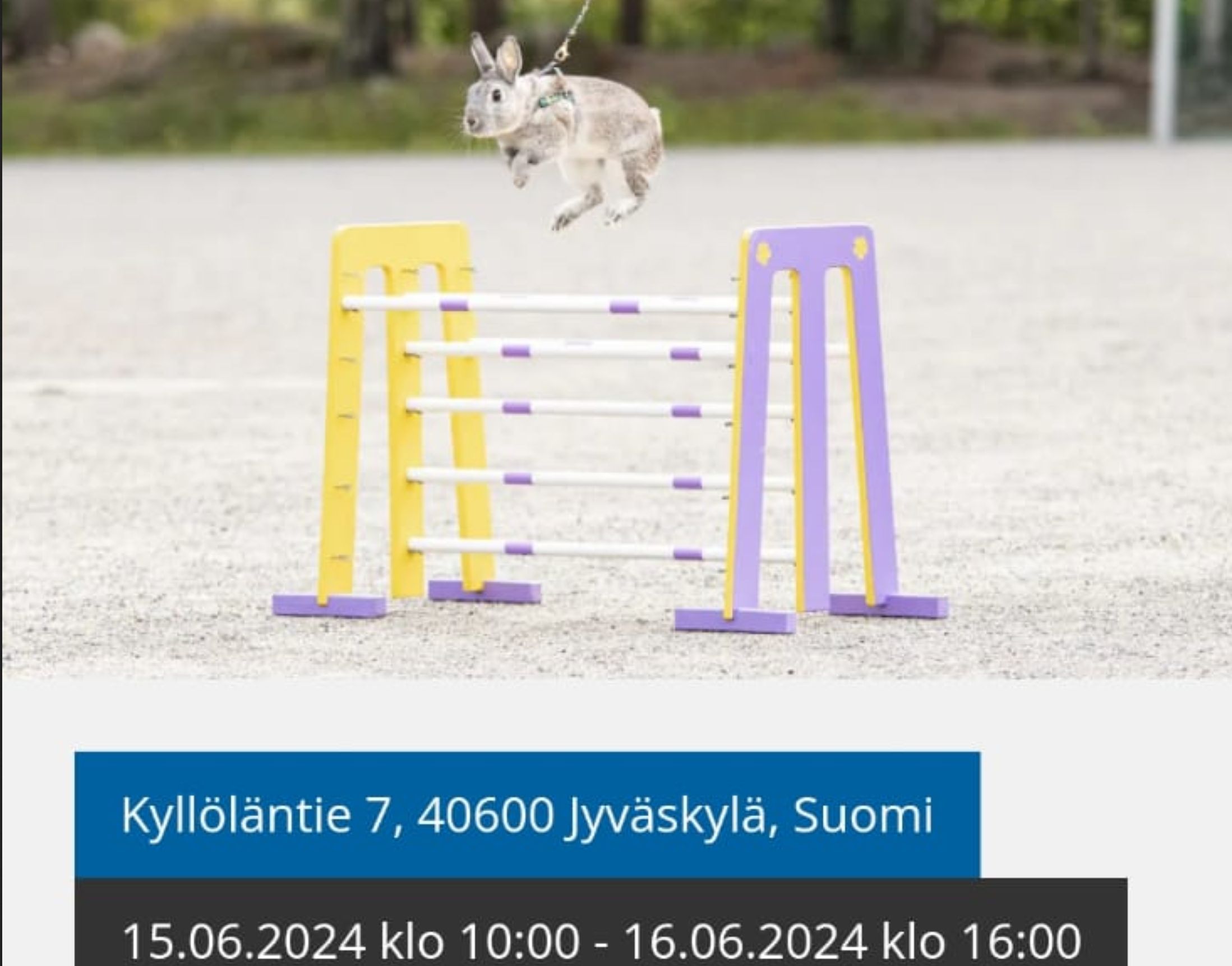
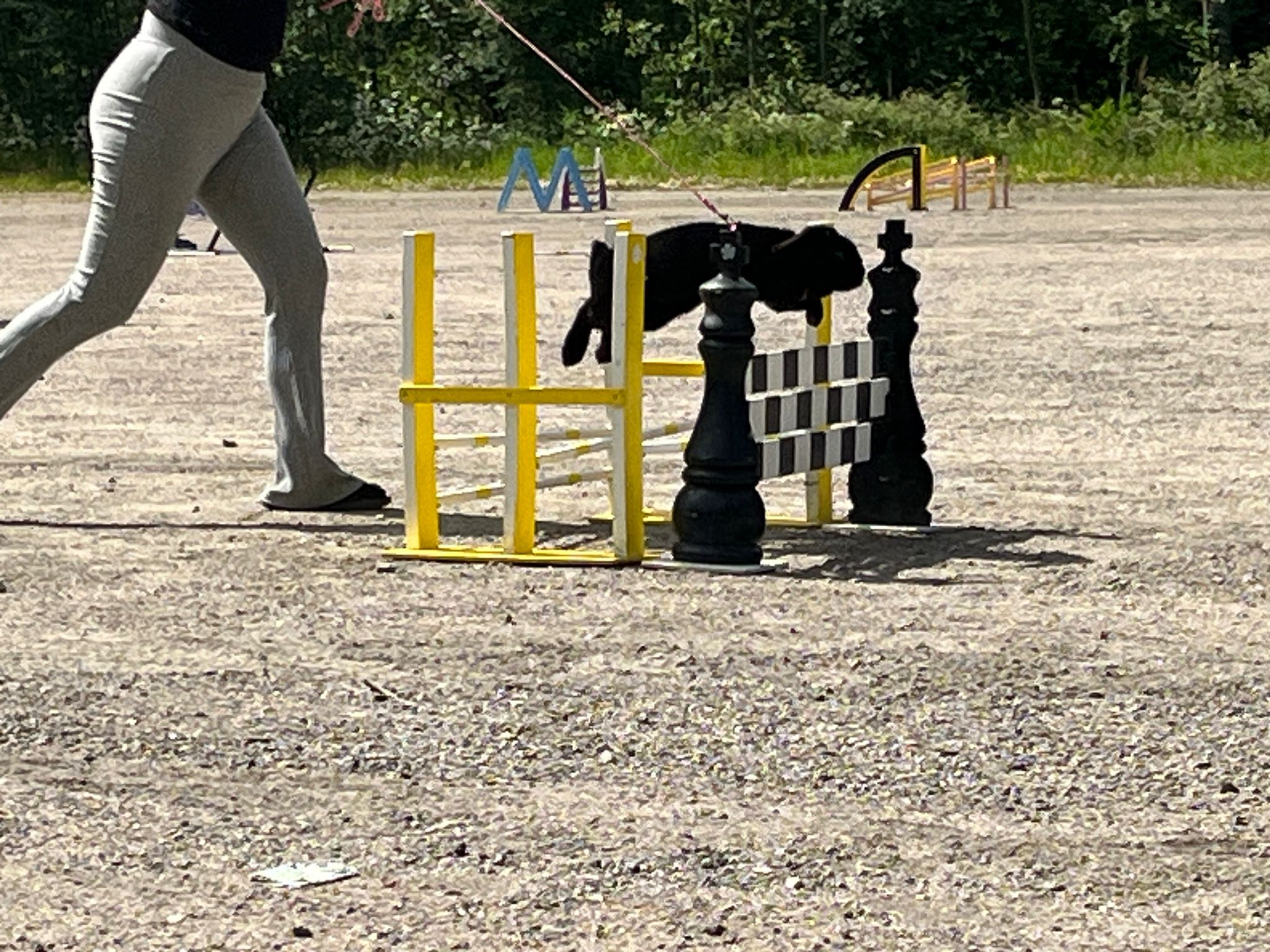
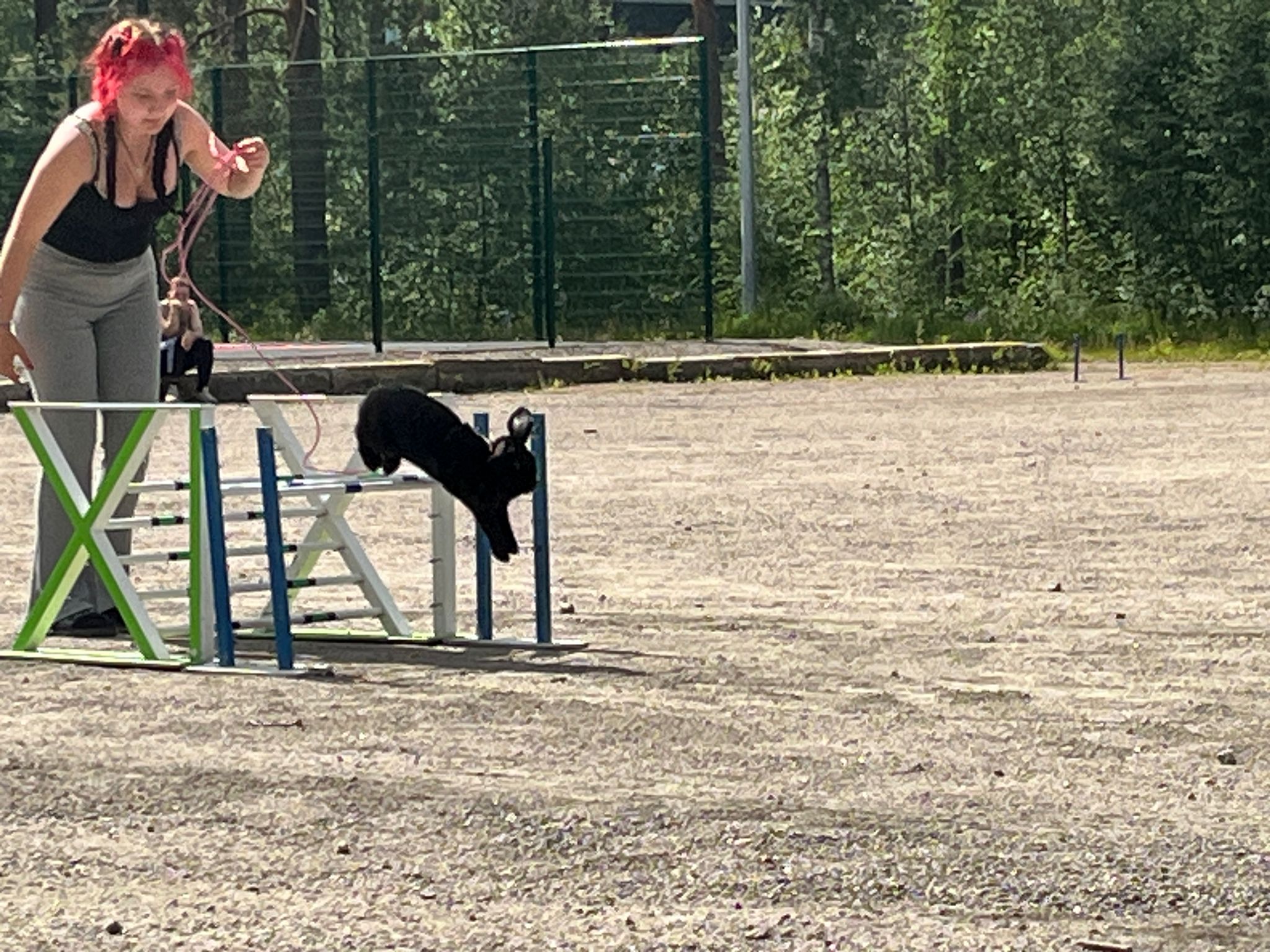
The Bunny Hopping championships are underway this weekend in Jyväskylä, Finland, where various bunny trainers get to pit their creatures (with names like wrestlers and gladiators) against each other on courses assessed for height and length. Today was the preliminary rounds, tomorrow at ten we see the elite finals and the distance heats.
Bunny Hopping has been a thing for twenty years, starting over there in That Fancy Sweden before migrating first to the Swedish-speaking west coast of Finland.
“The Swedes have been doing it for longer,” seethed one competitor. “So they’ve got the jump on us.”
Jonathan Clements is the author of A Short History of Finland. Just when he thinks there is nothing left to talk about…
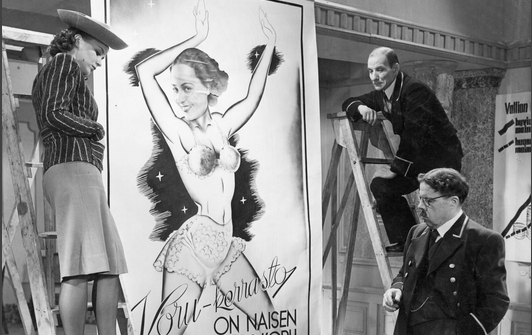
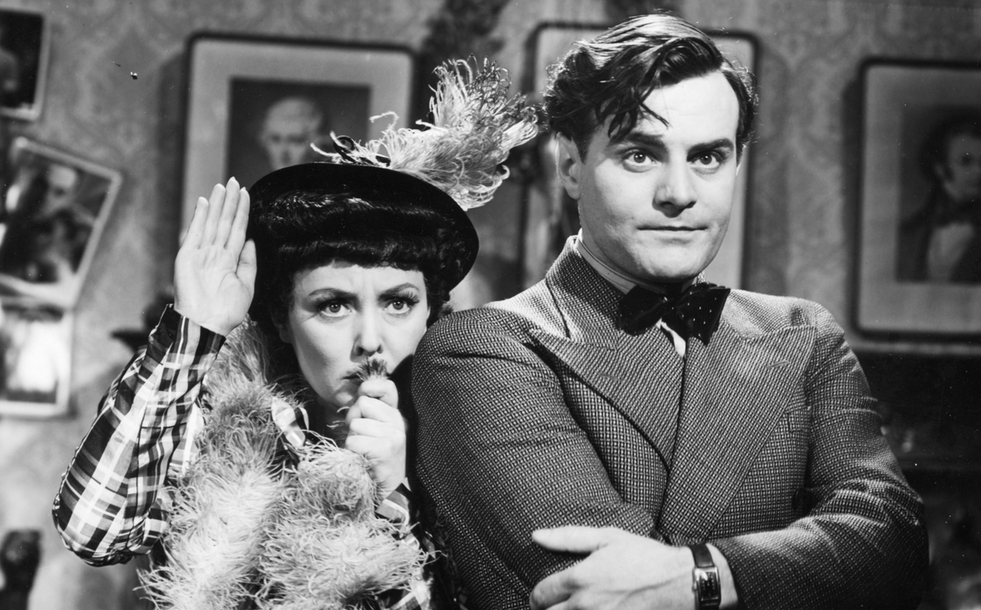
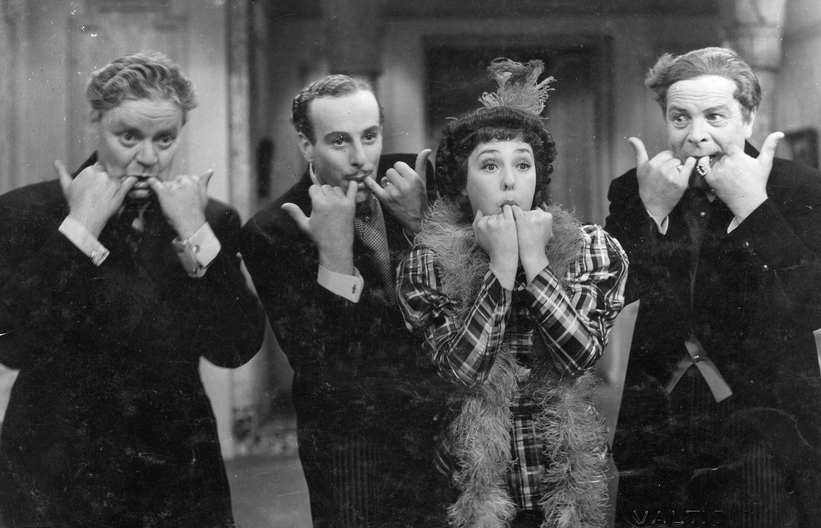
Unexpected controversy arises after the Original Advertising Agency’s new underwear poster is a hit all over town, leading to claims that the pert model featured in it is actually Margit Helleheimo (Birgit Kronström), the daughter of a government minister facing a mid-term election. Hoping to weather the storm, agency head Bruno Blomster (Toppo Elonperä) arrives at Mr Helleheimo’s office to pitch his ideas for a new campaign to push government bonds. This only drags him into political skullduggery, as underling Hilpeläinen (Thure Bahne) schemes to bring down cabinet minister Helleheimo (Sven Relander) by any means necessary, including slut-shaming his daughter.
Summoned to account for his artwork, advertising executive Kalevi (Tauno Palo) lies to spare Margit’s reputation, and claims that he based his pictures on a dancer he met in Helsinki. The doubting minister demands that he present the real model within 48 hours.
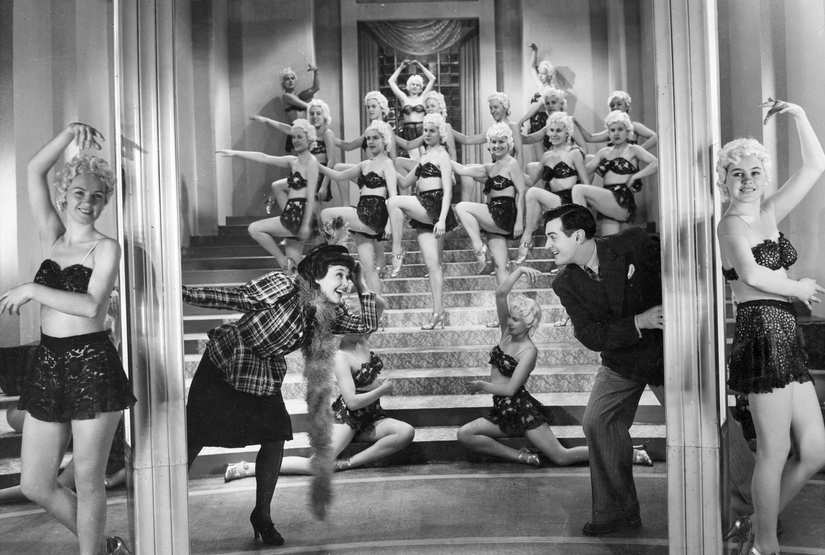
Thrashing about in search of a suitable Finnish woman, Kalevi lurks at the theatre company of the impresario Oikero (Ossi Elstelä), where he is amazed to discover Manta Mutikainen (a.k.a. Baby Peggy), a dancer who is the spitting image of Margit, mainly because she is Margit, who has donned an unlikely disguise to audition for the role of her own double. After a series of quick-change farces that threaten to reveal her true identity, “Peggy” wins over the ministers and drags everybody into a sing-along, whereupon Minister Helleheimo awards the advertising contract, and all is well…
But no! Because Hilpeläinen arranges a dinner date with “Peggy” where he tries to enlist her help with bringing down the government. Later, Kalevi escorts her home and makes his feelings plain by snogging her face off and giving her a dog (not a euphemism). You would think that this might be a happy ending, but now Margit is incensed that Kalevi is is cheating on her with another woman, even though she is the other woman. Eventually, all such concerns are settled, and Kalevi and Margit seek her father’s blessing to get married. When Helleheimo seems about to refuse, Kalevi blackmails him, threatening to disclose his daughter’s modelling past after all unless he relents.
“All is fair in love,” says Margit. “You’re a lucky minister.” And the couple kiss as the thespians kick off in a song-and-dance celebration, presided over by Oikero, who is inexplicably dressed as Napoleon.
Turo Kartto’s script for Suomen Filmiteollisuus’ Onnellinen ministeri was lifted from the 1937 German musical Das Ministerium ist beleidigt, and had previously been performed onstage in Turku in 1938. Suomi-Filmi’s last movie of 1941 turned out to be a remarkably clockwork intersection of daffy plots, jettisoning all the songs from the stage version and replacing them with a bunch of new ones, including “Katupoikien laulu” (Song of the Street Boys), which has become a much-covered classic, albeit with the original reference to the streets of Soho [London] snipped out to make it sound more Finnish.
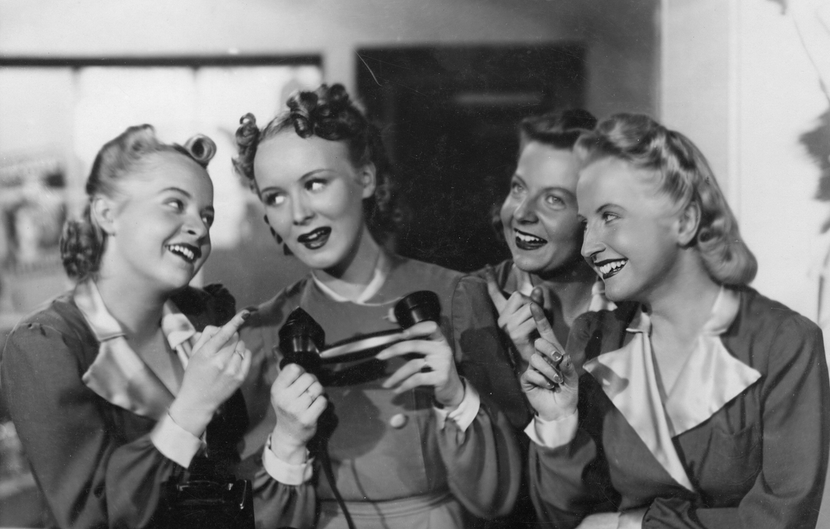
In fact, the film is crammed to bursting point with songs, starting off in the opening scene at the Original ad company, where the wartime starlets, the Harmony Sisters, cameo as singing telephonists, in a four-part harmony about how the boss can’t come to the phone right now. We’ve seen many musicals before over the last couple of years of this watchathon, but this one is the first to my mind that does anything more than ramming songs into the narrative. In The Lucky Cabinet Minister, dance and song are used to tell the story in all sorts of innovative and impressionistic ways – old news in the theatre, but rarely utilised in Finnish cinema until this point.
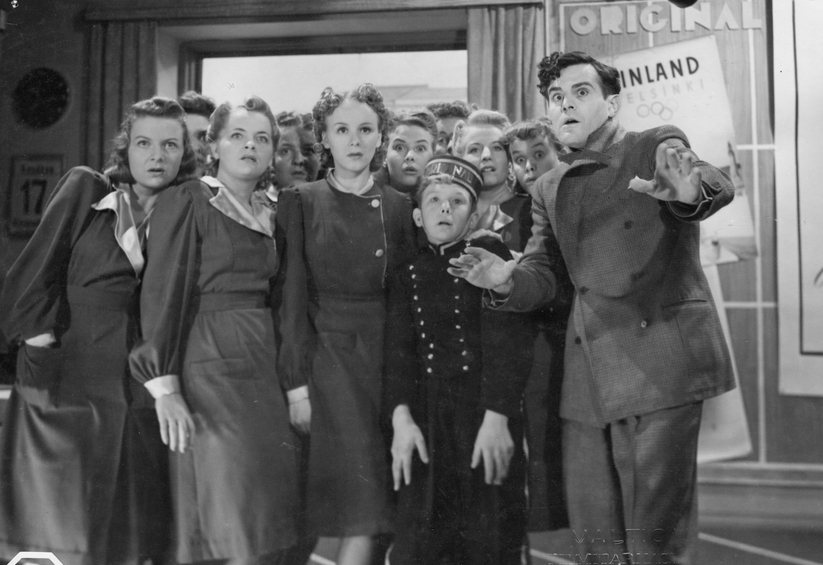
Take the opening number, “Mainostoimistolaulu” (Song of the Ad Agency). It doesn’t merely set up the bustle of the agency, but incorporates the arrival of Kalevi’s poster, and its distribution all around town. Proud of his company’s handiwork, Blomster walks briskly past admirers of the poster on the street, and buys a newspaper, and the camera focusses on his feet as he walks while reading, his jaunty pace coming to a shocked stop as he reads of the possible collapse of the government he hopes to take on as a client, flanked by a picture of the minister’s daughter in frilly knickers. Back at the office, the secretaries and their busboy (Lasse Pöysti, of The Suominen Family) are dancing around the poster in a Busby Berkley-esque group, alternately worshipping it and imitating it, as if to encapsulate the media fever around it… until the song is brought to a crashing stop by the arrival of Blomster.
Director Toivo Särkkä smartly leaves much of the singing in the hands of bona fide singers, as seen in a reprise in which Tauno Palo talks his way through his lyrics in a duet with Sirkka Sipilä and the Harmony Sisters. But that’s okay, because we know the Big Guns are waiting in the wings – Palo does eventually acquit himself in singing terms, but Birgit Konström, still coasting on her success after For the Money, has the dual singing and acting chops to carry the film all by herself. One expects that’s why she gets top billing, with a role that seems to have been written for a teenage ingenue, but which only the 36-year-old Konström could reasonably be expected to deliver.
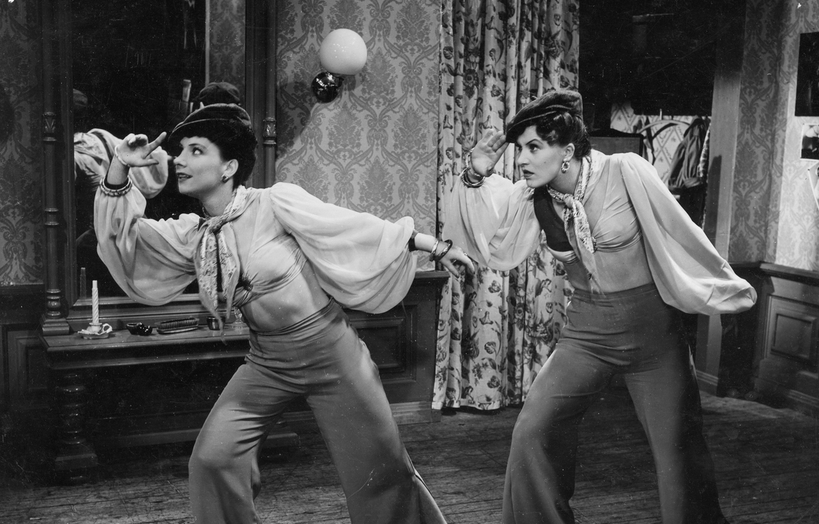
We might detect some vestige of the original theatrical production in the way in which the actors are given times to rest. The Harmony Sisters fade from view after the first hour, to make way for Konström and the Swing Sisters, who obligingly perform a shuffle-dancing striptease while the lead sings “Katupoikien laulu”. Much of the film’s location shooting comprises entertaining but unnecessary sights of the billboard all over contemporary Helsinki, cheekily shoved into a number of iconic spots, including all around the central statue of the Forging of the Sampo.
You would think that several stage incarnations would let the plot and execution be nicely matured by the time it made it to the screen, but this appeared to set many critics against this 124-minute film. Paula Talaskivi, in the Ilta Sanomat, bragged that she’d seen it twice on stage, and was left bored by this cinema version. Toini Aaltonen in the Suomen Sosialidemokratti commented that the original’s Parisian setting had been excised for Helsinki for no good reason, a comment which seems to deliberately misunderstand how films work. Olavi Vesterdahl in Aamulehti offered a far more incisive contextualisation of the film in terms of its era, noting that “idle celebrations and infidelities” seemed to be the touchstones of contemporary Finnish cinema, and that the film did itself no favours by relying so heavily on pratfalls and plot holes. “As such, the film is the lightest kind of entertainment, hardly even that, perhaps more correctly a waste of time from the viewer’s point of view.”
Posterity has been far kinder, with reviewers of the film’s later appearance on TV, untroubled be memories of the theatrical original, universally praising its vim and verve. I certainly found it much more enjoyable than I had been led to expect by the faint-hearted reviews of the 1940s, although in the woke 2020s, it is difficult not to take umbrage at the subtextual hand-wringing about a woman’s freedom to display her body. To be fair, the script depicts Margit as entirely uncaring about it, while the people of Helsinki, upon recognising her while out riding in public, literally break into applause. It is only the menfolk immediately around her who get in a tizz, before revealing how shallow their own perceptions are by failing to realise that Peggy and Margit are the same person. Meanwhile, there are some subtle suggestions of hypocrisy at work, particularly in a scene at her father’s home where Margit has a long conversation with a maid, in front of a massive rococo painting of a bunch of ladies with their baps out.
There is indeed, a certain class of Finnish women who all look the same, and it’s the thin, wriggly bright-eyed blondes usually favoured by foreign husbands (although not me). So much so, that at one Christmas party in 2003 for my beginner’s Finnish class when everybody brought along their Finnish wives, the pixie parade on display was so homogenous that I was genuinely worried someone might go home with the wrong Finn.
I asked our Finnish teacher if there was an equivalent language course where a majority of female students all had identical husbands.
“Yes,” she said with a sigh. “Swedish.”
Jonathan Clements is the author of A Short History of Finland. He is watching all the Finnish films, so you don’t have to.
On leave from the battlefront, officers Ryhmy (Oiva Luhtala) and Romppainen (Reino Valkama) try to head for Helsinki on a train, but are briefly discommoded because the last carriage has become detached. Onboard the train, the mysterious beauty Dora (Kirsti Hurme) tries to buy stolen papers from the shady-looking foreigners Kars (Santeri Karilo) and Virt (Sasu Haapanen), who throw Dora off the train.
In Helsinki, Ryhmy and Romppainen encounter Dora at a club, but are pursued by Santa Rosa (the fiercely over-acting Ville Salminen), an Argentinian journalist who thinks they are the thieves of the missing papers. Before long, the officers, the mysterious Dora, and the two foreigners are playing a game of cat-and-mouse across Helsinki, alternately double- and triple-crossing one another. Eventually all are arrested by Colonel Rastola (Paavo Jännes) who is inconsolable about his missing documents. When it is revealed that Dora is in fact his daughter, Ryhmy reveals that he has been hiding the papers in his boot, and hands them over.
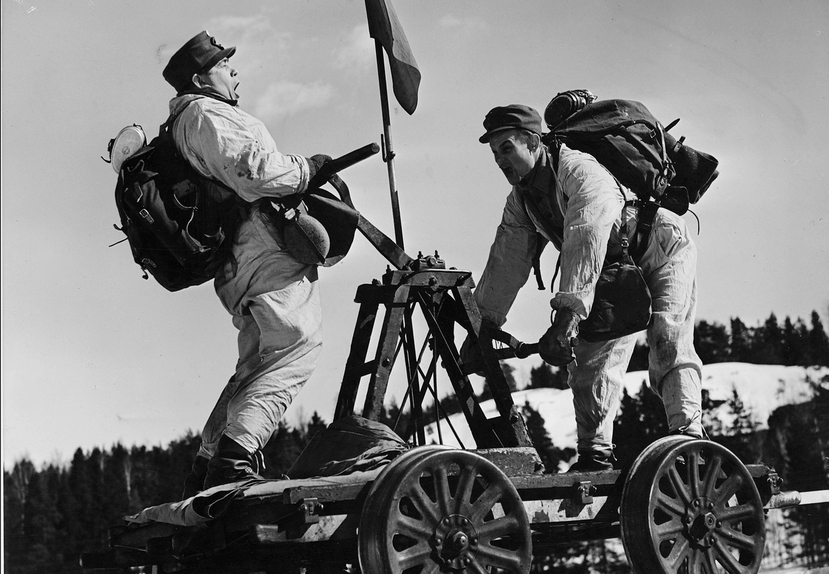
The first, but by no means last of a sub-genre of espionage movies to arrive in Finnish cinemas in the 1940s, Ryhmy and Romppainen’s concentration on an urban chase for a McGuffin seems born of the doubt among producers as to whether or not Finland would be at war when the film was released. Similarly, the concentration on vaguely defined “international ruffians” avoided a plot that might allude directly to the recent Winter War, or indeed the chances that Finland might be obliged to play nice with Russians at some future date. Consequently, producers at Suomi-Filmi chose to adapt the second of Armas J Pulla’s popular series of novels, in which two hapless soldiers somehow get to win medals and have adventures without ever really being in danger. Such larks were a feature of the Ryhmy and Romppainen books, the first ten of which enjoyed their heyday during the war, with five tardy sequels stretching into the early 1960s. With a dynamic not unlike the much-loved Lapatossu series, prints of which were a popular choice among soldiers at the front, Ryhmy and Romppainen is also a clear inheritor of the carnival celebration of military life to be found in many other films, including Red Trousers and Kalle Kollola, Cavalryman.`
The film features a long musical interlude at a masked ball in South American costume, all castanets, sombreros and cacti, which gives the cast a chance to dress up in ever more ridiculous get-ups.
Ryhmy and Romppainen were remarkably pacifist heroes, preferring to off their opponents Asterix-style with a dizzying club to the head, rather than a spurt of deadly machine gun fire. The books were also notable for the character of Natalia Vengrovska, a Soviet commissar hell-bent on catching her Finnish nemeses, but also struggling with her romantic feelings towards Ryhmy. This femme fatale was obviously a part that Kirsti Hurme was born to play, as indeed she did in the second film, all previous casting as the Colonel’s daughter forgotten. The second film, however, Yes and Right Away (1943) managed to fall foul of the censors in both Helsinki and Moscow, who objected, each for their own reasons, for the portrayal of Russian soldiers as harmless idiots. A similar blight afflicted the original novels, many of which were withdrawn from Finnish libraries, in spite of their popularity, because they presented the Soviet enemy as buffoons, and not a foe to be feared.
Lifting some plots and ideas from the second novel in the series, Ryhmy and Romppainen can be quite confusing – the press of the day singling out the need for the audience to fill in several gaps in the narrative themselves, otherwise it made no sense. The smoldering Kirsti Hurme is wasted in her role as the colonel’s cloaked and usually clueless daughter, and there are some frankly unnecessary bits of business with a pointless pet that just drag out the time.
Jonathan Clements is the author of A Short History of Finland. He is watching all the Finnish films, so you don’t have to.






 The Official Schoolgirl Milky Crisis Blog