A Time of Roses (1969)

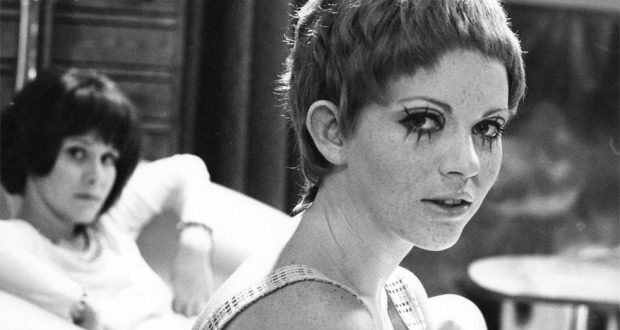
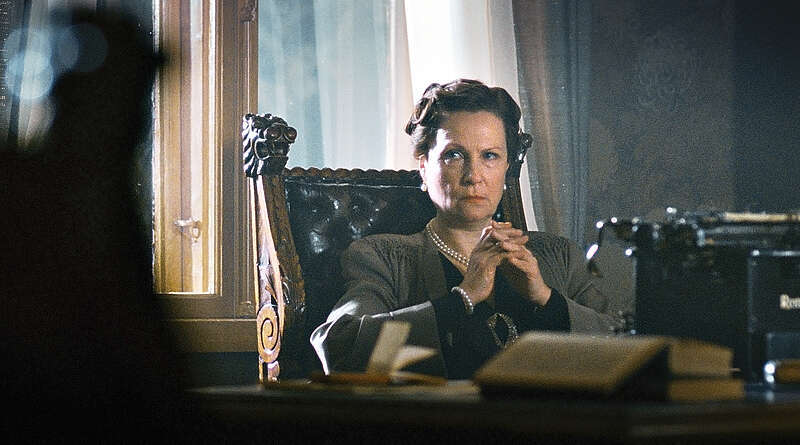
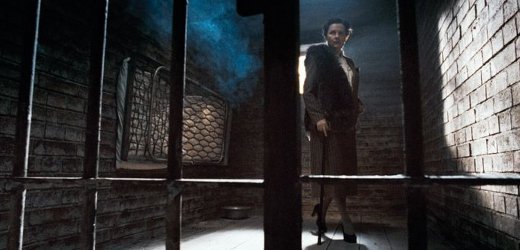
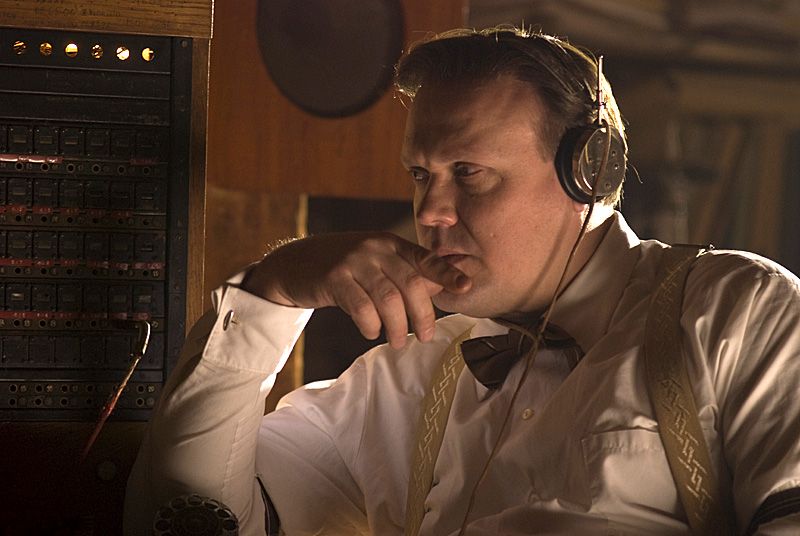
“Helsinki, Finland, in the year 2012 is a prosperous, peaceful society ruled by a meritocracy of technicians. The somewhat smug researcher Raimo (Tuominen) embarks upon a project to compare his time with that of his ancestors, by making a drama-documentary about the life of a figure from the past. He settles upon the life of Saara Turunen (Vepsä), an uneducated saleswoman in the chemicals industry and part-time erotic model, who met with a tragic end in 1976. His mistress and collaborator Anu (Markus) alerts him to the existence of Kisse (also Vepsä), a contemporary woman who bears a striking resemblance to the historical Saara, and who is persuaded to take on her role in the film.”

Over at the Encyclopedia of Science Fiction, I write up the 1969 Finnish oddity A Time of Roses.

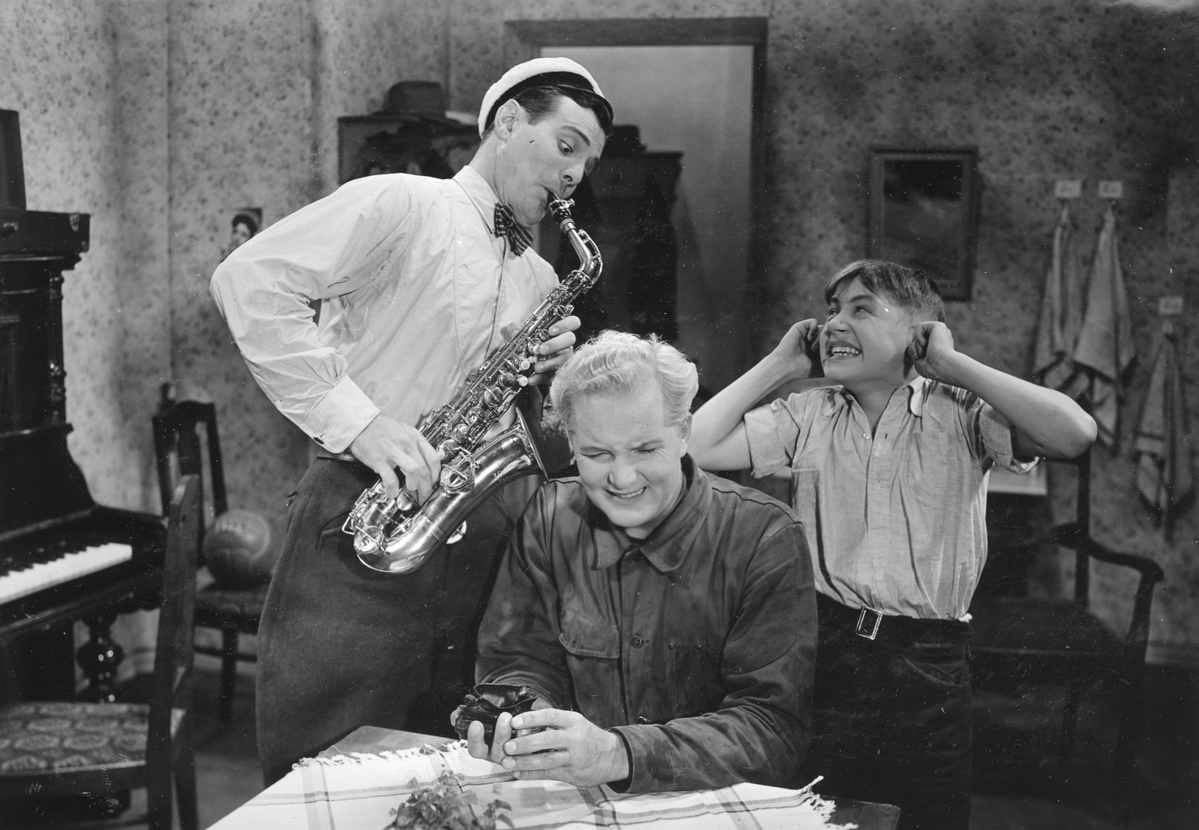
Dressed Like Adam and a Bit Like Eve (1940)

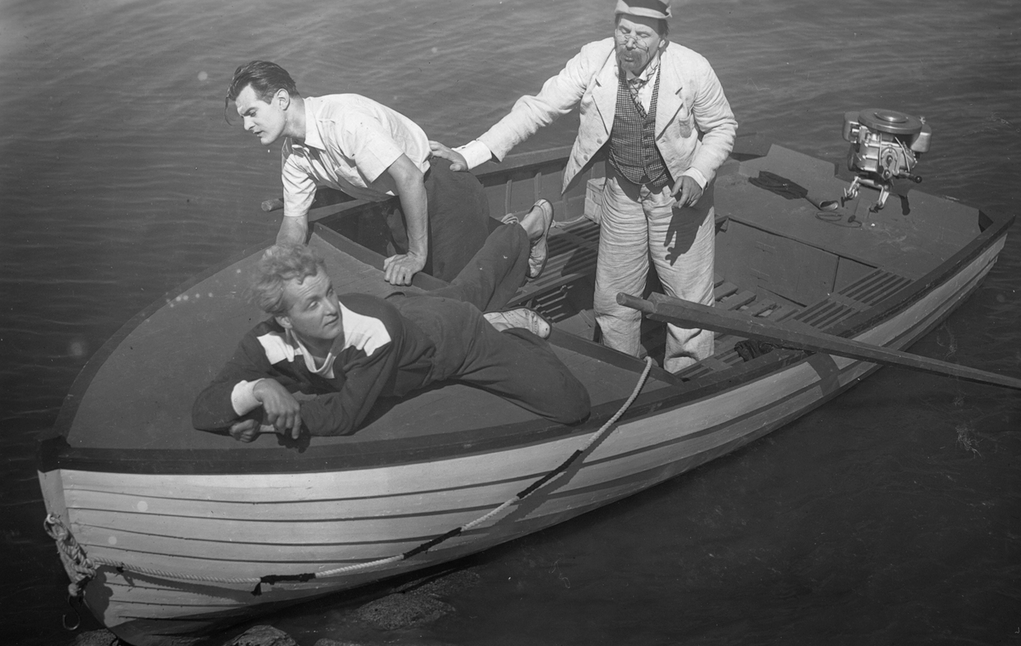
Vacationers Aarne (Tauno Palo), a pharmacist, and Paavo (Leo Lähteenmäki), a lieutenant in the army, offer to help the flustered station-master Mr Virimäki (Jalmari Rinne) get back home from the Finnish countryside. The trio set out in a motorboat, in an attempt to catch the steamer or reach the train station, but engine failure and a dunking in the lake leaves the two Good Samaritans wet, naked and marooned on an island.

Dressed like Adam and a Little Bit Like Eve began life as a 1928 novel by Agapetus, the unfunny scribe who has bafflingly provided so many Finnish “comedies” of the 1930s. By the time this 1940 production rolled out, it had already been turned into a film in 1931, as Finland’s first partial “talkie”, starring Jalmari Rinne’s brother Joel, and would re-made in East Germany in 1959, and again in Finland in 1971.

Terrifyingly, Dressed Like Adam begins in song, as Aarne and Paavo dick around their campsite boiling water and singing about the joys of sunshine. Mercifully, however, they soon stop, and get on with the story, a veritable comedy of errors.

As the nervy Mr Virimäki, the unrecognisable Jalmari Rinne boasts a pair of buck teeth that only add to the impression he gives of being the ever-late White Rabbit from Alice in Wonderland. His panic is pointlessly overblown – the boys pick him up at the dockside mere moments after the steamer has left the harbour, and frankly if he had only stopped pratting around and threatening to swamp the boat, they could have easily caught up with it.

The set-up, of course, superficially recalls Jerome K. Jerome’s Three Men in a Boat, and since Finns are involved, one might readily imagine that this, too, would turn into a bunch of people wittering about pets and discussing imaginary illnesses. But no, because within minutes, the boat has broken down, Aarne and Paavo have lost their clothes, and Mr Virimäki is beset upon by a field full of cows. The location work was shot on the manor at Pyhäniemi, a manor near Hollola that can also be glimpsed in several other Suomen Filmiteollisuus productions, including The House at Roinila (1935), All Kinds of Guests (1936), Seven Brothers (1939), and Serenade on a War Trumpet (1939). Its most recent use as a location was for Hella W (2011), a film about the writer Hella Wuolijoki, author of The Women of Niskavuori (1938).

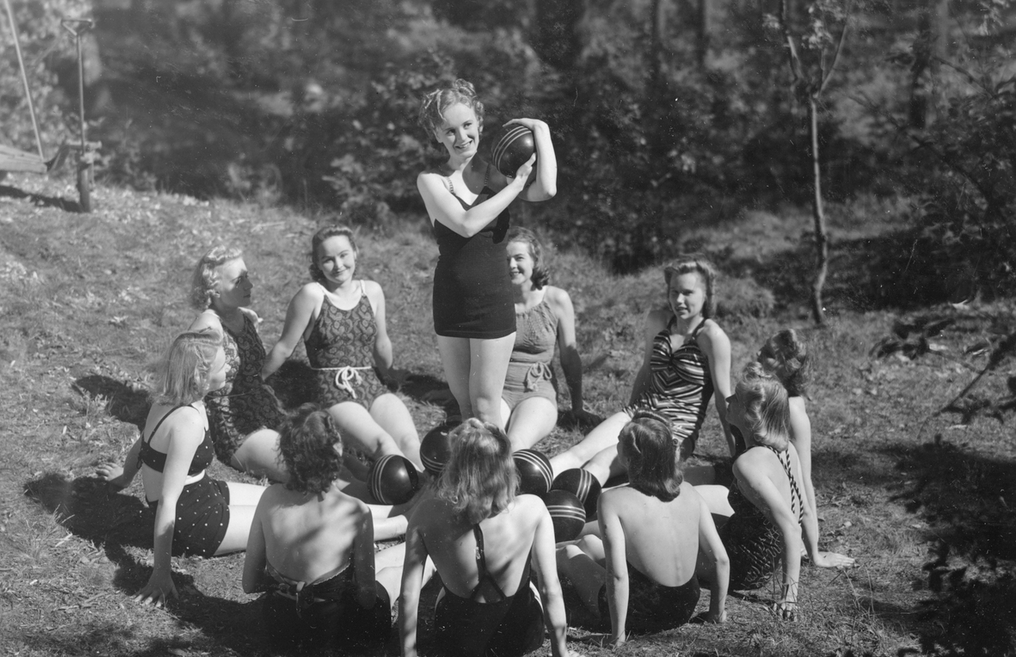
The farce is inevitably compounded when we are introduced to Alli (Sirka Sipälä) and her coterie of beauties exercising in the forest – a bevy of Finnish women in industrial-strength swim-suits, rhythmically lifting medicine balls like a dehydrated Esther Williams routine. She, however, is merely a bit of local colour to distract from the actual drama, which is escaped prisoner Vilho Vikström (Yrjö Tuominen, who played Paavo in the previous 1931 version), hiding out in the forest. Having got into a fight with Vikström and stolen his clothes, Paavo is mistaken for the criminal and arrested by the local police. When Paavo doesn’t return that night, Aarne also swims to the shore in search of him, and ends up having to climb a tree to escape from a dog in Alli’s garden.

Alli throws Aarne some clothes, causing him to spend much of the next act dressed as (and mistaken for) a woman. Cross-dressing comedy then ensues, with actor Palo convincing playing the ingenue, all except for his broad shoulders and prominent hairy chest threatening to give him away… but then again, this is Finland.

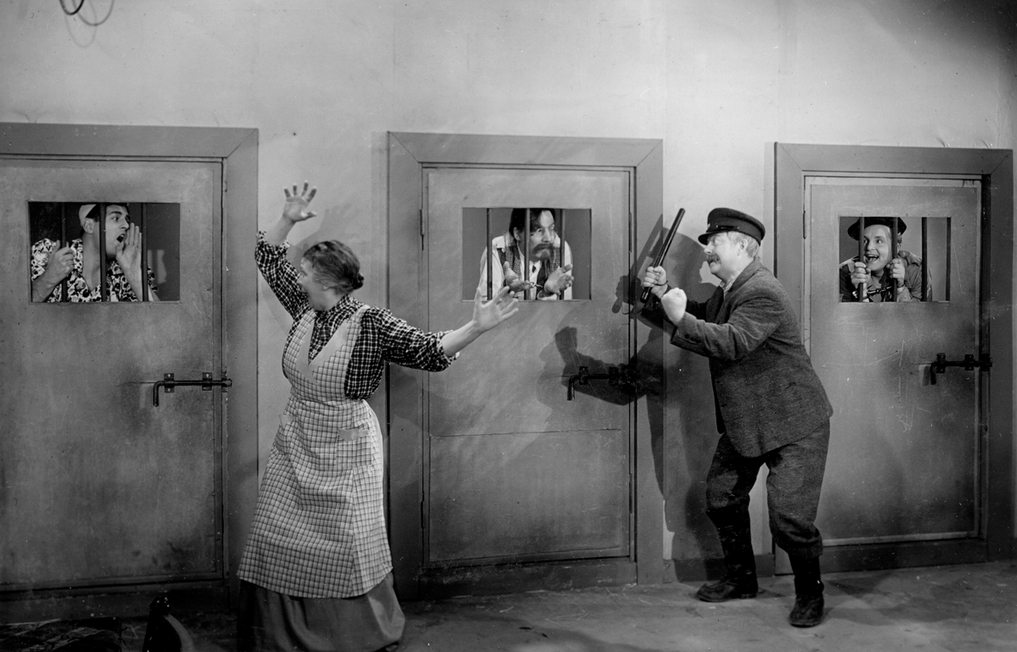
To be frank, I see so much nudity in modern-day Finland that it is difficult to take the jeopardy in this film as anything but manufactured. When my neighbours have proclaimed Topless Thursdays down by the lakeside near my house, and there are more baps on show than a Burger King assembly line, the fact that Paavo and Aarne haven’t got any pants on doesn’t feel all that much of a big issue. Like many other Finnish farces of the period, Dressed Like Adam relies on unconvincing slapstick and misunderstandings that could reasonably be dispelled by people simply having a conversation. Before long, all three men are incarcerated on suspicion of being Vikström, singing at each other in jail while Alli roams the countryside in search of the real criminal, who has, of course, got into their boat and made himself ill drinking a bottle of something he thought was moonshine.

That’s not to say there aren’t some moments of genuine humour, such as Paavo introducing himself to Vikström in the forest, standing to attention and reciting his name and division within the Jyväskylä Regiment, but with his cock plainly waving in Vikström’s face. High-jinks inevitably ensue, with Aarne falling for Alli, who remains blissfully and somewhat worryingly unaware that he is a man – compare to similar gender-bending in the earlier The Man from Sysmä. By the time Alli was crawling into bed next to Aarne for an all-girls-together slumber party, and then demonstrating her exercises scandalously and boobily in the nude, I was tittering away like a 1940s Finn, and unexpectedly warming to a script from an author whose work I usually find about as welcome as a prostate exam. Possibly, the victory here does not belong to Agapetus, but to Nisse Hirn, the screenwriter who adapted his novel. Hirn was also responsible for The Man from Sysmä and The Bachelor Patron, but at this point in his career, his greatest works were still ahead of him.

Extra points awarded for Alli’s pert nipples, which manage to be prominently on display even when she is wearing clothes again, poking through her summer dress. I guess that’s why actress Sipilä got top billing, even though the film’s triumph, among audiences and critics, was Palo’s prolonged and often convincing experiment with what constitutes femininity in 1940s society.

Jonathan Clements is the author of An Armchair Traveller’s History of Finland. He is watching all the Finnish films, so you don’t have to.

The Heir of Tottisalmi (1940)

Baron von Sumers (Paavo Jännes) is worried about his legacy. His grandson Klaus (Kalevi Koski) is displaying oddly violent and aggressive tendencies, and seems to have little sense of his obligation to be kind to his underlings, staff and servants. Fretting that Klaus needs to be taught about noblesse oblige before it is too late, the Baron tries to arrange for him to visit a local pastor’s family, where Klaus predictably acts like an entitled dick, and fights with the pastor’s boy Yrjö (Raino Hämälainen). But Yrjö isn’t the pastor’s son, he is the pastor’s ward, whose past increasingly obsesses the Baron.

Klaus is the child of the Baron’s daughter. But the Baron had a son, who was cast out and disowned twenty years earlier over a misunderstanding. Could it be that Yrjö is the Baron’s long-lost grandson, sired by the son in exile, and hence, technically, the true heir of Tottisalmi?

Well, yes, he is, but not if the scheming locals have anything to do with it. The Baron’s horrible son-in-law Frederik (Sasu Haapanen) is the guilty party who framed the heir all those years ago, now fretting that his machinations will be found out. Apparently unaware that the best thing to do when stuck in a hole is to stop digging, he instead enlists his servant Jonas (Hugo Hytönen) in a scam to frame Yrjö as a thief, before the bright and sunny boy wins over any other members of the family.

Not unlike the same season’s The Tenant Farmer’s Girl from rival studio Suomen Filmiteollisus, this Suomi-Filmi production displays all the signs of a company scrabbling for something to offer comfort under austerity conditions. Turning aside from the miseries of contemporary life, director Orvo Saarikivi instead delivers a slice of old-world aristocracy, itself deriving from Anni Swan’s 1914 children’s novel, featuring the producer’s ten-year-old daughter, Tuulikki Schreck in one of the lead roles, and even using the Schreck family’s home and furniture. Originally intended as a Christmas film in 1939, but postponed by the Winter War until it shuffled out in April 1940 to widespread indifference, it took several years to earn back its production costs, despite really obvious corner-cutting, such as a running time of a mere 66 minutes, and that’s with a 90-second opening overture that plays over an entirely blank screen.

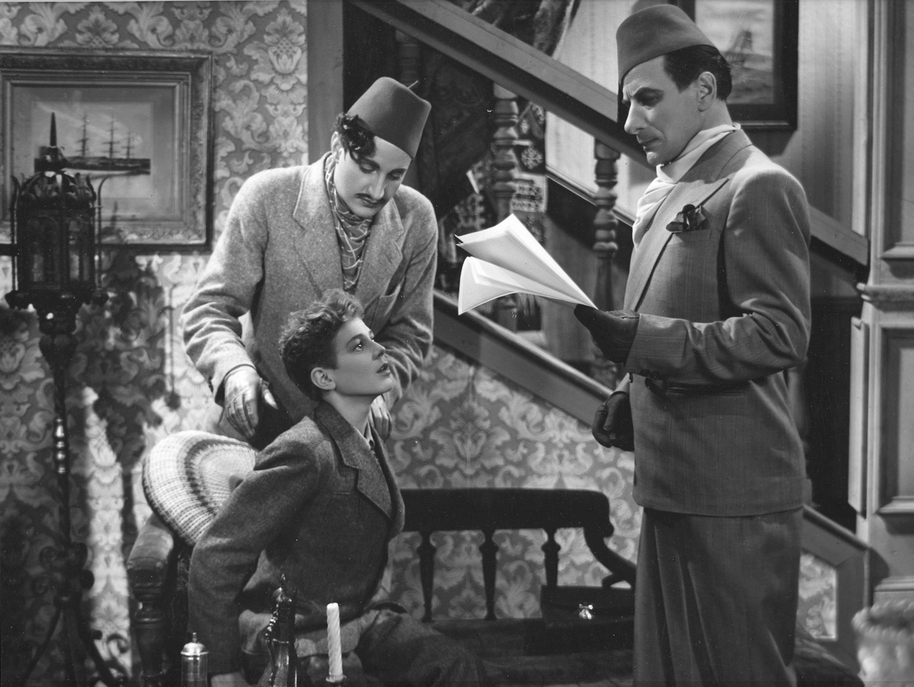
Again, as with The Tenant Farmer’s Girl, the transplant of a 19th-century story to a 20th-century setting only serves to accentuate the vast gaps in culture and expectations in the intervening period. In particular, the fact that the original story called for Yrjö’s father to die in the Battle of Navarino, during the Greek War of Independence in 1827. This explains how he ends up to have a posthumous son, born to a Greek woman six months later, and why a bunch of Greeks (Turo Kartto and Evald Turho, wearing fezzes because fezzes are cool) descend upon Tottisalmi to lend weight to Yrjö’s claim and, ultimately, spirit him back home to his mother in the Aegean. Presumably, von Sumers junior has been reimagined as some sort of volunteer in the First World War, but that would have just meant he dodged any involvement in the revolution and Finnish Civil War back home, and would hardly have endeared him to older viewers.

Little was written about it in a Finland still recovering from the Winter War, and by the time it appeared on television in 1975, the world had changed even more. “This is a film that has had its day,” wrote Mauri Taviola in the Helsingin Sanomat. “The children bang briskly through their lines like they are reciting verse at a six-year old’s birthday party, but you can hardly call it acting.”

Jonathan Clements is the author of An Armchair Traveller’s History of Finland.  He is watching all the Finnish films so you don’t have to.

SF Parade (1940)

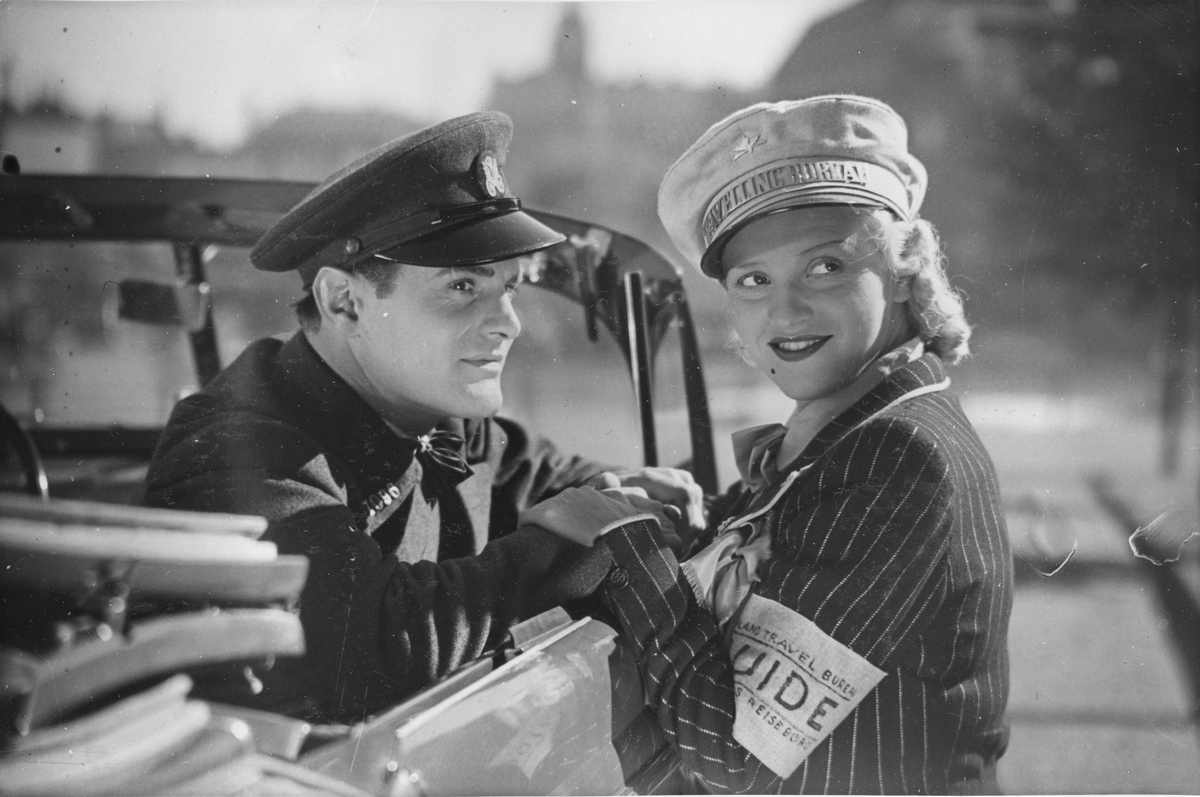
Taxi driver Tanu (Tauno Palo) is in love with Ansa (Ansa Ikonen), but she is suffering the unwelcome attentions of her tour-bus driver Jopi (Joel Rinne). After she rebuffs Jopi’s handsy molestations, Jopi feigns ignorance of the bracelet she is wearing – she had told him that it was lost property awaiting return to its owner, but he allows her boss Mr Anger (Kaarlo Angerkoski) to believe that she has stolen the bracelet from a tourist. Fired from her dream job, Ansa ends up working back in her mother’s kiosk, where she slowly warms to the earnest and similarly hard-up Tanu.

With a plot that could have been written on the back of a beermat, a title that might as well have been Finnish Film Company Film, and a cast that doesn’t even bother to come up with names for their characters, SF-Paraati is an odd confection, shot during the summer of 1939, but mothballed for a year as the Finns were plunged into the Winter War. Although surely beaten to the punch by The Two Vihtors (1939), it was intended as “Finland’s first musical film” by writer Tapio Piha – a plot as a thin excuse for a “revue”, cramming as many songs as possible into the narrative, and utilising the regular players of the Suomen Filmiteollisuus studio. Piha was so sure of who he wanted for most of the roles that he wrote in the real actors’ names as place-holders, most of which survived into the film’s final cut. The original title, however, Helsinki Sings, was changed at the last moment.

It was released in May 1940, after the Finns had fought the Russians to a standstill in Karelia, and signed away a huge chunk of their borderlands. This unexpected development adds a particular note of pathos to the film’s subplot, which Toppo (Toppo Elonpëra}, a Finn from the Russian side of the border, arrives in town in search of his missing brother Aku (Aku Korhonen). The film is also the last appearance for Kaarlo Angerkoski, who died shortly after his shots were completed, and for teenage tap-dancer Jacob Furman, who would leave cinema behind and go on to become a jazz drummer (he does, in fact, also sneak into the same year’s Lapatossu & Vinski’s Department Store, although he is credited there as Jaakko Vuormaa).

Owing much to the let’s-do-the-show-right-here attitude of the US hit Footlight Parade (1933, released in Finland under the title of Shanghai Lil) SF-Paraati was planned as an international film to wow visitors and would-be visitors for the Helsinki Olympics, scheduled for 1940 but cancelled because of WW2. Much is made of the multinational flags adorning the boulevard in Central Helsinki, with the Nazi swastika given pride of place, and Ansa Ikonen effortlessly switches between English and German as she tells her tourist clients that she will show them “the capital of Finland” – although if they hadn’t worked out where they were by the time they were on a bus in the centre of town, I’d say they were past helping.

For the first five minutes we are treated to Ansa’s bus tour of the Helsinki sights, including Kaivopuisto, the statue of Mänttä, and the Kappeli esplanade, where kiosk owner Siiri Angerkoski (suddenly and shockingly white-haired) and florist Aku Korhonen dance like a pair of bell-ends to a military marching band. We see the street that would soon be renamed Mannerheimintie, and even the 1931 parliament building, which is apparently the “most up-to-date parliament in the world.”

But this is all set dressing for the musical plot of the film, as Tanu and Ansa become known throughout Helsinki for their self-penned duet, “The Song of Love.” They briefly fall out when they argue over how the music should be locked down, leading to a live stand-off between two rival orchestras, with Tanu conducting the boys on brass, and Ansa conducting the girls on strings, and the whole song turning into a garbage fire. They are, of course, both ultimately proved right, with their variant tunes functioning as point and counter-point when they are eventually forced to sing them both together.

For a film that makes such a big deal of music, the visuals are oddly ignorant of how music actually works. As in the earlier Red Trousers (1939), footage of marching bands show soldiers excitably banging drums that are making no sound, while Tanu is somehow able to stop playing his saxophone in the middle of a number without any noticeable change to the tune when he does so. But Tanu and Ansa are made for each other, since both of them are obsessed with songs, singing snatches at each other as if they are in a Baz Luhrmann musical, not out of any evasion of copyright, but because they are trying to come up with the hit of swinging Helsinki for the summer.

SF-Paraati is a sweetly endearing film. It is truly remarkable how little central Helsinki has changed in the last eighty years, and the grungy focus-pulling, which is often a few seconds behind the action, makes the whole thing seem as if it was snatched on the run. Much of the music is diegetically convincing – we see Tanu putting his song together in pieces, and then see it as it spreads like a meme through the population, sung at first at an outdoor piano near Ansa’s kiosk, and then picked up all over Helsinki, heedless of the class divide, sung by mothers to their babies, and secretaries in a typing pool, before getting the big band treatment at a dance hall. In a moment of meta comedy, Tanu is chewed out by the police commissioner for writing songs instead of doing his job, although you had to know that the commissioner is played by the film’s composer, Georg Malmsten, to understand why this is funny.

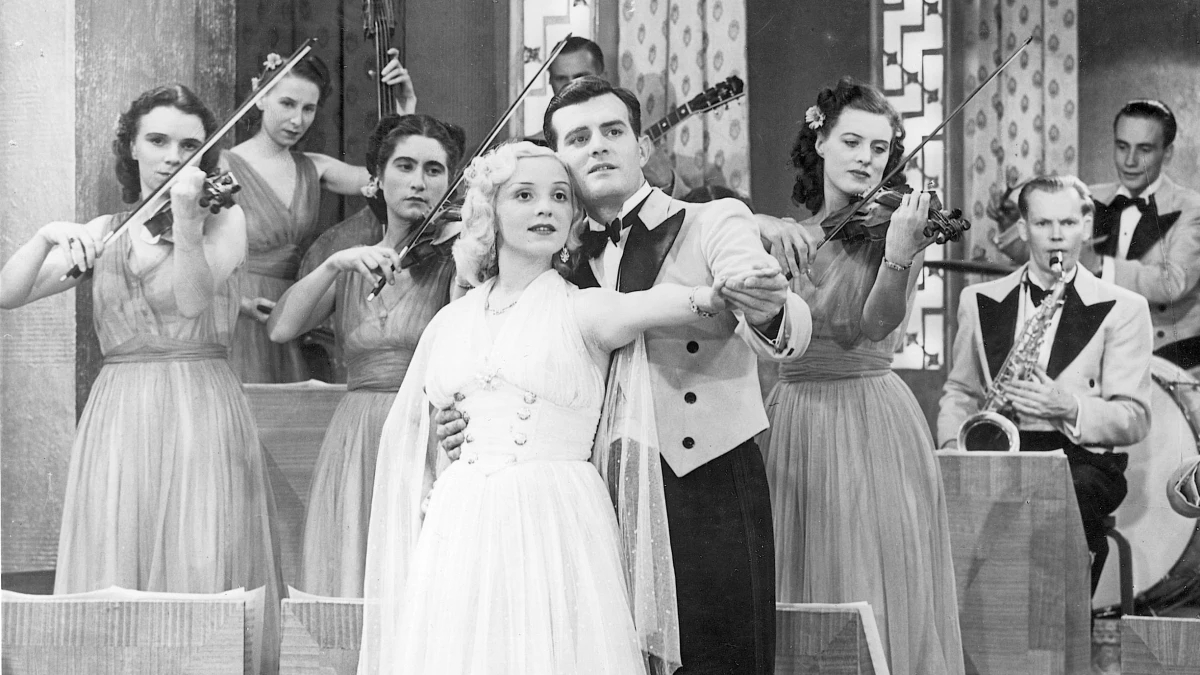
Inevitably, the film ends with big song-and-dance number, prolonged for two or three minutes, it seems, solely so that the pretty violinists can dance around in their underwear to take the film over the line to feature-length. Ansa and Tanu kiss and make up, their song is a big success, and their friends and family cheer them on from the audience. The Karelian brothers Aku and Toppo are also finally reunited, but in a feature of the film’s outdoor-broadcast quality, they drift in and out of focus and their dialogue stumbles over itself, as if not only their joy and surprise is real, but so, too is the unreadiness of the cameraman, who has had to scramble to capture a moment that is spontaneous and unexpected.

Jonathan Clements is the author of An Armchair Traveller’s History of Finland. He is watching all the Finnish films, so you don’t have to.

Finns Find the Orient

Finland’s first Chinese restaurant opened inside the spy-infested Hotel Torni in Helsinki in 1953. With characteristic Nordic bluntness, the restaurant was called simply “China.” There, claims food historian Ritva Kylli, visitors “eagerly tasted Chinese flavours and practised how to use chopsticks.” By the end of the 1950s, some Chinese influences had crept into Finnish cooking, including restaurants with wax tablecloths, and the usual utensils of Finnish eating – plates and forks and what-have-you, haunted by the presence of a bottle of soy sauce and a jar of chili oil.

“Dishes from the Torni,” she writes, “became familiar in the Finnish home kitchen, most often chop suey, which was known to have been developed in San Francisco, and become known all around the world as a classic dish of Chinese cuisine – everywhere except China.”

Chinese food is but a sidebar in Kylli’s exhaustive Food History of Finland: From Salted Meat to Sushi [Suomen Ruokahistoria: Suolalihasta sushiin], recently published in Finnish. In it, she charts the development of a national cuisine that has been famously pilloried by other nations – most famously, according to one well-known French politician, the second-worst in the world, after British food. She takes the Finnish palate from its early, bland fumblings with rye bread and dairy products (“Our Finnish cheeses are much praised,” claimed Daniel Juslenius in the 1700s, without a shred of proof), through the introduction of Russian foodways and French bistros, the impact of Prohibition in the 1920s, wartime austerity and the turnabouts of the modern world.

As her title implies, she finishes with another oriental foodstuff, at least nominally. Finns were certainly aware of Japanese food early on – she includes a letter from a baffled diner in Hakodate in north Japan, trying to come to terms with chopsticks and drinking soup from the bowl in the 1920s. But it’s not until 1978 that Kylli uncovers an advert in a Helsinki newspaper for a place calling itself the Yokohama restaurant. Although Kylli tracks a strong upward curve in Japanese food in Finland over the next few decades, it is not really until the 2010s that sushi has become a nationwide phenomenon outside Helsinki, and not because of the Japanese, but the Chinese and the Thais.

Most of the “Japanese” restaurants in Finland are run by Chinese and Thais, ever-ready to exploit the likelihood that Finnish men are sure to stock up on rice and stodge, but Finnish women will jump at the opportunity for a sort of salad that’s also a sort of lunch. For some reason, accountants and the Finnish tax office seem to smile upon “cold” lunches as a tax-deductible expense, further incentivising a bit of fish that hasn’t actually been cooked.

Kylli’s 500-page epic history of food is meticulously referenced and wonderfully detailed, and understandably shies away from the prospect that some Finns might be their own worst enemies when it comes to gastronomy. Once in a Helsinki restaurant that would probably prefer to be unidentified, my recurring inability to remember the word in Finnish for “bowl” led me to switch into Mandarin, and for the manager to suddenly snatch away my plate.

“Oh no!” he said, “Let me make you the good stuff. The buffet’s just the crap we serve the Finns!”

Jonathan Clements is the author of The Emperor’s Feast: A History of China in Twelve Meals. A Food History of Finland: From Salted Meat to Sushi is published in Finnish by Gaudeamus.

The Tenant Farmer’s Girl (1940)

Siiri Angerkoski and Aku Korhonen are angry parents berating their daughter Helga (Regina Linnanheimo) for having a child out of wedlock. But she drops her case against Pekka (Joel Rinne), the father of her child, in order to spare him the pain of perjuring herself, leading a local family to take pity on her and hire her as a housemaid.

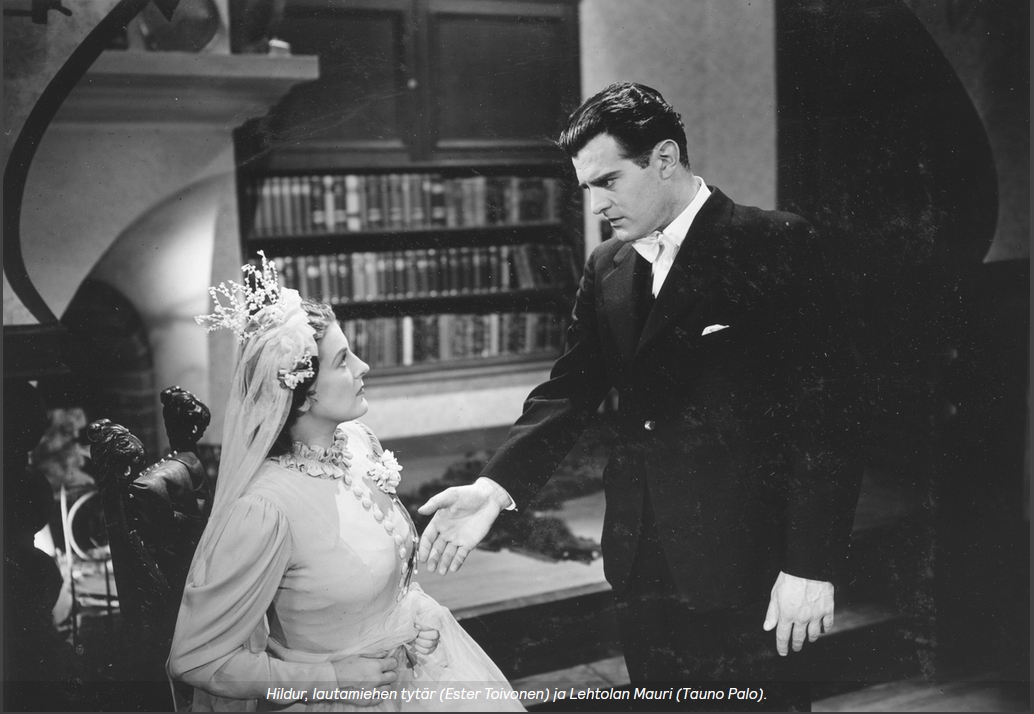
Helga becomes a witness to the goings on at the home of a well-to-do household, where heiress Hildur (Ester Toivonen) is due to be married to local boy Mauri (Tauno Palo). When Mauri comes to believe that he has drunkenly murdered someone (we’ve all been there), his confession causes his betrothed to reject him, only for Helga to turn up with evidence that acquits him. By that point, Mauri has decided that Helga is the girl for him – her insanely high standards of piety and righteousness trump any physical attractions of the radiant Hildur, and the two of them are married.

The opening credits boast that the film is based on Selma Lagerlöf’s “world-famous” story, presumably because earlier Swedish-language adaptations of her novella were shown in the United States. Lagerlöf was the first woman to win the Nobel Prize for Literature (in 1909), but this forgettable melodrama was surely one of her minor works. We have to view it through a series of filters – a story written originally from a Swedish perspective now dragged into a Finnish world; a story dating from 1908, suddenly forced into entertaining us in May 1940. Even at the time of its Finnish release, the press was dismissive of an old-fashioned tale about old-fashioned mores when Finns had other issues to deal with. “Particularly at a time like this,” commented Paula Talaskivi in the Helsingin Sanomat, “it’s difficult to get invested in the atmosphere required by a romantic love story.” The provincial press was more forgiving, with several reviewers commenting that a tale of simpler times was a welcome diversion.

Linnanheimo is a miserable protagonist, grizzling in the woodshed about her predicament, while the film has presumably been cranked out under understandably austere conditions – it’s shot on a limited number of sets, with exteriors largely limited to what appears to be someone’s backyard in a forest somewhere, presumably shot in the summer of 1939. Anything else interesting arrives as reported speech, read out of a newspaper at dinner or otherwise happening off-screen.

In something of a new direction for Ester Toivonen, she only appears to be the romantic lead. In fact, her character Hildur is destined to reject Mauri, thereby becoming a bit of a heel. We see her fretting at the dining table, surrounded by gossiping old wives, her wedding crown set tantalisingly before her. In this role, Toivonen becomes oddly beguiling, discovering perhaps that she enjoys being a disdainful posh girl more than she ever liked being the ingénue. At the end, it’s Hildur who drives Mauri to meet Helga on the road, where he proclaims his love for her, and the two of them rub cheeks like robots trying to attach their facial SCART leads. As Helga getting her happy ending, Linnanheimo tries to smile, but she looks like she is trying to thoughtfully pass a gallstone.

Jonathan Clements is the author of An Armchair Traveller’s History of Finland. He is watching all the Finnish films, so you don’t have to.

Hella W (2011)

In 1942, Soviet agent Kerttu Nuorteva (Maria Heiskanen) parachutes into Finland on a secret mission. Injured from a bad landing, she rings the doorbell of a mansion, and presents herself to the lady of the house looking for work as a maid. When they are alone, she reveals her true identity, and announces that she is looking for The Poet – the codename of a Soviet spy, the wealthy industrialist and author Hella Wuolijoki (Tina Weckström). Yes, says the lady of the house, that’s me.

Here, says the spy, I’ve brought you 100 grand spending money…

Wow, what a way to begin a film. Except that’s not how Hella W (2011) begins at all. It takes half a laborious hour to get to that scene, the real-life scandal that would ultimately land Hella Wuolijoki in prison, just missing the death sentence for treason by a single vote on a judicial appeal.

“What went wrong?” asked Tuomas Riskala in Iltalehti: “The editing is choppy and the narrative is disconcertingly fragmentary. Overdramatic music blows non-stop in the background. And why is a completely useless narrator’s voice glued on top? It is as if there is not enough trust placed in the story itself and its subject matter.”

Speaking as an author myself, particularly in the history field, even non-fiction works require a story – an elevator pitch, a grandstanding appeal to the cheap seats like the very best of book-jacket blurbs. I can spend years walking around a subject, examining it from different angles trying to work out where to start, where the story is. And so, I feel a certain degree of sympathy for veteran screenwriter Outi Nyytäjä, who not only seems to visibly struggle with finding a feature-length plot, but leaves all her abortive attempts to start on-screen until it feels like we are watching the first pages of a dozen discarded drafts.

In 1943, disgraced Finnish industrialist Hella Wuolijoki is sentenced to life in prison after a captured Soviet spy accuses her of two decades of subterfuge and espionage. She is stuck in a cramped cell with a chirpy, possibly-lesbian black-marketeer, and the two unlikely cellmates slowly become friends. Hella works on her appeal, and movingly pleads with a court martial that she only intrigued with the Russians to save Finland from a disastrous pact with Nazi Germany. When the Finns’ own government turns on the Nazis in 1944, Hella is suddenly released from prison.

No? Okay, how about…

In 1929, the onset of a global recession financially cripples the Finnish industrialist Hella Wuolijoki. Out of desperation, she turns to authorship, cranking out novels and plays under a variety of pseudonyms – she is unable to publish under her real name, because she is a known socialist in a country still smarting from its civil war. The Women of Niskavuori is performed in a left-wing theatre so impoverished that Hella has to lend the production her own furniture to use onstage. But the play is a rip-roaring success, and soon it, along with her later Juurakon Hulda, Forward to Life, and Green Gold are being adapted for the Finnish cinema…

No? Okay, how about…

1904. Estonian student Ella Murrik comes to Helsinki with little more than a suitcase, where she witnesses the upheavals of Russia’s defeat in the war with Japan, and marries a Mr Wuolijoki, a close friend of Lenin. Despite being a committed Marxist, she never joins the Communist party, being advised that she is of better use to the Bolsheviks as a wealthy aristocrat. Her house becomes a salon for left-wing thinkers, and an underground escape route for revolutionaries and spies…

Are you not entertained? All righty, then…

1944. Embittered landholder Vappu Tuomioja (Matleena Kuusniemi) struggles to keep the family estate functioning while all the men are off at war. She confronts her mother, Hella, who is in prison convicted of treason, over a life spent supposedly committed to socialism, whereas all Vappu can see is a soulless woman repeatedly, and vainly, trying to buy love with hard cash.

1945. Okay, in a tense Cold-War Helsinki, pardoned spy Hella Wuolijoki turns out to be the ideal choice to run Finland’s national broadcaster. Hijinks ensue as she tries to heal the wounds of the war and keep her former Soviet allies from invading again…

1943. An unnamed Finnish intelligence officer (Hannu-Pekka Björkman), has 24 hours to get a confession out of Hella Wuolijoki, a famous author whom he believes to be a Soviet spy. Unfortunately, he has yet to apprehend her contact, Kerttu Nuorteva, and must bluff his way through their interviews…

Amazingly, I could go on, and on, but that’s the problem with Hella W, a film directed by Juha Wuolijoki, a relative of its subject, and possibly too invested in telling everything. Nor was he the first to grapple with her amazing life; her grandson Erkki Tuomioja, wrote a joint biography of both Hella and her equally story-packed sister, under the title A Delicate Shade of Pink: The Lives of Hella Wuolijoki and Salme Dutt in the Service of Revolution, not long before he became Finland’s Foreign Minister. No, you really couldn’t make this up.

Hella Wuolijoki’s name has shown up several times in this blog of Finnish film history, and will show up several times again, since her Women of Niskavuori (performed in England as Women of Property – HG Wells went to the opening night, you know) would spawn several sequels, the most recent of which was a TV series in 1987. But sadly this bio-pic does not truly engage enough with any of the dozen possible angles that might have made it compelling. I was fascinated, for example, at the idea of a woman turning to writing to escape poverty, and the possibility that her theatrical success was buoyed up by aristocratic or revolutionary connections. And I was drawn to notes of ambiguity already present in the film, to the question of how Marxist Hella was when she was a sawmill magnate defaulting on her invoices, and how Marxist she was when a spy rang her doorbell and she essentially threw her out. And I was equally intrigued by the kind of shenanigans that must have gone on when she was appointed, presumably, as a Stalin-approved stooge to run Finnish media, so soon after being sprung from jail.

Instead, Juha Wuolijoki’s film admirably stretches its €1.7 million to the limit with lavish manor settings and country piles like some Finnish Downton Abbey, smoke-filled rooms and coldly-lit prisons, making the very best of the “found” architecture that still endures in modern-day Helsinki. One lovely scene, as Wuolijoki is arrested with a manuscript of one her plays, covered in invisible ink, is shot in Helsinki’s train station, right in front of where the Burger King is now. But it ends up feeling like a bunch of scenes from a dozen different films, leaving little space for any single one of them to shine.

Jonathan Clements is the author of An Armchair Traveller’s History of Finland

Serenade on a War Trumpet (1939)

Cheeky soldier Malakias Paavonen (Kaarlo Angerkoski) is supposed to be peeling potatoes but is caught sculpting one, instead, into the image of a woman. The angry Sergeant Tiainen (Ossi Elstelä) orders him confined to kitchen duties for the duration of the ongoing military manoeuvres, which are just about to be thrown into chaos. Battalion commander Major Harteinen (Tauno Palo) insists on conducting the military exercise on the grounds of the Mäkipalo estate, chiefly because he has designs on the lady of the manor, Oili Mäkpalo (Ansa Ikonen).

For reasons that defy understanding, an earlier Suomen Filmiteollisuus military farce by “Topias” (Toivo Kauppanen), The Regiment’s Tribulation (1938), was one of the biggest successes of the decade at the Finnish box office. This half-hearted respray, which crams many of the same actors into similar roles and situations, was intended to rake in more money from the punters, but failed to garner quite the ticket numbers as its predecessor, both in the theatre in 1938 and at the cinema the following year. Notably, the outdoor location shots were all completed first to make the most of the short Finnish summer in June and July 1939. The interiors, comprising the bulk of the footage, were shot in September, when the decline in good weather would not be an issue. The film was planned for a national release in November, but was held up by the outbreak of war. A few scattered provincial screenings did occur before the official Helsinki opening night on 1st January 1940, which is why I, along with the Finnish film archives, continue to list this film as a 1939 release.

As with The Regiment’s Tribulation, (and indeed its 1939 imitation Kalle Kollola, Cavalryman) the most interesting element of Serenaadi Sotatorvella is the primitive nature of the military equipment. Paavonen’s mess unit entirely comprises horses and carts. The sergeant tries to interfere with Paavonen’s cooking of that old military staple, pea soup, which ends with a bag of salt dropped into the pot and a ruined meal. Paavonen falls for local milkmaid Sandra (Siiri Angerkoski), providing a rare element of meta-textual comedy, in which Kaarlo Angerkoski is obliged to woo the actress that everybody in the audience knew to already be his wife.

Unfunny comedy business is provided by Korni-Mikko (Toppo Elonperä), a venerable veteran of the Turkish Wars, determined to befriend the young Finnish conscripts and lead them in a bunch of hearty shanties – as with Our Boys in the Air (1934), the film that began this watchathon, the script repeatedly calls for the cast to burst into song in precisely the same way that Finns don’t.

Misunderstandings and hijinks subsequently ensue, the Major loses his trousers and mistakenly believes that Oili doesn’t love him, and all’s well that ends well in a war game that entirely downplays the vicious conflict that Finns were already knee-deep in by the time this film actually saw the light of day. In theatrical exhibition, it laboured under the unfortunate alternate title of Soldier Paavonen’s Lucky Pants.

Perhaps luxuriating in the fact they got to see the film before all those hipsters in Helsinki, the provincial press acted like it was the best thing since non-stick frying pans. “A great stimulant to the mind” wrote an anonymous local critic in Vaasa, where people are apparently easily impressed. “Vigorously and briskly performed,” wrote some toady in Tampere. It may well be that they were moved to give the film more credit than it deserved because like the same year’s Rich Girl, it was tinged with tragedy. Leading man Angerkoski died shortly after filming was completed, suffering a heart attack in Kotka at a stage performance of The Jäger’s Bride. He died in his wife’s arms, and the Finnish media made much of the punishing hours of Finnish film-making, and the toll they had taken on him in late-night shoots, coffee and cigarettes.

Jonathan Clements is the author of An Armchair Traveller’s History of Finland

The Little Fiddler (1939)

The vagrant Anna (Regina Linnanheimo) leaves her son Olavi (Heimo Haitto) with Antti (Jalmari Rinne), a cobbler, where the boy soon develops a love and affinity for music. Placed in an orphanage after Antti dies, Olavi escapes with nothing but a cat and a violin. Eventually he is taken under the wing of The Professor (Aku Korhonen, charming as ever), who drags him into the performing arts.

Pikku Pelimanni was constructed as a star vehicle for the teenage Haitto, a violin prodigy from Viipuri, who had already wowed the Finns and several other countries with his musical ability in real life. It was co-written by Boris Sirpo, himself a student of Sibelius, and Haitto’s mentor, impresario and foster-father. One imagines that the idea was that Haitto himself would tour the Finnish cinemas, whipping up enthusiasm for this fictionalised account of his early teens. But by the time the film had been released, 12th November 1939, Haitto and Sirpo had already fled the country ahead of the war, and would sit out the next few years in the United States, where they toured giving concerts for Finnish war relief, and where Heimo would appear as himself in The Hard-Boiled Canary (1941). By 1945, Haitto had married a wealthy heiress and taken a job with the Los Angeles Philharmonic. He would come back to Finland briefly in 1948, which would lead to the film’s edited re-release in 1949 under a new title, From the Little Fiddler to the King of Violinists (Pikku pelimannista viulun kuninkaaksi), in which an extra fifteen minutes brought the leading man’s story up to date.

Unfortunately for the 1939 footage, the sound quality is utterly atrocious – half the dialogue sounds like the wah-wah-wah nonsense of the off-screen teacher in Peanuts. Meanwhile, even though Haitto has been hired for this role because he really is a violin prodigy, the production adds insult to injury by getting him to mime his own violin playing… which he turns out to be really bad at.

The best part of the film comes at the end of the 1949 re-release, which features a live film-studio recital by the adult Haitto, although this, too, is partly ruined by a Finnish narrator who witters over half of the performance. In a moment of touching self-reflexion, the camera tracks around director Toivo Särkkä  and his crew as they listen, spell-bound, catching itself and its operators momentarily in a mirror. The film ends with intercut footage of the younger and older Haitto, almost as if he is conducting a duet with himself, the better sound quality and extra decade’s experience of the 1948 footage serving to show how far he has come. But the elision between fact and fiction is clumsy and confusing — this is a concert by Heimo Haitto, but a coda to the story of the fictional Olavi.

Haitto would go on to lead a colourful life, including some years spent as a tramp roaming the United States, before a brief but triumphant return to form in the 1970s. His life would become the subject of another Finnish film, Da Capo (1985), which dealt in greater depth with the pressures and trials of childhood celebrity.

Jonathan Clements is the author of An Armchair Traveller’s History of Finland

Seurasaari

Off to Seurasaari, the Finnish Open-Air Museum, which is thanked in the credits to The Deer King, and has plainly provided much of the material inspiration for Masashi Ando and Masayuki Miyaji’s depiction of pre-modern societies in that anime. Someone has also plainly taken a lot of reference photos of all the surrounding forest.