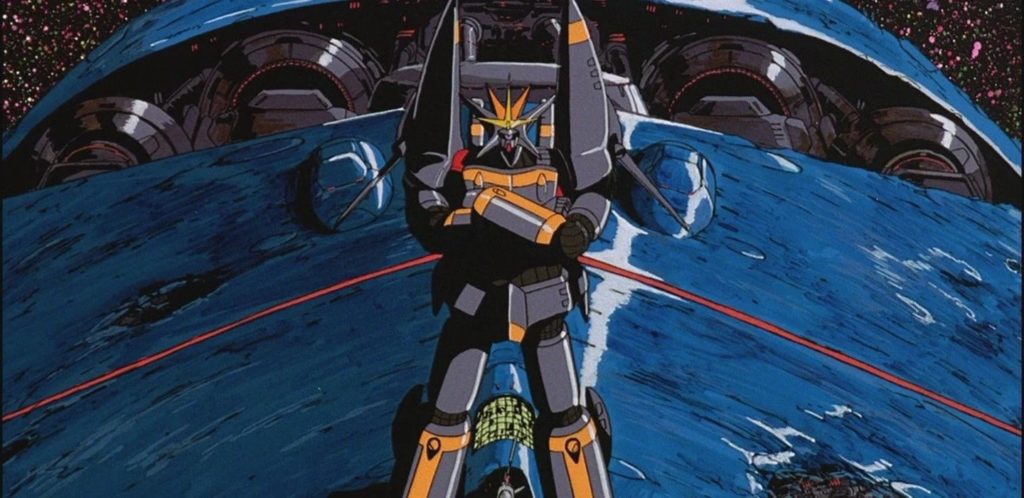
“Jonathan,” said Mamoru Hosoda, “I wonder if you have ever heard of an anime called Gunbuster? Because there’s this scene in Gunbuster where the mecha comes out and stands with its arms folded on the prow of the ship, and that’s such a fantastic moment in anime, and that’s what I was trying to evoke with Belle on the back of that whale.”
Over at All the Anime, I fold my arms and wait for the alien hordes.
“The chorus of voices that sings ‘“’Gunbuster~~~!’”’ in the eycatch is actually a single man, overdubbed repeatedly to sound like a group of people. The voice is that of the composer, Kohei Tanaka, sneaking his way onto the audio as a bit of cost-cutting DIY.”
Over at All the Anime, I investigate Kohei Tanaka’s wonderful score for the Gunbuster series.
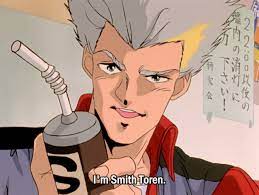
“Toren ended up living in a ‘room’ that was actually a walk-in closet that they had put a bed into. And during the time that he was there, the people of Gainax were working on Gunbuster, and decided that they needed a handsome love interest.”
Over at All the Anime, I explain the genesis of Gunbuster‘s love-interest, Smith Toren.
“A split-second shot of Japan from orbit, seen in the opening credits, actually shows the locations of all today’s nuclear power plants underwater, as if the nation has suffered a series of atomic disasters. When Okada mentioned this in a TV interview, it was mysteriously dropped from the eventual broadcast.”
Over at All the Anime, I reveal just some of the behind-the-scenes shenanigans on Gunbuster: Aim for the Top.
Toshio Suzuki has spent the last 20 years carefully steering late-era Studio Ghibli, a company that arguably cannot really function without the input of its three greats – Hayao Miyazaki, the late Isao Takahata, and Suzuki himself. In 2008, Suzuki appointed Disney Japan’s Koji Hoshino to take over as company president – a smart move, finding a man with world-class knowledge of running a cartoon company’s legacy.
But now Hoshino has resigned, claiming that the completion of Miyazaki’s How Do You Live?, is a good time to go, particularly since Hoshino’s going to be 67 in May. An alternative version of the story in the Japanese tabloids has Hoshino leaving under a cloud because his predecessor needed to “properly separate his public and private life.” Suzuki might have stepped down as president in 2008, but never quite went away, functioning instead as a general manager, whatever that means.
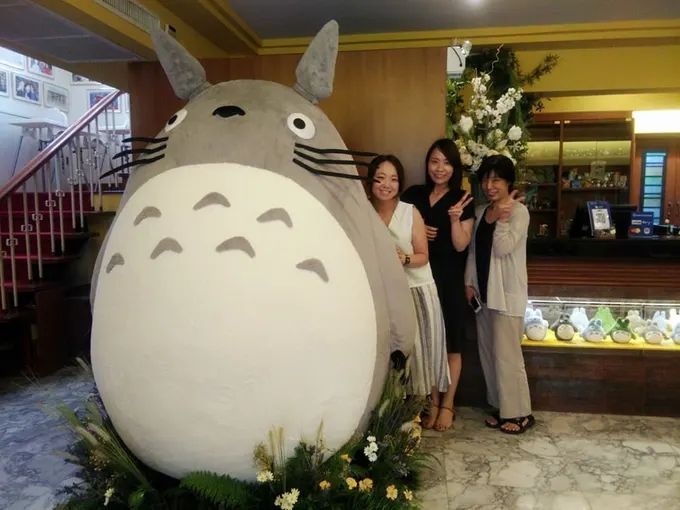
Suzuki, whose memoir of working at Ghibli carried the winning title Mixing Work with Pleasure, has been dishing out jobs to his Thai girlfriend Kanyada “May” Phatan. The two have allegedly been an item since she sold him some roadside chicken wings in 2013, after which Suzuki invested in her spa and restaurant. When those businesses went under, Suzuki steered Ghibli itself into authorising a Totoro café in Bangkok in 2018, May’s Garden House Restaurant, which shut down the following year just ahead of COVID.
Not to be deterred, Kanyada resurfaced as the mononymic photographer for The Ghibli Museum Story (2020), and for a book the same year of Toshio Suzuki quotations. She also writes a monthly poem for the Ghibli in-house magazine Neppu, and last month was feted at an Iwate exhibition of her photography, to tie in with a new, rather thin, compilation book.
In the era of Boris Johnson and Donald Trump, this barely moves the needle on the scandalometer. Some Ghibli staffers might bristle at the whiff of privilege, but it’s not like Suzuki hasn’t got form. He literally put a landscape gardener in charge of Tales from Earthsea because the guy was Hayao Miyazaki’s son. And nor is it all that unusual for people to get hired on the basis of personal connections, like that guy Roy Disney at Hoshino’s old company. Le Monde, of all places, fumed that Suzuki took the chance at the Iwate exhibition to “enjoy the hot springs with his girlfriend” which hardly seems like a crime.
If there’s any impropriety at work, it’ll be up to Hoshino’s replacement to clear it all up. That would be Toshio Suzuki, back as president after a 15-year absence.
Jonathan Clements is the author of Anime: A History. This article first appered in NEO #230, 2023.
To America, where a group of high-profile voice actors, many with a firm footprint in the anime world, have declared war on artificial intelligences. Or rather, artificial intelligence’s meat masters, noting that many actors performing “voice performance replication work are unaware of or do not fully understand their rights regarding employment contracts.”
Vocal Variants, a pressure group including Yuri Lowenthal, Stephanie Sheh and Matt Waterson, outlined a set of simple demands and stipulations. The group aims to inform companies and actors, chiefly to warn actors off inadvertently signing away all their rights to exclusivity in their own voices.
Any voice actor with a significant body of work inadvertently creates an audio bank of their voice. This is particularly true in the gaming world, where actors are often less reciting a script than delivering “barks” and soundbites. Sakura Wars even made a big deal out of its audio component, for which the Japanese voice actresses recorded themselves saying all 100 syllables in the language, thereby allowing the audio software to address the (Japanese) player by name, and, in theory, to say anything the computer wanted.
Give an AI enough material to play with, and it can generate dialogue as if the actor is saying it themselves. It was Steve Blum, the voice of Cowboy Bebop’s Spike Spiegel, who first poked his head above the Twitter parapet to ask who had the right to make him say things he never said. It started up a social media storm that led to the formation of Vocal Variants, and its statement that voice actors were entitled to safe storage of their voices, clear stipulation of what those voices might be used for, approval on the use of their voices to generate synthetic dialogue, and appropriate payment for use.
Stephanie Sheh noted on Twitter that although many of the AI apps agree to take down unsanctioned audio files, the actors are often obliged to police them themselves, and often don’t even know their voice has been uploaded unless they join each specific app service.
“As AI/Synthetic voice work now covers much uncharted territory,” says the Vocal Variants website, “it’s imperative that we collaborate to create and amend laws and contracts to protect both laymen and professional performers against deep fakes, improper use and exploitation of recorded performances.”
Jonathan Clements is the author of Anime: A History. This article originally appeared in NEO #229, 2023. Since its publication, Vocal Variants has become a division of the National Association of Voice Actors.
The distance from Puli to Hualien is 40 miles as the crow flies. You can drive it in just three hours, although, tellingly, today’s bus and train routes still take seven, edging all the way around the north of Taiwan, rather than making a beeline across the towering central mountains. But there was a time when it was a track unknown to all but a few aboriginal hunters, until one brave Japanese frontiersman, Katsusaburo Kondo, led a surveying party through the jungle.
That, at least, is what Kondo claimed, in a series of 1930s newspaper articles in which he chronicled his experiences among the tribesmen of the Taiwanese hinterland, a life-long association that led him to acquire the nickname “Kondo the Barbarian”. His memoirs have now been published by Camphor Press, a small publishing house that punches way above its weight in Taiwan Studies, responsible for much of the best and most original material in the field in recent years.
In October 1930 a group of Taiwanese Seediq tribesmen infiltrated the sports day at a Japanese-run high school and massacred over 130 Japanese, as well as two Chinese observers who had fatefully decided to cosplay in kimono. The “Musha Incident” became a touchstone of Japanese-aboriginal relations, and would lead to a brief colonial war that claimed hundreds of Seediq lives. The Musha Incident was a shock to the Japanese system, but has also been framed as a form of indigenous apocalypse, as the last generation of Seediq warriors, deprived of their traditional manhood rituals, went hunting for their colonial oppressors in a last, desperate attempt to merit the killers’ tattoos that would entitle them to join their ancestors in the afterlife.
Suppressed for decades under the Kuomintang government, the story of Musha sprang back into life in the 1990s, as the Taiwanese media gained increasing interest in indigenous issues. It was adapted into a comic by a native artist, which itself became a major source for the film Seediq Bale: Warriors of the Rainbow (2011, pictured), an epic action movie that reframed the story along the lines of Braveheart or the Native American “ghost dance” cult.
The Musha Incident, in fact, remains such a huge presence in reports of Taiwan under the Japanese that it still accounts for 10% of all the material published in Japanese relating to the fifty years of colonial rule. Paul Barclay’s new book digs down into one of the ur-texts that inform so many of these stories, the reminiscences of an unreliable narrator who tried to place himself at the centre of the story.
Katsusaburo Kondo is that most dangerous of conmen: an evocative and persuasive writer. He begins his story with the aftermath of the Musha school massacre, when he visits his estranged aboriginal stepdaughter, who confides to him the true reason for the war, before hanging herself in her prison cell. He then leaps back in time to tell the story of his relationship with Taiwan’s indigenous people, as an interpreter, explorer and trader.
In particular, Kondo is keen to insert himself into the narrative of the Fukahori Expedition, an ill-fated platoon murdered by head-hunters in the Taiwanese hinterland. He frames much of his subsequent adventures as a quest to avenge the lost soldiers, and to retrieve their bodies and possessions, finally striking it lucky when he stumbles across their skulls on display in a tribal longhouse. But as Barclay notes in his meticulous annotations, Kondo’s life-long claim that he, too, would have perished on the expedition were it not for a fortunate bout of malaria, was part of his ongoing attempt to appear far more involved than he really was.
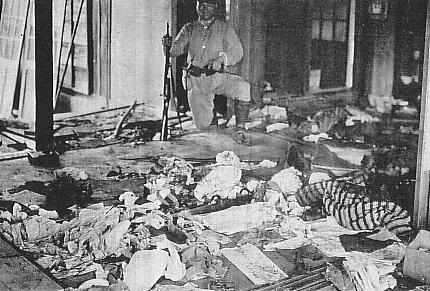
The scene of the Musha massacre, 1930.
“Despite… many inconsistencies, falsehoods and implausible claims,” observes Barclay, “Kondo’s writings wedged their way into discourse, by hook or by crook.” However, they are also loaded with tantalising and convincing glimpses of aboriginal culture, including a chilling account of the “guardian of heads” (the crone priestess who welcomes a new skull to the tribal shrine), and a charming anecdote in which an indigenous girl confides to Kondo that her people are “afraid of the Japanese people who tick-tock.”
It takes Kondo a while to realise that she is frightened of his pocket watch, which makes him, too, seem like an otherworldly creature bearing haunted devices. This is catnip to the historian in search of local colour, but Barclay is on hand to warn that it seems suspiciously close to another story told by one of Kondo’s associates, and was quite possibly something that he ripped off. In another part of the tale, he recounts a horrifying attack by several tribal youths, who decide to lynch him for his skull. He fights them off, but is so grievously wounded that he writes his will… except he is “fully healed” within two weeks. Well, which is it?
And yet, and yet, there are moments in Kondo’s story, translated here in full, that are truly illustrative of the stand-off between the aborigines and the Japanese, such as the sight of tribesmen going cap-in-hand to the local police station to plead for meagre parcels of gunpowder and a couple of bullets, merely so they can continue their livelihoods. Kondo tells tales of the Seediq hardening the soles of their feet by walking on hot iron rods, and of the strict lumber merchants whose insistence on unmarred timber is the cause of much misery among tribal log-carriers. Finding a corpse on their mountain mission, he asks his tribal companions if they want to eat it, and they look at him in horror – cannibalism being taboo among them, despite claims to the contrary made by the foreign media. These observations are so mundane, so everyday that they have to be true. Right?
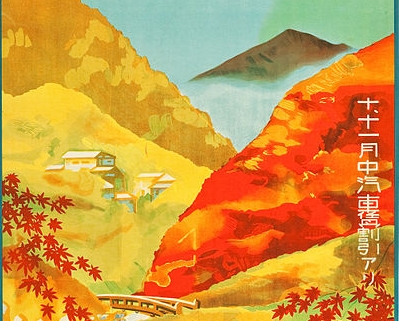
Taiwan as imagined in a 1930s Japanese tourist poster.
With Barclay as our guide, Kondo’s tall tales become an object lesson in text-critical analysis, as we get to grips with the lies he tells others, the lies he tells himself, and some of the truths that are still revealed. His account of his divorce from his common-law wife, in which he delivers a pig’s head and a keg of rice wine to her father, seems faithful to tribal traditions, although one wonders just how happy the former Mrs Kondo was with it – Kondo claims she waves him away with a laugh. Barclay even gently makes Kondo more relevant to modern historians, by redacting some of his hand-waving racist dismissals of everyone as “savages”, replacing his blanket descriptions with more exacting classification of tribes and sub-groups.
Sometimes, one thinks, the tribesmen have the last laugh. Kondo writes sneeringly of a moment on his expedition when he convinces his tribal companions that he has a magical amulet that will turn a single grain of rice into a full belly for each of them. “So simple-minded,” he scoffs when they appear to fall for it. And yet he also tuts in annoyance when they attempt to delay the mission by waiting for a new-born baby to grow up so that its mother is free to accompany them. Kondo decries this as a moment of savage sloth, but one wonders if the tribesmen weren’t concocting an excuse to delay the city boy’s dangerous mission for another season.
Resistance to the Japanese authorities was futile. Barclay has some winning data on the nature of colonial wars, pointing out that the Musha Incident was such an embarrassment to Tokyo that the soldiers who avenged it were handed the most desultory of medals and rewards. Even as the Hague Convention attempted to limit the savagery of modern warfare, colonial campaigns were somehow exempt, subjecting the Seediq to some of the very worst of modern weaponry, including aerial bombardment of their forest hideouts.
Kondo writes vividly of some of the attempts to get the aborigines to understand how pointless it was for them to fight back, with a tribal delegation brought to visit Japan itself to show them the power and might of the Land of the Rising Sun. Put aboard a train for the journey to Keelung, the Seediq scream in fear, protesting at the dizzying speed, pointing in terror at what appears to them to be “dancing trees” beside the tracks. It is a beautiful image, but Barclay points out that while Kondo’s early writings describe the aborigines as brave, hardy trackers and hunters, his later work transforms them into clueless, whiny man-children, reflecting Japan’s own drift towards imperial condescension. In Barclay’s hands, Kondo the Barbarian transforms from an account of the Taiwanese indigenous people to an even more revealing narrative about the Japanese who were writing about them.
“If you are a newbie to manga,” the authors write, “you can certainly find the perfect series to dive into.” And that’s certainly true – this is an excellent introduction to manga, especially for the curious teen.
Over at All the Anime, I review the new History of Modern Manga from Insight Editions.
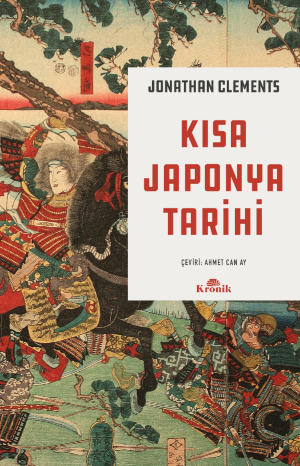
I see that the cover is up for the Turkish translation of my Brief History of Japan, out this month from Kronik in Istanbul.
“Yazar Clements, Japonya’nın dünü, bugünü ve yarını arasındaki bağlantıyı zekice ve nüktedanlıkla kuruyor ve geniş ama detaylı bir anlatıyla bu paradokslar ülkesini gözler önüne seriyor.”
[“Author Clements cleverly and wittily connects Japan’s past, present, and future, revealing this land of paradoxes in a broad but detailed narrative.”]