The Great Yokai War: Guardians

After a giant kaiju threaten to destroy Japan, the guardian spirits of the nation, known as ‘Yokai’ appear before the young boy Kei… They tell him he is the descendant of the legendary monster slayer Watanabe no Tsuna, and may be the only person who can stop the catastrophe. Great Yokai War Guardians is the epic manga adaptation of the hit movie!

Out today from Titan Manga, the first volume of Yusuke Watanabe and Sanami Suzuki’s manga based on the film, The Great Yokai War. The English script was translated by Motoko Tamamuro and I wrote a translator’s afterword in the hope of explaining some of the weirdness, but it was not included in the book, so here it is instead below:

A “night parade of one hundred demons” is a popular theme in Japanese folklore. There is a belief that supernatural beings march through the street at night and anyone who encounters them will perish if they do not have religious protection. Often, these beings are referred to as yokai, a name deriving ultimately from the first and last characters of the Chinese yao-mo-gui-guai (“phantoms-monsters-ghosts-apparitions”) – a catch-all title first used in the middle ages to refer to supernatural creatures.

There are two major schools of thoughts regarding the yokai. One is that they are all gods and those that have lost their respect and status have become regarded as demons. Another is that both yokai and gods have existed from the dawn of time, but that those that gain worshippers are upgraded as gods.

The centrepiece of the first volume of Sanami Suzuki’s manga Great Yokai War: Guardians is not a scene of apocalyptic urban destruction, but a grand conference of all the world’s apparitions, spirits and supernatural beings, playfully and punningly named with a combination of the terms yami (shadow) and summit – a Yammit. At this Shadow Council, we see a who’s-who of monsters, including a Gorgon, Dracula and Cyclops, familiar to Western readers.

But who is Backbeard? Is he some sort of piratic misprint? An eye in the middle of a dark circle, from which a bunch of tentacle-like limbs branch out, he is, in fact, a Japanese creation, first appearing in a 1965 manga by Yukihiko Kitagawa and Yoshio Okazaki. By 1966, he had been co-opted by Shigeru Mizuki’s Spooky Ooky Kitaro in Shonen Magazine, now introduced as the commander-in-chief of all American monsters. Often an adversary – he makes several attempts to invade Japan in the course of Mizuki’s stories – he appears here as a craven foreign dignitary, trying to make a swift buck on the back of Japan’s latest media obsession with the supernatural.

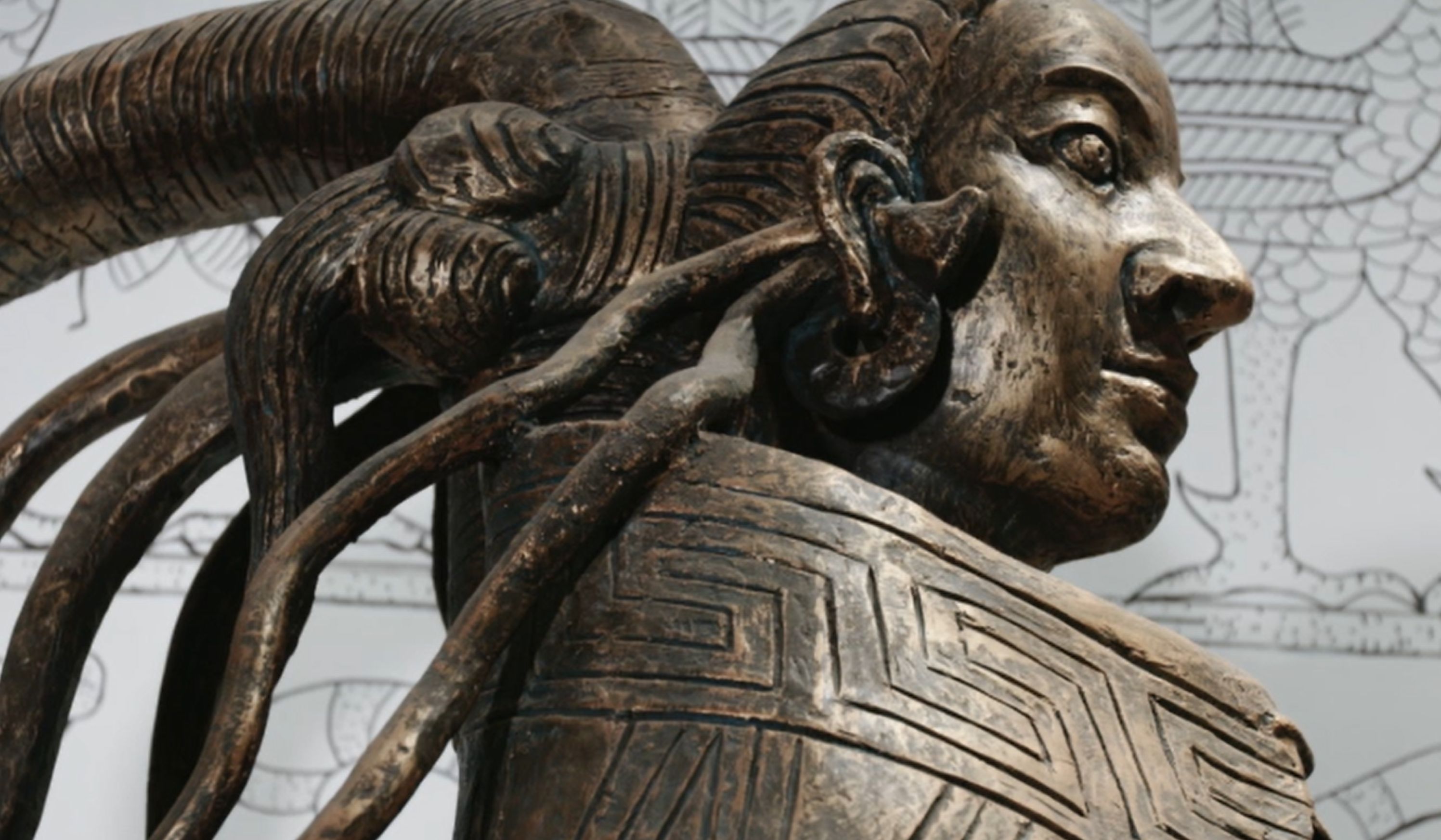
Backbeard in fact, was supposedly killed off in an early issue of the Kitaro manga, but kept returning because Mizuki found his unique appearance so compelling. He is immortalised today in one of the bronze plaques that decorate Mizuki’s home town of Sakaiminato, a permanent addition to Japan’s own mythology of monsters.

Shigeru Mizuki (1922-2015) is a crucial figure in the history of Japanese ghosts and monsters, not only cataloguing folktales from all around Japan, but inventing many of them himself. His works have become so ingrained in the Japanese psyche that one often has to go to his own publications, such as the magisterial Compendium of Japanese Yokai (1994) to work out which ones are his, and which ones belong to the nation.

It’s through the works of Mizuki that Japanese children often first encounter Nurarihyon, the old man who invites himself into your home and takes charge; Yuki-onna, the temptress who waits in the snows to entice passing travellers; the one-eyed, one-legged Ippon-datara that trample-hops onto people on one day of the year; or the zashiki-warashi urchins that haunt storage spaces. Here, we see them all banding together at a peace summit… sorry, yammit, in order to discuss a terrible tectonic event.

The silly humans think it’s just a natural disaster, but it’s really a mass haunting, of all the sea creatures who died during the forming of Japan millions of years ago. In the wake of the Tohoku earthquake of 2011, it is one of many media allusions to Japan’s modern traumas, leavened with a grand monster party, and a pre-teen hero who can save the day.

In an early scene, we see the young boys getting a fortune from a temple kiosk. Omikuji or fortune telling is common in Japanese temples and shrines. Worshippers draw a stick with a number on it and then open a drawer to find the paper with that number on it. In this manga, they draw a stick with the unlikely number 8 million (八百万). Traditionally the Japanese believe a god resides in everything and the expression ‘8 million gods’ means a myriad of various gods that exist in this world. What it signifies in this scene is that the protagonist ‘wins’ all the gods, but as far as he is concerned, all he is getting is the short end of the stick.

Grand Yokai War: Guardians ran in Shonen Ace magazine in December 2020, a few months ahead of the 2021 release of the film of the same name, itself a sequel to a 2005 movie that was based on a novel by Hiroshi Aramata, itself inspired by the multiple monster works of the 1960s. By this point, it is impossible to work out who came up with what, although the Daiei-Kadokawa conglomerate did its best by roping in as many creators as possible as producers. Sanami Suzuki’s manga retains the central motif of a young Japanese boy who discovers that he is the distant descendant of Watanabe no Tsuna (953-1025), the medieval samurai who wielded a sword with the ominous name Onikirimaru (the Demon Slayer).

The manga alludes to a popular legend that modern-day Watanabe family members do not take part in the Setsubun cleansing festival, in which each February Japanese households cast beans into the air to banish demons. Watanabes, it is said, have no fear of demons entering their houses, and need not bother, although tellingly, this story appears only to have arisen in the last few years. Could this, too, be a modern media myth, already sinking into the common ownership of Japanese folklore…?

The Translators

Suits You

“I can make you look taller,” says Tarzan. “I can make you look thinner.”

“Can you make me look more fun?” I ask.

“Almost certainly,” he says, pretending not to notice my Marks & Spencer’s trousers.

He is already leafing through samples of cloth discarding the plaids and herring-bones that would create a distracting moiré effect on camera. He sketches out a plan for a three-piece suit, with peak collars to draw the eye, and a ticket pocket to… keep a ticket in. When I can’t make up my mind between cufflinks and buttons on the shirt, he offers to do both, like I have become an international plug adapter for wrists.

“You can have a little JC monogram,” he adds, “and I think some cream edging on the buttonholes. Thick buttons. Do you want thick buttons?”

“I don’t know,” I say. “Do I?”

“Yes,” says Tarzan. “Now what about the lining?”

“Something Chinesey would be nice,” I say.

“You mean like dragons or something?”

“Yes. Can you do that?”

“I can do anything you want. You’re in charge.” He hands me a scrapbook of wacky silk linings, including the Bitcoin logo, skulls and crossbones, the poster for The Godfather, and some dragons.

“Oh yes,” I say. “Those.”

“You like them now,” says Tarzan. “But will you still feel that way in a few weeks?”

He’s right, the dragons are a bit naff. I keep poking around in the book until I see a pattern called “Queen of Dragons”, which is actually a series of repeating phoenix designs, gold on black.

“Thatsh the one,” I say, slurring a bit, because Sam’s Tailor, on Hong Kong’s Nathan Road, also make their own signature beer, and it’s a terrifying imperial IPA with 8.8% ABV. I’ve had three cans while Tarzan is talking through the design, and now I can’t feel my legs.

The first-generation founder, Sam Melwani, arrived in Hong Kong in 1952, and worked for another tailor before going it alone in 1957. By the end of the decade, his son Sham tells me, he had cornered the lucrative market in uniforms for the servicemen of the colonial administration. Which explains why the form I am filling in includes a space for my rank. Sham and his brother Manu can still be found lurking on the premises – it’s Manu who hands me what might have been my fourth beer, but by that point I had lost the ability to count. But it’s Manu’s son Roshan who is the modern face of the family business, rocking a waistcoat design that Tarzan has already sold me as “boss-style” (I realise now that he meant his boss), and with a clash of vibrant patterns on a shirt that has elbow patches just to show off.

“We get staff discounts on fabrics,” says Tarzan with a shrug. “We try stuff out.”

“Covid was a disaster for us,” says Roshan. “It used to be there was a queue going out the door. We were so busy. But then we had month after month where nobody was coming.”

I ask about the regulars. Because one of the delights of Sam’s is that they now have all my details on file, and I can literally send a WhatsApp message asking for a two-piece safari suit in Marimekko camo pattern with a purple paisley party shirt, and they will post it to me three days later, possibly just before they call the fashion police.

“Yeah,” says Roshan thoughtfully. “But everybody spent a year indoors. Nobody needed a suit.” Even so, he pursued them on social media. One of the reasons I can reach out to Roshan at seven thousand miles distance is that he has spent the last couple of years perfecting online consultations. If I do ask for that Marimekko safari suit next week, he’ll be there on a digicam trying to discreetly talk me out of it and save me from myself. But if I insist, he will do what I want and let me endure the ridicule.

And business hasn’t picked up?

“Maybe only twenty, thirty per cent of what it was,” says Sham.

Which makes me wonder what chaos there must have been pre-Covid, because when I come back a mere five hours later for my first fitting, the shop is heaving. There’s a picky Frenchman who isn’t sure he wants a suit at all (testing even Roshan’s patience), and a thick-necked man with a crew-cut who seems likely to be a holdover from the military days; a repeat customer dropping in to pick up something new and he’s arrived with three friends of his who all want suits of their own. They’ve never had a tailor before. I’m a bit surprised I got through the first five decades of my life without one myself.

In the last five hours, a Nanjing-born tailor called Mr Zhang has run up the first draft of my suit, and now he wants to stick pins in me to make sure that the cuffs show just enough shirt.

“Can you tell him to stand up straighter,” he mumbles at Manu.

“Tell him yourself,” laughs Manu in perfect Cantonese, “he speaks Mandarin.”

“No, he doesn’t,” says Mr Zhang.

“Yes, I blimmin’ do,” I say in Chinese, and we’re off, with Mr Zhang interrogating me thorough a mouthful of pins about how I could have possibly ended up in Xi’an, and what kind of temperatures I had at home, as that was going to affect the way the suit was built.

“I doubt very much,” I say, “I will ever have a chance to wear this suit at home. It’s probably only going to get outings in Scotland and on telly.”

“Ah yes,” says Tarzan. “The other shirts!” He is intrigued about the mechanics of shooting a television series, and his eyes light up at the thought of a schedule so punishing that I need up to five duplicate shirts for continuity purposes. One on; one off; one in the wash; one supposed to be in the wash but actually held hostage by a chamber maid in Gansu; and one irredeemably spattered with mud from a tribal fish-throwing ritual. I learned my lesson after my first big National Geographic job, where the shirt I wore on day one had to be worn again on days two, three and four, and never quite recovered. And on the Confucius shoot in Shandong, my biggest problem was our sound-man’s lavalier microphone glue, which ruined several mercifully cheap shirts as well as a few sizeable clumps of my chest hair.

I bring Tarzan one of my current crop of shooting shirts, and he sets about it with professional precision, tutting at the sleeves and scowling at the edging, and telling me that a shirt worn tucked out needs to have a certain kind of pointy thing. Tarzan knows his stuff, and if I let him steer me, it will look like I do, and that is surely the nature of good tailoring.

I walked into Sam’s on Wednesday morning. My suit is ready by the Saturday. When I walk back into the office, there is a small crowd admiring it as if it is a painting on the wall.

“I love the gauntlet cuffs,” says one man to me. I mutter something about not knowing what they are but… ooh, that’s what they are. Tarzan insists on putting the waistcoat and jacket on me himself, in order to demonstrate his dual cufflink/buttoned cuffs, the secret band that holds the suit in place, and the way to adjust the waistcoat shape.

The finished item comes complete with carefully stitched piping, a little pen pocket, and the Queen of Dragons motif repeated throughout. The shirts have my initials on the cuffs, and the act of putting them on feels strangely familiar… as if they had been made for me… which they were.

I am similarly happy with the sample shirt for on-camera appearances, and approve two more duplicates on the spot. Tarzan asks Tony the shirt-maker if he can turn them around before I leave tomorrow, and Tony tells him it’s too much of a faff — so they will just send them to me at home. Now I know I can just ask for whatever I want, and they can just make it happen, I fear they may have created a monster.

What if, I ask Tarzan, I come back with my wife? Can they fit her out with whatever she wants?

“Yes, we can,” says Tarzan. “But we can’t turn it around as fast as your suit. Women’s clothes can take one to two weeks. There’s more…. variables.”

Jonathan Clements is the author of A Brief History of China and Rebel Island: The Incredible History of Taiwan.

Nine Dragons

It was an eight-year-old boy, in March 1278, who gave the name to what was then the forested, hilly lands to the north of Hong Kong island. He counted eight hills – today’s Lion Rock, Tate’s Cairn, Unicorn Ridge, Beacon Hill, Crow’s Nest and so on, which today separate the urban coast from the New Territories. There are, he said, eight dragons.

No, said one of the men with him. There are nine. Because the boy was the 17th emperor of the Song dynasty, on the run from the invading Mongols. For as long as his dwindling naval forces kept heading south, for as long as he evaded capture, there was still a Song dynasty, and he was still its emperor. And so nine dragons it was Jiulong, or as pronunciation would have it in these days, and probably in those: Kowloon.

The boy Zhao Shi didn’t live long afterwards, dying of an illness on the run. Even then, he was the commander of a fleet of stolen boats, requisitioned with extreme prejudice from an angry Muslim merchant in Quanzhou, who would take his revenge by embracing the Mongol cause soon after. He was never quite the same after his boat capsized in a storm outside Leizhou, and even his presence in the area of what today is called Hong Kong was a feeble attempt at recuperation for the dying leader of a dying regime, mourning his drowned sister and his lost empire.

His even littler brother would be the last emperor of the Song, famously dragged beneath the waves by his suicidal courtiers as the fleet collapsed at the Battle of Yamen.

There was a monument in Hong Kong to the presence of the ninth dragon, at what came to be known as his Sacred Hill (sheng shan) – a hundred foot slab of rock, carved with the words Terrace of the Song King (song wang tai). This has made it into Cantonese as Sung Wong Toi – seemingly a deliberate move after the Mongol takeover to describe him as a lowlier royal, as calling him an emperor would have invalidated the mandate of the new rulers. The words for emperor and king are homophones in Cantonese, so possibly the people from the north didn’t realise they were being trolled. Under the British administration, placenames in the area were bullishly renamed Terrace of the Song Emperor, although this made no difference to the locals – see above re: pronunciation. It means that the actual slab has “king” written on it, but the station you get off at to look at it has “emperor”.

The boulder lasted until the 1940s, when the Japanese dynamited it to make extra space for the Kai Tak airfield. In 1945, the bit of the rockface that bore its name was relocated to a little area of parkland nearby. Today, the airfield has gone as well, and it is a sad little park in the middle of a busy road intersection, the air ripe with the stench of the nearby sewage works. But one of the last of the Song once took shelter here beneath a towering rock, and counted dragons in the hills.

One of his generals and guardians is memorialised a few stops along the metro, at the Che Kung Temple, remembered less for his doomed defence of the boy emperor, and more for scuttlebutt that associated him with the dispelling of plagues, for which he was deified in the Ming dynasty. Visitors to his temple are encouraged to spin ceremonial windmills and beat a ceremonial drum. No plague here today, so presumably it is working.

Jonathan Clements is the author of A Brief History of China.

Slow Boat

Taierzhuang is a charming “old town”, full of little bridges and temples in alleys. It’s new, of course. Most of it dates from 2008, but it is a faithful reconstruction of the town that previously existed on this spot, which was torn apart in 1938 in a famous battle with the Japanese army. It sat in ruins until the 21st century, and then got toshed up. “I like it,” I tell the camera as I walk through the streets, “because the reconstruction isn’t just about the buildings. This place also seems to reconstruct the visitors. Everybody is encouraged to leave in peace and harmony, and to indulge in traditional pursuits…, it’s the sort of place that Confucius would have loved.”

It won’t last, of course. I give it five years before the leases run out on the classier places, and they transform into mobile phone franchises and plastic machine-gun shops. There are already three bongo stores, which is my litmus test for the decline of civilisation. But for now, it is lovely, and so are the boatwomen.

Xu Zhenzhen is a graceful lady in a blue cheongsam, who sculls a gondola through the nearby canals, singing songs about the neighbourhood and delivering a constant tour-guide patter. I spend most of the day being squired through the canals with a film crew in the boat, then again along the same course with the crew chasing me in another boat, then again with a drone following us under the arches of the nearby bridges. She shows me how to flip the big oar back and forth, and sings a song about the wonders of Beautiful Taierzhuang.

The lyrics seem a little too simple to me, devoid of classical allusions and tonal assonance, leaning too heavily on rather simple concepts like “beauty”. It smells way too modern for me, and so I ask if it is an old song.

Oh yes, she says, it dates all the way back to 2005.

“I’ll stop you there,” says Frances the producer, literally rocking the boat. “National Geographic will need to clear the rights on any song that isn’t in the public domain. Something knocked up by the marketing department isn’t going to cut it.”

Xu protests that other film crews have recorded her singing without complaint, but other film crews aren’t planning on broadcasting outside China. She will have to sing something else.

I am very careful not to address her as a “sing-song girl”, which carries with it implications of Qing dynasty prostitution. The Girlfriend Experience in the 18th century would involve buying a night on a boat with a girl, who would punt you around for a while, cook you dinner, sing you some songs and then climb into bed with you, all on the boat. I carefully address her as Teacher Xu, using the same levels of honorific that I have used with all the middle-aged men who have formed most of the interviewee population on this shoot. Jonathan and I have already been debating the gender balance among our interviewees, and there is a degree of pressure on Xu to supply a bit of femininity among all the blokes. She’ll appear quite early in the show, which is handy, and she has plenty to say about her town.

I ask her if any tourists fall in the water.

“Not this year,” she replies. “We had a couple of drunks fall in last year, though, so we’ve actually put an underwater deck in the harbour. The canals are two metres deep over most of the town, but if you fall in near the dockside, the water’s actually barely deep enough for the boats.”

It’s time to record the opening words of the documentary, which we get in record time because Taierzhuang in the daytime is so sparsely populated, and I am the man who can recite pertinent passages of The Analects from memory. There are no distractions as I walk along the canal side and say: “Confucius said: ‘It is a pleasure to learn, and to put your knowledge to good use. It is a joy to welcome friends from afar.’ Well, I’ve come from afar, and I want to learn. I want to find out what’s so special about his homeland, the north-east province of Shandong, and how it has shaped the culture and history of the whole of China.” It’s the big opening for the whole show, and we shoot it so fast that the director gets whiplash.

Pieces to camera are not so much written as devised. Jonathan the director and I wander around the streets brainstorming what needs to be in them, and I supply a quote or an observation that might justify my particular presence. Then he argues about how it ought to sound, and whether it is too NHK (“Let’s have a look, shall we…”), or too ITV “CHINA! A LAND OF CONTRASTS…”).

It was Jonathan who put the full stop after “want to learn”, to create a momentary lull to be filled with “I want to find out…”

“It’s good to have a caesura there,” he says. “And wonderful to have a presenter who knows what a caesura is when I ask for one.”

Tomorrow is the last scheduled day of shooting, and the Chinese director will be leaving early, so tonight is a wrap party of sorts. There is lots of toasting and many proclamations of friendship. The Chinese director apologises repeatedly for shouting so much. Little Fish the sound guy apologises for ripping out all my chest hairs every time he has to adjust the microphone, and I make everyone laugh by telling him they are my gift to him. Bumfeely the grip gets so drunk he can hardly stand, and there are multiple toasts from Chunky the A cameraman, Specs the B cameraman, Baldyhat the grip, and a bunch of crewmembers as yet unassigned nicknames. Because the two foreign men on the production are both called Jonathan, I am constantly addressed hectoringly as “CLEMENTS!” as if I am still at school.

I am pleased. I have not troubled anyone by being crap. I have hit my marks and rarely fluffed my lines. Having two cameramen reduces the number of pick-ups, because they can shoot a wide and a close-up on the same take, so if I get my lines right, we can be done in mere minutes, even if it takes them an hour to rig the lights. So here’s hoping that the producer gets what she wants, and that this Shandong travelogue turns out to be a backdoor pilot for an entire series on China. If it is, then there should be other provinces for me to explore.

Jonathan Clements is the author of Confucius: A Biography. These events occurred during the filming of Shandong: Land of Confucius (2018).

This Great Stage of Fools

“At the time of his death in 1993, Booth was already famous for having written one of the best-ever books about travelling in Japan, The Roads to Sata (1985)… With a degree of nerdish delight, I discovered that This Great Stage of Fools has an entire section of anime reviews, with Booth according the creators of the 1970s and 1980s a degree of respect that he refused to grant the purveyors of V-cinema.”

Over at All the Anime, I write up a posthumous collection of journalism by Alan Booth.

Beautiful Regina of Kaivopuisto (1941)

1853/4: Regina Berg (Regina Linnanheimo) is an orphaned fisherman’s daughter who lives in Kaivopuisto, once nothing more than a pokey workman’s village, now the lynchpin of aristocratic Helsinki, a massive swathe of seaside parkland ringed by new villas and mansions. As a sometime delivery girl and flower seller, she is thrown into the lives of the nobles, specifically the entourage of the Russian princess Kristina Popoff (a welcome return from Ester Toivonen, absent from the screen since 1940’s Tenant Farmer’s Girl), who descends each summer on the “Finnish Riviera” to escape from St Petersburg. Regina is a hit with the serving girls at the manor, one of whom even shows her around the areas above-stairs.

In a twist knowingly redolent of Cinderella, Regina purloins some of Kristina’s clothes in order to sneak into a ball at her mansion, where she flirts with Kristina’s cousin Engelbert (Tauno Palo), a member of the Chevalier Guard, winning his affections and losing a golden shoe as she flees the venue. The mystery is swiftly solved after Kristina interrogates the servants, but Engelbert refuses to return the shoe unless its wearer comes to see him in person. He waits for three nights on the coast, and although Regina eventually arrives, she in turn refuses to accept any gifts from him unless he has honourable intentions.

After Engelbert tries to grab her, Regina returns home without her dress, leading her own family to suspect the worst and forbid her from any further dealings with the aristocrats. Engelbert’s lieutenant Ontrei (Unto Salminen), who helped Kristina escape from his clutches, takes the opportunity to confess his own feelings for her, and after spectacularly failing to read the room, offers to set her up as his own mistress in a Karelian love-nest.

On the eve of the Crimean War, Engelbert apologises for his crass behaviour and woos Regina for real, and the uncomplaining Ontrei drives them both to a nearby chapel, where Engelbert presents her with a wedding ring as a sign of his true love. He even suggests eloping to Stockholm, but Regina continues to refuse to do anything untoward. Engelbert heads off to war, and Kristina takes Regina under her wing, arranging for her to learn the manners and customs of the aristocracy. She even throws a Christmas ball to take Regina mind off her absent betrothed, and we see Regina dreaming wistfully of a dance with Engelbert…

…who turns out to have been killed in the Crimea, as remembered by an aged Kristina, now an old woman sitting by his graveside.

The story derived from the novel Kaivopuisto’s Beautiful Elsa (Kaivopuisto kaunis Elsa, 1936), written under the pseudonym of Tuulikki Kallio by Kaarina Kaarna, the wife of the artist, writer and sometime director Kalle Kaarna. Resolutely hanging onto her anonymity through a mail-drop in Tornio, Kaarna had offered the film to both Suomen Filmiteollisuus and its rival studio Suomi Filmi – Risto Orkko at the latter rejecting the deal on the grounds that filming an epic period drama in modern Helsinki would be prohibitively expensive.

No such qualms bothered Toivo Särkkä at Suomen Filmiteollisuus, who enthusiastically shot location work in the real-world Kaivopuisto, where even today a judiciously placed camera and a bit of concealing foliage can create a reasonable evocation of the 19th century. Actor Tauno Palo reported standing in Kaivopuisto, dressed in the uniform of one of the Tsar’s elite Chevalier Guards, only to find himself face-to-face with Gustaf Mannerheim, commander in chief of the Finnish armed forces. Mannerheim had himself been a Chevalier Guard in his youth, and regarded Palo quizzically, as if encountering a ghost from the past. Perhaps he had noticed that Palo’s costume neglected the historically accurate chamois leather pants of a Guard, which famously were so tight that they had be dragged on wet.

Filmed in the dying days of the summer of 1940, the story was renamed to reflect the big-name casting of Linnanheimo as the star – a rebranding so powerful as to lead to later editions of the book to be similarly altered. This blog has often asserted its disbelief that Linnanheimo was a star at all – to modern eyes, she often comes across as out-of-place as her contemporary Gracie Fields – but in the dour 1940s, ironically, she had finally learned how to smile.

Writer-director Toivo Särkkä was responsible for the shock ending, which deliberately disrupted the happy betrothal that closed the original with a bitter twist that only endeared the film even more to audiences reeling from the Winter War. The film is also fascinating for its treatment of sexual assault – not unlike the fierce Russian brute in The Great Wrath (1939), Engelbert assumes that Regina is his for the taking, that his interest in her is enough to justify her acquiescence. It’s something of a shock when he starts grabbing at her, and the camera lingers deliberately on her distress and denial, until her clothes come off and she (actually her body double) flees naked up the stairs. True to its setting, the film remains non-judgmental of Engelbert’s double standards, celebrating his ability to finally remember his manners, rather than damning him for not having any in the first place. Possibly, there is a nuance I haven’t noticed – that Engelbert has been somehow corrupted by Russian ways in St Petersburg, and needs to be reminded by a Finn of how a lady should be treated?

The film was the second-biggest box office hit of the year (beaten only by The Vagabond’s Waltz), the first Finnish movie to be exhibited at the Venice Film Festival, and exported to several other countries. Paula Talaskivi, in the Helsingin Sanomat, articulated what everybody else was thinking, that the number-one film had been so entertaining that its thematic follow-up could only be a disappointment, and that despite the largesse lavished on grand set pieces, the realistically verbose 1850s dialogue was wearing after a while. Toini Aaltonen in Suomen Sosialidemokraati agreed, noting that while it was okay on the surface, it was “half-hearted and naïve” in its inner soul. “But the saddest thing,” he wrote, “is the infinite, unrelenting cuteness of this movie story, which towards the end begins to be downright boring. After watching it, you definitely have the desire to bite on something salty.”

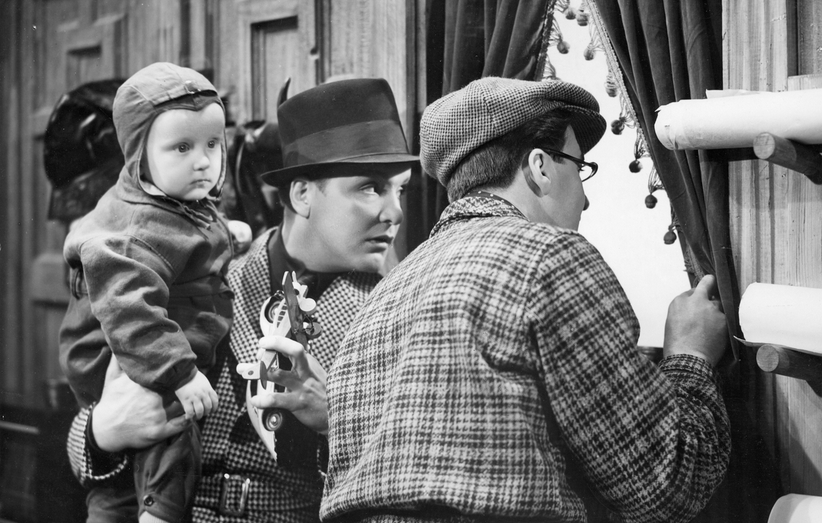
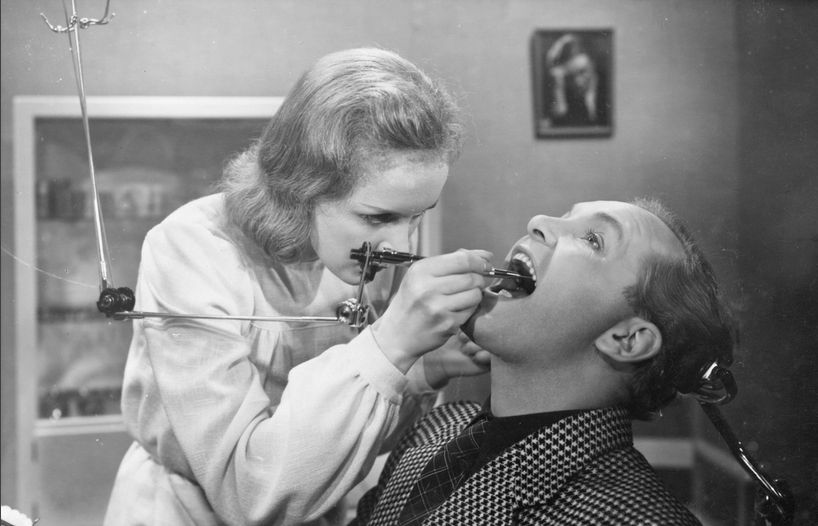
The critics have a point, but the ending stabs like a knife as it segues from the opulent dance sequence into the lone sight of Regina in the graveyard – the picture I share here is taken from an angle to the side of the filming, not the one which had Engelbert’s name added to the front of the tomb. It prefigures a similar juxtaposition of abundance and loss at the end of Alexander Sokurov’s The Russian Ark (2002), an entire world destroyed in the first half of the twentieth century, and surely all too real and raw for many in the 1941 audience. Sure, the film is twee and the story is ludicrous, but Särkkä’s final sequence hammers home the way in which war is the death of romance.

Jonathan Clements is the author of A Short History of Finland. He is watching all the Finnish films, so you don’t have to.

Charmingly Moist

I don’t know what day it is. Last time I looked, it was Sunday, and now it isn’t. We are only a couple of days away from wrapping, but we have some tough things ahead, mainly in story terms as we try to work out where to fit them. Today is one such question mark, as we are obliged to somehow fill five minutes of screen time with a piece on Heze, a town known only for its peonies.

In the time of Confucius, this was the state of Cao, where Confucius had a run-in with local temple heavies who mistook him for a vagrant. But there’s nowhere really appropriate to talk about that, so we are standing in Zhao Xinyong’s shed. He grows flowers there. Then he sells them… it’s hardly fun TV.

“Do you do… anything else?” asks the director warily.

Mr Zhao explains that he plants the peony flowers, then they grow in the greenhouse… and then ten years later they turn out different or the same. Luckily, there is a statue on the grounds of the Peony Fairies from an old folk tale, so I am able to walk around explaining that the first two varieties of peony were born from the unexpected union of two fairies and two brothers from Luoyang. Mr Zhao explains to me how nervous he was when the government assessors turned up after a ten-year wait, and told him that he had indeed created a dozen new varieties of peony.

With time to fill – we need to somehow spend five minutes of the show in this city – we head down to the local business centre, where I ransack a display of peony-related products while making sarcastic comments to the camera.

“Ooh, peony tea, good for the prostate. Ooh, peony toothpaste, for people with flowery teeth. Here’s some peony morpholift emulsion. I’m often told that my morphs need lifting, so I will get some of that.”

I end up examining peony-based face masks, and deciding that the one that is “charmingly moist” is probably the best for me. It’ll do. Honour is served; we’ve managed to make a silk purse of the sow’s ear that is Heze, and it should be on to the next destination. Except we are delayed for thirty minutes while the Chinese director has a massive row with Jiuqing the producer in front of the whole crew, which ends with him yelling at her: “I don’t care what van you ride in. You can ride with the gear if you don’t hurry up.”

The problem, as best I can work out, is that we need to be in Taierzhuang tomorrow to film the sing-song girl. Ideally, we should be somewhere else doing something about Chinese opera, but the opera singer is only available the day after tomorrow, so we will have to drive for four hours to get there, and then two hours back the following day. It seems like such a minor issue, but we are only a couple of days away from finishing the shoot, and nerves are fraying.

Partly, this is my fault. The crew are shooting such a punishing schedule because I am only available for two weeks. This places huge pressure on Jiuqing to get everyone moved around the province in time, and it will mean we are further away from the bullet train station on the last day than we really ought to be. Telling Jiuqing to ride with the gear means she will have to spend four hours with the grips, also known as the Garlic Boys because they walk around with a sack of raw garlic to insulate their stomachs against dodgy food. You can imagine how they smell, or perhaps you can’t.

Nobody is impressed. Confucius said: “When you are poor, it is often hard to keep a smiling face. But when you are rich, it costs nothing to be polite.” Which is pretty much how I feel about the director. He will go on to apologise profusely over the next two days for being such an arse, but there was no real reason for him to shout so much at Jiuqing after she has put in so much hard work.

We reach the next location minutes after midnight. It seems to be a charming old town, festooned with red lanterns. But we are all too tired to look around us.

Jonathan Clements is the author of Confucius: A Biography. These events occurred during the filming of Shandong: Land of Confucius (2018).

The Paper Chase

Here’s a stealthy bit of data that sneaked out recently – from the 20th June, Amazon announced an increase in printing prices for most of its print-on-demand books, offering authors the choice between upping their cover prices or taking the hit in their royalties. Amazon was reacting to ever-climbing prices of making books, as printworks shut down, logistics firms increase transport prices, and the cost of paper goes ever up.

It’s not just tomatoes and whatnot affected by covid constrictions and Ukrainian upsets. These increased costs are impacting everything that gets printed, and that includes DVD sleeves and collectors’ booklets. Particularly in the UK, where including an on-disc video extra like a commentary or Making-Of incurs punitive extra certification costs, collectors’ booklets have formed an important niche within bonus materials. That’s where you get the interview with the director; the storyboards; the Easter eggs. But I already hear whispers of companies cutting back on the size of their bonus booklets, or even giving up on them altogether.

Meanwhile, this year’s Annecy animation festival in France tried to make light of the absence of a print brochure. The Annecy brochure used to be a handy souvenir item, but this year it was taken online, supposedly for the convenience of punters, but actually to avoid paying 40% more for initiation costs.

Two of my most recent books were written under the radar, so to speak, given away as bonus extras as part of Blu-ray boxes. Some of you, I hope, were super-pleased to discover that your copy of Momotaro Sacred Sailors came with my 120-page book about its director – one of a tiny handful of full-length anime director biographies to be found in English. Others hopefully enjoyed the chance to read Future Boy Conan: Miyazaki’s Directorial Debut, a chunky 88-page monograph co-authored with NEO’s Andrew Osmond. Ironically, although such items were intended to add value to Blu-ray releases, they often went unmentioned (and unseen) by reviewers who stuck to describing the contents of the discs themselves.

Such scrimping worries me, of course, because I’m often paid to write the text that appears in these booklets. Hand-on-heart, some of my best writing in recent years has turned up in places like Arrow’s Shawscope box set, where punters might only encounter it when idly flipping through the extras. But if we’re on a slippery slope towards no extras, then we also risk a world where there’s nothing collectible at all to which a “collector’s edition” can be attached. In that case, all we have left is bare-bones releases, which itself is a drift towards no physical media at all.

Jonathan Clements is the author of Anime: A History. This article first appeared in NEO #233, 2023.

The Japan Lights

“He likens his writing on Brunton to kintsugi – that Japanese art of taking broken pottery and repairing it with flashes of alluring gold.”

Over at All the Anime, I write up Iain Maloney’s The Japan Lights, in which he travels in the footsteps of the Scot who built two dozen lighthouses in Meiji-era Japan.

Smiley’s People

Duan Yanping is waiting at the gate and smiling like a loon. He smiles all the time. I never see him not-smiling, although sometimes he crinkles up his face even more until his eyes are scrunched into little dots. He is the principal of an exclusive private school in Qufu, home town of Confucius, which purports to raise children in the Confucian way. The boarders are as young as five, and I watch them stopping to bow to their teachers as they walk across the playground. Since the teachers are arriving for the day, there’s a whole string of them across the courtyard, and for anyone, child or adult, to get across the open space takes a quarter of an hour, since they keep stopping and bowing at one another.

Today we are here for the Opening Brush ceremony, in which a bunch of six year olds will have red dots painted on their foreheads and then commence a series of “Confucian” rituals to mark the beginning of their education. We’ll see about that, as I say to camera: “I’m curious to see how many of these rituals will turn out to come from later dynasties.”

Most of them, as it turns out. The ceremonial presentation of tea to one’s teachers is all very well, but there was no tea in China in the time of Confucius. Nor were there robes in the style demonstrated by the pupils and teachers, all of whom are attired in the fashion of the Song dynasty. Pupils are presented with a pair of dates each as a symbol of the 00 that goes after a person (1) in order to make the top exam mark, but the very nature of this requires Arabic numerals, which didn’t arrive in China until a thousand years after Confucius.

The children are still children. After being exhorted to write their first symbolic character, ren or person, the kids are asked to hold up their papers (paper, also not around in the time of Confucius). The fat kid at the back has got bored and drawn two persons, and then half a wall around them, thereby turning his character into something different. I look up along the long line of diligent students holding up their papers and see: person, person, person, person… MEAT.

The kids plainly love Mr Duan. His constant smiling even puts me at ease, and the only time I see him stern is when he reminds Jiuqing the producer not to bugger about too long changing batteries, because she is effectively asking a bunch of six-year-olds to stand still behind their desks for an hour, while the crew huddle outside in the corridor staring at their monitors.

I ask Mr Duan what he thinks Confucius would make of the ceremony, and he crinkles his face and tells me that he would be most chuffed. I am not so sure. The younger Confucius, certainly, would have been aghast at so many anachronisms and what, to him, would be regarded as foreign customs. The older, wiser Confucius would have appreciated the effort, but still scandalised at the sight of himself worshipped as a sage, and women in the role of teachers. But I decide not to press Mr Duan too much on that point, because he seems so nice. His school teaches the kids all about The Analects, but also a bunch of musical instruments, the Chinese tea ceremony, meditation (which Confucius abhorred), and a number of other subjects which seem to come under a catch-all sense of Chinese classiness. Send your kid to Mr Duan’s school, and he or she will be spat out the other end able to offer a welcome whiff of refinement to any large Chinese gathering, which is likely to otherwise comprise pig farmers playing with their phones.

Confucius’s grave is empty. In fact, nobody knows where Confucius’s actual burial site was. In the Han dynasty, 500 years after his death, a rising trend in Confucianism demanded a place to pay respects, and some bright spark decided that the best thing to do would be to dump a pile of earth next to the grave of his son Top Fish and stick up a memorial tablet there. But if you really wanted to see the spirit of Confucius, Mr Duan’s school has it up and running, warts and all.

We are treated to lunch in the dining hall, only to discover that, true to Confucian principles, no talking is allowed. Jonathan the director and I have an intricate sign-language conversation about the possibilities of getting a drone up above the temple, while Ruby the Interpreter chomps her way through many scallops that she ends up invisible behind a towering midden of shells.

Yu the Chinese director tells a horror story about the last he had to work with a foreign presenter, on some sort of coproduction between CCTV and the BBC. Whoever this man was (the director wouldn’t say), he insisted that his Korean mistress be officially taken on in a sinecure position, and then proceeded to bang her so hard every night that he wasn’t up until ten the next day. He also insisted on clocking off at precisely 6pm, a state of affairs that endured for ten days before he was fired. So, I must look like a properly diligent pro by waking up when told to, and volunteering to work through till late each night as long as the cameramen don’t mind holding their gear up for longer. Jonathan asked me why I do this job…. Incredulously, like only a moron would sign up for it.

Mr Duan hands me a set of Confucian robes, and we have a fun half-hour trying to tie the strings and put the belt on the right way. I then interview him in the robes, thereby successfully ticking the box for any film shoot that a Clements must be put into a silly hat.

Jonathan Clements is the author of Confucius: A Biography. These events occurred during the filming of Shandong: Land of Confucius (2018).