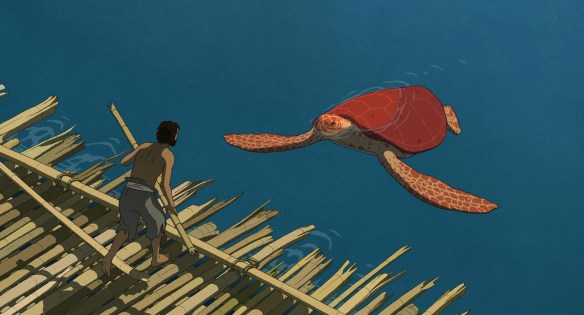
I’m taking the chance to publish the unexpurgated version of Mark Schilling’s interview with me for his piece last week in Variety. My comments were, naturally, reduced to a couple of soundbites, but I think some interesting things came up. Sometimes my brain doesn’t grind into action until it’s asked the right question, and some of my ideas here were straight off the cuff. The question was that old favourite, the “new Miyazaki” in the light of Michael Dudok de Wit’s forthcoming Red Turtle and Makoto Shinkai’s Your Name but as ever, I preferred to think of it not in terms of the creative abilities of modern animators, but of the ways in which the industry can find an equivalent revenue stream for the biggest money-spinner of the last generation.
Mark Schilling: In your view, has the torch truly been passed?
Jonathan Clements: No. There is no torch, at least not in the way that the public expects. Hayao Miyazaki wasn’t just a one-off, he was part of a trio. You can’t have the Miyazaki phenomenon without Isao Takahata and Toshio Suzuki as well. All three of them are retiring. Suzuki spent ten years not just looking for someone to take the torch, but examining the torch itself, trying to work out what parts of it could be replicated by other means. He concluded that there was no torch but the legacy of Ghibli itself, and that’s why the Ghibli Museum is so crucial to understanding the studio’s late period.
Do you view Shinkai, de Wit and others as “Miyazaki heirs”?
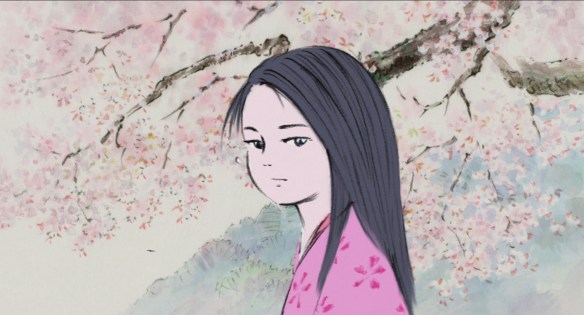
Studio Ghibli spent a decade looking for some way of continuing Miyazaki’s momentum. Takahata couldn’t get the same numbers, although Suzuki did hope to hide that by releasing The Tale of the Princess Kaguya on the same bill as The Wind Rises. When Kaguya was delayed, its box office numbers made it very clear that Takahata didn’t have the following that Miyazaki had. None of the non-Hayao Miyazaki films from Ghibli have done Hayao Miyazaki numbers.
Toshio Suzuki tried everything in the noughties. He tried to lure big-name directors into Ghibli, but they didn’t gel with the studio. He tried to train up new apprentices, some of whom have gone on to make names for themselves elsewhere. But he couldn’t find a proper replacement for Miyazaki.
So Suzuki engineered Goro Miyazaki’s controversial directorial debut, and invited audiences to come and see the car-crash. That lured Miyazaki himself back for Ponyo. That’s where they started the “We Made This” alphabetical credit listings, which conveniently obscured the fact that Miyazaki didn’t actually direct Arrietty! He engineered the father-son team-up on Poppy Hill, and got audiences to see that. Then he lured Miyazaki back for absolutely anything he wanted, no matter how controversial, so he could go out with The Wind Rises. He’s played Miyazaki (and the public) like a fiddle! He’s managed to stretch the heritage of Ghibli since 2006 with only two genuine Hayao Miyazaki movies. But after The Wind Rises, it really is over. Ghibli has to admit it’s got no more features in it that are going to trounce the next five rivals at the Japanese box office. It’s a brutal, accountants’ decision, but it’s based on firm evidence from the last decade that not even the Ghibli name on a film will guarantee that it will match the success of a Hayao Miyazaki film.
 But that’s not good enough for distributors, and it’s not good enough for exhibitors. Cinemas are fixed sites, they need more product. July is going to happen whether or not the film studios have something suitable for a vacation tent-pole movie.
The Ghibli Museum turns over US$7.5 million a year, just on admissions. Throw in the restaurant and the gift shop, and the museum is making its owners a modest movie’s worth of revenue every year, just by managing Ghibli’s own legacy. It doesn’t need to make any more films – in fact, doing so would risk compromising the brand. It just needs to keep the conversation going. It needs people like us talking about it like it’s still there, so people remember they want to take their kids to see the giant fluffy Catbus.
So what does it mean when they say The Red Turtle is a coproduction? Is Ghibli just putting its name on it, like it did with the Japanese releases of Aardman films? I’m guessing that Ghibli is slightly more involved in investment than that, but not in actual animation. The Red Turtle will be imitation Ghibli, ‘inspired by Ghibli’, and it’s an experiment to see if a Ghibli imprimatur is enough to get a movie a healthy box office return; and if it doesn’t work, they’ve got plausible deniability to edge it out of the studio history. It’ll be a tenth of Miyazaki numbers, but it’ll keep that conversation going for another year. There will be a Red Turtle exhibition at the Ghibli Museum. Ghibli will keep trending. This is legacy management with very modest expectations. Everybody will be pleasantly surprised if The Red Turtle is a box office smash, but I don’t think anyone is expecting it.
This isn’t new. We’ve seen a lot of this lately, where studios will rent out their IP to someone else and take 5% off the top. A Nigerian Astro Boy? An Indian Star of the Giants? A Wachowski Speed Racer? Ghibli has shut down its feature production arm, but what the hell, if someone else wants to take the risk, Ghibli will put in 5% of the effort for 5% of the returns. This is anime Moneyball.

Is there a “Miyazaki tradition” being passed on, even though Ghibli is not making features with its own directors?
That’s the conversation Ghibli wants us to keep having. Come and see this movie, to see if the director is The One! Will he save us? Is he the anime messiah? Or are we stuck hereafter with otaku-bait that can’t fill a single cinema for more than a couple of weeks?
That’s why Toei’s risk with Shinkai is so interesting. Shinkai has no trouble pulling in audiences on the small circuit. A Shinkai movie is usually a much more bespoke event. He makes a lot of personal appearances when his films go on tour, so it’s not just a trip to the cinema, it’s a trip to the cinema to see the director and get him to sign the DVD.
“Events” are a small but growing part of the Japanese cinema model, because if you have a small otaku audience, then you want to make sure they spend triple the usual money on a trip to the cinema. It’s not just about popcorn, it’s about T-shirts and phone cases, and often the limited edition Blu-ray. You limit and target the availability of the merchandise, and you make sure that you provide an experience which can’t be pirated. People are ripping off the software all the time, but Shinkai’s not going to sign a pirate copy, not of his movie nor the novel spin-off. He’s not going to shake your hand while you’re downloading the torrent.
“Events” at the moment are worth less than 5% of Toei’s revenue, but that’s a huge increase on just five years ago. It’s taking Japanese cinema back a hundred years to the days of the benshi and a cinema experience as a form of live vaudeville. But Kimi no Na Wa is different because it’s being touted, as you say, as a summer tent-pole movie. Shinkai can’t go to every screening; they can’t spread him that thinly. They’ll do some glad-handing for the hard-core fans at the premiere events, and hope that there’s enough momentum to keep it going with the general public. Watch the marketing on Kimi no Na wa, because I bet Toei goes all-out on interactivity. I bet they steal an idea from Mai Mai Miracle and try to engage the consumers with lobby exhibits. I bet they come up with a hashtag on social media and try and drag everybody into it. They are going to have to do this, because most of the users are going to have to bring their own event.
Look at the title, for God’s sake! They’ve called it Kimi no Na wa because I bet you half the general public will think it’s a remake. There was a radio series of the same name in the 1950s, adapted for TV in the 1960s, and again in the 1990s. Half the eyeballs for this movie’s advertising will only look because they think it’s something else. Much of the social media trending for this film will be people telling their confused friends that it’s not what they think it is. That’s some smart mockbuster marketing to get their attention. Then the pressure’s on Shinkai to keep it.
Or is the Miyazaki legacy (including his box office supremacy) in danger from not only Hollywood hits like Frozen, but also domestic trends?
I think everyone would love it if there were a domestic trend that could compete with Miyazaki’s numbers. I don’t think there is. Everyone has to dial down their expectations to a level where domestic anime earn the kind of money they did in the 1980s, not the 2000s (or rather, the kind of money that people have earned all the way through if they are not Hayao Miyazaki). That’s the problem with movie punditry. Everybody wants to talk about the outliers. The successes are outliers! Miyazaki was an outlier. The general trend is much more modest in terms of returns, and Miyazaki’s success has hidden that for a generation.
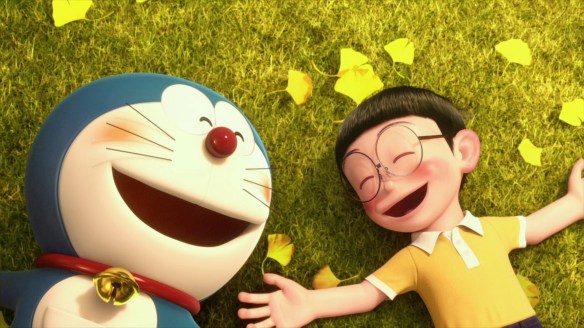
Frozen is a red herring – Disney cartoons have always outperformed domestic product at the Japanese box office, with the exception of Miyazaki movies. A much more long-term issue is CG, because the stats for CG make it abundantly obvious that Japanese movies are getting their ass kicked by computer animation. Japanese movies are still struggling to compete with CG, because even when they get a hit like Stand By Me Doraemon, it’s not exportable like a Miyazaki movie. Nobody wants it abroad because nobody knows what Doraemon is; part of the film’s domestic success was because of the blue-chip marketability of the Doraemon brand, which still doesn’t travel far outside Japan.
Of course, it does export to China, but what happened there? Stand By Me Doraemon wasn’t in the 34 movie quota for foreign movies in Chinese cinemas. The Japanese had to sell it for a lump-sum and take no further profits. That’s not growing a business, that’s treading water and hoping that something will happen.
China’s the elephant in the room in all of this, because it’s the largest possible new market for Japanese animation, but Japanese animation is made to feel very unwelcome in formal distribution channels. It’s censored, it’s banned, it’s shut out of theatre exhibition. There are only two brands that get any love in China: Studio Ghibli and Makoto Shinkai…
Jonathan Clements is the author of Anime: A History.

 Work continues over at the Science Fiction Encyclopedia, where I’ve contributed new entries on the Chinese tomb-raiding author Tianxia Bachang, and the controversial Cantonese polemic Ten Years (pictured), about life in a near-future Hong Kong. The China entries in the SFE constitute a book within a book, covering everything from early pioneers to Party people, and it’s all online for free, because that’s how they roll. Blessings of the state, blessings of the masses…



 Over at the
 This in turn has led to the phenomenon of hyper-localisation, as supposedly “Hollywood” movies pander to unseen Chinese audiences. Iron Man gets a leg-up from some Chinese guy; the Transformers keep pushing a brand of
  My obituary for the artist Tony Luke is
 Up now on the All the Anime blog,
  Spun off from my work on