 The Tolkien Estate has long mined the rich resources of its own archives, not the least with Christopher Tolkien’s 12-volume History of Middle Earth, a shelf-busting sump of drafts, notes, unpublished manuscripts and annotations which cunningly smuggles pretty much all of Tolkien’s intellectual property, including The Lord of the Rings itself, into copyright until the 22nd century – as the “co-author”, the still-living Tolkien Junior and his heirs retain ownership until 70 years after his own death. Were it not for this clever move, the likes of The Hobbit would become public-domain within the next 30 years.
Unpublished manuscripts, of course, are a different thing, and Verlyn Flieger is but one of many modern academics who get to treat musty Tolkien files in an Oxford library as if they are long-lost scrolls from the Silk Road. Her account of the condition of Tolkien’s original papers, etched with crossings-out and multiple renditions of the same line, makes it clear how much of a reconstructive exercise The Story of Kullervo is, of a text that was never quite constructed in the first place.
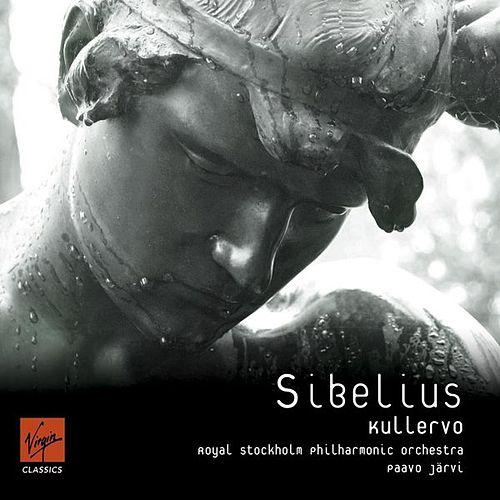
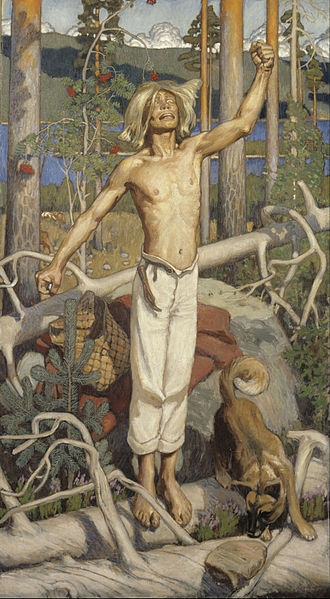 Kullervo was a very early work, undertaken by Tolkien in his twenties when he had stumbled across the myths and legends of the Finnish Kalevala. The eponymous hero is a slave-boy prone to fits of murderous rage, who kills his brother, turns cows into bears, shags his sister and has conversations with a talking sword. Naturally, with a resumé like that, he became an icon of Finnish nationalism, the subject of the first ever Finnish language stage-play, as well as a bunch of adaptations into other media, of which Tolkien’s was perhaps the most obscure, languishing unread in a pile of papers until rescued by a group of academic scavengers.
In a continuing, and frankly welcome modern trend in Tolkieniana, the relatively slim text of Kullervo itself is bulked out with relevant academic essays, including a lecture by Tolkien himself, and Flieger’s own analysis of the place of Kullervo within his work. This occasionally confronts the reader with the cant and argot of Tolkien specialists, such as the use of the term Qenya, for the Elvish proto-language, rather than Quenya, the High Elvish spoken by the time of the Lord of the Rings. In general, however, they are far more interesting than the text of Kullervo itself – eruditely footnoted, and steeped in the historiography of both Tolkien and Finland, right from the very cover image, which seems to invoke the Sami flag.
There is a regrettable moment of sloppy editing, that one hopes can be swiftly redacted in at least the digital version. The introduction claims that Sophocles’ Oedipus was set in the 4th century BC; if that were true, it would have been a special sci-fi Greek tragedy, set a hundred years in the future. No, it premiered in the 5th century, and alluded to events from Greece’s semi-mythical past. Meanwhile, editor Verlyn Flieger did herself no favours in a breathless BBC online article in which she seemingly makes the spurious claim: “Kullervo is the origin story for Shakespeare’s Hamlet… It is likely that Tolkien knew that Shakespeare had used this tale.” Let’s assume she was misquoted, since such an inspiration would require Shakespeare climbing into a time machine, buying a copy of the English translation of the Kalevala in 1888, and then jumping back to the 1100s, Terminator-style, to kill Saxo Grammaticus before he could write the Gesta Danorum.
Much has been made of Kullervo as a defining tale of Finnishness, although from the very first line, Tolkien’s version is shamelessly Anglo-Saxon in its meter and tone. You can almost imagine a much older Tolkien, chuffing on his pipe by a fireside, and beginning with Jackanory cadences:
In the days when magic was yet new, a swan nurtured her brood of signets by the banks of a smooth river in the reedy marshland of Sutse. One day, as she was sailing among the sedge-fenced pools with her trail of younglings following, an eagle swooped from heaven and flying high bore off one of her children to Telea…
This is all very well, but it is a world away from the primal, recursive, repetitive song-talk of the original, which is faintly preserved even in the old 1888 Kullervo translation by John Martin Crawford. Your mileage may vary, but for Kullervo to really hit the right note with me, it needs to sound more like this:
In the ancient times a mother
Hatched and raised some swans and chickens,
Placed the chickens in the brushwood,
Placed her swans upon the river;
Came an eagle, hawk, and falcon,
Scattered all her swans and chickens…
 The original literally lacks the vocabulary to avoid repeating itself. It is a spiralling cycle, intended not to be read but to be performed, constantly checking over its shoulder to make sure that the audience is keeping up.
Tolkien’s version, meanwhile, turns it into a narrative story with an occasional song interlude. He buffs it up for a notional audience of hobbits – as we might expect, he is already working through his nascent idea for a mythology of the English, and Kullervo is a private experiment, unintended for publication. It also reads all too often like someone pastiching Tolkien, with awful dialogue like: “Yonder, wife, is no reek of autumn smoke nor any passing gloom, but I fear me a cloud that goeth nowise swiftly nor before it has harmed my house and folk in evil storm.” Flieger writes of Tolkien’s brief and abortive struggle to teach himself Finnish, leading me to wonder if such purple prose is some bumbling attempt to imitate the way Finns talk.
This is young Tolkien. He will have to live another lifetime before he completes The Lord of the Rings. There is not yet much sign of any greatness in him. Even when he tries his hand at a bit of Finnish singing, his lyrics are tin-eared and chinless:
Now a man in sooth I deem me / Though mine ages have seen few summers / And this springtime in the woodlands / Still is new to me and lovely.
These are jottings, rehearsals, juvenilia. Finnish meter gets to you after a while, and the temptation to doggerel is high. Five years ago, I found myself in Karelia with Ellen Kushner and Delia Sherman, and we were all talking that way by lunchtime:
To the fridge went Lemminkäinen / Searching for the milky dregs / On the upper and the lower / Shelves he sought for several eggs.
“By my father’s knife,” proclaims Tolkien’s Kullervo, like some numpty at a Renaissance Fayre, “when I am bigger and my body waxeth stronger then will I avenge his slaughter and atone for the tears of thee my mother who bore me.” The absence of punctuation is faithfully replicated from the original, either a deeply intricate recreation of Finnish speech – Finnish sentences are often so long that Finns themselves have been known to breathe in while talking as well as out – or yet another indicator that this rough draft was rough indeed.
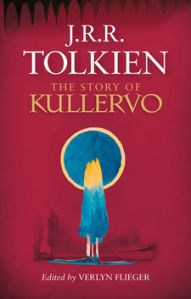 None of this should bother you. It certainly doesn’t bother Flieger, who is making no claims for Tolkien’s Kullervo as great literature. Indisputably, we can see within it the germ of what would become his Middle Earth. This is Tolkien’s own Finland fan fiction, pastiching a work that he loves beyond all telling, caught at a crucial moment when he is starting to change the names and shuffle the ideas, discarding the bits that he thinks he can do better himself. Frankly, the text of Kullervo itself is the least interesting part of this book, while the essays that accompany it are undeniably worth the cover price. More by luck than judgement, Harper Collins have chosen to publish a book by JRR Freaking Tolkien, about Finland and Finnishness, the week after Helsinki is announced as the site for the 2017 Science Fiction Worldcon. I think the sales will be fine.
Tolkien himself, already a couple of years older and wiser, is far more poetic and lyrical in the book’s reprinted lecture on the Kalevala than in Kullervo itself. He speaks of Finland (or at least a Finland of the mind), a country he never visited, as if he had been spirited there by elves:
Trees will group differently on the horizon, the birds will make unfamiliar music; the inhabitants will talk a wild and at first unintelligible lingo. I hope… after this the country and its manners have become more familiar, and you have got on speaking terms with the natives, you will find it rather jolly to live with this strange people and these new gods awhile, with this race of unhypocritical scandalous heroes and sadly unsentimental lovers: and at the last, you may feel you do not want to go back home for a long while if at all.
Jonathan Clements is the author of A Short History of Finland, available now in print and on the Kindle.

 My review of Rebecca Suter’s Holy Ghosts: The Christian Century in Modern Japanese Fiction, is up now on the All the Anime blog.