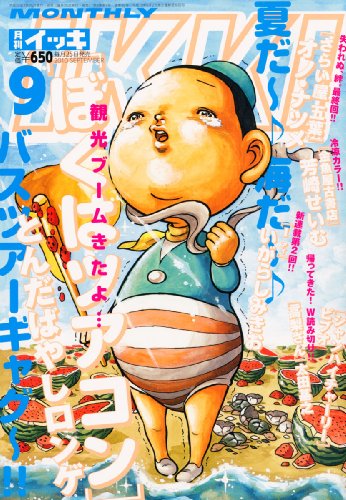
With the news that the manga magazine Monthly Ikki is shutting down after over a decade, I reprint my Manga Snapshot column on it from 2010. I’m afraid I don’t have the original images so I have had to scrape up what I can from the interwebs.
——–
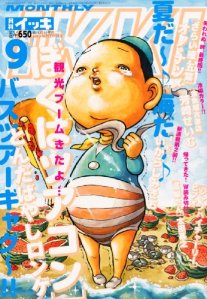 It’s another brick-sized manga magazine, but you’ll have trouble finding Ikki in a Japanese 7-11. It’s calculatedly, studiously different from the manga norm, which is just how Ikki magazine likes it.
The Japanese Magazine Publishers Association only provides one set of data for the relatively niche Ikki, and that’s the news that it prints a monthly distribution of just 13,750 copies. In Japanese terms, that’s miniscule – in fact, it’s the smallest statistic for men’s manga in the JMPA listings. That doesn’t mean it’s the least popular magazine we have ever covered in Manga Snapshot, as undoubtedly some of the boys-love and other niche titles we’ve examined have similarly low figures that aren’t audited, but even so, whatever Ikki does, it does it for a tiny proportion of the manga-reading crowd.
Big Comic Spirits, the parent magazine that spawned it as a one-off special in 2000, and then as a regular venture since 2003, is largely (54.1%) read by 300,000 people in their twenties, with an impressive remainder (30%) in their thirties. But Big Comic Spirits has such a broad readership, including readers as young as 17 and as old as 50, that’s it hard to see at a glance which sector of that market Ikki might be hoping to tap. BCS even boasts of 30% female readers, many of whom are the wives of the main target audience, which perhaps explains why this spin-off takes comics rather more seriously than some other “men’s” titles, refusing to run the “gravure” images of semi-naked ladies to be found in rival titles like Young Champion Retsu. Instead, the title positions itself as something of a find for early adopters, with a strapline that proclaims: “This is still the dawn of comics.” The implication is that the century-old medium is still only finding its feet, and that Ikki might be the Garo or Comic Afternoon of its age, where all the innovative experiments and hot new artists can be found. Them’s fighting words for what at first appears to be Just Another Brick-Sized Manga Mag, but notably it was the editor of Ikki who was at the forefront of a recent lobbying of the Japanese government, defending the right of artists to freedom of expression in increasingly censorious times.
Adverts in Ikki are thin on the ground. There’s one for a teen movie and another for a sportswear manufacturer, so right-on that it merely gives us the logo and a footballer wearing some gear, but doesn’t bother to push the gear itself. And branding is part of the deal – Ikki sets itself up as a lifestyle, with official “Ikki shops” dotted around Japan (and one in Seoul) that appear to be the only place you can actually be sure to buy Ikki. And from the looks of them, they are bookstores and video shops; you’ll have trouble stumbling across Ikki unless you are already a habitual reader or cineaste. But you are also likely to buy Ikki if you are a budding manga artist – every now and then the magazine runs its Ikkiman competition, with the prize being a paid commission and the chance to pitch an ongoing series.
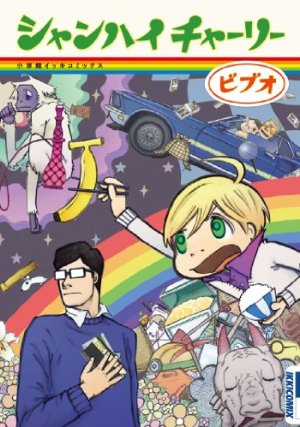
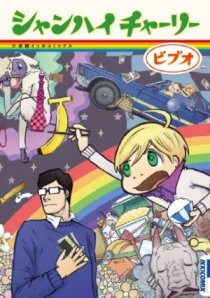 Shanghai Charlie by “Bibuo” has an opening chapter that introduces us to Charlie, a young boy, and “Shanghai”, his significantly older brother, who appears to be his legal guardian. Drab, everyday events like a trip to the supermarket are juxtaposed with Charlie’s dream existence, in which he plays with knights and dragons, and complains about his brother’s stingy decisions not to buy him extra sweets at the checkout. Shanghai Charlie is in love with childhood, told very much from Charlie’s point of view, but for the entertainment and education of readers much closer in age to the elder brother, and likely to have Charlies of their own. Charlie has tantrums and makes unfair accusations about his elders, but this is all part of the child’s worldview, and Shanghai Charlie exhorts its reader to remember that the irritating parasite who won’t eat his greens is also a dreamer and an explorer of the mind, who lives a different dream adventure every night, and ultimately only wants to feel safe and loved.
The winner of the most recent Ikkiman competition is the pseudonymous Ayumimi Yakahi whose manga Hamawou gets a chunky blue-tinted section in this issue. Yakahi herself sets her sights humbly low with her debut, noting: “I’ll be happy if you just read it to the end.” Her story is a sad elegy to modern city life, a perfectly normal tale in which all the parts are played by frogs and toads. Hamawou is in love with Renka, a bar-girl (well, barfrog) who stays out late drinking with fat company presidents, and tumbles home squiffy and giggling in the small hours, only to sleep it off during the day and head out again the next night. Hamawou, meanwhile, is reduced to driver, laundryman and occasional night-nurse, and slumps through the story with froggy eyes brimming with tears.
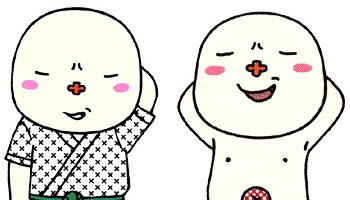 Such juxtapositions of the absurd and the mundane are a staple of avant-garde manga, and it should come as no surprise that more established creators have tried similar tactics. Noramimi by Kazuo Hara is, at one level, a kitchen sink drama about the people who run a merchandising goods franchise called Hello Kids. Think Hello Kitty, but with teddy bears and demons and God knows what else, and they all come to life and answer back, at least in the mind of the titular Noramimi. But this is all a lot more interesting than it sounds: infantilism, in Japanese studies, is often thrown around like a dirty word. Whenever I encounter it, it is usually with a resigned sigh as another a bunch of Japanese creatives act like children again. But here, in story after story in Ikki magazine, infantilism is instead a serious window into the minds of children.
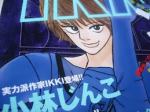 A candidate for the best Japanese pun ever, Jingo Kobayashi’s Jumpin’ Gap Clash is the self-narrated misadventures of Taika Wakatsuki, an otaku and sometime sci-fi fan who is secretly excited by scenes of violence. That, at least, is what the “story so far” claims; in this chapter, Taika simply goes shopping. Notably, Taika has a little sister, Laika – once again, we see the adult world filtered through that of an infant dependent, as if the presence of a child were an entirely everyday occurrence in the lives of the readership.
Similar child-centred but adult-aimed stories can be found in Tales of the Unwanted by Tsunpei Sanyu, whose heavily pencil-shaded imagery concentrates on a different kind of lone wolf and cub – an outcast boy in the forest who befriends a wandering wild dog, and then runs into a peasant girl who has fled an unwelcome betrothal. The emphasis here is on making new networks even in rejecting the mainstream – strange attractors, if you will.
Meanwhile, in Buranko by the Thai artist Wissut Ponnimit, the story of a family stuck in the middle of first contact with alien invaders is told in a resolutely cartoony form like the most childish of Tezuka artwork. A very similar art style can be found in Wild Mountain by Hideyasu Moto, in which a meteorite crashes in Tokyo’s Nakano ward, creating an impromptu new district, packed with aliens and their own mayor, a beleaguered official called Sugahiko Suga.
Other tales in Ikki are relentlessly skewed older. Jiro Matsumoto’s Freezer posits a near-future society in which the government legalises revenge killings. As long as you have a legally sanctioned vendetta against a criminal, you can not only have them killed, but hire a licensed assassin (or “freezer”) to do it for you. What could possibly go wrong…? Well, everything, as it turns out, in a tale that marries Battle Royale to a police procedural, with a set of cold-hearted hunting rules that see convicts turned loose in public and made to run from assassins hired by aggrieved victims, whether or not the convict is truly guilty. As you might expect, this has already been turned into a movie, directed by Kazuyoshi Kumakiri in 2006.
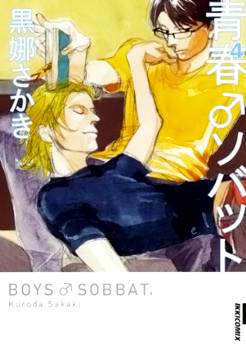
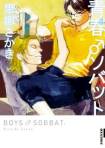 Sakaki Kuroda’s Sobbat posits a former all-girls school that gets a sudden influx of boys in the upper years. And the boys, typically for the manga world, are less interested in their giggling sailor-suited classmates than they are in each other. Sobbat offers a defamiliarised perspective on high school romance and teenage angst, affording a girl-friendly glance at male obsessions, on the understanding that the men in question could not possibly be a threat to the female reader.
Nanki Sato and Akira Kizuki’s manga “Sex nanka Kyomi nai”, loosely translatable as No Sex, Please, is a genuinely charming journey through the mind of an aging man, as he re-evaluates his life and his youthful erotic obsessions. Neither prurient nor puerile, it uses a chance hearing of a much-loved song by a forgotten band to contrast our protagonist’s first sexual encounter with Michi, the teenage girl who would eventually become his wife, with the woman that she has become. Boobs are the issue of the day, as he recalls his relatively flat-chested college lover, and the more well-endowed wife who sleeps now by his side. No angst, merely a bemused meditation that men always want what they can’t have, and that his current sleeping partner is a very different woman to the one he married. And the realisation that that’s kind of cool. As with the child-centred stories above, it’s perfectly aimed at a thirtysomething audience, with some intriguing bedroom philosophy, and, well, let’s face it, two sex scenes.
The heroine of Silly Kodama by Kario Suzukin is a 17-year-old klutz whose main loves are bike-riding and baseball, who has accidentally swallowed a ball-like spirit creature – the titular kodama (“bullet”) – which causes her to act strangely, and interact with mythological creatures. The series allegorises many teenage growing pains, playfully suggesting that they are the work of malevolent or uncaring creatures from Japanese folktales, and inevitably leaving the exasperated protagonist to clear up the mess and misunderstandings.
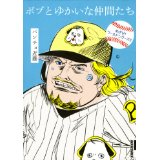 Baseball, that baffling Japanese obsession, is soon back on the cards again, quite literally in the case of Bob (“with his funky company”) by Pancho Kondo. The story, crammed tightly into only a few pages, is about the eponymous Bob Hoffman and his fellow teammates on the Bullries Bulldogs baseball team, although this issue is taken up with Bob, Jo the second baseman and Kanegong the star player bickering over product placement and character merchandise. In a little bit of manga artist fun, creator Kondo decides to translate his character bios into English to decorate the margins in this issue. “I think,” he writes snickeringly “I can be irresponsible just like Jo, ’cause nobody reads this translated text anyway.” Well, except for the thousands of people who bought this issue of NEO. Your secret’s safe, Pancho!
Wombs by Yumiko Shirai is much more original, a subtle science fiction epic set on the colony world of Hekio, where a war has broken out between the first wave of human arrivals and later, less welcome interlopers. Citizens are co-opted into the military to fight in a war they really don’t want, with women drafted to bear children for the war effort. The result is an intriguing combination of Armitage III and TheHandmaid’s Tale, viewing anecdotes of pregnancy through the intriguing prism of a far-future tale of space colonisation.
Ikki certainly does its best to poke and prod, push and stretch the manga medium in new directions in the 21st century. Half a century after the avant garde first began turning comics on their head, Ikki is still at it, searching all the time (and occasionally a little too hard) for something completely different. Ultimately, Ikki isn’t quite as groundbreaking and innovative as it would like to be, but at least it’s trying – far better to set high standards for oneself than to languish in the stinky swamp of low expectations.
Jonathan Clements is the author of Anime: A History. This article first appeared in NEO #76, 2010. The Manga Snapshot column has been reviewing a different manga magazine every month since 2005.

 Jeremy Graves is joined by Jerome Mazandarani, Andrew Hewson and Jonathan Clements in the 26th Manga UK podcast to discuss last week’s Studio Ghibli news, the San Diego Comic Con, upcoming releases, and your questions from Twitter and Facebook. Includes an inadvisable impersonation of Meryl Streep, commentary track shenanigans, and Jerome’s skateboarding stunts. You can download the podcast here.
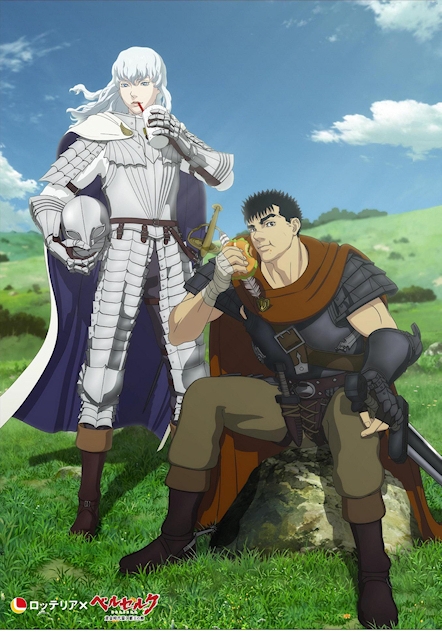 14:30. The prospects of a Ghibli-Disney tie-up, which are remote indeed. The unlikely story of a Berserk happy meal. Ghibli and children’s literature, and what made Ghibli such a good studio.