Theatre of the Absurd


8e490dd5d4781b6fd11095c2b63f13fe

A woman with hair like a condemned bird’s nest asked me when the kabuki started.

“Oh,” I said. “The Japanese have a tradition of not letting people know when they’re going to kick off. It dates all the way back to 1941.”

She was very pleased to have found herself an expert, and dutifully made notes when I explained to her about the wonders of kakegoe.

“At certain points of particularly poignant drama,” I whispered, “you’ll hear people shouting out their approvals of the actors’ performances. If you hear them, you should just join in. Shout out ‘bravo’ in Japanese.”

“Oh,” she giggled, “that sounds like fun. But how do I say it?”

“Wasabi,” I replied.

I took my seat amid a sea of white faces, few of whom seemed to have parted with ten bucks for an earphone commentary. I was heartened to see how many people were there on the opening night who were confident they could follow 300-year-old Japanese (as screeched by a man standing on one leg, imitating a washing machine on a slow spin cycle) without help.

As it turned out, they had simply been too dumb to follow the signs in the lobby that said “THIS WAY FOR YOUR EARPHONES” and spent the whole first act gasping for comprehension like surprised tuna in a disco.

“PLEASE REMEMBER TO RETURN YOUR EARPHONES AFTER THE PERFORMANCE” the intercom said, inscrutably. “OTHERWISE YOU WILL BE PUNISHED.”

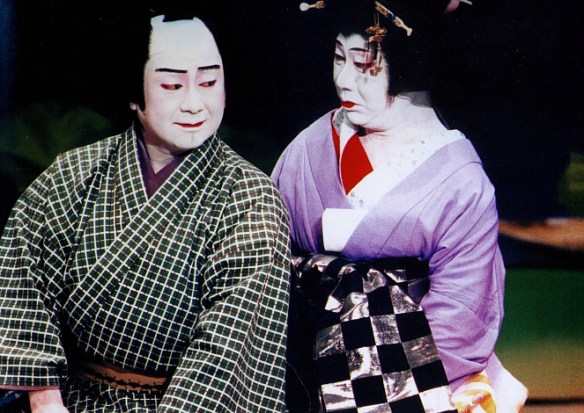
The first play began. Two old men (dressed as men) met two old men (dressed as women) near a temple. One of them told a joke about a rabbit, which was distinctly unfunny when I saw it in Kurosawa’s Ran, and twice as unfunny now. Then they did a dance, or perhaps synchronised stamping would be more appropriate.

One of the samisen players at the side kept grunting and growling, and twiddling his knobs. After a while, I realised, much to my surprise, that he thought he was out of tune, and was trying to turn plinks into plonks without anyone noticing. After a particularly rousing bit of stamping, a few plants in the audience appreciatively yelled out the name of one of the actors. A few seconds later, I heard my own secret agent, from somewhere at the back of the stalls, enthusiastically calling out “WASABI!”

“The actors,” hissed the commentator in my ear, “are being helped by stage hands, who traditionally are invisible.” This got the biggest laugh of the night, as the stage hands could not have been less invisible if they had been painted pink and wearing giant clown shoes. The actors, who couldn’t hear the commentary, only the laughter, thought they were onto a winner and did some bonus stamping.

“WASABI!” someone shouted from the back.

After some more stamping, the curtain fell. All around me in the front few rows, my earphone-less neighbours were scrambling for the exits, never to return. Still, there was still the main attraction coming up.

“I hope it’s got a lion in it,” said someone behind me, who had been to Japan once. “I like that thing they do when they wave their mane around.”

“I think,” I said, knowing that I was probably going to regret it, “there’s not much call for lions in a tale of doomed love.”
1170370“Oh,” he said. “When I went to Japan once, I saw a kabuki play and it…”

“Had a lion in it?”

“Yes.”

“Well this one hasn’t. It’s got two lovers committing suicide.”

“Then what?”

“That’s it.”

“Don’t give the end away!” he scowled in irritation.

“Give the end away!? It’s called Love Suicides at Sonezaki! What did you THINK happened at the end?”

“Well, I don’t know. I was quite hoping for a dancing lion.”

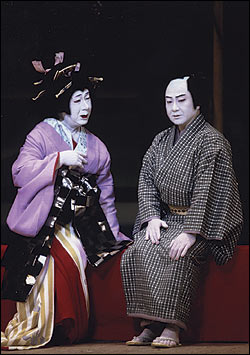
On stage, a respray of Romeo and Juliet unfolded. The audience tittered for the first fifteen minutes because nobody told them this was a tragedy, and they thought it was really funny that there was a fat man dressed as a woman onstage. It fast became clear that, while the Japanese have managed to miniaturise everything they ever encounter, the one exception is Ham.

As a professional apologist for Japan, I am supposed to like this sort of thing. I found every second historically fascinating, but while it might have entertained groundlings in 18th century Japan, by modern standards the writing was rather poor, the acting was merely passable, and regardless of a 50-year-old man’s achievements at portraying teenage femininity, I am tempted to point out that there are plenty of teenage females out there who could have been trained to do just as good a job.

To be fair, go to the Globe in London and see Shakespeare performed in similar period style, and many of the same problems arise. It might be art, but it was ossified and pretentious, as if drama hadn’t changed at all since Euripides, and we were all supposed to be impressed that there were people on the stage in front of us, speaking in ancient Greek. (Well, actually, that would be impressive, but it still wouldn’t be entertaining with that plot).

After what seems like eight hours, the star-crossed lovers decided to end it all. A decision I reached on my own somewhere in the middle of act two. They walked around a tree a few times, then spent 15 minutes getting ready. The female lead prepared to exit this world in excruciating torment, although she didn’t know the meaning of the word, because she had never had to sit on one of the special Endurance seats at this particular theater, designed to extract confessions from hardened criminals.

“Very shortly,” said the commentator earnestly in my ear, “he will show the depth of his feelings for her by stabbing her in the throat.”

The end. They still haven’t actually committed suicide.

“You said they were going to commit suicide,” complained the leophile behind me.

“Well, they were advancing on each other with edged weapons,” I pointed out.

“But they didn’t actually kill each other, did they?”

“No…” I sighed.

“You know what would have really made it perfect?” he added.

“A lion?”

“Yes! Exactly. Once of those whirly-head lion dances. They should put one in next time.”

“Or perhaps a something funny with a dog?” I suggested.

“As long as it danced.”

In front of us, the multiple curtain calls reached double figures.

“Wasabi!” shouted the audience appreciatively.

Jonathan Clements is the author of A Brief History of Japan. This article was originally written for the August 2008 issue of the cancelled PiQ magazine. It is published here for the first time.
Grave Mistakes

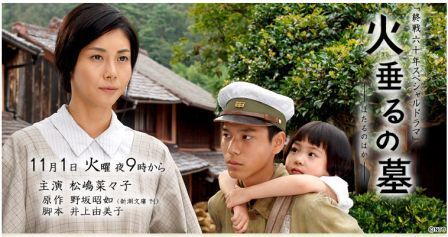
Isao Takahata’s Grave of the Fireflies is one of the pinnacles of modern anime, and arguably the greatest of the war-story sub-genre. Its live-action TV remake is, well… a travesty. Made in 2005 to mark the 60th anniversary of the end of the war, this NTV drama special plays not as an adaptation of the original novel, but as a homage and commentary on the anime classic.

Continue reading

Tampopo

tampopo3

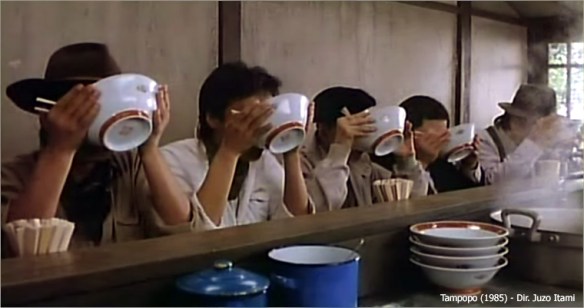
Oral fixation is a common recurrence in the anime world. I often got grumbles from anime fans when I would point at the outrageous, endless obsession with food exhibited by characters in anime for a pre- and early-teen audience as a sublimation of every other desire. The complaints were usually from people (and once, from the distributor of Slayers) who would rather not admit that the show they treasured was not made for 18-year-old Americans at all, but for Japanese primary school children. But eating was also the central theme of one of the rare Japanese films to get genuine mainstream western attention in the 1980s. I expect, in this modern day and age, it would have gone straight to video in the UK and been the subject of three blogs and a web review, but back then, when Japanese stuff was still rare and exotic, it had its own slot on Barry Norman’s Film 88, even though its plot might seem silly by modern standards: a woman’s quest to create the perfect bowl of noodles.

I first saw Tampopo then, only a couple of years after I had suddenly and inexplicably decided to learn Japanese. I had to go to the isolated, deserted arts theatre in Basildon because it wasn’t being shown anywhere else. My girlfriend and I were virtually alone in the cinema. I suppose, thinking back, that I probably had never even eaten any Japanese food at that time. I certainly didn’t speak any Japanese.

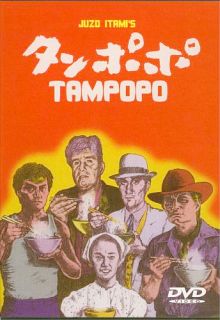
Today, despite getting serious press coverage on its original release, Tampopo still seems to be difficult to dig up. The version officially “on sale” at Amazon US seems to be a grey import from Japan, since the Japanese release is naughtily Region 0. The Japanese have a no-frills DVD release with appalling cover artwork that supposedly makes it part of a Juzo Itami series. The series is united by:

a) being directed by Juzo Itami
b) having appalling cover artwork

Although I am not aware of any complaints at the time from the British Board of Film Classification, one does wonder if the difficulty of getting hold of a copy has something to do with the fact that a turtle is killed on screen and two prawns are tortured in alcohol. Mrs Clements was greatly amused by the seriousness with which the Japanese approached something as daft as a bowl of noodles, particularly since she identified that the “joke” was lost in a world where the Japanese in movies approach everything seriously. What may have been ironic for Itami loses much of its clout in a world where the Japanese are serious about trains, serious about sumo, and serious about anything you care to name. Such po-faced concentration is supposed to distract us from the fact that putting a spring onion on some noodles is hardly rocket science. It might have been irony for Itami, but for many, many imitators it was just an excuse for bad film-making.

It has been 20 years since I first saw Tampopo — enough time for me to live that entire life again. It was made in 1985, at the height of the booming economy that would later collapse into a decade-long recession, and had a truly amazing cast. Back then, when I was 17, I had no idea that the gangster-narrator was played by Koji Yakusho, or that the sidekick was a very young Ken Watanabe. I am *still* piecing together the myriad cameos that only mean something to a Japanese audience — some for their associations at the time, others for the careers they would go on to have. And I am surprised at how relentlessly cruel it is.

School bullies are befriended by kicking the crap out of them, and this makes them one’s best mates all of a sudden. Men fight with each other because it’s what men do, and that makes them friends — no wonder the yaoi crowd started making people snog instead, it’s no less ludicrous. Tampopo herself is a woman who strives for the approval of a bunch of patronising losers (two truck-drivers, a tramp, a drunk and a chauffeur), whose worthless opinions on the preparation of the Japanese equivalent of a ham sandwich are imparted with godlike condescension. The characters admit that noodle appraisal is an amateur enterprise, and yet keep on coming out with pretentious attempts to make it sound posher than it really is.

I genuinely think Itami was being ironic. But I see such faux-connoisseurs all the time. People with the palates of fussy children and no frame of reference enthuse endlessly about different brands of cola, their favourite supermarket ice cream, or the texture of a sandwich, without realising that they are playing in a very small pond. Itami points beyond the world of noodles to a multicultural world of food, where enjoyment is paramount. Food itself, as seen in the spaghetti eating scene where a gaijin gets it “wrong”, is what he likes, and his closing shot, of a child merrily sucking away at a breast, is a marker that eating stuff can be, or rather should be, one of the universal and enduring pleasures of human life. So, possibly, exactly the wrong thing for me to be watching two days into my diet.

Jonathan Clements is the author of Schoolgirl Milky Crisis: Adventures in the Anime and Manga Trade. [Tampopo finally got a Criterion release, in the US, nine years later in April 2017]

Questions from the Big Giant Heads (Part Four)

From Page 223 of Schoolgirl Milky Crisis

Are there certain things such as Japanese colloquialisms, which do not translate well when working on English language scripts?

Japanese takes longer to learn than many “standard” languages, and it has many complexities. So yes, translating Japanese is not easy, but it’s not impossible. The problem is whether people are prepared to pay for it. Quite often, the guy who hires a translator is entirely ignorant of the quality of what he is asking to be translated. He has no clue whether his translator is up to the task. All he cares about is how quickly it can be turned around, and how cheaply.

The modern obstacles are actually beyond the language itself, within audience and distributor expectations. Many distributors simply don’t want to pay a living wage for anime or manga translation. Prices have dropped, as far as I can see, about 65% in real terms in the last decade. There’s a lot of short-term people in the business who don’t see why they should pay professional rates, who don’t realise how much an interesting original is being dumbed down and ruined in its translated form. So they simply refuse to pay professional rates and good material is ruined.

There’s also a powerful lobby within fandom that doesn’t understand that translations are about making the language barrier invisible. They want to keep as much Japanese in the “translations” as possible, with the spurious assertion that certain concepts are untranslatable. So we find ourselves in this embarrassing situation today when some reps from distributors are unable to even pronounce the title of the shows they are supposed to be selling, and nobody knows what they actually mean. I think that betrays the aims of translation, but as Confucius once nearly said: peanuts pay, monkeys get.

What would you say is the most bizarre anime concept out there?

Take your pick. A series about the competitive world of bread-making? The tribulations of a blind soccer team? A group of transforming robots hidden inside cigarette lighters? Five orphan ninja who dress in bird costumes for no apparent reason? A drama-documentary about the world of superconductors? A guide to obtaining a divorce without legal hassles? I could go on, but I can see you already think I am just making it up. Schoolgirl Milky Crisis!

If Schoolgirl Milky Crisis was an actual anime show, what would the storyline be about?

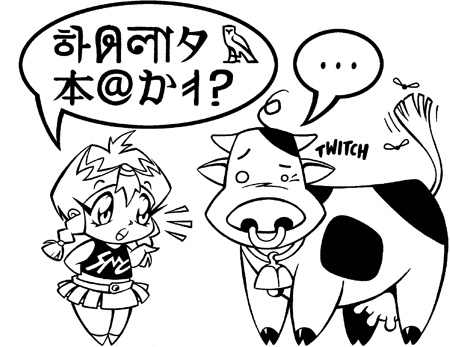
Steve Kyte, who’s drawn the Schoolgirl Milky Crisis artwork throughout the book, did say that he had tried to work out what the plot might have been by working through the numerous references in the articles and stitching them together. He appears to have come up with something about the vanguard of an alien invasion, accidentally landing on a dairy farm run by two Welsh girls called Bronwen and Gwyneth. But I think Schoolgirl Milky Crisis is a lot more fun when nobody knows what the story is and everyone has their own idea.

Fear Factor

TV Programming For Beginners

In my anime dungeon, where I torment fans who displease me, there is a special chamber for people who think that getting anime on TV is easy. Fans are locked in a room until they come up with their idea of a perfect evening’s anime viewing. Then I make them name the other eighteen hours they haven’t considered yet. Then I make them do it 365 more times, without once including a show that they wouldn’t want to watch themselves. After the wailing has finished, when their schedule is finally written in thirteen color-coded inks, I walk in and take away half the titles.

Continue reading