 In 1807, Napoleon Bonaparte (Ossi Elstelä), offers Finland to Tsar Alexander I (Leo Lähtenmäki) Finland as part of a treaty negotiations. The Swedish crown is chipped off Finnish buildings, and the people of what was the eastern Swedish marchlands are now suddenly Russian subjects. Oh dear, you might think, except Alexander II (played by the statue of him that still stands in the centre of Helsinki), is the “Good Tsar”, who offers his new Finnish subjects freedom to keep their language, their currency and their right of self-rule.
It is Alexander II’s dastardly, feckless grandson Nicholas II (Arvo Kuusla) who proclaims the February Manifesto of 1899, announcing that it’s time for the Finns to shut up, learn Russian and kneel before Zod. Don’t make the Finns angry; you won’t like them when they’re angry.
Helmikuun manifesti is the first film I’ve seen which boasts a “military uniform expert”, Bure Litonius, on the credits, but his influence is palpable from the earliest scenes, when the camera lingers momentarily on a perfectly recreated Chevalier Guard in the Tsar’s council chamber. The Finnish historian is apt to wonder what the chances were that one Lieutenant Mannerheim was indeed standing guard on the day that Nicholas II decided to shaft his most loyal subjects, undoing all his grandfather’s good deeds and creating an upswell of anti-Russian sentiment.
Cue a lot of scenes of Finns sitting around reading the words of the February Manifesto and getting annoyed about it. As the evil Governor Bobrikoff (Aku Korhonen) imposes increasingly draconian restrictions on journalism and the media, the men of Finland refuse en masse to answer the Tsar’s conscription call for the Russian army, chanting: “GOD IS OUR FORTRESS!”
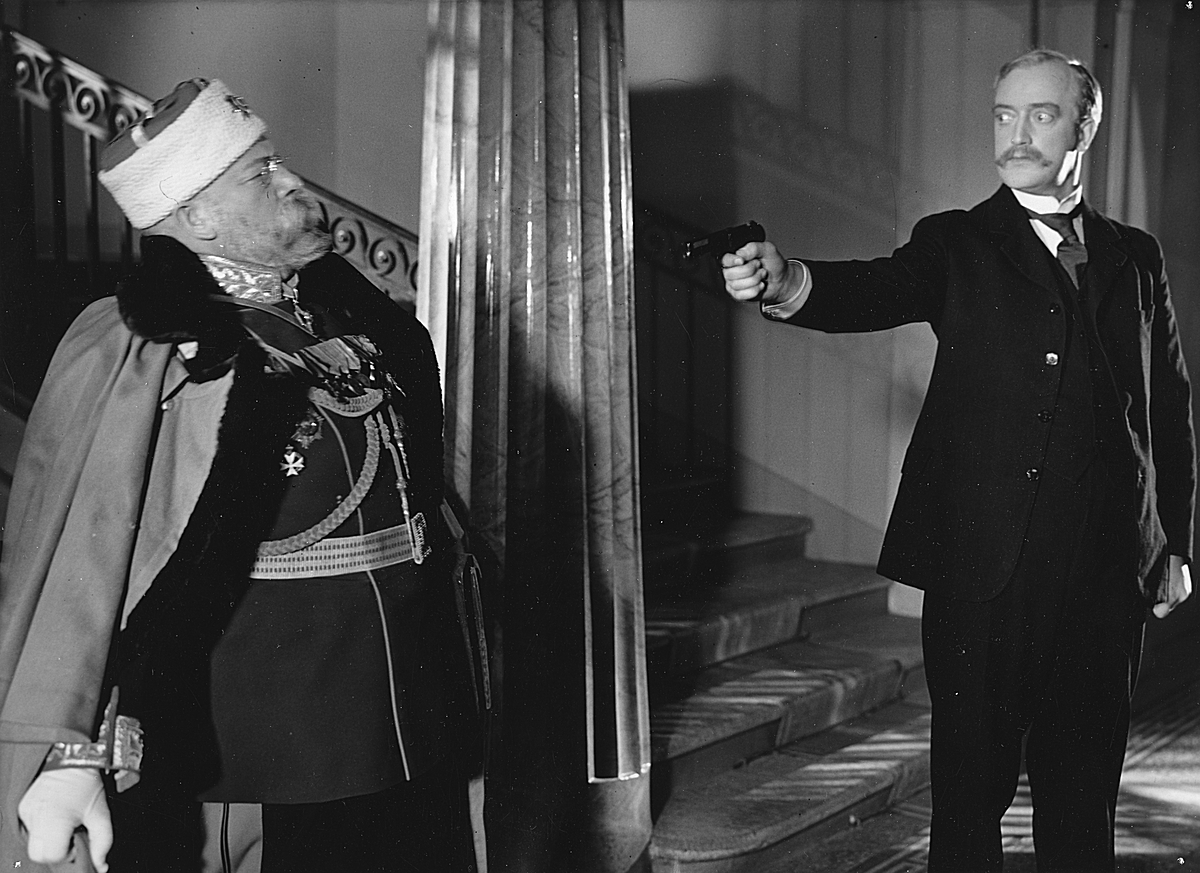
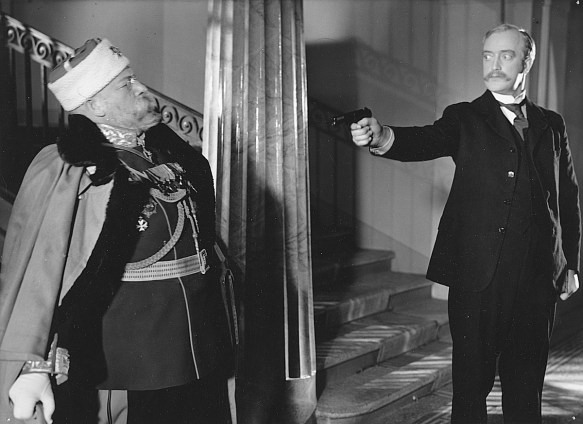 The film gradually zeroes in on the middle-class Jaakko Kotka (Tauno Palo) and the working man No-first-name Sihvola (Eino Kaipainen), two very different patriots, united in their desire for Finnish independence, and cunningly integrating them into moments of crucial Finnish history. So it is that when they are practising their marksmanship at a shooting range, they run into a man with a pistol who is way, way better than them. Aino Sihvola (Regina Linnanheimo) is more interested in the young man’s dog, while the menfolk struggle to remember his name. Oh yes, it was Eugen Schauman… played here by Runar Schauman, a distant cousin of the man who would assassinate Bobrikoff in 1904. This is just one of many sensationally realist touches in this film. It’s not just that Schauman plays his own relative, or that Korhonen is a dead ringer for Bobrikoff, it’s that the killing is filmed in the actual spot in the old Finnish senate building where it happened.
Mika Waltari’s script for The February Manifesto is wonderfully, provocatively nuanced. Finns, then as now, are often surprised to hear how popular the Russians once were in Finland, despite the evidence offered by Alexander II’s statue in Helsinki, where well-wishers still leave flowers to this day. Nicholas II is not presented as a snarling baddie, but as a fretful milksop, wringing his hands as he signs away all the goodwill his ancestors built up. “Niin alkuu,” he writes – so it begins. Implicit, but not quite stated outright, is the idea that Nicholas II lost his last, best friends on that day, and effectively signed his own death warrant 18 years down the line. A voice-over suggests that such cultural artefacts as the Kalevala, regarded today as an early step in the move towards Finnish independence, were harmless entertainments until they were co-opted into the anti-Russian movement. In other words, the February Manifesto claims to mark not just the beginning of the end for the Tsar, but the beginning of an independent Finland.
With Russian clampdowns on the press, the Kotka family become instrumental in the distribution of the underground newsletter Vapaita Sanoja (Free Words). The Tsar’s gendarmes, a not-so-secret police, hunt down would-be rebels, and destroy dangerous propaganda like prints of Eetu Isto’s controversial painting The Attack. In one emotional scene, Jaakko’s dissident father (Yrjö Tuominen), banished from his homeland, waves goodbye from the back of a train leaving a rain-swept station. The crowd that has come to see him off breaks into song, singing “Maame”, which would ultimately be adopted as Finland’s national anthem.
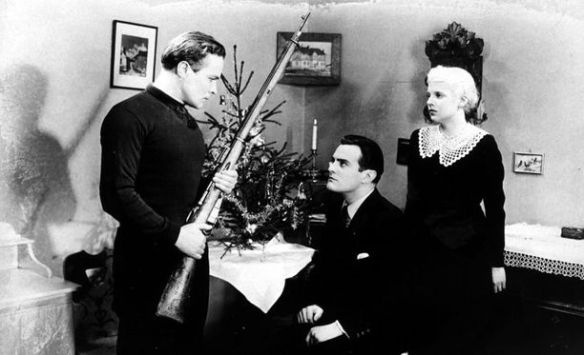
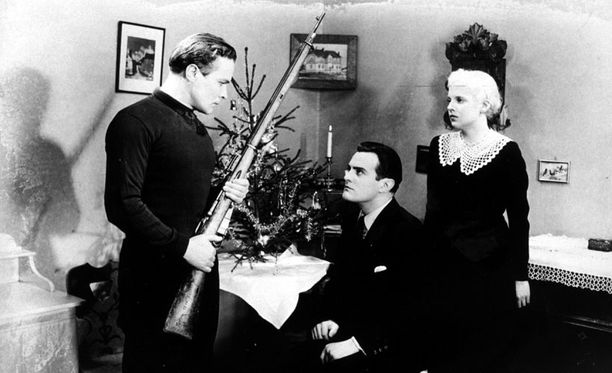
Jaakko and Sihvola get involved in gun-running, supervising the landing of a boat full of rifles from the infamous John Grafton – about which I shall one day be writing a book of my own. There also some wonderful glimpses of Finnish traditions, including a Yuletide sequence of the Kotka family melting tin in a fireplace ladle, and then flinging it into a bucket of snow to see what prophetic shapes are formed. This, incidentally, is what a Finn probably means if he tells you he has been to a New Year’s party ,”looking at some slag.” In this case, the flash-hardened tin forms the shape of a Cossack on horseback, cutting straight to a scene of cavalry riding through the streets of Helsinki.
The womenfolk are a little under-used, forced to largely stand at the side-lines and react, although Sihvola’s sister Aino (Regina Linnanheimo) does get the chance to play an occasionally comedic but largely, cringingly tense scene as she attempts to sweet-talk a bunch of Russian soldiers intent on searching her house for Jaakko.
Waltari is good on the liminal moments of resistance and collaboration. There are Finns prepared to stand idly by; Finns prepared to make a stand; Finns ready to join the resistance when a hero moves among them, but cowed before Russian might when they lack a leader. There are Finns who hate the Tsar, and Finns who are ready to support the Bolsheviks that replace him. Such confusions are entirely, historically accurate, and are echoed in 1939’s rival resistance film, The Activists.
 The story ends with the great tragedy of Finnish independence, that it came hand-in-hand with the bloody catastrophe of the Finnish Civil War. Jaakko and Sihvola both seek help for Finnish independence from different, doomed sources – Jaakko runs away to train in Germany with the jaegers, while Jaakko comes to believe not in Tsarist Russia, but in Russian Communism. Jaakko and Sihvola inevitably end up on opposite sides, with Jaakko fighting for the Whites while Sihvola is duped into supporting a Red revolution, only to be gunned down by Russian soldiers.
Jaakko and his jaegers march through the forest in distinctive white camouflage, foreshadowing what the Finns would be wearing themselves in the Winter War to come. The scenes are intercut with rushing waters, and suddenly it is not clear if we are watching Finland in 1917 or 1939.
Jaakko brings home Sihvola’s personal effects.
“So high is the cost of Finland’s freedom,” says his mother (Irja Elstelä), practically turning to the camera and staring pointedly at the audience.
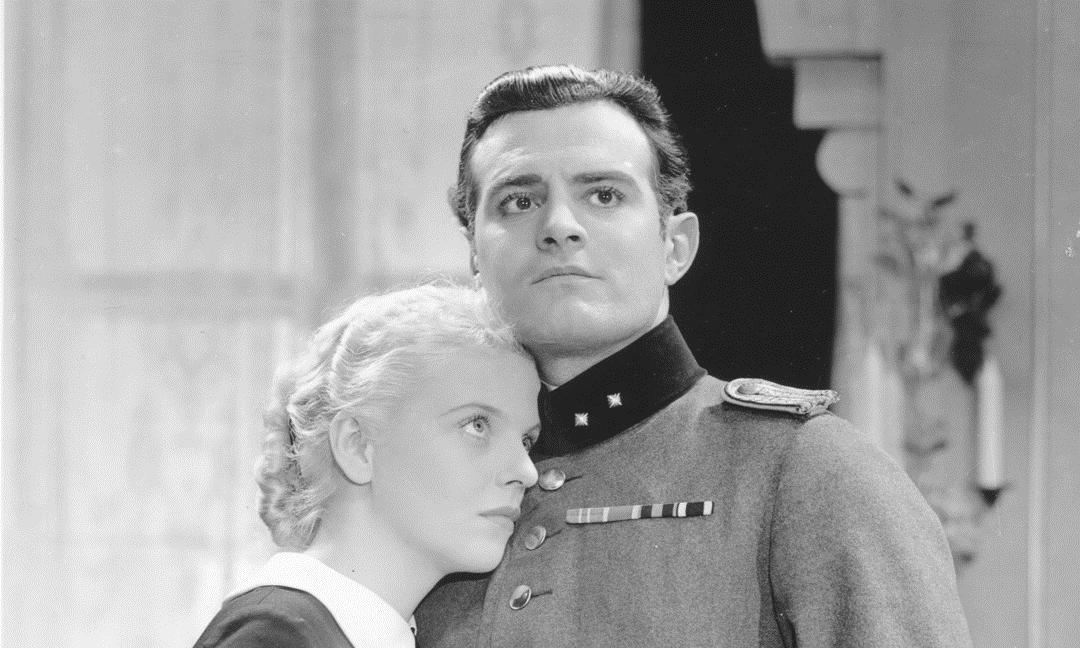
“And we are only halfway there,” says Jaakko, putting his arm around his betrothed, Aino Sihvola.
Both this film and The Activists would be banned in Finland for several decades after the Second World War, for fear that they would offend the Russians. I’d say that The February Manifesto in particular, in its treatment of sustained resistance to oppression, would still struggle to get a public release in some parts of the world today. I can think of several places where a screening of The February Manifesto would be liable to start a riot.
But the context for The February Manifesto in 1939 was about something else – the palpable threat that war would soon break out with Russia, and that Finland would face the threat alone. Nowhere is this clearer than in the closing shot of Suomenlinna, “the fortress of Finland”, where a still-extant inscription on the King’s Gate reads: “Eftervärld, stå här på egen botn, och lita icke på främmande hielp.” Those that come after us, stand here on your own foundation, and trust not in foreign help.
It’s a surprisingly moving film, not only in its account of the bravery of the Finns, but of the human drama contained within, such as one desperately sad moment when Eugen Schauman, knowing that he will not come back from his mission alive, fondly kisses his loyal dog goodbye.
Jonathan Clements is the author of An Armchair Traveller’s History of Finland.

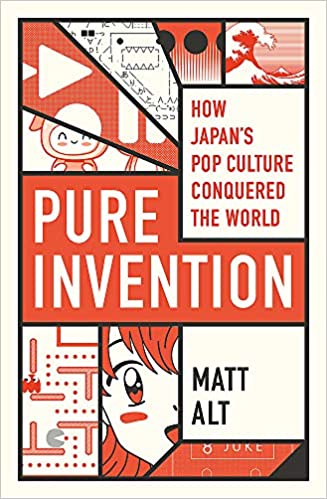 “This is a wonderful book, exuberant and joyful, full of love for Japan but a deep appreciation of the sorts of links that get left out of popular accounts – political economies, human-interest stories and technological determinism. We do not merely get to experience the Sony Walkman through the eyes of its designers and the company chairman who just wanted to listen to music in public, but also through the eyes of Steve Jobs, who is fascinated by its miniaturisation and utility, and the ears of William Gibson, who discovers a “strange grandeur” to Vancouver as he walks around his city with a new and personalised soundtrack.”





 The Official Schoolgirl Milky Crisis Blog