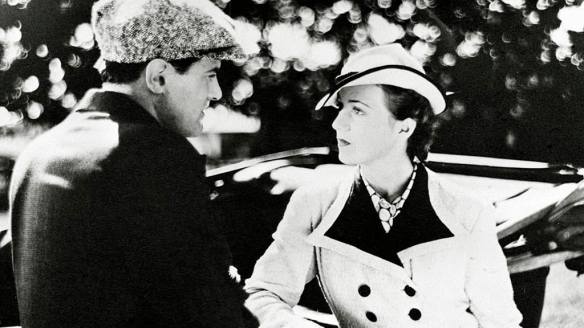
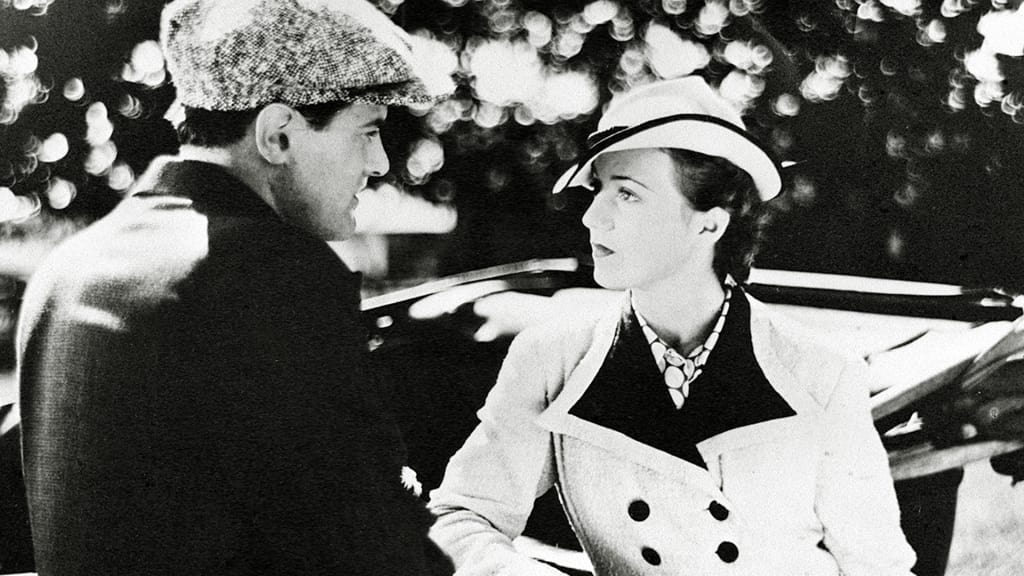
 Suomi-Filmi’s reliable director Valentin Vaala helms another script based on a play by Hella Wuolijoki, after the success of his earlier Hulda Juurakko (1937). Niskavuoren naiset is a fire-cracker of a story about another of Wuolijoki’s independent, disruptive female characters. The year is 1931 (so says Wikipedia, although people are seen drinking cognac, in contravention of that period’s Prohibition, still in force until 1932). Aging lady of the manor Loviisa Niskavuori (Olga Tainio) is trying to hold her village together in changing times, enduring with implacable stoicism the petty dramas of her heirs, particularly her performatively consumptive grand-daughter-in-law Martta (Irja Lauttia).
Farm life is presented not as a happy idyll, but as a complex, modern industry; the womenfolk discuss fat percentages and crop yields on their way to the store. This is no clueless place in the sticks – the council is quarrelling over the appointment of a teacher qualified to keep up with the times, and the menfolk have settled on Ilona Ahlgren (Sirkka Sari), a city girl who has “studied more than knitting patterns,” who arrives on the train with her fashionable hat at a jaunty angle.
The locals are relying on Ilona for more than schooling; the priest wants her to help out at Sunday school, the craft circle wants her helping out with the home economics, and even the drama club expects her to take a turn on the stage. They expect her to be a Jill of all trades, a vital contributor to all aspects of village life. She is excited to be in town, not the least because with Woolfian connotation, she has been yearning all her life for “a room of my own.”
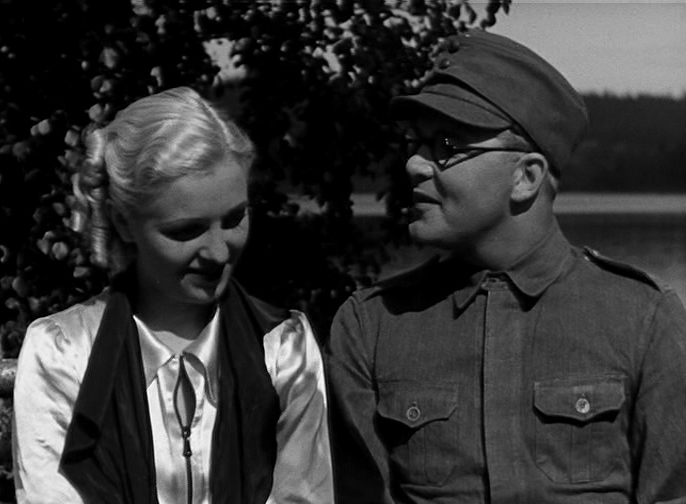
 Martta’s husband Aarne Niskavuori (Tauno Palo) falls for Ilona, obviously and hard, in a stirring dance sequence in which the camera intercuts extreme close-ups on the band’s musical instruments with the whirling faces of the would-be lovers. But the script keeps us guessing, cutting immediately from breathless flirtations at a summer ball, to a midwinter card game six months later, leaving us to guess what has transpired in the interim.
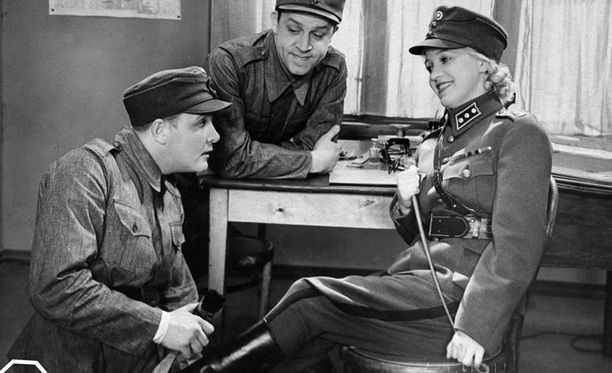
“Telephone” Sandra (Aino Lohikoski) is the local operator, constantly complaining that the schoolboys have damaged the overhead wires, but also sneakily eavesdropping on everybody’s conversations. It’s she who first suspects that Aarne and Ilona are having an affair, and spearheads the gossip. By the time their trysts are the talk of the town, Ilona is already carrying Aarne’s child. Aarne’s wife, Martta rages against That Woman, refusing to let her in “her house”, a house that as Loviisa dolefully reminds her, is not yet fully hers to rule.
Over a tense coffee conversation loaded with agricultural allusions, Ilona breathlessly talks of spring storms blowing down trees with giddy disregard, while Loviisa sternly reminds her that the men of Niskavuori have deep roots, and that she is a new transplant. Money, in terms of Martta’s wealth, is going to talk much louder than whatever feelings Aarne and Ilona have for each other, but even as the two women glare at each other over their cups and saucers, Aarne arrives with his friend Simola, and the foursome are forced to play along in a forcibly light-hearted conversation about the joys of marriage.
Loviisa has a plan, to marry Ilona to the less well-to-do Simola, avoiding a scandal, or at least squaring off a lesser one by suggesting that Mr Simola and Ilona are facing a shotgun wedding. Ilona’s own vague plan, to run away with her lover, seems thwarted by Aarne’s tardy realisation of his duty to his home manor.
The Women of Niskavuori was the debut role for Sirkka Sari, a young actress with a tragically short career ahead of her. However, ungallant though it may sound, on the basis of this performance, I assume that the ink spilled elsewhere as if she was some great lost talent was a commemoration error, as obituarists struggled to find nice things to say about a frankly unremarkable teenage ingénue, who met with a grisly end while completing her third film, Rich Girl (1939). Naturalism in dialogue is still uncommon in Finnish films of the period, but Sari comes across as an actress out of her depth, too busy trying to remember her lines to really put much effort into delivering them. If she were a star in the making, she seems miscast, here. She was barely eighteen years old when this film was shot, even though the character she is playing must surely be at least five years older, if not ten.
 The script is open to multiple interpretations – depending on the way that Ilona’s actress delivers her lines, she could come across either as a fiercely progressive modern woman, or a home-wrecking hussy unheeding of the damage she has done, or a deluded innocent, humped and dumped by a local scoundrel. But Sari persists in staring into the middle distance and softly speaking to nothing, as if she is in a dialogue with the voice of angels and not anyone around her. Meanwhile, Olga Tainio, as the no-nonsense matriarch, runs rings around her with a truly nuanced performance, empathetic with her condition, but steely in her prioritisation of the life and future of the manor.
Loviisa looks down at the old tome we have seen her reading in the opening scenes. It is the Bible, open to the Song of Solomon: “Many waters cannot quench love; rivers cannot sweep it away. If one were to give all the wealth of one’s house for love, it would be utterly scorned.”
The film ends with a tense parlour trial, in which Ilona refuses to name the man whose skis were seen outside her bedroom, while the townsfolk line up a parade of witnesses in order to force her confession. Martta and Loviisa already know who it was, of course, as do we, imparting an element of suspense as we wait not to find out who it was, but what will happen…
“Perhaps,” says Martta hopefully, “we can blame the women for this.” But it was the men of Niskavuori, at the beginning of the film, who were seen guffawing over the prospect that the new teacher might be a bit of hot stuff, deftly illustrating a systemic assumption that makes this film’s concerns ardently up-to-date, even 81 years after its release. As for what happens next, you will have to wait for the belated sequel, Aarne of Niskavuori (1954), although there would be several more films in the Niskavuori series, including the prequel Loviisa: Young Mistress of Niskavuori (1946), in which Palo would return to play his own grandfather. We’ll get to them eventually, although it might take years…
[Note – uncharacteristically, this film came with English subtitles on the DVD.]
Jonathan Clements is the author of An Armchair Traveller’s History of Finland.

 Over at the Encyclopedia of Science Fiction, I write up Kugane Maruyama, creator of the Overlord series, which “…artfully captures the mindset of the generation raised on Massively Multiplayer Online Role Playing Games, not merely in its distraction from the everyday, preoccupied with dramatic events in unseen online worlds, but the risks and hazards to an individual’s moral compass presented by the prospect of power and riches in a realm seemingly devoid of consequences.”



 The Official Schoolgirl Milky Crisis Blog