Computer Says No

Jonathan Clements asks: is Sibyl faulty?

psychopass-coverAs part of the research for the PSYCHO-PASS anime film, director Naoyoshi Shiotani trained with Tamura Tactical Gear, a company that offers military re-enactments. “I asked them what was never done in movies,” he recalls, “and they told me that hardly anyone ever shows the wounded getting treated. I thought that was a brilliant idea.” It’s precisely the sort of attention to counter-intuitive detail that has made PSYCHO-PASS one of the anime hits of recent memory.

In the year 2113, Japan is kept safe by the Sibyl system, a super-powerful computer that uses on-the-spot brain scans to determine how likely someone is to even think of committing a crime. Anyone with criminal leanings can be terminated or imprisoned before they do wrong, except for a few “latent” criminals who are employed as enforcers to do the establishment’s dirty work. What could possibly go wrong? Well, as it turns out, everything, from deluded criminals whose psychological profile shows up as normal, to innocent people who inadvertently show signs of criminal tendencies. And that’s assuming that the system itself isn’t faulty or open to corruption. What happens when Amazon stops recommending things you might like, and rings the police instead to grass you up for liking too many films about terrorists?

“Intelligent people do not fit in,” warns writer Gen Urobuchi. “Because in that world knowledge is not regarded as something that makes people happy, so those who devote themselves to knowledge are criminals and drop-outs from the career track. The Sibyl society is a utopia where people become happy by putting a lid on knowledge.”

If that all sounds a uncomfortably prophetic about our post-truth, Brexit-obsessed world, PSYCHO-PASS is rooted firmly in the “If this goes on…” school of sci-fi, positing a world where big data is increasingly used to control the citizenry. Far from creating a safe and happy society, the concentration on pre-crime has led to a paranoid and fearful dystopia, where people are tarred with the brush of criminality not because of what they have done, but what a computer thinks they might. The series reflects a healthy scepticism about the reliability of statistical tests – a particular bugbear in Japan, where school examinations are often ridiculed for squeezing out originality of thought in favour of rote learning.

The reasoning behind the scenes at animation studio Production I.G is liable to be tied up in both the success and limitations of their former cash cow: the Ghost in the Shell franchise (affectionately known in fandom as GiTS). Ever since the 1995 movie, GiTS has periodically rebooted as a TV series, as spin-off movies and video works, the rights in its ownership becoming increasingly tangled. With the oncoming splash of the live-action Hollywood GiTS movie, starring Scarlett Johansson, the intellectual property is liable to become even more convoluted. Meanwhile, GiTS is based on a manga from the 1980s, arguably a whole generation behind the times. For a long while, Production I.G has injected fresh new sci-fi ideas into the franchise, but someone must have surely asked: why don’t we just invent our own?

The name to watch behind the scenes is supervising director Katsuyuki Motohiro, a man with only an oblique relationship to the anime world. The director of the live-action TV and cinema smash Bayside Shakedown, Motohiro is a master at crafting thoughtful policiers, and brings to the table a healthy disrespect for anime trends. It was him, one suspects, who was largely to be credited with the production’s stated “anti-moe” policy, refusing to fetishise cute female characters as a sop to an imagined audience of emotionally stunted fanboys. The result is leading lady Akane Tsunemori, who believes in the system even though she is confronted with its many flaws.

A PSYCHO-PASS animated feature went into production alongside the second TV season, offering a new plot in which the “successful” Sibyl system is experimentally installed in a South-East Asian country. Writers Gen Urobuchi and Makoto Fukami welcomed the chance to showcase how an idea that almost makes sense in strait-laced, conservative Japan could go right off the rails in an unstable dictatorship where all sides have better access to firearms. They also observed that Motohiro was on hand to push them in unexpected directions, such as forcing the cast to speak English even in the Japanese release, and insisting on a puzzle introduced in the first act. “He said,” remembers Urobuchi, “that if you want the audience to sit there for two hours, you have to offer them a mystery at the start.”

Jonathan Clements is the author of Anime: A History. This article first appeared in Geeky Monkey #11, 2016.

Sacred Sailors

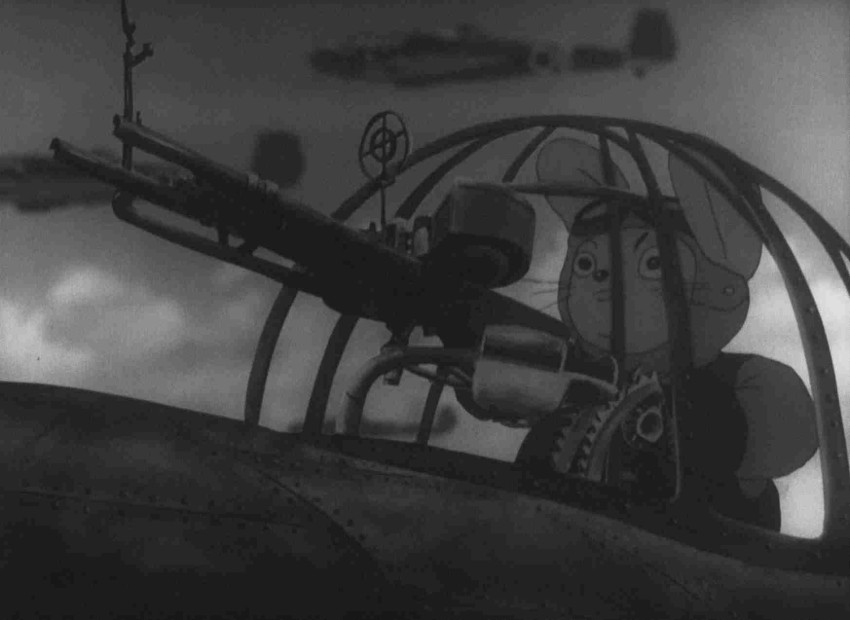
momotaro_still_page3_4-850x620Over at the All the Anime blog, I write an introduction to the wartime propaganda movie Momotaro, Sacred Sailors (i.e. Momotaro’s Divine Sea Warriors), which is receiving its belated UK premiere at Scotland Loves Anime next month.

“Japan’s first animated feature was a masterpiece of propaganda film-making, uncompromising in the bile it directed at the enemy, romantic in its evocation of home and hearth and of imperial Japan’s Pan-Asian aspirations, and still unsettling today in its depiction of the mindset of the Japanese military. Its survival to reach modern audiences is itself an adventure story in which it somehow evades bombing raids, burial, shredding and bonfires, emerging from hiding after almost 40 years to offer modern audiences a horrifying glimpse of a very different world.”

Armchair Beijing

41A5LcKbTvL._SX268_BO1,204,203,200_Comments are in for my new Armchair Traveller’s History of Beijing, from some impressively heavy hitters.

“This book is like having a friendly, knowledgeable companion taking your arm as you wander through the back alleys and boulevards of one of the world’s great cities. Clements wears his learning lightly, and his informed but inclusive tone makes this the perfect book for the visitor to Beijing.” — Rana Mitter, author of Modern China: A Very Short Introduction

“Beijingers, both Chinese and foreign, mourn the Chinese capital’s rapidly-disappearing traditional alleys but few of us appreciate Beijing as a city that has lasted through 2,500 years of building and destruction. Jonathan Clements’ tour of the city starts with Peking Man and a jovial candy seller, and moves on through the Chinese dynasties with a readable flair. He comes well-stocked with tales that will be new even to long-time residents. It’s a book for a warm teahouse on a cold winter afternoon.” — Lucy Hornby, China correspondent, Financial Times

“It’s hard to imagine anyone better equipped than Jonathan Clements to compile a readable account of Beijing. Authoritative yet deliciously irreverent, his history of the city is an essential companion for the visitor and a treasure trove of vicarious delights for the chair-bound.” — John Keay, author of China: A History

“If New York and London dominated the global imagination in the twentieth century, Beijing is already in the process of usurping them in the twenty first. An extraordinarily exciting city, possessed of enormous optimism and expectation, it has a long, fascinating and complex history. Jonathan Clements unpeels the onion that is Beijing and in a highly readable and informative book gives us a wonderful glimpse of the history of a compelling city.” — Martin Jacques, author of When China Rules the World

“…direct, well-written history, that travels at a steady pace from Peking Man to the ill-fated opening of a Starbucks inside the Forbidden City… if you’re after some interesting facts to impress friends and visitors with, this is the book for you.” — That’s Beijing

“Jonathan Clements evocatively captures the contradictions and complexities of contemporary Beijing while rooting the city in its broader historical context … Covering such a wide swathe of territory is no easy task, but Clements does so skilfully and often wittily, weaving together myth, factual data and vivid details … Clements’s written is lyrical at times, but there are also moments of jocularity in unexpected places. When introducing the Beijing Zoo, for example, he wryly notes that “dogs are available for rental, for anyone who wants to… rent a dog.'” — Times Literary Supplement

Available now from Amazon UK/US.

All My Sons Remembered

akirasan

It was a running joke that when Japanese interviewers would ask Akira Kurosawa what his favourite film was, he would always reply: “The next one!” His answer changed in the 1980s, when instead he would say simply: “Ran.” Released in 1985, this epic, lavish samurai drama was intended by Kurosawa as his final word. Although he would in fact go on to make three other movies, he genuinely thought that this time he was going out with a bang.

Kurosawa saw himself in the character of Hidetora (Tatsuya Nakadai), an aging lord who, King Lear-style, tries to partition his realm between his three sons. The youngest, Saburo (Daisuke Ryu), scoffs at his naive idealism, and is banished. But Saburo is right. Hidetora soon runs into old enmities long thought forgotten. His rise to the top was ruthless and blood-stained, and now we see his karma coming back to haunt him. His daughter-in-law Kaede (the fantastically swivel-eyed Mieko Harada), wants revenge for the deaths of her own family, and turns his eldest son Taro (Akira Terao) against him. Before long, Hidetora is on the run from his own children, as they annihilate each other and the realm he helped to build. It is chaos, turmoil, tumult – in Japanese: Ran.

But not long before this triumphant return to form, despite being garlanded with accolades all around the world, Akira Kurosawa couldn’t get arrested in his home country. He had only made three other films since Red Beard (1965), the troubled production that cost him his friendship with his muse and leading-man of choice, Toshiro Mifune. His directing contract with Toho Studios had ended, throwing him at the mercy of the free market. After the box office failure of Dodesukaden (1970), he had even tried to kill himself.

Help arrived from unexpected quarters. In 1975 he directed the acclaimed Dersu Uzala, in Russian, in Russia. There was surely a bitter taste in its Best Foreign Feature Oscar for a Japanese director who had literally been sent to Siberia. But just as the noise over Dersu Uzala was dying down, George Lucas scored an international hit with Star Wars, proclaiming in interviews that one of his inspirations had been Kurosawa’s 1958 adventure movie The Hidden Fortress. Lucas and his similarly wealthy colleague Francis Ford Coppola came knocking, offering to bankroll the foreign release of Kurosawa’s next film, and thereby stumping up enough cash for even the timid Toho to take a punt. It was the ultimate in geekery – rescuing one’s student idol from the bargain bin of history. The resulting film, Kagemusha (“The Shadow Warrior”) was one of the top Japanese films of 1980. It actually made money, which took Kurosawa back from zero to hero. He was back in business!

2456_1.jpg

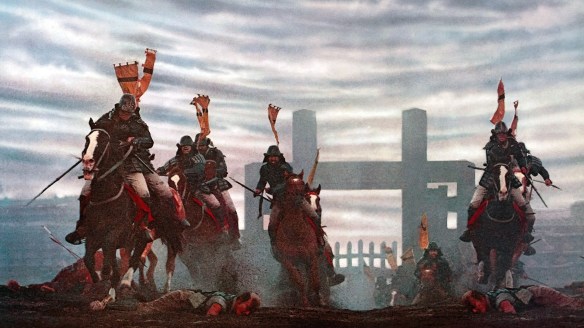
Eventually. It took another five years for Ran to get off the ground, in which time the septuagenarian director had ample time to storyboard every inch of every frame. With a $11 million budget (and this was when $11 million was a lot of money), he threw out every compromise in search of the biggest of impressions. He built an entire castle on the slopes of Mount Fuji, just so he could burn it down. He painted an entire field of flowers gold, to create a spectacularly surreal night scene, only to cut it in post-production (this scene can be seen in AK, the documentary included in the Blu-ray extras). He had literal armies of extras streaming along the hilltops and into massive battles, all shot from a numbing, alienating distance, with violence and terror reduces to swirling patterns of banners and firework displays of musketry.

From the film’s opening moment, at a fork in the road prefiguring the three-way conflict about to be unleashed, Ran is a triumph of symbolism. The characters are only depicted once sitting in a circle – whole and equal. Every other composition is broken and asymmetrical, daring the viewer to see further portents in the theatrical staging. And when it comes to home video, I would say its time has come. If you can’t catch it in a cinema, then at least most tellies are now big enough to catch all the expansive action, and modern media can capture every pixel. Go on, treat yourself.

Jonathan Clements is the author of A Brief History of Japan. This article first appeared in Geeky Monkey #8, 2016.

Under the Hammer

Tezuka_Sothebys1To Paris in June, where the local branch of the auction house Sotheby’s held a sale of 260 pieces of comics artwork, including samples from the likes of Jim Lee, Hugo Pratt and Uderzo, with a total sale value of €1.3 million.
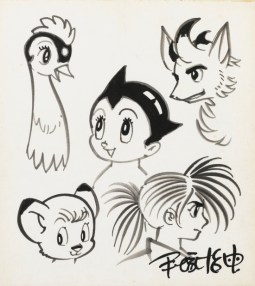
The manga component was only a small fraction – largely from Osamu Tezuka. Notably, the Tezuka pieces sold at the low end of their expected price, suggesting that Sotheby’s assessors, whoever they were, had rightly predicted their likely value. Your mileage may vary – none of them looked particularly interesting to me. Astro Boy et Autres Personnages, for example, which went for a posh-sounding €3,625, was a scrappy little pen-and-ink study of five unrelated Tezuka characters. What you were paying for was largely its provenance, which is to say that value of knowing that these images were drawn by Tezuka himself, who is too dead to draw any more.

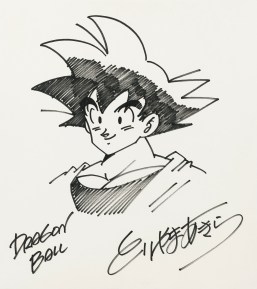
toriyama.jpgMost surprising was a single head-shot of Dragon Ball’s Son Goku, drawn by Akira Toriyama, which went for €15,000, five times the estimated price. Toriyama is still happily alive, and is presumably cackling to himself in his studio as he knocks out another hundred such sketches to put on eBay. One suspects that Chinese capital is at work here, bidding up the value among people who have read the manga in Mandarin.
In the meantime, here are my top tips for anyone seeking manga artwork as an investment.

Make sure it’s signed clearly, and preferably not to you. Future buyers will want the artist’s signature, not the fact that it includes the message “GEMMA YOU ARE TOPS!” Not unless their name is Gemma – a limited crowd.

Try to get a single study (a bust, full-length shot or face), not a random collection of heads; it’s worth more if it’s hangable as a portrait.

Beware of gimmicks – Motoko Kusanagi depicted as your girlfriend might feel like a giggle today, but only if you become as famous as she is.

Do think, too, about the capital you are already investing. If you’re spending £10 for the sketch, and giving up two hours in a line, and a weekend at the convention, and the train that got you there, the incidentals do mount up. Has it really cost you £10, or has it already left you £200 out of pocket? Because not every queue is going to be worth standing in.

Jonathan Clements is the author of Anime: A History. This article first appeared in NEO #153, 2016.

When Miyazaki Was There

himarnie

Asthmatic, blue-eyed Japanese girl Anna is sent away by her adoptive family to recuperate in north Hokkaido. She finds herself in an idyllic rural retreat, where the sea has a haunting habit of invading the marshy land; where a dilapidated mansion seems to call out to her, and where she befriends the ethereal, blonde stranger Marnie, who assures her that this is not a dream.

Based on the 1967 novel by Joan G. Robinson, Hiromasa Yonebayashi’s When Marnie Was There is a melancholy, elegiac account of a disappearing countryside and forgotten melodrama, set in Japan’s far north. Although there are twists of a sort in the tale, they are so obvious even in the above synopsis that the film becomes much more invested in the how rather than the what, and in the recreation of stunning vistas of the natural world. Such forests, such mountains, such skies, the animators whisper, are not a dream, either.

Marnie was the last feature-film production from Studio Ghibli, coming at the end of a decade-long series of fixes and bodges designed to keep the studio going after Hayao Miyazaki’s retirement. Producer and all-round svengali Toshio Suzuki tried to hire big-name directors to replace him; then he tried to train up new talents. He lured Miyazaki himself back for two more films, cunningly spacing them wide apart, and obscuring the precise details of who did what with an entirely alphabetical crew listing, so that when other directors took the reins, only the attentive audience members would even notice. Suzuki’s biggest and most controversial coup came with Tales from Earthsea, for which he dragged Miyazaki’s son Goro, a landscape gardener by trade, out from the rose bushes and into the director’s chair.

Goro had spent his whole life playing second fiddle to his parents. Before he even went to school, he and his brother had been the unwitting subjects of a book, Goro & Keisuke: A Mother’s Childhood Picture Diary. Hayao Miyazaki himself has publicly acknowledged that he neglected his own family while entertaining everybody else’s, and Goro rejected animation as a career. He contributed admirably to the Ghibli legacy by helping design its world-class museum, but was deeply reluctant to ride his father’s coat-tails. The critical failure of Tales from Earthsea, which begins with a prince stabbing his kingly father to death, was a foregone conclusion, but Suzuki milked the controversy, daring audiences to come and see the wreckage, and then daring them again to see how the two Miyazakis worked together on From Up On Poppy Hill, with dad writing the script and junior directing once more after a public burying of the hatchet.

Throughout all of this drama, Hiromasa Yonebayashi was the quiet labourer in the shadows. Rising through the ranks from in-betweener to key animator, Yonebayashi was arguably the most successful of Suzuki’s trainees. A cynic might infer that Yonebayashi did all the real work on Tales from Earthsea while Goro was just a figurehead. But Yonebayashi has had little chance to stamp his own imprimatur on his work. He’s spent the last ten years diligently pastiching Miyazaki’s world-beating style, helping to carry Studio Ghibli through a vital transition as its founders retire and its output devolves into “legacy management” – the museum, the gift shop, and the retrospective Blu-rays.

One of Miyazaki’s parting gifts to his studio was a list of 50 recommended “children’s books” – although some of them, like Sherlock Holmes and The Three Musketeers are hardly childish. It’s this list, it seems, that is a working document for the studio’s swansong, with Marnie picked from it in order to regenerate a bit of the old Ghibli magic.

There have been a lot of tears shed over the shuttering of Studio Ghibli’s animation division, but true geeks should celebrate the boldness of the move. Do we really want Totoro II or Spirited Away Again? Instead of devolving into slapdash sequels, with the leading lights retiring, what better way to preserve its legacy by quitting while they’re ahead? But spare a thought for poor Hiromasa Yonebayashi, who was nominated for an Oscar for Marnie, but who is little-known or recognised in the anime world, having worked for a decade to keep someone else’s reputation alive.

Jonathan Clements is the author of Anime: A History. This article first appeared in Geeky Monkey #9, 2016.

The King Hippo

Japan’s “forgotten” anime mogul, Hiroshi Okawa

toei logoThe animator Yasuji Mori used to call Hiroshi Okawa (1896-1971) the King Hippo, describing him (albeit not to his face) as a distant, preoccupied man in a suit whose approach would strike fear into the hardest of section chiefs. If Okawa was coming to visit, even the boss would have a mop out.
“He was a pompous king,” wrote Mori in his memoirs, “and rarely spoke to us commoners. I did meet with him once when we’d finished work on Hakujaden. Me and [Akira] Daikuhara, who did the key art, were invited to his office, and he just said ‘thank you for your work’ in this high-pitched voice, like when a tape is played on fast-forward. And in the autumn of the year that Toei Animation was founded, there was a sports day for all the Toei employees and their families, and the animator team won first prize in the fancy dress. I went to collect the prize money, and he said to me ‘that was really funny’ in a way that showed he really didn’t think it was funny at all.”

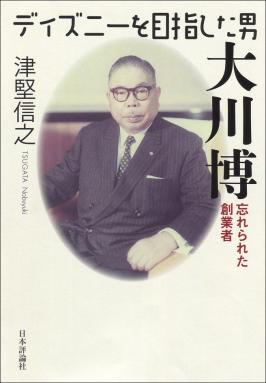
07186_1Nobuyuki Tsugata’s new Japanese-language book, The Man Who Aimed For Disney – Hiroshi Okawa: The Forgotten Entrepreneur, labours under the weight of its two subtitles, both of them seemingly concocted less for the benefit of readers than to ensure that the right tags are in place for search engines. Tsugata regards such phrases as points to be considered rather than statements of fact, as well he might. I bristle, for example, at the suggestion that Okawa truly is “a forgotten entrepreneur.” Obscure he may be, but of the two English-language books that cover his era, Hu Tze-yue has five references to him in her index to Frames of Anime, and my own Anime: A History has eight. Moreover, Tsugata’s own publication record has made him the institutional memory of the anime industry – he’s pretty much the guy who decides who is forgotten and who is not, and if he’s written a book about you, it’s fair to say everyone in the field will know who you are.

Okawa certainly aimed to be the “Japanese Disney”, and it’s this element of his career that has proved the most problematic in historical memory. That’s because, of course, the Astro Boy creator Osamu Tezuka also wanted to be known as the Japanese Disney, and the Tezuka estate has been far better at pushing its case. We might scoff today at such fervent auto-orientalism, but as Tsugata has argued in earlier books, while Tezuka did a marvellous job with public relations, Okawa has a valid claim to the crown from a business point of view.

After many years chronicling the world of animators and artists, Tsugata drags himself far from his comfort zone to talk about the life and times of an avowed Suit. He has no qualms, for example, about describing Okawa as “a film studio boss who knew nothing about films.” Okawa arrived at Toei Animation by the oddest of routes, starting his career as an accountant at the Ministry of Railways (“There was no man better with an abacus”), before being head-hunted to work for the Tokyo Rapid Electric Railway (Tokyu) corporation in 1942. He entered the post-war period as a middle-ranking executive at a company that was swiftly diversifying, pouring infrastructure profits into developing the first of those fantastic shopping malls that can be found at Japanese train stations. Don’t just get on the train home, stay and have dinner in a nice restaurant; do your shopping in our department store; catch a movie!

In 1946, Okawa found himself shunted over to a new role as the manager of a baseball team that Tokyu had somehow acquired. This moved him inexorably into the world of commodified entertainment, as he worked to turn baseball into more than just a run around the local park, but a media event that demanded merchandise, fixed sites, novelty food, and season tickets… Okawa became instrumental in the funding of the Pacific League, in which his team competed against a bunch of others, dragging fans around the country (by train, of course) to witness more matches.

Groomed as a likely president, Okawa was shunted sideways yet again, put in charge of turning around a trio of media companies, merged as Tokyo-Yokohama Films, Oizumi Films, and their parent Tokyo Film Distribution. This unwieldy mess, described by Okawa himself as a lame three-legged racer, hobbled by its own ties and deep in hock to loan sharks, is known today by a contraction of the words for Tokyo and Film, as “Toei”. Among its holdings was a modest collection of 36 cinema theatres. In an epitome of integration, Okawa helped to make the films that were shown in the cinemas and watched by the passengers who had eaten at the restaurants… funnelling money back into Tokyu at every stage.

Okawa dragged Toei out of the hands of its gangster creditors and into the arms of legitimate banks. He scooped up new film talent among refugees from Man-Ei Studio, newly returned from Japan’s lost puppet state of Manchuria. He ducked and dived in the movie market in search of new niches, heading downmarket but with a promise of more bangs for the buck by offering double bills on the same ticket at Toei cinemas. He scored his first big hit mere months after the end of the US Occupation with The Tower of Himeyuri (1953), a weepy about a unit of nurses killed at the Battle of Okinawa. In pursuit of the children’s audience, and in anticipation of the rise of television, he also acquired the struggling animation studio Nichido, renaming it Toei Animation in 1956.

white-serpent

Nichido’s animators were punch-drunk after a decade of living hand-to-mouth, and reported that Okawa was “more enthusiastic than us” about the prospects for animation. And this is where Tsugata’s book comes into its own, as he investigates the degree to which the success of Toei Animation in the 20th century can be credited to the talents of its many famous animators, or to the stern money-man who pushed them on to greater things.

In animation terms in the 1950s, making a full-length colour feature film was an enterprise akin to breaking the sound barrier. It was not merely a  case of building up the talents, training and materials necessary to get a workflow going on a 70-minute movie, it was the pay-offs in exhibition when that movie could sell its own ticket. Until Japan could produce its own feature-length cartoon, its animation output was doomed to remain as filler. Okawa, however, conceived a plan to churn out animators in an on-site training exercise, until he had so many that he could make a film. He got his wish in 1958 with the release of Hakujaden, Legend of the White Snake, a film that conveniently filled the gap left in Japanese cinema bookings by the petering out of Disney movies postponed since the war. He also pinned his hopes on export, hoping to ship the Chinese-themed film out to other Asian markets, effectively playing the race card against Disney, and banking on “Asian” trumping “Japanese” in the eyes of foreign buyers.

A rift grew ever wider between Okawa and Tokyu after the death of the company founder, Keita Goto in 1959. Okawa, it was said, had once been told the corporation would one day be his, and was understandably at odds with Goto’s heir. Tokyu effectively cut Toei free in 1964, right in the middle of its labour struggles with disenchanted animators, and just as a TV boom led to start-ups poaching its staff. There is surprisingly little about this in Tsugata’s book, but if we’re prepared to assign credit to Okawa for some of Toei’s achievements, then surely we should also consider the degree to which he may have been responsible for the agitation, strikes, disputes and lock-ins that characterised the studio’s troubled years. Certainly, there were grumbles at Toei Animation about a brand of cronyism that favoured employees parachuted in from railway affiliates and sister companies, rather than the artists who did the actual work. One of the most infamous of the angry voices was one Hayao Miyazaki, a shop steward who pushed for workers to be paid for what they did, rather than which branch of the company they hailed from.

Okawa’s training scheme led to Toei’s nickname as “Toei University”, but by the late 1960s, his business model was hopelessly outmoded. He had funded the training of the bulk of the anime industry, including Miyazaki himself, but in doing so, he had paid for the mentoring of countless rivals. He remained adamant that television was not the enemy – it might have seemed like cinema was suffering at the hands of home viewing, but Toei Animation turned a pretty profit making hundreds of animated adverts. Shortly after Okawa’s death in 1971, Toei pivoted to a leaner model, becoming the centre of a diverse web of companies formed by its former employees, outsourcing many jobs and letting the subcontractors take the risks.

Tsugata finishes his book with a prolonged meditation on Okawa’s legacy, both visibly in terms of the modern output of the Toei studio, and invisibly, in terms of its competitors, many of whom owe their founders’ education to Okawa’s schemes. After all, Nerima ward in Tokyo is known today as the anime district because it is the location not only of Toei, but of Toei’s many satellites.

Jonathan Clements is the author of Anime: A History.

The End of Cool Japan…?

41OlrO2WKWL._SX331_BO1204203200_Over at the All the Anime blog, I review the new collection of academic essays The End of Cool Japan: Ethical, legal and cultural challenges to Japanese popular culture.


“Thanks in particular to the rise of Fan Studies, it has become all too easy for the Western pundit to lock themselves in a convention-centred hugbox in which ‘everybody they know’ thinks that anime and manga are the bee’s knees. Then, someone ruins their day by giving them the actual sales figures. Not that sales figures should be the sole determinant for avenues of academic enquiry, but if someone is setting themselves up as an expert in what is ‘popular’, they’d better have some idea what that actually means.”