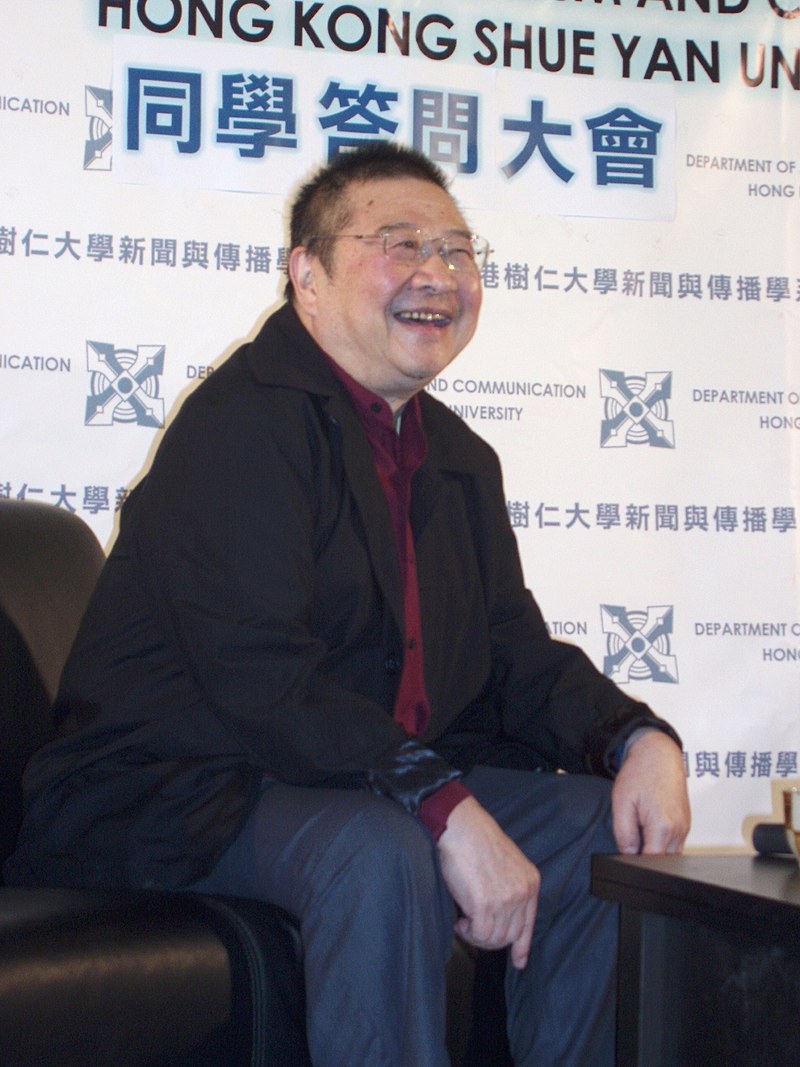
“Hong Kong remained his home thereafter, but his antipathy for the Communist regime did not slacken in later years. In a 2009 interview, he provocatively announced that he was less afraid of China during the purges of the Mao era, since the worst possible danger to the world would be presented by a predatory capitalist system run by a dictatorial elite.”
Ni Kuang, who died yesterday, is the subject of a long entry I wrote for the Encyclopedia of Science Fiction.
One of Master Wei‘s children has gone into business with one of the nephews, thereby proving that although they look normal, they are just as much mentalists as Master Wei. They have set up a bespoke restaurant that only serves products that have been made with tea. The clientele is somewhat exclusive, restricted to coach parties of tea nutters doing the Tea Tour, as well as visiting Party bigwigs and foreign film crews.
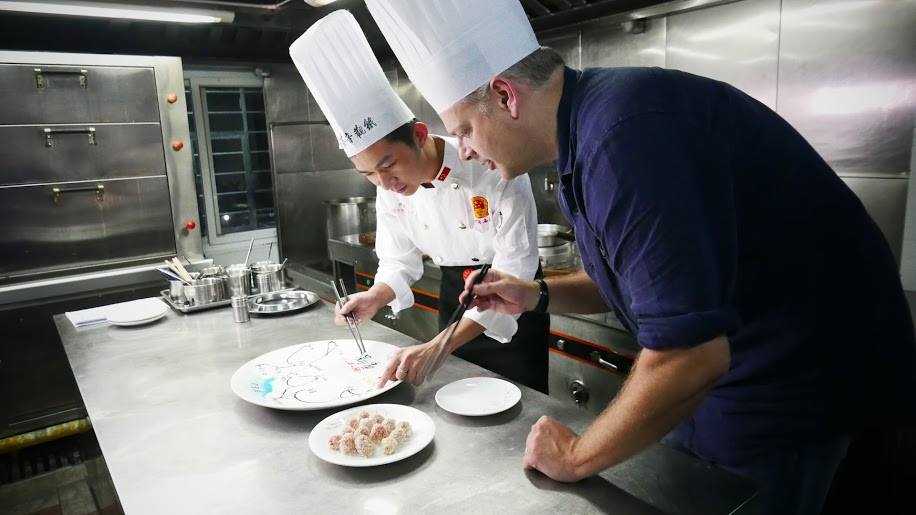
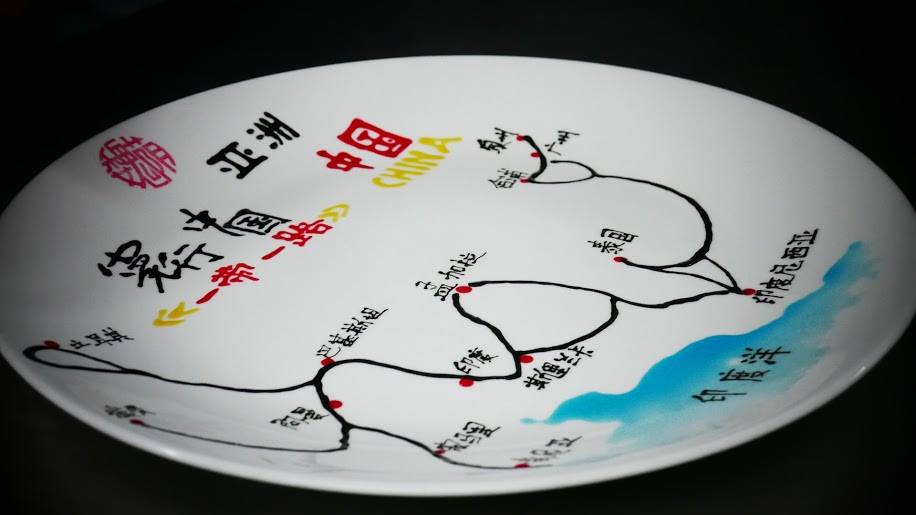
Chef Chen, the cousin, has drawn elaborate displays on each plate, picking out the National Geographic logo in custard, and drawing a map of the Silk Road in chocolate sauce. He shows me around his brushed-steel kitchen, and fires up the volcano stove, so named because it whooshes into life like a lost jet engine, and heats up his wok in half a minute .
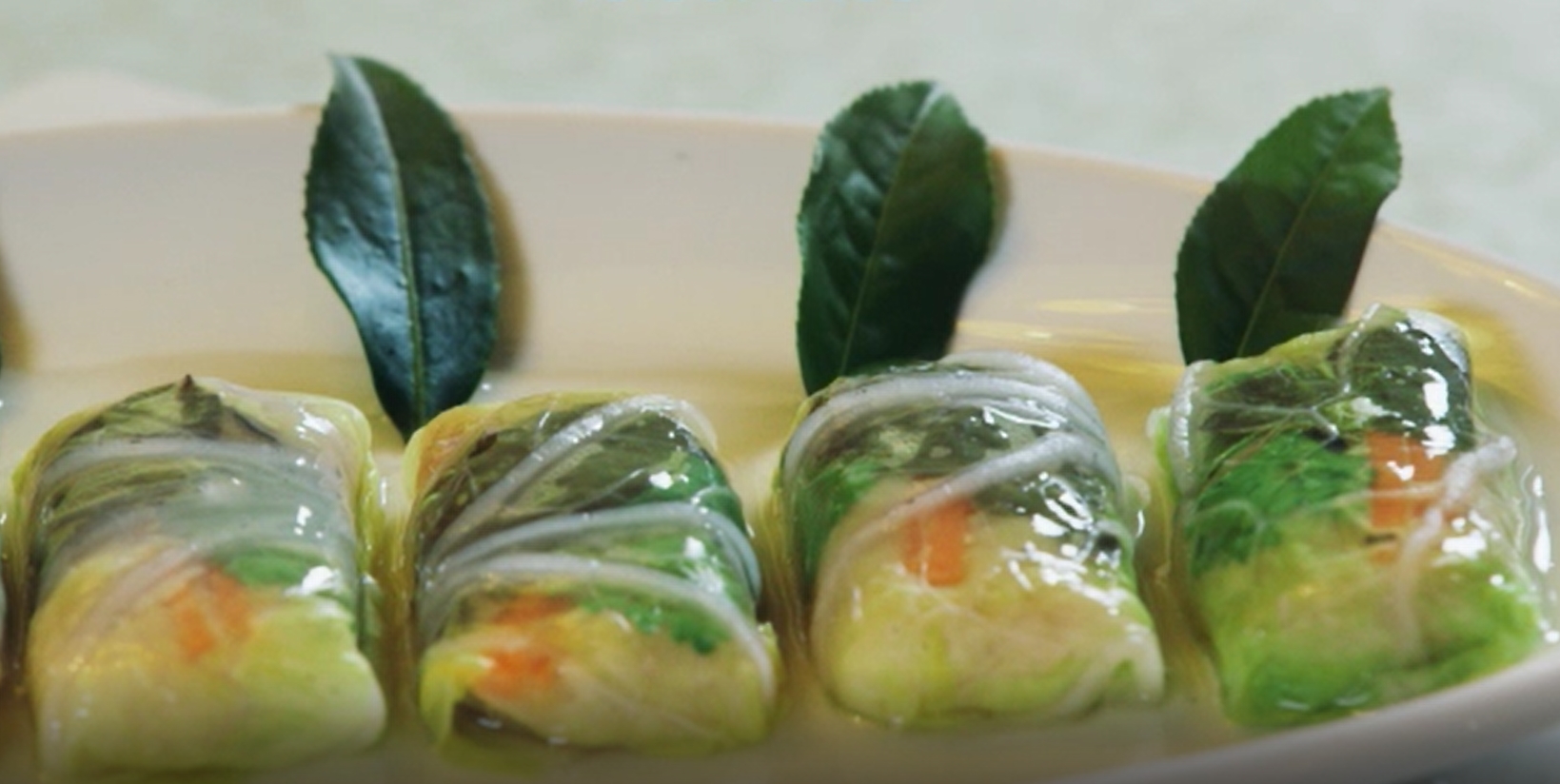
Chef Chen is decked out in all his funny-hat finery, and a chef’s hat is found for me as well so that I can look ridiculous next to him. He treats me to a selection of amuses-bouche, many of which have the slightly desperate taint of a man trying to find an excuse to put tea in things. There are deep-fried tea leaves in batter; goose feet braised in tea, lamb soup with a tincture of tea… you get the idea. I am forced to down far too many spoonfuls of his deep-fried bee larvae with crisped tea leaves for my liking, and there is no beer. Only… tea.
What first appears to be some sort of candy for dessert turns out to be balls of deep-fried salad cream, lightly dusted with… tea.
“You place them here on this map I have done in chocolate that shows the Silk Road,” he says. “There’s Quanzhou, where we are now, and Hong Kong, and Indonesia, Thailand… where are you from?”
“England,” I say. “So on this scale, that should be somewhere over there behind the fridge.”
For a lot of the time, I am mercifully excused from the kitchen while the crew film B-roll of Chef Chen at work concocting his masterpieces from ingredients that might as well have been randomly selected with a dartboard. This leaves me downstairs in the plush foyer, decorated with golden statues of elements of the tea-making process, and photographs of Master Wei shaking hands with a bunch of Chinese people I don’t recognise. There are also displays of the various Iron Guanyin teas that can be bought from the Wei family collective, including the infamous £36,000/kilo “Wei 18,” the most expensive tea in the world.
This leaves me for an hour in the company of the Wei son and his cronies, who while away the evening sipping little cups of… wait for it… tea, made by a prim young lady in business attire. My experiences in Yunnan have taught me the basics of the Chinese tea ceremony, and so I watch as she goes through the motions of cleaning, refreshing, boiling, washing… all seemingly quite common sense to me now, although they seemed impossibly intricate only a month ago. The men witter about nothing, while their serving girl remains impassive and silent. The time passes pleasantly enough, until midnight, when we are then informed that Chef Chen has now finished the food preparation for the documentary, but that now he expects us to eat it.
A tense and malevolently quiet banquet then ensues as we all try to force down as many bee larvae and deep-fried salad cream puffs as we can, before we are finally permitted to leave.
It is half past midnight, but that is of little help to us, since we have been consuming TEA all evening. I don’t get to sleep until 4am.
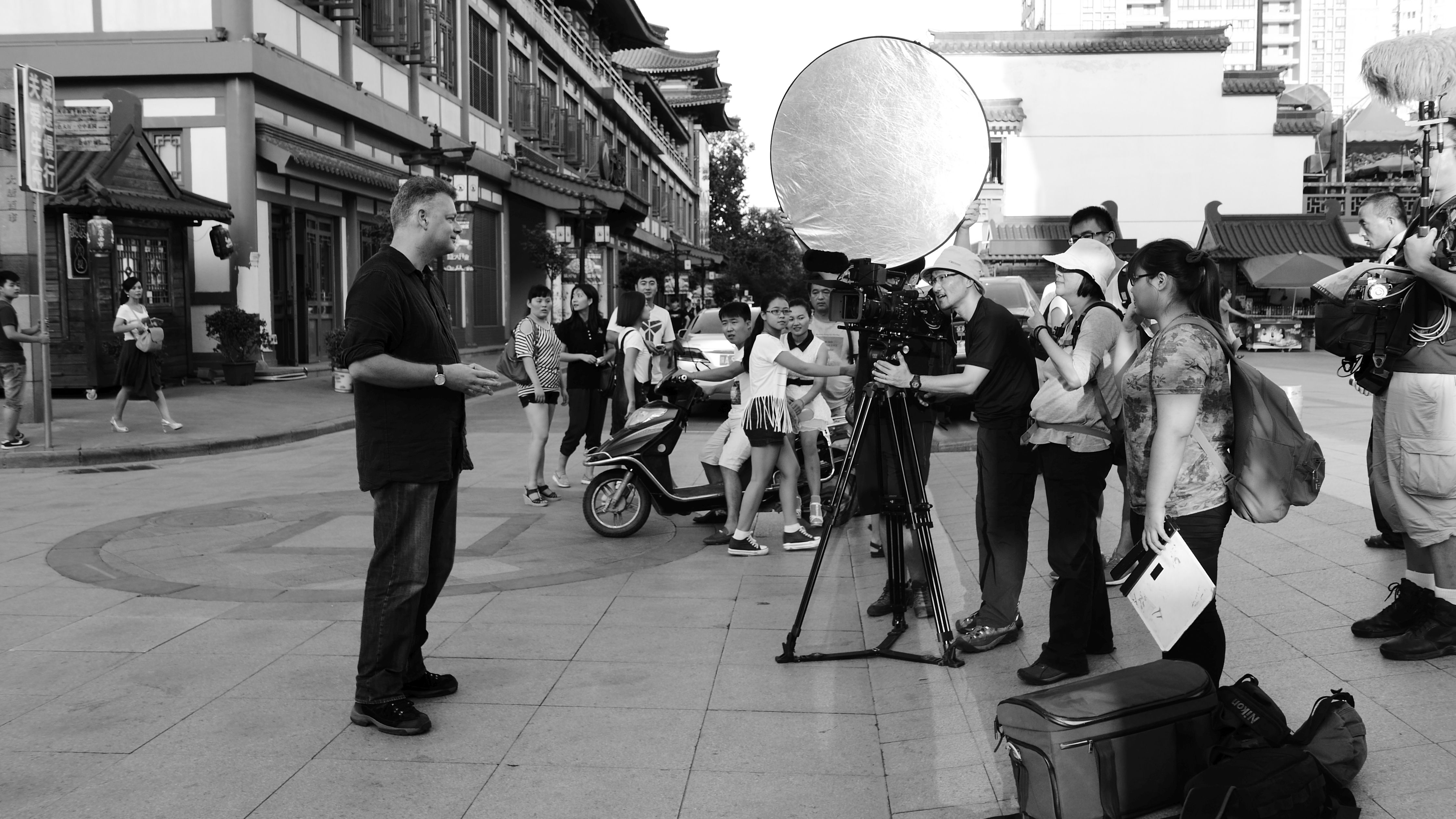
They woke up before dawn and drove for three hours to be here in time for the start of your business hours. Since then, they have been standing all day.
Why are they standing still?
Because footsteps or the rustling of clothes may interfere with the sound and ruin the take. Movement behind the camera may distract the talent and ruin the take. Moving shadows unrelated to onscreen action may interfere with the shot and ruin the take.
Why are they clearing away the gawpers?
Because every extra body near the shoot is an extra chance of a shuffle, or a belch, or a sneeze, or a cough, or a ringtone. See above.
Why won’t the grips let me help them?
They’ve got a job to do, and it’s a matter of pride. And if you drop a £3,000 lens, you’re paying for it.
What are they waiting for?
They are not waiting. The boom mike is recording ambient sound or “room tone” just in case they need to drop it in under a voice-over later.
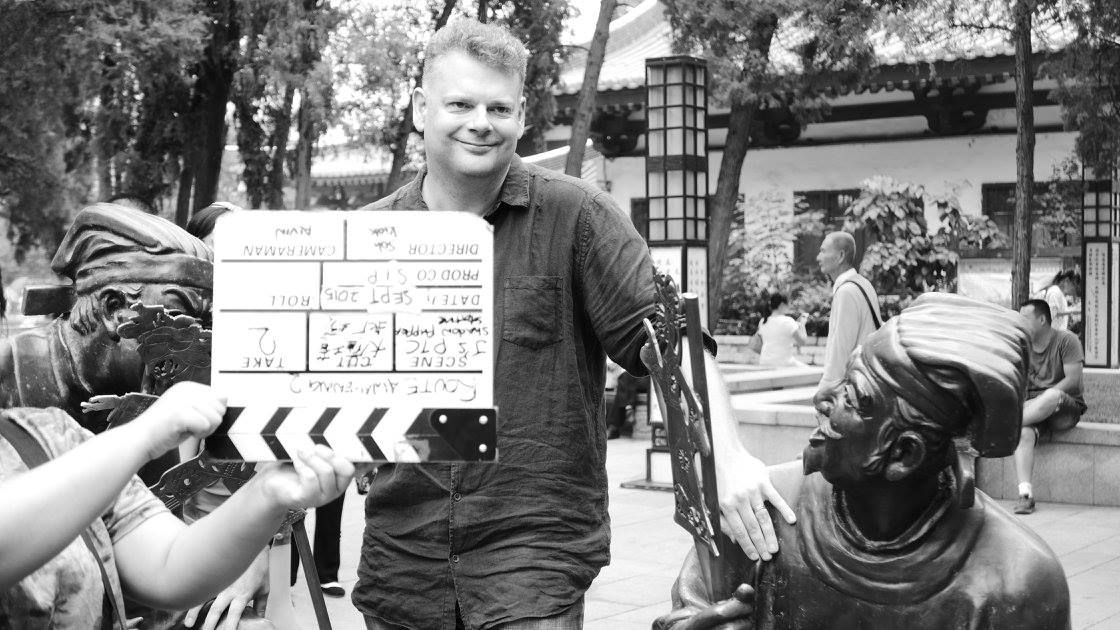
Why is the clapperboard upside-down?
Right way up for the start of a shot; Upside-down for the end of a shot. All so that the editor can spool through on fast-forward looking for the next take.
Why won’t they try our exciting local delicacies?
Because if someone has the squirts tomorrow it will cost thousands in lost time.
Can he use chopsticks?
He has three degrees and published an acclaimed translation of The Art of War. He has been using chopsticks since before you were born.
Why is the talent nodding at nothing?
The A-camera was on the interviewee for the first take, while the B-camera was focussing on anything she pointed at. For cutaways of the interviewer listening, they need to go back and film a second time, of him doing “noddies.”
Is he wearing the same clothes every day?
He has five duplicate sets of clothes, so that the continuity matches from day to day.
Why is the director annoyed with me…?
Are you wearing jangly keys? Is your phone off? Did you just try to sneak a photo of the shot, and forget that your phone makes a clicking noise? Are you just… there?
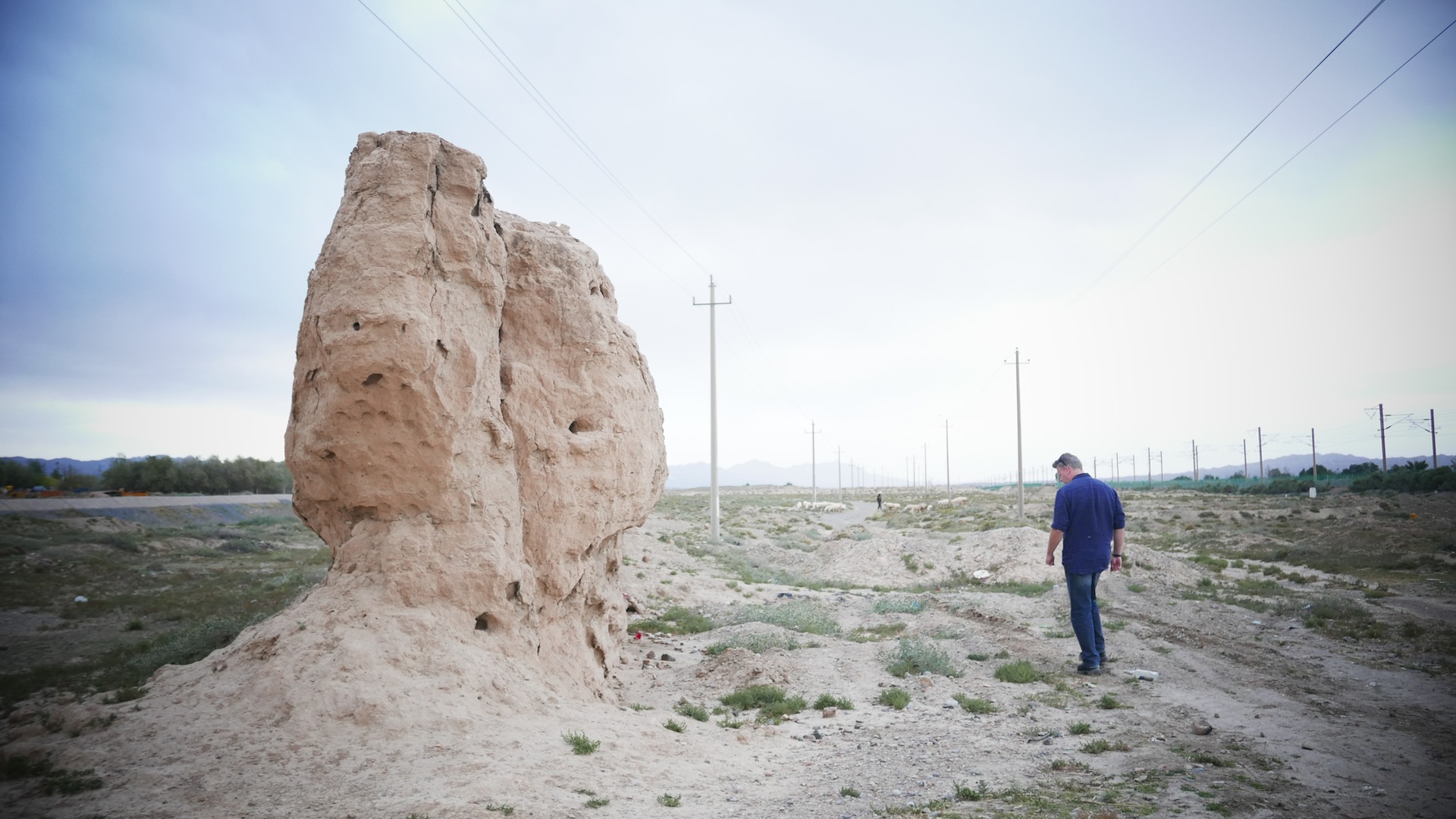
The Gansu end of the Great Wall is nothing like the posh Ming-era wall near Beijing. This is the Han-era wall, made of rammed earth, two thousand years old, and barely three metres high. It takes us the rest of the day to get there, and we lose our minibus to a broken gear-box on the way, forcing us to cram into the loaner Buick and the chase car just to get there before sunset. This is, I think, the fourth or fifth time that I have been at the Great Wall, although this version might be easily mistaken for a pile of mud.
I have to deliver a complex piece to camera which may form the opening speech of the series, and will certainly have to do for the opening of the trailer to be shown at the publicity event in October. I have to walk between a road and a railway, revealing that the Great Wall sits between them, and explain that the Great Wall here is “on the other side of China”, a gritty and real place, a thousand miles away from the tourist brochures. And then, I have to explain that I am a historian whose experience of China is really only from books, and that I am being forced to get my hands dirty finding about all these Chinese icons, and their place in a global trade network, past, present and future.
I have to do this in a single take, keeping my face to camera while my body is walking away from it, while the light is changing, while trains are zooming past on one side, and while trucks are zooming past on the other, while families of yokels keep stopping at the roadside and wandering over to see what is happening, and while a swarm of sandflies attack the crew, forcing me to deliver my lines while trying not to be distracted by the sight of nine people gesticulating wildly as they fight off a bunch of insects.
The Buick drivers take pictures with their cellphones, and I see a look in their eyes which is becoming increasingly familiar. They have spent all day watching the gangly fat foreigner, and wondering what the hell it is that he gets paid for. And then they have seen me deliver six passes at a 45-second monologue, while walking backwards beside the Great Wall, through broken glass and sandflies and passing dickheads.
The sun sets, we lose the light, and we have to pack up. The director has maybe three clean takes to work with, as well as several broken ones that might be stitched together in post. Considering the pressure (train, train, truck, truck, yokel, flies, light change, train, truck, GO!), I am pleased that we managed anything at all.
Xizhou, where we have been living in splendour and opulence for the last three days, was once a trading town on the Tea Horse Route. In 1941, it was the site of a forward radio station for the Flying Tigers and the transport aircraft bringing supplies over The Hump from Burma. Which explains an awful lot about the attitude of the Bai people here. When they ask me if I am an American, it is not out of ignorance but out of admiration, even now, for the pilots and soldiers who were stationed here to fight the Japanese.
What shock and awe there must have been, when one of these little valleys, glowing quietly in the afternoon sun, a pagoda on the hills, farmers in the fields, the clanging of cowbells and the calls of the birds, suddenly had its tranquillity shattered by the roar of shark-toothed American planes, screaming out of the sky in pursuit of Japanese fighters.
The breakfast room at our hotel is festooned with Flying Tigers memorabilia, wartime maps of China, the sunburst symbol of the Republican Chinese, pictures of Clare Chennault and his flyers, adverts for the (terrible) John Wayne film, and wartime bonds posters, exhorting “CHINA, THE FIRST TO FIGHT!” and “HELP HIM SAVE CHINA.” I try to explain the story to the crew, but I get quite tearful whenever I have to talk about it.
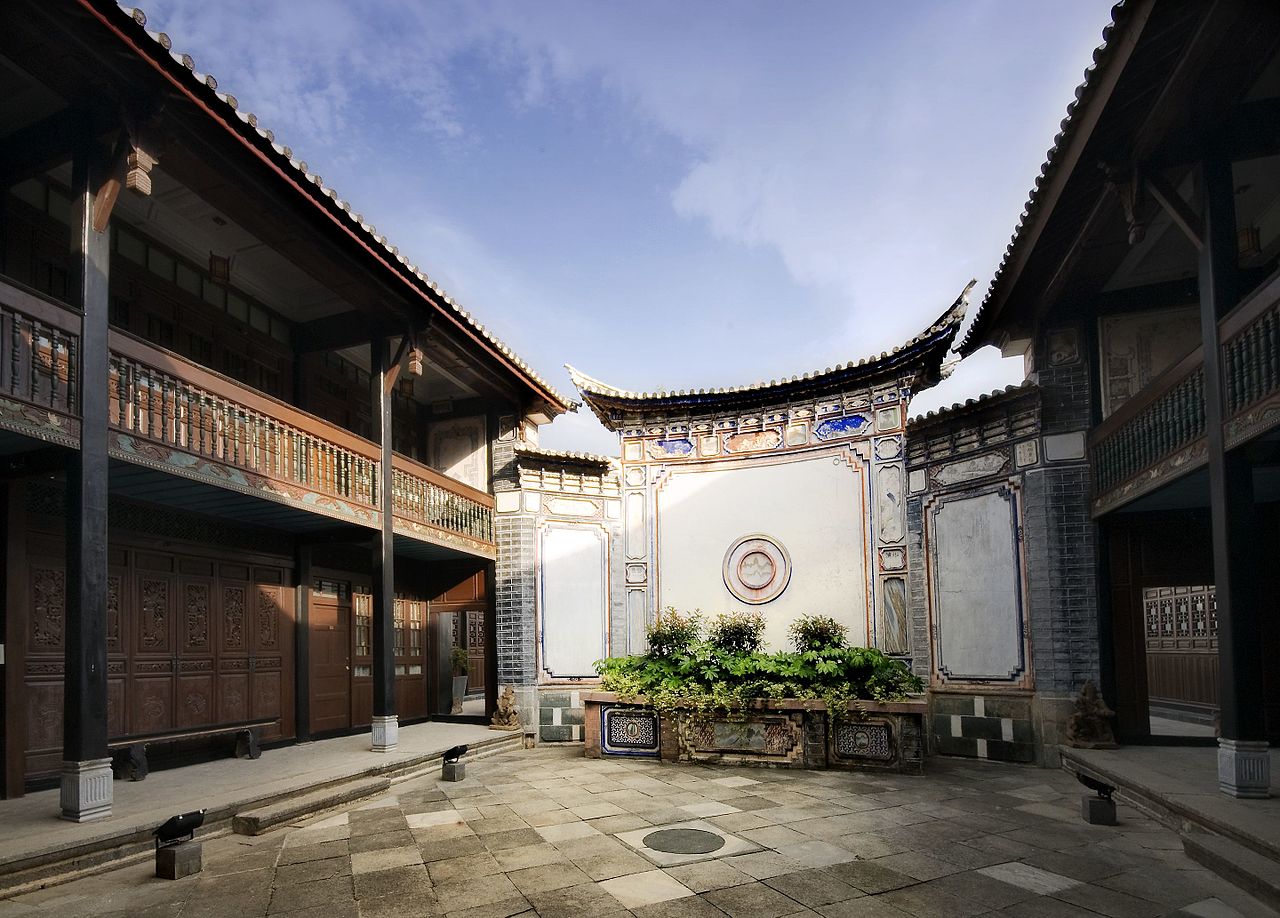
Our hotel is owned by Brian Linden, an American of Swedish extraction, who came to Xizhou eight years ago and has been fighting to persuade the Chinese to value their heritage instead of bulldozing it. He’s responsible for several sites in Xizhou, and appears to have been quite influential in the preservation of the surrounding area, which is clean but quaint and authentic, riddled with little shops and tea houses. He is in the process of restoring the radio station, too, which he intends to turn into another Flying Tigers museum, complete with a Boeing flight simulator that will allow visitors to relive the terror of navigating across the Himalayas.
Brian first came to China on a scholarship to study Mandarin. He met his future wife at Nanjing University, and was soon talent-spotted to play the lead in the Chinese movie He Came From Across The Ocean (1984), a dismal weepie about an American student who comes to China to study, but contracts fatal Encephalitis B. He spends much of the latter part of the film moping about the fact that his looming demise does not permit him to help China more. Brian reveals that there was no actual script, and since he was going to be dubbed anyway, he was told to simply talk nonsense for minutes at a time, while the crew made sad faces or happy faces behind him as a rough guide to his motivation.
“At first,” he says, “I tried to say what was going on in the scene, but then my shots stretched to five minutes, to seven minutes, so I just started repeating song lyrics. In the movie, my character is saying: ‘I am here to help the Chinese’, but if you can lip-read, I’m actually saying: ‘On a dark desert highway / cool wind in my hair….”
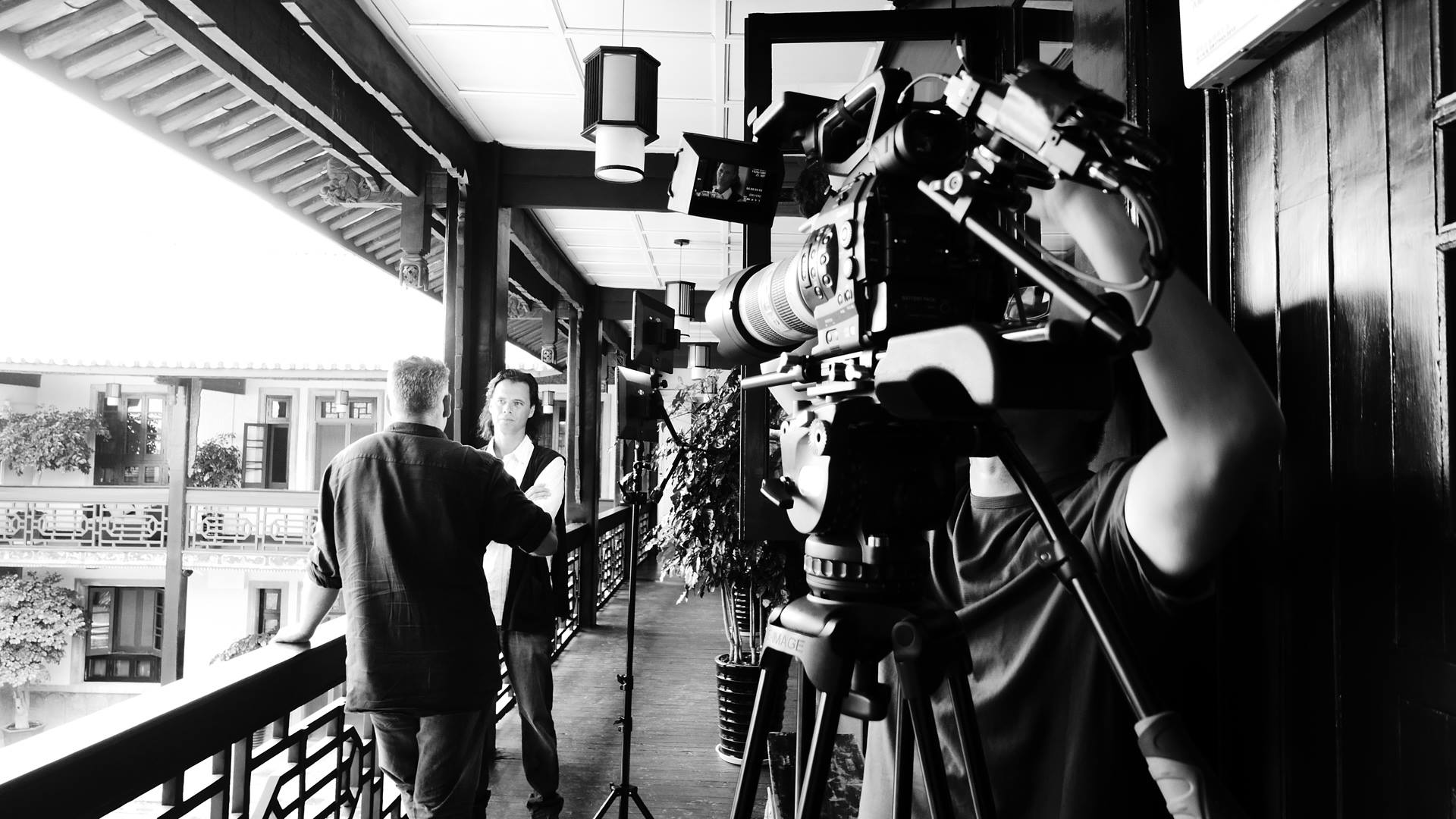
Brian is my easiest interview yet, since it is the first I have been allowed to conduct in my native language. We have lots to talk about. We are both the sons of antique dealers (he still has a shop selling Chinese antiquities somewhere in the mid-West), and since he was also once a cameraman, he takes an enthusiastic interest in the equipment we are using. He has never seen LED lighting before, and is amazed by the power and adjustability.
He is also something of a hippy turned businessman, and I have to steer him away from pat responses about how nice the Chinese government is, and rehearsed speeches about passion and travel. But we are soon commiserating with each other about the frustrations of having to obey Chinese laws when the Chinese can’t be bothered themselves.
“My fire prevention codes in this building cost me $120,000 for all the gear and alarms,” he sighs. “The guy next door has an illegal hotel, and all he needs is a bucket of water.”
He is also determined to encourage among his visitors the concept of heritage (an historical appreciation) as opposed to their fractured sense of tradition (which should mean a sense of how things are done, but tends with the Chinese to mean a sense of how things are done last week).
He explains that he faces constant frustration with the “hotelisation” of Chinese tourism, which values nothing but selfie sticks and gimmickry. His hotel provides a traditional experience, but the Chinese guests complain that they don’t have TVs in their rooms.
“They build a hotel somewhere with a 60-inch TV in every room, and then some guy builds one next to you with 65-inch TVs, so the Chinese want to stay there because it is ‘better’. Why are you people watching TV, you’re in Yunnan!?” he wails. “They go on vacation and you ask them what they did, and all they tell you is how great it was that their bathroom had a television in it.”
I think the director is becoming slightly exasperated that I am just having a conversation with Brian rather than pursuing a particular National Geographic agenda. But I get him back on to track by asking him about the merchants who built the house we are staying in.
“They didn’t just build things for their families,” he says. “They contributed to the local community. They built libraries, they built schools. They had a sense of obligation to their neighbours, and you don’t see that any more. Now they just take their money and run away to America. I am trying to show them, they can spend it here. They can live here. They can love it, here. I don’t want to see Mediterranean houses and California-imitation houses by the side of the lake. I want to see houses like this.”
The Macartney Mission of 1793 sometimes seems to be one of the most studied diplomatic events in Sino-British history – a failed attempt to open commerce and diplomatic dialogue between George III, who was already mad, and the Qianlong Emperor, who soon would be when he had to deal with British faffing over protocols. Over the years, it has been written up by, among others, its deputy, by its sea captain, by Macartney’s own valet (a fascinating document, recently republished by Frances Wood, and which I hope to review here soon), and, tardily, by Macartney himself, whose own diary of events remained unpublished until 1958, over a century after his death. In recent years, it has also been the subject of a wonderfully detailed approach in diplomatic terms, Eoin McDonnell’s Kowtow, as well as James L. Hevia’s Cherishing Men From Afar, which approaches the whole thing from the point of view of the Chinese.
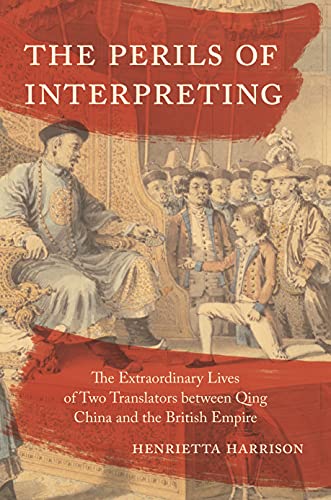
But all of these are valid and illuminating angles, as is Henrietta Harrison’s The Perils of Interpreting, which retells the story of the Macartney mission from the point of view of the poor men who had to interpret all the wrangles into and out of Chinese. Harrison focusses on Li Zibiao, the Italian-educated Chinese who interpreted for the mission, as well as the twelve-year-old George Thomas Staunton, who accompanied his father on the trip and was driven thereafter into a life of Chinese studies.
Harrison is particularly good at following the money, offering harsh financial explanations for historical phenomena. When it comes to the Macartney mission itself, she provocatively notes that of all the planetariums, muskets and clocks that Macartney tried to impress the Chinese with, he neglected to mention Britain’s most devastating and useful “new technology” – the national debt. It’s this, Harrison argues, that made it possible for the British to construct huge warships in the first place, while the Qing dynasty struggled to pay its bills.
She also places Macartney’s mission firmly in its historical context, noting only the massive amounts of money sloshing around the world in the ever-growing tea trade, but the degree to which Macartney’s own attitude was influenced by his personal experience in the Americas and India. Ousted from his former Caribbean post by the French, he was packed off to run Madras, where he was bogged down in a prolonged conflict with the neighbouring state of Mysore, and only permitted some breathing space when Britain’s acceptance of American independence brought an end to the war with France. India, Harrison writes, was supposed to be the new imperial possession to replace the lost Americas, and Macartney feared that Britain might lose India as it had lost the Thirteen Colonies. He was hence super-keen on establishing trade with China as a means of strengthening India as a British possession.
Occurring a number of times in Macartney’s diary of the mission, “Mr Plumb” the interpreter turns out to actually be Mr Plum (Chinese: Li), or Li Zibiao, a Chinese Christian who had studied at an Italian seminary, and was hence able to render Chinese into Italian or Latin. As the man literally at the ears of the Emperor and Macartney, Li was privy to all sorts of machinations and skulduggery, and indeed added some of his own by trying to work discussion of religious freedom for Chinese Catholics into some of the things he was translating. Harrison provides several chapters about the remarkable life that took Li from the edge of Tibet, to Italy and back to China, noting all the while that the Qing records of the Macartney Mission neglect to even mention that Macartney’s interpreter was Chinese.
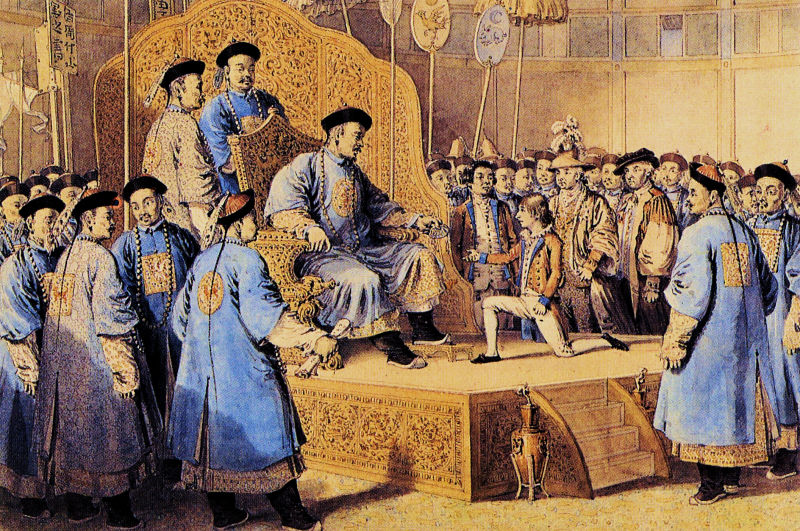
Much discussion of the mission tends to revolve instead around the mission’s “other” interpreter, George Staunton, the son and namesake of Macartney’s deputy. The twelve-year-old Staunton picked up enough Chinese on the journey to be able to stutter a few words in response to the Emperor’s attention, and also, in one of the British Empire’s more staggering delegations of responsibility, also put his sophomoric grasp of Chinese writing to use copying out the official diplomatic response to the Emperor. Harrison observes that the bigging up of Staunton in the official record is, at least in part, because it’s his Dad who wrote it, choosing to place his son’s encounter with the Emperor at the centre of the mission report, as one of the few moments of human interest in an otherwise tense and frustrating diplomatic encounter.
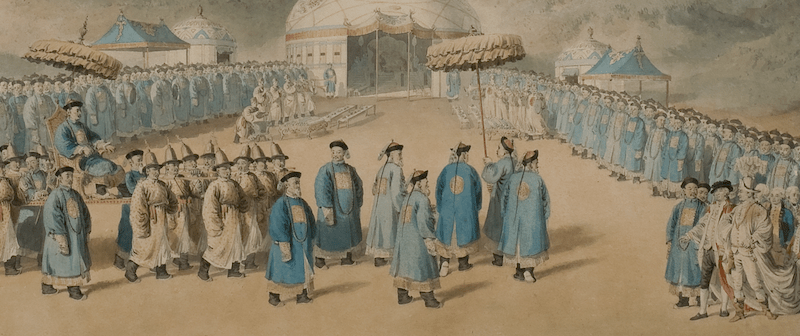
But there’s more to it than mere fatherly bragging. Staunton Junior, accepting a gift from the Qianlong emperor, became the centrepiece of the mission’s visual imagery, too. Harrison uses William Alexander’s painting of the Staunton encounter on her cover, noting in passing that it also includes the sole artistic representation of Li Zibiao. However, Harrison also observes that William Alexander didn’t actually accompany the entourage on their trip to meet the Emperor at his summer retreat. Instead, he drew his famous picture based on the description he received from people who actually had been there, and went through several drafts that depicted it in various different ways. Moreover, it seems highly likely that the centring of Staunton, effectively pushing Macartney himself into the background of the sole official depiction of his meeting with the Emperor, cunningly pulls the focus away from Macartney’s own interaction, which had been, and continues to be a matter of diplomatic controversy.
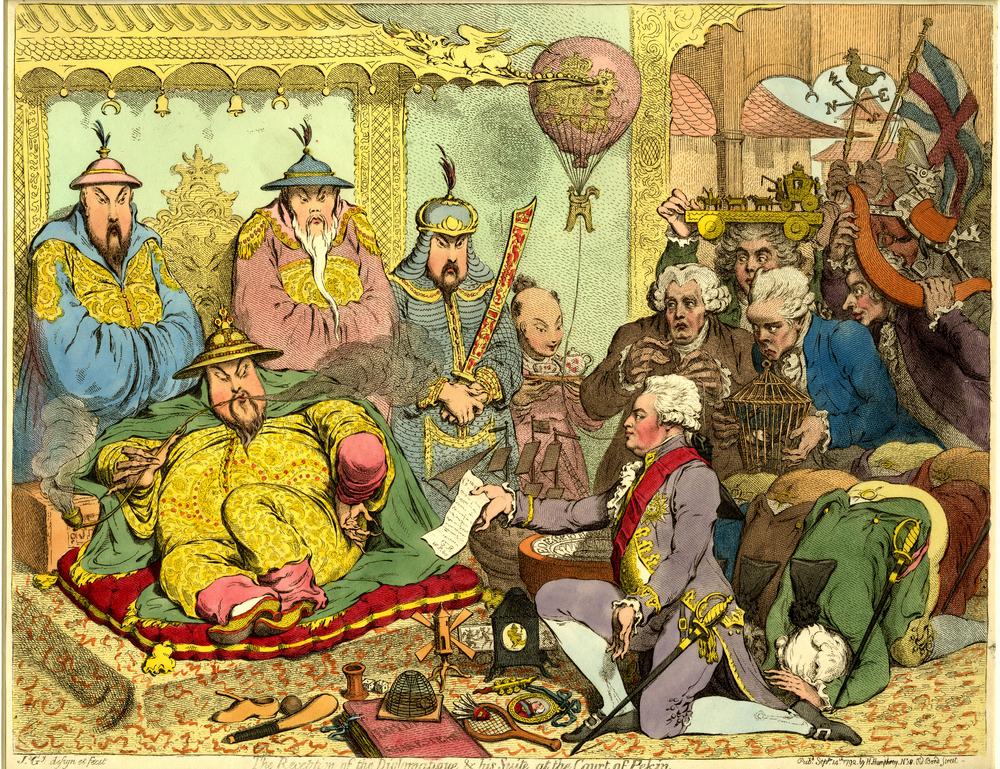
Even before Macartney left for China, there had been speculation about whether he would prostrate himself before the Emperor in the kowtow, (even to the extent of a Gillray cartoon, above, lampooning the idea) and Harrison gets gleefully grubby in the archives pointing out how Chinese and British writings on the fateful meeting offer widely different accounts of it, and that the elder Staunton’s own hand-written journal contains frantic crossings-out as he tries to find the best wording to describe Macartney’s behaviour as diplomatically as possible, none of which survive to the account as printed and published.
That’s not how the Chinese remembered it, and Harrison uncovers a cutting passage of courtly verse that compares the British to “wild deer, untamed and stubborn against the court rituals” and which brags that when push came to shove in the imperial presence, Macartney fell to both his knees.
So not the one knee that Macartney claimed himself, and not the full head-to-the-floor kowtow that the Chinese demanded? Whatever happened, after Macartney’s audience, the relations between the entourages turned increasingly frosty, and the British were bundled out of north China, being told that their time was up, but actually because the patience of the Chinese had run out.
The Macartney Mission was officially a failure, and its leader returned to Britain muttering that China was a rotting hulk, a ship of state doomed to sink or succumb to mutiny. That’s another story, of course. But Harrison stays with the two interpreters, charting their very different fates, as Li ended up as an increasingly unwelcome missionary in Shaanxi, while the younger Staunton nurtured a passionate interest in the Chinese language, and would return to China in his late teens as an employee of the East India Company. There, his years of careful study of Mandarin were confronted by the two-fold menace of Cantonese, as different from Mandarin as English is from Dutch, and by the horrors of Chinese Coastal Pidgin, a trading patois that mangled both Chinese and English into a new creole of its own.
There is more material extant on Staunton than on Li, and Harrison makes the most of her metadata, even including a graph tabulating the increase in his wealth from his bank accounts. Staunton gets to lurk as an interpreter in the corners of several other minor moments in Sino-British history, but suddenly comes to life, quite jaw-droppingly, in an encounter in 1811. With tensions riding high in Canton, the Mongol official Songyun arrives as a trouble-shooter, and demands to know who has written the impeccable Chinese on a British document. It was, of course, Staunton, whom Songyun first encountered a decade earlier, and the two are reacquainted at a banquet that suddenly turns nasty when Songyun, seemingly out of the blue, demands that Staunton drop to his knees and perform the kowtow to him. Staunton refuses so vehemently that a modern reader might even say that he was “triggered”.
Staunton is also on the side-lines in 1811 at a moment that passes without much notice, but which amounts to the culmination of all Macartney’s fears and warnings. Low on silver, and unprepared to listen to Songyun’s pleas for the moral high-ground, the English merchants in Canton voted to accept opium as a security in credit notes. That was sure to help the economy back in British India, but also set the nations on a collision course for the Opium Wars.
Harrison takes her narrative right up to and past the first Opium War, with a melancholy account of the ridicule and indifference with which the British back home treated Staunton’s knowledge of China. She writes of Staunton’s ire at being asked to be a mere interpreter with the later Amherst Embassy, despite the expectations of the Chinese themselves that he would be a leading envoy. Instead, fuming, he is initially asked to be a mere flunky, working for the bastard son of the Earl of Buckinghamshire, appointed to the role because he’s been to India and therefore apparently “knows the East.”
She also quotes from his heartfelt attempts, later in life as a Member of Parliament, to teach braying fellow MPs about the finer nuances of Chinese culture – his futile speech correcting the weasly comments of one MP ring all too true today, in a world in which, in the words of Michael Gove, people had already “had enough of experts” and preferred instead the comforts of ignorance.
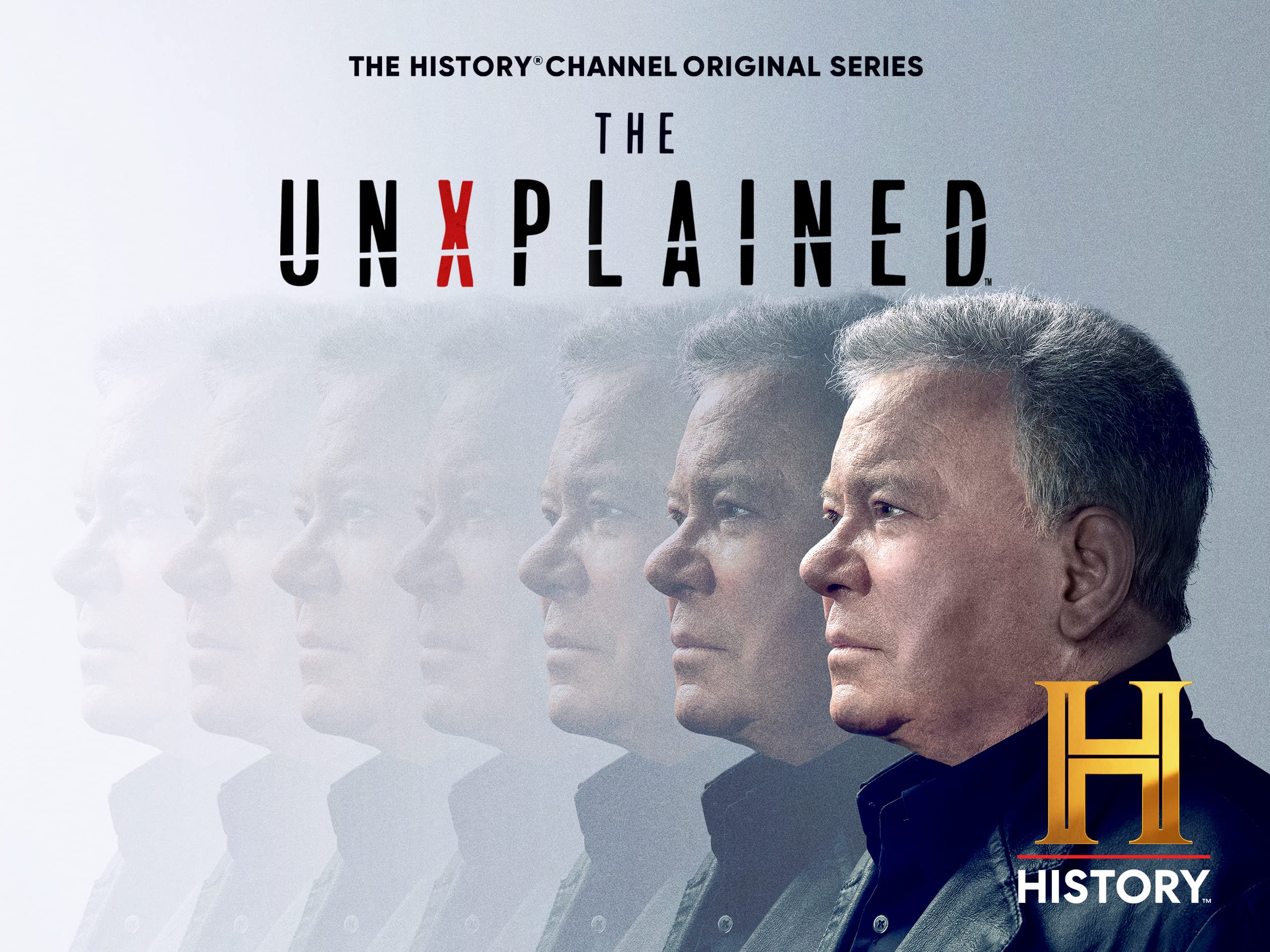
For viewers in the US, I believe I am on William Shatner’s UnXplained tomorrow (S03E14), talking about the mysteries of the tomb of the First Emperor of China.
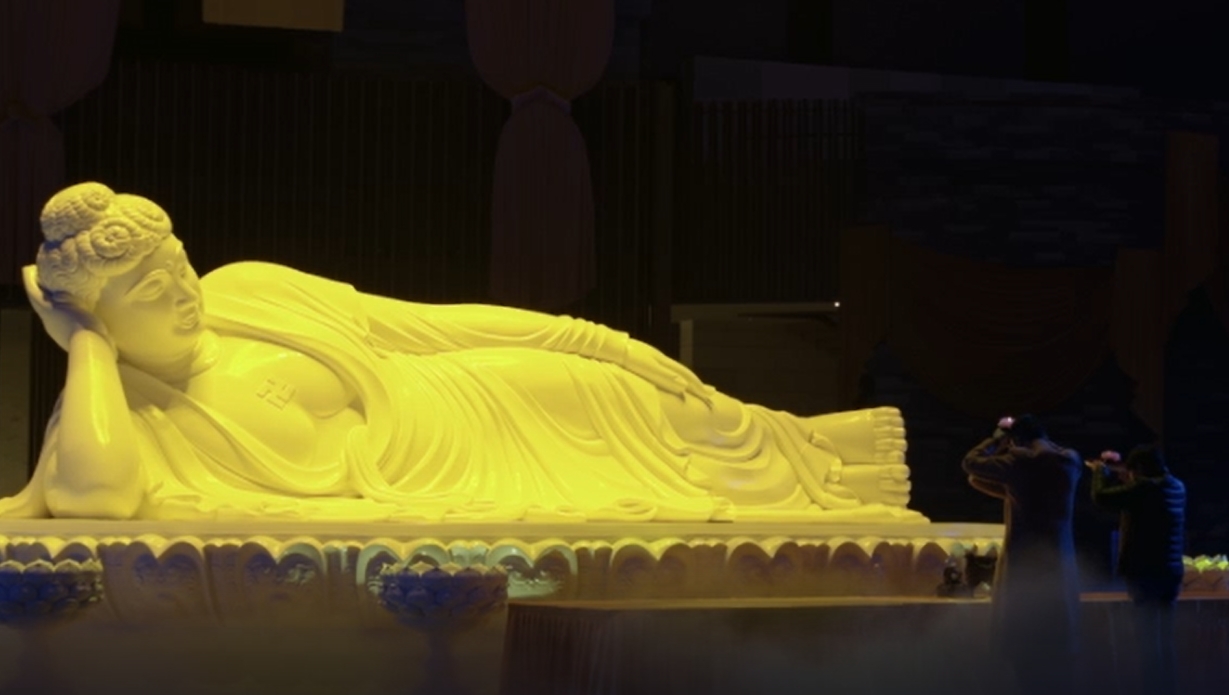
The mist has descended again, which means I can’t actually see Ox-Head Mountain, even as we’re driving up it. The pagoda swirls into existence out of the fog, next to a vast lotus-shaped dome that looks like a planetarium crossed with an airport. This is the resting place of a holy relic, a fragment of Buddha’s skull, embedded with gem-like sarira crystals. It was found inside the Porcelain Tower, but has been moved here, an hour outside Nanjing, for political reasons that nobody can really explain.
The Skull Relic Palace is not a temple. The guides keep telling us this, and the guy from Propaganda keeps telling us this, along with exhortations not to talk about Buddhism or film any Buddhists. Buddhists, however, are difficult to spot, because all the staff wear robes designed to evoke the Buddhist priesthood, many of them are glum tour guides who march sulkily with their hands clasped together, as if they would rather be doing jazz hands. Our liaison pouts all the way through lunch because we choose the Buddhist (vegetarian) canteen rather than the place where she can have nuggets. She gets me the Arhat noodles, having decided on very little evidence that I am a Buddhist who disapproves of eating in the meat-eaters’ canteen. I’m not, of course, it’s just that when visiting a Buddhist temple, I tend to go for the vegetarian option because I am curious what they do with tofu and mushrooms.
Ox-Head Mountain is a “Tourist Park” where people can experience Buddhist culture, architecture and iconography, although the visitors seem oddly divided between clueless, racist pig farmers in a coach party (“It’s Thursday so it must be Buddhist relics”) and super-devout, actual Buddhists. This, of course, is not my first Buddhist rodeo, so I know how to flash gang-signs to passing monks, and not to get in the way of pilgrim processions.
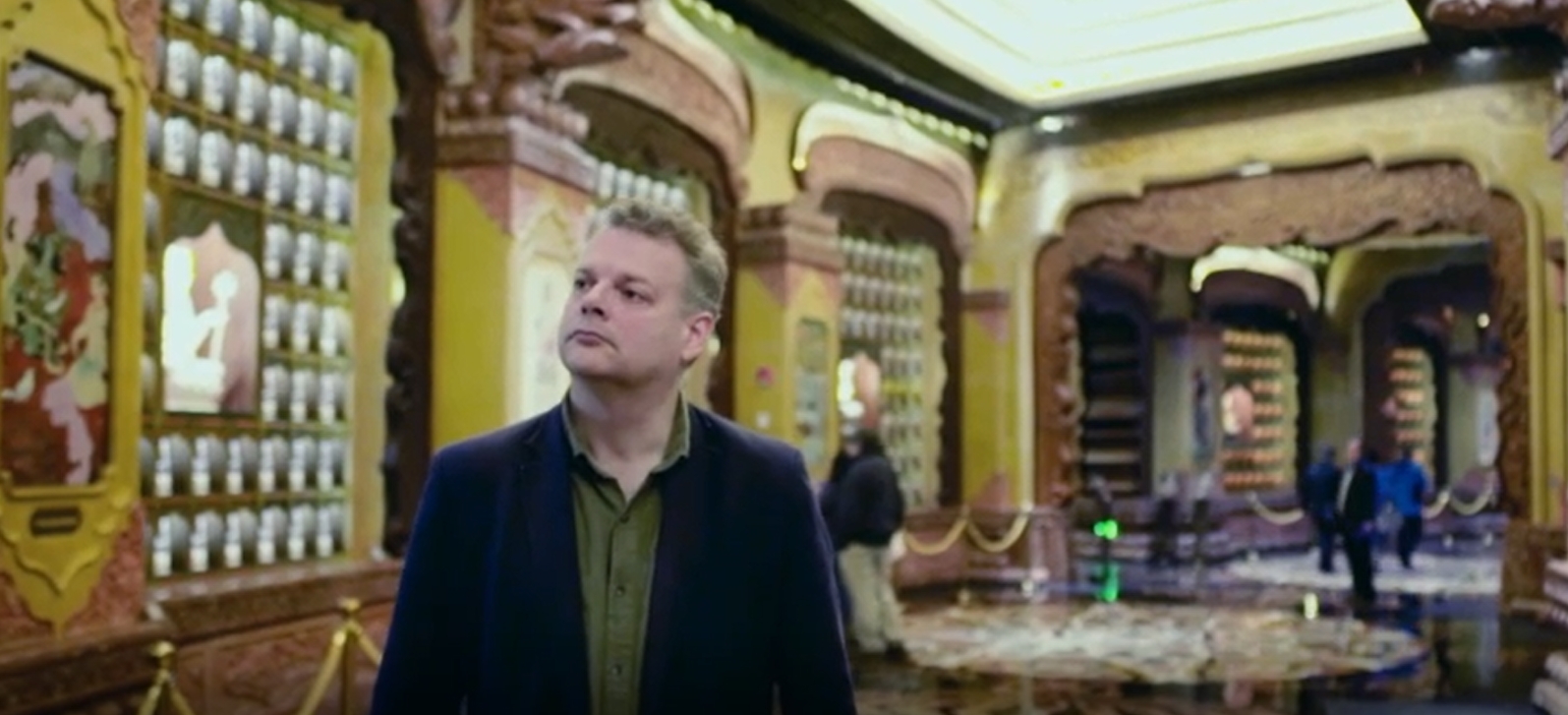
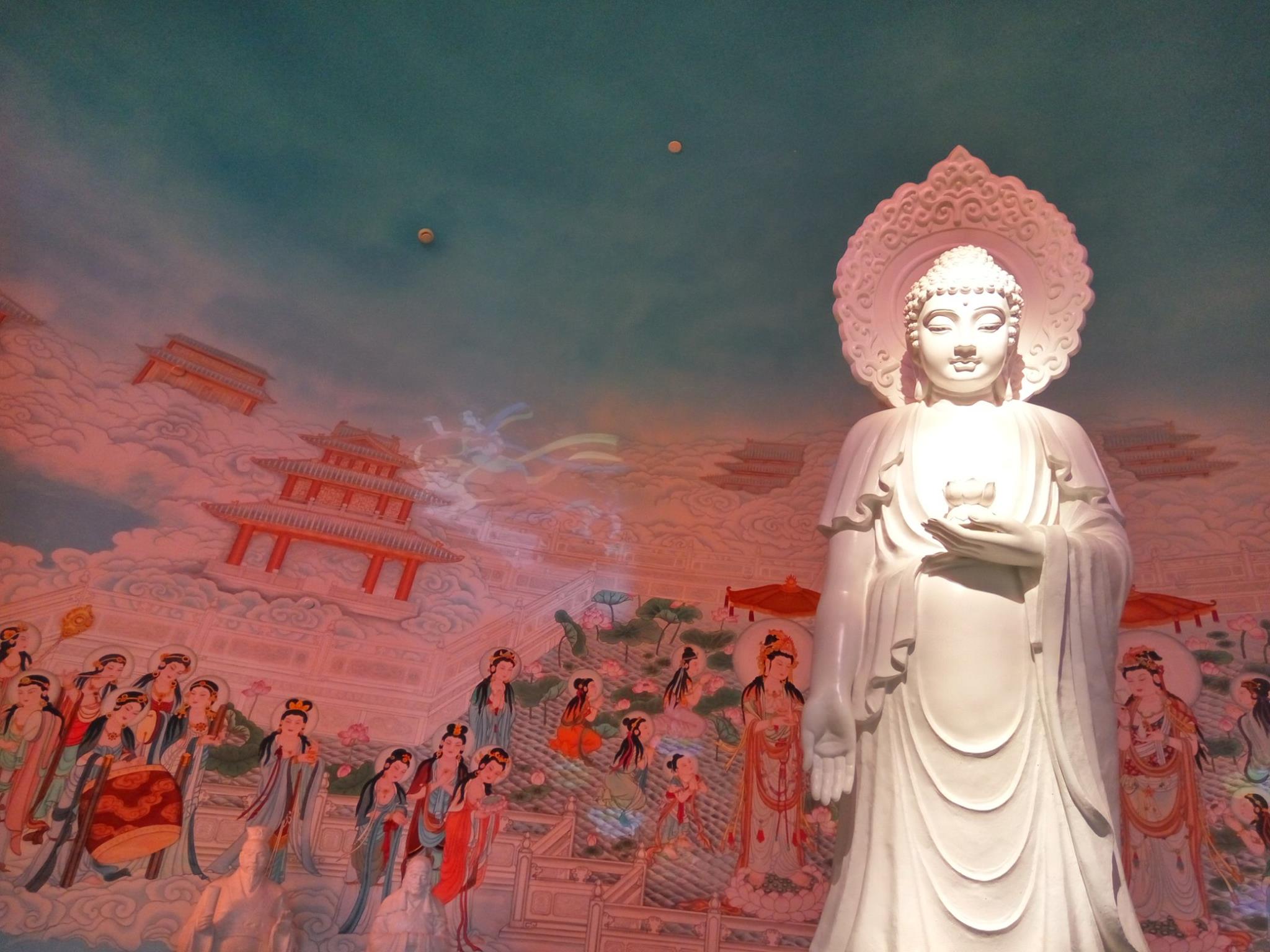
The inner sanctum is amazing, and the closest thing I have ever seen to a Buddhist cathedral, a “Thousand-Buddha Hall” chased in gold, with apsara nymphs curling through the heavens while various boddhisatvas sit on lotuses and do whatever it is that boddhisatvas do.
The director tells me to do a piece to camera, and I immediately observe that I find it ironic that, in Nanjing, the very city where Bodhidharma began to argue that material attachments were all bollocks, and that there were no scriptures, and no Buddhas, the very beginnings of what we now call Zen, that something so material, and so worldly should have been created.
This is not, she scolds, the place to start talking about Zen. I argue that it was literally the place to start talking about Zen, but some tourist board has snatched Buddha’s skull from the Porcelain Tower, driven it to a theme park in the middle of the mountains, and is now charging God knows how much to make visitors walk around it in circles before leaving through the gift shop. Where, incidentally, I found nothing worth buying, even though I am well aware of the ready market back home for scarves with swastikas on them, little Buddhist statues, big Buddhist statues, and other such paraphernalia.
Instead, I have to walk a delicate line between ridiculing the place for selling the chance to almost see a bit of bone, and ridiculing the builders for missing the point of Buddhism by a mile, but it was ever thus. Instead i focus on something that both Party and devout can agree on — the immense, game-changing influence that Buddhist culture has had on Chinese history for two thousand years. Denying it would be historical madness.
“This is the story of a girl / Who cried a river and drowned the whole world.” Over at the Encyclopedia of Science Fiction, I write up the delightfully absurdist Everything Everywhere All At Once, which repeatedly quotes the Nine Days song “Absolutely (About A Girl)”, but also comes loaded with references steeped in the Chinese language.
“The film subtly celebrates its liminal place between cultures, specifically those of Anglo movie-goers and bilingual Asian-Americans, each a wainscot society of the other. Its alternative title, displayed onscreen in untranslated Chinese, is Ma de duochong yuzhou, literally “The Multiverses of Mother”, but also a Mandarin pun meaning “F*cking Multiverses.”
The East Wind said: “I have just come from China, where I danced round the porcelain tower till all the bells jingled again. In the streets an official flogging was taking place, and bamboo canes were being broken on the shoulders of men of every high position, from the first to the ninth grade. They cried, ‘Many thanks, my fatherly benefactor;’ but I am sure the words did not come from their hearts, so I rang the bells till they sounded, ‘ding, ding-dong.’” – Hans Christian Andersen, The Garden of Paradise (1838).
The Porcelain Tower is famous, you see. The Chinese keep on telling me how famous it is, although to be frank, I had never heard of it until I got to Nanjing. It was featured in a Dutch traveller’s account of China in the 17th century, and ended up becoming the centrepiece of many blue-and-white china plates, a cute little pagoda that itself was supposedly made of porcelain.
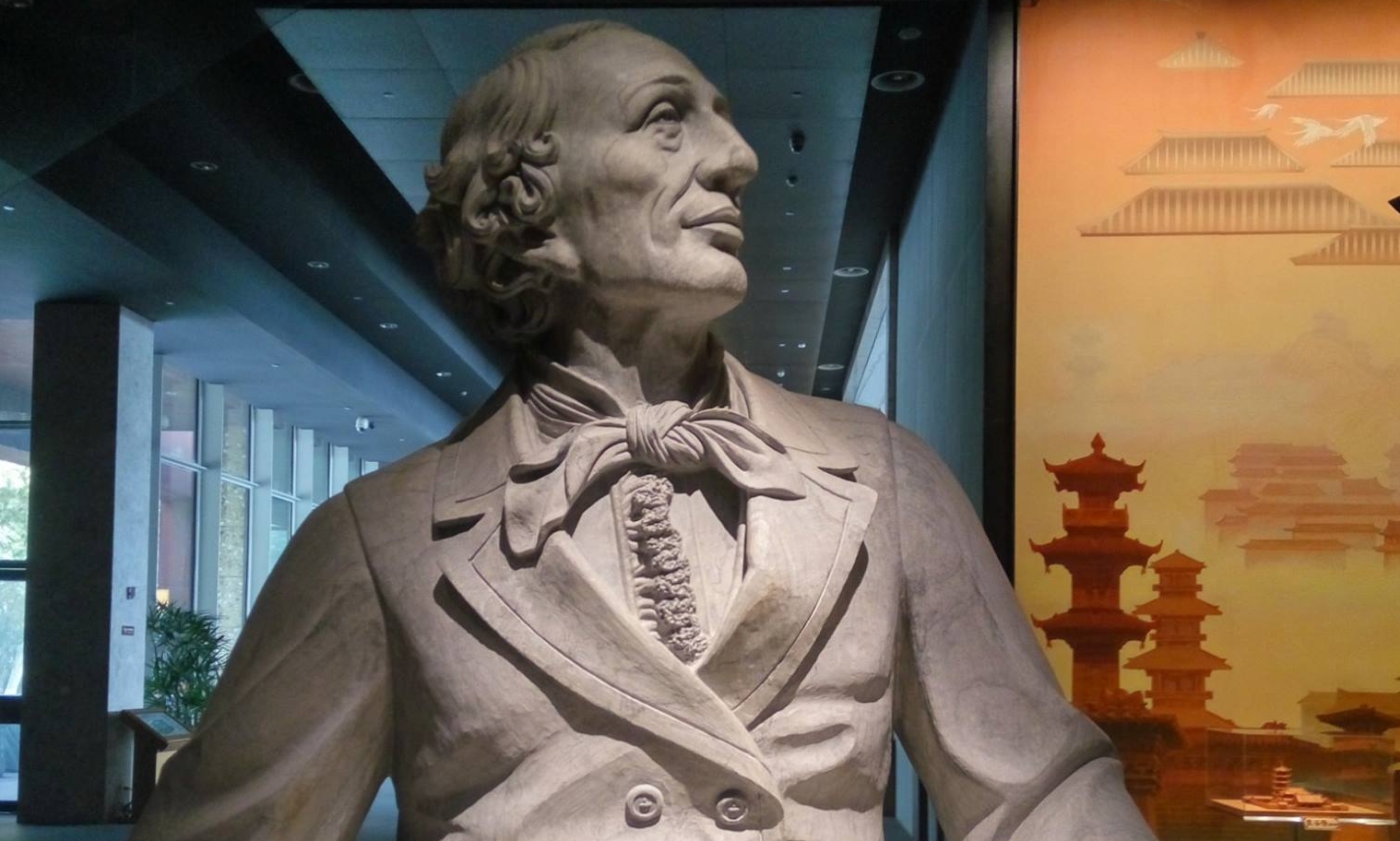
In fact, the Porcelain Tower was simply decorated with glazed bricks – sumptuous in golds and greens and yellow, lit at night with dozens of lanterns, and impressively tall. Its construction was begun in the era of the dastardly Ming emperor Yongle, and completed under the supervision of his long-time lieutenant, the faithful eunuch admiral Zheng He. It was vandalised by the Taiping rebels in the 19th century, who smashed up the Buddhist statuary and demolished the staircase to prevent their enemies using it as a reconnaissance platform, and was eventually completely destroyed. In 2010, the billionaire owner of the Wanda corporation paid to have it rebuilt, and a posher than posh museum stands on the site, including a statue of Hans Christian Andersen, tableaux from Buddhist history, and lavish exhibits of Buddhist largesse.
The restored tower itself is a glass affair of no real merit, but it sits above a vault that contains the Ashoka Reliquary, which was found in the foundations. Well, to be fair a stone vault was found in the ruins, containing an iron casket, which contained a gold reliquary, which contained a silver box, which contained an iron box, and so on, and so on, like a bunch of Buddhist matrushka dolls, until in the centre of it all was a piece of Buddha’s skull, donated by the Indian king Ashoka as one of hundreds of relics sent by him throughout the known world to prove how cool he was.
There are lots of things to shoot in the museum below, including other Ashoka Reliquaries from other parts of China, so many in fact that I declare it is a veritable Build Your Own Buddha game, and that a religiously minded app developer could turn every iPhone-using Buddhist in China into a Pokémon freak, racing around pilgrimage sites trying to reassemble Shakyamuni from all the bits of him that are apparently stashed away in temples all over the place.
Qi Haining is the man who found the piece of Buddha’s skull. He is cagey at first, having been burned before by Chinese television, who set him up as some sort of Indiana Jones figure.
“That was all nonsense,” he complains. “We always knew that there was a relic somewhere down there. We just didn’t bother to look until they told us they were going to put up a shopping centre. So that’s when we dug it up.”
But he is being economic with the truth. Nobody was really expecting to unearth something of quite the magnitude of Buddha’s skull fragment. The first time they knew what they had was when they read the provenance carved on the outer casket.
He likes the thought of us letting him tell the true story, and once again, is one of those interviewees who lights up when he realises I am not some nodding donkey. I can pinpoint the moment when he realises I’m not new to this.
“This is a find,” he says, “of a magnitude equivalent to the Famen Temple.”
“Well, the Famen Temple’s only got a finger bone!” I point out, and his eyes light up.
“YES! That’s right! You’ve seen it? In their underground palace? Just a little finger, right. And no magic crystals. We’ve got magic crystals, what about that, Famen Temple!”
Truth be told, the “magic” sarira crystals found in the remains of cremated Buddhist saints look awfully like gallstones, but far be I from one to interfere.


 The Official Schoolgirl Milky Crisis Blog