The End of Cool Japan…?

41OlrO2WKWL._SX331_BO1204203200_Over at the All the Anime blog, I review the new collection of academic essays The End of Cool Japan: Ethical, legal and cultural challenges to Japanese popular culture.


“Thanks in particular to the rise of Fan Studies, it has become all too easy for the Western pundit to lock themselves in a convention-centred hugbox in which ‘everybody they know’ thinks that anime and manga are the bee’s knees. Then, someone ruins their day by giving them the actual sales figures. Not that sales figures should be the sole determinant for avenues of academic enquiry, but if someone is setting themselves up as an expert in what is ‘popular’, they’d better have some idea what that actually means.”

Seven Years On

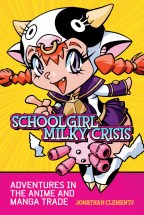
milkycrisis-12It’s been seven years since the publicity junkets for Schoolgirl Milky Crisis, the book that led to this blog being started in the first place. And over on Youtube, Nozomi Entertainment have posted up their podcast interview with me from spring 2009, in which we discuss everything from the demographics of fandom to the problem of getting Chinese waiters to do backing vocals on “Help Me Rhonda”.

The God of Manga

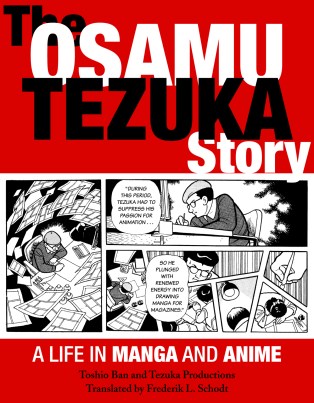
The Osamu Tezuka Story - A Life in Manga and Anime by Toshio Ban and Tezuka Productions Translated by Frederick L. SchodtToshio Ban’s The Osamu Tezuka Story: A Life in Anime and Manga is a ground-breaking manga biography of one of Japan’s best-loved and best-selling creators, the creator of Astro Boy and Kimba the White Lion. At 900 pages, it is a breathtakingly thorough sweep through Tezuka’s post-war struggles to become a comics artist, his misplaced faith in the financial returns of animation, and his pioneering efforts in setting up the studio Mushi Production.

Ban’s approach often has the relentless, linear plod of a TV movie, beginning with his leading man’s infancy, and working all the way through to his death. But in doing so, he draws deeply on Tezuka’s own memoirs, citing childhood incidents as crucial inspirations in his later work, such as the sticky-up hair that inspired the coiffure of his iconic Astro Boy. Most subjects would not warrant this intensive focus, but Tezuka is such a fundamental figure for understanding modern Japanese media that there is sure to be plenty of interest here for fans and scholars.

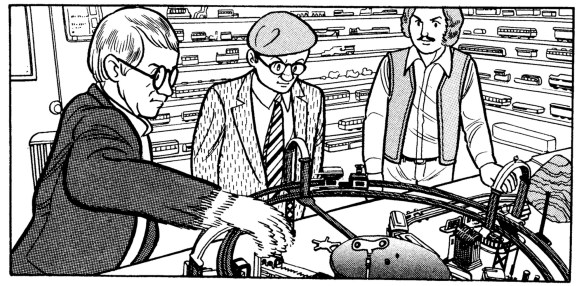
Ban’s artwork is deceptively simple. At first glance, it looks like the journeyman drafting of an educational comic, but actually goes much further. His depictions of many scenes are photo-real, deriving directly from documents, photographs and location hunts in the places under discussion. When Ban writes about the arrival of a letter from Stanley Kubrick, offering Tezuka the production designer’s job on 2001: A Space Odyssey, he doesn’t just tell you about it. He shows you the envelope it came in, complete with Kubrick’s return address. Translator Frederik L. Schodt almost fell off his chair in surprise when he got to a page recounting a visit by Tezuka to America, realising that the youthful hipster in one panel was himself as Tezuka’s interpreter, faithfully recreated from a forgotten photo.

fred and tez

Here we see the formative years of a young comics artist: the temptations of a career in medicine; the irresistible but risky pull of animation; the struggles of a young studio, and the confusing whirl of international attention. Tezuka is propelled to the height of the manga profession, only to risk it all with a blind-faith bet on animation. Much of the dialogue is taken, word-for-word, from his own books and speeches, including a wistful farewell in which he speculates about how the children of the future might regard the Earth from space. Cue Ban’s artwork running with Tezuka’s ideas to present a slingshot, sci-fi ending, as Tezuka’s work forges on into the future without him.

Ban also injects some subtle artistic elements. As Tezuka’s long-term assistant, he has mastered his boss’s style, drawing much of the manga in a direct pastiche of the original. Clearly channelling the idea of how Tezuka himself might have approached the project if he had been able to draw his life-story from beyond the grave, Ban presents the whole thing as a fantastical documentary, narrated by characters from Tezuka’s own works. The art-style degenerates into more amateurish cartooning when the young Tezuka is telling a story to an indulgent audience of relatives, but blossoms into richly toned artwork when recreating adult memories.

The Osamu Tezuka Story is an unparalleled gateway to Tezuka’s life and work. Many critics, myself included, warn that Tezuka and his estate have been expert curators of his memory, and that Ban’s work typically shines a spotlight so brightly on its subject that many of his contemporaries are confined to the shadows. But that doesn’t stop Ban from noting some of the low points, including Tezuka’s resignation from his own studio and his flirtation with depression. Unless you can read Japanese, this is the closest thing you’ll get to a warts-and-all portrayal, and undoubtedly the most informative, detailed and illuminating work on manga and anime to be published in English this year.

Jonathan Clements is the author of Anime: A History. This article first appeared in Geeky Monkey #10, 2016.

Warning! Chatterley

In-the-Realm-of-the-Senses-940x460-850x416

Over at the All the Anime blog, I review Kirsten Cather’s Art of Censorship in Postwar Japan, which chronicles several landmark cases, including dodgy films, suspicious books, and tawdry manga.

“Cather’s book tracks censorship in Japan from the landmark Chatterley case, through several key cinema and literary rulings, all the way to the present day and the first manga to have its merits debated in court. Her wit and irreverence takes its cue from VS Naipaul, who quipped on the issuing of a fatwa against Salman Rushdie that the Ayatollah of Iran was offering a somewhat extreme form of literary criticism. She moves into film in the 1960s, revealing that Tetsuzo Watanabe, last seen in Anime: A History leading a group of tanks against striking special effects technicians at Toho, went on to find an even more bonkers job working for the censorship authority Eirin. Eirin saw themselves as defenders of public morals, surrounded by an ever-rising tide as erotica as Japanese cinemas increasingly chased the blue-movie market. The statistics do not lie; Cather uses big data to point to the transformation of Japanese cinema. ‘In 1963, only 37 of the 370 films checked by Eirin warranted adult ratings, whereas by 1965 the number had reached 233 of the total 503.'”

Animation in China

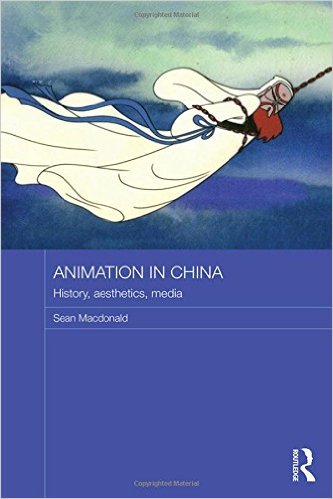
41haOrPwuXL._SX331_BO1204203200_Over on the All the Anime blog, I review Sean Macdonald’s excellent Animation in China: history, aesthetics, media and take the time out for a tangent about the politics of book pricing.

“Macdonald acknowledges the vital importance of Japanese animation for understanding the Chinese market, both in terms of early innovators such as Tadahito Mochinaga, who enjoyed a Chinese career under the name Fang Ming, and later helpers such as Tetsuya Endo, who did the real work on “Tsui Hark’s” animated Chinese Ghost Story. He discusses the famous Uproar in Heaven, the Monkey King from which remains the mascot of SAFS, not only in terms of its Chinese context, but of its parallels with Tezuka’s Alakazam the Great, which was released a year earlier. He even compares the working practices of the Wan brothers (with welcome translated quotes from one of their memoirs) with those of Osamu Tezuka in the age of “limited animation,” playfully comparing the car-crash scene in the first episode of Astro Boy to a famous sequence in Eisenstein’s Battleship Potemkin.”

Runner Up

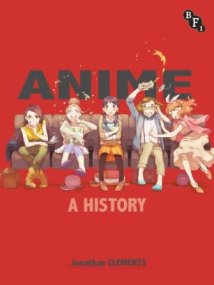
41bkTuP9TdL._SY445_My Anime: A History has just been declared the runner up in the Society of Animation Studies’ voting for the Norman McLaren – Evelyn Lambart Award for Best Scholarly Book on Animation. The winner was Animated Documentary by Annabelle Honess Roe, “a vital addition to both animation scholarship and film studies scholarship more broadly, expertly achieving the tricky challenge of synthesising these two scholarly traditions to provide a compelling and brilliantly coherent account of the animated documentary form.”

“Clements’ work stood out as the 2015 Runner-Up because of his fearless capacity to continually foreground the challenges of historical analysis, while putting this into practice to provide a much needed early history of anime that is rich with balanced detail.”

Animators Below the Line

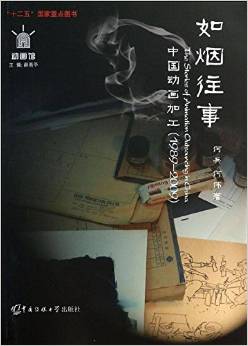
ruyan wangshi coverThe presence of Chinese animators and colourists in the film industry has often been ignored or denied. In Ruyan Wangshi, which bears the English-language title The Stories of Animation Outsourcing in China (1989-2009), He Bing and He Feng document life below the line for the artisans and labourers who do the dogwork on overseas cartoons, at first in Shanghai, and then as the industry expands, in spin-off companies and daughter-branches in Suzhou and Guangzhou, Nanjing and Chengdu.

Toei Animation is first on the scene in the year of Deng Xiaoping’s reforms, ordering seven thousand cels to be coloured in Shanghai in 1979. By 1985, it’s a company in Shenzhen, in the People’s Republic, that has animated the iconic logo used by the Hong Kong television channel TVB. The authors estimate that in the 1990s, out of a worldwide labour force of 50,000 animators, some 3000 dwelt in China – a proportion that has only increased in the 21st century as Chinese colleges pump out thousands of qualified personnel. By 1994, Disney reps are spotted in Suzhou looking for local talent, and before long, Chinese animators are toiling unnoticed on spin-offs from Pocahontas, Mulan and Hercules.

Many of the stories in the book echo similar tales of the Japanese industry. Art is never completed, only abandoned, and the Chinese struggle to find an equilibrium between the minimum amount of effort, which is a matter of economic sense, and the maximum, which is a matter of personal pride and artistic integrity. It is also theoretically infinite; there is always something that can be improved, a no-win situation that has driven many animators to exhaustion. There are mad dashes to get the artwork to the airport, and animation is described, in terms that echo those of Tadahito Mochinaga from the 1950s, as xinku de gongzuo – a bitterly hard job. The authors describe the Golden Age of Chinese outsourcing as the period from 1995-2005, bracketed by the boom in straight-to-video animation at one end, and, one supposes, the collapse of the anime bubble at the other. Less obvious at first glance is the impact of digitisation and the internet, which would allow Chinese art-college graduates, earning Chinese wages of £200 a month, and paying a Chinese cost of living, to essentially occupy a virtual office next door to their Japanese counterparts, who had to live in Tokyo, where £200 a month barely pays for parking.

Anime looms large in these memoirs, with references to work undertaken on Sakura Wars, Banner of the Stars, Lodoss War, Oh My Goddess, Madlax, Cowboy Bebop, Death Note and GTO, among others. Throughout the period, the Chinese animators dabble in making their own work, fumbling to make their own animated series based on famous proverbs, and holding out for a co-production deal.

Nothing makes the disruption between analogue and digital clearer than the book’s illustrations. A generous opening colour section offers a scrap book of images from the animators’ lives, but often contains frightfully dull pictures of people at forgotten banquets and grim group photocalls. Such images date from a time when cameras could only take 24 pictures, not the snap-happy 21st century where everybody documents their lunch. But the very mundanity of these images speaks volumes about conditions and attitudes in the industry, such as a shot of the anonymous, run-down block where a “studio” nestled above a print works, and a photograph of a visiting Japanese animator that simply credits him as “a visiting Japanese animator.” The clients, too, were often anonymous to their hirelings.

The Stories of Animation Outsourcing in China (1989-2009) is published as part of a series of books on animation by the Communication University of China Press. Several of its sister volumes cover well-worn topics like British or Japanese animation, but the titles relevant to China are far more ground-breaking, including a 336-page history of Chinese stop-motion animation that I hope to get around to reviewing sometime here, too. In the meantime, in attempting to delineate a history and a narrative of the uncelebrated low-echelon workers of the cartoon business, He and He have truly opened a new area in animation studies.

Jonathan Clements is the author of Anime: A History.

The Shoulders of Giants

attack-on-titan-movie-trailer-released

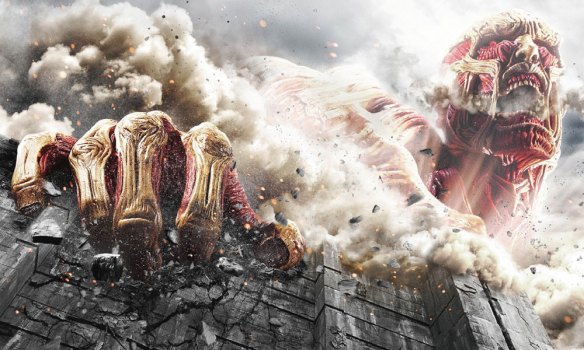
It has been a hundred years since humanity was first devastated by the Titans, hulking, occasionally skinless man-eating giants. What remains of the human race huddles behind a series of concentric walls under martial law, the best and brightest co-opted into one of several military organisations that use repurposed climbing equipment to scale the enemy attackers in search of their hard-to-find weak spot. Teenage brawler Eren Yaeger swears to avenge his mother’s death at the hands of the Titans, and joins up along with a group of his friends, only to discover that the mystery of the Titans’ appearance and motivations runs far deeper, and closer to home, than he previously imagined.

With more than 30 million copies in print worldwide, Attack on Titan is one of those manga that has truly escaped from the ghetto. Its US sales run rings around many supposedly popular superhero comics, and its fans are a rabid, visible costumed presence wherever geeks gather. Hajime Isayama’s original manga has been adapted into an animated series, novels and a computer game, which is pretty good going for something that looks on the surface like the fever-dream of someone off his face at a Bodyworks exhibit.

Attack on Titan has truly caught the zeitgeist both in Japan and abroad. Local audiences warmed to its allegorical Wall of Fear, as a symbol of the social and cultural barriers that often continue to shut Japan off from the troubles of the real world… at least temporarily. Similar symbolism can be found in recent anime like Summer Wars and Howl’s Moving Castle, both of which dealt obliquely with modern Japan’s reliance on the pursuance of faraway conflicts, and the revelation that terror could still hit close to home. Viewers in Hong Kong praised it as an inadvertent metaphor for the influence of the overbearing colossus of mainland China on their lives. Newspapers in South Korea touted the whole enterprise as a propaganda exercise in encouraging young Japanese to support military expansion. The story is so surreal that it lends itself to any number of political messages, not the least a winner with young teens who feel that the perils of the world are all coming to get them. It is a zombie apocalypse and a monster-of-the-week disaster movie all in one, leavened with a healthy scepticism about the lies that the authorities might tell to hang onto power. Plus big fights.

The Attack on Titan live-action movies are an intriguing confection. They seemingly went into production for the same reason as any other comics or media adaptation – out of a managerial confidence that high sales in one medium would translate into another. But the original choice as director, Tetsuya Nakashima, dropped out in 2012 over unspecified conflicts regarding the script. His replacement, Shinji Higuchi, must have looked like an all-round jackpot, not only for his track record in the liminal area of modern sci-fi and cross-media ties, but for his highly regarded work in tokusatsu movies – special effects epics about big monsters stomping on buildings.

Higuchi has always been very good at “quoting” elements of a much-loved original. Over-emoting is common in anime that lack the resources to convey visual expressions, but in the live-action Attack on Titan, the characters routinely strike ludicrous poses and spout gung-ho dialogue that seems, well, cartoony. Meanwhile, whereas the original is set in a European dreamtime, all the actors in the movies are understandably Asian, which makes a mockery of a particular subplot about the “last” Japanese girl in the world.

I was recently taken to task by a viewer at the Scotland Loves Anime film festival for not introducing the live-action movies with sufficient respect. Apparently it was my fault that the audience was laughing at the hokier moments and protesting at some of the switches in plot and character. Then again, another punter commented that the live-action movies were a fantastically enjoyable, funny parody of the anime, although nobody seemed to have told the cast and crew. So the live-action movies aren’t quite the re-up that fans were hoping for. They take themselves seriously in all the wrong ways, seemingly unaware that, ironically, it’s the earlier cartoon incarnation that really hits the right note.

Jonathan Clements is the author of Modern Japan: All That Matters. This article first appeared in Geeky Monkey #4, 2016.

Taxing Problems

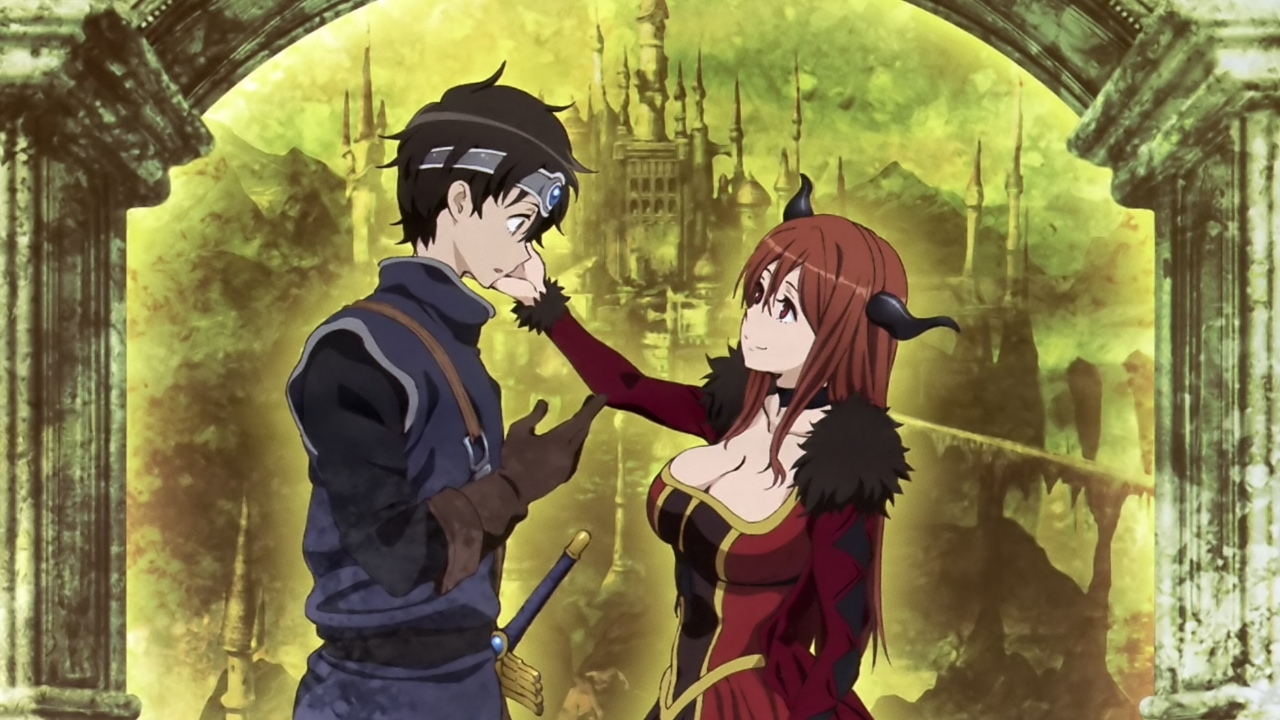
maoyuThis month’s big news in the anime world is the sentence handed down by the Tokyo District court to Daisuke Umezu, better known to anime fans by his writing name Mamare Touno. The author of series such as Maoyu and Log Horizon, Umezu had been indicted for tax evasion, on the grounds that he neglected to declare royalties to the Japanese tax man of an extra 122 million yen (that’s £754,000). His company was fined an additional seven million (£43,000) and he will have to wear a three-year suspended sentence, conditional on him not re-offending.

Let me start by saying how pleased I am that there is an author on the planet who can actually find himself owing that much. JK Rowling and Dan Brown are outliers – the average professional writer in the UK still earns barely £12,000 a year. Umezu’s accounts make it very clear that, in Japan at least, there is a thriving market of readers and, presumably, intellectual property spin-offs that will reward someone who writes something that readers and producers love – long may it continue. As my accountant occasionally mumbles, if your worst problem is paying more tax, then you’re not doing badly. And notably it’s Umezu’s company that has been fined – corporate tax law is a whole other ball game, in which ignorance is no defence. If you are running a company, you can’t just shrug and say you didn’t read the small print in the rules; you are expected to know what the rules are.

Umezu has been under house arrest for four months, so one might consider this time served. But lock the average writer in his home for 16 weeks, and he is liable to write another novel, so that’s Umezu already well on his way to paying his next tax bill. It paints a very different picture of the Japanese media than the one implied in a recent Tokyo government boondoggle, which offers a 300,000 yen grant (£1800) for anyone willing to make a ten-minute pilot for a new anime. That’s peanuts, not just to an author like Umezu, but to any anime company, which would be sure to spend ten times that money on such a venture. Your correspondent can’t see the point in it – it seems like a half-hearted measure to kick-start new productions, when as the success of Umezu’s enterprises seems to suggest, there are already plenty of stories out there that real people are already prepared to pay real money for. Long may that continue, too.

Jonathan Clements is the author of Anime: A History. This article first appeared in NEO #151, 2016.