This article originally appeared in Newtype USA magazine in August 2003. I have always felt a trifle guilty for not previously acknowledging Carl Gustav Horn, from whom I’m pretty sure I stole the “T-shirt” comment.
The Eyes of Texas
1

This article originally appeared in Newtype USA magazine in August 2003. I have always felt a trifle guilty for not previously acknowledging Carl Gustav Horn, from whom I’m pretty sure I stole the “T-shirt” comment.
 The Big Name Toy Company designed everything from the ground up, creating toys and cartoons in tandem. They had me working on six concepts for a TV series, that would be whittled down to three, then two, then one single idea that would be taken to the central office. There, it would compete with ideas from six other offices around the world, until the company put maybe a billion dollars factory time, animation, and advertising behind a single winning concept. They planned four years ahead. The toys in your stores this Christmas? They were decided in 2002.
I got to see The Book, a giant tome of psychology reports some six inches thick, containing what amounted to racial profiling of children around the world. Children in South America were more likely to play outside, German kids liked mechanical things earlier, and so on. When I turned to the Japanese section, two words jumped out at me: “Solitary Play”.
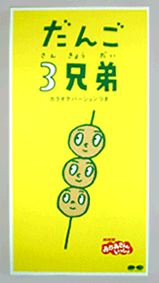
I started hearing a strange little tango song in my head, a Japanese novelty hit from 1999 about three dumplings on a stick. It began as a joke by commercial director Masahiko Sato, but for some reason it took off. Kids liked the catchy tune, but the main audience for it was the parents. The single sold more than three million copies in Japan, and before long, an anime followed. It, too, was only little — three-minute inserts as part of the series Watch With Mother. But The Dumpling Brothers anime ran for five years, only coming to an end in 2004. Let’s put that in perspective — an anime for the fan audience is considered a roaring success if it lasts for five months.
The Dumpling Brothers caught the mood of the time. Japan doesn’t have a draconian one-child policy, but sometimes capitalism can exercise its own constraints. Single offspring are increasingly common, and that severely limits family dynamics. After two generations of belt-tightening and downsizing, fewer Japanese children have brothers or sisters. Moreover, they are increasingly less likely to have any uncles, aunts or cousins. Much of the interest in The Dumpling Brothers seemed born of parental nostalgia, looking back to when they had siblings to play with, and with a sense of regret that their own children would never have the same experience.
The same period saw I Love Bubu Chacha, an anime series about a boy who discovers that dead pets and circus animals have been reincarnated as his toys. The only ‘human’ friend he has is a neighborhood girl who pretends to be his sister, although she is actually a ghost. The viewers who watched these shows as children are now old enough to buy Angel Tales.
Some modern anime seem made specifically for viewers that are not part of any community; solitary shut-ins with few if any friends. But anime toys have always been ready to fill the breach, and to exert pester-power on a workaday dad returning home to his nuclear family, and searching for a way to buy his kid’s affections. You hear it several times a day in anime for children.
“My father gave me a robot. My father gave me a robot. My father gave me a robot.”
Jonathan Clements is the author of Schoolgirl Milky Crisis: Adventures in the Anime and Manga Trade. This article first appeared in Newtype USA in 2006.
This article first appeared in Newtype USA in October 2007.
Courtesy of the Big Giant Heads, here’s another extract from Schoolgirl Milky Crisis; an article that originally appeared in Newtype USA back in 2005.

Are there certain things such as Japanese colloquialisms, which do not translate well when working on English language scripts?
Japanese takes longer to learn than many “standard” languages, and it has many complexities. So yes, translating Japanese is not easy, but it’s not impossible. The problem is whether people are prepared to pay for it. Quite often, the guy who hires a translator is entirely ignorant of the quality of what he is asking to be translated. He has no clue whether his translator is up to the task. All he cares about is how quickly it can be turned around, and how cheaply.
The modern obstacles are actually beyond the language itself, within audience and distributor expectations. Many distributors simply don’t want to pay a living wage for anime or manga translation. Prices have dropped, as far as I can see, about 65% in real terms in the last decade. There’s a lot of short-term people in the business who don’t see why they should pay professional rates, who don’t realise how much an interesting original is being dumbed down and ruined in its translated form. So they simply refuse to pay professional rates and good material is ruined.
There’s also a powerful lobby within fandom that doesn’t understand that translations are about making the language barrier invisible. They want to keep as much Japanese in the “translations” as possible, with the spurious assertion that certain concepts are untranslatable. So we find ourselves in this embarrassing situation today when some reps from distributors are unable to even pronounce the title of the shows they are supposed to be selling, and nobody knows what they actually mean. I think that betrays the aims of translation, but as Confucius once nearly said: peanuts pay, monkeys get.
What would you say is the most bizarre anime concept out there?
Take your pick. A series about the competitive world of bread-making? The tribulations of a blind soccer team? A group of transforming robots hidden inside cigarette lighters? Five orphan ninja who dress in bird costumes for no apparent reason? A drama-documentary about the world of superconductors? A guide to obtaining a divorce without legal hassles? I could go on, but I can see you already think I am just making it up. Schoolgirl Milky Crisis!
If Schoolgirl Milky Crisis was an actual anime show, what would the storyline be about?
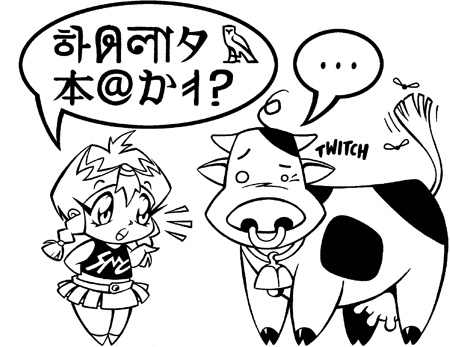
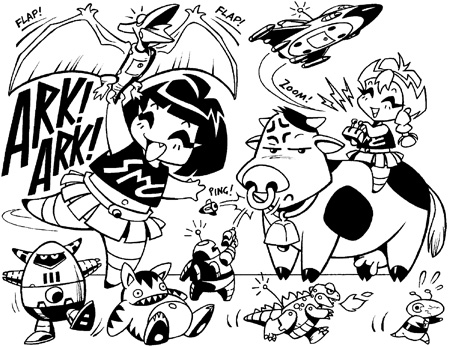
Steve Kyte, who’s drawn the Schoolgirl Milky Crisis artwork throughout the book, did say that he had tried to work out what the plot might have been by working through the numerous references in the articles and stitching them together. He appears to have come up with something about the vanguard of an alien invasion, accidentally landing on a dairy farm run by two Welsh girls called Bronwen and Gwyneth. But I think Schoolgirl Milky Crisis is a lot more fun when nobody knows what the story is and everyone has their own idea.
Another extract from Schoolgirl Milky Crisis, a Newtype USA column about how toy companies make their decisions.
TV Programming For Beginners
In my anime dungeon, where I torment fans who displease me, there is a special chamber for people who think that getting anime on TV is easy. Fans are locked in a room until they come up with their idea of a perfect evening’s anime viewing. Then I make them name the other eighteen hours they haven’t considered yet. Then I make them do it 365 more times, without once including a show that they wouldn’t want to watch themselves. After the wailing has finished, when their schedule is finally written in thirteen color-coded inks, I walk in and take away half the titles.
Today’s Independent newspaper has a nice chunky feature on manga, which, for a pleasant change, actually talks a bit about real Japanese comics. There is even a Schoolgirl Milky Namecheck, since, as ever, I am the bad guy who dares to suggest that manga come from Japan.

 The Official Schoolgirl Milky Crisis Blog