Rice Rice Baby

Two years after Japan seized Taiwan from imperial China in 1895, the government in Tokyo had started to wonder if it was worth the hassle. The local people were notoriously difficult to control; the anti-Japanese resistance continued to bubble away in the hinterland, and the infrastructure was a mess. Some wag in the Japanese parliament even made the modest proposal that, all things considered, Japan had been sold a lemon, and should probably consider off-loading the whole thing for a bargain price on the first mug to come along… probably France.

Toshio Watanabe’s The Meiji Japanese Who Made Modern Taiwan is a study of those Japanese engineers, politicians and scientists who refused to give up, turning Japan’s newly acquired colony into a testing ground for some of the grand schemes that would later be unrolled all across the Japanese empire.
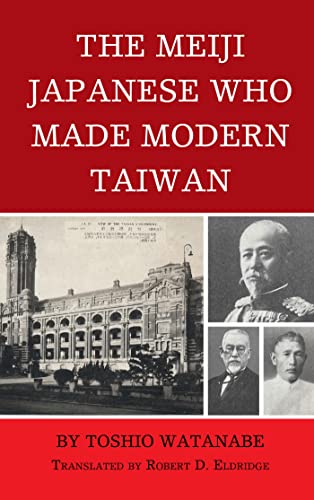
Watanabe zooms in on Shinpei Goto, the administrator whose thoughtful approach to researching his new posting led to the commissioning of invaluable, multi-part scientific surveys, including a 4000-page report on tribal traditions among the indigenous inhabitants – often the first time such matters had been documented. It was Goto who dragged the island out of almost a decade of infrastructural decay, setting up the Bank of Taiwan to disburse investment funds for roads and railways, and declaring a Twenty-Year Plan to make the island a net contributor to the imperial Japanese economy.

Watanabe focuses on several linked elements of Japanese colonial development in Taiwan, particular­­­ly the creation of a new strain of rice, optimised not only for local conditions, but also for the Japanese palate. The result was a strain named for the ancient Chinese isles of the immortals, Penglai Rice (a.k.a. Horai Rice or Ponrai Rice), and Watanabe takes the story of this miracle crop out of both Taiwan and the Meiji era, to demonstrate its wide-ranging impact overseas, particularly in India in the 1950s. Even today, it and its descendants represent up to 93% of all the rice grown in Taiwan – Watanabe’s chapter on Horai Rice scales way, way out, making a bold claim to it as the saviour of millions of twentieth-century lives. This has, however, done some damage to crop diversity on the island – a fact alluded to in Crook and Hung’s Culinary History of Taipei, which notes the extinction of certain other rice strains in the wild.

But the crop was only half the story. Watanabe also delves into the history of the fields where it grew, particularly the plains between Chiayi and Tainan, the agricultural capabilities of which were multiplied a hundred-fold during the Japanese colonial era. For this, we have to thank a Japanese hydraulic engineer, Yoichi Hatta, who designed an irrigation system covering hundreds of square miles, holding back floodwaters and saving them to re-use in dry spells, to turn the Chia-Nan plain from a farming disaster-area into a rice-producing power-house with three crops a year.
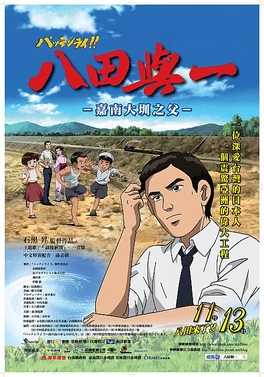
Hatta was justly celebrated as one of the icons of Japanese Taiwan, and enjoyed a vibrant afterlife, particularly at the turn of the the 21st century, when a Japanese prime minister, Yoshiro Mori, turned out to come from the same part of Japan. The result was a veritable Taiwan-Japan love-in, with diplomatic visits, high-level glad-handing, and even the release of a worthy-minded dramatization of his life, Noboru Ishiguro’s animated film Batian Lai – well, Batian Lai (“Here Comes Hatta”), is how I translated the title in the Anime Encyclopedia, but the Japanese original Patten Rai, has a stab at replicating the way his name would have been pronounced by the actual Hokkien-speaking locals. The anime film concentrates on Hatta’s obsession with the irrigation system, and his pride and joy, the Wushantou Dam, which for six years in the 1930s was the largest in the world. Hatta’s most recent appearance in the media was in 2017, when a crazed politician in search of clickbait decapitated his commemorative statue at his gravesite beside the dam.

After Japan lost Taiwan in 1945, the new Kuomintang government adopted a scorched-earth policy towards the fifty years of Japanese rule. They played up colonial atrocities (of which there were many), deported thousands of Taiwan-born “Japanese”, banned the Japanese language from public life, and did everything they could to wipe out the Japanese colonial legacy. Watanabe’s book is a celebration of the oft-forgotten achievements of Taiwan’s Japanese era, although in pushing to recognise the achievements of the Japanese, he might occasionally have forgotten the Taiwanese who did much of the hard labour, and the occasional European who might have helped a little bit, such as William Kinnimond Burton, the Scottish engineer who designed many of the island’s Meiji-era sanitation systems.

But Watanabe’s book is more interested, naturally, in the Japanese, whose lives he describes with empathy and occasional melodrama. Nowhere is this more obvious than in the tragic end to Hatta’s story, when he dies aboard the Taiyo Maru, a ship torpedoed by an American submarine. His body lies in the water for a week, in which time the flesh is so picked clean by marine scavengers that he can only be identified by his clothes and personal effects.

His wife, Toyoki Hatta, held on until the 15th August 1945. On hearing the news of Japan’s surrender on the radio, she calmly walked through the rain to the Wushantou Dam, took off her shoes, and threw herself into the waters.

Jonathan Clements is the author of A Brief History of Japan. The Meiji Japanese Who Made Modern Taiwan is published by Rowman & Littlefield.

Innocents Abroad

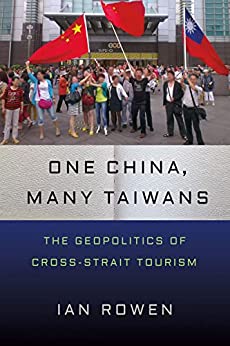
You can forget Sun-Moon Lake. It’s so last season, darling. “It’s pretty but I don’t go there anymore,” says one of Ian Rowen’s interviewees. “If I wanted to feel like I am in China, I’d just go to China,” she adds.

Rowen’s new book, One China, Many Taiwans, delves into what it actually means when Taiwanese tourist officers and mainland Chinese entrepreneurs tried to rustle up tour groups to come to that famous island across the Taiwan Strait – an island with tourist attractions that can actually be seen among the watermarks of a People’s Republic passport. What would they see? What would they not see? He ends up lifting an idea from the science fiction of China Miéville, particularly The City and the City – that the Taiwan where people actually live is a reality that phases in and out of existence in tandem with the Taiwan experienced by mainland visitors.

Rowen’s account of the geopolitics of cross-Strait tourism starts with the long decades of no contact at all, and the slow thaw that saw a few veterans and exiles granted compassionate leave to visit long-lost family members or attend funerals. But he swiftly dives feet-first into the sudden boom in actual tourism that saw thousands of mainlanders boarding planes to see the island that still claimed to be the Republic of China.

The centrepiece and tour-de-force of Rowen’s book is his fourth chapter – a diary of his adventures on a ghastly package tour for Chinese visitors around Taiwan’s major tourist sites in August 2014. Along with his fellow inmates, he schleps dutifully around the edges of Sun-Moon Lake, sees Alishan, and almost gets into Taroko Gorge (closed due to landslides), mopes joylessly around the shopping centre at the base of Taiwan 101 (because a trip to the observation gallery costs extra), soaks up some culture at the National Palace Museum, and refuses to buy over-priced tea shilled at him by pushy girls in aboriginal costumes.

Recalling the arch commentary of Mark Twain in Innocents Abroad, Rowen chronicles the miseries of his fellow passengers, the local factionalism among two very different tour groups lumped in together, and the careful language of their put-upon guide. He also interviews hotel managers and tea-sellers, restaurateurs and bus drivers, in order to get a sense of what high-falutin’ scholars might call the political economy of Taiwanese tourism.

Rowen is fascinated by the degree to which attempts to depict Taiwan as just another Chinese province repeatedly backfire, everywhere from the booking office where secretaries tut at his very inclusion, to passport control, where a small boy doesn’t understand why the visa form has a different flag on top of it, and indeed why his mainland family needs a visa at all.

He is particularly good on nuances within nuances – the market traders who have learned, without official directives, to rephrase their language in order to avoid ruffling the feathers of sensitive mainland visitors. Sometimes this can result in intriguingly counter-intuitive approaches, as in the case of a tour guide who studiously avoids mentioning the 228 Incident and the ensuing “White Terror”. You would think something like that would be catnip to visitors from the People’s Republic, but the tour guide regards Chiang Kai-shek and his Nationalists as “people from the mainland” too, and hence doesn’t want to insult customers that he regards as their cousins.

Rowen also notes a recurring complaint among his fellow tourists that the Taiwan tour experience is too xiaoqingxin – a difficult term to translate, but immediately evocative for me of the last twenty years of Japanese tourism aimed at office ladies and empty-nest housewives – I say twenty years, but Japanese media theory has related it to the last fifty, ever since women with disposable incomes were identified as an exploitable travel niche. I suspect that a lot of the experiences that the Chinese chafe at were first concocted to impress Japanese ladies who lunch, with history thrown out of the window in favour of gourmet experiences, photo-ops and kawaii.  

For years, I have cherished the idea of booking myself into one of the coach tours advertised in London’s Chinatown, taking in Bath and Stonehenge, Harry Potter’s supposed childhood home and the Bicester freeport. They are not officially Chinese-only, but you need to read Chinese to know they are even there. And I have been fascinated by the implications, and curious about the information imparted. Are they, to steal the lyrics of a satirical Chinese song, a case of: “Get on the coach and sleep / get off the coach and pee / go home knowing nothing”?

Rowen unpacks his own experience within a far broader context – that of the immense bargaining power wielded by Chinese tourists since the opening up of their country and the enrichment of its middle class. This is a concept that has exercised me on many occasions, not the least in my travels with National Geographic, where my attempts to chronicle the dying customs of a remote hill-tribe were once compromised by the invasion of an entire coach party of amateur photographers from Guangzhou, come to do the same. In the case of Taiwan, he points to what he unflinchingly calls weaponised tourism, which is to say a massive ding-dong between Beijing and Taipei, particularly after the landslide win of the Democratic Progressive Party in 2016 called into question the status quo that had existed across the Taiwan Strait for the previous two decades. Rowen argues that this political event jeopardised many years of lucrative cross-straits tourism, particularly after the torrent of PRC tourists in Taiwan slowed to a trickle, putting thousands of people’s livelihoods and businesses at risk.

Such big-picture politics helps put things like China’s own interest in internal tourism – e.g. the cynical creation of a new holy mountain – in perspective. Rowen also relates it to local political infighting in Taiwan, especially the Sunflower movement of 2014, ably demonstrating how supposedly parochial issues over language and policy can escalate into empty Arrivals halls and deserted hotels… themselves the cause of a massive protest march by Taiwan’s hospitality sector in 2016, which Rowen gleefully joins.

He also takes the time to ask, very pertinently, if amidst all this cross-Straits hoo-ha, the Chinese tourists are actually getting value for money, or are they being ground up in a relentless money-making scheme that shunts them around a bunch of non-descript hotels and maroons them for hours on end in shops trying to sell them tat? “Chinese tourists are getting up earlier than roosters,” comments one tourism official, “eating worse than pigs, and are totally exhausted from spending most of their days on intercity buses.”

Jonathan Clements is the author of A Brief History of China. Ian Rowen’s One China, Many Taiwans: The Geopolitics of Cross-Strait Tourism is published by Cornell University Press.

Absolutely Fabless

Chris Miller’s Chip War begins with a stirring account of US Navy operations in the Taiwan Strait in 2020. With China lobbing missiles into the sea, the USS Mustin toughs it out by flying the Stars and Stripes. The US government had recently revised its Entity List – previously a set of limits on exporting materials or technology with military applications, so, you know, please don’t send uranium to Iran or missiles to North Korea. But now the Entity List had been significantly tightened, and included a ban on shipping computer chips to China, itself a warning shot fired at Huawei, the Chinese manufacturer that was drastically under-cutting the international competition.

Miller links all this bluster to the “must-have” commodity of 2020, the Apple iPhone 12, an item crucial to the profits of its manufacturers in China and its distributors in the United States and all around the world. The iPhone 12, it turns out, is unable to function without something called the A14 chip, which at the time was exclusively made by the Taiwan Semiconductor Manufacturing Company (TSMC), a company that is responsible for 37% of the planet’s annual computing power. The Taiwanese chip fabrication market has a stranglehold on global commerce, and the power to shut down most modern production lines. It comes as no coincidence that the sabre-rattling in evidence began in the middle of the COVID-19 pandemic, when the fragility of the global supply chain had been amply demonstrated.

TSMC was founded in 1987 by Morris Chang, a man of Chinese extraction who had served for 25 years as a prominent figure in Texas Instruments. It had been Chang, in fact, who accompanied Texas Instruments’ Mark Shepherd to Taiwan in an almost-disastrous business trip in 1968, where the chippy Texan bristled at the serving of his steak with soy sauce, and almost lumped the economics minister for saying that intellectual property was a colonialist bullying tool. Despite such potential wrenches in the works, Texas Instruments had a Taiwanese chip factory by 1969. Passed over at TI for the job of CEO, Chang was eventually lured back to Taiwan to establish TSMC, for which a bunch of Taiwanese businessmen ponied up much of the funding, after some sinister arm-twisting from the Taiwanese authorities.

Miller suggests that the People’s Republic of China was aware of the implications and importance of semiconductors as early as the 1960s, but had already shot itself in the foot by sending all its best scientists into the countryside for “re-education”. It was only with the grand reforms of Deng Xiaoping in the 1980s, particularly the massive investment in high-tech industries around the soon-to-be-handed-over Hong Kong, that China really got going in high technology at all. But even then, its integrated circuits turned out to be sub-par, sometimes with only one in a thousand functioning as planned. Instead, China’s high-tech industries started to fudge the science part.

This, as Miller chronicles, turned many of them into “fabless” manufacturers – companies that lacked fabrication facilities to buy their own chips, but instead bought them in from somewhere else. As computer chips became crucial components in everything – not just computers, but also cars, fridges, and children’s toys (not to mention missiles), the PRC even leaned on its ideological enemies, bending over backwards to let Chang establish a Shanghai division of TSMC in 2000, even to the extent of allowing special permission for an on-site Christian church. But that was then; this is now, and the 2020s see a number of enclosures sweeping the world – of borders, of supply chains, and even of data. Xi Jinping is now scrambling to bring China’s chip manufacture up to a global standard.

“World War II was decided by steel and aluminium,” writes Miller, “and followed shortly thereafter by the Cold War, which was defined by atomic weapons. The rivalry between the United States and China may well be determined by computing power.” With Taiwan stuck in the middle.

Jonathan Clements is the author of A Brief History of China. Chris Miller’s Chip War: The Fight for the World’s Most Critical Technology is published by Simon & Schuster.

Chinese Food on Taiwan

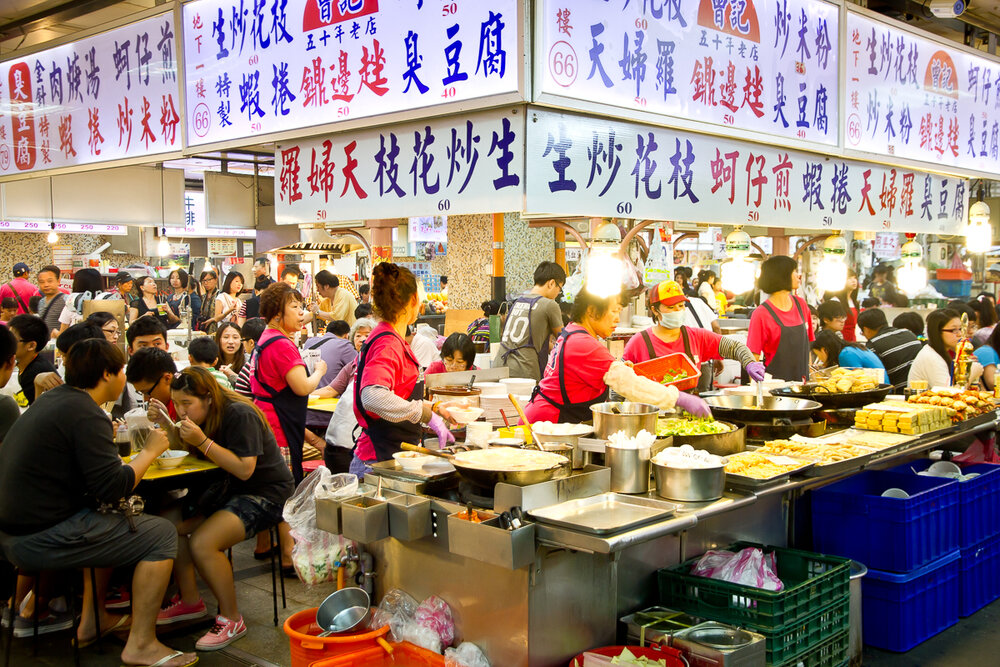
Photo: Nick Kembel — 20 Best Night Markets in Taiwan

Some years ago, I walked into a new “Taiwanese” restaurant in London’s Chinatown with my friend Andy. The waitress shuffled over and imperiously announced that Taiwanese food wasn’t like any other food we had ever had.

“I doubt that,” said Andy to her in Mandarin. “We both lived in Taipei when we were students.”

The waitress visibly blanched and called over her colleague.

“We’re both from Shanghai,” she confessed, huddling closer. “We don’t know what any of this stuff is!”

She could have used a copy of Steven Crook and Katy Hui-wen Hung’s A Culinary History of Taipei: Beyond Pork and Ponlai, a truly exhaustive account of the multiple cuisines not just of the city, but of the entire island, from the various delicacies of its aboriginal peoples, through the foods and crops brought in by various settlers – including the Dutch, Spanish, Cantonese, Fujianese and Hakka – and local food’s many modern transformations. Their book takes in the powerful, enduring influence of Taiwan’s fifty years as a Japanese colony, as well as the austerity era of the mid-twentieth century juan cun emergency housing, when Taiwan was flooded with refugees from the mainland, and the modern logistics of everything from pork transportation to convenience-store microwave cookery.

“Those who live in the mountains eat what they can find in the mountains; those who live by the sea eat from the sea.” Crook and Hung begin with subsistence foods, before delving deep into indigenous folklore in search of reasons for multiple conflicting tribal taboos. When the Chinese first arrived on the shores of Taiwan, they were disgusted at the natives’ penchant for deer’s intestines, while the aborigines were aghast that the Chinese ate chicken. They are nicely focussed on etymologies, including a long discourse on why the humble frog became known as the “water chicken.” The natural assumption, they suggest, is that it is a euphemism designed to conceal the origins of an icky food from disapproving diners. But Taiwanese diners love frogs’ legs – it is far more likely that the new name arose to get around a Song-dynasty government ban on killing frogs, not because they were taboo, but because they were of higher value in eating insects in the rice paddies.

Of particular interest is the sudden rediscovery of indigenous dishes in the 1990s, after the rise to power of the nativist Democratic Progressive Party pushed the mainland-focussed Chinese agenda aside. At the inauguration banquet of president Chen Shui-bian, diners were treated to milkfish ball soup and óaⁿ kóe (“bowl pudding”), a savoury porridge. Both were common dishes in Chen ‘s hometown, and the president would go on to troll his guests in later dinners by pointedly serving taro to represent those who were not native to Taiwan (i.e. the descendants of 1940s refugees), and sweet potatoes to represent the Chinese who had lived there for hundreds of years previously.

Except, of course, the sweet potato is itself a new arrival, only showing up in south-east China in the 16th century, a New World food arriving via the Spanish Philippines. It, along with hundreds of other foodstuffs, was entirely alien to the island, but now forms part of Taiwan’s vibrant food culture, which incorporates vast swathes of Cantonese and Fujianese foodways, but also vestiges of the home cultures of multiple groups of refugees. Crook and Hung explain why Taiwanese bread is often so sweet – the predominant style arrived with the Japanese, who tended to regard it as a dessert rather than staple. They detail the menu of a standard military breakfast, the transformations of sushi brought about by the availability of local fresh fish, and the impact of Western food franchises in the late twentieth century.

They are also fantastically informative on the metadata of Chinese food. When Taiwan joins the World Trade Organisation in 2002, one of the unexpected fall-outs is a sudden, five-fold leap in the price of cooking wine, an entirely benign and vital condiment, now classed as an alcoholic beverage and subject to a tax hike. Crook and Hung chronicle the ripple effect this has, not only on the family kitchen, but on the black economy, as gangsters and spivs rush to fill the hole in the market with ersatz replacements. Similarly, the authors devote an impressive page-count to the multiple puns and euphonies of festive dining, explaining just why certain foods are popular with superstitious locals on particular family occasions and festivals.

Jonathan Clements is the author of The Emperor’s Feast: A History of China in Twelve Meals. Steven Crook and Katy Hui-wen Hung’s A Culinary History of Taipei: Beyond Pork and Ponlai is published by Rowman and Littlefield.

The Pirate King of Taiwan

Over at the History Hack podcast, I talk about the life and times of Coxinga, the “pirate king of Taiwan,” the leader of the anti-Manchu resistance in the 17th century, son of the richest man in the world and his samurai girlfriend, scholar-turned-rebel, twice made a god, one of the most interesting figures in Chinese (or Japanese, or anyone else’s) history.

Also available on YouTube. And of course, should you want to read the book, you can find it here.

Chi Ta-wei

“Chi has argued that discrimination and stigma are forms of societal self-harm, a position that gained substantial weight after a Taiwanese scandal in which donor organs from a dead man were transplanted into five Taiwanese recipients, along with the AIDS virus, because the donor’s family had been unaware of his condition or its implications.”

Over at the Encyclopedia of Science Fiction, I write up the remarkably prescient Chi Ta-wei.

The Cafe Conflict

It all started at the Tasty Congee & Noodle Wantun Shop, a Hong Kong airport café requiring customers to order at the counter and wait for their number to show up. Online reviews for the chain are extremely complimentary – Yelp is full of comments about some of the best fried noodles and congee to be found, high praise indeed for a food-obsessed place like Hong Kong. There are, however, occasional references to a certain brusqueness of service at the airport branch, a very large menu that is difficult to process in a hurry, and an anxious overcrowding that can cost dawdling customers their table if they don’t keep a watchful eye for their order number.

Some or all of these elements combined for two Mainland ladies in 2018, who had plainly already had a miserable time on their Hong Kong vacation.

“I felt like I was subjected to shame and humiliation,” one had tweeted earlier, as reported in the South China Morning Post by Naomi Ng. “In Hong Kong, if you speak English, people will be polite to you. If you speak Mandarin, they will roll their eyes at you.”

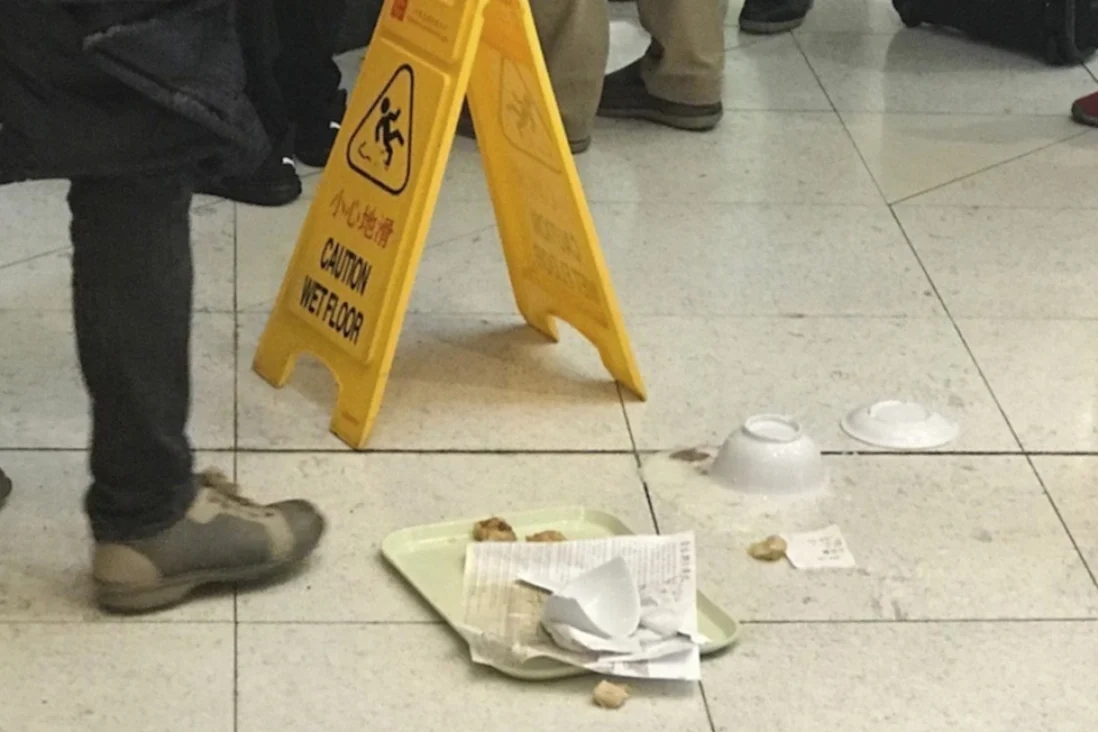
At the café, waiting for their homebound flight, they got into a scuffle with a member of staff. They complained about poor customer service. He told them to stuff it and swore at them. Both sides, according to one witness, started throwing food around, until the man pushed a tray of congee and noodles at them, splashing some on one of the women’s clothes.

Reading between the lines: it was post-Christmas/New Year rush, people had probably been working overtime and covering for winter flu. The café was crowded, and the staff under pressure to keep tables moving. Someone misses their number; someone takes their table; someone gets told to hurry up; someone says they wanted theirs without chili not with it. After some shouting, the women were refunded their bill and left, but a media footprint was already growing – including shots of the incriminating tray, left on the floor for mere minutes afterwards.

Social media magnifies and preserves such incidents in a way not possible in previous generations. The pictures and the online footprint of something that would have otherwise been forgotten in moments provided enough material for newspaper follow-ups. It is a story I can access years later, and part of a narrative that continues Hong Kong’s cross-cultural stand-off of “dogs and locusts.” I remain in two minds about whether this is a good thing, and here’s why.

In 1991, I was witness to a hysterical altercation at a family-run fish restaurant in Kending, Taiwan. As best as I could tell, someone had married someone they shouldn’t, and granny’s inheritance risked being frittered away and someone should have cleaned out the pumps, and in what seemed like mere seconds, a scrum had developed at the front of the restaurant, open to the warm summer-night air and the beach beyond. The old granny grabbed a meat cleaver and smashed its blunt corner into the glass fish tanks, inundating the plaza outside with water and gasping trout. The crabs made a break for it into the street, scuttling through swerving traffic, as the old lady sat sobbing at one of the empty tables. Her children scattered back to the kitchen and rushed to clean up the tables, and everybody pretended there weren’t a dozen huge fish dying on the patio.

I had no idea what was going on. At the time, I lacked the Chinese or the authorial pushiness to really ask. But the only evidence of this is me telling you. I didn’t have a film studio in my pocket that could document it all. Access to the World Wide Web was still a year in my future. I’m sure that the Great Kending Fish Restaurant Fight was an order of magnitude of drama and controversy above a scuffle in an airport café in 2018, but the technology we use in our everyday lives has changed the way that we prioritise and remember. In the 21st century, such technology can be used for the evils of fake news and filler, but it can also be used to swiftly escalate issues in food safety and law. Access, accountability and archives are a feature of modern social media, and the way we talk and think about food and the food industry.

Jonathan Clements is the author of The Emperor’s Feast: A History of China in Twelve Meals.

Puppets, Gods and Brands

“…a brilliant juggling act on a tightrope between anthropology and sociology, which manages to keep ideas in the air from soft power to difference feminism, nation branding and emotional labour. This could have all too easily gone very wrong, but Puppets, Gods and Brands will be welcomed by an entire generation of students trying to talk their supervisors into taking animation seriously.”

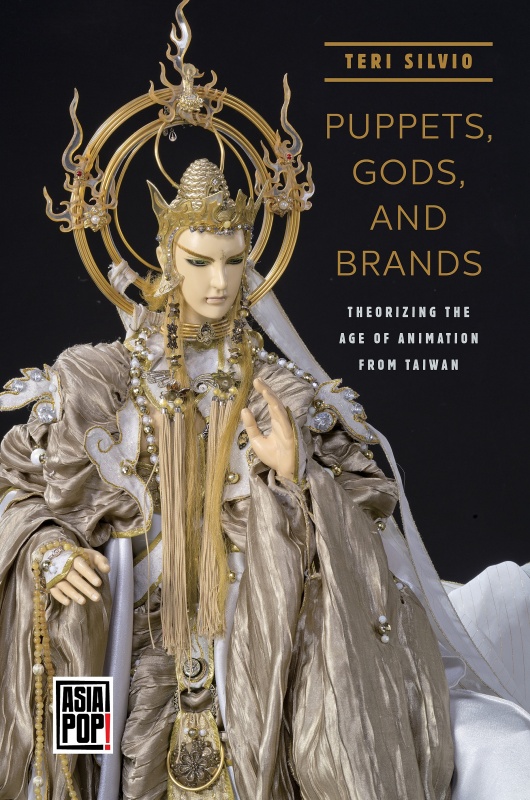
Over at All the Anime, I review Teri Silvio’s Puppets, Gods and Brands, out now from the University of Hawaii Press.