Scotland Loves Anime 2015

miss-hokusaiPacking my suitcase for this year’s Scotland Loves Anime, which begins on Friday in Glasgow. Keiichi Hara is in town to introduce the UK premiere of his Miss Hokusai, while I shall be fronting the UK premiere of Ryotaro Makihara’s Empire of Corpses, the steampunk epic based on the novel by Project Itoh and Toh Enjoe. I’m also looking forward to Production I.G’s latest Ghost in the Shell (another UK premiere) and the studio’s own self-inflicted competition over the same genre ground in Psycho-Pass: The Movie (which is, in case you hadn’t guessed, a UK premiere).

Behind the scenes, I shall be speaking about the state of the anime industry, both at the Edinburgh Education Day and in a pop-up lecture in Nottingham next Monday. I shall also be chairing the jury in Edinburgh as four opinion-formers argue over the conferral of this year’s Golden Partridge Judges’ Award. Shunji Iwai has a film in competition, and almost everybody is liable to be distracted by the Attack on Titan quadruple-bill (two anime movies and two live-action), but I’ll make sure the jury is in the right place at the right time.

Holy Ghosts

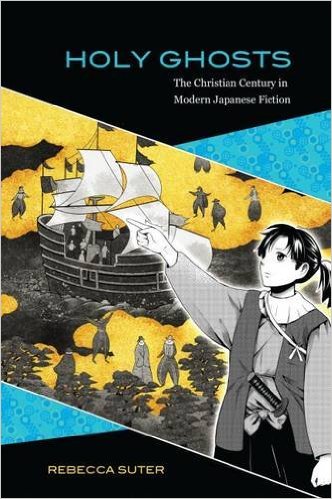
suterMy review of Rebecca Suter’s Holy Ghosts: The Christian Century in Modern Japanese Fiction, is up now on the All the Anime blog.

“[The book] does not shy away from Endo and his ilk, but as her beautiful and striking choice of cover image makes plain, she is not afraid of digging around in the maze of manga and anime in search of new and exciting comparisons.”

Little Drummer Girl

Ricchantainakaritsu3045420119201200You might not recognise Satomi Satou in the street, but you have heard her voice. She’s probably got the most attention in the UK as Wendy Marvell, the 12-year-old dragon slayer in Fairy Tail, but Satou has played literally scores of anime roles since her 2009 debut in Kamichama Karin. A lot of them have been kids – she has the kind of voice that still sounds childlike, which is prized like gold-dust in anime voice acting, because producers can get a junior performance from someone without having to worry about making the kids stay up late for that 2am recording session.

She was also Ritsu Tainaka, the short-haired, forgetful drummer in K-On, an anime series about an afterschool rock band. She’s taken the usual anime starlet route of idol-singing and public appearances, so the K-On songs have stayed with her repertoire, alongside her own songs – her solo singing career has taken off in the last year… Now she’s graduated to full-on pop star status, with her very own stalker, 39-year-old Jun Yasumoto from Osaka, arrested on 25th July by the police because he threatened to hurt her at her next concert. On Twitter.

I’m guessing this is why the Japanese media seem to have thrown innocent-until-proven-guilty out the window, and are happy to report his identity before he’s even made it in front of a judge. While Twitter might feel like you’re thumbing around with your phone and mouthing off to your mates, it can be inconveniently public and traceable if you are planning on, you know, making any death threats in a cheap real-life knock-off of Perfect Blue.

Another day, another nutter giving anime fans a bad name, although this one is going to have extra traction over here. Back when the movie was debuting in the UK, I went ten rounds with one of K-On’s producers over the amount of access to the director. We practically had a three-day fight about it, with me demanding Q&A’s with actual questions and actual answers, and him trying to micro-manage every single moment. He wanted every event to be little more than a curtain call with a homily, and had conniptions at the thought of members of the audience actually being able to interact with the guests. I said he was over-reacting and paranoid. Now I’m looking at my inbox every couple of minutes, wondering when I’m going to get the “I told you so” email.

I shall continue trying to make anime events actual events rather than glorified identity parades, but really, fandom, you don’t make it easy for me. Or for Satomi Satou.

Jonathan Clements is the author of Anime: A History. This article first appeared in NEO 141, 2015.

Vinegar Joe

IMG_0063But why, I hear you ask, would anyone take a ridiculously hilly bend in the river, a thousand miles inland in jungle conditions, and build a massive city there? Everywhere else I have been in China has been carefully built on flat ground. Chongqing is like the map you delete on Sim City because you can’t work out where you are going to put any roads.

Well, for one, this is a bridging point for the Yangtze. Tankers stacked with containers can make it this far on the river, which is itself an amazing thought, thanks to the Three Gorges Dam downriver. But historically, Chongqing only ever flourished where there is no other hope for anywhere else in China. It was first conferred with city status in the Southern Song dynasty, when a game of musical chairs with the refugee Chinese emperors suddenly turned its local princeling into the ruler of what was left of China. And most famously, in the twentieth century, with the Japanese running riot all over the east coast like an outbreak of the walking dead, Chongqing was jury-rigged as the temporary capital, bastion of the Nationalists, kept alive by the infamous Hump airlifts across the Himalayas, which is why there is a wreck-strewn gorge in India called Aluminum Valley.

Chongqing, or Chungking as it was romanised back then, spent half a dozen years as the last hope of free China, landlocked and surrounded. Chiang Kai-shek was the general in charge, although all his dealings with his American supporters were smoothed by his wife, Soong May-ling, who had studied in America and spoke perfect English with a sexy Southern accent. Their best-known unit was the American Volunteer Group, a.k.a. the Flying Tigers, who were formed in secret in Burma in 1941 by “resigned” American pilots, and were hence ready for action a mere fortnight after Pearl Harbor, shooting the Japanese out of the sky in Kunming.

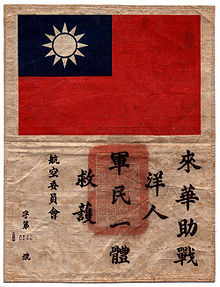
Regular readers of this parish will know about my obsession with the Flying Tigers, although it has never turned into a book because Daniel Ford has already written one that says everything I would say about them. The backs of their flying jackets were sewn with a blood chit, bearing the Nationalist Chinese flag (now only seen in Taiwan), and an oddly poetic statement in Chinese: “From beyond the ocean, he comes to aid in the Celestial war. Soldier and Citizen alike, aid and protect him.” It’s tough to translate; some will take issue with my version, but the choices of wording even in Chinese are a bit quirky and classical.

This is all going to come up again very soon in the media, since the new Bruce Willis film is called The Bombing, and is about the 100,000 people killed by Japanese air raids in wartime Chongqing. No, I can’t imagine why that has suddenly gone into production with Chinese money this year.

Chiang_Kai_Shek_and_wife_with_Lieutenant_General_StilwellI went to the former home of Joseph Stilwell, whose association with China began in 1911, and who was a military attaché in Beijing in the 1930s. He was sent back to China in WW2, over his own protests, because he was the only general Roosevelt had who could speak Chinese. And so he was stuck in Chongqing for several years, arguing with the Flying Tigers and getting increasingly exasperated with Chiang Kai-shek. There is a lovely photograph of him, Chiang and Soong May-ling, cracking up over some joke or other in the garden. The official portrait of the three of them has them all looking serious, but it’s the outtake that makes them all look human, pissing themselves about some long-forgotten fart joke or similar tomfoolery. Stilwell’s otherwise caustic sense of humour earned him the nickname Vinegar Joe, although he was also known as Uncle Joe, largely for his hatred of pomp and ceremony, and his insistence on wearing a uniform without rank or insignia.

His home is a bunker-like block of 1920s chic, set in a hillside on one of the many ridges overlooking Chongqing. It is refreshingly off the beaten track. I cause a traffic jam on the winding mountain road simply by stopping outside to pay my taxi, and inside there is a baffled caretaker washing a cabbage, next to a litter of mewling ginger kittens. Within, the house is wreathed in a jungle of creepers, and surrounded by banyan trees and palm trees, fizzing in the heat. It is a welcome change from the nonsense of so many other Chinese tourist sites, many of which appear to have been designed by the same committee who think that everything needs a shopping mall and a car park.

IMG_0119The exhibition inside includes details of Stilwell’s career, but also pushes his involvement with the Dixie Mission, an abortive attempt by the Americans to collaborate with the Communists, which was called off in 1947. The Chinese still remember, however, that the plane that flew in to Yan’an to evacuate the Americans came loaded with medical supplies to leave behind. Actually, they remember an awful lot about Stilwell, and there is an inscription on the wall about how when the guns are silent and the smoke has faded, only friendship remains.

Across the road, situated in such a way as to make Vinegar Joe spin in his grave fast enough to power all of Chongqing, there is a museum dedicated to the Flying Tigers, the air group who were a royal pain in his arse all the time he was in China. The staff were oddly fluent in English, as if they are used to coach parties of US servicemen rolling up to hear all about the American Volunteer Group and their shark-nosed planes.

220px-REB-AVG-CHIT-1I couldn’t resist buying some Flying Tigers tea from the gift shop and a couple of books, although I did balk at the crappily reproduced Flying Tigers T-shirts and baseball caps. I also bought my very own blood chit, advertising me as a man who has come from beyond the sea, although it does so in a pinkish manner that suggests it was run off on a laser printer. I also bought a book about the Hump airlifts, because I find them oddly interesting. There has been quite a lot written about them – the Berlin Airlift was masterminded by Hump veterans – and as the Hump exhibition at the Zhang family mansion in Changchun also mentioned, they didn’t get a lot of glory because there isn’t really a dramatic narrative in simply delivering fuel and fags to a bunch of soldiers, even if doing so involves caroming through narrow canyons in the Himalayas. Who am I kidding, it would make an awesome movie, particularly these days, when special effects could show all the crashes. I am rather surprised Hollywood hasn’t got involved already, since one Arnold Spielberg was a radio-gunner in a B-25 squadron in India, and his son Steven has become something of a name these days. The Hump, for what it’s worth, was set up by Colonel Merian C. Cooper, better known to posterity as the producer of King Kong, although I know him better as the chief of staff for Claire Chennault of the Flying Tigers.

Jonathan Clements is the author of A Brief History of China.

The Story of Kullervo

1379598266945164721The Tolkien Estate has long mined the rich resources of its own archives, not the least with Christopher Tolkien’s 12-volume History of Middle Earth, a shelf-busting sump of drafts, notes, unpublished manuscripts and annotations which cunningly smuggles pretty much all of Tolkien’s intellectual property, including The Lord of the Rings itself, into copyright until the 22nd century – as the “co-author”, the still-living Tolkien Junior and his heirs retain ownership until 70 years after his own death. Were it not for this clever move, the likes of The Hobbit would become public-domain within the next 30 years.

Unpublished manuscripts, of course, are a different thing, and Verlyn Flieger is but one of many modern academics who get to treat musty Tolkien files in an Oxford library as if they are long-lost scrolls from the Silk Road. Her account of the condition of Tolkien’s original papers, etched with crossings-out and multiple renditions of the same line, makes it clear how much of a reconstructive exercise The Story of Kullervo is, of a text that was never quite constructed in the first place.
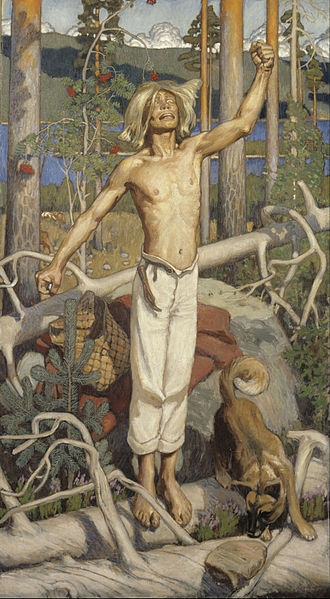
330px-Akseli_Gallen-Kallela_-_Kullervo_Cursing_-_Google_Art_ProjectKullervo was a very early work, undertaken by Tolkien in his twenties when he had stumbled across the myths and legends of the Finnish Kalevala. The eponymous hero is a slave-boy prone to fits of murderous rage, who kills his brother, turns cows into bears, shags his sister and has conversations with a talking sword. Naturally, with a resumé like that, he became an icon of Finnish nationalism, the subject of the first ever Finnish language stage-play, as well as a bunch of adaptations into other media, of which Tolkien’s was perhaps the most obscure, languishing unread in a pile of papers until rescued by a group of academic scavengers.

In a continuing, and frankly welcome modern trend in Tolkieniana, the relatively slim text of Kullervo itself is bulked out with relevant academic essays, including a lecture by Tolkien himself, and Flieger’s own analysis of the place of Kullervo within his work. This occasionally confronts the reader with the cant and argot of Tolkien specialists, such as the use of the term Qenya, for the Elvish proto-language, rather than Quenya, the High Elvish spoken by the time of the Lord of the Rings. In general, however, they are far more interesting than the text of Kullervo itself – eruditely footnoted, and steeped in the historiography of both Tolkien and Finland, right from the very cover image, which seems to invoke the Sami flag.

There is a regrettable moment of sloppy editing, that one hopes can be swiftly redacted in at least the digital version. The introduction claims that Sophocles’ Oedipus was set in the 4th century BC; if that were true, it would have been a special sci-fi Greek tragedy, set a hundred years in the future. No, it premiered in the 5th century, and alluded to events from Greece’s semi-mythical past. Meanwhile, editor Verlyn Flieger did herself no favours in a breathless BBC online article in which she seemingly makes the spurious claim: “Kullervo is the origin story for Shakespeare’s Hamlet… It is likely that Tolkien knew that Shakespeare had used this tale.” Let’s assume she was misquoted, since such an inspiration would require Shakespeare climbing into a time machine, buying a copy of the English translation of the Kalevala in 1888, and then jumping back to the 1100s, Terminator-style, to kill Saxo Grammaticus before he could write the Gesta Danorum.

Much has been made of Kullervo as a defining tale of Finnishness, although from the very first line, Tolkien’s version is shamelessly Anglo-Saxon in its meter and tone. You can almost imagine a much older Tolkien, chuffing on his pipe by a fireside, and beginning with Jackanory cadences:

In the days when magic was yet new, a swan nurtured her brood of signets by the banks of a smooth river in the reedy marshland of Sutse. One day, as she was sailing among the sedge-fenced pools with her trail of younglings following, an eagle swooped from heaven and flying high bore off one of her children to Telea…

This is all very well, but it is a world away from the primal, recursive, repetitive song-talk of the original, which is faintly preserved even in the old 1888 Kullervo translation by John Martin Crawford. Your mileage may vary, but for Kullervo to really hit the right note with me, it needs to sound more like this:

In the ancient times a mother
Hatched and raised some swans and chickens,
Placed the chickens in the brushwood,
Placed her swans upon the river;
Came an eagle, hawk, and falcon,
Scattered all her swans and chickens…

500x500The original literally lacks the vocabulary to avoid repeating itself. It is a spiralling cycle, intended not to be read but to be performed, constantly checking over its shoulder to make sure that the audience is keeping up.

Tolkien’s version, meanwhile, turns it into a narrative story with an occasional song interlude. He buffs it up for a notional audience of hobbits – as we might expect, he is already working through his nascent idea for a mythology of the English, and Kullervo is a private experiment, unintended for publication. It also reads all too often like someone pastiching Tolkien, with awful dialogue like: “Yonder, wife, is no reek of autumn smoke nor any passing gloom, but I fear me a cloud that goeth nowise swiftly nor before it has harmed my house and folk in evil storm.” Flieger writes of Tolkien’s brief and abortive struggle to teach himself Finnish, leading me to wonder if such purple prose is some bumbling attempt to imitate the way Finns talk.

This is young Tolkien. He will have to live another lifetime before he completes The Lord of the Rings. There is not yet much sign of any greatness in him. Even when he tries his hand at a bit of Finnish singing, his lyrics are tin-eared and chinless:

Now a man in sooth I deem me / Though mine ages have seen few summers / And this springtime in the woodlands / Still is new to me and lovely.

These are jottings, rehearsals, juvenilia. Finnish meter gets to you after a while, and the temptation to doggerel is high. Five years ago, I found myself in Karelia with Ellen Kushner and Delia Sherman, and we were all talking that way by lunchtime:

To the fridge went Lemminkäinen / Searching for the milky dregs / On the upper and the lower / Shelves he sought for several eggs.

“By my father’s knife,” proclaims Tolkien’s Kullervo, like some numpty at a Renaissance Fayre, “when I am bigger and my body waxeth stronger then will I avenge his slaughter and atone for the tears of thee my mother who bore me.” The absence of punctuation is faithfully replicated from the original, either a deeply intricate recreation of Finnish speech – Finnish sentences are often so long that Finns themselves have been known to breathe in while talking as well as out – or yet another indicator that this rough draft was rough indeed.
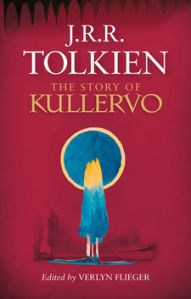
225px-The_Story_of_KullervoNone of this should bother you. It certainly doesn’t bother Flieger, who is making no claims for Tolkien’s Kullervo as great literature. Indisputably, we can see within it the germ of what would become his Middle Earth. This is Tolkien’s own Finland fan fiction, pastiching a work that he loves beyond all telling, caught at a crucial moment when he is starting to change the names and shuffle the ideas, discarding the bits that he thinks he can do better himself. Frankly, the text of Kullervo itself is the least interesting part of this book, while the essays that accompany it are undeniably worth the cover price. More by luck than judgement, Harper Collins have chosen to publish a book by JRR Freaking Tolkien, about Finland and Finnishness, the week after Helsinki is announced as the site for the 2017 Science Fiction Worldcon. I think the sales will be fine.

Tolkien himself, already a couple of years older and wiser, is far more poetic and lyrical in the book’s reprinted lecture on the Kalevala than in Kullervo itself. He speaks of Finland (or at least a Finland of the mind), a country he never visited, as if he had been spirited there by elves:

Trees will group differently on the horizon, the birds will make unfamiliar music; the inhabitants will talk a wild and at first unintelligible lingo. I hope… after this the country and its manners have become more familiar, and you have got on speaking terms with the natives, you will find it rather jolly to live with this strange people and these new gods awhile, with this race of unhypocritical scandalous heroes and sadly unsentimental lovers: and at the last, you may feel you do not want to go back home for a long while if at all.

Jonathan Clements is the author of A Short History of Finland, available now in print and on the Kindle.

Finland Expects

41CH3PO2YYL._SY445_With the happy news that Helsinki is the site of the 2017 World Science Fiction Convention, it’s time for foreign fandom to find out about their new destination. You need the Armchair Traveller’s History of Finland, available now in print and Kindle form from Amazon UK and Amazon US.

—-

One hundred years old in 2017, the modern nation of Finland is also the heir to centuries of history and heritage, as a wilderness at the edge of early Europe, an important component of the Swedish empire, and a Grand Duchy of Tsarist Russia. From prehistoric reindeer herders to the creators of Angry Birds, medieval barons to the rock band Lordi, Finnish history is rich with oddities and excitement, as well as unexpected connections to the outside world – the legendary English bishop who became its first Christian martyr; the Viking queen who hailed from the wastes of Lapland; the bored country doctor who helped inspire The Lord of the Rings; and the many war heroes who held off the Soviet Union against impossible odds.

Jonathan Clements examines Finland’s public artworks and literary giants, its legends, folktales and its most famous figures, building an indispensable portrait of this fascinating nation, sure to add value to any visitor’s experience, be it for business or pleasure. Particular attention is paid to the historical sites likely to feature on any tourist’s itinerary. Special emphasis is also given to the writings and reactions of visitors through the centuries.

A comprehensive and illuminating look at the rich history of this dynamic and little-known region, and an easy-to-use reference source for the tourist, traveller, and baffled science fiction fan.

Jonathan Clements is the author of Mannerheim: President, Soldier, Spy, the biography of the Finnish president whose former career included a two-year undercover mission in China, posing as a Swedish ethnologist.

Parks and Recreation

ikiru2News arrives from Okinawa that a retired artist has donated 300 million yen (that’s £1.5 million) to the Zenda Forest Park in Kumejima, Okinawa, to make a Children’s Interaction Centre. He even designed it for them! What a kind old man, like that guy in Akira Kurosawa’s Ikiru, who devotes his twilight years to getting some swings in the local playground. It helps that the philanthropist in question is Hayao Miyazaki, and it should come as no surprise that the Zenda park is getting something of a reputation as a home away from home for displaced refugees from the Fukushima disaster.

So Miyazaki gets to do some more for the kids, and to return to his trademark ecological themes in a new way. One wonders, perhaps, if the park’s layout might be expected to have a bit of input from his son, Goro, a former landscape gardener whose career in anime has hardly set the world on fire.

Miyazaki’s interest in parks and playgrounds has been a recurring feature of recent years. His recently-translated Turning Point devotes more space to discussing the Studio Ghibli crèche than to his latest movie, as Miyazaki exhorts his fellow animators to observe the film’s target audience in their natural habitat. But his studio has also got a park of its own, the famous Studio Ghibli Museum in Mitaka, which generates a movie’s worth of income every year.

How does it manage it? Firstly, it carefully kettles its customers, insisting on pre-booked entries to ensure that the staff are neither left short-handed nor idle. Then it promises exclusive experiences, including Ghibli short films that can only be seen at the museum. Then there’s the restaurant and the gift shop… but it’s a much classier affair than your average theme park. Miyazaki and his fellow designers put incredible effort into visualising the experience from a child’s eye view, with pathways that make it possible to wander but never to get lost, and little easter-eggs visible only if you are meter high.

The Ghibli Museum and the plans for Zenda demonstrate only too well that Miyazaki truly is one of a kind. You won’t get that sort of treatment from the people who brought you Transformers.

Jonathan Clements is the author of Anime: A History (UK/US). This article first appeared in NEO #140, 2015.

We Are Woman

bata00_p_01_04The first of two Chinese translations of my Empress Wu biography is now being advertised, with the title Zhennai Nuren  — “I am Woman” declined with an imperial first-person pronoun, like the Royal We. This Taiwanese edition translated by Lai Yeqian, is released this month by Gusa. There’s another translation coming in the People’s Republic sometime in the autumn.

From my introduction to the Taiwan edition:

“Even as I delivered the original manuscript of this book in 2007, I was fielding phone calls from a TV production company interested in adapting the story of Empress Wu into a drama series. Nothing came of that, but I have twice sold the rights to this book to producers hoping to reimagine it as a saga of intrigue to rival Game of Thrones. Perhaps I shall be lucky the third time.

“What is it about Empress Wu that excites such interest? For foreign producers, it’s the dual appeal of manly adventure and feminine wiles, but also the chance to present medieval China, a country often regarded as monolithic and homogenous, as cosmopolitan and multiracial. At the height of the Tang dynasty, there were ‘blue-eyed girls in the taverns of Chang’an,’ ambassadors from Bohai and Syria, and handsome refugees from Persia. There were Christian priests and Muslim traders, offering tantalising potential for any director wanting to present a diverse and vibrant society.

“Wu remains a lively topic, even today. Since this book was first published, Tsui Hark has brought the pomp and ceremony of Wu’s reign to the screen with Detective Dee and the Mystery of the Phantom Flame (2010, 狄仁傑之通天帝國) and its prequel. Archaeologists have found the grave of Shangguan Wan’er, and Chinese television has become embroiled in a new scandal fitting for its most infamous female sovereign. Low-cut dresses and flashes of cleavage in Fan Bingbing’s lavish Empress of China (2014-15, 武媚娘传奇) had made the PRC censor worried about a possible corrupting influence. Such stories are wonderful news to any historian – if anything lures in new readers of non-fiction, it’s the discovery that the Tang dynasty is ‘too hot for TV’ even in modern times.”

If you can read Chinese, there are several extracts available online, here, here, here, and here.