All Night Long

Just a housekeeping note for British readers — there’s only a week to go until the notorious Sci Fi London Anime All-Nighter, running at *two* screens in the middle of town. Your chance to see what, as far as I can tell, amounts to two UK premieres (or near as dammit) and a taster of next year’s big anime movie titles, while downing Red Bull and ice cream until past dawn.

24th October at the Apollo Piccadilly Circus.
THE SKY CRAWLERS
KING OF THORN
TIME OF EVE
EVANGELION 1.0
EUREKA 7 the movie

Tickets are £30 – including goody bag, or roughly a third of the price of a London hotel. I’m just saying, for all you people going to the London Expo that weekend…

Finder's Keepers

To Germany, where Ayano Yamane’s manga series Finder has been been rated as “harmful to young persons.” From the shocked reaction on some message boards, you’d be forgiven to think that the Germans were dragging up every copy of Finder that they could… er… find, and burning them in the streets. In fact, the story has been simply “indexed” by an organisation with the Teutonically exacting title of Federal Department for Media Harmful to Young Persons. The name pretty much does what it says on the tin – they look for harmful stuff, and then make sure people know about it.

We can learn a lot from the German censorship system. Dodgy anime, unpleasant porn, morally suspect manga, all these things are freely available in Germany. You can buy anything you want, but you won’t find it in the high street or the shopping mall. If you want to find something that is unsuitable for children, you have to go to a place where only adults are welcome to buy it. Hence, in Germany, there is none of the tiresome brinkmanship and false “surprise” that hounds the anime and manga business elsewhere in the world. You won’t find German parents accidentally picking up a Toshio Maeda anime in the video store, and assuming that it will make a nice gift for their kids (this has happened in the US). You won’t find German journalists combing eagerly through the comics section of a sci-fi store, doggedly, desperately hoping to find something to which they can react with feigned indignation (this has happened in the UK). You won’t find German customs officers probing your luggage in case you are carrying one of those awful manga books that so notoriously corrupt the young (this has happened in Canada).

You won’t find any of these things, because fine, upstanding, conservative citizens, by definition, would never go to a sex shop or the adults-only section of a comics store, and hence cannot possibly be taken by surprise by what they see there. Nor, of course, will you find anyone underage in such places. Ten years ago, in the afterword to the Erotic Anime Movie Guide, I made a modest proposal, that other countries might examine the German model as a means of keeping everyone happy.

Finder is not “banned” in Germany. It’s simply been rated as unsuitable for children, along with Legend of the Overfiend and a host of other titles, such as the computer games Duke Nukem 3D, Command & Conquer: Generals, and Mortal Kombat II. If you want it, you have to go to a place that sells that sort of material. If you are a child, you are not supposed to encounter it. You can’t point at it at the shelves and pester your parents for it, because you won’t see those shelves. What criticism there is about the German model revolves around two other issues. One is the question of who gets to decide what is “harmful”. The other is how far this indexing goes. It remains unclear, legally speaking, whether the indexing of a title makes it illegal to even talk about it. Advertising an indexed title is a problematic area, although of course, merely turning up on the index adds an element of notoriety and publicity. I’ve never been moved to mention Finder before in this column, but now, because of this… here we are.

(This article first appeared in Neo 62, 2009)

About the Author


This is probably not going to be approved as the author photograph for my biography of Admiral Togo, even if it does combine many crucial elements. That vessel in the background is his flagship, the Mikasa, which trounced the Russian fleet at the Battle of Tsushima. The statue is Togo himself. The beer is Amiraali, an obscure Finnish brand from the 1970s that once featured a bunch of famous Admirals on the label. The fact that Togo was on it charmed the Japanese, who now appear to brew it under licence just so they can sell it in Mikasa Park. And then there’s me, stuck in Yokosuka with an accidentally-opened bottle of Togo beer, in front of Togo’s statue. With my reputation…

Getting material from Japan is significantly easier these days. Otaku.com or Amazon Japan will deliver to your door. It’s true, I may have accidentally just spent £200 in a Japanese bookshop, but that was a moment of weakness. Writers still have to do the legwork. If someone can find out 95% of the necessary information just by sitting at their computer with a credit card, it behoves the professional author to go that extra mile. In the case of Togo, I was clambering over his battleship photographing the makers’ stamps on steel girders, measuring the thickness of the armour plating around the helm, and getting a picture of his famous “Z” signal, which still flies from the Mikasa’s mast every day.

This trip to Japan has incorporated several projects. I have been acquiring photographs to adorn two books that are already complete and scheduled for publication in 2010, Admiral Togo and A Brief History of the Samurai. I am also amassing research for three other books that I hope to write one day, as soon as someone is prepared to pay me for them. And of course, I have picked up enough manga to keep my Manga Snapshot column for another year, along with a stack of books on anime history.

That personal touch is still necessary. Not only for getting the photographs of particular sites, but for pacing over the ground where history happened. Last month, I went to the site of the Battle of Yashima, and came back with no photographs, no souvenirs and no books. But I did come back with a sentence to add to my forthcoming samurai book that would never have occurred to an author who had not been there himself to observe the local geography,

In recent years, I have become addicted to small museums. If I am in a new place, the first place I run to is the little showcase of local history, because that’s where I am going to find the books without ISBNs that Amazon doesn’t carry. That’s where I’ll find the privately printed pamphlet by the local retired schoolmaster, detailing folklore or local legend that hasn’t made it into the history books. Japanese museums often have giveaway newsletters publishing new theories or research on an irregular schedule. When I was in the tiny town of Hondo, on the Amakusa archipelago, the local museum chief Kenji Kameshi gave me a huge stack of them, representing several years of data and research on the Shimabara Rebellion, too new for the history books.

This all places interesting demands on my itinerary. Taxi drivers are baffled to discover that I am prepared to travel three hours to an obscure hill in the middle of nowhere, and rarely understand that a single photograph of the right hill will pay for the entire trip. There’s no point in me going to a major museum if it won’t allow photography, but an out-of-the-way venue with a single interesting piece is worth my trouble if it’s a relevant object.

Nine times out of ten, when I tell people I am a writer, they don’t believe me. I have lost count of the number of times that I have to explain, no, that I am not a teacher, no, not a student, no, not a journalist. I am a person who writes books. Not a person who thinks he does, or who would like to one day, but someone who genuinely gets paid to sit down and tell stories about long-dead pirates, empresses and admirals. With pictures. Where possible.

The Far West

In the Komyoji, Sendai

In the Komyoji, Sendai

Several years ago, the cost of obtaining the images for a book I’d written ended up amounting to more than I’d been paid to write it. Ever since then, I have worked on the policy that if I am going to be contractually obliged to get photographs and the expense is going to be several thousand pounds, I might as well get them myself and use the trip to amass more materials. Which is why I am here in Sendai, former seat of the Date clan, slowly assembling the pieces of information for a putative book about their most famous accomplishment. In 1614, Date Masamune sent several samurai on a long voyage. In a ship they’d built themselves, they crossed the Pacific, walked over Mexico, and then boarded a Spanish vessel bound for Europe. The leader of the group, Hasekura Tsunenaga (or Philip Faxecura in European accounts) eventually met the Pope in Rome, before beginning his long trip back to Japan. By the time he returned to Sendai, several years later, Christianity had not merely fallen out of fashion but had become a capital offence. His mission was entirely in vain, and he died of unknown causes soon afterwards.

He is buried in the grounds of the Komyoji temple in Sendai. The man in the picture is the sub-priest Ken Ouchi, who is showing me a wall-painting of Hasekura’s mission, donated to the temple by artist Tetsuro Hama. He very kindly took time away from cleaning the temple for the upcoming equinox celebrations to show me the interiors and also Hasekura’s modest grave.

He asked me where I was from, and I told him.

“Oh!” he said. “Britain! My wife and daughter are studying English there. In a place called Cardiff!” The reach of the Torchwood Institute is far indeed.

Sendai

When I was a child, I imagined that Sendai was the headquarters of a vast satanic conglomerate called Muramasa Industries, which spanned the globe and several neighbouring dimensions in a bid for mastery of the universe. In 1987, I wrote my Geography O-level paper on the little-known Muramasa Steelworks in Sendai, which I had entirely made up (it did not help that I accidentally drank a bottle of sake before going into the exam — I got a B, thanks for asking). When I left Japan in 1992, I told the immigration clerk that I was sure to come back, “because I haven’t been to Sendai yet”. I have always imagined that Sendai would be a really cool place. And now, more than twenty years after I began imagining what Sendai was like, I am finally here.
Continue reading

Clouds on the Hill

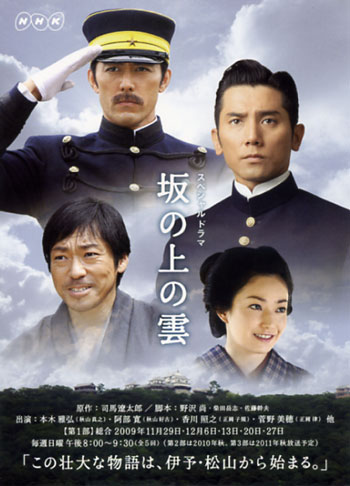
Ryotaro Shiba, a prominent writer of historical fiction, serialised the novel Clouds on the Hill (Saka no Ue no Kumo) from 1968 to 1972. He was a master at hunting down those people in Japanese history whose lives spanned crucial events and critical issues. In the case of Clouds on the Hill, he focussed on the Akiyama brothers, two boys from Matsuyama (see last blog entry) who witnessed the rapid modernisation of Japan, joined the new-look military, attained high military rank, one in the army and the other in the navy.
Continue reading

Manga Snapshots

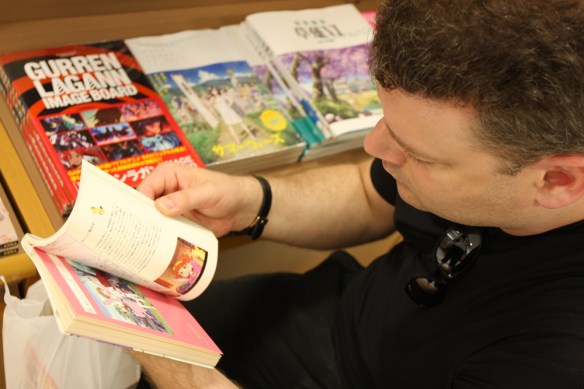
For several years, I have been writing a column in Neo magazine called Manga Snapshot. Every month I take a different Japanese comics anthology magazine and literally take it apart, examining everything from the paper quality to the adverts. There are so many comics magazines in Japan that despite running now for four years, Manga Snapshot has yet to repeat a title. I’ve covered all the usual magazines for boys and girls and housewives, and the usual niches like romance and war comics, but also weirder areas. Detective stories for lonely Goths, educational golfing magazine containing nothing but manga about golf, a magazine entirely devoted to mahjong… several of these were reprinted in the Schoolgirl Milky Crisis book, and in the event that there is a Schoolgirl Milky Crisis 2, there will be many more of them.
Continue reading

From the People Who Brought You Pearl Harbor

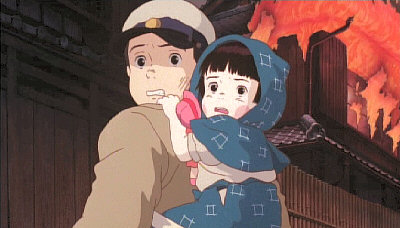
WW2 has become a stripped-down fable of Star Wars proportions – a few brave heroes, taking on a force of terrifying evil against impossible odds. On the Good Side, the rag-tag hard-pressed Alliance. On the Bad Side, the dark empire, with its storm troopers and its nice uniforms. The good guys win, and the good guys are us.

This doesn’t work in Japan.
Continue reading

Wandering Ghost

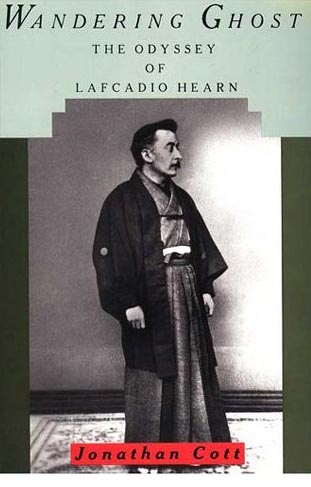
Wandering Ghost: The Odyssey of Lafcadio Hearn is a biography of the journalist and writer who eventually became a Japanese citizen, and who wrote so many books about the country before his death in 1904. For someone who witnessed Japan’s passage into the modern age, and did so much to inform the West about it, Hearn is strangely absent from college reading lists. His name only cropped up once in my entire university career, and that was in a folktale that would have raised a chuckle from Hearn himself. The ghost of Lafcadio Hearn is used to scare young undergraduates in Japanese, to warn them of the dangers of benevolent racism, and to prevent them from dying, as he is alleged to have done, from a broken heart when Japan failed to live up to expectations.
Continue reading