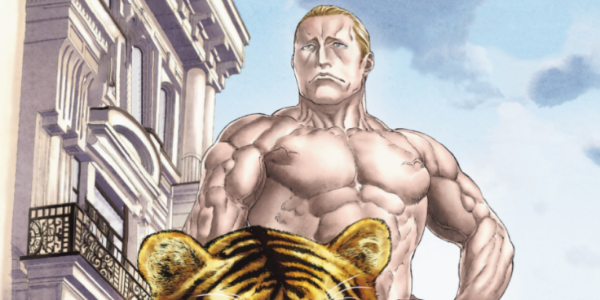
Ride-On King by Yasushi Baba is properly mental. No teenage boys letching after a bunch of witch-girls here. Instead, our leading man is Alexander Plutinov, president-for-life of the small Central Asian “Republic of Prussia”, who is transported to another world one day when he is crushed by a falling chunk from a massive statue. And in this new fantasy kingdom, Plutinov has magic powers, can ride around shirtless on a wyvern, and put his martial arts skills to a new and noble use, saving a bunch of teenage girls from marauding orcs, wild boar and dragons or something. It is, for the world-weary politician, something of a holiday in a fantasy realm, an extended tour of an absurd fantasy realm accompanied by jailbait half-elves.
No, no, wait for it. There’s more. Because your correspondent had to scurry off to double-check that Ride-On King didn’t have a Russian-language Wikipedia page. Fortunately, it doesn’t, because if it did, I think there would be tanks in Tokyo by tomorrow morning – in case you didn’t already guess from the synopsis above, this manga epic is nothing less than “In Another World with Vladimir Putin,” its protagonist a cheeky allegory for Russia’s favourite shirtless martial-arts-loving president-for-life. I just loved the premise of this ridiculous manga, not so much for its off-the-peg D&D adventuring, but for the sheer gumption of casting an older man in the role so often snagged by ungrateful teenagers who, frankly, never make the most of it. The whole thing is a refreshing change from the norms of the so-called isekai genre, and makes me think about all the wonderful possibilities for similar celebrity spin-offs: Is it Wrong to Try to Pick Up Girls in the White House?, That Time I Got Reincarnated as Michael Gove, or Sorcerous Stabber Joanna Lumley. Admit it, you would read all of those.
Jonathan Clements is the author of Anime: A History. This is an excerpt from the Manga Snapshot column on Sirius magazine that appeared in NEO #217, February 2022.
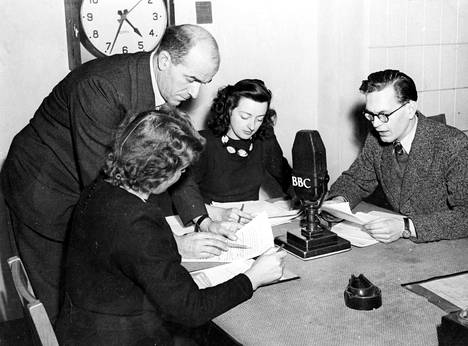
After the Russian attack on Finland in 1939, BBC producers scrambled to rustle up some Finnish speakers to produce programming. It took them so long that by the time the first broadcast went on-air in 1940, the Winter War was already over. Reasoning that there was still a value in pandering to the Finns and correcting whatever nonsense the Russians were telling them, the BBC broadcasts kicked off anyway, and were hence already up and running when the Continuation War broke out.
Moscow tried to seize the airwaves with their own stooges, including Armas Äikiä, who had briefly been the Minister for Agriculture in the short-lived “Finnish Democratic Republic” proclaimed in what is now the St Petersburg suburbs. The real star, however, albeit for all the wrong reasons, was Aino Kallio, a.k.a. “Moskovan Tiltu”, bestowed with a name that recalled, for Finns, imagery from a popular 1920s song of credulous teenage cluelessness. While “Tiltu” harangued the Finns about their co-belligerency pact with the Nazis, (a style ridiculed in a popular song as nothing but “soup and rattling”) the BBC also entered the fray, with broadcasts from Greta Kivinen, a.k.a. “London Jenny.” She also slagged off the Finns for getting into bed with Hitler, but tried to warn them off Stalin as well.
In the Finnish-language book This is London: the BBC’s Finnish Broadcasters in the Information War Between East and West (Lontoo Täällä: BBC:n Suomalaistuomittajat Idän ja Lännen Välisessä Informaatiosodassa) editor Ilpo Salonen and contributors Risto Uimonen and Hanna Rajalahti present a bitty grab-bag of reminiscences and anecdotes. There are, in fact, dozens of authors, with almost every surviving journalist seemingly given a couple of pages to reminisce about their challenges and careers. This can occasionally lead to chapters that repeat themselves, but represents a fascinating patchwork of accounts of the changing requirements of these obscure cogs in the Bush House machine, who referred to themselves as the bushfinnit.
During the Cold War, it was not even clear if anyone was listening. The Soviets began jamming the BBC’s short-wave radio frequency, such that many Finns reported nothing but a crackle of static when they turned the dial to the correct point. Up until 1956, when the Soviets returned the Porkkala peninsula to Finland, “you had to strain to listen carefully if you wanted to hear something through the noise.” By the 1960s, the journalists had got the hang of it, and worked out what sort of news stories would be catnip to the Finns. In the face of ongoing BBC bureaucratic stone-walling, they fought for extra time to do justice in Finnish broadcasts of Churchill’s funeral (1965) and the state visit to London by the Finnish leader Urho Kekkonen in 1961.
A new generation of staffers arrived in the 1970s, determined to shake up what they saw as a stuffy establishment. As the old guard retired, their younger replacements, raised on sixties radicalism, began to argue that while they understood that it was the mission of the BBC’s foreign service to report on the world from a “British” perspective, they would secure a larger audience if they tried to pander, at least a little, to Finnish interests. There were, for example, substantial arguments behind the scenes over the BBC’s intended coverage of Vatican matters, since Finland hardly has any Catholics who would give a toss. The Finnish section was also somewhat wrong-footed by the occupation of the Falkland Islands, which they regarded for several days as an eye-rolling “And Finally…” joke, until Thatcher sent a task-force to counter-attack.
Many of the correspondents are plainly incredible Anglophiles, and there are many touching stories about Swinging London and the early rumblings of Cool Britannia. Not to mention a cringe-worthy Alan Partridge moment, as, after the broadcast of Paul Macartney’s glasnost-era concert in Moscow, famously featuring the triumphalist “Back in the USSR”, the Finnish section’s Petri Nevalainen spots Macartney coming out of a studio, and sees the chance for doorstepping journalistic gold.
He grabs the former Beatle, shoves a microphone in his face, and demands to know why he has never performed in Finland.
“I did,” says Macartney. “With Wings.”
For many years, the BBC maintained at least one stringer in Finland, but from 1996 had a dedicated Helsinki office in Kaisaniemi, effectively moving much of the Finnish broadcast operations in-country. There was, however, a less obvious need for the BBC to stick its oar in at all, and in the face of cutbacks and increasing competition from the Finns themselves, the short-wave broadcasts shut down for good in 1997.
A closing essay by Jyrki Kokki takes the story of the foreign languages section up to 2020, amounting to a litany of funding cuts, ill-conceived revenue-generation initiatives, and the slow shuttering of a service once deemed vital by government and administrators. In some cases, this was a matter of changing demographics – there seems, notes Kokki, little point in running German-language broadcasts if all the Germans speak English anyway. But there is also a note of quiet concern, as a national broadcaster is undermined by its own government, slowly chipped away into nothing, even if nation still needs to speak unto nation.
Jonathan Clements is the author of An Armchair Traveller’s History of Finland. Lontoo Täällä: BBC:n Suomalaistuomittajat Idän ja Lännen Välisessä Informaatiosodassa is published by WSOY.
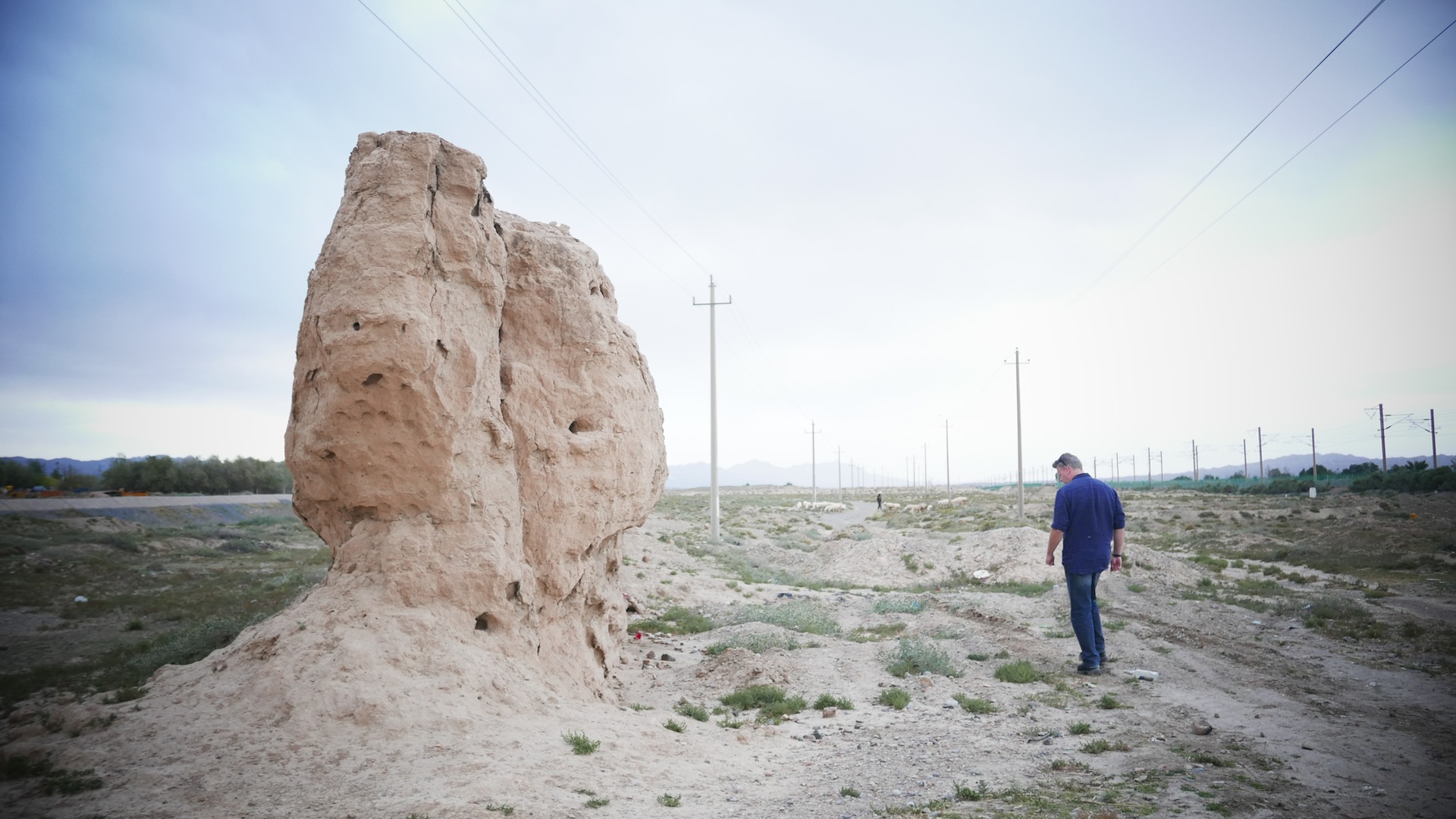
The Gansu end of the Great Wall is nothing like the posh Ming-era wall near Beijing. This is the Han-era wall, made of rammed earth, two thousand years old, and barely three metres high. It takes us the rest of the day to get there, and we lose our minibus to a broken gear-box on the way, forcing us to cram into the loaner Buick and the chase car just to get there before sunset. This is, I think, the fourth or fifth time that I have been at the Great Wall, although this version might be easily mistaken for a pile of mud.
I have to deliver a complex piece to camera which may form the opening speech of the series, and will certainly have to do for the opening of the trailer to be shown at the publicity event in October. I have to walk between a road and a railway, revealing that the Great Wall sits between them, and explain that the Great Wall here is “on the other side of China”, a gritty and real place, a thousand miles away from the tourist brochures. And then, I have to explain that I am a historian whose experience of China is really only from books, and that I am being forced to get my hands dirty finding about all these Chinese icons, and their place in a global trade network, past, present and future.
I have to do this in a single take, keeping my face to camera while my body is walking away from it, while the light is changing, while trains are zooming past on one side, and while trucks are zooming past on the other, while families of yokels keep stopping at the roadside and wandering over to see what is happening, and while a swarm of sandflies attack the crew, forcing me to deliver my lines while trying not to be distracted by the sight of nine people gesticulating wildly as they fight off a bunch of insects.
The Buick drivers take pictures with their cellphones, and I see a look in their eyes which is becoming increasingly familiar. They have spent all day watching the gangly fat foreigner, and wondering what the hell it is that he gets paid for. And then they have seen me deliver six passes at a 45-second monologue, while walking backwards beside the Great Wall, through broken glass and sandflies and passing dickheads.
The sun sets, we lose the light, and we have to pack up. The director has maybe three clean takes to work with, as well as several broken ones that might be stitched together in post. Considering the pressure (train, train, truck, truck, yokel, flies, light change, train, truck, GO!), I am pleased that we managed anything at all.
To Dublin, the one in Georgia, not the one in Ireland. That’s Georgia, the one in the United States, not the one on the Black Sea. Okay, to America, where a man has been sentenced to three years in prison for using a COVID relief loan to buy a $57,000 Pokémon card.
Vinath Oudomsine had told the Small Business Administration last year that he owned an “entertainment services” company with a high turn-over and a growing staff, and pleaded for $85,000 to keep things going during the pandemic. Then, he spent two thirds of the money nabbing himself a highly collectable Charizard card.
This was not what the Small Business Administration had in mind, and Oudomsine was obliged to hand over the ridiculously high-priced card, which I can only assume was one of the ultra-rare, first-printing Japanese basic sets from 1996. So, unlike the 1999 Holographic Charizard #4 ($36,000) or the 1999 Shadowless Holographic #4 Charizard ($25,500), the first-printing lacks a rarity symbol, because it was printed in the first two weeks of the existence of the game, before anyone thought rarity symbols would be necessary. It would have been literally one of the first Pokémon cards ever printed, which is apparently worth something to someone.
The issue of trading cards is even a matter of some academic speculation, as covered in Gilles Brougère’s “How Much is a Pokémon Worth?” in Pikachu’s Global Adventure (2004, you’re welcome, media students). Back in NEO #165, this column expressed my doubts about the collectability of many collectables. But Oudomsine’s case demonstrates that there was at least one person in the world prepared to assign such a value to a “trading” card.
Oudomsine wasn’t sent to jail for placing notional value on a rare Charizard – that is still not a crime. He was sent to jail for defrauding the US government to be able to afford one, so don’t worry, the Poké-police will not be knocking on your door any time soon. But what I want to know is what happens to that card now? Will the Small Business Administration will be trying to sell it off to get its money back, and if so, does it come with a new bill of provenance, increasing its value even further by noting that it was that card, from that case, that got all the international press coverage?
Jonathan Clements is the author of Anime: A History. This article first appeared in NEO #219, 2022.
“Pompo is an unapologetic cheerleader for B-movies, cranking out Asylum-level nonsense with scream-queens and scary monsters. But she has a mindset that is vital in producers (and in critics, and indeed on festival juries) – she loves each of her films for what it is. She assesses her films on the basis of how they can be the best type of that film that they could be, and it soon becomes obvious that she has a similar attitude towards people.”
Over at All the Anime, I write up Pompo the Cinephile, coming to UK cinemas in June.
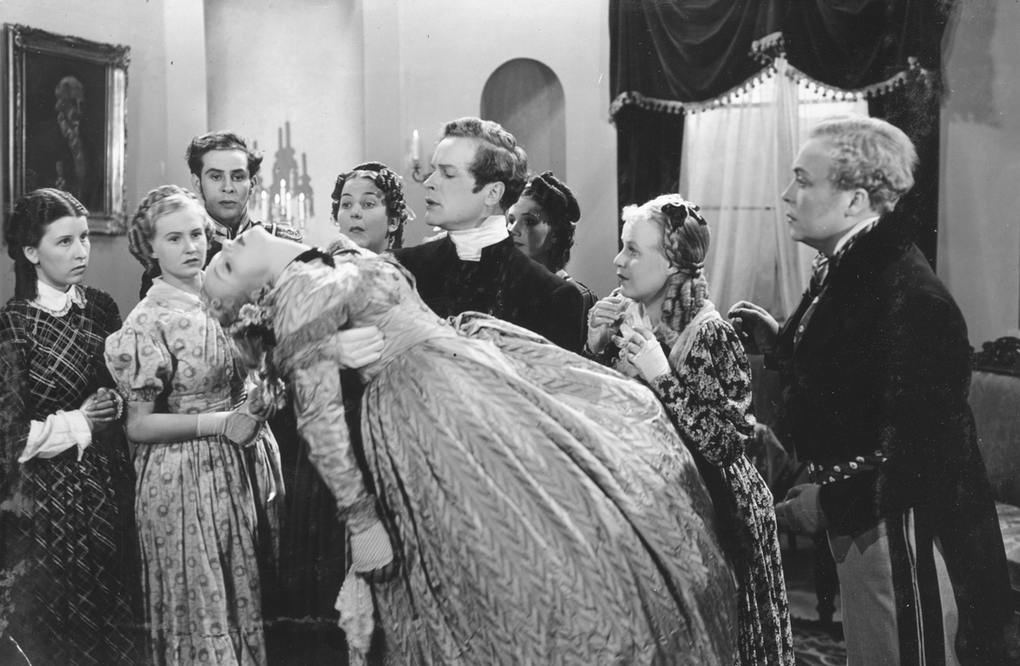
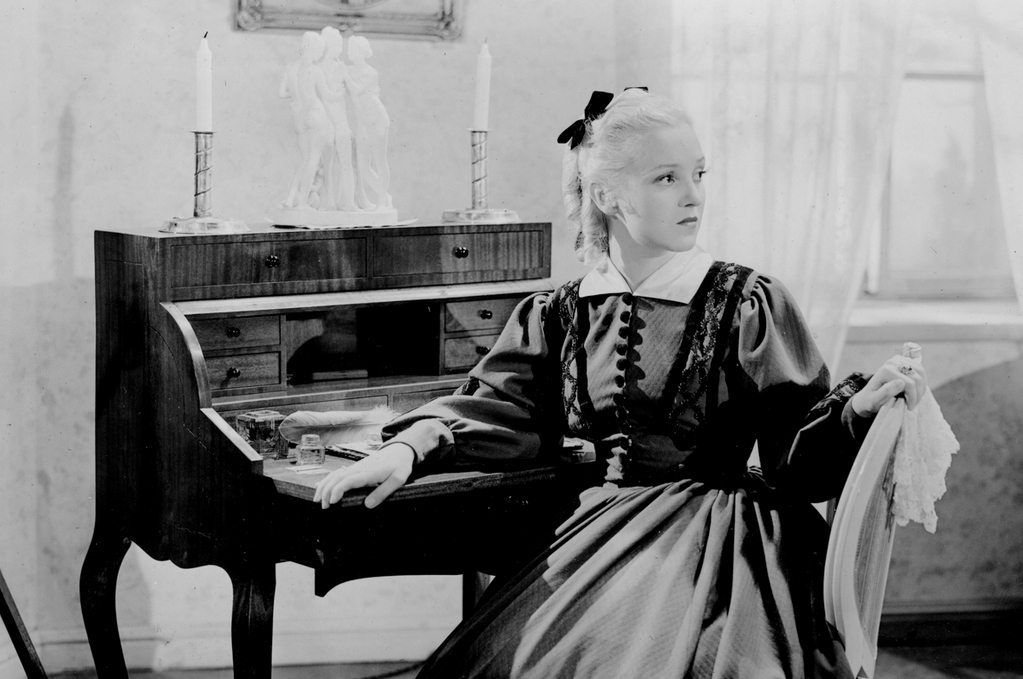
At the time of its release, Runon kuningas ja muutolintu was the longest-gestating film in Finnish history. Playwright Elsa Soini was commissioned to write the script in 1937, principal photography by Yrjö Norta commenced in 1938, but was delayed by the onset of the Winter War, with the premiere of the film not coming until October 1940 – compare to similar delays besetting The Heir of Tottisalmi and In the Kitchen.
The story spans a crucial decade from 1837 to 1848, beginning with poet J.L. Runeberg’s acceptance of a post teaching Latin literature at a Porvoo college. This inevitably drags him away from the hustle and bustle of life in That Fancy Helsinki, and his wife Frederika (Anni Hämäläinen) frets that his creative genius will wither in the provinces.
A few years later, the young Emilie Björkstén (Ansa Ikonen) moves to Porvoo and soon attracts the wagging tongues of the town gossips, who regard her as trouble because she is a beautiful woman without a squire – “the right jar of syrup to catch flies.” A fan of Runeberg’s poetry, she is drawn to him, and he to her, in a series of will-they-won’t-they, did-they-do-they encounters. Runeberg (Eino Kaipainen) protests that he is a man, not merely a poet, seemingly warning her that her fangirling over him might be misinterpreted by his hindbrain as sexual advances.
Eventually, the two end up snogging, and Emilie’s landlord, the local bishop (Ossi Elstelä) accuses her of “tarnishing the poet’s crown.” Brow-beaten into staying away from him Emilie puts on a brave face, and tells him at their next meeting that she is expecting to be betrothed to her beau Robert (Unto Salminen). But instead of taking this for what it is – a gentle acknowledgement that their love is not to be – Runeberg calls her a temptress and a flirt for stringing him along.
Leo Schulgin in the Helsingin Sanomat thought it was “the best Finnish film yet made”, while the hard-to-impress Paula Talaskivi in Ilta-Sanomat deemed it to be “a pleasant surprise,” praising not only for its choice of subject matter, for its attention to detail and the fact that it was shot in extremely adverse circumstances. These two leading reviewers were echoed by much of the rest of the press, with Uusi Suomi remarking on the loving evocation of mid-19th-century Porvoo. Posterity has been less kind, with more cynical modern commentators regarding it as an entirely unbelievable version of the past, accorded way too much slack by the audiences of the 1940s.
But Runon kuningas ja muutolintu was dogged by controversy from the moment it commenced production, based on Bert Edelfelt’s book Some Old Pages from a Diary (1922, Ur en gammal dagbok). There is a whirlpool of tensions beneath the surface of this film, in which a resolutely Finnish production team celebrates the Swedish-speaking poet who would write Finland’s national anthem, but also reveals that he was a human being with human foibles. On announcing that the film was in production, director Toivo Särkkä was mobbed by a delegation of university lecturers, pleading with him not to besmirch the character of Finland’s national poet. Runeberg was an untouchable demigod of Finnish culture, and to suggest that he might have his head turned by some girl was regarded as sacrilege. I am also tempted to point out that leading man Eino Kaipainen had founded his entire movie career to date on being a Finnish heart-throb that no red-blooded woman could possibly resist, which rather places an unfair pressure on any character obliged to remain immune to his charms.
Our own era has been even more critical of the film, noting that it sets up Runeberg as some pious, dutiful patriot, and his lover as a flighty “migratory bird”, breezing into his life to cause chaos like that uncaring strumpet in The Women of Niskavuori. This, modern critics have argued, is only Runeberg’s film because of what his written work has become to Finns – pity the poor woman whose poetry doesn’t get sung at public occasions decades after she has died in obscurity. But that is precisely what Elsa Soini’s script is driving at through much of the film – the fact that gender and customs and assumptions of the mid-19th-century have doomed posterity to assume that Emilie is a talentless flirt, and Runeberg a tormented poet, when in fact, allowed to interact as equals, they prove to be able and creative collaborators. Runeberg’s own wife dismisses his flirtation with a shrug, Emilie thanks God for helping her “resist temptation”, but buried deep down in all this is an artful consideration of noble sacrifice.
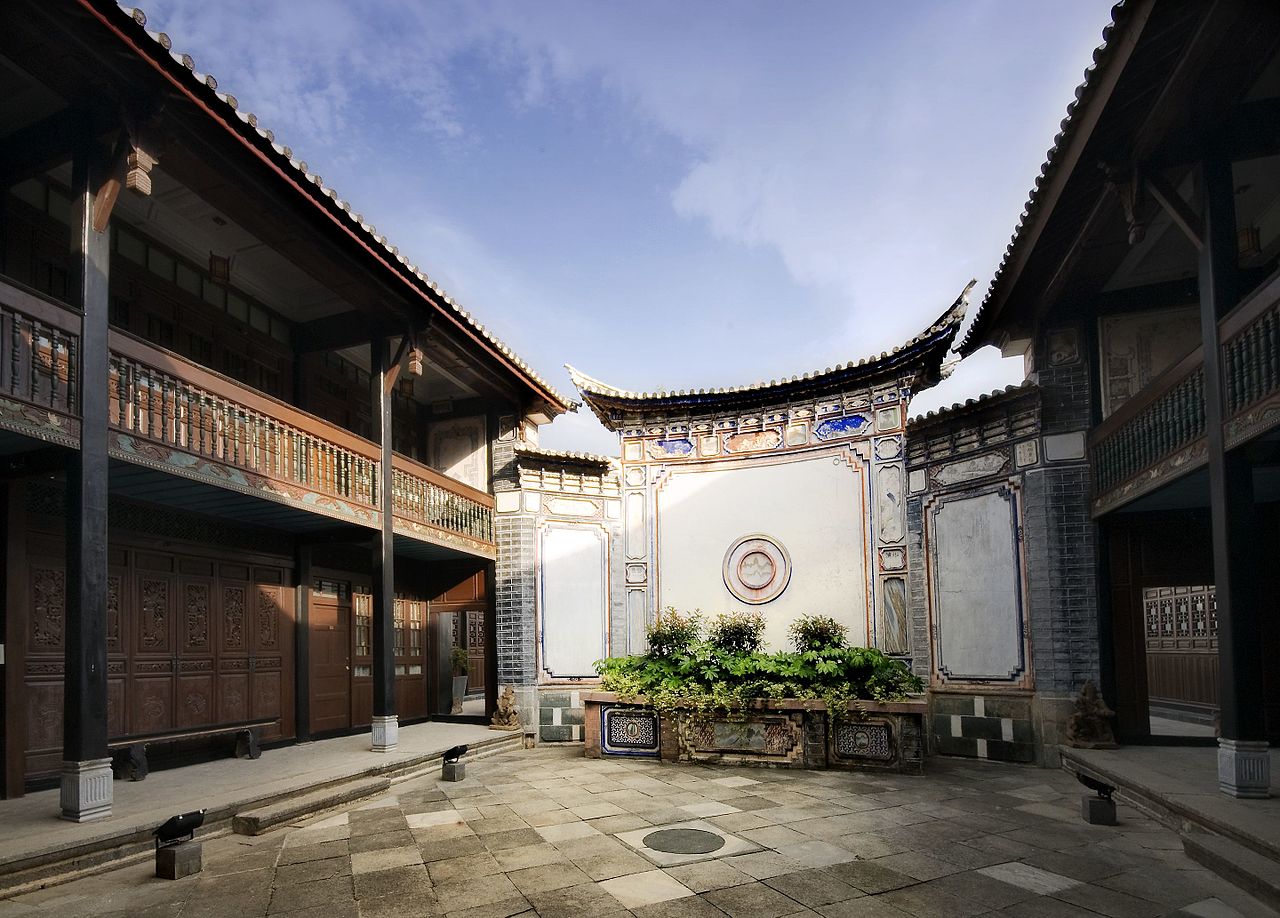
Xizhou, where we have been living in splendour and opulence for the last three days, was once a trading town on the Tea Horse Route. In 1941, it was the site of a forward radio station for the Flying Tigers and the transport aircraft bringing supplies over The Hump from Burma. Which explains an awful lot about the attitude of the Bai people here. When they ask me if I am an American, it is not out of ignorance but out of admiration, even now, for the pilots and soldiers who were stationed here to fight the Japanese.
What shock and awe there must have been, when one of these little valleys, glowing quietly in the afternoon sun, a pagoda on the hills, farmers in the fields, the clanging of cowbells and the calls of the birds, suddenly had its tranquillity shattered by the roar of shark-toothed American planes, screaming out of the sky in pursuit of Japanese fighters.
The breakfast room at our hotel is festooned with Flying Tigers memorabilia, wartime maps of China, the sunburst symbol of the Republican Chinese, pictures of Clare Chennault and his flyers, adverts for the (terrible) John Wayne film, and wartime bonds posters, exhorting “CHINA, THE FIRST TO FIGHT!” and “HELP HIM SAVE CHINA.” I try to explain the story to the crew, but I get quite tearful whenever I have to talk about it.
Our hotel is owned by Brian Linden, an American of Swedish extraction, who came to Xizhou eight years ago and has been fighting to persuade the Chinese to value their heritage instead of bulldozing it. He’s responsible for several sites in Xizhou, and appears to have been quite influential in the preservation of the surrounding area, which is clean but quaint and authentic, riddled with little shops and tea houses. He is in the process of restoring the radio station, too, which he intends to turn into another Flying Tigers museum, complete with a Boeing flight simulator that will allow visitors to relive the terror of navigating across the Himalayas.
Brian first came to China on a scholarship to study Mandarin. He met his future wife at Nanjing University, and was soon talent-spotted to play the lead in the Chinese movie He Came From Across The Ocean (1984), a dismal weepie about an American student who comes to China to study, but contracts fatal Encephalitis B. He spends much of the latter part of the film moping about the fact that his looming demise does not permit him to help China more. Brian reveals that there was no actual script, and since he was going to be dubbed anyway, he was told to simply talk nonsense for minutes at a time, while the crew made sad faces or happy faces behind him as a rough guide to his motivation.
“At first,” he says, “I tried to say what was going on in the scene, but then my shots stretched to five minutes, to seven minutes, so I just started repeating song lyrics. In the movie, my character is saying: ‘I am here to help the Chinese’, but if you can lip-read, I’m actually saying: ‘On a dark desert highway / cool wind in my hair….”
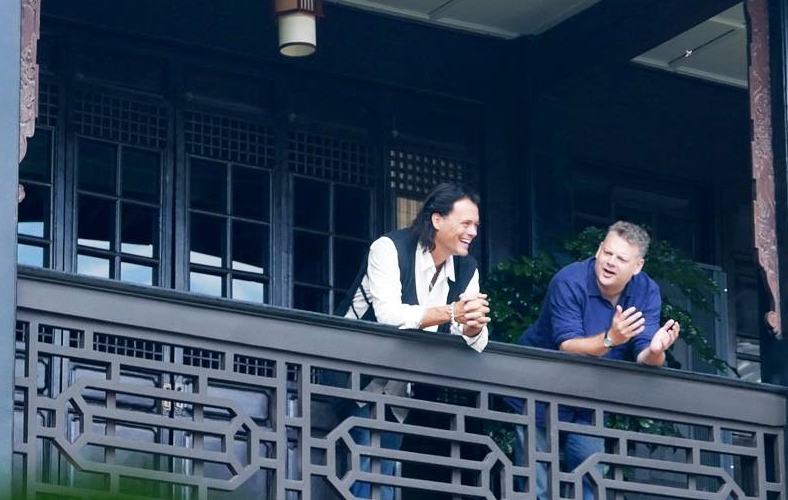
Brian is my easiest interview yet, since it is the first I have been allowed to conduct in my native language. We have lots to talk about. We are both the sons of antique dealers (he still has a shop selling Chinese antiquities somewhere in the mid-West), and since he was also once a cameraman, he takes an enthusiastic interest in the equipment we are using. He has never seen LED lighting before, and is amazed by the power and adjustability.
He is also something of a hippy turned businessman, and I have to steer him away from pat responses about how nice the Chinese government is, and rehearsed speeches about passion and travel. But we are soon commiserating with each other about the frustrations of having to obey Chinese laws when the Chinese can’t be bothered themselves.
“My fire prevention codes in this building cost me $120,000 for all the gear and alarms,” he sighs. “The guy next door has an illegal hotel, and all he needs is a bucket of water.”
He is also determined to encourage among his visitors the concept of heritage (an historical appreciation) as opposed to their fractured sense of tradition (which should mean a sense of how things are done, but tends with the Chinese to mean a sense of how things are done last week).
He explains that he faces constant frustration with the “hotelisation” of Chinese tourism, which values nothing but selfie sticks and gimmickry. His hotel provides a traditional experience, but the Chinese guests complain that they don’t have TVs in their rooms.
“They build a hotel somewhere with a 60-inch TV in every room, and then some guy builds one next to you with 65-inch TVs, so the Chinese want to stay there because it is ‘better’. Why are you people watching TV, you’re in Yunnan!?” he wails. “They go on vacation and you ask them what they did, and all they tell you is how great it was that their bathroom had a television in it.”
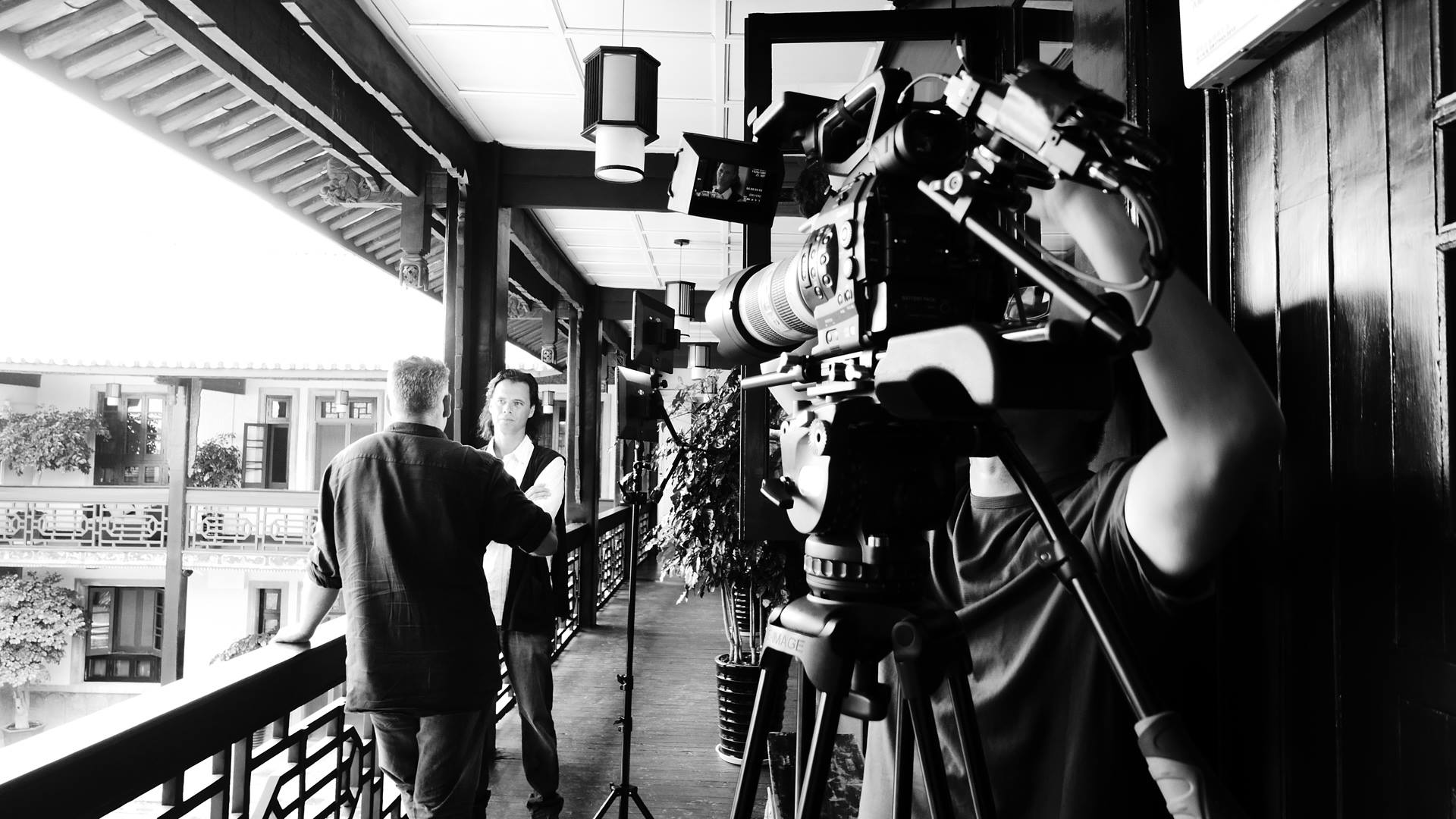
I think the director is becoming slightly exasperated that I am just having a conversation with Brian rather than pursuing a particular National Geographic agenda. But I get him back on to track by asking him about the merchants who built the house we are staying in.
“They didn’t just build things for their families,” he says. “They contributed to the local community. They built libraries, they built schools. They had a sense of obligation to their neighbours, and you don’t see that any more. Now they just take their money and run away to America. I am trying to show them, they can spend it here. They can live here. They can love it, here. I don’t want to see Mediterranean houses and California-imitation houses by the side of the lake. I want to see houses like this.”
The Macartney Mission of 1793 sometimes seems to be one of the most studied diplomatic events in Sino-British history – a failed attempt to open commerce and diplomatic dialogue between George III, who was already mad, and the Qianlong Emperor, who soon would be when he had to deal with British faffing over protocols. Over the years, it has been written up by, among others, its deputy, by its sea captain, by Macartney’s own valet (a fascinating document, recently republished by Frances Wood, and which I hope to review here soon), and, tardily, by Macartney himself, whose own diary of events remained unpublished until 1958, over a century after his death. In recent years, it has also been the subject of a wonderfully detailed approach in diplomatic terms, Eoin McDonnell’s Kowtow, as well as James L. Hevia’s Cherishing Men From Afar, which approaches the whole thing from the point of view of the Chinese.
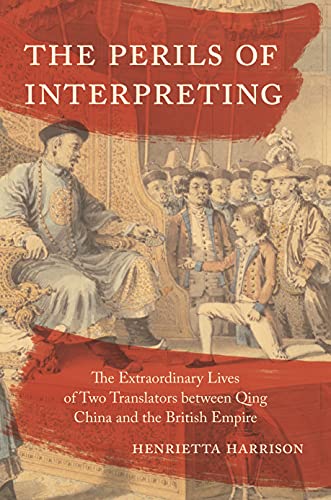
But all of these are valid and illuminating angles, as is Henrietta Harrison’s The Perils of Interpreting, which retells the story of the Macartney mission from the point of view of the poor men who had to interpret all the wrangles into and out of Chinese. Harrison focusses on Li Zibiao, the Italian-educated Chinese who interpreted for the mission, as well as the twelve-year-old George Thomas Staunton, who accompanied his father on the trip and was driven thereafter into a life of Chinese studies.
Harrison is particularly good at following the money, offering harsh financial explanations for historical phenomena. When it comes to the Macartney mission itself, she provocatively notes that of all the planetariums, muskets and clocks that Macartney tried to impress the Chinese with, he neglected to mention Britain’s most devastating and useful “new technology” – the national debt. It’s this, Harrison argues, that made it possible for the British to construct huge warships in the first place, while the Qing dynasty struggled to pay its bills.
She also places Macartney’s mission firmly in its historical context, noting only the massive amounts of money sloshing around the world in the ever-growing tea trade, but the degree to which Macartney’s own attitude was influenced by his personal experience in the Americas and India. Ousted from his former Caribbean post by the French, he was packed off to run Madras, where he was bogged down in a prolonged conflict with the neighbouring state of Mysore, and only permitted some breathing space when Britain’s acceptance of American independence brought an end to the war with France. India, Harrison writes, was supposed to be the new imperial possession to replace the lost Americas, and Macartney feared that Britain might lose India as it had lost the Thirteen Colonies. He was hence super-keen on establishing trade with China as a means of strengthening India as a British possession.
Occurring a number of times in Macartney’s diary of the mission, “Mr Plumb” the interpreter turns out to actually be Mr Plum (Chinese: Li), or Li Zibiao, a Chinese Christian who had studied at an Italian seminary, and was hence able to render Chinese into Italian or Latin. As the man literally at the ears of the Emperor and Macartney, Li was privy to all sorts of machinations and skulduggery, and indeed added some of his own by trying to work discussion of religious freedom for Chinese Catholics into some of the things he was translating. Harrison provides several chapters about the remarkable life that took Li from the edge of Tibet, to Italy and back to China, noting all the while that the Qing records of the Macartney Mission neglect to even mention that Macartney’s interpreter was Chinese.
Much discussion of the mission tends to revolve instead around the mission’s “other” interpreter, George Staunton, the son and namesake of Macartney’s deputy. The twelve-year-old Staunton picked up enough Chinese on the journey to be able to stutter a few words in response to the Emperor’s attention, and also, in one of the British Empire’s more staggering delegations of responsibility, also put his sophomoric grasp of Chinese writing to use copying out the official diplomatic response to the Emperor. Harrison observes that the bigging up of Staunton in the official record is, at least in part, because it’s his Dad who wrote it, choosing to place his son’s encounter with the Emperor at the centre of the mission report, as one of the few moments of human interest in an otherwise tense and frustrating diplomatic encounter.
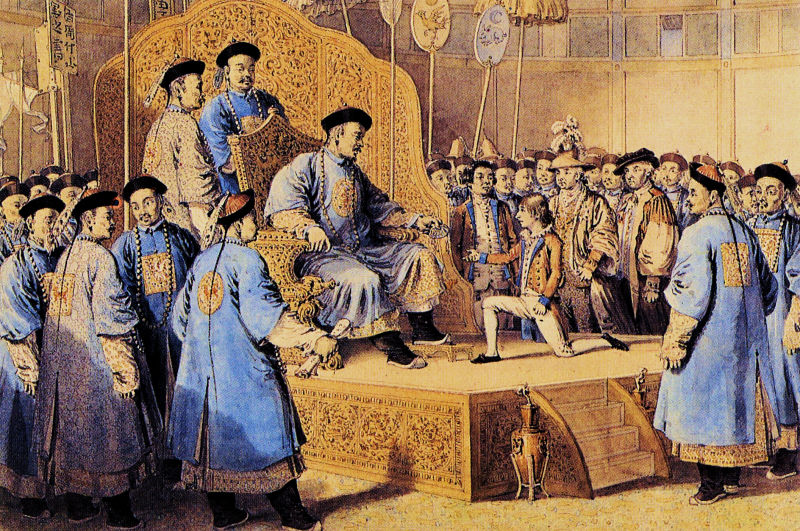
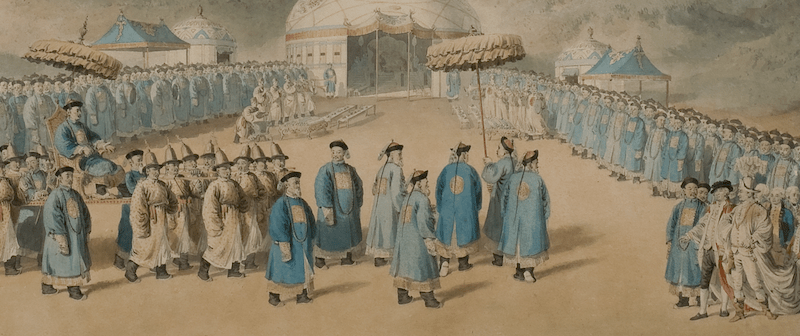
But there’s more to it than mere fatherly bragging. Staunton Junior, accepting a gift from the Qianlong emperor, became the centrepiece of the mission’s visual imagery, too. Harrison uses William Alexander’s painting of the Staunton encounter on her cover, noting in passing that it also includes the sole artistic representation of Li Zibiao. However, Harrison also observes that William Alexander didn’t actually accompany the entourage on their trip to meet the Emperor at his summer retreat. Instead, he drew his famous picture based on the description he received from people who actually had been there, and went through several drafts that depicted it in various different ways. Moreover, it seems highly likely that the centring of Staunton, effectively pushing Macartney himself into the background of the sole official depiction of his meeting with the Emperor, cunningly pulls the focus away from Macartney’s own interaction, which had been, and continues to be a matter of diplomatic controversy.
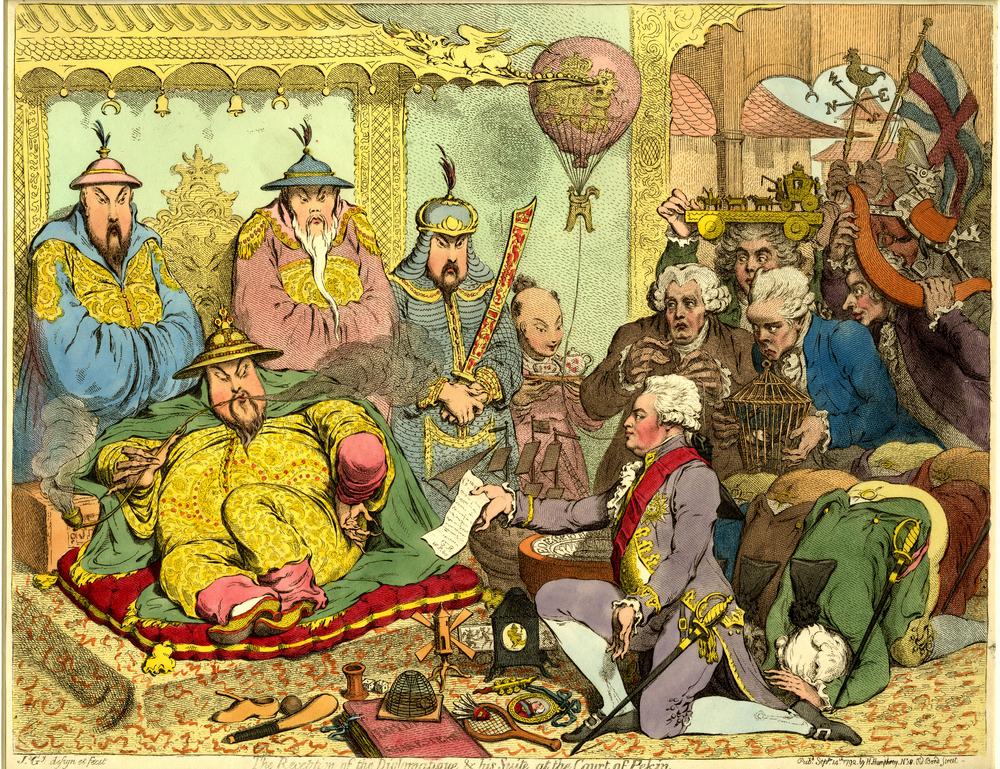
Even before Macartney left for China, there had been speculation about whether he would prostrate himself before the Emperor in the kowtow, (even to the extent of a Gillray cartoon, above, lampooning the idea) and Harrison gets gleefully grubby in the archives pointing out how Chinese and British writings on the fateful meeting offer widely different accounts of it, and that the elder Staunton’s own hand-written journal contains frantic crossings-out as he tries to find the best wording to describe Macartney’s behaviour as diplomatically as possible, none of which survive to the account as printed and published.
That’s not how the Chinese remembered it, and Harrison uncovers a cutting passage of courtly verse that compares the British to “wild deer, untamed and stubborn against the court rituals” and which brags that when push came to shove in the imperial presence, Macartney fell to both his knees.
So not the one knee that Macartney claimed himself, and not the full head-to-the-floor kowtow that the Chinese demanded? Whatever happened, after Macartney’s audience, the relations between the entourages turned increasingly frosty, and the British were bundled out of north China, being told that their time was up, but actually because the patience of the Chinese had run out.
The Macartney Mission was officially a failure, and its leader returned to Britain muttering that China was a rotting hulk, a ship of state doomed to sink or succumb to mutiny. That’s another story, of course. But Harrison stays with the two interpreters, charting their very different fates, as Li ended up as an increasingly unwelcome missionary in Shaanxi, while the younger Staunton nurtured a passionate interest in the Chinese language, and would return to China in his late teens as an employee of the East India Company. There, his years of careful study of Mandarin were confronted by the two-fold menace of Cantonese, as different from Mandarin as English is from Dutch, and by the horrors of Chinese Coastal Pidgin, a trading patois that mangled both Chinese and English into a new creole of its own.
There is more material extant on Staunton than on Li, and Harrison makes the most of her metadata, even including a graph tabulating the increase in his wealth from his bank accounts. Staunton gets to lurk as an interpreter in the corners of several other minor moments in Sino-British history, but suddenly comes to life, quite jaw-droppingly, in an encounter in 1811. With tensions riding high in Canton, the Mongol official Songyun arrives as a trouble-shooter, and demands to know who has written the impeccable Chinese on a British document. It was, of course, Staunton, whom Songyun first encountered a decade earlier, and the two are reacquainted at a banquet that suddenly turns nasty when Songyun, seemingly out of the blue, demands that Staunton drop to his knees and perform the kowtow to him. Staunton refuses so vehemently that a modern reader might even say that he was “triggered”.
Staunton is also on the side-lines in 1811 at a moment that passes without much notice, but which amounts to the culmination of all Macartney’s fears and warnings. Low on silver, and unprepared to listen to Songyun’s pleas for the moral high-ground, the English merchants in Canton voted to accept opium as a security in credit notes. That was sure to help the economy back in British India, but also set the nations on a collision course for the Opium Wars.
Harrison takes her narrative right up to and past the first Opium War, with a melancholy account of the ridicule and indifference with which the British back home treated Staunton’s knowledge of China. She writes of Staunton’s ire at being asked to be a mere interpreter with the later Amherst Embassy, despite the expectations of the Chinese themselves that he would be a leading envoy. Instead, fuming, he is initially asked to be a mere flunky, working for the bastard son of the Earl of Buckinghamshire, appointed to the role because he’s been to India and therefore apparently “knows the East.”
She also quotes from his heartfelt attempts, later in life as a Member of Parliament, to teach braying fellow MPs about the finer nuances of Chinese culture – his futile speech correcting the weasly comments of one MP ring all too true today, in a world in which, in the words of Michael Gove, people had already “had enough of experts” and preferred instead the comforts of ignorance.
Well, I’d like to thank the Academy, but it turns out there’s no need, since this year’s best animated feature competition at the Oscars is Encanto, Flee, Luca, The Mitchells vs the Machines and Raya and the Last Dragon.
The longlist was a different story. There were six Japanese animated features eligible for consideration there, but then again, the longlist is always a bit of a mug’s game, as everybody tries to cram as many titles in there as possible. So, it would have been nice, say, if Fortune Favours Lady Nikuko, which won the Judges’ Award at October’s Scotland Loves Anime, had made it over the penultimate hurdle. Considering Hollywood’s love of self-referentiality, I’m a little surprised there wasn’t a smidgen of love for Pompo the Cinephile, which is a gleeful celebration of movie-making.
And then there’s the giant, speaker-laden blue whale in the room, Mamoru Hosoda’s Belle, which is sending critics worldwide into tailspins of praise, garnering five-star reviews in the mainstream press, and has been resoundingly ignored.
You may be wondering why anyone really cares. The Oscar-voters’ frames of reference are plainly blinkered beyond belief, limited to whatever their kids are watching and a sop to the woke Danes. But as Ichiro Itano once sagely said, there’s no medal for coming fourth. Come third, be an also-ran in the race, and you’re still part of the conversation, you’re part of the news cycle. People see you on the podium and wonder who you are, and maybe they Google you, and maybe they give your movie a try. I’m sure there’s no coincidence that Belle’s UK cinema run was timed to coincide with the shortlist announcement, in the hope that its distributors could slap the words “nominated for an Oscar” on the posters.
If you read this magazine, then you presumably have an interest in Japanese cartoons, and can probably name one or two that might have deserved an Oscar in the twenty years since Spirited Away took one home. The Oscars might be conservative and parochial, but so is much of the world’s movie-going audience, and that’s why we keep coming back with our fingers crossed, hoping that senpai will notice us.
Jonathan Clements is the author of Anime: A History. This article first appeared in NEO #218, 2022.
“Veni, Vidi EUROVICCI!” We’re back for the game of the year, the Eurovision Song Contest hosted this time by Italy, whose entry last year was a breath of rocking fresh air, but sadly inspired a lot of the lesser countries to send a bunch of crappy garage bands.
Ukraine’s entry, in fact, is the favourite to win, even though it wasn’t actually good enough to even win a Song for Ukraine, and only made it through after Alina Pash was disqualified! Our things to look for this year take that into account, as well as the Eurovision loophole that politics are supposedly banned from the venue, but there’s nothing wrong with waving a Ukrainian flag to support their entry… or painting a Ukrainian flag on your hand, or wearing a costume in Ukrainian colours.
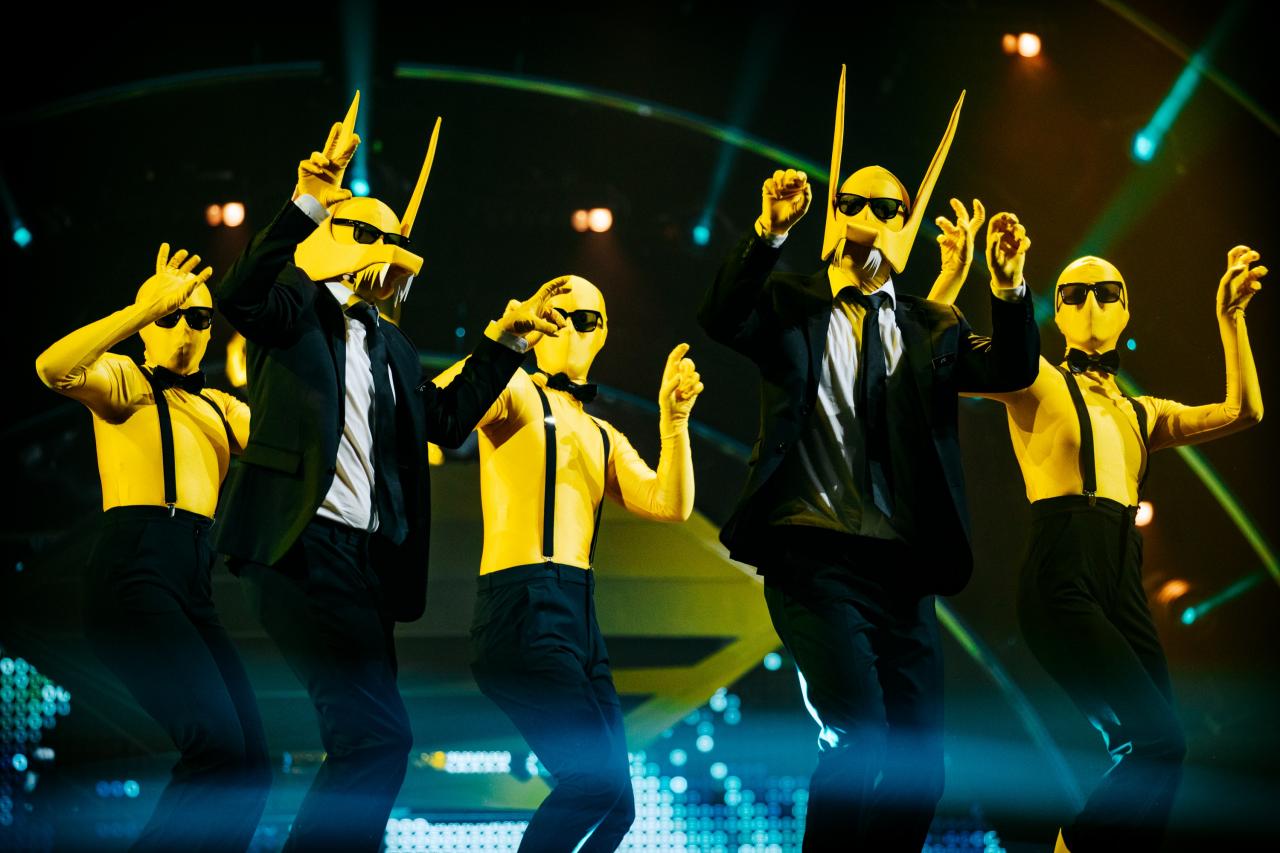
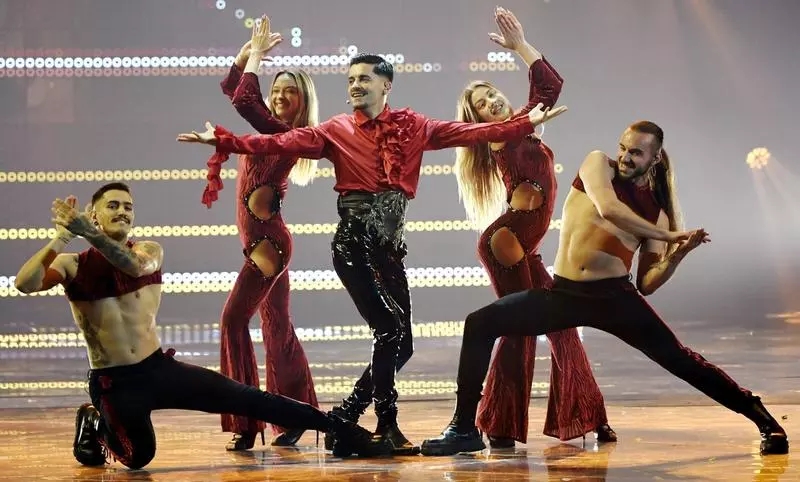
Step One: you will probably need to be quite drunk. Step Two: The following sights and sounds will occur during this Saturday’s Eurovision Song Contest. Can you spot them first? Remember to shout it out. As ever, there is more than one key change, and plenty of orbital cleavage. Keep your eyes (or ears) open for any of the following. And when you notice it, SHOUT IT OUT! Points can be scored all through the contest, on and off stage, including during the voting and in the greenroom.
In no particular order, in Saturday’s final you should be ready for:
KEY CHANGE! (every time you hear one)
Someone dares to actually say: “Veni, Vidi, Eurovicci”)
“What is the secret of a healthy body?”
Kite made of lasers.
Accordion!
Yellow balloon
LYRICS: “Hey! Ho! Let’s Go!”
One White Leg
It’s the pound-shop Liza Minnelli!
Face furniture
French women walk up some steps
French women walk down some steps
Wrestler’s belt.
LYRICS: “Shlabadabbadabba”
Black Goop
Broken heart made of lasers! On his face!
Hand-washing onstage
Man in a crop top
Pointing
LYRICS: “I really like your teeth”
Plays guitar with a bow
Hands make a heart
FLAME ON! (every time there’s pyrotechnics)
WINKING
COSTUME CHANGE
Bimbling*
ORBITAL CLEAVAGE**
Buddha Jazz Hands***
Our optional bonus categories are:
COVID BINGO – which entry will be suddenly withdrawn from live competition owing to a plague scare?
SLAVA UKRAINI – shout it out every time you see a Ukrainian flag, wherever it may be, and whenever someone gives douze pity-points to that terrible song.
HOLA OLA! Surprise sighting of former supervisor Jon-Ola Sand. Can he really stay away?
Greece awards 12 points to Cyprus / Cyprus awards 12 points to Greece / Former Yugoslavian Republic awards 12 points to Former Yugoslavian Republic.
(*swaying one’s head from side to side in a snakey fashion) (**ostentatious cleavage sufficient to see from a satellite in orbit, which, according to Eurovision bra consultant Tom Clancy, requires a minimum of C-cup)
(***the dancers all pile behind the singer in a line and then fling their arms out, creating a multi-limbed oriental deity-look)






 The Official Schoolgirl Milky Crisis Blog