
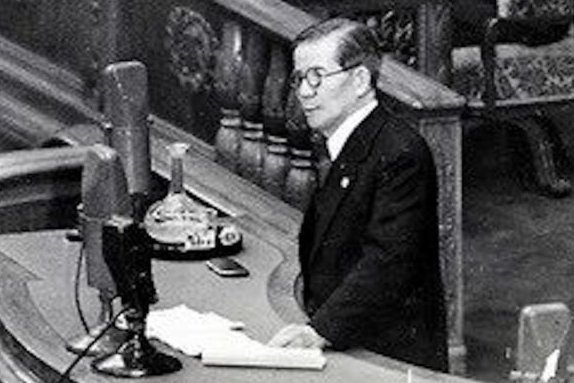
On 2nd February 1940, a frail old man rose to his feet in the Japanese Diet and commenced a ninety-minute speech. Saitō Takao was seventy-one years old, an obscure politician who only occasionally spoke out on controversial issues, leading to one cartoonist to call him “the Lord of the Mice.” But today, he could reasonably be said to have had enough. Saitō was no pacifist – he was a conservative, broadly supportive of Japan’s expansion into Korea and Manchuria. The problem was, he began, that the stated aim of securing Japan’s resources and materials had been accomplished. He simply couldn’t see the point of the latest adventures in China, which were a costly and endless money pit.
Saitō’s problem was with a revolving-door of governments that seemed to think that their responsibilities were discharged by resigning at the first sign of trouble. A million Japanese men had been sent overseas; a million more faced the same fate. A hundred thousand Japanese had died, and all for what? Saitō took apart the government’s directives and policies, pointing out that they were riddled with contradictions. How could they claim to support China, while also trying to undermine it with rival regimes? Were they going to save China by destroying it? Is this what they meant by the “New Order in Asia,” some misguided rip-off of what Hitler was doing to Europe? How could the Prime Minister embark on a costly war in Asia, while also promising that he would demand no indemnity from the Chinese if they surrendered – who was going to pay for all this?
“If we ignore this reality, or camouflage it with the words ‘holy war,'” he said, “pointlessly neglecting the people’s sacrifices for an array of elusive pretexts such as ‘international justice’ or a ‘moral foreign policy,’ or ‘co-existence and co-prosperity’ or ‘world peace,’ and thereby lose a rare opportunity and thereby end up ruining the great state plan of the century… today’s politicians will commit a crime that we cannot compensate for with our deaths.”
Saitō had witnessed the Army coming to his own district near Kobe, and ripping up the local railway tracks, taking them away for some unspecified industrial venture in South-East Asia. How was this helping the Japanese? In what possible situation could the Japanese be compensated for the sacrifices they had already been called upon to make?
He conceded that there were exceptions: not all Japanese were being crushed by austerity. There were “boom firms” that were making a killing supplying the war effort, gobbling up military contracts.
“I do not understand the cause of this war,” he said. “I do not understand why we are at war. I do not know. Do you gentlemen know? If you have it figured out, then explain it to me.”
Saitō was heckled throughout by his fellow politicians, and much of the latter part of his speech was cut from the official record at the instigation of the Army’s observer in the council chamber. Politicians and the press derided him as a blasphemer against Japan’s “holy war,” and he received death threats and hate mail. He resigned from his party and was ejected from the Diet – his speech marked the moment when any further criticism of Japanese militarism was purged from the government.
And yet, there were still glimmerings of hope. Among the letters calling for him to do Japan a favor and kill himself, accusing him of being anti-war or anti-military, or even of being a British or American stooge, there were letters of support, thanking him for standing up for the common Japanese people. Despite a smear campaign in the media, he would later win re-election as an independent, although the Diet he re-entered was little more than an echo chamber for propaganda by that point.
At one point in his speech, Saitō referred to his belief that the China Incident was the largest war that Japan had fought with China in 2,600 years. His choice of numbering was quite deliberate, since the year 1940 in the Christian calendar had been determined by the Japanese government to mark a momentous occasion – the 2,600th anniversary of the legendary coronation of Japan’s first-ever ruler, the Emperor Jinmu. Jinmu’s very existence was a matter of unsubstantiated myth, while the dating of his enthronement to 660 BCE was the vague pronunciation of a medieval chronicle, but ever since 1873, his achievements had been celebrated in National Foundation Day, which fell on 11th February. This, in turn, might sound at first like harmless legend, except it had already been used as a further argument for the superiority of the Japanese race. Ōkawa Shūmei (1886–1957), a former South Manchuria Railway employee, now a university professor, only released in 1939 after serving time in prison for his involvement in some of the attempted coups of the 1930s, had written a much-reprinted book arguing that since Japan was the oldest state in the world, it was its destiny to rule it.

1940 was hence a year of grand ceremonial importance to Japan’s state Shintō religion. On New Year’s Day, the people not only of Japan, but also of Japan’s empire overseas, had been ordered to bow, at precisely 9am, in the direction of the imperial palace in Tokyo, and to shout: “Long Live His Majesty the Emperor.” There was no possible way that anyone could claim not to know their duty – the directive was printed in newspapers and broadcast on the radio. It was also written into neighbourhood round-robin newsletters, which could not be passed on between households until the head of each family had affixed his seal. This was merely the first of a dozen timed mass rituals that would unite the Japanese in 1940, including moments of silence to mark Army Day, Navy Day and the anniversary of the Marco Polo Bridge Incident, and the twice-annual days when the Emperor conducted ceremonies for the war dead at the Yasukuni Shrine.
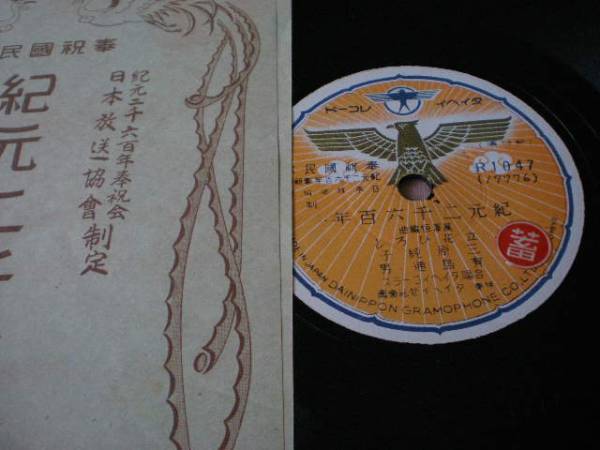
The state broadcasting corporation, NHK, held a competition to come up with a “national song” to mark the occasion. Masuda Yoshio beat 18,000 contenders with his stirring lyrics for “The Year 2600” (Kigen Nisen Roppyaku-nen), which were set to music by Mori Yoshihachirō, and began with a reference to the Golden Kite of Japanese legend, which blinded the enemies of the Japanese, and settled on the bow of the legendary Emperor Jinmu.
Our bodies receive the divine light of the glory of Japan
Shining from the Golden Kite
We pray at the dawn of the Year 2600
A hundred million breasts swell with pride.
Standing firm on the jubilant earth
We await the imperial decree in the Year 2600
The clouds clear after the founding of our nation
Growing up in a fractious world Our gratitude burns with a clean flame, in the Year 2600.
The conflict in China, however, had been limping along for almost a decade, leading several satirists to come up with parody versions. Some of the most enduring refashioned Masuda’s lyrics so that instead of declaring the divine providence of the Japanese Empire, they complained about the rising prices of cigarettes – not the free Onshino packs handed out to military men, but the everyday brands on sale to the general public. These included the super-cheap Golden Bat (Kinshi) brand produced by Mitsui, renamed Golden Kite in 1940 to reflect rising patriotic fervor. At the former price of 4 sen a packet, smokers had previously been able to buy 500 cigarettes for just one yen.
[A pack of] Golden Kites is 15 sen
It’s 30 for a pack of Glorys.
These days, prices are going up
In the year 2600
100 million people weep.
An extract from Japan at War in the Pacific: The Rise and Fall of the Japanese Empire in Asia (1868-1945) by Jonathan Clements.


 The Official Schoolgirl Milky Crisis Blog