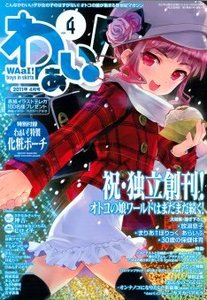
This blog only republishes a mere 10% of the wordcount I write for Neo magazine every month, but with the news just out that WAai! Boys in Skirts magazine has suspended publication, I’ll take the opportunity to upload my Manga Snapshot article about it from issue 92, back in 2012. As you can see, I was deeply suspicious of its motives, but also wary of the etiquette of even voicing that suspicion.
——
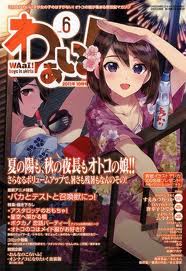 Issue #6
Debut Year: 2010
Page Count: 270
Publisher: Ichijinsha
Price: 950 yen (£7.96)
I Want to See Your Smiling Face, by Kamiyoshi, seemingly lifts its opening gambit from the Train Man series. A boy finds himself falling in love with the girl who often sits opposite him on the train to school. One day, he finally plucks up the courage to talk to her and ask her out, only for the “girl” to reveal that she is really a he. A standard school romance then unfolds, with a shared gender being the only discernable difference between this story and any other tale of snogging behind the bikesheds.
Just when you thought that the manga world couldn’t surprise you any more, there’s always some new odd niche that springs into life. And this month’s topic is the oddest yet. WAai! Boys in Skirts is exactly what it says on the cover: a manga magazine for and about transvestites!
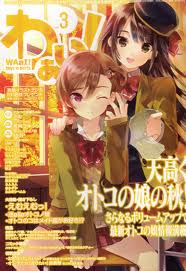
I’m sure you’ll agree, this is something of a subgenre of a subgenre. But ever since spinning off from the boys’ magazine Comic REX in April 2010, WAai has still had enough faith in the size of its readership to punt out 270 pages of glossy, high-quality printing four times a year – that’s once per season, in order to ensure varying uses of colours and imagery. The cover to this issue by Akira Kasakabe has two attractive ladies in a state of summery deshabillé, sorting out their lippy and watching the midsummer fireworks. Oh, except they are not ladies. They are both blokes, it says here.
If at first you can’t believe your eyes, the strapline at the top makes it as clear as possible: “Inside this publication are cute kids, but they are not girls. This is a new magazine for otoko no ko of the new generation.” The Japanese otoko no ko literally means Man-Girl or Mannish Girl, but is it intended here to mean “ladyboy”? We are back in the fascinating world of the implied reader – is this a magazine for boys who like dressing up as girls, or is it a magazine for girls who like to look at boys dressed up as girls?
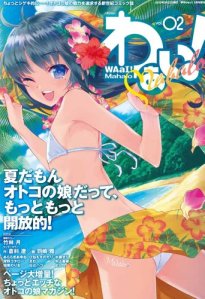 The advice page doesn’t help. Mitsuba, the pseudonymous author of Wanna Be a Pretty Girl, offers tips on make-up and hair stylings. Even if Mitsuba is actually a man, as her biography implies, there is nothing unusual in Japan about men hectoring women on their looks. Indeed, in the kabuki days, the onnagata female impersonators were widely regarded as the arbiters of taste for how women should behave. The title of Mitsuba’s column uses the verb naritai (“want to become”), but the nature of the “becoming” is nicely vague. Is this a column for plain janes who want some top tips, or is it actually a crash course in femininity for boys who want to look like girls?
In Reversible School Life, by Suemi Tsujikka, an all-boys’ school makes the odd decision to force half of its attendees to dress up as girls on any given day. Transfer student Shu is thrown in at the deep end, since he has no clue how to coordinate his clothes. He is aided and abetted by the more experienced Tsubaki, in a school story that dispenses with the usual “hidden boy” trope in favour of an environment in which cross-dressing is openly encouraged, in fact mandated, as part of school life. As with I Want to See Your Smiling Face, there is a sense that the protagonist is entirely clueless and lacking in experience. The usual mystery of unattainable girls is replaced here with boy-on-boy crushes, but also with initiation into the rules and regulations of living life as a woman. For the generation raised on the arcane taxonomy of Pokémon and the shifting fads of cosplay, perhaps cross-dressing really is the final frontier. It’ll probably keep some people busy for years. Just remember, boys, stripes aren’t slimming.
WAai’s niche is still small – it is half the size and double the price of mainstream magazines, and is not included in the online sales figures of the Japanese Magazine Publishers Association. But this is how all new niches start; the publisher Ichijinsha would be mad to print a million copies and hope that the readership to match it magically arrived out of nowhere.
The Japanese mainstream has treated the otoko no ko “phenomenon” with a degree of suspicion – perhaps wisely, considering the penchant of the media for making up new fads on the spot and hoping the herd will follow. In 2010, the Engan bus company offered spoof free tickets to transvestites as an April Fool’s joke. Later in the year, the same company offered a free ticket promotion for real, but only to female passengers who would dress up as sexy “moe” girls. The transvestites should sue!
The use of the term otoko no ko has been gaining ground in Japanese for the last ten years. But it’s only in the last two years that it has suddenly blossomed into a definable subculture, with its own publications, slang, traditions and inevitable media attention. WAai isn’t even the only magazine for otoko no ko. Already in the last year, the Japanese market has seen the arrival of Change H, Oto(star)ko and Otoko no Ko Club magazines. Meanwhile, Enterbrain has test-marketed the manga anthology Super Otoko no Ko Time, and Square Enix has tried Joso Shonen Anthology (Boys in Girls’ Clothing). Newtype, the trend-setting anime magazine, has already tested an experimental title for the otoko no ko market, with the release in August 2011 of a live-action photography special featuring boys dressed as girls. It sold out on the day of release – but was that a sign of an untapped market, or simply of deliberate under-printing to manufacture headlines?
Its aficionados are keen to point out that these characters are not transsexuals – they are transvestites, dolled up in women’s clothes as an attempt to show a sensitive side. They are, we are assured, boys who like the idea of softness and silkiness, experiments with lipstick and girlish pursuits – an assertion which places them firmly on a timeline that reaches back for several generations, to the manga revolutions of the 1960s that valorised flower-sniffing sensitive types in reaction to the ludicrously macho heroes of the day. Japanese Wikipedia even has its own page on the phenomenon, which goes to great pains to point out that otoko no ko have absolutely nothing to do with sexuality. Just because a boy wears women’s clothes, he is not homosexual, nor does he “want” to be a woman. The artwork in WAai makes that abundantly clear, with images of characters in bikinis and lingerie, pouting for the camera but displaying telltale flat chests and posing pouches that leave nothing to the imagination.
 Meanwhile, many of the stories simply refashion old manga saws with all-male casts, such as Secret Devil-chan by Rumu. This is yet another magical-“girlfriend” tale, in which a hapless Japanese boy called So lands himself with a mini-skirted bedmate who turns out to be a cross-dressing devil-boy called Demon Kogure. School high jinks, knicker flashing and snogs soon ensue, while So’s girl-next-door (an actual girl) fumes at the arrival of her supernatural competition. To coin a phrase, it’s Urusei Yatsura with nobs on. Also, there are nuns in it.
In Past Future by Tsukasa Takatsuki, a girl called Mirai becomes increasingly irritated with her brother Kago’s habit of “borrowing” her clothes. She drags in her friend Ran in an attempt to wean Kago off, but instead inadvertently encourages him. Instead of chasing after Ran and trying to get into her knickers in an altogether different way, Kago instead starts asking her for fashion tips. Meanwhile, people keep shouting Mirai’s name all the time – it literally means “future”, and hence imparts a sci-fi resonance to everything that’s going on, even though it is resolutely set in the present-day era of iPhones and Nintendo DS. That’s as close as the mag gets to SF, although there is more scope for fantasy in the ghost-busting, tentacle-heavy tale Yorishiro, written and drawn by Muranako. Presumably, some of the “girls” in it are boys.
However, there is a flipside. Is this really a magazine for transvestites? The editorial content delivers one message, but the advertising tells a different story. If we want to be cynical for a moment, let’s not immediately assume that otoko no ko materials reflect a grass-roots demand that Japanese conglomerates are sweetly serving. Let’s instead assume that a bunch of large cosmetics companies have realised that heterosexual men represent a bogglingly large untapped market for sales of make-up. Has some bright spark at Shiseido or Nivea suggested that the marketing team take a step beyond “metrosexual” and try to flog lip-gloss and crimpers directly to absolutely everybody? WAai’s concept of femininity does appear oddly and over-enthusiastically consumerist. In other words, its attitude is that women are “made” by buying stuff. Shopping maketh the woman, in WAai’s eyes – it’s a beautician’s idea of beauty, and seems largely materialist and product-orientated.
This is a no-win situation for critics. If we question the motives of the publishers, we are attacking transvestites’ right to be different. But if we report on a “phenomenon” that isn’t really a phenomenon at all, but a cynical appropriation of a subculture as an excuse to bootstrap a new fashion fad, then we are mere stooges of the marketing machine. Meanwhile, it is arguably the height of cynicism to latch onto someone’s heartfelt beliefs and lifestyle, merely because you want to shift a job-lot of depilatory cream. If it’s “in” to be a transvestite this season, that’s all very well, but that’s like saying its fashionable to be Asian, or short-sighted, or tall. What happens next year?
 Mitsuba’s make-up tips aside, why haven’t the WAai ad sales team placed oodles of adverts for face creams and blushers, make-up brushes and powdery things? WAai is a magazine with definite, blunt views on femininity, even though the advertisers aren’t playing along. Where are the adverts for clothes? Surely, the interests and concerns of the average transvestite (whatever that might mean) present myriads of possible attractions to several subcultures, but there is no evidence at all that anyone has taken the bait. Instead, the adverts in WAai are exactly the same sort of material you might expect to find in a teenage boys’ magazine – online gaming, and the Tora no Ana dojinshi shop.
Meanwhile, there is a heavy and frankly boyish concentration on new anime series, with larger-than-normal features dedicated to modern serials such as Astarotte and Baka & Test: Summon the Beasts. Games reviews also take up a substantial proportion of the front matter, including self-explanatory titles such as The Boy Loves Dressing Up as a Maid and Bokukano: Ladyboy Sex Chat.
Regular readers of this magazine may have noted on several occasions that the Japanese comics market is embroiled in a massive argument about the depiction of minors. Its most recent incarnation was in September 2011, when two members of the Japanese parliament presented a petition calling for anime, manga and games to adhere to the same sort of censorship rules as other publications. In other words, there is still a massive fight about the depiction of little girls in print, and it is your correspondent’s suspicion that a large part, if not all of the otoko no ko phenomenon is not about reader demand at all, but merely a new way of circumventing the censor. Just as white panties and blank crotches, tentacles and robots formed new and odd tropes in anime and manga, could it be that bluntly stating that these “girls” are really boys is a sneaky way for certain publishers to hang onto images of flat-chested dollymops, without incurring the wrath of future censors? If so, it’s a very sneaky trick, but let’s not assume it’s a sign of sea-change in attitudes towards cross-dressing… Unless it is.
Jonathan Clements is the author of Schoolgirl Milky Crisis: Adventures in the Anime and Manga Trade and Anime: A History. This article first appeared in NEO 92, 2012. The Manga Snapshot column has been reviewing a different manga magazine every month since 2005.

 At the request of the Czech convention Animefest earlier this year, I reprised my infamous speech on the Anime Erotic — a transcript of which can be found in my book Schoolgirl Milky Crisis (US/UK). The speech has now been uploaded onto Youtube with English subtitles and, soon, I am told, subtitles in Czech. You can watch it here.