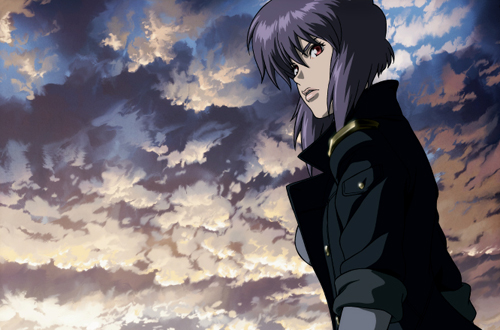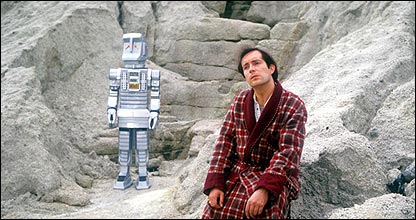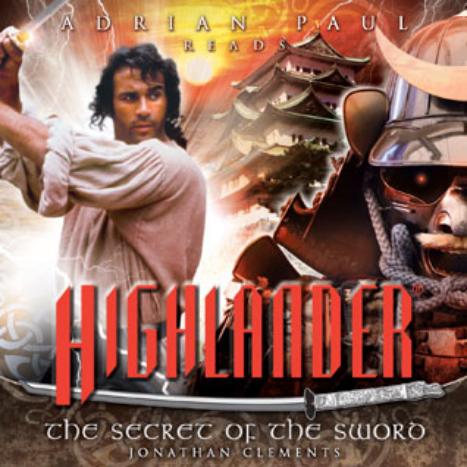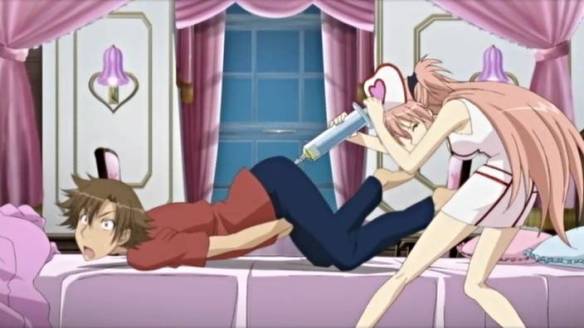
We lived together for two years, I’ve known him for ten, he’s in his forties, and he’s never been interested in Japanese cartoons. Which was why I fell off my chair when a friend confessed to buying some anime last month.
Continue reading
Author Archives: ixarette
Trading in Insults
A call came in from the editor of the script book of Serenity, the movie spin-off from Joss Whedon’s Firefly. In which, you may recall, people swear in Chinese.
“We’re just doing the back cover,” he said, “and we wondered if you could write us a Chinese slogan: ‘If you do not buy this book, your associates will consider you to be a stupid inbred sack of meat.’”
Taxing Time

Another tax-year gone, and I’m stuck with a bucket of receipts. The usual deduction issues ensue – are contract killers a reliable contract-enforcement expense? If I had fun watching an anime, can I still call it work? When I buy a copy of Golgo 13, it’s for work purposes only. It’s not like I enjoy it.
Anime companies have the same problems with media accounting. If a director has a packet of peanuts, is that ‘entertainment’ or ‘subsistence’? But there are perks, largely tied up in the sector of anime shows that take place outside Japan. There’s nothing an anime crew likes more than a roké-han, a ‘location hunt’, otherwise known as the thinly disguised staff holiday. No works outing to Grimsby for Japanese animators – imagine the misery of the Gunsmith Cats crew when they were all carted off to Chicago to drive fast cars and play with guns. They even filmed it as part of the Making of documentary. You see, they told the tax man, it was research.
Once you get your head around the accounting complexities of office perks, some of anime’s weirder moments make more sense. In Detonator Orgun, the invading alien robot action grinds to a halt for a whole minute while the female lead explains that she’s driving a replica of a 1963 E-type Jaguar. Pause for loving pans across the car’s flanks, zooms on its upholstery, and general auto porn. Well, someone had to get hold of a Jaguar for research purposes, didn’t they? And after that, they’d damn well better use it or face a tribunal. Does this mean that if I write about a date with a voice actress, I can claim for it on expenses? I asked my accountant if a dirty weekend could ever be tax deductible.
“Only if it’s with me,” he said, somewhat creepily.
Jonathan Clements is the author of Schoolgirl Milky Crisis: Adventures in the Anime and Manga Trade. this article previously appeared in NEO #6, 2005.
The Third Dimension
Cinema always needs to be one gimmick ahead. You can watch stuff at home… ah, but if you want to see color, you have to go to a cinema. You can watch color at home… ah, but if you want amazing sound you have to go to a cinema. You can watch movies at home… ah, but if you want to see them earlier you have to go to a cinema. Every generation has its cinema-TV tensions, and two decades of consumer electronics have given many modern fans the chance to replicate much of the cinema-going experience in their own homes. The risk remains that audiences simply won’t leave their houses to go to see a film. With movie-going manners at an all-time low, are we really surprised?
Confucius Says…
After such a meteoric rise to prominence during the rule of the Shining Duke, Confucius’s absence from the court did not go unnoticed. He was even asked why he did not involve himself in the running of the state.
“You’re the Translator. Translate!”

Stargate is a film about an immigrant’s love for America. It has a wonderment, a fascination with the American way that seems almost undimmed by the history of the 20th century. Stargate is what happens when the Prime Directive of Star Trek meets the Manifest Destiny of the real world.
It’s also about a bunch of American soldiers getting bogged down in a desert war about a mysterious, magical resource, fighting a power that is almost unknowable. Stargate was made in 1994, right after the First Gulf War, and it ends with this terrible realisation that they have only fought one battle, and that their enemy has many allies, that will be coming for them next.
That’s not all. Stargate is adored by translators all over the world, because it’s one of only a handful of films in which the translator is the hero.

I have been in those situations. No, not quite brought back from the dead and forced to debate politics in a recently learned dead language with an immortal alien… but close. I have been dumped into negotiations way over my head, in a language or dialect I don’t even speak, and had to muddle through. I have turned up in the middle of fights threatening to escalate into real trouble, and they’ve said to me “You’re the translator. Translate!” I have stared at a blackboard where someone has tried to have a crack at my specialist subject, and said: “Who wrote this crap?”
You can thank Roland Emmerich for that, I imagine. This is a man who grew up speaking German. He knows whereof he speaks. There’s a great scene in Stargate when Daniel Jackson is in a cave with his love interest, Sha’uri; Daniel points at hieroglyphs and reads out the pronunciations, and she tells him what the vowel mutations and consonantal shifts are. If you learn to speak Mandarin first, that’s how you learn to convert it into Cantonese! Although sadly not every language course supplies a Sha’uri to jolly things along.
I think that at its deepest level, the thing that really strikes home in Stargate is that Daniel Jackson isn’t just a translator. He’s a writer in Hollywood. He’s the weedy, wimpy specky guy with the big ideas that nobody wants to hear, dragged off to the middle of nowhere by a bunch of bullies and told to twist his skills in new and unexpected directions. The soldiers hate him. They’re all producer types who just want car chases and boobs, but he’s there with his books in the desert, wide-eyed with amazement at this incredible thing, that is all his dreams coming true, as long as the producers don’t ruin it. And at the end, he gets the girl!
Well, at the end of the movie, anyway. In the TV series… well, there’s some small print…
Jonathan Clements has translated Sun Tzu’s Art of War, among other things.
Available Deaths
I once wrote the script for a military sci-fi computer game, only to find that the producers had put dancers in the motion-capture suits. All the soldiers marched like ballerinas. Easier on the eye in the studio, perhaps, less fun in the finished product.
Continue reading
Fan Service
Phantom of Inferno could well be the future of entertainment. An anime on DVD, in which you use the DVD remote to control the direction of the plot. The first title to truly straddle the closing gap between anime and computer games. A director’s cut in which you are the director, in many ways! Except you’re not.
Continue reading
Art Beat
When Satoshi asked me if I’d go to the hospital with him, I felt like I’d been punched in the stomach. He was so young! My Japanese ability wasn’t even equipped to find out why. I asked him what was wrong and got a series of staccato jigu jago Japanese syllables. It’s easy to get mixed up if the vocabulary isn’t familiar. Shuy? is a tumor. Sh?yu is soy sauce, and I didn’t want to press him for clarification. Meekly, I said I’d be there for him, and tagged along.
Continue reading
Fatal Attraction
In 1940, in a Japan at war, Wagoro Arai began work on an animated version of Puccini’s Madama Butterfly. Twelve minutes long, his version focussed on the closing act of the opera, as the dutiful wife waits expectantly for her husband to return home, only to find that he has abandoned her in favour of an American woman. It was the perfect propaganda strike against the Allies – a heartless foreigner, discarding a Japanese spouse, who avenges herself with suicidal fervour. Arai planned to use the voice of Tamaki Miura, a Japanese singer who had travelled the world in happier times, singing the role of Butterfly in Boston and New York, Rome and Florence.
There was one small problem. Puccini was Italian. This was not like the intellectual property of the Disney cartoons or Popeye shorts that the Japanese felt able to rip off with impunity as part of the spoils of war. Puccini had only died in 1924; his opera was still in copyright, and Italy was Japan’s ally. Arai would have to play by the rules.
Gingerly, and with thousands of frames of animation already complete, Arai went to Puccini’s estate to ask how much the music rights would cost. The price was so high that he could not afford it, and his Madama Butterfly cartoon was forced into a regrettable compromise, stuck with a hastily compiled alternative soundtrack.
It was not the last time that we encounter a foreign claim on a supposedly Japanese story. Madama Butterfly might be seen as quintessentially Japanese, but few of those who carried her story to the West were Japanese themselves. The latest incarnation, which I saw at the New York Metropolitan Opera on Saturday, is another glorious piece of Japanning. Produced by the late Anthony Minghella, directed by Carolyn Choa, and starring Patricia Racette as Butterfly, it luxuriates in the oriental, and in a foreigner’s-eye view of exotic Japan.

When I say I “saw” it in New York… the performance was in New York. I personally was seven time zones away, one of thousands of people all around the world watching it as a live broadcast in an HD-ready cinema. I had thought that the idea would appeal to hardly anyone, but instead I found a packed theatre. It seems that from Brixton to Brazil, there are people who are prepared to pay £25 for “virtual” front-row seats at a performance that might otherwise set them back ten times as much.
I loved the backstage glimpses, and the moments of irreplaceable close-up. As Butterfly and her servant Suzuki (Maria Zifchak) waited in silence on a Nagasaki hilltop for a man who will not come, the camera caught a real-life tear rolling down Zifchak’s face. I wouldn’t have seen that from a football field away in the cheap seats. The Met’s live broadcast knew when to pull back for the set pieces, and when to zoom in for the detail – the masterpiece on Saturday belonged not only to the performers, but to the live broadcast director who kept the camera transfers seamless.
The story of Madama Butterfly might be set at the turn of the 20th century, but owes its influences to events of a generation earlier. Butterfly’s relatives, who disown her when she converts to Christianity, display an attitude that belongs to 1870s Japan, when Christianity was only newly decriminalised. The allusions to her late father, presented with a dagger by the Emperor and ordered to take his own life, is likely to be a vestige of the Satsuma Rebellion of 1877, when the last of southern Japan’s samurai rose up against the unwelcome influence of foreigners and modernisers. This is why Butterfly is so reluctant to let Pinkerton see the knife among her meagre possessions – it is a reminder that her father died trying to rid Japan of the likes of Pinkerton, and that in the aftermath, her family has fallen on hard times. It took a generation for such muddled facts to migrate into fiction, to circle the globe and then re-emerge as Puccini’s most famous opera.
There was no single historical Butterfly. There were many like her. Impoverished girls in the treaty ports gained an erotic frisson for foreign visitors, particularly Pierre Loti, whose Madame Chrysanthème (1887) portrayed Japanese girls as charming but mercenary hookers with hearts of gold, encouraging a generation of sex tourists in search of a “temporary wife”. The most infamous was perhaps the Russian Prince Nikolai, who in 1891 arrived in Japan, caroused the red light districts, got a tattoo, and was soon knifed by an irate local in a resort town near Kyoto. He bore the scar for the rest of his life, along with a hatred of all things Japanese, which blossomed into disaster when, as Tsar Nicholas II in 1904, he led his country into the Russo-Japanese War.

1904 was also the year of Madama Butterfly’s premiere in Italy, with a libretto drawn from these influences and many more. Butterfly is also the product of a short story “as told to” an American writer by a sister newly returned from Japan; a performance of Japanese theatre by the legendary actress Sadayakko; and a general vogue for Japonisme as the vanquished factions in Japan’s civil war, the likes of Butterfly’s father, offloaded family heirlooms onto the European antiques market.
Puccini’s Butterfly was not the sexually charged bed-warmer of Madame Chrysanthème. She was written as a tragically infatuated innocent, a 15-year-girl who genuinely believes that she has found her soulmate in B.F. Pinkerton, an American cad who has leased a wife and a house for 999 years, but fully intends to cash both of them in after only a few months. Abandoned by her family and soon by Pinkerton himself, Butterfly patiently raises Pinkerton’s child and wait for her husband’s return, as her finances dwindle and she lapses back into poverty. But Pinkerton is not coming back – even at their wedding, he boasts to the disapproving Consul Sharpless that he is looking forward to having “a real, American wife.”
This makes him, as far as I am concerned, opera’s Worst Bastard. Yes, even worse than that arrogant bitch Turandot. In one of the illuminating interviews, all part of the Met’s live broadcast for those people who don’t leave their seats at the intervals, singer Marcello Giordani pleaded for mercy, arguing that Pinkerton was not as bad as that, and that in his own way, he loved Butterfly, too. I don’t buy it. Although, possibly, I have been influenced by my mother, who throughout my own childhood used to regularly heckle the stereo with “HE’S NOT WORTH IT, CIO-CIO-SAN!”
Notably, the Met also had Butterfly committing suicide in the open. Most productions have her knifing herself behind a screen in silhouette – a fact that Wagoro Arai’s 1940 cartoon version exploited to the full by presenting the entire story in silhouette form. Butterfly’s death is, admittedly, a crucial moment for any performance, but all the more important to Japanese audiences. In killing herself after a prayer to a Buddhist altar, she repudiates her newly and vaguely adopted Christian values, returning to the bosom of her family by acknowledging the samurai way, seeking “honour in death” when it has been denied her in life. To modern, Western audiences, this might make her come across as something of a bunny-boiler, but even that has a strong connection to Western appropriations.
A “bunny-boiler”, of course, is a piece of modern slang we have inherited from Fatal Attraction (1987), in which Glenn Close plays a Madama Butterfly fan who decides not to let her personal Pinkerton get away with it. The original ending of Fatal Attraction (now available as a DVD extra) had Close slicing her own throat with a knife that bore Michael Douglas’s fingerprints, while Puccini played on her stereo. After testing badly with audiences all over (except, unsurprisingly, in Japan), the ending was dropped in favour of a Hollywood-style confrontation, to Close’s annoyance and to the film’s detriment. However, rumours persist that the original ending was retained in Japanese theatres; I genuinely don’t know if this is true or not – if anyone out there saw Fatal Attraction at a Japanese cinema, do drop me a line and let me know.
Jonathan Clements is the author of A Brief History of Japan.