The latest issue of the Journal of Anime and Manga Studies reprints some of the papers from this summer’s Lancaster University symposium on “Transnational Perspectives on Anime”, including my speech on anime in the People’s Republic. I don’t think I’ve ever seen a journal move so fast — sometimes you wait years, but JAMS have really kicked it out.
——–
The history of anime in China is a roller-coaster ride of diplomatic boondoggles, under-the-radar industries, unsanctioned releases and censorship scandals. Jonathan Clements investigates the fluctuating fortunes of Japanese animation in China, not only in terms of its reception among audiences, but of its hidden impact in the production sector, the politics of its distribution and exhibition, and the effect of recent government backlashes and clampdowns as the People’s Republic seeks animation autarky.
Singapore once grew riches from gambier, nutmeg and rubber – yet today, not a trace remains. Lost Plantations reveals a Singapore few remember – when gambier, nutmeg and rubber covered the land, and fortunes rose on the backs of bold planters and backbreaking labour.
—
I make a couple of sneaky audio cameos in this new documentary from Sitting In Pictures, my former employers on Route Awakening.
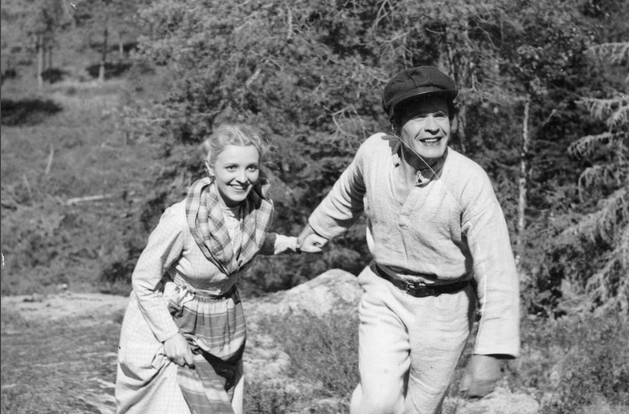
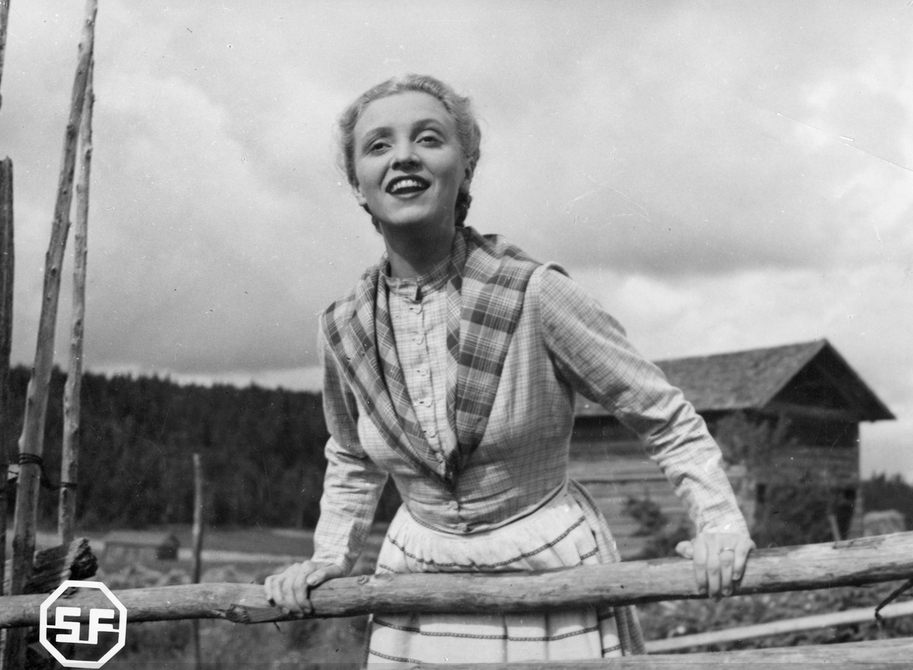
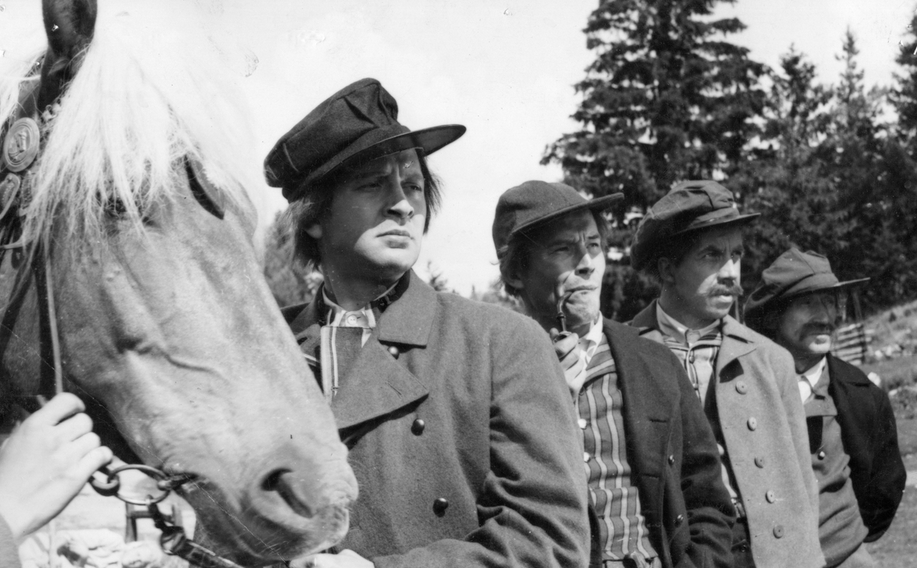
In rural Finland in the 1860s, the young, handsome Taavetti (Eino Kaipainen) takes over his father’s struggling croft, and hopes someday to get himself a wife. He is too proud to sell his prize mare to the landlord Isoaho (Toppo Elonperä) but manages to win the hand of Maija (Ansa Ikonen), a spunky girl from the neighbouring farm at Töyrylä. It later transpires that local boy Jussi (Pentti Viljainen) had rather hoped to marry Maija himself, and regards himself of having been swindled out of a deal that was all but done.
Taavetti and Maija are made an offer they can’t refuse by the logger Veijonen (Veikko Linna), who is prepared to hand them a tidy sum for the lumber from 500 trees on their land. But Veijonen has dastardly deeds in mind, and persuades the locals who witnessed their deal to lie about it. Taavetti ends up getting into a fight over it, and must suffer through a court case in which he is accused of assault and of welching on a deal he never made. He is sentenced to 26 months in prison, where he unexpectedly bonds with his cellmate Antti (Edvin Laine), and becomes an accomplished carpenter.
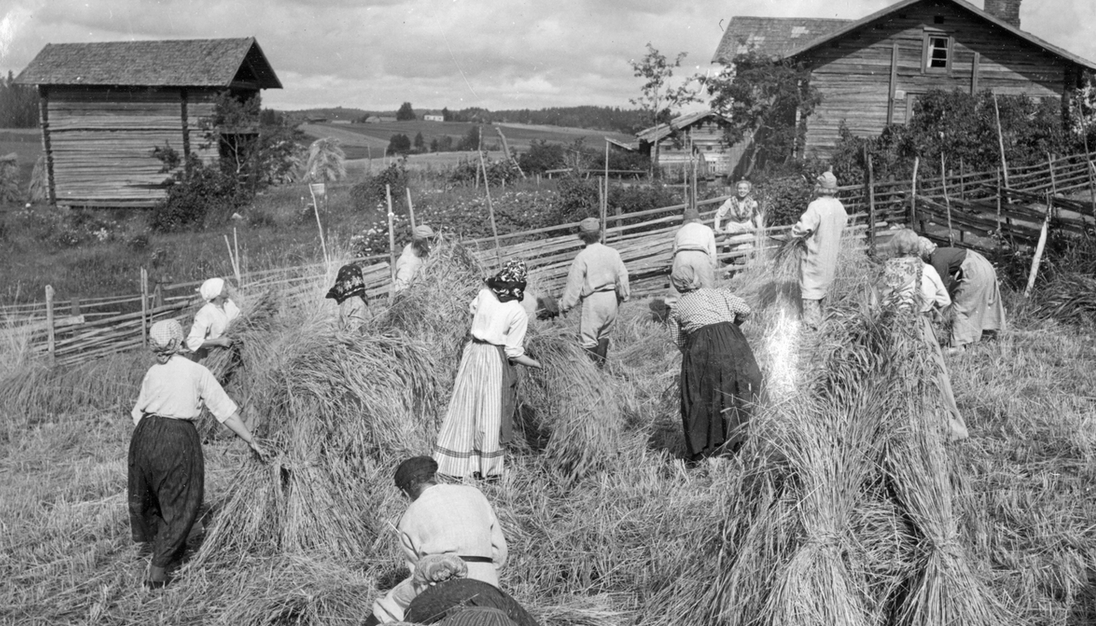
Maija, who is predictably pregnant, struggles with getting in the crops at Rantasuo farm, grateful for the customary shared-harvesting tradition of talkoot, when everybody pitches in. Old Isoaho comes to her rescue when money-lenders try to foreclose on the farm, and when Taavetti finally comes home, having paid his unwarranted debt to society, all is well, the farm is flourishing, Isoaho has got the mare’s foal in payment for his help, and Maija and the child are waiting for him on the porch.
“Finally,” blurted the advertising copy for this adaptation of Urho Karhumäki’s 1923 novel, “we have a film with a strong Finnish spirit, a story of a Finnish forest ranger’s giant battle against vicious nature and malicious mankind – a struggle for which the prize is his own land and his own wife!” There are, after all, many ways to distract a nation at war. Rantasuon raatajat was released on the same day as its studio stablemate That’s How It is, Boys! (1942), but whereas Eino Ketola’s barrack-room comedy made light of war and duty, Toivo Särkkä’s script wades knee-deep into the fertile swamp of nationalism and local pride.
Shatneresque leading man Eino Kaipainen has been here many times before, most notably in Finland, Our Dear Native Land (1940). Here, he is reunited with co-star Ansa Ikonen from The King of Poetry and the Migratory Bird (1940), in an uplifting tale of struggle against adversity that pretends it is about tough times in the Great Famine, but is really all about maintaining a stiff upper lip in the midst of the Continuation War. As Taavetti, Kaipainen is a wronged hero who nevertheless wins through, a model citizen and even a model prisoner, who emerges from incarceration with a new skill and a best friend. Unlike the milksops of many a romantic comedy, he has an unreconstructed masculinity that is unafraid to fight for what he believes in, and a touching faith in the support of his loved ones.
I am particularly taken with the depiction of the talkoot in this film, because such communal mucking-in remains a feature of Finnish life today. They might have all come off the farms two generations ago, but twice yearly in my old street, all the plumbers and computer programmers, schoolteachers and car salesmen still got together to clear the leaves and trim the bushes until we’d filled a massive skip and could sit back for a coffee and a sausage. I once spent a happy day with my neighbour, Seppo, industriously digging a hole, until we were informed by another neighbour that we were supposed to be filling it in. Seppo made time pass, for him at least, by ceaselessly recounting everything he could remember about the songs of Whitney Houston, which was not a lot, because he couldn’t speak English, and I was obliged to translate each one for him. But I digress.
The press loved the film, describing it as a glorious “Christmas gift” from the Suomen Filmiteollisuus studio, and gracefully ignoring the fact that it often played like an obvious retread of Eino Kaipainen’s break-out picture, The Ostrobothnians (1936). At 42, in fact, Kaipainen was now a little long in the tooth to be playing a youthful lead, but he was not yet ready to slip into character work, and his public was not ready to let him. Ansa Ikonen, at 29, can just about get away with it, but the real-world Kaipainen was old enough to be his character’s Dad, and such cragginess can be distracting in a story that is supposedly about two youngsters barely out of their teens.
As ever, it was Paula Talaskivi in the Helsingin Sanomat who was best able to assess the film in both the context of its time, and its likely reception to posterity. “The plot itself,” she wrote, “with its relatively few turns of events and one-dimensional action, is not an exemplary film subject, but as a beautiful, devout film depiction of Finnish rural life, it defends its place well.” In its way, it is just as much as prisoner of its era as That’s How It Is, Boys!, fraught with what now seems to be overblown histrionics and intense passion, which are far more understandable in the context of film-makers and audiences who were facing the beginning of a fifth year of war and uncertainty.
Jonathan Clements is the author of A Short History of Finland. He is watching all the Finnish films so you don’t have to.
The other Jonathan Clements, who died on Sunday of complications from lung cancer, served for twenty years as a finance journalist for the Wall Street Journal. In semi-retirement he embarked upon a new career as an internet guru, dispensing monetary advice through his website Humble Dollar.
People often used to get us mixed up. We were both authors, both born in Britain, although he had lived in America for so long that his speech had drifted into a sort-of midlantic twang. But whereas I wrote about Japanese cartoons and Chinese history, he wrote about finances, investments and pensions.
Invariably, we would get each other’s mail. I would get occasional requests to address learned audiences about handy hacks for the American tax system, something about which I knew absolutely nothing. He would get asked to show up at a convention where people dressed as anime elves. Only last year, I found him angrily haranguing my US publicists for Rebel Island, after they had hash-tagged him in on the release of a history of Taiwan, to which he reacted like an old man exhorting them to get off his lawn. The publishers of my Empress Wu audio book also refused to admit that he hadn’t written it in their publicity tweets, leading him to spend much of his final months on Twitter shouting at them: “For the umpteenth time, you’ve got the wrong Jonathan Clements.”
In the strangest cross-Clements incident, I was left flustered and speechless when an elegant Japanese lady tried to pick me up in a Swiss cinema, assuming that I was him. “That never happens to the real me,” he fumed.
At one point in our correspondence, we embarked on a wacky quest to find the other other Jonathan Clements, a now-deceased author of 1960s erotica, whose Keep it Kinky and Dearest Mummy, I’ve Been Ravaged have repeatedly skewed our online search results, and continue to do so. Finance Jonathan would eventually publish the results on his own website as a page called Imposters, listing people like me who claimed to be him. Back when I had a website of my own, I had a reciprocal imposters page, decrying him for impersonating me.
In May 2024, he was eating his breakfast when he suddenly felt off-balance. A trip to the doctors for what was presumed to be a routine issue, turned out to be serious. He had lung cancer, which had already metastasised to his brain.
“What would you do if you were told you might have just 12 months to live?” he wrote. “For me, this isn’t a theoretical question.” He immediately began retooling his website, shutting down its donations function, and setting up as a slower, but more targeted series of updates about estate management and legacy planning.
“Cancer is obviously not what I want,” he told me. “But I have the privilege of knowing roughly how much time I have left, and that time offers the chance to get a few last things done that are important to me.”
His final months saw some of his best ever work – a detailed account of estate planning and “sadmin”, by a man making the very best of the knowledge that his days were numbered. He got married to his long-term partner, and wrote a thoughtful piece about how long he would have to stay alive for his bride to benefit from his pension. He left behind deeply useful columns about how to make life easier for the people we leave behind. This included obituarists, for whom he wrote a detailed farewell elegy on his website, leaving an account of his life as he would like it to be remembered.
““I want to take the time that I have left,” he said, “and squeeze as much happiness out of those days as possible.”
Jonathan Clements is the author of A Brief History of China. Other Jonathan Clementses are available.
Over at Kenny Smith’s Power of Three podcast, “the most lovely journalist in Britain” interviews me about Kingmaker, my unproduced script for the short-lived Richard E. Grant animated Doctor Who series, which was eventually put into production as the Paul McGann story Immortal Beloved for Big Finish.
I show up 40 minutes in, after Kenny has marshalled a bunch of readers to perform the original pitch, something that I haven’t even thought about for nearly twenty years. The interview takes in the story’s incredibly convoluted path to release, beginning with two men in a Brixton pub, trying to come up with a Strontium Dog script for Sanjeev Bhaskar, which somehow turns into Ian McNiece threatening to kill people, and Elspet Gray channelling my grandmother.
The details are up at lovesanimation.com for this year’s Scotland Loves Anime film festival, to be held in Glasgow, Edinburgh, and the very Scottish city of London. Guests include Takeshi Koike, who is not yet aware of how obsessed the festival director is with his Redline, Baku Kinoshita in town to talk about The Last Blossom, Yasuhiro Aoki onstage to talk about his ChaO, and Kenichiro Akimoto popping up to talk about All You Need is Kill. I shall be the master of ceremonies, jury chairman and onstage interviewer, as usual.
Although I aim to update this blog twice a week, things have slowed over the summer owing to the termination of several sources and the delay of several announcements. It’s been over a year since the All the Anime blog shut down original content, and several months since NEO closed, so there are no longer any new articles to point you at. I finally reached the end of my chronicle of shooting Route Awakening with National Geographic (or at least, all the days worth blogging about), so there is no longer a fortnightly account of behind-the-scenes shenanigans.
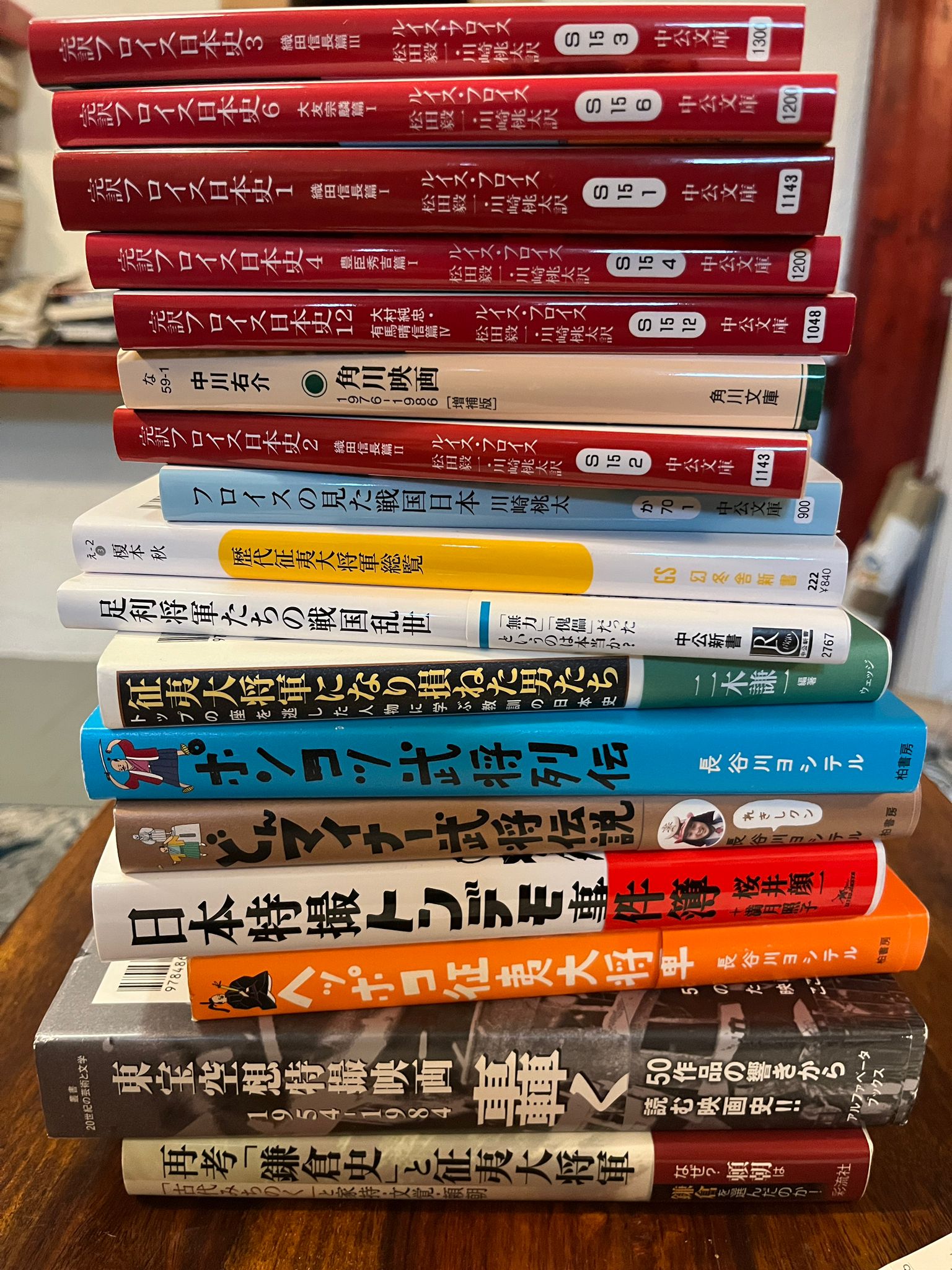
I have three recorded podcasts waiting to hit the ether, another book chapter waiting to be announced, two more DVD commentaries and several other foreign editions in the works. I will get some more posts up here when the chance arises, but for now, I am wading through the above pile of books, on a big new project, and I need to clear a thousand words of that each morning before I can get to anything else.
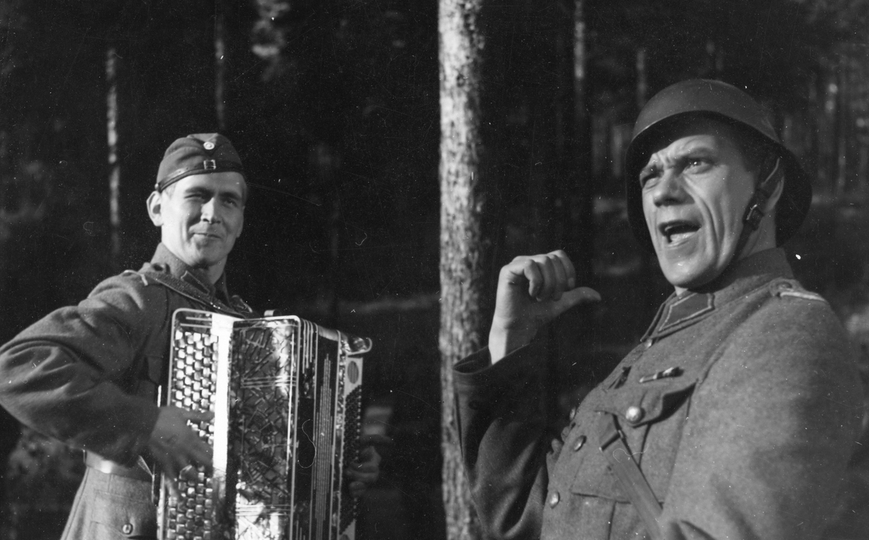
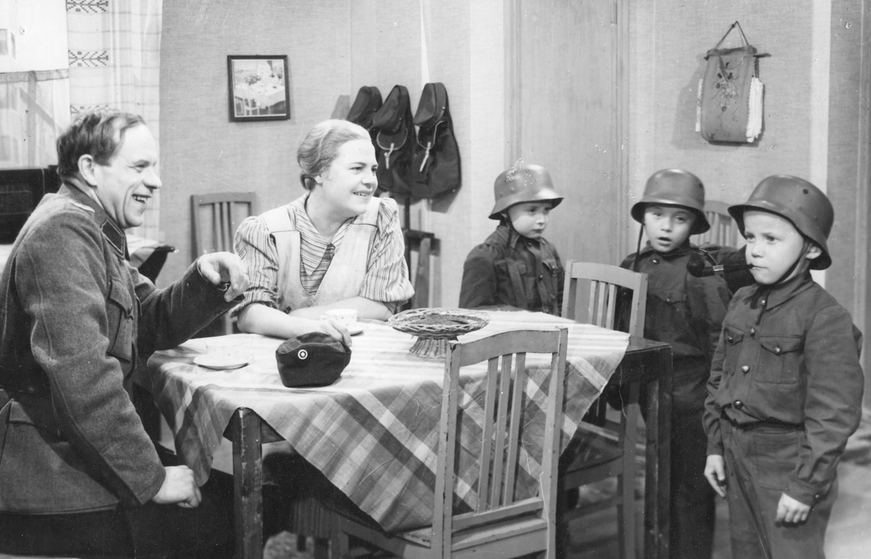
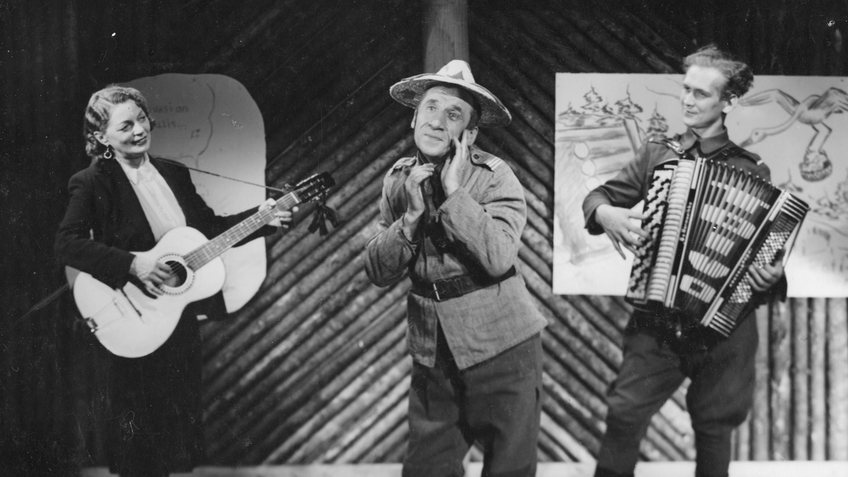
The relentlessly cheerful Corporal Möttönen (Einari Ketola) is wounded in the Winter War, shipping home for a chance to see his wife and three children, who are exhorted to run their home life with military discipline. By the time he returns to the front, he finds himself ordered to be the local liaison for the entertainment troupe – a mismatched band of malingerers, milksops and drama queens. After he improvises a ditty about Päivänkilo (Eero Eloranta), a man who has been excused active service because of his bad tummy, Möttönen is transferred to the entertainment unit itself, where Päivänkilo confesses that he is ashamed of his previous behaviour, and that he wants to be a real soldier.
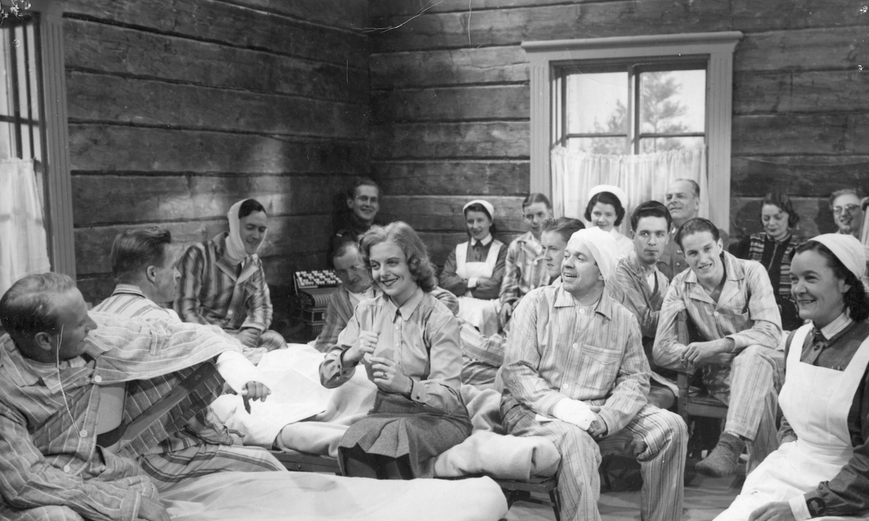
After another bout of home leave (he always seems to be off again to see the missus and his three aggressively cute children), Möttönen is the master of ceremonies at a massive show, where his ability to improvise and pull replacement performers out of the audience turns it into a roaring success.
This historical blog of Finnish cinema is creaking with the weight of military comedies, including The Regiment’s Tribulation (1938), Kalle Kollala, Cavalryman (1939) and Serenade on a War Trumpet (1939). And the war has been very much on everybody’s mind for the last three years, either openly acknowledged or conspicuously avoided. But Niin se on, pojat is an altogether different phenomenon, sneaking out in the last week of 1942 as a vehicle for a man who had been turned into a star by the war itself.
Einar Ketola had appeared in several films we’ve covered, but never in such a big role that he has been worth mentioning before. But in a creative environment in which production was stalled, many forms of entertainment were literally forbidden, and cinemas were obliged to stack their programmes with re-runs of old hits like Lapatossu (1937), Ketola became a sudden star-of-the-moment. In the two years before this film was released, he somehow racked up over a thousand performances, not merely in provincial theatres and dance halls, but at hastily cobbled-together frontline stages and in hospital canteens, where his “wooden-leg” humour was a welcome distraction for wounded veterans. Corporal Möttönen was his most popular character, a good-hearted barrack-room comedian always prepared to see the sunny side, and ready to brush off any setbacks with his breezy catchphrase: “That’s how it is, boys!”
The Finnish press dismissed the film with little more than shrugs, noting that it was a thinly disguised excuse for a variety show in the vein of SF Parade (1940), stitched together with scenes that allowed Ketola to reprise his stand-up material. Some of the big stars of the day lend some weight, including an uncharacteristically smiley Regina Linnanheimo, who shines in a Hawaiian dance number – is she only ever cheerful when she’s in a black wig?
When the writer-star himself was already admitting in interviews that Möttönen was a wartime phenomenon that was unlikely to last long in peace, this film is a fascinating glimpse of a star that shone brightly for a brief moment. “Some watch and listen to him with pleasure,” sighed Olavi Vesterdahl in Aamulehti, “while others find him tedious when they see so much of him at once.”
Some reviewers objected to “tasteless” sequences ridiculing Josef Stalin – content that would become substantially more problematic after 1945. In the tense censorship environment that would cancel several wartime hits in order to avoid offending the Soviet Union, That’s How It Is, Boys! was shorn of ten minutes of footage, not merely regarding Stalin, but also lines in which Möttönen lent his support to the Nazi-inspired notion of a “Greater Finland” – a controversial issue even at the time, since many Finnish soldiers had joined up to defend their country, not invade someone else’s. Its star suffered an even worse fate, kicked out of the actors’ union on the pretext that his performances didn’t really count, and blacklisted from many Finnish theatres, on the grounds that he was a fascist sympathiser, and his presence on a playbill would draw dire consequences. His struggles even continued after retirement in 1969, when his right to a soldier’s pension was tied up for years in the reddest of red-tape delays.
Ketola’s crime, it seems, was being a massive propaganda success during the Continuation War, for which elements within the post-war administration were reluctant to forgive him. The story goes that he didn’t receive his pension until 1976, four years before his death, when President Kekkonen heard about his treatment, and heads rolled at the social security office.
Jonathan Clements is the author of A Short History of Finland. He is watching all the Finnish films so you don’t have to.
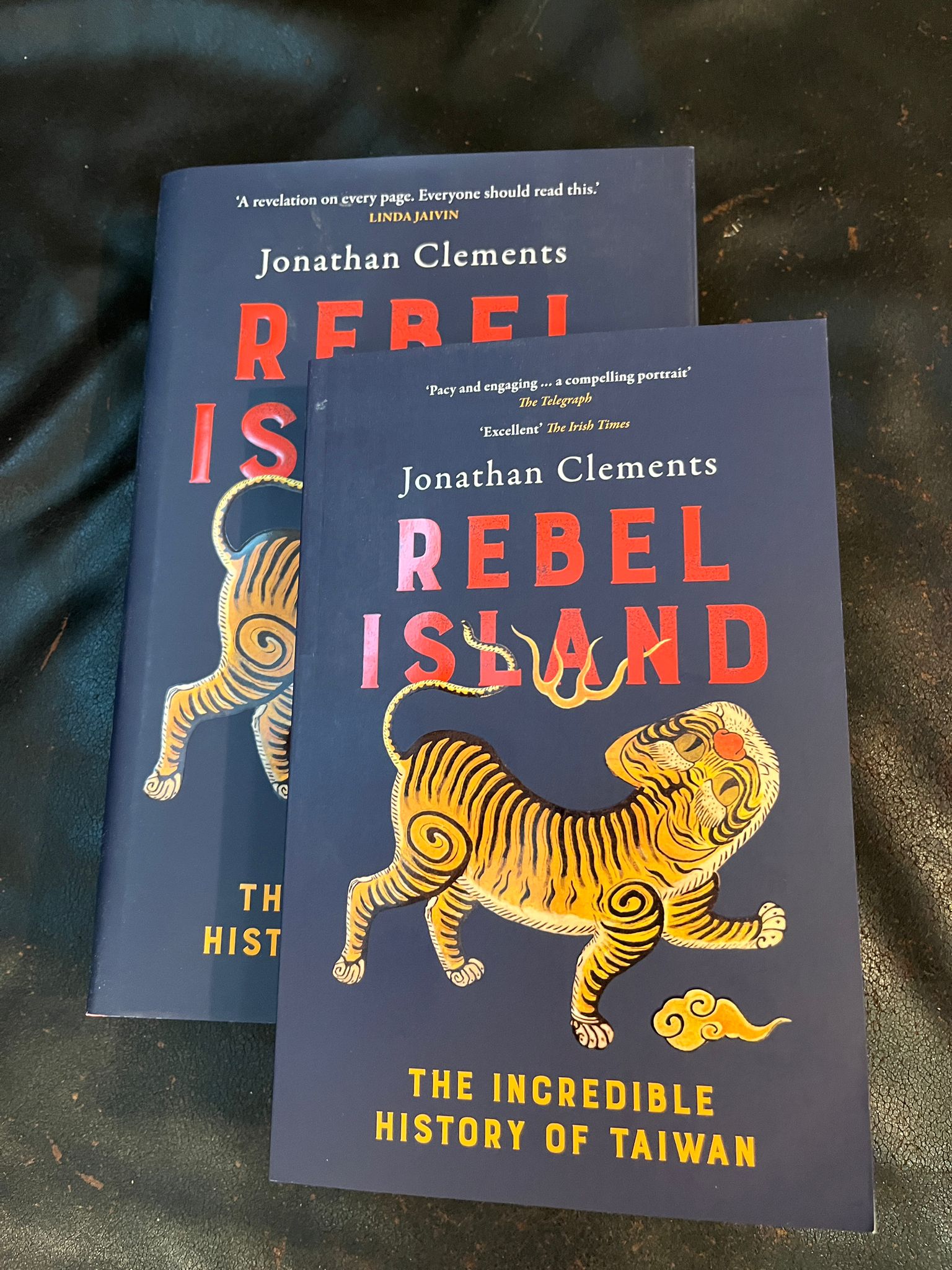
In the post this morning, my author’s copies of the compact, mass-market edition of Rebel Island, which throws in a couple of paragraphs about the presidential election, two pages of reviewer quotes, and a “NO A.I. SCRAPING” command in the indicia.






 The Official Schoolgirl Milky Crisis Blog