Animation in China

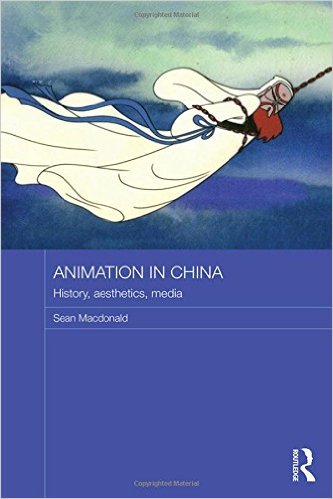
41haOrPwuXL._SX331_BO1204203200_Over on the All the Anime blog, I review Sean Macdonald’s excellent Animation in China: history, aesthetics, media and take the time out for a tangent about the politics of book pricing.

“Macdonald acknowledges the vital importance of Japanese animation for understanding the Chinese market, both in terms of early innovators such as Tadahito Mochinaga, who enjoyed a Chinese career under the name Fang Ming, and later helpers such as Tetsuya Endo, who did the real work on “Tsui Hark’s” animated Chinese Ghost Story. He discusses the famous Uproar in Heaven, the Monkey King from which remains the mascot of SAFS, not only in terms of its Chinese context, but of its parallels with Tezuka’s Alakazam the Great, which was released a year earlier. He even compares the working practices of the Wan brothers (with welcome translated quotes from one of their memoirs) with those of Osamu Tezuka in the age of “limited animation,” playfully comparing the car-crash scene in the first episode of Astro Boy to a famous sequence in Eisenstein’s Battleship Potemkin.”

Frost on Top of Snow

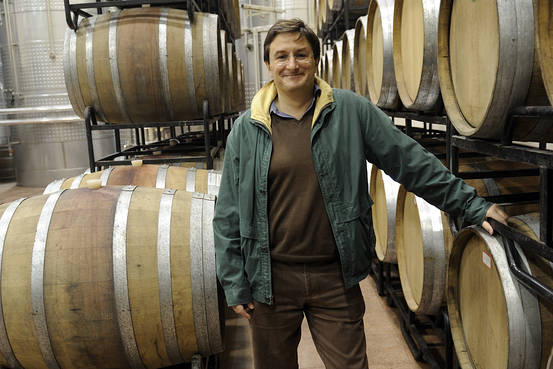
ruffle 1In A Decent Bottle of Wine in China, author Chris Ruffle recounts his foolhardy efforts to set up a vineyard and build a replica Scottish castle in Shandong. This is not as crazy as it might sound, since Shandong was arguably the home of the modern Chinese booze industry – a former German colony that saw the first lines of grapes planted to make the usual acrid Riesling, as well as the site of the Tsingtao brewery. Ruffle decides to get in on the game, naming his company Treaty Port Wines with a certain degree of tactless cheek. His is by no means the first book to grapple with doing business in China – Tim Clissold has twice sobbed into his typewriter on such matters, and then there’s Paul Midler’s horrifying Poorly Made in China, for starters – but the wine trade brings with it unique issues of classification, husbandry and supply, not the least the government’s insistence that it is not “farming”, but “industry”.

Ruffle is no bumbling idiot or starry-eyed dreamer. He has already successfully restored a real Scottish castle, inadvertently becoming a baron along the way, so has a head start on sourcing architects and materials. He is a master strategist, thinking ahead not only about access roads and transport links, but also about the nature of his customers – the castle is there as a branding exercise, and because he knows the biggest chance of the Chinese spending big money is if they are in a wedding party, and he’s as interested in providing the view, the food and the roof over their heads.

Ruffle is a true money man – an investment capitalist with an eye for the bottom line and a smart drive to understand where his customers’ money is going. This being China, the usual troubles of any new business are compounded by additional hassles, which create, as the Chinese say, “frost on top of snow.” Ruffle’s agonies include inclement weather, corrupt officials and workshy staff. Although he sometimes leaves his tormenters anonymous, there are occasions where he bluntly names the names behind incompetences and betrayals. This, of course, only makes the book more fun, particularly when he reveals the blatant grade-inflation of the Shandong authorities, who talk up his investment almost tenfold in their official reports. As Ruffle observes, it’s this disruption between industry on the ground and officialdom’s appraisal of it that makes investment in China such a volatile enterprise. He captures this reality gap with his account of landing in a private jet at Shanghai airport – oh, it’s ever so swish, except one’s plane has been parked so far from the terminal that getting there requires a 30-minute ride across the tarmac in a ramshackle minibus.

Ruffle tries to do right by the local farmers, only to discover that they have been offered the merest fraction of the sum he handed over to the authorities to buy up their land. Some play the system by planting apple trees on their plots. These three-inch saplings transform their cabbage plots overnight into “orchards” and thereby increase their resale value. On several occasions, Ruffle loans money to grasping employees who then skip town, and he is even scammed by men who pretend to be buying an entire truckload of wine for the People’s Liberation Army, merely to get a free meal out of him.

Although Ruffle presents himself as a gruff and exasperated Yorkshireman shouting at yokels in flipflops, he has a degree in Chinese from Oxford. They don’t just hand those out with packets of cornflakes, putting him further ahead of the competition when it comes to getting things done. But as numerous slamming doors and maddened resignations imply, Ruffle’s plan is regarded by many of his underlings and professional advisers (and occasionally by Mrs Ruffle) as a quixotic money pit.

Despite such misgivings, he is an admirable salesman for capitalism. As he makes clear, but could have perhaps even made clearer, his nutty scheme for putting a Scottish castle in eastern China not only creates a slew of jobs for the population, but encourages the government to improve local amenities. His frankly blind faith in the quality of the soil lures the Lafite corporation to set up its own vineyard next door, and several of his disgruntled ex-employees are not quite so disgruntled that they don’t attempt to ape his project with vineyards of their own. Graciously, Ruffle does not regard them as competition, understanding that a cluster of rival vineyards is more likely to attract longer-term tourism. This, of course, brings problems of its own, such as the threat that some latecomer with no taste will ruin the valley by putting up a shopping mall on the next ridge. But it also brings economies of scale, with the rival vintners lending each other plant and machinery to get the best out of their crops.

Ruffle’s tenses waver from past to present, betraying the book’s origin as an occasional diary – halfway through, we see him having the idea to repurpose it as a book to promote his vineyard, which is honest at least. But like many novice authors, Ruffle has not quite worked out who his readership is. There are several chapters seemingly missing, sometimes out of modesty, sometimes out of discretion, sometimes out of lack of editorial foresight. It’s unclear at the start if Ruffle even knows anything about wine – it’s not until the closing chapters that he describes the industrial process in any detail, and only then reveals his numerous research trips to more established vineyards. Some chapters read like a business report; others like a sump of documents; still others like a Christmas round-robin, name-dropping a bunch of people that the reader stands no chance of knowing. There are odd cul de sacs, such as the full text of a visiting intern’s testimony, along with the suggestion that all was not as reported, but no further details.

As Ruffle notes himself, all land in China is owned by the state, “so what you are buying is only the right to use the land for a specific period of time: residential land for seventy years, industrial for fifty years and agricultural thirty years. No one knows what will happen at the end of the specified periods, but if there is not some ability to roll-over ownership, I guess there will be another revolution.” I was ready to pick up a banner and a brick myself by the end, when he finally glimpses success, only to be kneecapped by the very same institutions he has been struggling against.

In 2013, new government austerity initiatives deliver a savage blow to the gift-giving and booze-drinking market that Ruffle hopes to supply. Meanwhile, the authorities who have thus far only seemed to express an interest in back-slapping and glad-handing, suddenly come up with a bunch of tagalong schemes that seem destined to ruin Ruffle’s venture even as they profess to help it. There is a half-hearted effort to build a Taoist temple nearby, which gets its own eyesore access road, even though it is never finished. Ruffle’s efforts for the valley are eventually rewarded with the news that the government plans to drive a motorway right through the middle of it, compulsorily purchasing back large tracts of the vineyards, and sullying the carefully managed view.

Ever the disarming Oxbridge charmer, Ruffle does not let his anger show, although his quoting of a Czech proverb makes his feelings plain. “In capitalism, man exploits man. In communism, it’s the other way around.”

Jonathan Clements is the author of The Emperor’s Feast: A History of China in Twelve Meals.

If This Goes On…

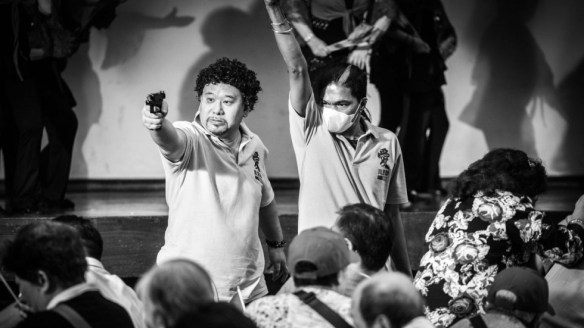
ten yearsWork continues over at the Science Fiction Encyclopedia, where I’ve contributed new entries on the Chinese tomb-raiding author Tianxia Bachang, and the controversial Cantonese polemic Ten Years (pictured), about life in a near-future Hong Kong. The China entries in the SFE constitute a book within a book, covering everything from early pioneers to Party people, and it’s all online for free, because that’s how they roll. Blessings of the state, blessings of the masses…

China Goes Global

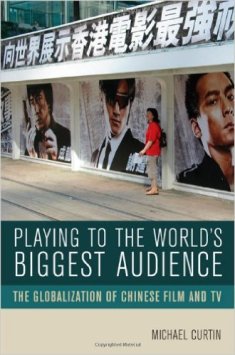
51KIiTJn-HL._SX328_BO1204203200_Over at the All the Anime blog, I review Michael Curtin’s Playing to the World’s Biggest Audience, which is possibly the best book I have read on the Chinese film market.

“As Dan Harmon once said of Hollywood, if the food industry offered the same quality standards as movies, every third can of tuna would have a human finger in it.”

Martial Artistry

big troubleSpun off from my work on A Brief History of the Martial Arts, the Encyclopedia of Science Fiction gets to feel the benefit, with several new entries from me on Chinese authors. There’s a new thematic entry on Wuxia (martial arts fiction), as well as author entries on Louis Cha (a.k.a. Jin Yong), Ni Kuang and Wang Dulu, the author of Crouching Tiger, Hidden Dragon. I’ve now written well over 100,000 words in the SFE on the literature of China and Japan, and the work is still ongoing.

Vinegar Joe

IMG_0063But why, I hear you ask, would anyone take a ridiculously hilly bend in the river, a thousand miles inland in jungle conditions, and build a massive city there? Everywhere else I have been in China has been carefully built on flat ground. Chongqing is like the map you delete on Sim City because you can’t work out where you are going to put any roads.

Well, for one, this is a bridging point for the Yangtze. Tankers stacked with containers can make it this far on the river, which is itself an amazing thought, thanks to the Three Gorges Dam downriver. But historically, Chongqing only ever flourished where there is no other hope for anywhere else in China. It was first conferred with city status in the Southern Song dynasty, when a game of musical chairs with the refugee Chinese emperors suddenly turned its local princeling into the ruler of what was left of China. And most famously, in the twentieth century, with the Japanese running riot all over the east coast like an outbreak of the walking dead, Chongqing was jury-rigged as the temporary capital, bastion of the Nationalists, kept alive by the infamous Hump airlifts across the Himalayas, which is why there is a wreck-strewn gorge in India called Aluminum Valley.

Chongqing, or Chungking as it was romanised back then, spent half a dozen years as the last hope of free China, landlocked and surrounded. Chiang Kai-shek was the general in charge, although all his dealings with his American supporters were smoothed by his wife, Soong May-ling, who had studied in America and spoke perfect English with a sexy Southern accent. Their best-known unit was the American Volunteer Group, a.k.a. the Flying Tigers, who were formed in secret in Burma in 1941 by “resigned” American pilots, and were hence ready for action a mere fortnight after Pearl Harbor, shooting the Japanese out of the sky in Kunming.

Regular readers of this parish will know about my obsession with the Flying Tigers, although it has never turned into a book because Daniel Ford has already written one that says everything I would say about them. The backs of their flying jackets were sewn with a blood chit, bearing the Nationalist Chinese flag (now only seen in Taiwan), and an oddly poetic statement in Chinese: “From beyond the ocean, he comes to aid in the Celestial war. Soldier and Citizen alike, aid and protect him.” It’s tough to translate; some will take issue with my version, but the choices of wording even in Chinese are a bit quirky and classical.

This is all going to come up again very soon in the media, since the new Bruce Willis film is called The Bombing, and is about the 100,000 people killed by Japanese air raids in wartime Chongqing. No, I can’t imagine why that has suddenly gone into production with Chinese money this year.
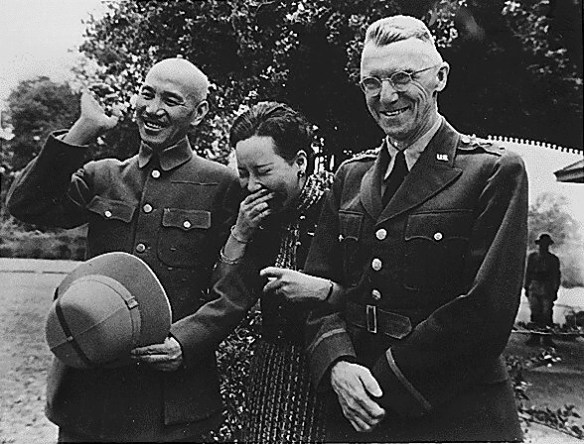
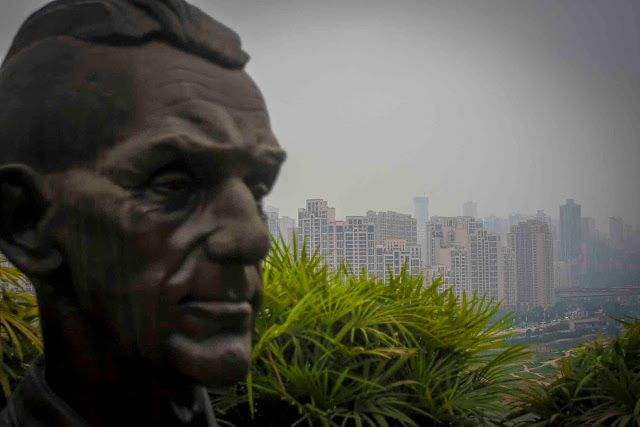
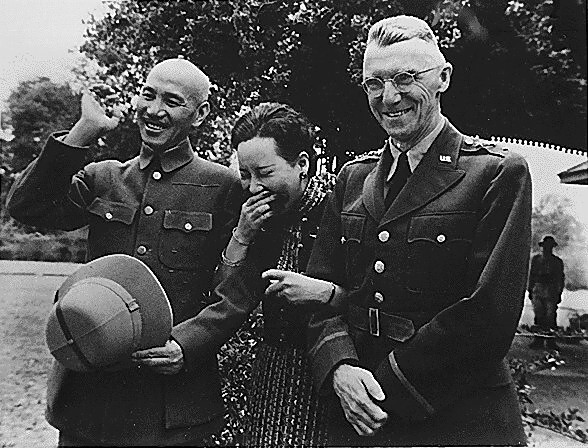
Chiang_Kai_Shek_and_wife_with_Lieutenant_General_StilwellI went to the former home of Joseph Stilwell, whose association with China began in 1911, and who was a military attaché in Beijing in the 1930s. He was sent back to China in WW2, over his own protests, because he was the only general Roosevelt had who could speak Chinese. And so he was stuck in Chongqing for several years, arguing with the Flying Tigers and getting increasingly exasperated with Chiang Kai-shek. There is a lovely photograph of him, Chiang and Soong May-ling, cracking up over some joke or other in the garden. The official portrait of the three of them has them all looking serious, but it’s the outtake that makes them all look human, pissing themselves about some long-forgotten fart joke or similar tomfoolery. Stilwell’s otherwise caustic sense of humour earned him the nickname Vinegar Joe, although he was also known as Uncle Joe, largely for his hatred of pomp and ceremony, and his insistence on wearing a uniform without rank or insignia.

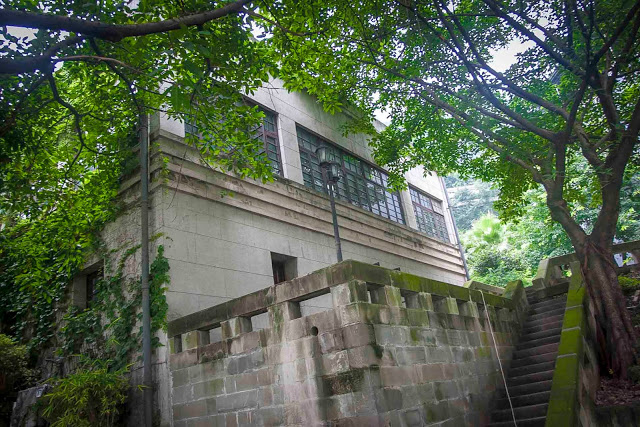
His home is a bunker-like block of 1920s chic, set in a hillside on one of the many ridges overlooking Chongqing. It is refreshingly off the beaten track. I cause a traffic jam on the winding mountain road simply by stopping outside to pay my taxi, and inside there is a baffled caretaker washing a cabbage, next to a litter of mewling ginger kittens. Within, the house is wreathed in a jungle of creepers, and surrounded by banyan trees and palm trees, fizzing in the heat. It is a welcome change from the nonsense of so many other Chinese tourist sites, many of which appear to have been designed by the same committee who think that everything needs a shopping mall and a car park.

IMG_0119The exhibition inside includes details of Stilwell’s career, but also pushes his involvement with the Dixie Mission, an abortive attempt by the Americans to collaborate with the Communists, which was called off in 1947. The Chinese still remember, however, that the plane that flew in to Yan’an to evacuate the Americans came loaded with medical supplies to leave behind. Actually, they remember an awful lot about Stilwell, and there is an inscription on the wall about how when the guns are silent and the smoke has faded, only friendship remains.

Across the road, situated in such a way as to make Vinegar Joe spin in his grave fast enough to power all of Chongqing, there is a museum dedicated to the Flying Tigers, the air group who were a royal pain in his arse all the time he was in China. The staff were oddly fluent in English, as if they are used to coach parties of US servicemen rolling up to hear all about the American Volunteer Group and their shark-nosed planes.
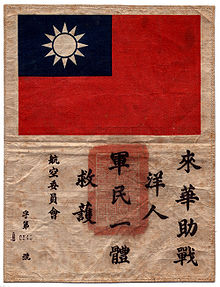
220px-REB-AVG-CHIT-1I couldn’t resist buying some Flying Tigers tea from the gift shop and a couple of books, although I did balk at the crappily reproduced Flying Tigers T-shirts and baseball caps. I also bought my very own blood chit, advertising me as a man who has come from beyond the sea, although it does so in a pinkish manner that suggests it was run off on a laser printer. I also bought a book about the Hump airlifts, because I find them oddly interesting. There has been quite a lot written about them – the Berlin Airlift was masterminded by Hump veterans – and as the Hump exhibition at the Zhang family mansion in Changchun also mentioned, they didn’t get a lot of glory because there isn’t really a dramatic narrative in simply delivering fuel and fags to a bunch of soldiers, even if doing so involves caroming through narrow canyons in the Himalayas. Who am I kidding, it would make an awesome movie, particularly these days, when special effects could show all the crashes. I am rather surprised Hollywood hasn’t got involved already, since one Arnold Spielberg was a radio-gunner in a B-25 squadron in India, and his son Steven has become something of a name these days. The Hump, for what it’s worth, was set up by Colonel Merian C. Cooper, better known to posterity as the producer of King Kong, although I know him better as the chief of staff for Claire Chennault of the Flying Tigers.

Jonathan Clements is the author of A Brief History of China.

The World of Suzie Wong

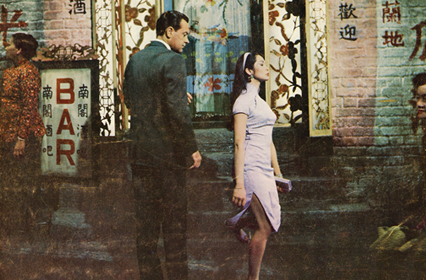
cropped-the-world-of-suzie-wongThe World of Suzie Wong by Richard Mason is a glimpse of the world of 1957, when old soldiers could still talk of having had a “good war”, and the British Empire was still teetering on the brink. Kindle makes it possible for me to nab it within moments, although Suzie Wong is one of those subjects that I have heard mentioned all my life, but never actually encountered before – a bit like Fu Manchu and the Black &White Minstrels, it seems to have been airbrushed from history in more enlightened times.

Robert Lomax is filth in all but name (Failed in London, Try Hong Kong), a clueless wannabe painter in Hong Kong, who accidentally takes a room in the Nam Kok Hotel, which turns out to be a brothel. Readers of this parish may scoff, but are reminded that the Clements family also somehow managed to end up a few floors up from a knocking shop in Chengdu, so it’s not like it’s impossible.

mysterious_world_01Lomax falls for Suzie, a wilful, proud bar girl with a half-caste baby, and much of the story is taken up with their long, long, looonnng courtship, occasionally interrupted by other suitors and various dramas among the other bar girls. Mason has a matter-of-fact approach to dealings at the brothel, and that, coupled with the coy requirements of 1950s censorship, turn his account into a far less prurient tale than one might at first imagine. He certainly seems to know his way around the etiquette of the red light district, and has interesting observation about the peculiar protocols of the girls, who, for example, deride any sailor who doesn’t pick one girl and stick to her for the duration of his stay in town as a “butterfly”. It encourages comparison with Akasen Chitai (Red Light Zone), Kenji Mizoguchi’s last film, shot in a realist style in Toyko’s brothel district around the same time, just before prostitution was criminalised in Japan.

Curiously, the leading man is presented as somewhat ignorant of the East, which is exactly what I would expect from the average hack cranking out a Hong-Kong-hooker-with-a-heart-of-gold novel. But Mason was an old Asia hand, having fought in Burma in the war, and drafted to learn Japanese as a POW interrogator. It’s thus all the more impressive that he is prepared to present his leading man as a callow, nice-but-dim posh boy, drifting from plantation job to would-be artistry in Hong Kong, and failing to read a single squiggle. I don’t think I would have been able to resist the temptation.

Meanwhile, his slice-of-life of 1950s Hong Kong presents tantalising glimpses of a small town overwhelmed by a massive refugee influx from over the border. Suzie herself is from Shanghai, and there are whispers throughout the book that the girls are women fallen on hard times, forced to seek any job they can in order to escape the even greater miseries of (we now know) the Great Leap Forward.

stepsLomax is just as much an outsider among the British expat community, which he regards as stifling and hidebound, not the least for its refusal to accept mixed-race marriages – when he approaches a consul for a wedding certificate for him and Suzie, the consul is actually surprised to learn that he is allowed to marry them. He also has some deeply odd things to say about oriental femininity, such as suggesting that the attitudes of Asian girls are designed to support masculinity, while those of European women are designed to destroy it.

Really. Presumably, by “destroying it” he means the unhelpful willingness of European women to have ideas and opinions of their own, thereby threatening to shatter the fragile worldviews of thin-skinned men.

I’d say that the book could never be written today (except that there’s one about Thai bar girls, called Paradise Lust, which is basically the same story, and many of the same observations, from fifty years later). But certainly modern readers would tut in indignation at the sense of entitlement of Suzie’s suitors, one of whom spanks her for daring to look at another man (like that isn’t her job). Although the book does attempt to present the girls’ case and the girls’ view, it is largely the tale of Chinese women available for rent, to largely uncaring and callous men, often cheating on their wives, who are themselves presented as ghastly termagants.

20081209173338484338368380There have been two unofficial sequels, both of which seek to tell the story of Hong Kong as a whole through Suzie’s eyes. One wonders what a modern author would do with the same material. Guo Xiaolu, for example, author of A Concise Chinese Dictionary for Lovers, might take the title literally, and tell it solely through the eyes and words of Suzie herself, thick with detail about the China left behind and the intricacies of the Nam Kok, but as numb and uncomprehending of Lomax’s world as he is of hers.

Suzie Wong was adapted for the stage within a year of its publication (starring William Shatner in the initial theatrical run, imagine!), and then turned into a film. The book was apparently a best-seller, which perhaps explains why Richard Mason doesn’t appear to have worked all that hard at being a novelist afterwards – he died in 1997, living just long enough to witness the Hong Kong Handover, but despite listing him as a “novelist”, his obituaries only seem to come up with four books to his name, of which Suzie Wong was the fourth. In 1962, at 43 years old (my age), his writing career was apparently over, presumably because he was quids-in for the rest of his life. I might be wrong – other mentions of him online suggest that he had a day-job working for the British Council, so possibly lost interest in writing anything else.

Jonathan Clements is the author of A Brief History of China.