Tartar Source

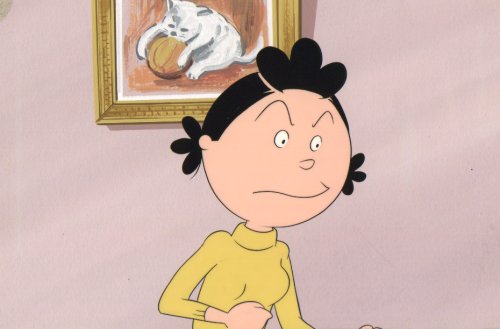
Determined to make a trip to the dairy more fun for all the kiddies, the Snow Brand Milk Products company decided it needed a cartoon. The result was Tengri the Boy of the Steppes (1977), a 21-minute promotional film pointing out to people just how tough dairy production was in the bad old days. Set on the plains of Central Asia, it showed scenes in the troubled life of Tengri, a hunter boy who develops a brotherly relationship with Tartar, a young calf. We learn all about life on the steppes, until a fateful winter when Tengri is ordered to kill the calves for food. Unable to bring himself to off his bovine best friend, Tengri “loses” Tartar in the snow.

Years later, a grown-up Tartar somehow saves the village, and the previously unknown Recipe for Cheese allows Tengri’s fellow villagers to bring aid to the starving. Cheese is the saviour of the steppes, as it allows milk to be preserved long past the date it is extracted from a cow. Consequently, the villagers have food all through the winter, and don’t need to kill cattle for meat.

This odd story, seemingly not mentioning that all dairy cattle end up slaughtered for meat, was dashed off by Astro Boy creator Osamu Tezuka at Snow Brand’s request. His contribution, described as “a character sketch and a four-page story outline,” was thrown at the animation company Group Tac, which sat on it for two years. They were, it seems, rather busy at the time on Manga Fairy Tales and the animated Adventures of Huckleberry Finn. With time ticking away, the project landed at Shin-Ei animation, where animator Yasuo Otsuka finally took it on in what would be his sole directing credit, obliged to crank it out on a 45-day production schedule.

Otsuka was plainly not a fan of Tezuka, a man whom he regarded as largely responsible for the collapse in the quality of Japanese animation. To put things bluntly, while Tezuka readily lapped up any praise that called him “the Japanese Disney”, he owed much more in his working practices to the extremely limited animation practices of Hanna-Barbera. Tezuka’s production-line system and cost-cutting measures might have made it possible to make anime on weekly television schedules, but they also irredeemably cheapened animation, Otsuka thought. Animators worked hard before Tezuka, but after Tezuka they worked like dogs, in an industry notorious for chewing up its practitioners and spitting them out.

Otsuka was hence not all that impressed with Tezuka’s tales of “Tartar source”, particularly since he got the impression Tezuka had dashed off a vague story in less time than it took to smoke a fag. Otsuka also had problems with Tezuka’s outline, particularly the original Shane-inspired ending where Tengri heads off towards the west, a lone drifter, with the implication being that he takes cheese to Europe, like a dairy Prometheus.

Otsuka began planning a rewrite, only to be told by the producer Eiji Murayama that the ending was “suffused with poetic sentiment” in depicting a hero who “leaves the trifling human world” in order to journey to Europe. Which is, presumably, not populated by humans.

But this was supposed to be a cow + boy story, not a cowboy story. Otsuka understood the elegiac quality, but he thought that a children’s film should end with its protagonist welcomed back by the village. Risking the ire of Tezuka and the dairy, he changed the ending by hiding the horizon behind a bunch of cows, so that it wasn’t immediately plain to see where Tengri was heading. If you wanted to believe he came home at the end, you could now believe that.

Not that the horizon needed much hiding, as Otsuka had to use standard-sized cels. Despite a setting on the rolling grasslands of Asia, a union rep had told Otsuka there would be no great vistas in the background, as that was too much work for the colorists. Otsuka protested that even staunch union men in the animation business took enough pride in their work to draw a wide plain if a wide plain was called for, but he was overruled. What really wound Otsuka up was that the union had accepted the job, claimed they could do it, and then threatened to walk out when it proved impossible. He’d have preferred it if they’d refused from the outset, so he could have gone back and asked for a budget increase to do a better job.

In the end, Otsuka was forced to sit with his arms folded, sulking bitterly, at the preview screening, as his under-funded anime rolled out to a largely unappreciative audience. People filed out saying that it would “do”, and Otsuka – one of the greatest animators in 20th century anime – never directed a film again.

Although some online reviewers on Amazon Japan claim to have seen Tengri the Boy of the Steppes on TV, for thirty years it was officially only available to people who either visited the Snow Brand factory showroom, or rented it out from the dairy as a 16mm film print. But then, a series of events propelled Otsuka’s obscure cartoon back into the media.

In 2000, Snow Brand Milk Products achieved a different kind of notoriety when over 14,000 Japanese reported unpleasant side effects of consuming “old milk”, past its sell-by date.

The following year, Yasuo Otsuka discussed the film’s production history in his autobiography. In the process, he mentioned something that revealed to Snow Brand they were sitting on a dairy anime goldmine that could help dispel their media milky crisis. As a result, Snow Brand authorised the release of Tengri the Boy of the Steppes as a deluxe DVD in 2007, bringing this forgotten anime back into the limelight once more.

Of course, it probably helped that the new credits acknowledged the contribution of Yasuo Otsuka’s young layouts assistant, a previously uncredited young animator called Hayao Miyazaki.

Jonathan Clements is the author of Schoolgirl Milky Crisis: Adventures in the Anime and Manga Trade. This article first appeared in the SFX Ultimate Guide to Anime, 2011.

Evangelion 2.22 review

A decade into an apocalyptic war against alien invaders called “the Angels”, Shinji Ikari is one of several young pilots co-opted into the last-ditch Evangelion programme – an ethically-unsound bioweapons project to fight the aliens with their own technology, no matter what the human cost. Behind the scenes, there are scandals within scandals about the cores of the “Eva” units, while the pilots bicker and squabble, and fight to keep their sanity in savage, blood-soaked battles against random enemies.
Hasn’t this all happened before? Well, yes it has, in the Evangelion TV series, bestselling Evangelion manga, and several remastered, slightly-tinkered DVD releases. The most recent incarnation was Evangelion 1.0, to which this film is nominally the sequel, although there is a lot more to it than a simple remake.

It’s easy to forget that when Evangelion was originally broadcast, it was something of a mess. Production delays and cashflow problems led to hilariously (and then, frustratingly) long cost-cutting shots with little or no animation. The grand finale was a glorified radio play, and there was undeniable filler peppered throughout the latter half of the season. It’s fair to say that the 13 hours of original Evangelion TV might be reasonably slashed down to the four intended feature-length movies without losing much in the way of quality or plot, and that’s before production studio Gainax start wedging in big new chunks of footage. Watch in particular for a prolonged sequence at a marine preservation park, and a loving CG panorama of early morning bustle in Tokyo-3. This is no mere clip-show, that’s for sure.

This latest incarnation also reaches us an entire generation after the original – it’s been sixteen years since the TV show first appeared on Japanese television. The intervening period has seen great changes in the make-up of fandom, which the film acknowledges with a wry jibe at the expense of internet slash fiction writers, when two male characters almost snog. There are some even odder angles and changes of focus throughout, and part of it is undoubtedly aimed at fans of the original, particularly that sector of thirty-something uber-geeks whose love of figurines and other collectables keeps much of modern anime afloat. It’s salutary to remember that these enthusiasts would have been mere teenagers at the time of the serial’s original debut.

The Gainax studio seems all too aware of this. A couple of years ago at the Locarno Film Festival, their merchandise man with an Eva laptop and an Eva cellphone showed me Evangelion egg-timers, underpants and lucky gonks – part of over 3000 items of spinoffery that keep completists busy and poor. Mari Illustrious Makinami is undoubtedly part of this enterprise – a pretty new face literally parachuted into the plot in order to sell more pin-ups. In an odd piece of anime trivia, she is supposedly intended to “look British”, whatever that means. But she also throws the old character dynamics into turmoil and serves to remind long-time fans that there are many, deeper changes to the story. Many of the “old” characters have also been altered, much more subtly – there are changes to their names, backstories and personalities that completely affect their motivation and behaviour.

There are similar changes elsewhere, not the least in an off-hand reference to a “Vatican Treaty” that playfully backtracks on Gainax’s previous claims that all the story’s apocalyptic religious imagery was purely ornamental. As with many science fiction franchises, it is also strange to find ourselves living in a time after the notional D-day. 2001: A Space Odyssey doesn’t sound so futuristic any more; Terminator’s Judgement Day has been and gone, and Evangelion itself is now set in the past. Or is it?

There are tantalising clues dropped throughout these movies that suggest Gainax are thinking way ahead of the curve. It’s not just minor changes in the plot; it’s tiny references in the background that seem to obliquely refer to previous versions. Sharp-eyed viewers will notice that the Moon in these remakes has a smear of blood across it, seemingly referencing a battle in the original series, and a character who arrives in the post-credits teaser openly suggests that all this has happened before. There is a chance, unconfirmed by the filmmakers themselves, that every change, every tweak in this film is entirely deliberate, and intended to tell a story that is not a remake at all, but a sequel, set aeons after the original, when everything has come back full-circle. The prospect remains that Evangelion 2.22 is inspired most of all in that regard by the Ron Moore Battlestar Galactica, or perhaps for anime fans, the similarly cyclical storyline of the 1980s classic Gall Force. Gainax know the score: there are many copies… but they have a plan.

Jonathan Clements is the author of Schoolgirl Milky Crisis: Adventures in the Anime and Manga Trade. This review first appeared in the SFX Ultimate Guide to Anime, 2011.

Look Back in Manga

Online magazine The Raygun has published a set of reminiscences of twenty years of the company Manga Entertainment. Part one includes former managing director Mike Preece talking about his time running the company, and noting: “We were with it but just far enough removed so as not to become of it and I really believe that’s why it was successful, as up to then the genre had lent itself to those who become so fixated with the product that objectivity for its marketability is blinded by passion for content.” I’m sure such words will chafe with many long-term anime fans, but I also feel that they are a fair assessment of why many of Manga Entertainment’s competitors failed in the same market.

Part two includes the current head of acquisitions, Jerome Mazandarani, as well as Schoolgirl Milky Crisis author Jonathan Clements (that’s me), bringing the rose-tinted memories up to date with some coverage of the late-1990s doldrums and recent changes in the company’s behaviour. Please note, owing to some strange wording on my part, it seems as if at one point I am implying that Naruto is a shojo show. I’m not — I’m merely noting that neither Naruto nor shojo shows were the sort of thing that the company used to make a success of.

“Look Back in Manga” was also the title I used for a monthly piece in Manga Max magazine, detailing the things that were going on in the anime business five years earlier. Tempting to revive it to cover 20-year-old news so that today’s fans can realise that they’ve never had it so good, but then again, I fear that such a series would only appeal to a tiny circle of oldsters like myself. Kids today don’t want to hear about the good/bad old days, which makes the publication of these testimonials, particularly Preece’s, valuable documents for future researchers.

Ad Men

Over on the Manga UK blog today, I’ve written an article about the most widely seen anime of 1958. If you thought it was Legend of the White Snake, then you’re in for a surprise. It’s actually one of the many anime adverts, often overlooked by the anime studies community.

Although nowhere near as outright creepy as this one:

Lost in Translation

The top ten reasons why anime are “lost in translation”…

10: Lip Sync and Line Length
Lip Synchronisation, known in America as “fitting the flaps”, is a means of ensuring that the sound of the words being spoken matched the lip movements of the onscreen speaker. This can often lead to the addition of words on the spur of the moment in the dubbing studio – in erotic horror like Return of the Overfiend, this usually means the use of the F-word as a bonus adverb, adjective and noun! Subtitles normally suffer from the opposite problem – the deletion of parts of a script in order to make the lines fit a pre-determined length. Subtitlers must take into account not only the meaning of the line, but the reading speed of the average viewer…

Continue reading

Perceived Value

This article first appeared in Neo #50, 2008.

Back in April 2003, I attended the Tokyo demonstration of Blu-ray. I rushed home trilling about the benefits of an entire TV series on a single disc! Except this was precisely what the Japanese TV industry didn’t want. At meetings with expensive biscuits all over Tokyo, people fretted about Perceived Value. It’s all very well, they said, to cram the entirety of Schoolgirl Milky Crisis onto a single disc, but how much can we charge for it? Will our target 16-year-old buyer really drop £100 all at once on that single disc, particularly if he’s never seen an episode beforehand?
Continue reading

The Ascent of Manga

Today’s Independent newspaper has a nice chunky feature on manga, which, for a pleasant change, actually talks a bit about real Japanese comics. There is even a Schoolgirl Milky Namecheck, since, as ever, I am the bad guy who dares to suggest that manga come from Japan.

(You can view the article here)

Continue reading

Endorsements

Steve Kyte artwork from SMC

As part of the process of getting Schoolgirl Milky Crisis ready, the Big Giant Heads asked around the anime industry if, you know, a book of my speeches and articles was a good idea. These are some of the very nice replies they got back:

Continue reading

Welcome!

It was the best of shows. It was the worst of shows. Whenever I had to cover my tracks, I simply called it Schoolgirl Milky Crisis.

I have been writing about Japanese comics and animation for almost two decades, taking potshots at anime, manga and related fields, spreading scurrilous gossip and telling tall tales. And my friends in the business didn’t seem to mind, as long as they had plausible deniability, which meant that sometimes, even though the real name of a work was obvious to everyone, I needed to call it something else.

So I picked three random words out of nowhere: Schoolgirl Milky Crisis. At first, it was one of many fake titles, along with such creations as Warriors of the Test Card, Geek Gets Girls and Devil Devil Beast Beast. But there was something about Schoolgirl Milky Crisis that captured readers’ imaginations, and the non-existent show began to crop up regularly in my columns on the UK Sci Fi Channel’s website, in Newtype USA, and later in the Judge Dredd Megazine, NEO, and SFX Total Anime.

As time passed, colleagues approached me with woeful grievances and axes to grind. They would press documents into my hands naming names and stirring trouble. All they asked was that if I talked about this terrible show or that awful production experience, I should make sure everyone knew it was Schoolgirl Milky Crisis.

This blog is just a taste of the kind of things in the book that is due for publication in early 2009. The book contains serious newspaper articles, seminar speeches, frivolous web journalism and bitchy gossip from the specialist anime press. There is hard, useful information there, even in stories about gloves full of custard and snowball fights with martial artists. As part of the selection process, my editors and I have focussed on material that educates and informs, even if also discussing the ethics of sending celebrity guests to bondage clubs.

Schoolgirl Milky Start!

Jonathan.