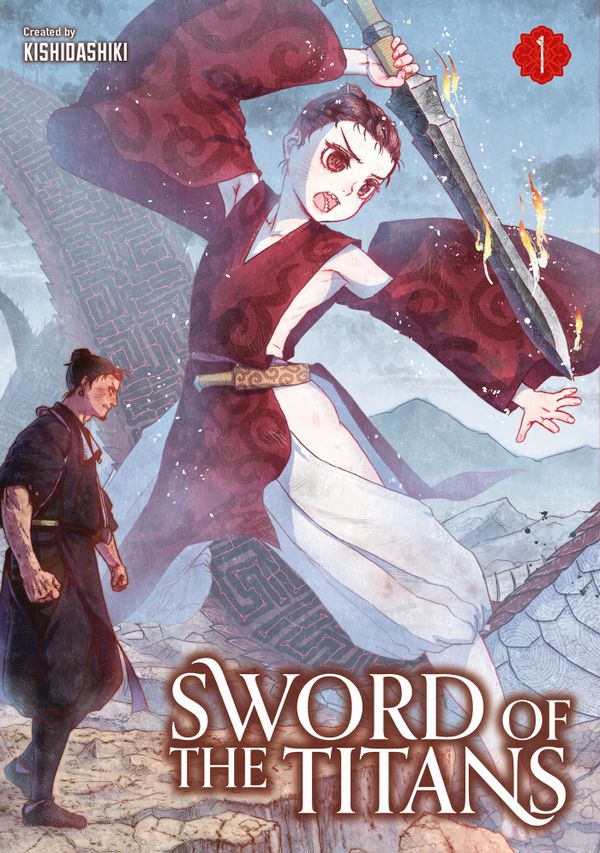
Grace Rosa is an assassin, driven by a single thing: discovering the secret of her adoptive father’s disappearance. He trained her to become a lethal killing machine, able to wield any weapon she can get her hands on, before inducting her into the ranks of the shadowy organisation known as Alterna. But could the very people she serves as a hired gun have something to do with him vanishing? And to what lengths will she go to enact her vengeance on the people who have wronged her?
Out now from Titan, “volume one” (I am not sure there was ever a volume two) of Himuro’s manga Grace Rosa. Motoko Tamamuro and I worked on the shooty bang-bang English script, which is very John Wick meets Gunsmith Cats.
No, not radiation. Not the struggles of war and the agonies of constant trauma, transforming into a rampaging, city-stomping beast. Because that would be the trailer for a Godzilla movie, and those words are spoken by Beyoncé Knowles in the advert for her concert movie Renaissance. And both of them are fighting for space on IMAX screens.
Takashi Yamazaki’s Godzilla Minus One is a stark reboot of the monster franchise, playing upon the idea that Japan in 1945 has already been reduced to “zero”, and that an attack by an unstoppable beast just makes everything so bad that we go into negative numbers. But whereas Minus One hit many cinemas outside Japan at the beginning of December, its UK release waited a critical couple of weeks, in a business decision that might end up benefiting absolutely everybody.
The UK has 52 IMAX screens, while Ireland has another two, with the majority of the screens being part of Cineworld/Odeon cinemas. That’s substantially less than the United States of America, where presumably Godzilla Minus One and Renaissance would be able to jostle for audience attention without wrecking the theatres.
I put the question to Anna Francis at Minus One’s UK distributor, Anime Limited, who conceded that Beyoncé’s Renaissance had already been booked into a number of IMAX screens before Godzilla began clambering out of the sea to smash stuff. But Beyoncé, she states, “was only part of the picture… the main reason was that we wanted to avoid the busier film period at the start of December.”
So, it’s not that the King of Monsters was scared of going head-to-head with Queen Bey, more like the presence of multiple distractions as the holiday season got going. Instead, Minus One got its UK release on 15th December, gaining a fortnight’s respite before yet another monster blockbuster landed in cinemas on Boxing Day: Hayao Miyazaki’s The Boy and the Heron.
But wait a minute, Minus One dropped on 1st December not just in the USA, but also in Canada, France, Italy, Spain, Poland, Australia, New Zealand and even Belgium. Could it be that all those places were confident there was no cross-over, whereas British audiences demonstrated an equal love for both the Big G and the Big B that had to be accommodated? At least they are spared a Barbenheimer decision…
Jonathan Clements is the author of Anime: A History. This article first appeared in NEO #237, 2024.
“The ability to buy into the ‘ownership’ of a new anime while it is being made can save a canny investor hundreds of thousands of dollars at the distribution end.”
Over at Variety, Mark Schilling interviews me about the pitfalls of international animation co-productions between Japan and other Asian countries — a good chance for me to quote from the China chapter added to the second edition of my Anime: A History.
Jonathan Clements var ikke helt så tweedklædt og stiff upper lip en brite, som jeg havde forestillet mig. Han var tværtimod en utroligt imødekommende herre i T-shirt og med gråt strithår. [“Jonathan Clements was not quite as tweed-clad and stiff-upper-lip a Brit as I had imagined. On the contrary, he was an incredibly welcoming gentleman in a T-shirt and with gray stubble.”]
This is why you should always dress up for Zoom conferences. Over at Zetland, I discuss Hayao Miyazaki and Pippi Longstocking, as part of Marie Carsten Pedersen’s beautiful article about what Totoro means to her. Well worth a read (and a listen), even if you need Google Translate to navigate the Danish.
“I had a pretty tough life until I became popular with Maruko. I had so many part-time jobs, and even when I debuted as a voice actor, I was good at being poor, but… I was happy because my voice was similar to Momoko-chan’s.”
Over at All the Anime, I write the obituary for the actress singer-songwriter Tarako.
In an unusual YouTube anime, the aggrieved creative Chiho Okura attempts to explain Japan’s consumption tax to freelancers. Her 15-minute Invoice School series features a bunch of animals, including a gorilla greengrocer who’s ploughing on through it, and a snake who is giving up a career in illustration because he just can’t be arsed any more.
British readers will be entirely unphased by the idea of a “Value Added Tax” – because VAT is basically what we are talking about here – an actual alien turns up partway to point this out to the other animals. But in Japan it was only introduced in 1989, at a piddly little rate of just 3%. It got hiked in 1997 to 5%. In the aftermath of the Tohoku earthquake, a government in search of more money racked it up to 8%. Facing the costs of the Olympics and a declining population of income tax payers, Shinzo Abe turned the thumbscrews yet again in 2019, raising it to 10% for many items – I was actually on a ship touring Japan at the time, and the passengers were advised to buy their objets d’art immediately, and not the following day when everything would literally cost more.
The 1st October 2023 saw a new twist in Japan’s tax law, shunting a bunch of the burdens for freelancers on the person who writes the invoice. I don’t pretend to understand a lot of this, because I have never earned enough money to have to pay British VAT [Sorry – Ed.], but I get the impression that it is a massive faff for anyone who has to do it, and entrepreneurs end up having to set aside multiple days each month to collect tax on the government’s behalf.
Okura and her collaborators, Spinnauts and the character designer Nonoa, are clearly distressed about a new avalanche of paperwork that will only make it harder for them to do their jobs. A very enthusiastic rabbit tells the other animals that everything will be just fine, but it’s plain to see that Okura’s sympathies lie with the dejected illustrator-snake, who frets his customers will refuse to pay the extra money on his invoice, and pass the expense on to him instead. It seems like twisting the knife to point out that in the anime business, he’s unlikely to ever earn the £54,000 that would oblige him to complete the paperwork.
Jonathan Clements is the author of Anime: A History. This article first appeared in NEO #236, 2023.
Forty-three years ago on this day in anime history, the impact of Gundam first became truly apparent at a riotous launch event. See my article over at the AlltheAnime blog.
“The posters were gone by 10am. By midday, Tomino estimated the numbers were pushing 15,000, which threatened to turn the event into a riot. Ever since the Anpo Protests over the controversial US-Japan Security Treaty (an event later referenced in the opening unrest of Akira), ‘public demonstrations’ had been illegal around Shinjuku station. Enough Gundam fans had now gathered to risk attracting police attention, and Tomino fretted that an injury in the crowd could attract exactly the wrong kind of media attention. His ‘new anime century’ risked dying before it could even begin, with future events shut down as too dangerous.”
This isn’t the first time I have boggled the people at History Hack with tales of Taiwan. You can also hear my archived interviews about The Pirate King of Taiwan and the historical importance of two obscure shipwrecks.
The picture shown is one of the hastily created Republic of Formosa postage stamps: “whether it represents a dragon or a squirrel or a landscape or anything else or even which is the right way up we have not been able to discover,” according to the Stanley Gibbons Monthly Journal. It is, of course, the tiger of the republican flag.
Articles about the late Michael Bakewell struggled to contain his career high-points. He had, after all, been the BBC’s first Head of Plays, appointed in 1963 to add a touch of class to broadcasting. He arrived at the television wing after almost a decade directing radio for the “Third Programme”, and continued to oversee radio adaptations of Arthur Conan Doyle, Agatha Christie, and the acclaimed radio version of The Lord of the Rings.
Bakewell was a hands-on director, often taking a partial credit for the scripts. Surviving footage of him at work shows him pushing his actors to wring every nuance from their words, vitally aware that in radio, words are often all they have. In the mid-1970s, shortly before his radio triumphs with Holmes and Frodo, Bakewell was roped into an unusual job, replacing the audio of a Japanese television programme with believable English dialogue.
“We thought at first the thing was undubbable,” he told Nationwide. “The only way to get it at was to do it in what I can only describe as, kind of, English Oriental tradition, somewhere in between Fu Manchu and The Goon Show.”
The programme was The Water Margin, based on the manga by Mitsuteru Yokoyama, itself inspired by a classical Chinese novel. An entire generation of British children grew up listening to Burt Kwouk’s cod-philosophical voice-overs, and puzzling at some of the weirder churns of dialogue made to match the lip-sync. NTV’s Monkey soon followed, making Bakewell the go-to guy for difficult Asian dub-jobs.
A few years later, he was hired by Manga Entertainment to oversee their early cartoons for grown-ups, often punched up with questionably racy dialogue. His output was sometimes dismissive, giving trash like Dark Myth and Mad Bull 34 little better than they deserved, but also with some real gems among the classier releases. Roujin-Z, with an ADR script from George Roubicek, was a superb job, as were Bakewell’s English audios for the Patlabor movies. Even his throwaway projects have often gained a certain cachet – Cyber City Oedo 808 has come to be something of a classic because of its sweary dub, scripted by John Wolskel.
Budget cuts at Manga coincided with Bakewell’s brush with bowel cancer, leaving much of the later-period 1990s Manga Video dubs either bought in from America or flung together at a lower-rent outfit. In semi-retirement, he turned to writing, leaving a clear mark on Manga Entertainment’s style and library in its heyday. Anime News Network lists literally dozens of anime dubs to his credit, entirely unmentioned in his mainstream obituaries.
Jonathan Clements is the author of Anime: A History. This article first appeared in NEO #235, 2023.