"I have not told the half of what I saw."

Although they may be self-indulgent and self-regarding, I’ve really been enjoying everybody else’s round-ups of the ten years since the numbers rolled over from 19– to 20–. Herewith the last decade as it looks from here.

2000. In the first week of January, I discover that I am not going blind after all. Instead, the screen is dying on the laptop I have used since grad school. The purchase of a new desktop unit brings the internet into my home for the first time, and with it, an avalanche of Amazon parcels. Manga Max magazine is shut down in July, two days before I receive a Japan Festival Award for editing it. I write six episodes of Halcyon Sun, and briefly work on an IMAX movie project that falls at the first hurdle. Then, I’m hired to storyline and then co-script a console game that has been part-funded by a crazy arms manufacturer.

2001. The mad game is cancelled, apparently because of 9/11. By this time I am already working on another console project, writing three new “episodes” for a much-loved sci-fi franchise. It is only after the voices are all recorded, with the original cast, that the manufacturers decide to pull the plug. Something to do with the game being a stupid idea in the first place. All this gaming money gets funnelled into the Anime Encyclopedia, which eventually breaks even for me in 2007. I love working on that book so much that I look forward to getting out of bed every morning (a condition regularly repeated over the following years — I really do love my job). My first trip to America: Atlanta, for the book launch.

2002. Having superb fun working on the Dorama Encyclopedia. I am a presenter on the Sci Fi channel’s bizarre and mercifully forgotten Saiko Exciting, which first involves me reading the anime news, and later speed-translating and performing modern pop classics into Mandarin. I am offered the editorship of Newtype USA seven times, but decline because I have just got my dream job: a publisher has commissioned my obsession of many years, Pirate King. First DVD commentary, for Appleseed; I’ve since done many more for Manga Entertainment, Momentum Pictures, Artsmagic and ADV Films. Consultant on the first season of the TV series Japanorama. Film festivals in Italy and Norway.

2003. Working for a famous toy company on the “story” that will accompany their new line of toys. Fantastic fun, and very educational. Back to Japan for the first time in years, Kyoto and Tokyo; Dallas for another anime convention, and Turku, Finland. Writing the Highwaymen novelisation, and a whole rack of Big Finish scripts, including Judge Dredd, Strontium Dog, and Sympathy for the Devil. Start learning Finnish, because life’s not difficult enough.

2004. Sign a deal to write a book a year about China ahead of the Beijing Olympics. This year, Confucius: A Biography. Back to Atlanta for another anime convention. Buy half a flat in London.

2005. A Brief History of the Vikings presents a fantastic excuse to poke around old sagas for a few months. Present my History of Japanese Animation lecture series at the Worldcon in Scotland, and later sell it as a series of magazine articles. I also write a massive 12-part History of Manga for Neo magazine. Start writing the Manga Snapshot column, which is still running five years later. Publication, somewhat late, of my novel Ruthless.

2006. The First Emperor of China. Off to Xi’an and Beijing. A new edition of the Anime Encyclopedia. Consultant for The South Bank Show on anime, although I am largely ignored. Write the novella Cheating the Reaper.

2007. Got married — honeymoon in Estonia after Mrs Clements vetoed Georgia. Wu. Not a book title that is easy to bring up on search engines, although you can hear me doing a great interview about it here on Radio Four. Before it’s even published, there are excited feelers from a TV company, which hires me to work on the outline of a 16-episode drama series based on the early Tang dynasty. Nothing comes of it, although I do spend the money going to Japan to get materials for another book: Nagasaki and the Amakusa archipelago.

2008. Beijing: The Biography of a City is published. But my next book, Christ’s Samurai, is left in limbo when Sutton Publishing can no longer afford to pay for it. Luckily, Haus Publishing has decided it wants a massive multi-volume history of the Paris Peace Conference, and has me writing the biographies of the Chinese and Japanese representatives. Big Finish scripts for Highlander and Doctor Who. Titan Books ask me to start this blog.

2009. Switzerland for the Locarno Film Festival. Back to Japan for a month getting materials for three new book projects. Then Shanghai, Sydney, Melbourne, Honolulu, San Francisco, Vancouver and New York on the way home. Mannerheim: President, Soldier, Spy is a Christmas bestseller… in Finland, although it goes down a storm at the launch in London’s Finnish Institute. Big Finish scripts for Robin Hood, Judge Dredd and Doctor Who. My collected articles and speeches appear as Schoolgirl Milky Crisis. I am rendered poor as a church mouse by an exploding boiler.

2010. Next year, I am supposed to be going to Taiwan for the filming of Koxinga: Sailing Through History, a documentary for National Geographic. I have two big publications coming on Admiral Togo and A Brief History of the Samurai — although if it’s got more than 300 pages, can we really call it brief? I’ve got a deadline for another book in January, and after that, who knows…?

I don’t know about you, but that little list sure scares the hell out of me. This, I guess, is the flipside of those cheery little adverts in the broadsheet press, that trill “Why Not Be a Writer?” That’s why not. Because unless you love your job so much that you need to be dragged away from it, you will never put in the required hours. And yet, like Marco Polo, “I have not told the half of what I saw.”

Happy New Year.

2009: The Year in Anime Books

It has been a good year for worthy books on Japanese animation. Apart from my own Schoolgirl Milky Crisis, of course, there have been a couple of books I have yet to read but suspect I will like: Andrew Osmond’s Satoshi Kon: The Illusionist and Thomas Lamarre’s The Anime Machine: A Media Theory of Animation. Surely the prize for best anime book of the year must go to Hayao Miyazaki’s Starting Point, lovingly translated by Frederik L. Schodt and Beth Cary, and treating the anime fans of the English-speaking world to an unparalleled glimpse inside the mind of the medium’s most famous director, warts and all. Miyazaki is surrounded at all times by a cloud of idle speculation and spin, and it’s great to see him speaking up in his own words. Not wholly about anime, but deeply illuminating about one of its best-publicised elements, was Lowenthal and Platt’s Voice-Over Voice Actor, also published this year.

Osamu Tezuka has enjoyed a revival, with two excellent English language studies of him arriving in swift succession, first from Natsu Onoda Powers in May, and then Helen McCarthy in October. Meanwhile, in Japanese, the “God of Manga” was the subject of the multi-authored The Osamu Tezuka That Nobody Knew, and Yuka Minakawa’s chunky, gossip-ridden tomes, The Rise and Fall of Japanese Animation: Osamu Tezuka School, 1: The Birth of TV Anime, and 2: Psychologist With an Abacus.

Japanese-language books on anime this year have offered some tantalising glimpses behind the scenes. Just before the end of 2008, the Association of Japanese Animations (sic) and Tokyo Bureau of Industrial and Labour Affairs published a new syllabus for trainee animators and those wishing to enter the business, which seemed to carefully airbrush out much of anime history before the millennium. You might argue that on a need-to-know basis, new animators don’t really need to know… but for those of us with a historical perspective, industry stories are vital for keeping a sense of institutional memory in a notoriously amnesiac business. Mitsuhisa Ishikawa, guiding light of Production IG, published The Animation Business and a Non-Conformist Producer’s On-the-Spot Revolution, and Masanobu Komaki published his memoirs from behind the scenes at magazine in My Time at Animec. Meanwhile, Mana Takemura published Magical Girl Days. And in 2008, although I did not acquire it until this year, Mamoru Oshii (yes, him) published a management guide called (deep breath) : Salvation Through Outside Help: Seven Powers for Work That Does Not Fail, which not only included some wonderful insights to the anime movie-making process, but some mental photographs.

Few of these works seemed to have troubled the reading lists of people who call themselves anime fans, or indeed who call themselves anime scholars. It irritates me that so much anime scholarship seems to revolve around the re-invention of the wheel, as hordes of newcomers blithely ignore what has already been published in the field. Enough respect, then, for Simon Richmond, whose Rough Guide to Anime, also published this year, took the trouble to acknowledge his predecessors. If you just like watching Japanese cartoons for fun, then this shouldn’t bother you in the slightest, but anime seems to be attracting a lot of self-styled experts these days, and it wouldn’t kill some of them to pick up a book every now and then. Starting with the Anime Encyclopedia, which really does have some very interesting essays in it, the contents of which I keep finding other people to have ‘discovered’ independently, which is frankly a waste of their time, and of mine!

Herald Angels

15th February 2010 sees the UK premiere of the Gainax movie Evangelion 2.0 You Can (Not) Advance at the Glasgow Film Theatre. I shall be introducing it, although unlike the time I introduced Death and Rebirth in Oxford, I shall not be performing the finale solo using shadow puppetry and silly voices. There are all sorts of things going on the same day, as well, including a brief talk on anime censorship by a lady from the BBFC, and the UK premiere of the long-awaited Gentleman Broncos. Hopefully, the trains will be working by then.

Advancing

As if by magic, the First Emperor of China rears his ugly head again only a few days later, with the word from my publishers that he’s finally earned out his advance. This is a cause for great celebration for an author — it means that a book is performing in a manner which the publisher is liable to find satisfactory, and is now, at least in theory, a little income-generating machine that can be left to perpetually whirr away in the corner and occasionally spurt out coins.

Opinions are divided about advances. One acquaintance of mine is always despondent when a book of his earns back its advance. He regards it as a sign that he wasn’t paid enough in the first place, and that he should have held out for more money. For my part, I regard an advance as a two-way contract, in which a publisher’s faith in a book’s potential is borne out by a sum paid over before the book has even started to earn any money… i.e. “an advance”. The clues are all there in the name… If it does well, everybody wins. If it doesn’t, well, someone overestimated the book’s (or the author’s) likely appeal.

The first edition of the Anime Encyclopedia, if I remember rightly, earned back its advance in a terrifyingly swift six weeks. For books that don’t quite fly off the shelves so fast, three or four years seems to be a reasonable time. My First Emperor book was published in 2006, so it’s done very nicely: with a hardback, a paperback, a dozen foreign editions, and as a cherry on the cake, an edition published in Chinese. My publishers, my agent, and I are entirely baffled why the Chinese would actually want to read what I have to say about him, but their money’s as good as anyone else’s.

The Terracotta Army exhibition helped, as did the opera in New York and the attention I got a year later from the Empress Wu, with some territories buying Wu and coming back for the First Emperor later on. But now, since the advance is all paid off, if there are any future sales of foreign editions (COME ON, NORWAY! WHAT’S KEEPING YOU?), then it’s all gravy. Now all I need is a hundred people to buy a copy, every day, for the rest of my life, and I can retire….

I said it was an income-generating machine; I didn’t say it was a *big* income.

The Embers of Black Flame

News arrives via David Bishop’s blog that a number of novels in the old 2000ad line, including my own Strontium Dog: Ruthless, have suddenly appeared in Kindle editions.

Ruthless had a bizarre gestation. I’d written two Strontium Dog audio plays for Big Finish Productions. Featuring Simon Pegg (now better known as Scottie in Star Trek) as Johnny Alpha, they were critically acclaimed, albeit not stellar sellers, and eventually sold to the BBC Cult website, which offered them in the user-unfriendly streaming format.

The first of my Strontium Dog scripts, Down to Earth, featured a car chase in the dark, the execution of which impressed someone at Black Flame enough for him to ask me if I would consider writing the novelisation of the movie Highwaymen, which was frankly one long car chase in need of fleshing out. While that was limping through the production process (and, curiously, never actually going on sale, despite the claim of some second-hand booksellers to have copies available), I was then put forward to write the first of the Strontium Dog novels for Black Flame’s new line.

Soon after, my original contact was kicked upstairs in a well-deserved promotion, leaving me to the less able ministrations of his minions. The original commissioning editor had been great to work with, but faded into the background to be replaced with someone who kept sending me other people’s emails, a sub-editor with a chip on her shoulder, and a man who once accused me of breaking the terms of a contract that he hadn’t actually read, only to slink back and acknowledge that I had done exactly what I was asked to do. Black Flame began pushing my Strontium Dog novel to the trade, and took a couple of thousand advance orders. They did, however, forget one crucial point. At the time, they hadn’t actually contracted me to write it.

So it was that I had a panicked message from a new editor with a week to go before a deadline that only existed in his head, asking me if there was any chance I could knock out the book by the day before yesterday. Er… no, I said.

Black Flame scrabbled around and found another book to plug the gap, with the ironic title of Strontium Dog: Bad Timing. My own novel, Ruthless, eventually limped out as the third in the series, complete with an opening chapter designed to introduce new readers to the franchise, even though they would now have been reading two other books first.

Despite all this, I had a fantastic time. There is nothing, I repeat, nothing as much fun as writing a novel. I spent a lazy summer in a shed by a lake in Finland, writing my required number of words per day, and loving every minute of it. I veered off into tangents about alien biology, blocked out fight scenes on hijacked space liners, and speculated on the future of Martian journalism. After so many years squeezing my ideas into haiku, song lyrics and short stories, suddenly I had the freedom offered by 70,000 words. It was never going to set the literary world alight (as one Finnish newspaper article unkindly suggested), but I loved it anyway.

Now I hear that Black Flame is no more, which shows you how much attention I’ve been paying. I stopped pitching ideas to them in 2005 or thereabouts, having long since tired of broken promises and petty cock-ups, souring what had begun as a very cordial relationship. I’m pretty sure, too, that they remembered me ever after as the guy who refused to bail them out when they accidentally sold a book that hadn’t been written yet.

Now, apparently, the time elapsed since the demise of Black Flame means that the rights have reverted to Rebellion, the owners of Strontium Dog, which allows Rebellion’s Abaddon imprint to re-release the book in Kindle format. Like the other authors in the line, there’s nothing in it for me personally – we were working with other people’s characters, and signed away our rights to future royalties, but that’s not the point. It’s just nice to see that it’s still out there.

Pimpage

“Jonathan Clements is one of the rare commentators who writes for the English speaking anime enthusiast without resorting to supposition. .. Clements’ work stands as an effective testament to the value of print commentary in anime. Personally, I couldn’t be more pleased to have more of this work captured in a shelf-suitable bound edition.” (Ain’t It Cool News)

Tomorrow, this blog is a year old. It’s been twelve whole months since the Big Giant Heads showed me the negatives, and assured me that they would release them to the press unless I updated this blog twice a week with titbits from a writer’s life, rants at the injustices of the world, and pictures of cats. Although I talked them round about the cats.

In the process, I’ve uploaded a whole bunch of things that didn’t quite fit in Schoolgirl Milky Crisis, as well as many more articles that might well turn up in a sequel, should I ever be able to talk the Big Giant Heads into printing it. With that in mind, nothing sways a publisher like a massive spike in December sales, so do please consider Schoolgirl Milky Crisis as a Christmas gift for an anime fan in your life. Or an eccentric uncle. Or anyone on an award committee who complains that there are too many books on the market about women who “find” themselves or men who like blowing stuff up. Every little helps.

Titipu

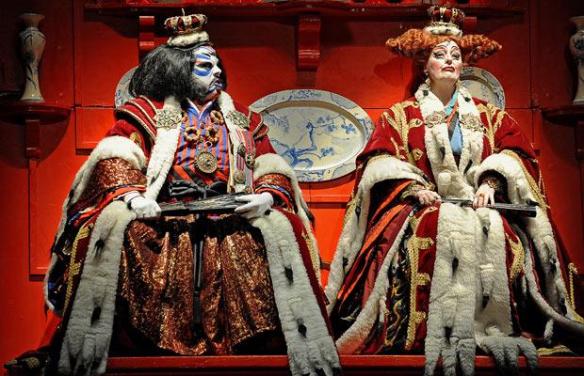
opera_1469582i

The inside of the Sydney Opera House is controversially unfinished; the original architect stormed off in a huff during construction, leaving the building looking nice on the outside but a sub-Barbican mess of concrete and tubes within. He supposedly came back to consult on the finish, but the toilets still seem like an afterthought.
Jacqueline in the bar was an accomplished saleswoman: “I would like to point out that we are 100% full, so it’s a good idea to order your drinks for the interval so you don’t have to elbow your way through people who can’t make up their minds. You can have them in the North Foyer, with a lovely view of the harbour. So lovely, in fact, that that’s where we put all our ugly bar staff. Or you can have them here in the South Foyer, where the view is not so nice, but the staff are prettier.”

It often felt just like the Barbican. A trillion miles away from London, there were the same cardigans and snorting fat girls; the same impossibly long walks to a dead end; the same scrubbed children politely trying not to admit they are bored out of their minds; the same smattering of youthful, preppy drama students who have to be there for their homework, and the same herd of doddering tosswits who seem to be confused by the sight of a staircase, but give it a go anyway with ponderous, meandering slowness while a crowd backs up behind them.

The Mikado was exactly what I was expecting from Gilbert and Sullivan – a twee pantomime. As with their previous Pirates of Penzance, the Australians did everything they could to liven it up with comedy business and pratfalls, and put a charismatic local in the role of the Lord High Executioner: Anthony Warlow, former Pirate King and Phantom of the Opera, who stopped the show in act one to impersonate Michael Crawford. In keeping with local ideas of what an ex-convict would sound like, he kept an Australian accent and made occasional sarcastic asides about how ludicrous everything was. The “Little List” song of things that piss him off was altered to include a bunch of Australian malaises, achieving the writer’s desire of ensuring that there were belly laughs in the first half, although to be honest, they were the only ones.

The wet romance of dull Nanki-Pu and self-absorbed Yum-Yum did not interest me in the slightest, but the costumes were nice, and the audience was, I am mortified to report, better behaved than the English equivalent. There was a rustle of excitement among the Australians when the Lord High Executioner began singing “Tit Willow”, as this appears to be a song known to them out of context, and many had no idea that it was from the Mikado. I certainly first heard it on the Muppet Show sung by Sam the American Eagle, so there perhaps some Australian vaudeville artist has crooned it out for no apparent reason as well.

I was far more interested in the aims of the original Mikado, written in 1885 at the height of Japanesquerie, when the impoverished samurai class of Japan, left behind by the onrush of modernity after the Meiji Restoration, sold off so much of their family treasures, dumping them on the European art market where they were snapped up by the likes of Arthur Liberty. The opening chorus speaks of being the men of Japan, familiar from “many a vase and fan”, and alludes to the mystery and awe felt towards the Japanese, so recently forced to open their doors to the world after 200 years of isolation, revealing an entirely alien country stuck in an oriental time warp.

1877 saw the revolt of Saigo Takamori, a doomed war in the south led by the fabled “last samurai”, a man who refused to kow-tow to the new order and paid for it with his life. It was the events of this uprising that inspired Madama Butterfly a generation later, with its talk of a teenage girl whose family must sell her because of their own poverty, itself caused by her father’s hapless participation in an unspecified samurai revolt. In 1884, when Gilbert and Sullivan were working on their operetta, Japan was briefly plunged into another conflict, when peasants in the famous silk-weaving region of Chichibu rose up in themselves. In the days before Hepburn romanisation, this would have been written Titipu, and no doubt the English found it dreadfully amusing.

Meanwhile, a bunch of Japanese set down in Knightsbridge and constructed what was referred to at the time as a “Japanese village” – some sort of ghetto and/or theme park where the English went to gawp at performers and buy tat. I am fascinated by this event – who were the Japanese who turned up in Knightsbridge, and how long did they stay? Knightsbridge is still crawling with Japanese to this day, as it’s where the Japanese embassy staff all seem to live. Were the people in Knightsbridge really representatives of central Japan, or were they early emigrants from Satsuma and Choshu, those two fractious southern domains who were instrumental in the Meiji Restoration, and who sent so many early students abroad to study foreign ways – including the future Admiral Togo, in England from 1871-8. I do find it spooky that amid all the cod-oriental, willow-pattern nonsense and whimsy, a fragment of real Japanese music should suddenly burst out of the performance, as the Mikado himself arrives and the chorus briefly sings a recognisable shard of the Satsuma battle hymn: “Miyasama, Miyasama…”, the Japanese broken and garbled, but still recognisable, the tune exactly reconstructed. Someone, it seems, has heard real Japanese people singing a real Japanese song, and has attempted to faithfully transcribe the lyrics, managing to salvage about six short lines.

Prince, 0 Prince!
What is it
Fluttering there
In front of your horse?

The next verse, which they didn´t include, should go:

Don’t you know that that
Is a royal brocade flag
Signifying our resolve
To defeat our enemies?

The royal brocade flag, of course, was knocked up by the Meiji Restorationists to shame their opponents into surrender, when the only other option is to charge against the imperial banner. There is something thrilling about hearing pieces of real history poking through a throwaway English operetta, thousands of miles from home, and thousands of miles even further away from the battlefields where it was first sung.

Jonathan Clements is the author of A Brief History of the Samurai.

Shock Treatment

“Oh, you just wait!” she said. “Our exhibition has got all kinds of manga stuff in it. But the coolest part, the really amazing part, is an Adults Only bit. I mean, don’t get me wrong, we understand that manga and anime cross over all kinds of genres and areas, and that there’s manga for kiddies and manga about pets, and manga for old people as well. So we get that. But we also know that the adult stuff is part of the whole picture, and we don’t want to leave that out.”
Continue reading

Due Diligence

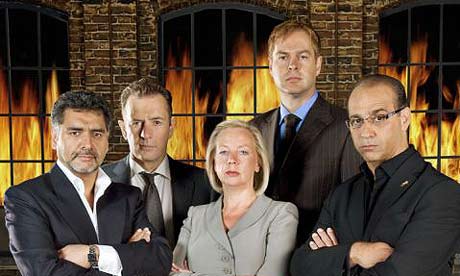
In Japan, where the concept was first invented, they were called the Money Tigers. In Finland they are the Lions. In Israel, the Sharks. We call them the Dragons, and their job is to audit the plans of would-be entrepreneurs in the Dragons’ Den. If Judge Judy isn’t on, I’m there, watching the way they pierce to the heart of bad ideas. And sometimes, for fun, I imagine what it would be like if someone tried to attract the Dragons to invest in the anime industry.
Continue reading

Nebulous Achievements

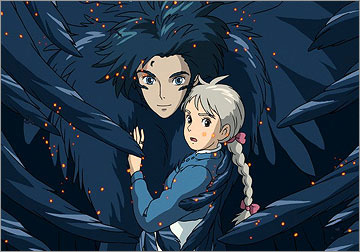
It’s sweet of the Science Fiction and Fantasy Writers of America (SFWA) to award a Best Script Nebula to Howl’s Moving Castle, but hopefully the anime community will take it for what it is – a very belated recognition of a supreme talent. In my opinion, Howl is nowhere near Miyazaki at his best; it often plays like a committee’s attempt to reverse-engineer his greatest achievements. It’s more likely that Howl gets its award for being cosily familiar to the voters – one of those weird Japanese cartoons, but based on a book by an English-speaking author, and directed by that nice old man who made all those great movies in the 1990s that the voters mainly ignored. It is notable that the only anime to previously get a nomination from the SFWA were Princess Mononoke, which had Neil Gaiman credited for the script adaptation, and the subsequent Spirited Away, whose Oscar victory was inescapable. It is also notable that a large number of the SFWA voters are in Japan this month at the Yokohama Worldcon – perhaps they were booking their flights at the same time as they filled their ballots, and figured it couldn’t hurt.
Continue reading